International Journal of Innovative Technology and Exploring Engineering (IJITEE) ISSN: 2278-3075, Volume-8 Issue-10, August 2019
An Integrated Technique for Face Sketch
Recognition Using DCNN
Shivaleela. Patil, Shubhangi.DC
Abstract- Face Recognition (FR) is considered as one of the chief use in the investigation of criminals. In the majority of the cases, information about the criminal is not available. In such situations, sketch artist draw the sketch of the guess with the oral explanation provided by the eyewitness. These sketches can then be matched manually against mug shot photos. This process is time-consuming. Hence there require a method that efficiently goes with composite sketches to the gallery of mug shot databases. Thus the proposed system uses a scheme for matching composite sketch and photo images, photo image features are extracted and fused to train the system. Composite Sketch feature is matched with face photo images. Feature extraction (FE) is done using Multi-Scale Local Binary Patterns (MLBP) Tchebichef Moments and Multiscale Circular Weber Local Descriptor (MCWLD), Principal Component Analysis (PCA) is used for fusion of extracted features, DCNN used as a classifier to recognize the face. The experiments are conducted using PRIP-HDC dataset and the proposed system gives good accuracy in face recognition.
Keywords- Composite Sketch, MCWLD, Tchebichef Moments and MLBP and Tchebichef Moments and DCNN Classifier, Knowledge Base (KB)
I. INTRODUCTION
FR has been one of the most attractive and significant research fields in the past two decades. FR is also considered as an important application in catching various types of criminals. If the suspect’s facial photograph is on hand, then the criminals are identified easily. But in most of the situations, all these images are not available in a mug shot. In such situations, the suspect sketch is drawn based on the oral illustration provided by the eye witness. As the sketch based on the style of artists, it is not possible for an artist to present a feature of victims perfectly. FR was conducted manually and accuracy depends on the expert level of humans. Normal face recognition and original images differ in shadow, texture, and shape therefore, it is very complicated to match accurately. The handwritten sketch is sent to law enforcement and media outlets. Matching facial composites to mug shot allows faster identification of suspects. Composite sketches are commonly used to recognize the victims, whereas a forensic sketch needs a well-trained artist for drawing and sculpting. As per the survey is given in 80% of law enforcement uses composite sketches. It has become a popular substitute for illegal justice and other agency of law enforcement. A small number of extensively used software kits to produced computerized sketches contains IdentiKit, Mac-a-Mug, and FACES. This software allows synthesizing sketches by selecting a sketch by choosing a set of facial component, examples of eye,
Revised Manuscript Received on August 05, 2019
Shivaleela. Patil, Department of Computer Science and Engineering Godutai Engineering College for Women, Kalaburgi, India.
Dr. Shubhangi.DC, Department of Computer Science and Engineering VTU Regional Centre, Kalaburgi, India.
hair, eyebrow, mouth, shape, nose, and eyeglass [12].CS created by viewing the mug shot will not be much useful in criminal investigations. Surveillance composites can also be created by viewing the image of the mug-shot these images are of having low quality.
. In our research, we choose hand-drawn composite sketches [22] shaped by forensic artists. Matching these CS to photographs is a not simple task because the sketches are drawn based on the eyewitness report, much law enforcement organization uses facial composite sketches, which permit the user to build Composite Sketches (CS).
The proposed system has presented a CS face reorganization based on photo image. The system is trained using photo images, FE by each facial component and the FE points are fused and trained to the system. The knowledge base is created using the extracted features of each facial component. The CS face is recognized using the features stored in the knowledge base. DCNN used as a classifier
II. LITERATURE SURVEY
Mohammad Reza Faraji et.al [01] has proposed a face recognition system against lighting variations. This system presented a technique related to the logging purpose and fractal analysis to generate an LFD picture which will not be changed due to variation in illumination. The proposed Fractal Analysis component related technique is an extremely successful edge enhancer method to remove and improve facial features such as nose, eyebrows, eyes, and mouth. System extensive experiment depicted that the proposed manner performs the best identification accuracy using when compared to six lately proposed states of art techniques.
Xuelong Li et.al [02] has proposed an efficient approach for a sketch photo fusion. Sketch-photo fusion plays a major role in act enforcement and digital entrainment. Only utilizes pixel intensities as a feature in most of the existing techniques face images represented by a number of attributes, this paper presented a novel multiple representations related face sketch-photo synthesis technique which will adaptively combine these multiple representations to represent as a patch of the image.
Shutao Li et.al [03] has proposed a technique for the reorganisation of the face using scale WLD and multi-level data fusion approach. The experimental result shows good accuracy in recognition. This system introduces the WLD, a novel, and efficient local descriptor to illustrate the facial pictures and uses a non-linear quantization approach to improve its discriminative power. Result of the experiment shows the effectiveness of the proposed technique on three standard datasets.
feature descriptors such as LBP and Gabor features for representing the face. They have proposed an unsupervised feature learning technique to train hierarchical feature representation. Experimental results conducted on five extensively used face dataset and give a good performance.
Yonggang Qi et.al [05] has proposed an automatic sketch creation approach. Substitute for gathering insight from the photograph, forth first time: they have extracted data from a large pool of person sketches. Further, illustrated that by resolving the problem of gestalt confliction of encoding relative data of each rule, more identical to sketches drawn by human were generated. Since they had released a manually labeled sketch data set of 96 object classified and 7680 sketches.
Jin Zhou et.al [06] has presented a technique for generating an automatic pencil sketch drawings from photos. They have also proposed a gradient estimation technique, which could serve the purpose superiorly than the conventional techniques. Experimental results depicted that the proposed techniques can be used for face images as well as another kind of images.
Hu Han et.al [07] has presented a component-based illustration method to detect the resemblance between a CS and a mug shot. Specifically, they have automatically detected facial landmarks in CS and face photos using an active shape model (ASM). Features are then extracted from all facial components using MLBPs and to every component resemblance is determined
Nannan Wang et.al [08] has presented that there are usually two drawbacks for most obtainable heterogeneous image transformation techniques: (1) the nearest neighbor is constant which incurs blur effect (2) some significant details
data loses due to an average of overlapping areas. They correspondingly proposed two techniques to overcome or enhance these two defects; SFS and SVR based image improvement.
Nannan Wang et.al [10] has presented an efficient transductive photo sketch synthesis technique. They first build a probabilistic framework to create the sketch-photo. Then provide a different optimization technique to overcome the proposed problems. The tests are done on CUHK face sketch dataset illustrating the performance of this approach by comparing it with representative inductive learning-based face sketch-photo synthesis procedure.
From the above survey, it is concluded that many papers have been published to overcome variation parameters and to increase performs for better recognition rate, but still, the system is lagging to achieve better accuracy in recognition rate. Hence we proposed a system to over the addressed problem and get better accuracy.
The paper organization is as follows: section II explains Literature Survey, section III explains Methodology, section IV explains Experimental Results and section V explains Conclusion.
III. METHODOLOGY
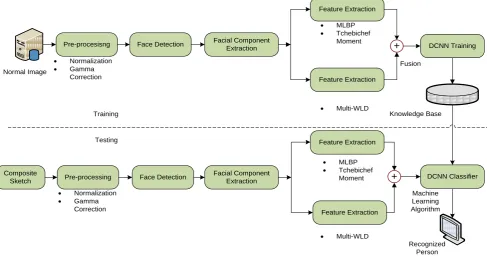
In figure 1 shows the proposed system. It includes two phases of testing and the training Phase. In the training phase, the knowledge base (KB) is created by considering normal image features. Normalization and gamma correction techniques are used to the images to maximize the visual effect of the image. FE algorithms are applied to collect the respective features of each image, FE is trained using DCNN and the KB is created.
Pre-procesisng
Feature Extraction
Feature Extraction
Composite
Sketch Pre-processing
Feature Extraction
Feature Extraction
DCNN Classifier Facial Component
Extraction Face Detection
Facial Component Extraction Face Detection
· Normalization
· Gamma
Correction Testing
Knowledge Base
Recognized Person Normal Image
+
+
Machine Learning Algorithm
· MLBP
· Tchebichef Moment
· Normalization
· Gamma
Correction
DCNN Training
· Multi-WLD
· MLBP
· Tchebichef Moment Training
Fusion
[image:2.595.60.548.422.679.2]· Multi-WLD
Figure 1: Architecture of a Proposed System
In the testing phase, CS is considered as an input to create a database. The composite images are pre-processed; gamma correction and normalization are the pre-processing applied to the input images. After pre-processing face detection and extracting the facial components of the query image is carried out. MLBP, Tchebichef moments and Multi-CWLD are the FE algorithms are used to get all the
possible features from the facial components of the image. DCNN is used as a classifier.
3.1 Pre-Processing
Pre-processing is the initial step when we are dealing with images, in FR system
pre-International Journal of Innovative Technology and Exploring Engineering (IJITEE) ISSN: 2278-3075, Volume-8 Issue-10, August 2019
processing steps carried out. The pre-processing step increases robustness and results of the system by increasing discriminative information contained in the image.
Normalization
Normalization is a technique to make an altar in the pixel value to adjust the dynamic range of gray level of the image.
Gamma correction
Gamma Correction is a nonlinear gray-level transformation that replaces gray-level with or where is a user-defined factor. It enhances the dynamic range of the image while compressing it.
3.2 Face Detection (FD) and Facial Components Extraction
AdaBoost is an algorithm used to FD in a pre-processed image as shown in figure 2. Typically AdaBoost is an algorithm for constructing a strong classifier as a linear combination of weak classifier . The can be thought of as one feature.
(a) Input Image (b) Face Detection Figure 2: Face Detection
An image where
indicates positive or negative examples is the jth Haar-Like features of ith example
· Initialize weights
Where m, n denotes the number of positive or negative examples respectively
· For t=1,…., T Normalize the weights
For each feature , train a weak classifier , and evaluate its error with respect to
Where is a parity bit and is a threshold. Choose the classifier with the lowest error
Update the weights , where if
the example is classified correctly, otherwise and
· Final classifier
Where
Once the FD is done, all facial components are detected and extracted as shown in figure 3.
(a)Left Eye Region
(b)Right Eye Region
(c)Nose Region
(d)Mouth Region Figure 3: Facial Components Extraction
3.3 Feature Extraction (FE)
FE is done using M-WLD, Chebyshev moment and MLBP method, which effectively enhance the edge using the edge enhancer method to extract facial components. Summarizing local gray level structure is called LBPs. LBP method gives effective result against pose and illumination variation. It considered surrounding pixels, thresholds the surrounding pixels by taking the value of the central pixels. The result is a binary value or decimal value. Then the histogram of each image patch is used as a local descriptor.
LBP is basically described for 3*3 neighbor pixels, which then gives 8-bit integer value. The extension version of LBP is MLBP, which gives more complete image information then LBP. In some cases facial datasets, it needs enhanced facial features classification for good performance. By using MLBP, performance is improved.
3.2.1. FE using MLBP
[image:3.595.319.540.406.511.2]The pre-processed image is processed with the FE. Facial FE has done using MLBP as shown in figure 4. MLBP is the combination of LBP descriptors with different radii.
Figure 4: MLBP Working
Facial components extracted are divided into a region of
pixels overlapping by pixels. Within each region, a histogram of LBP is derived from components at each pixel. The LBP value calculated at a very pixel is computed using comparisons to neighboring sample points at a radius of length .
Where symbolize the gray value at each of the
surrounding pixels, stand for the gray value at the center and , otherwise. The selection of parameters is tuned to each component. All facial components use the radii combination and and employ uniform binary patterns. Figure 6 shows the flow chart of MLBP.
3.2.2.
FE using Tchebichef Moments
The kernel denoted as a filter for computation
of . The extent of will be better for oscillating
images at the comparative rate to along
texture examination since the surface contains the spatial reiteration of force designs. Consequently, demonstrates a surface asset can be obtained by estimation of the dependence present apart from everything else size on the request, which is recognized with the recurrence substance of pieces. For this reason, the accompanying component vector is proposed defined as Eq. (7):
The component gives information about the property of texture and can be seen as a face mask. To compute the particular characteristic caught by ), the conduct of Tchebichef pieces in both spatial and frequency domains is studied. The total features extracted from each sample is 50.
3.2.3.
FE using MCWLD
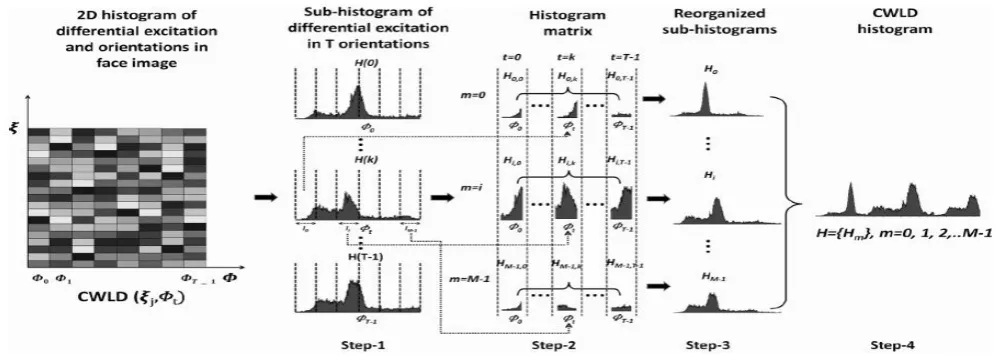
Each facial components are given to FE, MCWLD is one of the FE technique is used to extract features. MCWLD includes of two main components
1. Differential Excitation (DE) 2. Gradient Orientation (GO)
Algorithm 1: MCWLD Input:Facial Components
Output: the MCWLD feature vector H.
Step 1.
The 2D histogram is encoded into 1D histograms. DE, are grouped into orientation sub histograms, wherecorresponds to each dominant orientation.
Step 2.
Within each dominant orientation, the range of differential excitation is evenly divided into intervals and then reorganized into a histogram matrix. Each orientation sub histogram in is thus divided into segments ,where and . For all
DE interval lower bound is computed as
and upper bound
(10)
Each sub histogram is further composed of S
bins and is represented as:
Where s=0,1,...,S-1, S=3 and is represented as
Here is interval to which DE
belongs that is is the index of quantized orientation and is defined as below
Step 3.
Sub histogram segmentation,Step 4.
M sub histograms are concatenated into a single histogram thus representing the finalcircular WLD histogram. The range of DE is segmented into separate intervals to account for the variations in a given face image and assigning optimal weights to these segments further improve the performance of CLWD descriptor.
[image:4.595.49.549.503.681.2]End algorithm.
Figure 5: Describes the Steps of MCWLD
All the extracted features are fused using the PCA method. PCA is one of the mathematical procedures used to convert a set of correlated variables into a set of uncorrelated variables called principal components. The
number of principal components will be less than or equal to a number of original values i.e.,
3.4 DCNN Classifier
International Journal of Innovative Technology and Exploring Engineering (IJITEE) ISSN: 2278-3075, Volume-8 Issue-10, August 2019
increases the performance of the system. Neural networks are used in many numbers of application. Face recognition is one of the application. a significant amount of training data is needed to reduce over-fitting consequence. The trained network enables faster convergence, decrease the probability of finding poor local minima and leverages the regularisation effect that enables better generalization. The work in this paper also benefits from transfer learning by
using the original photo images and composite images to fine-tune the that was trained with 30 face images. It was designed for recognition of faces as done in this work, the face photos used for training represent one of the modalities used in the task of face photo composite sketch recognition.
Convert to 2D Intensity Value
Generate Radial Filter
for Each Radii
Find the Difference Between Pixel With d*d Neighboring
Pixels
Encoding the Result Into Binary Word
End
Defined Multiple Radii r
Extracted Feature Start
2D Gray Image
[image:5.595.205.431.144.564.2]
Figure 6: Flow Chart of MLBP IV. EXPERIMENTAL RESULTS
The system has presented an integrated approach to face recognition using DCNN classifier. It consists of two stages, training and testing phase. In the training phase, normal images are used. These photo images are trained and stored in the knowledge base. In testing phase composite sketch is taken as the input image, which is matching to the photo images by using DCNN classifier. PRIP Composite (PRIP-HDC) database used in the paper contains 47 composites sketch. Out of which 35 samples are taken for training.
Figure 7(a) shows photo images considered to train the system. Figure 7(b) composite sketch taken as a query image from the dataset. Figure 7(c) and (d) shows the face detection and components are detected, from the detected face facial components are extracted as shown in figure 8.
The amount of precision of a quantity is called accuracy which is given by the formula,
Precision is nothing but scientific or mechanical exactness which is given by,
[image:6.595.43.538.55.507.2]
Sensitivity is a degree of responsiveness or awareness of external or internal changes.
Table 1: Confusion Matrix
N = Predicted Predicted
35 No Yes
NO TN = 4 FP = 1 5
Yes FN = 0 TP = 30 30
4 31
Figure 7: (a) Input photo Image; (b) Composite Sketch (c) Face Detection; (d) Facial Components Detection
Left Eye Region
Right Eye Region
Nose Region
Mouth Region
Figure 8: Facial Components Extraction Table 2: Accuracy Comparison of Existing and
Proposed Model
S.N O
Author Name
Feature Extraction
Classifie r
Accurac y
01 Jing Wang
et.al [19] MLBP ASRC 94.71%
02 Jiwen Lu
et.al [03]
MLBP and Gabour
feature
SVM 89.4%
03 Amit R.
et.al [13]
Gabor feature and
geometric feature
Artificial Neural Network
92.7%
04 Mehal K
et.al [07] LBP
Haar
feature 87.0%
05 Amirhosei
n et.al [14]
Geometric feature
K-Nearest neighbor
91.0%
06 Proposed
model
MLBP, Tchebichef
, and Multi-Weber
local descriptor
International Journal of Innovative Technology and Exploring Engineering (IJITEE) ISSN: 2278-3075, Volume-8 Issue-10, August 2019
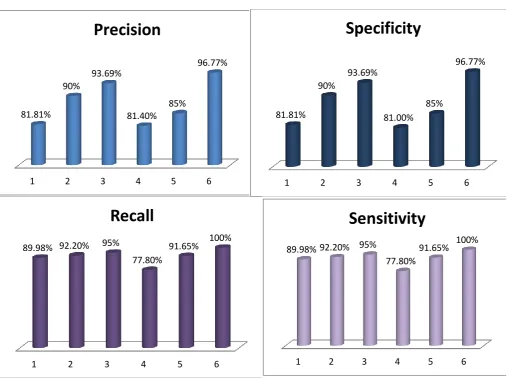
Table 2 shows the accuracy comparison of the existing and proposed system. Table 3 shows the comparison Table 3 and Figure 9 proposed and existing systems precision,
[image:7.595.52.562.327.707.2]specificity, Recall, and sensitivity, it helps to find the quality, condition, or fact of being exact and accurate.
Table 3: Comparison Table for Proposed and Existing Systems for Precision, Specificity, Recall and Sensitivity S.NO Author
Name Methods Precision Specificity Recall Sensitivity
01 Vinay A
et.al [16] SIFT+ EOH 81.81% 81.81% 89.98% 89.98%
02 Shruthi
et.al [18] Gabor features+PCA 90% 90% 92.2% 92.2%
03 Amit R
et.al [14]
Gabor feature and geometric feature+ANN
93.69% 93.69% 95% 95%
04 Mohan M
et.al[20]
HOG
+SVM 81.4% 81.% 77.8% 77.8%
05 Yuanyan
et.al[15] AROP 85% 85% 91.65% 91.65%
06 Proposed
model
MLBP, Tchebichef and Multi-WLD+ DCNN
96.77% 96.77% 100% 100%
Figure 9: Performance Graph
V. CONCLUSION
This paper proposes an automated system for face identification using texture features extraction approach like
MLBP, Tchebichef moment and MCWLD. Our proposed scheme mainly consists of a two-phase called training phase and testing phase, both
training and testing include five modules,
Pre-1 2 3 4 5 6
81.81% 90%
93.69%
81.40% 85%
96.77%
Precision
1 2 3 4 5 6
81.81% 90%
93.69%
81.00% 85%
96.77%
Specificity
1 2 3 4 5 6
89.98% 92.20% 95%
77.80%
91.65% 100%
Recall
1 2 3 4 5 6
89.98% 92.20% 95%
77.80%
91.65% 100%
processing, Face detection, Facial components extraction, FE and DCNN classifier. The experimental results explained that the proposed method is effective. Experiments are conducted on 35 composite images of PRIP Viewed (PRIP-HDC) database. The model used multiple feature extraction methods to reduce complexities and increase accuracy. In order to increase classification performance, DCNN classifier is used. The proposed algorithm is evaluated on PRIP-HDC dataset resulting inaccuracy of 97%.
REFERENCE
1. Faraji MR, and Qi X, “Face Recognition under Varying Illumination with Logarithmic Fractal Analysis”, Signal Processing Letters, IEEE, Vol. 21, No. 12, pp.1457-1461, 2014.
2. Peng C, Gao X., Wang N, Tao D, Li X, and Li J, “Multiple Representations-Based Face Sketch–Photo Synthesis”, Transactions on Neural Networks and Learning Systems, IEEE, Vol. 27, No. 12, pp.2201-2215, 2016.
3. Li S, Gong D and Yuan Y, “Face Recognition using Weber Local Descriptors”, Neurocomputing, Elsevier, Vol. 122, pp. 272-283, 2013. 4. Lu, J, Liong V E, Wang G, and Moulin P, “Joint Feature Learning for Face Recognition”, Transactions on Information, IEEE, pp.1371-1383, Vol. 10, No. 07, 2015.
5. Qi Y, Guo J, Song Y, Z, Xiang, T, Zhang H, and Tan Z H, “Im2Sketch: Sketch Generation by Uncomplicated Perceptual Grouping”, Neurocomputing, Elsevier, Vol. 165, pp.338-349, 2015. 6. Zhou, Jin, and Baoxin Li, “Automatic Generation of Pencil-Sketch
Like Drawings from Personal Photos,” International Conference, IEEE, pp. 1026-1029, 2015.
7. Han H, Klare B.F, Bonnen K and Jain, A.K, “Matching Composite
Sketches to Face Photos: A Component-Based
Approach, Transactions on Information Forensics and Security”, International Conference, IEEE, Vol. 08, No. 01, pp.191-204, 2013. 8. Wang N, Li J, Tao D, Li X and Gao, “Heterogeneous Image
Transformation”, Neurocomputing, Elsevier, Vol. 10, No. 07, pp.77-84, 2013.
9. Vu N S, “Exploring Patterns of Gradient Orientations and Magnitudes for Face Recognition”, Transactions on Information Forensics and Security, IEEE Transactions on Information Forensics and Security, Vol. 08, No. 02, pp.295-304, 2013.
10.Wang N, Tao D, Gao X, Li X. and J, “Transductive Face Sketch-Photo Synthesis”, IEEE, Vol. 08, No. 01, pp.1364-1376, 2013. 11.Ding C, Xu C, and Tao D, “Multi-Task Pose-Invariant Face
Recognition”, Transactions on Image Processing, IEEE, Vol. 24, No. 03, pp.980-993, 2015.
12.Deepinder Singh and Dr. Rajat Gupta, “Matching Facial Composite Sketches to Police Mug-Shot Images Based on Geometric Features”, IOSR Journal of Computer Engineering, Vol. 16, Issue 3, pp.29-35, 2014.
13.Reshma C. Mohan, Jayamohan and Arya raj, “Matching Sketches with Digital Face Images using MCWLD and Image Moment Invariant”, IOSR Journal of computer engineering, Vol. 17, Issue 6, pp. 131-137, 2015.
14.Paritosh Mittal, Mayank Vatsa, and Richa Singh, “Composite Sketch Recognition via Deep Network A Transfer Learning Approach”, International Conference, IEEE, pp. 251 – 256, 2015.
15.Mittal Paritosh, Mayank Vatsa, and Richa Singh, “Composite Sketch Recognition via Deep Network-A Transfer Learning Approach”, International Conference,IEEE, pp. 251-2562015, 2015.
16.Ganesh S. Pakmode, “Component-Based Representation Approach to Recognize Face Photo using Composite Sketches”, International Journal of Innovative Research in Computer and Communication Engineering, Vol. 3, Issue 6, pp. 5756-5758, 2015.
17.Faraji MR. and Qi X, “Face Recognition under Varying Illuminations Using Logarithmic Fractal Dimension-Based Complete Eight Local Directional Patterns”. Neurocomputing, Elsevier, pp.16-30, 2016. 18.Mollahosseini A, Chan D., and Mahoor, M.H, “March. Going Deeper
in Facial Expression Recognition Using Deep Neural Networks”, Applications of Computer Vision, IEEE, Vol. 24, Issue 2, pp. 1-10, 2016.
19.Wang, J, Lu C, Wang, M, Li, P, Yan, S. and Hu, X, “Robust Face Recognition via Adaptive Sparse Representation”, Transactions on Cybernetics, IEEE, Vol. 44, Issue 12, pp.2368-2378, 2014.
20.Qianwen Wan and Karen Panetta, “A Facial Recognition System for Matching Computerized Composite Sketches to Facial Photos using
Human Visual System Algorithms”, International Conference,IEEE, pp. 1-6, 2016.
21. http://biometrics.cse.msu.edu/pubs/databases.html
22.Scott Klum, Hu Han, Brendan Klare, and Anil K. Jain. “The FaceSketchID System: Matching