International Journal of Innovative Technology and Exploring Engineering (IJITEE) ISSN: 2278-3075, Volume-8 Issue-10, August 2019
Abstract: With the widespread application of Inconel alloys in manufacturing industries especially in the automobile as well as aerospace industries leads to manufacturers to pay more attention towards the understanding of machinability aspects of these alloys. Attributable to the need for large-scale manufacturing of Inconel machined components, the optimization of machining process variables become crucial to produce quality products economically by means of enhancing process performance. In common, several process parameters namely depth of cut, feed rate, and spindle speed influence the performance of turning operation in their own way. Concurrently, in the machining of Inconel alloys, the important performance indices are Material Removal Rate (MRR), surface roughness, and cutting force. This work deals with the assessment of process performance of Inconel 825 alloy amid turning operation. For the optimization of multiple responses, grey relation analysis has been employed that transforms the multiple responses into a corresponding single response known as overall grey relation index (OGI). Based on OGI, as a function of selected process variables, formulation of a non-linear regression model has been done and considered as the fitness function. To conclude, two evolutionary techniques, Teaching-Learning-Based Optimization, well famous as TLBO, and JAYA algorithm have been considered for optimization.
Index Terms: Inconel 825, Optimization, JAYA, TLBO, Turning.
I. INTRODUCTION
The aerospace machinery mainly operates with high velocity at unfavorable atmospheric conditions having an extremely high temperature and pressure. The nickel-based superalloys find their extensive importance and applications under such conditions due to their extraordinary mechanical properties. These materials are capable to retain their strength and fatigue-resistance properties even at elevated temperature. Meanwhile, these materials fall in the category of
Revised Manuscript Received on August 01, 2019.
Rajv Kumar Yadav, Mechanical Engineering Department, Jadavpur University, Kolkata, West Bengal, India.
Anadh Gandhi, Mechanical Engineering Department, IITRAM Ahmedabad, Gujarat, India.
Kumar Abhishek, Mechanical Engineering Department, IITRAM Ahmedabad, Gujarat, India.
Siba Sankar Mahapatra, Mechanical Engineering Department, NIT, Rourkela, Odisha, India.
Gotam Nandi, Mechanical Engineering Department, Jadavpur University, Kolkata, India.
difficult to-cut-materials as they possess hard abrasive inter-metallic compounds besides having high shear strength, a high degree of work hardening, high chemical affinity, low thermal conductivity [1], [33]. Inconel 825 is the most extensively used nickel-based superalloys in several sectors viz. nuclear, aerospace, and chemical plants due to their admirable mechanical and chemical properties at higher temperatures. However, it is difficult to machine due to aforesaid reasons. Furthermore, it comprises extremely abrasive carbide particles that liable to adhere to the tool surface and deteriorates the quality of the surface finish. Consequently, it is indispensable to evaluate the machinability aspects of the Inconel alloys. It has been found that enormous work has been done for Inconel alloys, particularly for Inconel 718 but less work has been focused on the machining of Inconel 825. Choudhury and Baradie [3] have studied the effect of cutting tools mainly coated and uncoated on the surface roughness during the machining of nickel base alloys. The quality of surface finish achieved with the uncoated carbide tools was superior to the quality of surface finish achieved with the coated carbide tools. Jindal et al. [4] examined the influence of certain coatings on the tool life. Carbide tools coated with titanium carbonitride (TiCN), titanium aluminium nitride (TiAlN), and titanium nitride (TiN) has been used for machining of Inconel 718 alloy. TiAlN coated tools yield enhanced tool life.
Arunachalam et al. [5] performed machining operation on Inconel 718 by means of coated carbide tools in dry and wet environmental condition and calculated the surface integrity. To achieve superior outcomes, this study suggests preferring the negative rake type insert in dry condition whereas the positive rake type inserts in wet machining. Ezugwu and Bonney [6] scrutinized the influence of coolant pressure during machining of Inconel 718 using coated carbide tool. The study revealed that high coolant pressure provides efficient cooling and lubrication that result in a reduction in cutting force. Nose wear is a leading tool failure mode during machining of Inconel 718. Altin et al. [7] performed wet machining on Inconel 718 and evaluated the effect of cutting speed on tool wear and tool life during the work.
Machining Performance Optimization for
Turning of Inconel 825: An integrated
Optimization Route Combining Grey Relation
Analysis with JAYA and TLBO
The notch wear and flank wear have been identified as major tool failure when the machining was done with round type insert. However, when the same operation was performed with the square type insert, the major toll failures occurred during the machining were flank wear and crater wear.
Devillez et al. [8] studied the machinability aspects of cutting force and wear in dry machining of Inconel 718. Coated carbide tool reduces the cutting force compared to the uncoated tool. Flank wear, notch wear, and chipping of cutting edge are major tool failure criteria while machining with Inconel 718. Zhang et al. [9] focused on cutting force and tool life during end milling of Inconel 718 in dry and Minimum Quantity Cooling Lubrication (MCQL) using coated carbide tool. Progression of tool wear is responsible for an increase in cutting force. Moreover, the study concluded that MCQL reduces the cutting force significantly due to the reduction in friction. Maiyar et al. [10] optimized machining parameters (cutting speed, feed rate and depth of cut) for end milling of Inconel 718 using Taguchi based grey relation analysis. Surface roughness and Material Removal Rate (MRR) were investigated as machinability criteria. Machinability criteria significantly affected by cutting velocity. Ozel et al. [11] have validated the experimental results with 3-D finite element results for dry machining of Inconel 718. Modified J-C model can predict the machining forces better than J-C model. Predicted cutting temperature by modified J - C model is lower than experimentally measured one. Thakur et al. [2] have studied the wear and chip characteristics in dry turning of Inconel 825. In dry machining condition, PVD coated carbide tool perform better than an uncoated tool. Vajeeha et al. [12] optimized the cutting parameters for end milling of Nimonic 75. Depth of cut, feed rate, and speed have been taken as variable parameters. The response surface methodology (RSM) has been employed for data analyzation. Surface roughness and MRR were taken as decision parameters. Multi-response equation shows that at high feed rate, excellent outcomes can be achieved with a high depth of cut and low cutting speed.
Patil and Sadaiah [13] performed turning on Nimonic 80A and optimized the cutting parameters viz. depth of cut, cutting velocity, and feed for the operation. A focus has been spotted over the flank wear and surface roughness. The study tells that the feed rate is the utmost influencing aspect for surface roughness whereas in case of flank wear, the cutting speed influences it the most. Munde and Pansare [14]
conducted dry turning of Inconel 825 using PVD and CVD coated carbide tools. The effect of spindle speed and feed was investigated. PVD coated tool has significantly less flank wear than CVD coated tool. Flank wear increases when the spindle speed increases. Altin [15] optimized the machining parameters using Taguchi L18 orthogonal array in dry machining of a nickel-based superalloy. The feed is the dominating factor during dry machining for component force. It is evident from the literature that most of the work mainly focus in order to investigate the effect of machining variables on different output responses like MRR, Ra, and
International Journal of Innovative Technology and Exploring Engineering (IJITEE) ISSN: 2278-3075, Volume-8 Issue-10, August 2019
However, aforementioned evolutionary algorithms work under an outfit of assigned data of algorithm-oriented parameters. Hence, it is important to have specific control over these parameters. In order to avoid this, TLBO has been proposed by [25], [26] first parameter less algorithm which gained more attention in the field of optimization. Encouraged by the accomplishment and application capability of TLBO algorithm; Rao [27] proposed one more parameter less algorithm known as JAYA for finding the solutions of both constraint and unconstraint optimization problems. With the possibility of exploring JAYA algorithm, this study evaluates the optimal machining conditions for Inconel 825. This algorithm is different as compared to the other advanced algorithms. It is quite easy and simple in use as does not require any algorithm oriented parameters to begin [10], [28]-[33]. In this work, investigations on some machining aspects of Inconel 825 has been carried out in the current work which highlights a multi-objective extended optimization methodology implemented in the machining of Inconel 825.
II. EXPERIMENTATION
Inconel 825 has been used as workpiece material. The total length of the material is 500 mm. The diameter and the cutting length have been taken 45 mm and 20 mm respectively. Table 1 lists the chemical configuration (percentage by weight) of the material.
A. Workpiece material
[image:3.595.316.544.50.379.2]Inconel 825 has been used as workpiece material. The total length of the material is 500 mm. The diameter and the cutting length have been taken 45 mm and 20 mm respectively. Table 1 lists the chemical configuration (percentage by weight) of the material.
Table 1.Inconel 825 configuration (percentage by weight) Element Contents (%) Elements Content (%)
(C) 0.03 (Mn) 0.12
(Si) 0.35 (S) 0.02
(P) 0.01 (Cr) 22.70
(Ni) 39.01 (Mo) 2.78
(Cu) 2.78 (Al) 0.05
(Ti) 0.65 (V) 0.06
(Co) 0.034 (W) 0.4
(Fe) 30.99
B. Cutting tool
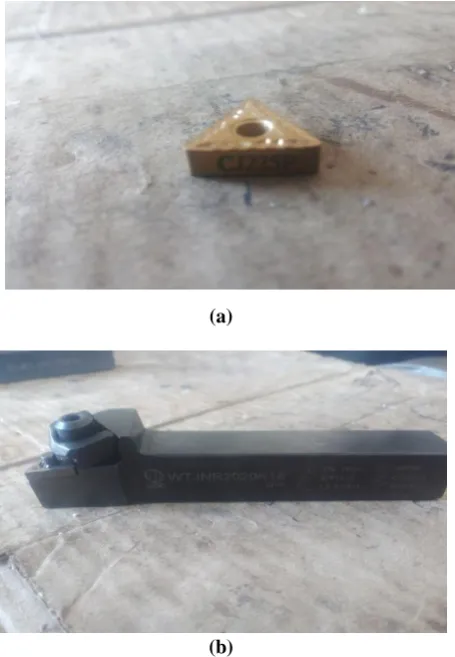
Single point turning insert TNMG160408 (KYOCERA made) has been used for the machining operation. Fig. 1 shows the insert and inserts holder used during machining. The experimental setup has been illustrated in Fig. 2.
(a)
(b)
Fig. 1. (a).Insert and (b).the type of insert holder used for holding the cutting tool
Fig. 2. Experimental setup C. Design of experiments (DOE)
[image:3.595.311.540.423.604.2] [image:3.595.41.295.511.663.2]Table 2. Input parameters, their levels, and Taguchi’s L9
based experimental trails
S.no.
Spindle speed (RPM)
Feed rate (mm/rev)
Depth of cut (mm)
Nose radius (r)
1 247 0.111 0.4 0.4
2 247 0.222 0.8 0.8
3 247 0.333 1.2 1.2
4 371 0.111 0.8 1.2
5 371 0.222 1.2 0.4
6 371 0.333 0.4 0.8
7 557 0.111 1.2 0.8
8 557 0.222 0.4 1.2
9 557 0.333 0.8 0.4
D. Equipment
Experiments have been performed on Banka 40, a hand controlled lathe machine. During machining operations, the cutting forces have been evaluated in different directions (Fx, Fy, and Fz) with the help of dynamometer (Kistler made, Type 9272). The resultant cutting force has been assessed using the following equation:
2 2 2
z F y F x F r
F (1)
The calculation of Material removal rate (MRR) has been done by measuring the weight differences of each sample before and after the trail. For weight measurement, a high precision electrically operated digital balance meter (SAB E10) made by SCALE-TEC has been used.
) / ( .
3
s mm t
w w MRR
m f i
(2)
Here, Wi= Initial weight of the workpiece in gm, Wf = final weight of the workpiece in gm, ρ= density of the work material,. tm= machining time in the second.
[image:4.595.306.541.453.727.2] [image:4.595.40.295.605.761.2]Computation of corresponding MRR values has also been accomplished. Talysurf (Taylor Hobson, Surtronic S128, UK) has been employed for surface roughness measurement. The measured cutting force, surface roughness parameter, and the material removal rate (MRR) have been presented in Table 3.
Table 3. Experimental data S.no. Ra (µm)
Resultant force (N)
MRR mm3/sec
1 0.78 168.067 13.0725123
2 1.1 510.705 44.2260442
3 0.76 987.164 76.9551708
4 1.18 408.867 27.5184275
5 1.16 739.97 126.662713
6 0.98 357.426 40.4924939
7 0.58 468.138 70.20007
8 0.9 150.47 24.8947174
9 1.56 500.391 161.337346
The chip thickness ratio is defined as the ratio of chip thickness after machining to uncut chip thick-ness. It is very important machinability criteria as it is directly connected with machining forces and power consumption. In oblique machining the uncut chip thickness is a function of feed and approach angle. During the machining, the cutting insert is tightly held by the MCLNR2020K12 type tool holder, which has approach angle of 95°.
III. PROPOSEDOPTIMIZATIONROUTE:RESULTS ANDDISCUSSION
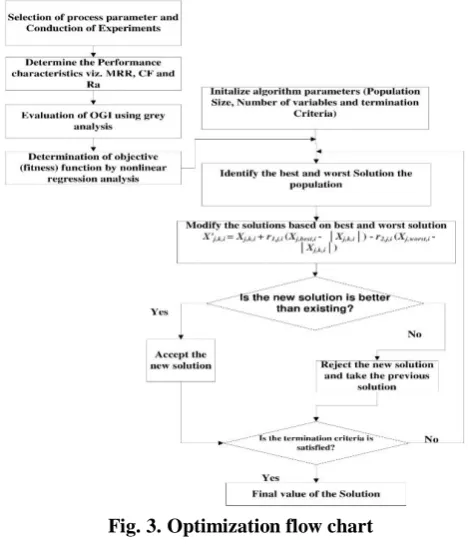
Single response optimization may not be lucrative all the time. As we know, its multi-performance features have always described the performance of a product or a process. Therefore, in this section, multi-response optimization has been discussed. To execute this, there will be the requirement of sui generis optimal process environment because some objective functions may have different optimal settings. Hence, the aggregation of multi-performance characteristics must be done so that an equivalent single objective function could be achieved. In this case, the equivalent single objective function is overall grey relation index (OGI) and to attain the optimal machining environment, the obtained OGI
must be optimized. Here, the aggregation of
multi-performance output characteristics (viz. cutting force, MRR, and Ra) has been accomplished by means of grey relation which yields an equivalent single performance index known as overall grey relation index (OGI). Fig. 2 depicts the optimization route.
International Journal of Innovative Technology and Exploring Engineering (IJITEE) ISSN: 2278-3075, Volume-8 Issue-10, August 2019
To avoid conflict in criteria requirements, diverse units, and data variation range, the normalization (Table 4) of experimental data (Table 3) has been done. For MRR, higher is better criterion has been chosen, whereas for cutting force and surface roughness, lower is better criterion has been picked.
The normalization has been accomplished by means of the following equations:
For the Lower- is-Better (LB) criterion:
) min( ) max(
) max(
xij x
x x Y
ij
ij ij
ij
(3)
For the Higher- is-Better (HB) criterion:
) min( ) max(
) min(
xij x
x x
Y
ij ij ij
ij
(4)
Here, Xij represents experimental value. The maximum and minimum observed values are denoted by max Xij and min Xij respectively. However, the Xijvalue will be distinct for each experimental output responses.
In order to determine the individual of the grey relational coefficient for the normalized output response (Table 4), the following equations have been used:
0 i
0 j
min max
x (k), x (k)
(k) max
(5)
0
x (k)= reference sequence andx (k)0 =1,
k
1, 2,3,..., m
ij j
k
x
k
x
0(
)
0(
)
(6)
ij
x
k
x
min
min
0(
)
(7)
ij
x
k
x
max
max
0(
)
(8)
= distinguishing co-efficient and0
1
, generally
= 0.5Finally, It is essential to aggregate all responses into a single response i.e. overall grey relation grade (OGRG). The OGI can be assessed as follows:
mi ij j
k
R
1
1
(9)
j
R = grey relation grade (GRG) for
j
th the experimental value [image:5.595.45.542.331.820.2]k
= no. of performance characteristicTable 4. Normalized value and individual GRG and OGRG of experimental results
S.N o. N-Ra
N-M
RR N-Fr G1 G2 G3 OGI 1 0.8 1.0 0.0 0.7 1.0 0.3 0.7 2 0.5 0.6 0.2 0.5 0.5 0.4 0.5 3 0.8 0.0 0.4 0.7 0.3 0.5 0.5 4 0.4 0.7 0.1 0.4 0.6 0.4 0.5 5 0.4 0.3 0.8 0.5 0.4 0.7 0.5 6 0.6 0.8 0.2 0.6 0.7 0.4 0.5 7 1.0 0.6 0.4 1.0 0.6 0.4 0.7 8 0.7 0.8 0.1 0.6 0.7 0.4 0.5 9 0.0 0.2 1.0 0.3 0.4 1.0 0.6
Implementation of JAYA has been done on the fitness function. The fitness function, also known as the objective function has been derived by means of non-regression analysis on OGI (where OGI has to be maximized).
( 0.011) (0.111) ( 0.140)
OGI0.731 V f d (10)
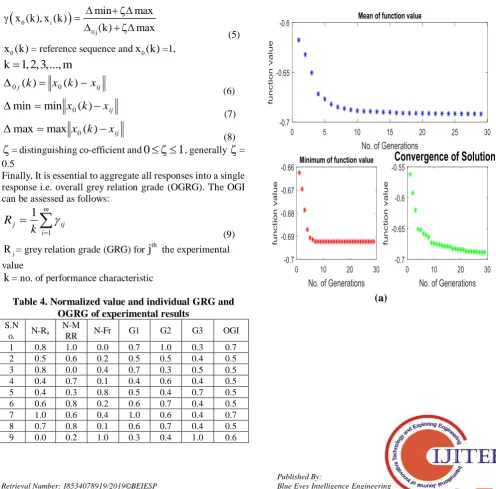
The model has been found adequate with R299.4% and the actual value of the overall grey relation index has been compared with the results derived from the mathematical model. Finally, this model has been considered as a fitness function for optimization by means of JAYA algorithm. The optimal settings for maximizing MPCI has been attained as V= 247 RPM, f = 0.333 mm/rev, and d = 0.4 mm with closer to 0.7002 as a fitness function value (Table 5). With the same fitness function value, a similar kind of optimal settings has been achieved using TLBO algorithm (Table 5). The convergence plot for JAYA and TLBO algorithm has been depicted in Fig. 3. From Fig. 3, it is clear that to converge a global optimum value, the Jaya algorithm consumes lesser time as compared to the TLBO algorithm. Therefore, the JAYA algorithm is superior to the TLBO algorithm in terms of convergence timing.
(b)
Fig. 3. Convergence of overall grey relation index by (a). JAYA and (b). TLBO algorithm
Table 5. Optimal parametric combination obtained by JAYA and TLBO along with fitness value
Algorith m
Response s
Optimal Parametric
Combination Fitness value Spindle
speed Feed
Depth of cut
TLBO OGI 247 0.33
3 0.4 0.70072
JAYA OGI 247 0.33
3 0.4 0.70072
IV. CONCLUSIONS
The foregoing work recommends a unified optimization route integrating grey relation analysis, nonlinear regression, and JAYA optimization algorithm in order to assess the favorable machining condition during the turning of Inconel 825 alloy. It has been identified that spindle speed of 247 RPM, the feed rate of 0.333 mm/rev and depth of cut of = 0.4 mm is the optimal parametric combination for attaining the most favorable output responses (process performance). It has also found that the optimal input parametric settings attained by means of JAYA and TLBO algorithms seem to be identical. Nevertheless, the JAYA algorithm consumes little convergence time. Therefore, its implementation is quicker in comparison to the TLBO algorithm.
REFERENCES
1. Rahul, Kumar Abhishek, Saurav Datta, Bibhuti Bhusan Biswal, Siba Sankar Mahapatra, “Machining performance optimization for electro-discharge machining of Inconel 601, 625, 718 and 825: an integrated optimization route combining satisfaction function, fuzzy
of Mechanical Sciences and Engineering, Volume 39, Issue 9, pp 3499-3527, (2017).
2. Thakur A, Mohanty A, Gangopaddhyay S and Maity K P, “Tool wear and chip characteristics during dry turning of Inconel 825”, Procedia Material Science, Vol 5, pp. 2169-2177, (2014).
3. Choudhury I A and El-baradie M A, “Machinability of nickel base super alloys: a general review”, International Journal of Material Processing Technology, Vol. 77, Issue 1 - 3, pp. 278 – 284, (1998).
4. Jindal P, Santhanam A T, Schlienkofer U and Shuster A F, “Performance of PVD TiN, TiCN and TiAlN coated cemented carbide tools”,
International Journal of Refractory Metals & Hard Materials, Vol. 17, Issue 1 - 3, pp. 163-170, (1999).
5. Arunachalam R M, Mannan M A and Spowage A C, “Surface integrity when machining age hardened Inconel 718 with coated carbide cutting tool”, International Journal of Machine Tools & Manufacture, Vol. 44, Issue 14, pp. 1481-1491, (2004).
6. Ezugwu E O and Bonney J, “Effect of high pressure coolant supply when machining nickel - base, inconel 718, alloy with coated carbide tool”,
Journal of Materials Processing Technology, Vol.153 - 154, Issue , pp 1045-1050, (2004).
7. Altin A, Nalbant M and Taskesen A, “The effect of cutting speed on tool wear and tool life when machining inconel 718 with ceramic tools”,
Materials and Design, Vol. 28, Issue 9, pp. 2518-2522, (2007). 8. Devillez A, Schneider F, Dominiak S, Dudzinski D and Larrouquere D,
“Cutting forces and wear in dry machining of Inconel 718 with coated carbide tools”, Wear, Vol. 262, Issue 7 - 8, pp. 931-942, (2007). 9. Zhang S, Li J F and Wang Y W, “Tool life and cutting forces in end milling
Inconel 718 under dry and minimum quantity cooling lubrication cutting conditions”, Journal of Cleaner Production, Vol. 32, issue , pp. 81-87, (2012).
10. Maiyar L. M, Ramanujam R, Venkatesan K and Jerald J., “Optimization of machining parameters for end milling of inconel 718 super alloy using Taguchi based Grey relation Analysis”, Procedia Engineering, Vol. 64, pp. 1276-1282, (2013).
11. Ozel T, Llanos I, Soriano J and Arrazalo P J, “3-D finite element modeling of chip formation process for machining INCONEL 718 : Comparison of FE software prediction”, Machining Science and Technology, Vol. 15, Issue 1, pp. 21-46, (2013).
12. Vajeeha S., Mohammad Farhood K, Vishnu Vardhan T and Harinath Gowd G, “Evaluation of Optimal Cutting Parameters in CNC Milling Of NIMONIC 75 Using RSM”, International Journal of Innovative Research in Science, Engineering and Technology, Vol. 4, Issue 8, pp 7190-7196, (2015).
13. Patil J and Sadaiah M, “ Optimizationof cutting parametersin turning of Nimonic 80Aby using Taguchi method”, International Journal on Recent and Innovation Trends in Computing and Communication, Vol. 4, Issue 4, pp 1-4, (2016).
14. Munde V and Pansare V, “Flank wear measurement of Inconel 825 using CVD and PVD carbide tools”, International Journal Research of engineering and Technology, Vol. 4, Issue 8, pp. 1353-1359, (2017). 15. Altin A, “A comparative study on optimization of machining parameters by
turning aerospace materials according to Taguchi method”, Int. J. Simul. Multisci. Des. Optim, Vol. 8, A1, (2017). DOI: 10.1051/smdo/2016015. 16. Yunlu L, Colak O., Kurbanoglu C., “Taguchi DOE analysis of surface integrity for high pressure jet assisted machining of Inconel 718”, Procedia CIRP, Vol. 13, pp. 333-338, (2014).
17. Pandey A., Goyal A. and Meghvanshi R., “Experimental investigation and optimization of machining parameters of aerospace material using Taguchi’s DOE approach”, Materials Today: Proceedings, Vol. 4, Issue 8, pp. 7246-7251, (2017).
18. Gopal P. M., Prakash S. K., “Minimization of cutting force, temperature and surface roughness through GRA, TOPSIS and Taguchi techniques in end milling of Mg hybrid MMC”, Measurement, Vol. 116, pp.178-192, (2018).
19. Kant G, Sangwan KS, “Prediction and optimization of machining parameters for minimizing power consumption and surface roughness in machining”, Journal of Cleaner Production, (2014).
20. Rathod G. R., Sapkal S. U., Chanmanwar R. M., “Multi-Objective Optimization of Photochemical Machining by Using GRA”, Materials Today: Proceedings, Vol. 4, Issue 10, pp. 10830-10835, (2017). 21. Singh A., Dutta S., Mahapatra S. S., Singha T. and Majumdar G.,
[image:6.595.41.298.390.529.2]International Journal of Innovative Technology and Exploring Engineering (IJITEE) ISSN: 2278-3075, Volume-8 Issue-10, August 2019
22. Kumar Yogendra., Singh Hari, “Multi-response Optimization in Dry Turning Process Using Taguchi's Approach and Utility Concept”,
Procedia Materials Science, Vol. 5, pp. 2141-2151,(2014).
23. Parthiban K., Duraiselvam M.,Manivannan R., “TOPSIS based parametric optimization of laser micro-drilling of TBC coated nickel based superalloy”, Optics and Laser Technology, Vol. 102, Issue, pp. 32-39, (2018).
24. Majumder H., Maity K., “Prediction and optimization of surface roughness and microhardness using grnn and MOORA-fuzzy-a MCDM approach for nitinol in WEDM”, Measurement, Vol 118, pp. 1-13, (2018).
25. Jiang Z, Zhou F, Zhang H, Wang Y, Sutherland J W, “Optimization of Machining Parameters Considering Minimum Cutting Fluid Consumption”, Jou. of Cleaner Production, (2015).
26. Rao S. M and Venkaiah N, “Parametric optimization in machining of Nimonic - 263 alloy using RSM and particle swarm optimization”,
Procedia Materials Science, Vol. 10, pp. 70-79, (2015).
27. Vijayakumar K., Prabhaharan G., Asokan P., Saravanan R., “Optimization of multi-pass turning operations using ant colony system”,
Inter. Jou. of Machine Tools and Manufacture, Vol. 43, Issue 15, pp. 1633-1639, (2003).
28. Rao R. Venkata, Kalayankar V.D., “Multi-pass turning process parameter optimization using teaching–learning-based optimization algorithm”,
Scientia Iranica, Vol. 20, Issue 03, pp. 967-974, (2013).
29. Pawar P.J., Rao R. Venkata,“Parameter optimization of machining processes using teaching–learning-based optimization algorithm”, The Inte. Jou. of Advanced Manufacturing Tech., Vol. 67, Issue 5-8, pp. 995-1006, (2013).
30. Rao R. Venkata, “Jaya: A simple and new optimization algorithm for solving constrained and unconstrained optimization problems”,
International Journal of Industrial Engineering Computations, Vol. 7, pp. 19-34, (2016).
31. Rao R. Venkata, Waghmare G.G., “A new optimization algorithm for solving complex constrained design optimization problems”, International Journal of Industrial Engineering Computations, Vol. 49, Issue 01, pp. 19-34, (2017).
32. Rao R. V. and Rai D. P., “Optimization of selected casting processes using Jaya algorithm”, Materials Today: Proceedings, Vol. 4, Issue 10, pp. 11056-11067, (2017).
33. Mohanty CP, Mahapatra SS, Singh MR, “An experimental investigation of machinability of Inconel 718 in electrical discharge machining”, Procedia Material Science, Vol. 6, pp. 605-611, (2014).
AUTHORSPROFILE
Rajiv Kumar Yadav, received the master degree in mechanical engineering from NIT, Rourkela, Odisha, India. He is currently the Ph.D. candidate of the department of mechanical engineering, Jadavpur University, Kolkata, West Bengal, India. His research interests include machining of super alloy, simulation modeling etc. He has published 5 international journals.
Anadh Gandhi received the master degree in mechanical engineering IITRAM Ahmedabad, Gujarat, India. He has published 2 international journals.
Kumar Abhishek, received PhD degree in mechanical engineering from NIT, Rourkela, Odisha, India. He is currently working as an assistant professor of department of mechanical engineering, IITRAM Ahmedabad, Gujarat-380026, India. His research interests include Composite Machining, Multi-objective Optimization. He has published more than 50 journals
Siba Sankar Mahapatra, received PhD degree in mechanical engineering from IIT, Kharagpur, West Bengal, India. He is currently working as a professor of department of mechanical engineering, NIT, Rourkela, Odisha, India. His research interests include Composite Machining, Multi-objective Optimization, and Operations Management etc. He has published more than 200 international journals.