DEMOGRAPHIC RESEARCH
VOLUME 29, ARTICLE 34, PAGES 907-936
PUBLISHED 30 OCTOBER 2013
http://www.demographic-research.org/Volumes/Vol29/34/ DOI: 10.4054/DemRes.2013.29.34
Research Article
How do educational and occupational resources
relate to the timing of family formation?
A couple analysis of the Netherlands
Katia Begall
© 2013 Katia Begall.
This open-access work is published under the terms of the Creative Commons Attribution NonCommercial License 2.0 Germany, which permits use, reproduction & distribution in any medium for non-commercial purposes, provided the original author(s) and source are given credit.
1 Introduction 908
2 Theoretical background 909
2.1 Couple employment and fertility in the context of the Netherlands, 1960-2009
910
2.2 Earning potential and the transition to parenthood 911
2.3 Career dynamics and the transition to parenthood 913
3 Methods 914
3.1 Data 914
3.2 Analytical strategy 915
3.3 Measures 917
4 Results 918
5 Conclusion 925
6 Acknowledgments 927
References 928
How do educational and occupational resources relate to the timing
of family formation? A couple analysis of the Netherlands
Katia Begall1
Abstract
BACKGROUND
Fertility research often uses data from women only. This can bias the results if the effects of education and occupation on fertility are dependent upon the characteristics of the male partner. Using retrospective life-course information from both partners, this study examines the effects of educational and occupational characteristics on the transition to a first childbirth.
OBJECTIVE
The objective is to examine how the respective earning potential and career dynamics of the male and the female partners in couples influenced the timing of their entry into parenthood from 1960 to 2009 in the Netherlands, as well as the extent to which the characteristics of the two partners were interdependent in terms of their influence on the transition to a first birth.
METHODS
Using couple-period data from four pooled cross-sectional waves (1998-2009) of the Family Survey of the Dutch Population, discrete time event history models accounting for unobserved heterogeneity at the couple level are estimated to predict the birth of the first child, starting from the moment couples started living together.
RESULTS
The results show that a high earning potential of the female partner (based on her educational attainment, the status of her first job, and whether she is in full-time work or has supervisory responsibilities) has delaying effects on her transition to a first childbirth. With regard to the male partner, the only significant predictors of the entry into parenthood are educational attainment and working hours, and there is no evidence of an interdependence of the partners. The comparison of effects over time indicates that the female partner’s higher earning potential has become a stronger predictor of
1
delayed parenthood over time, while a positive effect for the male partner’s higher earning potential is seen only up to 1990.
CONCLUSION
The results suggest that the educational and occupational characteristics and the labor market participation of the female partner are stronger determinants of first-birth timing than the characteristics of the male partner.
1. Introduction
The decision to have a first child is generally made jointly by the two partners in a couple. While this may seem obvious, many studies on the interrelationship between paid work, education, and childbearing focus on women only. Previous research has confirmed that both partners in a couple influence decisions about having children (Beckman 1984; Coombs and Chang 1981; Corijn, Liefbroer, and de Jong Gierveld 1996; Jalovaara and Miettinen 2013; Jansen and Liefbroer 2006; Thomson 1997; Vignoli, Drefahl, and De Santis 2012), but the lack of suitable couple data often causes fertility researchers to focus only on women. This can be problematic because the exclusion of partner information has been shown to lead to an overestimation of the negative effects of women’s employment on fertility (Matysiak and Vignoli 2008). A more substantive reason behind the female focus of fertility research is the theoretical notion that women are the driving force behind fertility decisions and the postponement of parenthood. This notion is based on the assumption that having a child involves greater investments of time and energy for women than for men, because even though women’s educational attainment and labor force participation levels have increased significantly in recent decades, they continue to perform the majority of childcare and household tasks (Kühhirt 2011; Morgan and Taylor 2006). The birth of the first child is, indeed, associated with indirect and direct costs for women’s careers in virtually all industrialized countries (Amuedo-Dorantes and Kimmel 2005; Budig and England 2001; Ellwood, Wilde, and Batchelder 2004; Gangl and Ziefle 2009). How much these anticipated costs affect the decision to have a child is in the current study assumed to also be dependent on the occupational and educational resources of the partner, as well as on the institutional and historical contexts.
couple, the relative importance of the female and the male characteristics can be assessed. Furthermore, the relatively long observation period (1960 to 2009) means that the effects of the educational and occupational resources of both partners on the first childbirth can be examined during historical periods that differed strongly with regard to women’s labor force participation, policies providing parental leave, and the availability of childcare facilities. Thus, the validity of the theoretical predictions during different historical periods can be tested. The present study therefore contributes to our understanding of the context dependency of the relationship between (female) employment and fertility. The research questions addressed are as follows:
1. How do the earning potential and the career dynamics of the male and the female partners in a couple influence the (timing of) their entry into parenthood?
2. To what extent are the earning potential and the career dynamics of the two partners interdependent in terms of their influence on (the timing of) the birth of the first child?
3. How have the influences of earning potential and career dynamics on the (timing of) the first childbirth changed over time?
2. Theoretical background
In recent decades, the lives of men and women have changed substantially. Alongside the unprecedented expansion of educational and professional opportunities, new and diverse relationship and family structures have evolved which have effectively turned marriage and parenthood into a subset of many possible life choices (Mills, Blossfeld, and Klijzing 2005). Although the great majority of people still aspire—and ultimately choose—to live with a partner and have children, the trajectory leading to this major life course transition has become more flexible, and is influenced by individual educational and occupational choices and aspirations (Billari 2004). This study examines specific aspects of these educational and occupational choices; namely, earning potential and career dynamics. Earning potential is determined by educational attainment, the occupational status of the first job, the level of supervisory responsibilities, and weekly working hours. Career dynamics refer to the experience of upward and downward job mobility in the previous year.
expectations with regard to the effects of earning potential and career dynamics on the timing of the first birth are then discussed.
2.1 Couple employment and fertility in the context of the Netherlands, 1960-2009
Before the onset of fertility postponement in the 1970s, fertility rates in the Netherlands were among the highest in Europe, at just over three children per woman (Coleman and Garssen 2002). Between 1965 and 1975, the total fertility rate fell to 1.66. Thereafter, the fertility rate recovered slightly, and has been at approximately 1.7 children per woman in the last two decades, which is relatively high in the European context (Fokkema et al. 2008).
This study covers the time period from approximately 1960 to 2009, a period characterized by educational expansion and increasing female labor force participation. The proportion of women completing higher education increased from approximately 15% in the generation born in the 1940s to approximately 35% in the cohort born after 1970, with Dutch women born after the 1970s surpassing the men in their cohort in terms of higher education attainment (Eurostat 2012). In the Netherlands, women began to enter the labor force comparatively late, and the male breadwinner/female homemaker constellation was the predominant family model until the 1970s (Van Gils and Kraaykamp 2008). Since then, the labor market participation rates of Dutch women have gradually increased, reaching approximately 80% in 2009, which is above the European average (women aged 25-54; Eurostat, 2012). However, the great majority of women in the Netherlands work part time, especially after the birth of the first child, making the so-called ―combination,‖ or one-and-a-half earner model, the new standard arrangement for couples in the Netherlands (Plantenga 2002; Van Gils and Kraaykamp 2008; Verbakel and De Graaf 2009). The reasons for this persistent pattern are both institutional and cultural: the Dutch tax system heavily favored single-earning couples2, and male wages are comparatively high (Kremer 2005; Van Gils and Kraaykamp 2008). Additionally, unemployment in the Netherlands has been low in recent decades, with the exception of the economic crisis in the 1980s, and workers are well-protected by labor laws and social insurance benefits (Fouarge and Baaijens 2009). Furthermore, childcare availability was very low until the end of the 1990s, and there are strong cultural barriers to full-time childcare use (Clerkx and Van Ijzendoorn 1992; Portegijs et al. 2006).
The combination of relatively high male wages, low unemployment, a high rate of part-time female employment, and poor childcare availability implies that in the period
2
under study, mothers faced relatively large barriers to full-time employment and the pursuit of higher level professional careers. This constellation of factors also suggests that men were generally the main providers of household income.
In this study, three distinct historical periods are identified to describe changes in the effects of educational and occupational resources on the transition to a first childbirth over time. The first period, 1960 to 1975, was characterized by low levels of female employment and low institutional support for combining motherhood and work. The second period, 1976 to 1990, was characterized by increases in female employment, as well as by high levels of (youth) unemployment and the broader emergence of part-time jobs during the economic crisis of the 1980s. Finally, during the period from 1991 to 2009, most women continued to work (part-time) after the birth of their first child, and parents were entitled to (part-time unpaid) parental leave.
2.2 Earning potential and the transition to parenthood
historical period must also be considered (Lewis et al. 2008; Matysiak and Vignoli 2008). In addition, cultural norms and expectations about the importance of maternal care for young children and the prevailing ―gender culture‖ may encourage or constrain mothers’ paid work, and may therefore influence the evaluation of behavioral options after the transition to parenthood (Pfau-Effinger 2012).
In the Netherlands, the institutional context has generally favored a sex-specific division of labor, at least until the end of the 1990s (see Section 2.1); and the standard strategy of work-family compatibility still consists of women working part-time after becoming mothers. In this context, a woman with a high earning potential may be expected to delay the birth of her first child, as it is assumed that she will be reluctant to reduce her work commitments after becoming a mother. Conversely, for a man, having a higher earning potential should be associated with a faster entry into parenthood, as men’s earnings provide the majority of household income after the first child is born. But because Dutch couples tend to be homogenous with regard to educational attainment and occupational status (Kalmijn 1998; Verbakel and De Graaf 2009; Verbakel, Luijkx, and de Graaf 2008), the opportunity cost effect for the female partner likely has a greater influence than the income effect that is hypothesized for the male partner. When both partners in a couple have a high earning potential, the first birth is likely to be postponed, even if the man’s income is sufficient to support the transition to parenthood. Thus, the effect of the male partner’s higher earning potential should be dependent on the employment status of the female partner: the fact that the male partner has a high income may positively influence fertility decisions only in situations in which the female partner does not face high career costs of parenthood. The higher earning potential of the male partner should therefore be associated with a faster transition to parenthood in one-and-a-half earner (female partner works part time) and male breadwinner (female partner does not work) couples.
2.3 Career dynamics and the transition to parenthood
In addition to the characteristics of the current and the first job, occupational changes are considered in the analysis. Investments in the female partner’s professional careers increase the opportunity costs of childbirth for the couple, and an upward career move often involves taking on additional responsibilities and new tasks. In this situation, temporary withdrawal from the job due to pregnancy and childbirth can signal a lack of commitment or a low level of career ambition (Gangl and Ziefle 2009). A recent move to a job with higher status by the female partner is therefore expected to delay the transition to parenthood in the first year after the job change. According to the logic of the economic theory, an upward job move by the male partner should be associated with a faster transition to parenthood because it increases the household income. However, this effect can be expected to have weakened—or even to have disappeared—in recent years because men and women have become less specialized in their roles, both inside and outside of the home (Van der Lippe 2006). As the birth of a first child is associated with new time-intensive care tasks for the male partner as well, the decision to have a child might be postponed in response to a recent upward job change.
countries where men are the main providers of household income, such as the Netherlands (Schmitt 2012; Vignoli, Drefahl, and De Santis 2012). A downward job move by the male partner should therefore be associated with a lower first birth probability.
3. Methods
3.1 Data
The data used combined four waves of the Family Survey of the Dutch Population (Familie-enquête Nederlandse Bevolking, FNB), collected in 1998, 2000, 2003, and 2009. The FNB is a large-scale repeated cross-sectional survey administered in the Netherlands (De Graaf, De Graaf, Kraaykamp, and Ultee 1998, 2000, 2003; Kraaykamp, Ruiter, and Wolbers 2009). The surveys cover the Dutch population between the ages of 18 and 70, with an overrepresentationof couples. The survey data are collected through structured face-to-face interviews and self-completed questionnaires administered to both partners. The FNB registers the complete life courses of the primary respondents and their partners with respect to education, occupation, religion, mobility, and partnership formation through retrospective questioning. Using this information, a couple-period file containing information about couples’ transitions to the first childbirth, as well as information about both partners’ educational and occupational trajectories, was constructed.
Sample selection: The four waves of the FNB contain information about 4,490 female and 4,368 male respondents born between 1914 and 1999, of whom 3,866 were living in a shared household. The analysis was restricted to respondents born after 1945 in order to capture enough variability in women’s occupational status (n= 3,115). The sample was further restricted to couples who did not report a first childbirth with a partner other than their current one. This means that the 332 couples (11%) in which one of the partners reported having had a child with a previous partner were not included3. The final analytical sample consisted of 2,783 couples, of whom 2,215 (80%) had a child. After omitting cases with missing values, 2,534 couples and 1,975 birth events are analyzed.
To ascertain that the selection of (stable) couples did not lead to selection bias, the probability of transitioning to a first birth was also estimated for a less restricted sample of all men and women born after 1945 (including respondents who were never
partnered or divorced/widowed, or 3,549 women and 3,489 men). The analyses are presented in Appendix B, and show that all of the results were robust against the selection of the analytical sample.
3.2 Analytical strategy
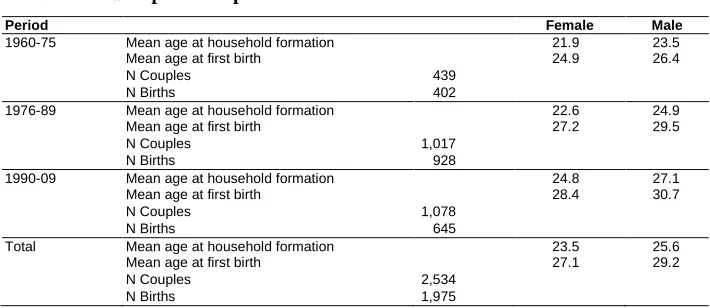
To analyze couples’ transitions to a first childbirth, we estimated a discrete time event history model with random effects in which the couple constituted the unit of analysis (Allison 1982; Jenkins 2005; Mills 2011; Steele 2008). The data were organized in a couple-period format, with each row of the dataset corresponding to a time period of three months in the relationship and containing information about both partners4. The period of observation began when each couple started living together (or got married, whichever happened first; referred to as household formation). The observation period ended at the date of the conception of the first child, or was censored at the date of the interview or when the female partner reached age 45 (whichever happened first). Table 1 presents by time period the mean ages of the participants at the point of household formation and at the first birth. The time before both partners had reached age 15 was regarded as censored; couples entered the analysis at age 15 or older.
Table 1: Sample descriptive statistics
Period Female Male
1960-75 Mean age at household formation 21.9 23.5
Mean age at first birth 24.9 26.4
N Couples 439
N Births 402
1976-89 Mean age at household formation 22.6 24.9
Mean age at first birth 27.2 29.5
N Couples 1,017
N Births 928
1990-09 Mean age at household formation 24.8 27.1
Mean age at first birth 28.4 30.7
N Couples 1,078
N Births 645
Total Mean age at household formation 23.5 25.6
Mean age at first birth 27.1 29.2
N Couples 2,534
N Births 1,975
4
To define the event of interest, the conception of the first child, nine months were subtracted from the date of birth of each child to avoid the misspecification of the order of conception and occupational and educational transitions. For this reason, the terms ―birth‖ and ―conception‖ are used interchangeably. The event of interest is thus the probability of a first conception of couple i occurring during the specified interval t, conditional on the fact that it did not occur before time interval t: pti= Pr(yti=1|yt-1,i=0)
(Steele, 2005). This probability of a first childbirth was modeled as a function of the relationship duration, the observed individual characteristics (constant and time-varying), and the unobserved time-invariant characteristics. The discrete-time probability function was defined by a logit link5. The probability of conceiving a child for couple i at time t is modeled as:
i ti ti ti ti
ti
D
X
u
h
h
h
1
log
)
(
Logit
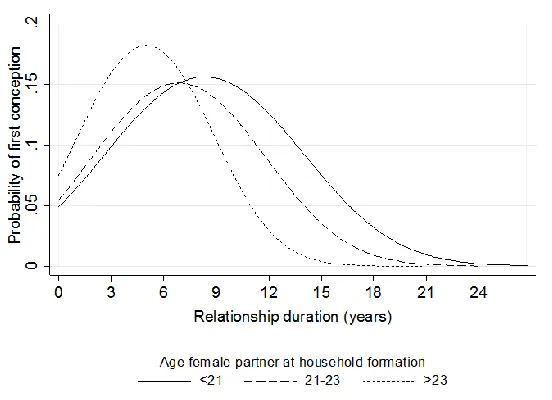
(1)Where is a quadratic function of the relationship duration interacted with dummies representing a young (≤ 20 years), an average (21 to 23), and a high (≥ 24 years) age of the female partner at the point of household formation to allow for different fertility trajectories among these groups6. A quadratic function is chosen to model the temporal dependence in the data because family formation trajectories typically take a hump-shaped form over time (see Figure 1 for a graphical representation). Additionally, denotes a vector of covariates of educational and occupational characteristics of both partners (time-varying or constant) with coefficients . Furthermore, a normally distributed random effect ui on the couple level is included, with a mean of zero and a
standard deviation to be estimated ( [ ]). The inclusion of these couple-specific unobserved factors that are constant across episodes ensures that selection effects (due to unobserved heterogeneity), and the fact that episodes from the same couple cannot be regarded as independent observations, are accounted for (Mills, 2011; Steele, 2005).
5
To ensure that the choice of link function did not influence the results, the model was estimated with a probit and complimentary log-log link; no substantial differences were found (results available upon request). Because most social scientists are more familiar with the interpretation of logit coefficients, this link function was chosen.
6
3.3 Measures
The time-varying status of the main activity of each of the partners distinguished between periods of paid work, homemaking (female partners only7), unemployment/ disability/inactivity, and enrollment in education.
The educational attainment of each of the partners was measured as a time-varying indicator, and was coded in four categories: lower secondary or below, short upper secondary/short vocational, upper secondary (vocational and academic tracks), and tertiary (professional and scientific) education.
The weekly working hours of each of the partners were measured by a time-varying indicator, and distinguished between part-time (< 38 hours/week), full-time (38-40 hours/week), and long (> 40 hours/week, male partners only7) working hours.
The occupational status of the first job was measured by the International Socio-Economic Index of Occupational Status (ISEI), which ranges from 16 to 90, with a higher value indicating a higher occupational status (Ganzeboom, De Graaf, and Treiman 1992; Ganzeboom 1996). Information about the first job was included as a time-varying covariate and in a categorical specification to account for non-linear effects, including a control for respondents who had not started a first job. Four categories were distinguished: low status (ISEI between 16 and 30), medium-low status (ISEI between 31 and 45), medium-high status (ISEI between 46 and 60), and high status (ISEI of 61 or higher).
The supervisory position of each of the partners was measured by a (time-varying) dummy which indicated whether the respondent was supervising at least one other employee in his or her job (not counting pupils, clients, patients, or residents).
Measures of recent career dynamics were constructed for each of the partners. These measures indicated at each point in time whether the respondent had experienced a downward occupational move (that is, a change to a job with an occupational status at least five points lower on the ISEI scale than the previous one) or an upward occupational move (a change to a job with an occupational status at least five points higher than the previous one8) in the preceding 12 months.
The historical period indicator referred to the calendar year of household formation, defined as the point at which the couple started cohabiting or got married (whichever happened first). Three time periods were distinguished: 1960 to 1975, 1976 to 1989, and 1990 to 2009.
7 The case numbers in these categories were too low (< 20 events) for the other partner.
The control variables consisted of dummies indicating the year of data collection, which were included in all of the models; and a time-varying measure of the relationship status which distinguished between cohabitation and marriage.
Refer to Appendix A for the distribution and number of events in each category for all of the variables used.
To test the hypothesis of couple interaction effects, the following interaction terms were included one by one, and were then removed if the model fit did not improve significantly: indicators of the earning potential of the male partner (the occupational status of his first job, his weekly working hours, his educational attainment, and whether he was in a supervisory position) each interacted with the main activity and work hours of the female partner.
4. Results
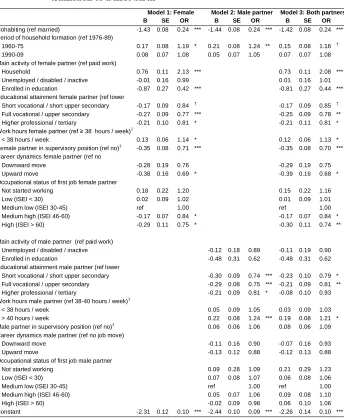
The results of the analyses are presented in Tables 2 and 3. Before discussing the empirical findings, the shape of the baseline risk is presented in Figure 1. The duration dependence was defined by a quadratic function of relationship duration interacted with the age of the female partner at the point of household formation, categorized as an early age (≤20), an average age (21-23), or a high age (≥24). Figure 1 shows that couples who formed a common household at comparatively early ages waited longer periods before having a first child than late starters. Additionally, the more compressed risk distribution of the couples who formed common households later than the sample mean is clearly visible. These couples had children sooner, and had a steeper decline at longer durations.
Figure 1: Probability of a first childbirth by relationship duration and age of the female partner at the household formation
Note: Predicted probability of a first conception calculated for a married couple, household formation 1976-89, with both partners having a lower secondary level of education, full-time employment, no occupational change in the previous 12 months, no supervisory position, a first job with a medium-low status, ui = 0, see Table 2-Model 3 for estimates.
attainment were, contrary to the hypothesis, found to have been less likely to have transitioned to first parenthood.
The second expectation focused on role specialization within couples and proposed that male partners with a higher earning potential would have made a faster transition to parenthood, especially those in male breadwinner and one-and-a-half earning couples (i.e., couples in which the female partner was not employed or worked part time). This hypothesis was tested by introducing interaction terms of the indicators of the earning potential of the male partner (his educational attainment, his working hours, whether he was in a supervisory position, and the status of his first job) and the main activity and work hours of the female partner into the model, and then removing them if the model did not improve significantly. The empirical results showed no support for the theoretical expectation that men with a higher earning potential transitioned to a first birth more quickly, even in situations in which the female partner did not face high opportunity costs; none of the interaction terms were found to have significantly predicted the probability of a first birth9. However, one form of interdependence of the partners which was visible in the results was homogamy in educational attainment. Among the male partners, the negative effect of higher education (compared to the lowest category) was attenuated once information about both partners was included in the full model (see Table 2, Model 3); this indicates that the lower likelihood of entering parenthood found among highly educated men was driven by their highly educated female partners.
With regard to career dynamics, the expectation was that recent upward and downward occupational changes would affect the fertility decisions of couples over and above current employment and career status. In the case of an upward job move, defined as moving (in the preceding 12 months) to a job that is at least five points higher in occupational status (measured by ISEI), an increased probability of a first childbirth was expected in couples in which the male partner had experienced this kind of mobility, while a decreased probability of having a child was predicted if the female partner moved up. The results of the empirical analyses showed only partial support for this expectation. A recent upward job move by the female partner indeed delayed the transition to parenthood, but no significant effect of upward career mobility was found for the male partner. Conversely, a recent downward job move was expected to have increased the probability of childbirth if the female partner was involved, but to have delayed the birth if the male partner was undergoing the transition. The results of the analyses showed no difference in the probability of a first childbirth between the couples in which one of the partners experienced downward mobility in the previous year, and the couples who did not experience a job move.
Table 2: Estimates from a discrete time random effect logit model of the transition to a first birth
Model 1: Female partner
Model 2: Male partner Model 3: Both partners
B SE OR B SE OR B SE OR
Cohabiting (ref married) -1.43 0.08 0.24 *** -1.44 0.08 0.24 *** -1.42 0.08 0.24 *** Period of household formation (ref 1976-89)
1960-75 0.17 0.08 1.19 * 0.21 0.08 1.24 ** 0.15 0.08 1.16 † 1990-09 0.08 0.07 1.08 0.05 0.07 1.05 0.07 0.07 1.08 Main activity of female partner (ref paid work)
Household 0.76 0.11 2.13 *** 0.73 0.11 2.08 *** Unemployed / disabled / inactive -0.01 0.16 0.99 0.01 0.16 1.01 Enrolled in education -0.87 0.27 0.42 *** -0.81 0.27 0.44 *** Educational attainment female partner (ref lower
sec.)
Short vocational / short upper secondary -0.17 0.09 0.84 † -0.17 0.09 0.85 † Full vocational / upper secondary -0.27 0.09 0.77 *** -0.25 0.09 0.78 ** Higher professional / tertiary -0.21 0.10 0.81 * -0.21 0.11 0.81 * Work hours female partner (ref ≥ 38 hours / week)1
< 38 hours / week 0.13 0.06 1.14 * 0.12 0.06 1.13 * Female partner in supervisory position (ref no)1
-0.35 0.08 0.71 *** -0.35 0.08 0.70 *** Career dynamics female partner (ref no
occupational change)
Downward move -0.28 0.19 0.76 -0.29 0.19 0.75 Upward move -0.38 0.16 0.69 * -0.39 0.16 0.68 * Occupational status of first job female partner
Not started working 0.18 0.22 1.20 0.15 0.22 1.16 Low (ISEI < 30) 0.02 0.09 1.02 0.01 0.09 1.01 Medium low (ISEI 30-45) ref 1.00 ref 1.00 Medium high (ISEI 46-60) -0.17 0.07 0.84 * -0.17 0.07 0.84 * High (ISEI > 60) -0.29 0.11 0.75 * -0.30 0.11 0.74 **
Main activity of male partner (ref paid work)
Unemployed / disabled / inactive -0.12 0.18 0.89 -0.11 0.19 0.90 Enrolled in education -0.48 0.31 0.62 -0.48 0.31 0.62 Educational attainment male partner (ref lower
sec.)
Short vocational / short upper secondary -0.30 0.09 0.74 *** -0.23 0.10 0.79 * Full vocational / upper secondary -0.29 0.08 0.75 *** -0.21 0.09 0.81 ** Higher professional / tertiary -0.21 0.09 0.81 * -0.08 0.10 0.93 Work hours male partner (ref 38-40 hours / week)1
< 38 hours / week 0.05 0.09 1.05 0.03 0.09 1.03 > 40 hours / week 0.22 0.08 1.24 *** 0.19 0.08 1.21 * Male partner in supervisory position (ref no)1
0.06 0.06 1.06 0.08 0.06 1.09 Career dynamics male partner (ref no job move)
Downward move -0.11 0.16 0.90 -0.07 0.16 0.93 Upward move -0.13 0.12 0.88 -0.12 0.13 0.88 Occupational status of first job male partner
Table 2: (Continued)
Model 1: Female partner Model 2: Male partner Model 3: Both partners
B SE OR B SE OR B SE OR
0.67 0.08 *** 0.54 0.09 *** 0.66 0.08 ***
Observations 51,104 51,104 51,104
Log likelihood (df) -7,788.7 (28) -7,844.7 (28) -7,775.1 (42) N couples / N events 2,534 1,975 2,534 1,975 2,534 1,975
Source: FNB 1998/2000/2003/2009, calculations by author
Note: † p < 0.10, * p < 0.05, ** p < 0.01, *** p < 0.001 (two-tailed)
B: unstandardized logistic regression coefficient. SE: standard error of coefficient B. OR: Odds Ratio = Exp(B)
Coefficients of duration dependence (age at household formation and relationship duration, see Figure 1) and year of data collection are omitted from the table.
1 Information about work characteristics refers only to work episodes; all non-work episodes are assigned zero and information about non-work episodes is included in the model (household, unemployment/disabled/inactive, enrolled).
With regard to the relative importance of the male and the female partners, the results showed that the occupational resources and the characteristics of the female partner are stronger predictors of the transition to parenthood than those of the male partner. However, adding the characteristics of the male partner to the model with information about the female partner still improved the model fit (likelihood ratio test Chi2(14) = 27.2, p = 0.02)10.
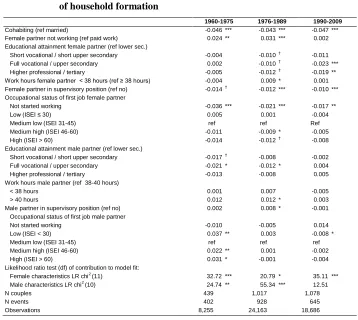
To gain further insight into the changes in the effects of educational and occupational resources on the timing of the first birth over time, the full model presented in Table 3 was estimated separately for the three historical periods examined. Table 3 presents the average marginal effects of all of the covariates11 for the three periods. In line with the expectations previously noted, the educational level and the earning potential of the female partner were found to have become more important predictors after 1975, and, in the more recent time period, the paid employment of the female partner was not shown to have delayed the first childbirth. While couples with a female partner who was not working were more likely to have entered parenthood until 1990, this effect was no longer significant in more recent years. Conversely, the delaying effects of the female partner’s higher educational attainment and supervisory position increased from 1975 onwards. If the woman’s first job was of a higher occupational status, the transition to parenthood was delayed from 1976 to 1989, possibly because the opportunity costs of childbirth were especially high in the
10 For comparison: LR test when female information was added to the model with only the male partners’ information: LR chi2 (14) = 139.2, p < 0.00.
11
Netherlands during the 1970s and 1980s; i.e., the institutional support for combining motherhood and employment was weak, and unemployment was relatively high. Additionally, working reduced hours before the first birth was found to have been associated with a higher first birth probability from 1975 to 1989, a period in which there was an economic crisis, and part-time work was introduced as a potential remedy for unemployment. In all of the time periods, couples in which the female partner had not yet entered the labor market had significantly lower probabilities of having transitioned to parenthood. This finding is related to the ―incompatibility effect‖ of educational enrollment and motherhood (Blossfeld and Huinink 1991), which was also visible in the combined model when full-time enrollment was controlled for separately (see Table 2, main activity indicators).
Regarding the effects of the earning potential of the male partners, the results indicated that the positive effect of high earning potential generally declined over time. This observation was supported by the finding that the overall contribution of the male characteristics to the model fit was declining, as was shown by the likelihood ratio test reported in Table 3.
Table 3: Average marginal effects of the educational and occupational
resources of both partners on the first birth probability by the period of household formation
1960-1975 1976-1989 1990-2009
Cohabiting (ref married) -0.046 *** -0.043 *** -0.047 *** Female partner not working (ref paid work) 0.024 ** 0.031 *** 0.002 Educational attainment female partner (ref lower sec.)
Short vocational / short upper secondary -0.004 -0.010 † -0.011 Full vocational / upper secondary 0.002 -0.010 † -0.023 *** Higher professional / tertiary -0.005 -0.012 † -0.019 ** Work hours female partner < 38 hours (ref ≥ 38 hours) -0.004 0.009 * 0.001 Female partner in supervisory position (ref no) -0.014 † -0.012 *** -0.010 *** Occupational status of first job female partner
Not started working -0.036 *** -0.021 *** -0.017 ** Low (ISEI ≤ 30) 0.005 0.001 -0.004 Medium low (ISEI 31-45) ref ref Ref Medium high (ISEI 46-60) -0.011 -0.009 * -0.005 High (ISEI > 60) -0.014 -0.012 † -0.008 Educational attainment male partner (ref lower sec.)
Short vocational / short upper secondary -0.017 † -0.008 -0.002 Full vocational / upper secondary -0.021 * -0.012 * 0.004 Higher professional / tertiary -0.013 -0.008 0.005 Work hours male partner (ref 38-40 hours)
< 38 hours 0.001 0.007 -0.005 > 40 hours 0.012 0.012 * 0.003 Male partner in supervisory position (ref no) 0.002 0.008 * -0.001 Occupational status of first job male partner
Not started working -0.010 -0.005 0.014 Low (ISEI < 30) 0.037 ** 0.003 -0.008 * Medium low (ISEI 31-45) ref ref ref Medium high (ISEI 46-60) 0.022 ** 0.001 -0.002 High (ISEI > 60) 0.031 * -0.001 -0.004 Likelihood ratio test (df) of contribution to model fit:
Female characteristics LR chi2 (11) 32.72 *** 20.79 * 35.11 *** Male characteristics LR chi2
(10) 24.74 ** 55.34 *** 12.51
N couples 439 1,017 1,078
N events 402 928 645
Observations 8,255 24,163 18,686
Source: FNB 1998/2000/2003/2009, calculations by author.
Note: †p < 0.10, * p < 0.05, ** p < 0.01, *** p < 0.001 (two-tailed).
Average Marginal Effects (dy/dx) were calculated as the discrete change from the base level from predicted probabilities assuming ui
= 0.
5. Conclusion
The aim of this study was to advance our understanding of the influences of the educational and occupational resources of men and women on the timing of the first childbirth, using extensive and dynamic indicators of earning potential and career transitions, and employing a couple framework. The question of the degree of the interdependence of the partners in a couple is of particular relevance to fertility research, as in many studies on fertility trends only information about women is used to predict fertility outcomes. However, if the impact of the occupational characteristics of the female partners on fertility is conditional on the male partners’ occupation and education, the conclusions drawn from studies that rely only on data from women could be incomplete or even misleading.
Relating the empirical results of the analyses back to the research questions, a central conclusion is that the educational and occupational characteristics of the female partner are stronger predictors of the timing of the first birth than those of the male partner. Additionally, the findings indicated that the degree of interdependence of the partners was small, a conclusion that is in line with that of a recent study using Finnish register data on socioeconomic resources and first birth timing among couples (Jalovaara and Miettinen 2013). With regard to the effects of individual characteristics, the results for the female partners were fully consistent with the theoretical expectations: if a woman had a higher earning potential and had recently moved up in her career, the transition to parenthood was delayed. For the male partner, on the other hand, only educational attainment and weekly working hours were significant predictors of the couple’s probability of having a first birth. The estimation of the model for three different historical periods also revealed interesting changes over time; the effect of the educational attainment of the female partner was fully captured by controlling for educational enrollment in the 1960s and 1970s, and it became a strong predictor over and above educational enrollment only after 1990. During this final time period, couples with a non-working female partner no longer made the transition to parenthood faster. The comparison of the effects over the three time periods also suggested that the earning potential of the male partner was a stronger predictor of fertility decisions when women’s human capital and labor market participation levels were lower.
to the higher opportunity costs of childbirth that women face, but also to the fact that there was less variability among men than women in terms of occupational trajectory and work status (see descriptive statistics in Appendix A). This difference might be related to the selection of men with relatively favorable characteristics in the analytical sample, a point that is addressed in more detail below.
The overall conclusion drawn from the results presented in this study with regard to the interrelationship of employment and the timing of the first birth is that, while women’s employment has become an accepted phenomenon over the course of the past few decades, and is no longer necessarily viewed as being in conflict with motherhood, having a high level of human capital and having a job which requires continuous commitment are still associated with the postponement of the first childbirth. The impact of the career of the male partner on the first birth was not as strong as that of the female partner, and it decreased over time, a development which is most likely due to the increasing educational and occupational homogamy between the partners. This implies that a man with a high earning potential is likely to have a partner who is also highly committed to her career (Verbakel et al. 2008). The data used did not permit us to test the effect of career dynamics over the different time periods, which is unfortunate, as doing so might have provided us with some insight into whether the more equal sharing of childrearing tasks among more recent cohorts of men has led to a postponement of the transition to parenthood in response to an upward career move.
respondents, and is in line with previous research reporting an association between relationship stability and socioeconomic status (Jalovaara, 2001).
In conclusion, this study has confirmed the importance of taking into account detailed occupational and work characteristics when studying the relationship between fertility and the paid employment of women (Brewster and Rindfuss 2000; Matysiak and Vignoli 2008). In relation to the inclusion of partner characteristics, the results presented here suggest that by obtaining information about the educational levels and working hours of the male partners, researchers should be able to accurately model the transition to a first birth. An extensive couple data collection or a restriction of the sample to stable couples might not always be necessary. Future research on the relative importance of the partners’ characteristics is desirable, and should address not only the transition to the first birth, but also to higher order births and union formation processes in different national contexts.
6. Acknowledgments
References
Allison, P. (1982). Discrete-time methods for the analysis of event histories. Sociological Methodology 13: 61–98. doi:10.2307/270718.
Amuedo-Dorantes, C. and Kimmel, J. (2005). The motherhood wage gap for women in the United States: The importance of college and fertility delay. Review of Economics of the Household 3(1): 17–48. doi:10.1007/s11150-004-0978-9.
Andersson, G. (2000). The impact of labour-force participation on childbearing behaviour: Pro-cyclical fertility in Sweden during the 1980s and the 1990s. European Journal of Population 16(4): 293–333. doi:10.1023/A:100645490 9642.
Becker, G.S. (1991). A Treatise on the Family. Cambridge, MA: Harvard University Press.
Beckman, L. (1984). Husbands’ and wives' relative influence on fertility decisions and outcomes. Population and Environment 7(3): 182–197. doi:10.1007/BF01255 488.
Begall, K. and Mills, M.C. (2011). The impact of subjective work control, job strain and work–family conflict on fertility intentions: A European comparison. European Journal of Population 27(4): 433–456. doi:10.1007/s10680-011-9244-z.
Billari, F.C. (2004). Becoming an adult in Europe: A macro(/micro)-demographic perspective. Demographic Research, Special Collection 3(2): 15–44. doi:10. 4054/DemRes.2004.S3.2.
Blossfeld, H.-P. and Huinink, J. (1991). Human capital investments or norms of role transition? How women’s schooling and career affect the process of family formation. American Journal of Sociology 97(1): 143–168. doi:10.1086/229743.
Brewster, K.L. and Rindfuss, R.R. (2000). Fertility and women’s employment in industrialized nations. Annual Review of Sociology 26(1): 271–296. doi:10.1146/ annurev.soc.26.1.271.
Clerkx, L.E. and Van Ijzendoorn, M.H. (1992). Childcare in a Dutch context. On the history of nonmaternal childcare in the Netherlands. In: Lamb, M.E., Sternberg, K.J., Hwang, C.P., and Broberg, A.G. (eds.). Childcare in context. Crosscultural perspectives. Hillsdale, NJ: Erlbaum: 55–81.
Coleman, D. and Garssen, J. (2002). The Netherlands: Paradigm or exception in Western Europe’s demography? Demographic Research 7(12): 433–468.
doi:10.4054/DemRes.2002.7.12.
Coombs, L. and Chang, M. (1981). Do husbands and wives agree? Fertility attitudes and later behavior. Population & Environment 4(2): 109–127. doi:10.1007/ BF01255801.
Corijn, M., Liefbroer, A.C., and De Jong Gierveld, J. (1996). It takes two to tango, doesn’t it? The influence of couple characteristics on the timing of the birth of the first child. Journal of Marriage and Family 58(1): 117–126. doi:10.2307/ 353381.
De Graaf, N.D., De Graaf, P.M., Kraaykamp, G., and Ultee, W.C. (1998). Sectie Sociologie, Katholieke Universiteit Nijmegen, Familie-enquête Nederlandse bevolking 1998; Family Survey Dutch Population 1998. (Persistent Identifier: urn:nbn:nl:ui:13-e0f-3i5).
De Graaf, N.D., De Graaf, P.M., Kraaykamp, G., and Ultee, W.C. (2000). Sectie Sociologie, Katholieke Universiteit Nijmegen, Familie-enquête Nederlandse bevolking 2000; Family survey Dutch population 2000. (Persistent Identifier: urn:nbn:nl:ui:13-itw-u6l).
De Graaf, N.D., De Graaf, P.M., Kraaykamp, G., and Ultee, W.C. (2003). Radboud Universiteit Nijmegen, Familie-enquête Nederlandse bevolking 2003; Family Survey Dutch Population 2003. (Persistent Identifier: urn:nbn:nl:ui:13-d52-i53). Dribe, M. and Stanfors, M. (2010). Family life in power couples: Continued
childbearing and union stability among the educational elite in Sweden, 1991-2005. Demographic Research 23(30): 847–878. doi:10.4054/DemRes.2010. 23.30.
Eurostat (2012). Eurostat Statistical Database. EU-LFS Series [electronic resource]. Luxembourg: Eurostat. [http://epp.eurostat.ec.europa.eu/portal/page/portal/ eurostat/home/].
Filer, R. (1985). Male-female wage differences: The importance of compensating differentials. Industrial and Labor Relations Review 38(3): 426–437.
doi:10.2307/2523769.
Fokkema, T., De Valk, H.A.G., De Beer, J., and Van Duin, C. (2008). The Netherlands: Childbearing within the context of a ―Poldermodel‖ society. Demographic Research 19(21): 743–794. doi:10.4054/DemRes.2008.19.21.
Fouarge, D. and Baaijens, C. (2009). Job mobility and hours of work: The effect of Dutch legislation. Maastricht: ROA Research Centre for Education and the Labour Market (Research Memorandum Series No. 4).
Gangl, M. and Ziefle, A. (2009). Motherhood, labor force behavior, and women’s careers: An empirical assessment of the wage penalty for motherhood in Britain, Germany, and the United States. Demography 46(2): 341–369. doi:10.1353/ dem.0.0056.
Ganzeboom, H.B.G. and Treiman, D.J. (1996). Internationally comparable measures of occupational status for the 1988 International Standard Classification of Occupations. Social Science Research 25(3): 201–239. doi:10.1006/ssre.1996. 0010.
Ganzeboom, H.B.G., De Graaf, P.M., and Treiman, D.J. (1992). A standard international socio-economic occupational status index. Social Science Research 21(1): 1–56. doi:10.1016/0049-089X(92)90017-B.
Grunow, D., Schulz, F., and Blossfeld, H.-P. (2012). What determines change in the division of housework over the course of marriage? International Sociology 27(3): 289–307. doi:10.1177/0268580911423056.
Jalovaara, M. (2001). Socio-economic status and divorce in first marriages in Finland 1991-93. Population Studies 55(2): 119–133. doi:10.1080/00324720127685.
Jalovaara, M. and Miettinen, A. (2013). Does his paycheck also matter? Demographic Research 28(31): 881–916. doi:10.4054/DemRes.2013.28.31.
Jenkins, S.P. (2005). Survival Analysis. Essex: Institute for Social and Economic Research University of Essex.
Kalmijn, M. (1998). Intermarriage and homogamy: Causes , patterns , trends. Annual Review of Sociology 24(24): 395–421. doi:10.1146/annurev.soc.24.1.395.
Kraaykamp, G., Ruiter, S., and Wolbers, M.H.J. (2009). Radboud University Nijmegen, Familie-enquête Nederlandse bevolking 2009; Family Survey Dutch Population 2009. (Persistent Identifier: urn:nbn:nl:ui:13-9a8-j83).
Kremer, M. (2005). How welfare states care. Culture, gender and citizenship in Europe. [PhD Thesis]. Utrecht: University of Utrecht, Faculty of Social Sciences. Kreyenfeld, M. (2010). Uncertainties in female employment careers and the
postponement of parenthood in Germany. European Sociological Review 26(3): 351–366. doi:10.1093/esr/jcp026.
Kühhirt, M. (2011). Childbirth and the long-term division of labour within couples: How do substitution, bargaining power, and norms affect parents’ time allocation in West Germany? European Sociological Review 28(5): 565–582.
doi:10.1093/esr/jcr026.
Lewis, J., Knijn, T.C.M., Martin, C., and Ostner, I. (2008). Patterns of development in work/family reconciliation policies for parents in France, Germany, the Netherlands, and the UK in the 2000s. Social Politics: International Studies in Gender, State & Society 15(3): 261–286. doi:10.1093/sp/jxn016.
Matysiak, A. and Vignoli, D. (2008). Fertility and women’s employment: A meta-analysis. European Journal of Population 24(4): 363–384. doi:10.1007/s10680-007-9146-2.
Mills, M.C. (2011). Introducing Survival and Event History Analysis. London: Sage. Mills, M.C., Blossfeld, H.-P., and Klijzing, E. (2005). Becoming an adult in uncertain
times: A 14-country comparison of the losers of globalization. In: Blossfeld, H.-P., Klijzing, E., Mills, M.C., and Kurz, K. (eds.). Globalization, Uncertainty and Youth in Society. London: Routledge: 393–411.
Morgan, S.P. and Taylor, M.G. (2006). Low fertility at the turn of the twenty-first century. Annual Review of Sociology 32: 375–399. doi:10.1146/annurev.soc. 31.041304.122220.
Oppenheimer, V.K. (1994). Women’s rising employment and the future of the family in industrial societies. Population and Development Review 20(2): 293–342.
doi:10.2307/2137521.
Pfau-Effinger, B. (2012). Women’s employment in the institutional and cultural context. International Journal of Sociology and Social Policy 32(9–10): 530–543. doi:10.1108/01443331211257634.
Plantenga, J. (2002). Combining work and care in the polder model: An assessment of the Dutch part-time strategy. Critical Social Policy 22(1): 53–71. doi:10.1177/ 02610183020220010601.
Polachek, S.W. (1981). Occupational self-selection: A human capital approach to sex differences in occupational structure. The Review of Economics and Statistics 63(1): 60–69. doi:10.2307/1924218.
Portegijs, W., Cloïn, M., Eggink, E., and Ooms, I. (2006). Hoe het Werkt met Kinderen. Moeders Over Kinderopvang en Werk. Den Haag: Sociaal Cultureel Planbureau.
Schmitt, C. (2012). Labour market integration, occupational uncertainty, and fertility choices in Germany and the UK. Demographic Research 26(12): 253–292.
doi:10.4054/DemRes.2012.26.12.
Steele, F. (2005). Event History Analysis. ESRC National Centre for Research Methods (Methods Review Papers No. 004).
Steele, F. (2008). Multilevel models for longitudinal data. Journal of the Royal Statistical Society: Series A (Statistics in Society) 171(1): 5–19.
Thomson, E. (1997). Couple childbearing desires, intentions and births. Demography 34(3): 343–354. doi:10.2307/3038288.
Trappe, H. and Rosenfeld, R.A. (2004). Occupational sex segregation and family formation in the former East and West Germany. Work and Occupations 31(2): 155–192. doi:10.1177/0730888404263895.
Van der Lippe, T., Jager, A., and Kops, Y. (2006). Combination pressure: The paid work-family balance of men and women in European countries. Acta Sociologica 49(3): 303–319. doi:10.1177/0001699306067711.
Van Gils, W. and Kraaykamp, G. (2008). The emergence of dual-earner couples: A longitudinal study of the Netherlands. International Sociology 23(3): 345–366.
Van Wel, F. and Knijn, T.C.M. (2006). Transitional phase or a new balance? Working and caring by mothers with young children in the Netherlands. Journal of Family Issues 27(5): 633–651. doi:10.1177/0192513X05284858.
Verbakel, E. (2010). Partner’s resources and adjusting working hours in the Netherlands: Differences over time, between levels of human capital, and over the family cycle. Journal of Family Issues 31(10): 1324–1362. doi:10.1177/ 0192513X09360188.
Verbakel, E. and De Graaf, P.M. (2009). Partner effects on labour market participation and job level: Opposing mechanisms. Work, Employment & Society 23(4): 635–654. doi:10.1177/0950017009344909.
Verbakel, E., Luijkx, R., and De Graaf, P.M. (2008). The association between husbands’ and wives’ labor market positions in the Netherlands. Research in Social Stratification and Mobility 26(3): 257–276. doi:10.1016/j.rssm.2008. 05.002.
Vignoli, D., Drefahl, S., and De Santis, G. (2012). Whose job instability affects the likelihood of becoming a parent in Italy? A tale of two partners. Demographic Research 26(2): 41–62. doi:10.4054/DemRes.2012.26.2.
Appendix A: Distribution of exposure time and events for all variables used
Variable Categories Exp. % Events
Age female partner at < 21 14,844 29.1 533 household formation 21-23 21,274 41.6 798 > 23 14,986 29.3 644 Year of data collection 1998 10,544 20.6 414
2000 7,665 15.0 328
2003 12,525 24.5 468
2009 20,370 39.9 765
Relationship status Cohabiting 21,677 42.4 351 Married 29,427 57.6 1,624 Period of household 1960-75 8,255 16.2 402 formation 1976-89 24,163 47.3 928 1990-09 18,686 36.6 645
Total 51,104 1,975
Female partner Male partner
Exp. % Events Exp. % Events
Main activity Paid work 43,211 84.6 1,650 46,943 91.9 1,884 Household 2,606 5.1 216 n.a. n.a. n.a. Unemployed/disabled/inactivea 1,985 3.9 66 1,504 2.9 42 Enrolled in education 3,302 6.5 43 2,657 5.2 49 Educational Lower secondary 8,449 16.5 423 9,324 18.3 441 attainment Short vocational/upper sec. 10,596 20.7 427 8,749 17.1 310 Full vocational/upper sec. 16,816 32.9 606 15,185 29.7 560 Higher professional/tertiary 15,243 29.8 519 17,846 34.9 664 Supervisory Not working 7,893 15.4 325 4,161 8.1 91 position No 34,952 68.4 1,405 32,241 63.1 1,264 Yes 8,259 16.2 245 14,702 28.8 620 Work hours Not working 7,893 15.4 325 4,161 8.1 91 < 38 hours / week 17,728 34.7 710 5,872 11.5 214 38-40 hours / weekb 25,483 49.9 940 34,852 68.2 1,343 > 40 hours / week n.a. n.a. n.a. 6,219 12.2 327 Occupational status Not started working 3,743 7.32 77 3,007 5.9 62 first job Low (ISEI < 30) 7,582 14.84 350 8,247 16.1 330 Medium low (ISEI 30-45) 14,300 27.98 635 20,794 40.7 821 Medium high (ISEI 46-60) 19,553 38.26 700 11,763 23.0 481 High (ISEI > 60) 5,926 11.60 213 7,293 14.3 281 Career dynamics No change 48,337 94.59 1,899 47,670 93.3 1,853 Downward move 1,088 2.13 33 1,241 2.4 46 Upward move 1,679 3.29 43 2,193 4.3 76
Total 51,104 1,975 51,104 1,975
Source: FNB 1998/2000/2003/2009, calculations by author.
Note: a
Appendix B: Estimates from the discrete time random effect logit model of the transition to a first birth (from age 15) for respondents born ≥ 1945 (including left- and right-censored respondents)
Female Respondents Male Respondents
B SE OR B SE OR
Part of analytical sample (ref no) -0.42 0.07 0.66 *** -0.21 0.08 0.81 ** Age 0.65 0.04 1.91 0.51 0.04 1.67 *** Age squared -0.01 0.00 0.99 *** -0.01 0.00 0.99 ***
Relationship status (ref married)
Single / dating -2.93 0.08 0.05 *** -3.18 0.09 0.04 *** Cohabiting -1.39 0.07 0.25 *** -1.45 0.07 0.24 *** Historical period2
(ref 1960-69)
1970-79 -0.96 0.13 0.38 *** -0.96 0.14 0.38 *** 1980-89 -1.21 0.14 0.30 *** -1.28 0.15 0.28 *** 1990-99 -1.04 0.14 0.35 *** -1.13 0.15 0.32 *** 2000-10 -0.85 0.16 0.43 *** -0.93 0.17 0.39 ***
Main activity (ref paid work)
Household (female only) 0.79 0.09 2.21 *** Unemployed / disabled / inactive -0.01 0.13 0.99 -0.24 0.15 0.79 Enrolled in education -0.52 0.20 0.60 ** -0.37 0.25 0.69 Educational attainment (ref lower sec.) Short vocational / short upper secondary -0.35 0.08 0.70 *** -0.25 0.08 0.78 *** Full vocational / upper secondary -0.48 0.08 0.62 *** -0.34 0.07 0.71 *** Higher professional / tertiary -0.48 0.09 0.62 *** -0.24 0.08 0.79 *** Work hours (ref 38-40 hours / week)1 <38 hours / week 0.13 0.06 1.14 * 0.03 0.08 1.03 > 40 hours / week (male only) 0.16 0.07 1.17 * Supervisory position (ref no)1 -0.32 0.07 0.72 *** 0.05 0.05 1.05
Career dynamics (ref no job move)
Downward move -0.20 0.16 0.82 -0.12 0.10 0.89 Upward move -0.27 0.14 0.76 * -0.14 0.09 0.87
Occupational status of first job
Not started working -0.02 0.18 0.98 -0.04 0.24 0.96 Low (ISEI < 30) -0.01 0.07 0.99 0.06 0.07 1.06 Medium low (ISEI 30-45) ref 1.00 ref 1.00 Medium high (ISEI 46-60) -0.19 0.06 0.82 *** -0.01 0.07 0.99 High (ISEI > 60) -0.26 0.10 0.77 ** -0.04 0.09 0.96
Year of data collection (ref 1998)
2000 0.23 0.08 1.26 ** 0.23 0.08 1.26 * 2003 0.02 0.08 1.02 0.01 0.08 1.01 2009 -0.02 0.07 0.98 -0.02 0.07 0.98 Constant -10.34 0.62 0.00 *** -9.26 0.65 0.00 ***
0.65 *** 0.60 ***
Observations 180,393 182,551
Log likelihood (df) -11,235.8 (26) -10,908.4 (26) N Respondents N events 3,549 2,624 3,489 2,516
Source: FNB 1998/2000/2003/2009, calculations by author
Note: †p < 0.10, * p < 0.05, ** p < 0.01, *** p < 0.001 (two-tailed)
B: unstandardized logistic regression coefficient. SE: standard error of coefficient B. OR: Odds Ratio = Exp(B)
1
Information about work characteristics refers only to work episodes; all non-work episodes are assigned zero, and information about non-work episodes is included in the model (household, unemployment/disabled/inactive, enrolled).
2