Vol. 65, No. 7 JOURNALOF VIROLOGY,JUIY1991, P.3721-3727
0022-538X/91/073721-07$02.00/0
Copyright C) 1991, American Society for Microbiology
In Vitro
Binding of
Human
T-Cell Leukemia Virus
rexProteins
to
the
rex-Response Element of
Viral Transcripts
RALPHGRASSMANN,1* SUSANNE
BERCHTOLD,l
CHRISTIANAEPINUS,l
CLAUDIA BALLAUN,2 ERNSTBOEHNLEIN,2 ANDBERNHARD FLECKENSTEIN'Institut fur Klinische und Molekulare Virologie der UniversitatErlangen-Nurnberg, Loschgestrasse 7, D-8520Erlangen,
Federal
Republic of Germany,'
andSandozResearch Institute, A-1235 Vienna, Austria2Received 30 November1990/Accepted26 March 1991
Human T-celi leukemia virus (HTLV-I, HTLV-II) rex protein function is required for the cytoplasmic
expression of incompletely spliced viral transcriptsencoding structural proteins. The effect is mediated bya
cis-acting rex-response element (RRX) which is located near the 3' end of all viral mRNAs. We show thatrex
polypeptides of HTLV-I andHTLV-IIexpressedinEscherichiacoliarecapableof specifically binding
RRX-containing transcripts of bothviruses incell-freeassays.Bindinganalyseswith deletionvariantsofrexproteins revealedadomainwith RNA-binding activity in the first 77 N-terminal amino acids.Removalofabasic peptide
of 19 aminoacids from the N terminus abrogated RNA binding, whereas a l-galactosidase fusion protein
containingthis peptide boundtothe RRX. These resultssuggestthat directbinding ofrexproteintotheRRX isimportant forrex-mediated regulation of viralgeneexpression and thatashort stretchof positivelycharged
amino acidscontributestothespecificbinding ofrextoitstargetRNA.
Human T-cell leukemiavirus (HTLV) genomes contain, in additiontothe genes common to all retroviruses, asegment ofabout 1.6 kb termed the Xregion(21, 27).The Xregion is located near the 3' terminus of the viral genome and is related to the T-lymphocyte-immortalizing phenotype of HTLV-I (8). The X genes are translated in two different reading frames from a doubly spliced mRNA (15, 22, 34). The HTLV-I transcript codes for at least two trans-acting regulatory proteins, the 40-kDa tax protein, a transcriptional activator (4, 24, 30), and the 27-kDa phosphoprotein, rex (11). The equivalent HTLV-II mRNA is translated into proteins of 38 and 26 kDa (25, 26). The rex protein is localized mainly within the nucleoli of infected cells; this is mediated by a highly basic sequence motif (nucleolar local-ization signal [NLS]) at the amino terminus (29). The HTLV-I rex function is required for the expression of the structuralproteinsgagandenv(10),facilitating the transport ofunspliced orsingly spliced mRNAfrom the nucleus into thecytoplasm (9). Viral mRNA contains a sequence near the 3' terminus that mediates rex responsiveness (9, 23). The rex-response element of HTLV-I (RRX1) resides within a sequenceofabout 280 nucleotides (nt) that is homologousto the U3 and Rregion of the viral long terminal repeat (LTR) andcanform a stable secondary structure (32). To getsome
insightinto the mechanism of selective rex-regulated HTLV mRNA export, weexpressed therexgenein Escherichia coli andanalyzed the RNA-binding propertiesof rexprotein by using Northwestern (RNA-protein) blot and filter-binding analyses. Our data indicate thatrex polypeptides bind
spe-cifically
toRRX-containing invitro transcripts and suggest that theRNA-binding domain,atleastin part, islocalizedatthe amino terminus of theprotein.
MATERIALS ANDMETHODS
Construction ofrexexpression plasmids. HTLV rex
poly-peptides were expressed as fusion
proteins by
using
the plasmid pROScomprisingthe375N-terminal amino acids of* Correspondingauthor.
P-galactosidase
and thecleavage site ofblood-clotting factorXa, asequence-specific protease(7). Toobtain pROS-Rexl, the rex open reading frame (ORF) of HTLV-I (Fig. la), including its genuine start and stop codons, was taken from pLHcRex, a plasmid containing a 1.1-kb cDNA segment (Fig. lb) (3). A 2.0-kbSphI fragment was inserted into the SphI site of pROSS, a variant of pROS having a SphI
octamer linker (New England BioLabs, Beverly, Mass.) inserted in the unique EcoRV site. The HTLV-II rexgene wasobtained from pcXIILTR, a plasmid containing a cDNA copy of the doubly spliced mRNA and a complete LTR (kindly provided by K. Shimotohno, National Cancer Re-search Institute, Tokyo, Japan). To construct the prokary-otic expression plasmidpROS-Rex2, a 1.8-kbSphI-HindIII fragment wasisolated and, after selective removal of the 3' protruding SphI end, inserted between the EcoRV and HindIII sites ofpROS. Properinsertionofthe openreading framewasverified by DNAsequencing. Plasmidsexpressing carboxy-terminal-deletedrexfusionproteinswere
generated
by removing HindIII-FspI (pRexN-126), HindIll-Clal (pRexN-77), and HindIII-NcoI (pRexN-19) fragments from pROS-Rexl. Protruding ends were filled in with Klenow polymerase and religated. In analogy, plasmid pRex2N-19 was constructed by using pROS-Rex2 as progenitor. Mu-tants containing N-terminal-truncated rex open
reading
frameswereobtainedbydeletingaSalI-NcoIor aSall-Accl fragmentfrompROS-Rexl byKlenowpolymerasetreatment and by religation, resulting in the
expression
plasmids
pRexC-170andpRexC-154, respectively.
Expressionandpurificationofrexproteins. Fusion
proteins
were isolated from transformed E. coli BMH 71-18 and W3110afterinducingthe lac promoter(2, 7). Thepolypep-tides could be visualized in Coomassie-stained sodium do-decyl sulfate
(SDS)
gels
and were enriched as described previously (1, 7). Complete fusionproteins
were isolated frompreparative SDS-10%polyacrylamide
gels by
electro-elution. The fusionproteins
were cleaved with factor Xa (Boehringer,Mannheim,
FederalRepublic
ofGermany)
into rex polypeptide and theP-galactosidase
portion.
Fusion proteinsandeukaryotic
cleavageproducts
wereidentifiedby
3721
on November 10, 2019 by guest
http://jvi.asm.org/
A
pol env pX
I
HTLV-I11 III
g00 0 0 0 0 0 0 0 0 0 0 0 0 0 0 0 0 0 0 0 E0 0 0 00 0 0 0 0 0 0 o 2.lkb mRNA
1kb
000000 00 0O 0 t p40 tax
B
ATG STOP
lac-promoter
F--"
SOhI
0 00 0 0 0 0 0 0 0 o p27 rex
lkb
pROSS
HTLV- I
RRX
RRXs
RRXa
MOO. RRX3/8
0.1kb
Riboprobes
HTLV-IL
U3 R U5
RRX
I LTRs LTRa
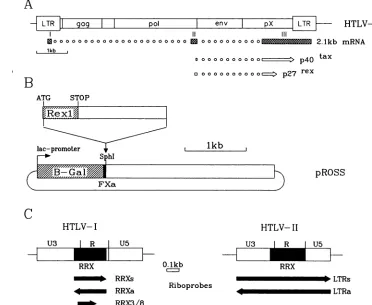
FIG. 1. Construction ofprokaryotic rex expression plasmid and RRX in vitro transcription cassettes. (A) Genetic map of HTLV-I provirus, theopenreading frame for p27rex, and thedoubly splicedmRNA. (B) Expressioncloningofa rex0-galactosidasefusionprotein
(M). A2.0-kbSphI fragmentwasisolated from theeukaryoticexpression plasmid pLHcRex. Itconsists of 1.0 kb of cDNA derived from
the doubly spliced mRNA (nt 253 to 1316) and vector sequences. It was cloned in the unique SphI site of pROSS. (C) Origin of
RRX-containing RNA probes obtained byinvitrotranscription. RRXs,RRX3/8,and LTRsare sensetranscripts;RRXa andLTRaareinthe antisense orientation.
Western immunoblot analyses with anti-peptide antisera directed against the carboxyl termini of rex proteins. The fusionpolypeptidesisolated from bacteria transformed with pROS-Rexl hada molecularmass ofabout 70kDa. Factor Xa treatment yielded a cleavage product of about 27kDa, which reacted with the anti-rexi rabbit serum (Fig. 2A). Cleavage ofthe 70-kDa rex2fusion protein yielded a rex2-specificpolypeptide of about 26 kDa that stained specifically in Westernblots. Arex2-specific antiserum recognizingthe 30 C-terminal amino acids was kindly provided by K. Shimotohno.
Subcloningand invitro transcription ofRRXs. RRXDNA of HTLV-I was obtained by polymerase chain reaction amplification. The primers used contained recognition
se-quences for BglII (5' end) and HindIII (3' end). Amplified fragments were cloned into the BamHI-HindIII sites of
pBluescriptlI KS- (Stratagene, La Jolla, Calif.), aplasmid providingbacteriophage T3 and T7promoters.The resulting plasmid,pKSRRX25/26, contained a286-bp (nt 302 to574) fragment of HTLV-I DNA representing acomplete RRX;
plasmidpKSRRX3/8 containsanonfunctional RRX
subfrag-mentof137bp (nt 334to471)(2b). Runoff transcripts were
synthesized after linearization withHindIlI (sense)orXbaI
(antisense)by using T3orT7polymerase.For thegeneration ofRRX2-containing transcripts, a0.9-kbHindIII LTR frag-mentwasisolated frompIILTRCAT (28)andligated into the
HindIII site ofpBS- (Stratagene). Tworesultingplasmids, pBSL3s and pBSL3a, containing the inserts in opposite orientations were used to generate sense and antisense transcripts initiatingattheT3 promoter. Togeneraterunoff transcripts, pBSL3s was cleaved with EcoRI and pBSL3a was cleavedwithAsp718. In vitro transcripts werelabeled by addition of 50 ,uCi of [ot-32P]UTP (400 ,uCi/mmol) and purified by phenol extraction, repeated ethanol precipita-tions, and, in some cases, additional Sephadex G-50 chro-matography. Transcripts were monitored by Cerenkov counting and electrophoresis in 5% denaturing polyacryl-amide gels. Themethod used results in RNA with specific activityof about 60 nCi/ngfor alltranscripts.
RNA-binding analysis. Northwestern blots were
per-formedasdescribedpreviously (1)withminormodifications. Briefly, protein preparations containing 2 x 10⁻¹ to 6 x 10-11 mol of rex polypeptide were separated on SDS-polyacrylamide gels (10to17.5%acrylamide), electroblotted
onto nitrocellulose (NC) membranes, and allowed to
rena-tureforatleast 12 h in NWbuffer(50mMNaCl,10 mMTris [pH 7.5], 1 mM EDTA, 0.02%Ficoll, 0.02% polyvinylpyr-rolidone). Incubation was carried out in NW buffer which alsocontained 32P-labeled invitrotranscripts (1 x 10⁶cpm), E. coli tRNA (200 ,ug/ml), 0.02% bovine serum albumin (BSA), and0.5 mM dithiothreitol. Blotswerewashedthree
C
-1
(a FX
on November 10, 2019 by guest
http://jvi.asm.org/
[image:2.612.121.493.85.390.2]HTLV rex PROTEIN BINDING 3723
B
I RRXS--4 RRXa- I-H
PHV--G P R G P R G P R
kD
-24
I
C
-LTRs q
G P R
kD
9 -24
I
I
D
%complex formation
1001
50-0 %4
l l l
[image:3.612.151.484.78.467.2]-7 -6 -5 -4 log competitor
FIG. 2. rexprotein binding with therexRRX.(A) Westernblotanalysis oftherexprotein expressedin E.colitobeused inbindingstudies.
FactorXa-treated (lane R)anduntreated(lane F) rexl fusionproteinwereseparatedon anSDS-12.5%polyacrylamidegelandelectroblotted. TheNC filterwasprobedwithanantipeptiderabbitserumdirectedagainst amino acids173to189 ofrexl.(B)Northwestern blotwithRRX1
invitrotranscripts. FactorXa-digestedrexi fusionprotein (lanesR),partially purified ,-galactosidase (lanes G) derived fromvectorpROSS, andproteasefactor Xa(1,ug) (lanes P)wereelectrophoresedandblotted.Filtersderivedfrom thesamegelwereprobed withriboprobesHPV, RRXs, and RRXa. (C) Northwestem blot with HTLV-IIspecifictranscripts.TheNC-filter preparedasdescribed forpanel Bwasincubated
withriboprobe LTRs. (D)Competition ofrexbindingto 32P-labeled specific andnonspecificRNA fragments byunlabeledE. colitRNA. FactorXa-treated fusion protein purified frompROS-rexl-infectedcells wasincubated withspecific 32P-labeledRRXstranscripts (0) and
nonspecific 32P-labeled human papillomavirus RNA (0) and in the presence of variousamounts ofunlabeled competing E. coli tRNA. Protein-RNAbinding was measured bya filter-binding assay. The values represent an averageof three independent experiments. The radioactivitybound in the absence ofcompetingtRNAwastakenas 100%.
times with NWbufferpriortodrying andexposedtoX-ray films.
TomeasureRNA-protein interaction in solution, weused NCfilter-bindingassays. Radioactively labeledin vitro
tran-scripts (0.5 x 10⁻¹ to 2 x 10-11 M) were incubated with factor Xa-cleaved rexi fusion protein (1.2 x 10⁻⁸ to 2.5 x 10⁻⁸M)inthepresenceofvariousamountsof E.colitRNA. Binding reactions were performed by using 1 ml of filter-binding buffer (50 mM NaCl, 10 mM Tris [pH 7.5], 1 mM EDTA, 0.2 mMdithiothreitol, 0.01%BSA, 20 U of RNasin
per ml) for 15 min on ice. Protein-RNA complexes were recoveredbyfiltrationthrough25-mmNCround filters(pore size, 45 ,um; Schleicherund Schull, Dassel, Germany) at a
constantlowflowrate. Filtersweredried for 20minat37°C,
andboundradioactivitywasevaluated byliquid scintillation counting.
RESULTS
Specific bindingofrextothe RRX. Toanalyzethebinding capacity ofrexproteinto radiolabeledRRX transcripts, we used the Northwesternblottingassay,whichwaspreviously used successfully to demonstrate specific binding of the
humanimmunodeficiency virus proteinsrev andtatto their
corresponding RNA targets, the rev-response element and thetat-responseelement,respectively (1, 14, 35).Thefactor Xa-cleavedpolypeptideswereseparated by SDS-gel
electro-phoresis, transferred to NC filters, and incubated with
A
R F
kD
-66
-45 -34
-29
-24
-20
-14 VOL.65, 1991
40
1
on November 10, 2019 by guest
http://jvi.asm.org/
3724 GRASSMANN ET AL.
32P-labeled
in vitrotranscripts.
Severalindependent
experi-ments demonstrated thatrecombinantrexi
protein
strongly
bindssensetranscripts
ofRRX1(Fig.
2B,
laneR),
whereas neitherfactorXa(Fig.
2B,
laneP)
nor,-galactosidase
(Fig.
2B,
laneG)
shows anyreaction. Inagreement
withprevious
results(9),
thisRRX1 sequencedisplayed biological
activity
(2a).
Asignificantly
weakerinteraction was observed withthe antisense
transcript,
RRXa(Fig.
2B).
To estimate the differencein theRNA-binding capacity,
theboundradioac-tivity
from threeindependent
Northwestern blotexperi-mentswasdetermined
by liquid
scintillationcounting.
Sensetranscripts
boundmuchmoreefficiently
thanantisenseRRXRNA
(9.8
times;
standarddeviation,
3.7).
Toanalyze
whethernonspecific binding
to double-stranded RNA orcomplex
RNAsecondary
structures could account for theaffinity
toantisensetranscripts,
weusedadeletedversionofRRX1
(RRX3/8)
astheprobe.
Thistranscript
of137nt(-0.4
kcalperbase
[-
1.67kJperbase])
essentially
contains steml as well asstem-loops
A, B,
and C ofRRX1(32)
and wasshown to be
biologically
inactive(2b).
Binding
ofRRX3/8 was farweaker and could be visualizedonly
after extendedexposure.
Again,
theradioactivity
bound was estimatedby
liquid
scintillationcounting.
There wasnosignificant
differ-ence from
background
values,
but theactivity
was 12- to17-fold lowerthan with
complete
sensetranscripts.
In vitroRNA was also
generated
fromplasmid
pEBF33,
apBS
derivativecontaining
a554-bp
insert fromthehumanpapil-lomavirus
type
33 E2region
(nt
2796to3356) (5).
Computer
predictions
suggest
that thecorresponding
RNAprobably
does not form a
highly
stablesecondary
structure(-0.18
kcalperbase
[-0.75
kJperbase]).
Asexpected,
this invitrotranscript
didnotyield
anydetectablesignals (Fig.
2B),
evenafter
long
exposure.Todemonstrate
specific binding
of dissolvedrexprotein
toRRX1,
we alsoanalyzed complex
formationby
protein-mediated retention ofradioactiveRNAonNC filters
(filter-binding
assay).
An indirectcompetition
assay was used todetermine the relative affinities ofrex to its natural
target
RNA and to an
unspecific transcript.
rexprotein
inexcesswasincubatedwith labeled RRXs and human
papillomavirus
transcripts
in the presence of various concentrations of unlabeledcompeting
tRNA(Fig.
2D).
Comnpetitor
concen-trations
required
toreduceradioactivecomplex
formationto50% were taken as a measure of the relative
binding
affin-ities. To obtain 50% reduction ofcomplex formation,
40 to50 ng of tRNA per ml was
required
when the unrelated humanpapillomavirus transcript
was used as the labeledprobe.
In contrast,however,
about 20,ug/ml
wasnecessaryto achieve 50% inhibition of rex-RRXs
formation,
which demonstrates that theaffinity
of rex to RRXs is about 400-foldhigher
than itsaffinity
toan unrelated RNA.Binding properties
ofrex2protein
and RRX2. rexpolypep-tidesfromHTLV-Iand
HTLV-TI
canfunctionally
substitute for each other(9).
Wefoundspecific
binding
in Northwest-ern blots when HTLV-I rexprotein
wasprobed
with HTLV-II LTRtranscripts
(Fig.
2C). It wascomparable
instrength
tothebinding
withRRX1sensetranscript,
whereas antisenseRNA(LTRa)
(Fig. 1C)
resulted inasignificantly
weaker
signal.
A very similar pattern ofphysical
interaction wasdetectedwhen rex2proteins
wereprobed
withHTLV-I sense(RRXs)
and antisense(RRXa)
transcripts (Fig. 3).
Again,
thepapillomavirus
transcripts
did not lead to any detectable interactions with rex2protein.
Localization of
RNA-binding
activity
within therexprotein. To map domains ofrexi
required
for RNAbinding,
wegenerated
a series of deletion mutants oftheprocaryotic
RRXS
1 23 4RRXa 1 2 3 4
0
[image:4.612.354.519.76.249.2]24- - -24
FIG. 3. Binding of RRX to rex protein of HTLV-II. Factor
Xa-digested fusion proteins derived from pROS-Rex2 (lane 1)and
pROS-Rexl (lane 2) were separated on an SDS-17.5% polyacryl-amidegel and transferredtoNC filters. Thecorrespondingblotwas
cutintotwo equalfilter strips andprobedwith RRXs and RRXa.
Lane 3 containsa
P-galactosidase
fragment expressedfrompROS; lane 4 contains factorXa.expression plasmid pROS-Rexl. Fusion proteins derived from plasmids pRexN-126, pRexN-77, and
pRex-N19
aretruncated at the carboxy terminus; fusion proteins from pRexC-154 andpRexC-170 suffer N-terminal deletions in the rexportion (Fig. 4). The plasmidswere namedaccordingto
the numberof rex-corresponding amino acids retained in the peptides. Factor Xa-cleaved fusionproteins with C-terminal deletions (N-126, N-77) bound as efficiently as full-length proteintoRRXs (Fig. 5A, left panel, lanes 1to3). Interac-tion with RRXa and RRX3/8 transcripts was
significantly
lower, confirming the specificity of the reaction (Fig.
5A,
middle andright panels, lanes 1 to 3). The deletedpeptides, however, exhibitedless-specific binding than didfull-length protein. These experiments indicate the presence of an
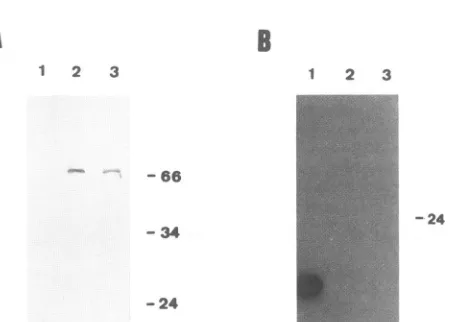
RNA-bindingdomainwithinthe first77 amino acids ofrexi. To map its location more precisely, two fusion proteins containing N-terminally deleted rex polypeptides were treated with factorXa andtestedinNorthwesternblots. The rex polypeptides with deletions of 35(C-154) or 19(C-170)
amino acids did not show any binding activity even after
im
NLSI
_~~~~~~~~~~~~~~~~~~~~~~~~~~~~~~~~~~~~~~~~~~~~~~~~~~~~~~~~~~~~~~~~~
goAL
goA~ ~~~
CDo.LI
Rexl
N-126
N-77 - N-19
jjII.Ifl
C-170C-154 FIG. 4. Diagramof truncatedrexfusionproteins. The rex
por-tionisdepictedasablackbar;deletionsareindicatedasthinlines.
J. VIROL.
on November 10, 2019 by guest
http://jvi.asm.org/
[image:4.612.317.554.565.709.2]HTLV rex PROTEIN BINDING 3725
RRXs
1 2 3 4 5
RRXS
2 3
RRXa
1 2 3 4 5
RRXa
1 2 3
RRX3i8
1 2 3 4 5
RRX 3f8
1 2 3
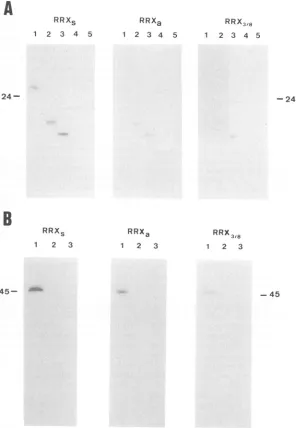
FIG. 5. Binding of C-terminal-truncated rexproteintoRRX RNA. (A)Northwesternblot with factor Xa-cleaved fusion proteins. Equal filterstrips derived froma single SDS-17.5% polyacrylamide gelwereincubated with 32P-labeled transcripts RRXs, RRXa, andRRX3/8.
Proteinswerepurified from E. coli transfected withpROS-Rexl (lane 1), pRex-N126 (lane 2), pRex-N77 (lane 3), and pROSS (lane 4). Lane
5 contains factor Xa. (B) Northwestern blots of fusion proteins N-19. Equal filter strips were obtained from a single SDS-17.5% polyacrylamide gel loaded with the fusion proteins N-19 (lane 1) and C-170 (lane 2) and with j3-galactosidase (lane 3). The riboprobes used
werethesame asin panel A.
very long exposure times (Fig. 6). This suggested that the first 19 amino acids, a highly basic region which also contains the NLS(29),isrequiredfor RRXbindingin vitro. A 3-galactosidase fusion protein (N-19) containingthe NLS was tested in Northwestern blots. This polypeptide bound RNA withaclearpreferencefor RRXs(Fig. SB,leftpanel). The control transcripts, RRXa and RRX3/8, bound much
more weakly, resulting in signals with 5- and 15-fold less intensity, respectively (Fig. 5B, middle and right panels). Analogous results were obtained with protein expressed from pRex2-N19 (N-192), a fusion protein including the homologous sequence motif of HTLV-II. The polypeptide N-192boundequally stronglytothesensetranscriptsRRXs and LTRs (Fig. 1B), whereas antisense or RRX3/8
tran-scriptsboundsignificantlymoreweakly (datanotshown). In
summary, these experimentssuggest thatthe known NLSs (29)areabletoconferRRX-bindingspecificitytoa P-galac-tosidase fusion protein.
DISCUSSION
Therex-regulated nuclear export ofincompletely spliced HTLV mRNA is mediatedbythe RRXsequence(9, 23, 32). Using Northwestern blot and filter-binding analyses, we
demonstrated that rex polypeptides bind specifically to in
vitro-generated RRX transcripts and less specifically to a biologically inactive deletion variantor to unrelated RNA. Thisstronglysuggests that directcomplexingofrexprotein
A
24- -24
B
45-_
- 45
VOL.65, 1991
on November 10, 2019 by guest
http://jvi.asm.org/
[image:5.612.169.474.83.511.2]A
B
1 2 3 1 2 3
66
-34
[image:6.612.73.298.65.226.2]-24
FIG. 6. Absence of RNA-binding capacity in N-terminal-trun-catedrexproteins. (A) Western blot of fusion proteins toconfirm
correcttranslation of the C terminus ofrex.Proteinswereseparated on an SDS-10% polyacrylamide gel and electroblotted. The NC filter was probed with an antipeptide antiserum directed against
aminoacids 173 to 189 ofrexi. (B) Northwestern blot analysis of
factor Xa-treated fusion proteins. Filters derived from an
SDS-17.5% polyacrylamide gel were probed with the RRXs (sense)
transcript. Lanes: 1, N-77; 2, C-154; 3, C-170.
toRRX RNAis afunctionally important stepin thenuclear
exportofincompletely spliced retroviral mRNA. The sense transcripts from both HTLV-I and HTLV-II interacted equally well with rex polypeptides of both viruses. This is consistent with theobservation thatrex2canfullysubstitute forrexi function in vivo (9). Our studies showedaweaker, although significant, in vitro binding of HTLV RRX an-tisensetranscripts. Computerpredictions indicatethat RRX antisense RNA forms a mirror-image secondary structure
including identical double-stranded sequences. Our results
agree with results of previous studies suggesting that the secondary structure of HTLV RRX is important for rex function(32). Preliminary experiments have also shown that in vitro-transcribed RNA from the HIV-1 rev-response
ele-ment,which also has the potentialtoforma,stable stem-loop
structure(13), weakly interacts withrexpolypeptides of both
HTLVtypes. This isconsistent with the observation thatrex
can functionally substitute for rev (12, 17) with lower effi-ciency (20, 31), although neither polypeptides nor RNA
targets sharerecognizable sequence homologies. In conclu-sion, these observations suggest a model of specific rex
binding to the RRX and less-specific binding to complex secondary structures. Althoughthis work suggests that rex
binding to RRX is a prerequisite, it is not sufficient for mediating therex effect. Host proteins have been shownto
beimportant for the biologicalactivities of the RNA-binding HIV proteins rev and tat (6, 33). Cellular factors may
directly interact with HTLV mRNA or also with the rex
protein,assuggested by the existenceof trans-dominantrex
mutants(3, 18). The requirement forrexfunctionofa 15-bp
sequence element at map position 5171 to 5185 (23) could indicate a binding site for such a factor. An appropriate
topological arrangement ofrex and cellular factors on the
viralRNAmaybe relevant for biological activity.This could
explain the failure to detect in vivo function of
reverse-positioned RRX (9).
RNA-binding analysis of the truncatedrexproteins N-126
andN-77resulted in specific recognitionof the RRX by these peptides. The deleted peptides however, exhibited less
spe-cificbinding than the wild-type protein. This loss in
speci-ficity could be due to the deletion of
protein
domains involvedin therecognition ofthe RNA target.Alternatively,
analtered
secondary
structure orpartially
nonspecific bind-ing caused by the increasingisoelectricpoints of the short-enedproteins
could beresponsible
for the less-specific binding observed. Theseexperiments
indicate the presence of an RNA-binding domain within the first 77 N-terminal amino acids. Deletion of 35 or 19 amino acids from the N terminus of therex protein completely abolishedtheRNA-binding capacity in Northwestern blotanalyses. This could meaneitherthat the first N-terminal amino acidsare
impor-tant for the generation ofsecondary ortertiary structures
necessary for RNA binding or that this short stretch of amino acids directlyinteracts with RNA. The first 19 N-ter-minal amino acids (N-19 peptide)were attached to a n-ga-lactosidase fragmentthat had no RNA-binding capacity by itself. The resulting chimeric polypeptide bound complete RRXswith significantly
higher
affinity
than it boundbiolog-ically inactive RNA. Although it cannot be ruled out that
,B-galactosidaseinfluencesRNAbinding bysomenonspecific interaction,our
experiments
suggestthat the N-19peptide
is involved in the RNA binding by HTLV rex protein. The N-19 peptide could either represent a part of alarger
RNA-binding structure or represent the complete
binding
domain. This highly positively charged peptide sequence waspreviouslydescribedas anNLS(29),whichwas shown tobe essentialfor the
biological
function ofrex(16). Coin-cidence ofRNA-binding
domains consisting of short stretches of basic amino acids with NLSs were recently describedforthe HIVregulatoryproteins
tatandrev(17, 19,
36). A tat
peptide
of 14 amino acidscontaining
thecorre-sponding region
was showntospecifically
bindto a target structure within the tat-response element(19,
36).
This indicates that a small basicoligopeptide
is sufficient toproduceafunctional
RNA-binding
domaincapable
of recog-nizinga specifictargetstructure. Bifunctional domainsthat bind to complex RNA structures and mediate nucleolar targeting may define a class of smallregulatory proteins
including
the lentivirusproteins
tat and rev as well as the HTLV rexproteins.ACKNOWLEDGMENTS
The excellent technical assistance ofIngrid Buckreusis greatly appreciated.Wethank E.Beyer-Finklerforproviding pEBF33and
J.HauberforprovidingplasmidpLHcRex.
This work wassupported by Deutsche Forschungsgemeinschaft (Forschergruppe "DNA-Viren des hamatopoetischen Systems") andProjekttragerAIDS desBundesministeriums furForschungund Technologie (FKZ11-100-89).
REFERENCES
1. Aepinus, C.,R.Voll, M. Broker,andB. Fleckenstein. 1990. A
rev/p-galactosidase
fusion protein binds in vitro transcripts spanning the rev-responsive element of human immunodefi-ciencyvirus type 1(HIV-1).FEBSLett. 263:217-221. 2. Amann, E.,andJ. Brosius. 1985. 'ATG vectors' forregulatedhigh-levelexpression of clonedgenesin Escherichiacoli. Gene
40:183-190.
2a.Ballaun,C. Unpublisheddata.
2b.Ballaun, C.,andE.Bohnlein. Unpublished data.
3. Bohnlein, S., F. P. Pirker, L. Hofer, K. Zimmermann, H. Bachmayer, E. Bohnlein, andJ. Hauber. 1991.Transdominant
repressors for human T-cell leukemia virus type I Rex and
human immunodeficiency virus type 1 Rev function. J. Virol. 65:81-88.
4. Cann, A.J., J.D. Rosenblatt, W.Wachsman,N. P. Shah,and
I. S. Y. Chen. 1985. Identification ofthe generesponsible for
human T-cell leukaemiavirustranscriptional regulation.Nature
on November 10, 2019 by guest
http://jvi.asm.org/
HTLV rex PROTEIN BINDING 3727
(London) 318:571-574.
5. Cole, S. T., and R. E. Streek. 1986. Genome organization and nucleotide sequenceof human papillomavirus type 33, which is associated with cervical cancer. J. Virol. 58:991-995.
6. Cullen, B. R. 1990. TheHIV-1 tat protein: an RNA
sequence-specific processivityfactor? Cell63:655-657.
7. Ellinger, S., R. Glockshuber, G. Jahn, andA.Pluckthun. 1989. Cleavage of procaryotically expressedhumanimmunodeficiency
virus fusion proteins by factor Xa and application inWesternblot
(immunoblot) assays. J. Clin. Microbiol. 27:971-976.
8. Grassmann, R., C. Dengler, I.Muller-Fleckenstein, B. Flecken-stein, K. McGuire, M.-C. Dokhelar, J. G.Sodroski, and W. A. Haseltine. 1989. Transformation to continuous growth of pri-mary human Tlymphocytes by human T-cell leukemia virus type I X-region genes transduced by a herpesvirus saimiri
vector. Proc. Natl. Acad. Sci. USA86:3351-3355.
9. Hanly, S. M., L. T. Rimsky, M. H. Malim,J. H.Kim, J. Hauber, M. Duc Dodon, S.-Y. Le, J.V.Maizel, B.R. Cullen, and W. C. Greene. 1989. Comparative analysis ofthe HTLV-I Rex and HIV-1 Rev trans-regulatory proteins and theirRNA response
elements. GenesDev. 3:1534-1544.
10. Inoue, J.-I., M. Yoshida, and M. Seiki. 1987. Transcriptional
(p40t") and post-transcriptional(p27rex) regulatorsarerequired for the expression and replication of human T cell leukemia
virus type I genes. Proc. Natl. Acad. Sci. USA84:3653-3657.
11. Kiyokawa, T., M. Seiki, S. Iwashita, K. Imagawa, F. Shimizu,
andM. Yoshida. 1985.p27x`I1 andp21xl"',proteins encodedby the pX sequence of human T-cellleukemia virus typeI. Proc. Natl. Acad. Sci. USA 82:8359-8363.
12. Lewis, N., J. Williams, D. Rekosh, and M.-L. Hammarskjold. 1990. Identification ofa cis-acting element in human immuno-deficiency virus type 2(HIV-2)thatis responsive to the HIV-1 revand human T-cellleukemia virus types I and II rex proteins. J. Virol. 64:1690-1697.
13. Malim, M. H., L. S. Tiley, D. F. McCarn, J. R. Rusche, J. Hauber, and B. R. Cullen. 1990. HIV-1 structural gene expres-sion requires binding of the revtrans-activatortoits RNA target sequence. Cell60:675-683.
14. MuUler,W. E., T. Okamoto, P. Reuter, D.Ugarkovic, and H. C. Schroder. 1990. Functional characterizationoftat protein from human immunodeficiency virus. Evidence that tat links viral RNAs to nuclear matrix. J. Biol. Chem. 265:3803-3808. 15. Nagashima, K., M.Yoshida, and M.Seiki. 1986. Asingle species
ofpX mRNA of human T-cell leukemia virus type I encodes
trans-activator p40X and two other phosphoproteins. J. Virol. 60:394-399.
16. Nosaka, T., H. Siomi, Y. Adachi, M. Ishibashi, S. Kubota, M. Maki, and M. Hatanaka. 1989. Nucleolar targeting signal of human T-cell leukemia virus type I rex-encoded protein is
essential for cytoplasmic accumulation of unspliced viral
mRNA. Proc. Natl. Acad. Sci. USA86:9798-9802.
17. Olsen, H. S., A. W. Cochrane, P. J. Dillon, C. M. Nalin, and C. R. Rosen. 1990. Interaction of human immunodeficiency virus type 1 rev with a structured region in env mRNA isdependent on multimer formation mediated through a basic stretch of amino acids. Genes Dev.4:1357-1364.
18. Rimsky, L., M. Duc Dodon, E. P. Dixon, and W. C. Greene. 1989.Trans-dominant inactivation ofHTLV-Iand HIV-1 gene expression by mutation of the HTLV-I Rex transactivator.
Nature (London) 341:453-456.
19. Roy, S., U. Delling, C.-H. Chen, C. A. Rosen, and N. Sonenberg. 1990. A bulge structure in HIV-1 TAR RNAis required fortat binding and tatmediatedtrans-activation. Genes Dev.
4:1365-1373.
20. Sakai, H., H.Siomi,H.Shida, R. Shibata, T. Kiyomasu, and A. Adachi. 1990. Functional comparison of transactivation by human retrovirus revand rex genes. J. Virol. 64:5833-5839. 21. Seiki, M., S. Hattori, Y. Hirayama, and M. Yoshida. 1983.
Human adult T-cell leukemia virus: complete nucleotide se-quenceof theprovirus genomeintegrated in leukemia cellDNA. Proc. Natl. Acad. Sci. USA 80:3618-3622.
22. Seiki, M., A. Hikikoshi, T. Taniguchi, and M. Yoshida. 1985. Expression ofthepX gene ofHTLV-I: general splicing
mech-anism in the HTLV-family. Science 228:1532-1534.
23. Seiki, M., J. Inoue, M. Hidaka, and M. Yoshida. 1988. Two
cis-acting elements responsible for posttranscriptional
trans-regulation of gene expression of human T-cell leukemiavirus
typeI. Proc. Natl. Acad. Sci. USA 85:7124-7128.
24. Seiki, M., J. Inoue, T. Takeda, and M. Yoshida. 1986. Direct
evidence thatp4Ox of humanT cellleukemiavirus type I isa trans-acting transcriptional activator. EMBOJ. 5:561-565.
25. Shina, H., M. Takano, K. Shimotohno, and M. Miwa. 1986.
Identificationofp26Xbandp24Xbof human T-cell leukemiavirus typeII. FEBSLett. 209:289-294.
26. Shimotohno, K., M. Miwa, D. J. Slamon, I. Chen, H. Hoshino, M. Takano, M. Fujino, and T. Sugimura. 1985.Identification of
new gene products coded from X regions of human T-cell leukemia viruses. Proc. Natl. Acad. Sci. USA82:302-306. 27. Shimotohno, K., Y. Takahashi,N.Shimizu,T. Gojobori,D. W.
Golde, I. S. Y. Chen, M. Miwa, and T. Sugimura. 1985.
Complete nucleotide sequenceof aninfectiousclone ofhuman
T-cell leukemia virus type II: an open reading frame for the
protease gene. Proc. Natl. Acad. Sci. USA82:3101-3105. 28. Shimotohno, K., M. Takano, T. Teruuchi, and M. Miwa. 1986.
Requirement of multiple copies of a21-nucleotide sequencein the U3 regionsof human T-cell leukemia virus type I and typeII
long terminal repeats for trans-actingactivation oftranscription. Proc. Natl. Acad. Sci. USA 83:8112-8116.
29. Siomi, H., H. Shida, S. H. Nam, T. Nosaka, M. Maki, and M.
Hatanaka. 1988. Sequence requirements for nucleolar localiza-tion of human T cell leukemia virus type I pXprotein, which regulates viral RNA processing. Cell55:197-209.
30. Sodroski, J. G., W. C. Goh, C. A. Rosen, Z. Salahuddin, A. Aldovini, G. Franchini, F. Wong-Staal, R. C. Gallo, K. Sug-amura, Y. Hinuma, and W. A. Haseltine. 1985. trans-activation ofthehumanT-cell leukemia virus large terminal repeat corre-lates with theexpression of the x-lor protein. J. Virol. 55:831-835.
31. Solomin, L., B. K. Felber, and G. N. Pavlakis. 1990. Different sites of interaction for rev, tev, and rex proteins within the rev-responsive element of humanimmunodeficiency virus type
1. J. Virol. 64:6010-6017.
32. Toyoshima, H., M. Itoh, J.Inoue, M. Seiki, F. Takaku, and M. Yoshida. 1990. Secondary structureof the humanT-cell leuke-mia virus type I rex-responsive element is essential for rex
regulation of RNA processingandtransportofunsplicedRNAs. J. Virol. 64:2825-2832.
33. Trono, D., and D. Baltimore. 1990. A human cell factor is essential for HIV-1 rev action. EMBO J. 9:4155-4160. 34. Wachsman, W.,K.Shimotohno,S. C. Clark,D. W. Golde,and
I. S. Y. Chen. 1984. Expression of the 3' terminal region of human T-cellleukemia viruses. Science226:177-179.
35. Walley, A. J., S. Heathy, and I. M. Jones. 1989. Direct RNA-binding by the rev productofHIV-1. AIDS 3:859-861. 36. Weeks, K. M., C. Ampe, S. C. Schultz, T. A. Steiz, and D. M.
Crothers. 1990. Fragments of the HIV-1 tat proteinspecifically
bind TARRNA. Science 249:1281-1285.
VOL. 65, 1991