Vol.61, No. 6 JOURNAL OF VIROLOGY,June 1987,p. 1842-1850
0022-538X187/061842-09$02.00/0
Copyright© 1987,American Society forMicrobiology
Phenotypic
Characterization of Temperature-Sensitive Mutants
of
Vaccinia
Virus with Mutations in
a
135,000-Mr
Subunit of the
Virion-Associated DNA-Dependent
RNA
Polymerase
MARCIA J. ENSINGER
The Wistar Institute of Anatomy and Biology, Philadelphia, Pennsylvania 19104 Received 9 October1986/Accepted22February1987
Thephenotypic defects of threetemperature-sensitive (ts)mutantsofvacciniavirus,thetsmutations of which were mapped to the gene for one of thehigh-molecular-weightsubunits of the virion-associatedDNA-dependent
RNApolymerase, werecharacterized.Because thevirion RNApolymeraseisrequiredfor the initiation of the viralreplication cycle, it has beenpredicted that this type ofmutantis defective in viral DNAreplication and thesynthesisofearly viralproteinsatthenonpermissivetemperature.However,all three mutantssynthesized
both DNA and earlyproteins,and twoof the threesynthesized late proteins as well. RNA synthesis in vitro by permeabilized mutant virions was not more ts than that by the wild type. Furthermore, only one of three RNA polymerase activities that was partially purified from virions assembled at the permissive temperature displayed altered biochemicalproperties in vitro that could be correlated with itstsmutation: thets13activity
had reducedspecific activity, increased temperaturesensitivity, and increasedthermolabilityunder avariety
ofpreincubation conditions.Althoughthepartially purified polymerase activityofasecondmutant,ts72,was also morethermolabilethan thewild-typeactivity, thethermolabilitywasshowntobe the result of a second mutationwithin the RNA polymerase gene. These results suggest that the defects in these mutants affect the assembly ofnewlysynthesizedpolymerase subunits into active enzymeortheincorporationof RNApolymerase
into maturing virions; once synthesized at the permissive temperature, the mutantpolymerasesare ableto
functioninthe initiationof subsequent rounds of infection at thenonpermissive temperature.
The vaccinia virus virion contains a number ofenzyme
activities thatareinvolved in mRNA
biosynthesis,
includinga DNA-dependent RNA polymerase and
capping,
methyl-ating, andpolyadenylating
enzymes (for reviews, see refer-ences 11and 29). Viral coresprepared in vitrobytreatmentofpurified virions with anonionic detergent anda
reducing
agentsynthesizeRNA thatis similartoinvivomRNA. Itis cappedatthe 5' end, is poly(A)+ atthe 3' end, is similarin
size, and can be translated in vitro to yield authentic viral proteins.Invivo, early viralmRNAis madeby theenzymes
within partially uncoated virions, and thus their action is required for the initiation of the viral replication cycle. The
isolation of conditionally lethalmutants with defects inthe
virion-associated enzymes would be instrumental in under-standing the molecular mechanisms of mRNA biogenesis. Becauseof the role thatthese enzymes play in the initiation
of infection, it has been predicted (37) that this type of
mutantwouldnotinducethesynthesisof early viral proteins or replicate viral DNA under nonpermissive conditions.
Less than 10% ofthe temperature-sensitive (ts) mutants in any one collection are DNA-minus, however; and no ts mutantshave been identified thus far that fail to induce the
synthesis ofearly viral proteins at the nonpermissive tem-perature (7-10, 12, 13, 25). Thus,either the techniques that wereemployed to isolate ts mutants selected against
virion-associatedenzymemutants or the enzyme mutants that were
generated didnot have the predicted phenotype.
The vacciniavirusRNA polymerase is a complex enzyme
composed ofseven to eight subunits, two of which have
molecular weights of approximately135,000 (135K subunits)
(2, 32, 36). In twolaboratories the gene for one of the 135K
subunits has beenmapped to the region of the HindIII-J and -Hrestrictionendonuclease site on the vaccinia virus DNA
(5, 28). A single early mRNA with a translational product
that waspreviously estimatedtobea110Ksubunit hasbeen
mappedprecisely within thisregion (1, 26).I report here the
phenotypic characterization of threemutants, ts8, tsl3, and ts72,inone
complementation
groupwithtslesionsthat have beenmapped totheregion
oftheHindIII-Jand -Hjunction (16). The mutations in ts8 and tsl3 have been previously showntolie within thegeneforthe RNApolymerase 135K subunit(16), and here I showthatthe mutationin ts72 alsolies within this gene. Contrary tothe prediction that RNA
polymerase mutants are defective in the early stages of the
replication cycle, these mutants did synthesize early viral
proteins and DNA at the
nonpermissive
temperature, andtwo of the three
synthesized
lateproteins.
Furthermore, biochemical studies with the RNA polymerase that waspartially purified from virions produced at the permissive
temperature revealed that only one of the mutant RNA polymerase activities is tsinvitro.Thus, it is likelythat the
primary effect ofthe ts defects ofthese mutants is on the
assembly of newly synthesized RNA polymerase subunits into activeenzyme or theassemblyofthe RNApolymerase into maturing virions.
MATERIALS AND METHODS
Cells, virus, and virus purification. The isolation of ts mutants ofvaccinia virus strain WR, preparation of viral
stocks,andvirustitrationby plaque assay employingBSC40 cells have been described elsewhere (13). Virions were
purified from suspensioncultures of HeLa cells infected at
33°C bytwosequentialsucrosegradient sedimentations(22). Measurement of viral DNA replication by dot blot hybrid-ization. Monolayers of BSC40cells in tissue culture dishes
(diameter, 35 mm;
106
cellsperdish) were infected with 10 PFUofmutantorwild-typevirus per cell and incubated at 33 or 39.5°C. At various times after infection, the cells were 1842on November 10, 2019 by guest
http://jvi.asm.org/
RNA POLYMERASE MUTANTS OF VACCINIA VIRUS 1843 scraped from the dishes, centrifuged, washed once with
phosphate-buffered saline, and suspended in 0.3 ml of load-ing buffer
(10x
SSC [lx SSC is 0.15 M NaCl plus 0.015 M sodiumcitrate]
containing 1 M ammonium acetate). The samples were frozen and thawed three times in a dry ice-ethanol bath and diluted with 4 volumes of loading buffer. A 0.1-ml portion was loaded onto a nitrocellulose filter, which had been presoaked in loading buffer, by using a microsample filtation manifold (Schleicher& Schuell, Inc., Keene, N.H.). The DNA was denatured by soaking the filter in 0.5 N NaOH and 1.5 M NaCl. After two successive washes in 1 M Tris hydrochloride (pH 7.5)-1.5 M NaCl, the filter was dried, baked at80°C
for2 h in a vacuum oven, and then hybridized to an excess of the cloned vaccinia virusHindIII D fragment (3) that had been labeled with
[32P]CTP
by nick translation (35). The hybridization conditions de-scribed by Thomas (38) were used.
Sodium dodecyl sulfate-polyacrylamide gel electrophoresis
of
[35S]methionine-labeled
proteins. Monolayers of BSC40cells in Eagle minimal essential medium containing 5% fetal calf serum and one-third the normal concentration of methi-onine were infected with 10 PFU per cell and incubated at 33 or
39.5°C.
At various times after infection, the monolayers were washed with methionine-free medium and then incu-bated for 30 min in 0.5 ml of prewarmed methionine-free medium containing 50,uCi
of [35S]methionine (1,000 Ci/mmol) per ml. At the end of the labeling period, the cells were washed twice with ice-cold phosphate-buffered saline and then lysed by the addition of 0.1 ml of RIPA buffer (50 mM Tris hydrochloride [pH 7.2], 0.15 M NaCl, 1% Triton X-100, 0.1% sodium dodecyl sulfate [SDS], and 1% sodium deoxycholate [17]). The lysate was scraped into a centrifuge tube, frozen and thawed five times in a dry ice-ethanol bath, and centrifuged for 15 min at 10,000 rpm in a Sorvall rotor. The supernatant was carefully removed, and a portion of each sample representing an equivalent number of cells was electrophoresed on 10% SDS-polyacrylamide gels by using the discontinuous buffer system described by Laemmli (24). Assay ofpermeabilized virions for RNA polymerase, mRNA methyltransferase, and poly(A) polymeraseactivities.Purified mutant or wild-type virions were incubated in a standard reaction mixture (0.1 ml) containing 50 mM Tris hydrochlo-ride (pH 8.4), 5 mM dithiothreitol, 0.05% Nonidet P-40, and
0.4A260 units of virus (39). The following additional compo-nents were added to specific reaction mixtures: (i) DNA-dependent RNA polymerase-2 mM ATP, 1 mMeach of CTP and GTP, 0.5 mM
[3H]UTP
(20 mCi/mmol), and 4.5 mMMgCl2(39); (ii) mRNAmethyltransferase-2 mM ATP; 1 mM each of CTP, GTP, and UTP; 1 ,uM
S-adenosyl[methyl-3H]methionine
(10 Ci/mmol); and 5 mM MgCl2 (39); (iii)poly(A) polymerase-0.5 mM [3H]ATP (10 mCi/mmol), 0.5 mM MnCl2, and 0.1 mM poly(dA)-poly(dT) as primer (30). Reactions were incubated at 33 or39.5°Cfor 30 min,and 75
pI
was spotted onto DEAE-cellulose filter paper disks to measure the incorporation ofradioactivity into macromolec-ular material (4).Partial purification of RNA polymerase. RNA polymerase activity was partially purified from approximately 100 A260 units of purified mutant or wild-type virions following the initial steps of the procedure described by Baroudy and Moss (2). Briefly, virions were disrupted with sodium de-oxycholate and dithiothreitol, centrifuged toremove insolu-ble proteins, and passed through a DEAE-cellulose column in buffer with a high salt concentration toremoveDNA. The flowthrough from theDEAE-cellulose column was dilutedto contain 50 mM NaCl in 50 mM Trishydrochloride (pH
8.5)-i
mM
dithiothreitol-0.1%
TritonX-100-10% glycerolandap-plied
to aDEAE-Sepharose
column in thesamebuffer. Thecolumnwaswashedwith additional buffercontaining50 mM
NaClfollowed
by
0.1 MKCl,
and thenthe RNApolymerase
activity
wasstep-eluted
with buffercontaining 0.2 M KCl.Fractions
containing
the polymeraseactivity
werepooled
and stored at
-70°C.
These partially purifiedpreparations
contained
approximately
3to4%of theinitialvirionprotein,
with 100% orgreater recovery of
activity.
Assayofsolubilized RNApolymerase, mRNA
methyltrans-ferase,
and poly(A) polymerase activities.(i)
For the RNApolymerase
assay, reaction mixtures (0.1 ml) contained 50mMTrishydrochloride (pH7.9); 2 mMdithiothreitol; 1 mM
ATP, CTP, and GTP; 0.04 mM
[3H]UTP
(0.25 Ci/mmol); 4mM
MnCl2,
90 mMKCl; and 50,ug
ofdenatured calfthymus
DNAperml(2). (ii)For the mRNA methyltransferase assay,
reaction mixtures contained 50 mM Tris hydrochloride (pH 7.5), 1 mM
dithiothreitol,
1 mM GTP, 1 ,uMS-adenosyl
[methyl-3H]methionine
(10Ci/mmol),
1 mM MgCl2, and 50,ug
of unmethylated vaccinia virus invitro-synthesized
mRNA perml as substrate (14). (iii) For the poly(A)
poly-merase assay, reaction mixtures contained 50 mM Trishydrochloride (pH 8.5), 1 mMdithiothreitol, 1 mM
[3H]ATP
(10
mCi/mmol),
1 mM MnCl2, and 0.1 mM poly(dA-dT) asprimer (30). All reactions were incubated at the indicated
temperaturesfor 30
min,
and 75pul
was spottedonto DEAE-cellulose filter paper disks to determine theincorporation
into macromolecular material
(4).
Thermal inactivation of RNA polymerase activity. Partially purified RNA polymerase activities were incubated at the
indicated temperatures in the standard reaction mixture
containing 10% glycerol and from which DNA, all four
ribonucleoside triphosphates, orboth DNA and ribonucleo-side triphosphates were omitted. Samples (50 pul) were
withdrawn and mixed at
4°C
with an equal volume of thestandard reaction mixture containing twice the normal
con-centration of the component that was omitted from the preincubation mixture. The samples were kept onice for 30
min and thenincubated at
33°C
for 30min to determine the amountofresidual polymerase activity.Marker rescue. Marker rescue employing cloned
restric-tion endonuclease fragments of wild-type vaccinia virus DNA was performed by the two-step procedure described
previously (15). Briefly, monolayers of BSC40 cells were
infected with ts72 and then transfected with calcium
phos-phate-precipitated recombinant DNA. The cultures were
incubatedat
39.5°C
(selective conditions) or at33°C (nonse-lectiveconditions), and thefinalyieldof virus was titratedat33 and
39.5°C
to determine the proportion ofwild-type
recombinants. TheHindIII-H-AhaIII and HindIII-H-AvaII DNA fragments used in marker rescue were obtained from S. Broyles and B. Moss (National Institutes of Health,
Bethesda, Md.). They werepurified by agarose gel electro-phoresis after restriction endonuclease cleavage of cloned HindIII-H.
RESULTS
Viral DNA synthesis in mutant-infected cells. Vaccinia virus DNAreplication takes place in discrete areas, termed factories, in thecytoplasmof infected cells(6).I haveshown previously (13), by using the DNA binding dye Hoechst 33258, that cytoplasmic DNA factories appear normally in cells that are infected
by
all three mutants in this comple-mentation group. However, because of the prediction that mutantswithlesions in one of the virion-associated enzyme VOL.61, 1987on November 10, 2019 by guest
http://jvi.asm.org/
1844 ENSINGER
WT *@@@
****
ts8 ele*
ts69 0
*-ts72 * **
0 14i 3 5 9 22 01143 5 9 22
39 .5 'C 33 C Hourspost irnfectior-i
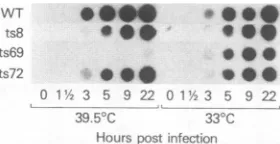
FIG. 1. Dot-blotanalysisofvirus-specific DNAaccumulationin
mutant-andwild-type-infectedcells.BSC40cellswereinfected with tsmutantsorthe wildtype(WT)and incubated at 33or39.5°C.At the indicated times the cells were scraped from the dishes and
disrupted byfreezingand thawing.Aportion ofeachsample was
loadedonto anitrocellulose filter,treated with NaOH to denature the DNA, and hybridized to a 32P-labeled recombinant vaccinia virus HindIII-D DNA fragment, as described in the text. An
autoradiogramis shown. ts69 isaDNA-minus mutant(13).
activities would be deficientinthesynthesisof viralDNA, I reexaminedthis question more quantitatively by following
theaccumulation ofviral-specificDNAsequencesin mutant-infected cells. Total cell lysates prepared at various times
after infection were hybridized to an excess of nick-translated vacciniavirus-specific probe by using a dot blot
filter hybridization technique (see above). Control
experi-ments indicatedthat the probe was in excess and that the hybridizationwasdue to the DNA and not to the RNA that
waspresentin thecelllysates (datanotshown).Thekinetics
ofaccumulation of virus-specific DNA sequences in ts8-, ts72-, andwild-type-infected cells are showninFig. 1. The
results obtained withaDNA-minusmutant(ts69)areshown
forcomparison. Althoughthepreviousobservation thatts8 andts72areable toreplicatetheir DNAatthenonpermissive temperaturewasconfirmed,therewas adelayinthe
appear-anceofviral-specificDNAsequencesaswellas areduction
in the final level that was achieved relative to that in wild-type-infectedcells.However,becausethesedifferences
were also seen toalesser extent in cells that wereinfected bythesemutantsat33°C,it isunlikelythat thispartialdeficit
in DNAreplicationis a majorfactor in the ts replicationof
these mutants. In earlier experiments in which pulses of [3H]thymidinewereemployed,DNAreplicationincells that
were infected withtsl3wasfound to be similar tothatseen
in ts8-and ts72-infected cells (datanotshown).
Protein synthesis in mutant-infected cells. Viral protein synthesisin vacciniavirus-infected cells takes placeintwo phases: an early phasethatoccursbefore the onset ofviral
DNAreplicationandalateorpostreplicative phase. Ifviral
DNA replication is prevented either by using drugs that
inhibitDNAsynthesisorby infectingcellswithmutantsthat
are unable to replicate viral DNA under nonpermissive conditions, only earlypolypeptides are made. Because the
three mutants in this complementation group were able to replicate viral DNA at the nonpermissive temperature, I
next asked if the switch from the early to late pattern of polypeptide synthesis occurred normallyinmutant-infected
cellsat39.50C. MonolayersofBSC40cellswerepulsedwith
[35S]methionineat varioustimes afterinfection with mutant
or wild-type virus, and the labeled polypeptides were
ana-lyzed by SDS-polyacrylamide gel electrophoresis, as
de-scribed above. Each mutant gave a distinct pattern of
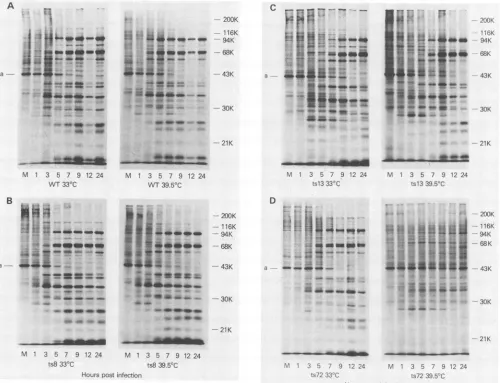
polypeptide synthesisat39.5°C (Fig. 2). Ints8-infected cells,
thepattern ofpolypeptide synthesiswasalmostidenticalto
that inwild-type-infected cells,althoughaslight delayinthe
appearance of the late polypeptides was noted when the
sampleslabeledat3hpostinfectionwerecompared. Incells
infected withtsl3at
39.5°C,
thedelay
in thesynthesisof latepolypeptides
was moredramatic; early polypeptides
ap-peared
asusual at1 h afterinfection,
but latepolypeptides
were not synthesized until 7 h postinfection. In
addition,
there was
prolonged
synthesis
ofhostpolypeptides.
How-ever, both these differences were noted in cells that wereinfected with tsl3 at 33°C as well. The greatest difference
fromthe
wild-type
patternofpolypeptide synthesis
wasseenin cells thatwereinfected with ts72at39.5°C. The
synthesis
of late
polypeptides
wasgreatly
reduced,
and hostpolypep-tide synthesis continued unabated for 24 h. At 33°C the
pattern of polypeptide synthesis was normal.
Thus,
ts72(and,
to a lesser extent,tsl3)
resembles the defective lateclass ofmutantdescribed
by
Condit andMotyczka
(8)
andby Lake and Cooper
(25).
Although the defective late mutantsdescribedby
Condit andMotyczka (8)
did shut off hostprotein synthesis, and ts72 did not, this difference may beareflection of thehigher multiplicityofinfection(20PFU percell) thatwas used in theirexperimentscompared with the 10PFU per cell used in myexperiments.
RNA synthesis by permeabilized virions in vitro. The fact that all three of the RNA
polymerase
mutantssynthesized
DNA atthe nonpermissive temperature suggests thatonce virions are assembled in cells that are infected at the
permissive temperature, the RNA polymerase activity is stabilized by association with other polymerase
subunits,
othervirionproteins, or DNA in the viruscoreand thus is able to function in the initiation ofsubsequent rounds of infectionat39.5°C. Totestthishypothesis directly, mutant and wild-type virions purified from cells infected at 33°C wereassayedfor theirabilityto synthesizeRNAinvitroat 33 and39.5°C. All threemutantsincorporated [3H]UMPinto macromolecular material equally well at 39.5°C relative to thatat33°C(Table1). However, tsl3 virionscontained
only
one-fourth of the RNApolymerase activitythatwasfound in the wild type. Todetermine if the reduced incorporationof radioactivity into RNAbytsl3 virionswasadirecteffect of the mutation in the RNA polymerase or a more
general
viriondefect,I assayed permeabilizedvirions fortwoother enzyme activities that are involved in the production of maturemRNA: mRNAmethyltransferase in an assay that is
dependent on transcription for the generation of the sub-strate (39) and poly(A) polymerase in an assay that is independent of transcription with poly(dA-dT) as primer
(30). Both of these activities were present in ts8 and ts72 virions in quantities that were similar to those present in wild-type virions (Table 1). In tsl3 virions, however, the methyltransferase activity was reduced, while the
poly(A)
polymeraseactivity was closer to the level observed inthe wild-type virions. SDS-polyacrylamide gel electrophoresis ofvirion polypeptides revealed that tsl3 virions contain an equivalent amount of thehigh-molecular-weight subunits of theRNA polymerase relative to that of the wild type (data
notshown). Because virions purified fromtsl3-infected cells
always had a three- to fivefold higher particle-to-PFU ratio
than the wild type, these results suggest that the
noninfec-tiousparticles containreduced or inactive RNA polymerase activity.
Biochemical characterization of theRNApolymerase activ-itysolubilized frommutantandwild-type virions. To investi-gate the biochemical properties of the RNApolymerase of
thesemutants, the enzyme activities were partially purified from disrupted virions following the initial steps of the
protocol described by Baroudy and Moss (2) (see above). The specificactivity of the partially purified RNA polymer-aseoftsl3 was only 16% of the wild type activity,whereas J. VIROL.
on November 10, 2019 by guest
http://jvi.asm.org/
[image:3.612.109.249.71.143.2]RNA POLYMERASE MUTANTS OF VACCINIA VIRUS
A
-
-;e
Ei
us-.g-a _$_ eee
^
-Ai?rr
m ^*_** ...
--
aat~.
_...
* N*._-;2=.As~~.ut
Ow
_ n _...s.
a -_ ....
---200K -116K
94K
-68K
-43K
-30K
ac-n--_-i~
aa_
X##_
--21K
M 1 3 5 7 9 12 24 WT33°C
M 1 3 5 7 9 12 24 WT39.5°C
M 1 3 5 7 912 24 ts1333C
M 1 3 5 7 9 12 24 ts1339.5°C
B .
eeA
At__
__ee2c|i
a- ~~e<
___Of
4 _ 4
4kWdp.s
w_____ _ _~~~~~~40f____ _
---200K
-- 116K
94K
68K
-43K
-- 30K
[image:4.612.61.561.75.458.2] [image:4.612.67.562.560.724.2]200K -116K
<4X| t
~~43K
3
-- 30K
- 21K
-. 21K M 1 3 5 7 9 12 24
ts833°C
M 1 3 5 7 9 12 24 ts839.50C
Hourspostinfection
M 1 3 5 7 9 12 24 ts72 33C
M 1 3 5 7 9 12 24
ts7239.5-C
HoLurspDOStInfetlion
FIG. 2. Protein synthesis intsmutant-andwild-type-infected cells. Cellswereinfectedwithtsmutantsorwild-type (WT) vacciniavirus
andpulsed for30minwith[35S]methionineattheindicated times. Labeled polypeptideswereelectrophoresedon 10o
SDS-polyacrylamide
gels (20 cm)asdescribedin thetext.Autoradiogramsareshown. M denotesalysatefrommock-infectedcells. The migrationofmolecular weight markersis indicatedonthe right, and the migration of cellularactinisindicated bytheaontheleft.
TABLE 1. Enzymeactivities inpermeabilizedmutantandwild-typevirions Activity
Strain
Assay
RNA polymerasemRNA
methyltransferase
Poly(A)
polymerase
temp(°C) [3H]UMP % of Hmethyl % of [3H]AMP % of
incorporation ncorporation incorporation % of
(pmolI3Omm) wildtype (po1Om) wildtype
(poIOm)wild
type(pmolV30min) (pmoV/30min) (pmol/30min)
Wild type 39.5 534 100 2.66 100 714 100
33 513 100 3.42 100 681 100
ts8 39.5 519 97 2.40 90 693 97
33 498 97 3.19 93 626 92
tsl3 39.5 130 24 1.23 46 495 69
33 142 28 1.23 36 450 66
ts72 39.5 434 81 2.22 83 541 76
33 440 86 2.81 82 521 77
200K 116K
94K
68K
* 43K
30K
21K
VOL. 61,1987 1845
__M
on November 10, 2019 by guest
http://jvi.asm.org/
TABLE 2. Enzyme activities solubilized frommutantand wild-type virions
Activity
RNA polymerasea mRNAmethyltransferaseb poly(A) polymeraseb
Strain [3H]UMP [3
H]methyl
[3HIAMPincorporation (pmol/30 %of
incorporation
w of incorporation %of minper mgofprotein) wildtype(pmol/30omin
wildtype o(pmol/30min wild typeWildtype 1.74 x 10⁵ 100 2.66 100 269 100
ts8 1.78x 10⁵ 100 2.83 110 249 93
tsl3 2.87 x 10⁴ 16 1.99 75 361 130
ts72 8.89 x 10⁴ 51 2.19 82 294 110
aSpecific activities of the partially purifiedRNApolymerase activitiesaregiven.
bEquivalentportionsof theflowthrough of the DEAE-Sepharosecolumnchromatographystepduringpurificationof the RNApolyrmerasefromvirionswere
assayed formRNAmethyltransferase and poly(A)polymeraseactivity,asdescribed in thetext.
the specific activities of the ts8 and ts72polymerases were 100 and51%of the wild type activity,respectively (Table 2). I also compared the levels ofthe solubilized mRNA
meth-yltransferase and poly(A) polymerase activities, which are presentintheflowthrough ofthe DEAE-Sepharose column
(2). Bothofthese activities were presentinall three mutants at levels approximating those in the wild type (Table 2). Thus, the reduction of the mRNAmethyltransferase activity that was seenwith permeabilizedtsl3 virions (Table 1) was
due to the dependence of the methyltransferase on the
activity of the RNA polymerase for the generation of its
substrate.
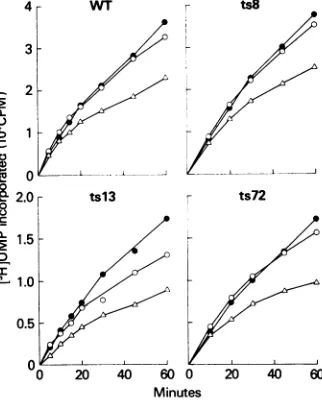
Inextexamined the kinetics ofincorporationof[3H]UMP into macromolecular material by thesolubilized mutant and
wild-type RNA polymerase activities at33, 39.5, and 42°C. Although the tsl3 activity displayed somewhat increased temperature sensitivity at both 39.5 and42°Crelative to that at 33°C (Fig. 3), neither the ts8 nor the ts72 activities were more ts thanthewildtype. However, if Ifirstpreincubated
thepolymerase activities at43°Cintheabsence ofDNAfor
various times before I assayed the residual activityat33°C,
3
a-WT ts8
2.0 tsl3 ts72
C
~1.5
1.0
0.5
0
0 20 40 60 0 20 40 60
Minutes
FIG. 3. Timecourseofincorporationof[3H]UMP bymutantand
wild-type (WT) RNA polymerase activities at33, 39.5, and42°C. Standardreaction mixtures containingeither 3.5,ug(wildtype,ts8,
andts72)or7.1,ug (tsl3) of partiallypurified RNA polymerasewere
incubatedat 33, 39.5, or42°C. Samples (75 p.l) were takenatthe
indicatedtimes and spottedontoDEAE-cellulosefilterpaperdisks.
Synpbols: 0, 33°C;0, 39.5°C; A,42°C.
the ts72 activity was markedly more thermolabile than the wild-typeactivity (Fig. 4A); the tsl3activitywassomewhat more thermolabile than that of the wildtype, while the ts8
activitywasinactivated at the same rate asthat of the wild type. Similar results were seen with several different poly-merasepreparations and whenonly a single ribonucleoside triphosphate was included in the preincubation mixture (data not shown). Increased thermolability was also observed when tsl3 and ts72 activities were preincubated in the absence of all four ribonucleoside triphosphates (Fig. 4B) and when all three mutant activities werepreincubated in the
absence of bothDNAandribonucleosidetriphosphates(Fig. 4C).
Evidence that ts72 containstwomutations within theRNA polymerase gene. Among the phenotypic characteristics of the mutants that have been examined sofar, the strongest biochemical indication that the RNA polymerase ofthese mutantsis altered is the increasedthermolabilityof the ts72
polymerase activity. I considered the possibility that the
thermolability of the ts72 polymerase activity could be the resultofasecondmutation that wasdistinct from that which is responsible for its ts replication in vivo. Therefore, I
examinedthethermolabilityofwild-typerecombinants from a marker rescue experiment performed with the smallest cloned fragment of wild-type DNA that rescued ts72: a
2.85-kilobase-pair (kbp) fragment that extends from the HindIII-J and -Hjunctiontothe first EcoRI site on HindIII-H (16). When the marker rescue was performed under selective conditions at39.5°C, Inoted thatalthoughmostof theplaquesonthe39.5°C plaqueassayplates were the same size as thewild-type plaques,7%ofthe plaquesweresmaller than thewild-type plaques. However, if the marker rescue was performed under nonselective conditions (33°C), 25 to
30% of the recombinants that were capable of forming plaquesat39.5°Cformed smallplaques. Therefore, Iplaque purified three large- and three small-plaque recombinants
from independent marker rescue experiments and partially
purified the RNA polymerase activity from purified virions asdescribedabove. Thepolymerase activities fromall three of thelarge-plaquerecombinantsregained the thermolability pattern of the wild-type activity, while those from the
small-plaque recombinantsretained the thermolability of the ts72activity. The datafor one large- and one small-plaque recombinant are shown in Fig. 5.
The most likely explanation for these results is that ts72 does infactcontain twomutations, both of which lie within the 2.85-kbp HindIII-EcoRI fragment that was used in the marker rescue experiment. Although the major transcript
encodedwithin the HindIII-H-EcoRI fragmentis the 1.35K subunit of the RNA polymerase, one additional early and J. VIROL. 1846 ENSINGER
l
on November 10, 2019 by guest
http://jvi.asm.org/
[image:5.612.101.262.459.659.2]RNA POLYMERASE MUTANTS OF VACCINIA VIRUS
C)
0
..>
C)
09
10 20 30 0 10 20 30 0 4 X
Minutesat430C Minutesat450C Minutesat40°C
FIG. 4. Thermal inactivation ofmutant and wild-type RNA polymerase activities. Partially purified RNA polymerase activities were incubated atthe indicated temperaturesin the standard RNApolymerase reaction mixture from whichDNA (A), all fourribonucleoside triphosphates (B), orb6th DNA and ribonucleosidetriphosphates (C) were omitted. Samples were withdrawn at the indicated times and assayedforresidual polymerase activity at 33°C, as described in the text. Symbols: A, wild-type; A, ts8; 0, tsl3; *, ts72.The protein concentrations during thepreincubationwere as follows (inmicrograms per milliliter): wild type, 11.3; ts8, 11.8;tsl3, 22.8; ts72, 21.8. twolate transcripts have been mapped near the EcoRI site
(5, 26, 27) (Fig. 6). To determine if both mutations lie within the geneforthe RNApolymerase subunit, I employed two
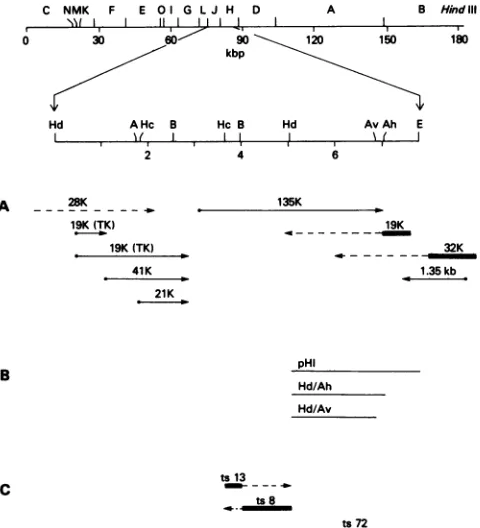
smaller subfragmentsofHindIII-H to rescue ts72: a 2,032-bp subfragment that extends from the HindIII-J and -H
restric-tion site to a unique AhallI site and a slightly smaller
fragment fromtheHindIllsite to anAvaIl site atnucleotide 1864(Fig.6). TheHindIII-H-AhaIII fragment containsall of thecodingsequence of the RNApolymerasesubunit that lies
withinHindIII-H and an additional 37 bp that includes 34 bp
ofcoding sequenceof a late19Kpolypeptide (5). TheAvaIl site is 131bp upstream ofthe polymerase subunit
termina-tion codon. Markerrescue wasperformedat33°C, and the
finalyield of viruswasassayed at 33 and39.5°C to determine
100
40
40-
~20-t810L
t a
6 4
2
0 10 20 30
Minutesat420C
FIG. 5. Thermal inactivation of ts72 and recombinant RNA polymerase activities. Recombinantsthatwereabletoformplaques
at 39.5°C were selected from marker rescue of ts72 with the wild-type 2.85-kbpHindIII-H-EcoRI DNAfragment (15).The par-tially purifiedRNApolymerase activities ofonesmall-plaque and
one large-plaque recombinant were preincubated at 42°C in the absence ofDNAas described inthe text. Symbols: A,wild type (11.9 ,ug/ml);
A,
large-plaque recombinant(8.8 ,ug/ml); *, ts72(15 ,ug/ml);0,small-plaque recombinant (16.4p.g/ml).
C NMK F E OI G LJ H D
N 11
0
0 30 60
A
90 120 150
kbp
B Hindill 180
Hd AHc B Hc B Hd Av Ah E L
2
A -- 28K
19K(TK)
4-19K(TK)
41K 21K
B
C
4 6
135K
19K
32K 1.35kb
I
pHI
Hd/Ah Hd/Av
ts 13 ts8
ts72
FIG. 6. Summary of restriction endonuclease sites, RNA tran-scripts, DNAfragments usedin marker rescue, andphysical map locations ofts mutants. Restriction endonuclease sites are takerl frompreviously publishedreports (1, 3, 5,26, 27, 34). Restriction endonucleasesareabbreviatedasfollows:A, AvaI;Ah,AhaIII; Av, AvaII, B, BglII; E, EcoRI; Hc, HincII; Hd, HindIII. (A) The positions ofRNAtranscripts are takenfrom previously published reports(1,5, 20,26, 27). Thedirectionoftranscriptionand sizeof thepolypeptide productareshown.TK denotes the mRNAforthe viral encodedthymidine kinase. Late mRNAsare diagrammedas
solid lines, representingthe minimum size requiredto encode the observedpolypeptide product,followedbyadashedlinetoindicate the extentof3'heterogeneity(27).(B) RecombinantDNAfragments used inmarkerrescueofts72(Table 3)areshown.(C)The limits of thephysicalmappositionsoftsmutationsareshown(16)(Table2).
VOL.61, 1987 1847
on November 10, 2019 by guest
http://jvi.asm.org/
[image:6.612.113.522.75.249.2] [image:6.612.317.557.324.588.2] [image:6.612.77.285.476.646.2]1848 ENSINGER
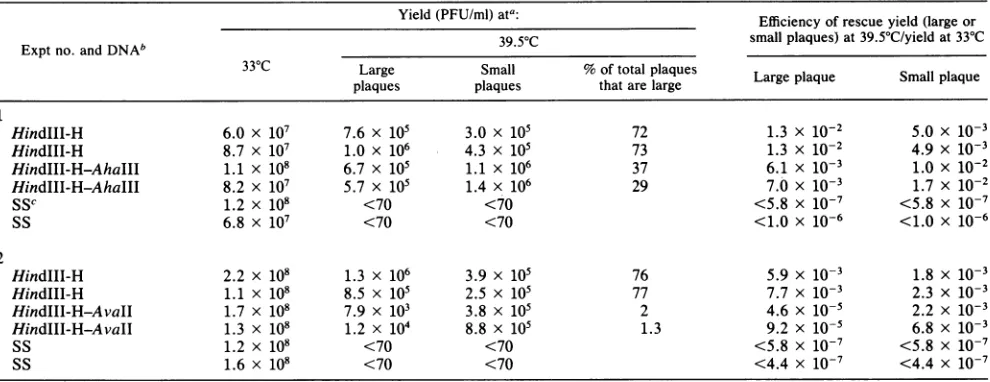
TABLE 3. Markerrescueofts72
Yield(PFU/ml) ata: Efficiency of rescue yield (largeor Exptno. andDNAb 39.5aC small plaques) at
39.5aC/yield
at33°C33C Large Small % of totalplaques
plaques plaques thatarelarge Largeplaque Smallplaque
HindIII-H 6.0 x 10⁷ 7.6 X 10⁵ 3.0x 10⁵ 72 1.3 x 10⁻² 5.0 x 10⁻³
HindIII-H 8.7 X 10⁷ 1.0 X 10⁶ 4.3 X 10⁵ 73 1.3 X 10⁻² 4.9 X 10⁻³
HindIII-H-AhaIII 1.1 X 10⁸ 6.7 X 10⁵ 1.1 X 10⁶ 37 6.1 X 10⁻³ 1.0 X 10⁻²
HindIII-H-AhaIII 8.2 X 10⁷ 5.7 X 10⁵ 1.4x 10⁶ 29 7.0 X 10- 1.7 X 10²
SSC 1.2 x 10⁸ <70 <70 <5.8 x
10-7
<5.8 x10⁻⁷
SS 6.8 x 10⁷ <70 <70 <1.0 X 10⁻⁶ <1.0 X 10⁻⁶
2
HindIII-H 2.2 x 10⁸ 1.3 x 10⁶ 3.9 x 10⁵ 76 5.9 X 10⁻³ 1.8X 10⁻³
HindIII-H 1.1 X 10⁸ 8.5 x 10⁵ 2.5 x 10⁵ 77 7.7 x 10⁻³ 2.3 x 10⁻³
HindIII-H-AvaII 1.7 x 10⁸ 7.9 x 10³ 3.8 X 10⁵ 2 4.6X 10⁻⁵ 2.2 X 10⁻³
HindIII-H-AvaII 1.3 X 10⁸ 1.2 x 10⁴ 8.8 x 10⁵ 1.3 9.2x 10⁻⁵ 6.8 x 10⁻³
SS 1.2 x 10⁸ <70 <70 <5.8 x 10⁻⁷ <5.8x 10⁻⁷
SS 1.6 x 10⁸ <70 <70 <4.4x 10⁻⁷ <4.4x 10⁻⁷
aMarkerrescue wasperformedas ayield experimentinwhichcellsinfected withts72 weretransfected withtheindicatedDNAsandincubatedat33°Cfor 72h.
bThe HindIII-H fragmentwascloned in pBR322 (3), andtheHindIII-H-AhaIII andHindIII-H-AvaIIfragmentswereisolatedbyagarosegelelectrophoresis
aftercleavage of the clonedHind-Hfragment withtheappropriateenzymes. 'SS, Salmonsperm DNA.
theproportionoflarge- andsmall-plaque recombinants. The
yield of small-plaque recombinants was similar whether the entireHindIII-Hfragment, theHindIII-H-AhaIIIfragment,
or the HindIII-H-AvaII fragment was used for marker rescue(Table 3). However,theyield of large-plaque recom-binants decreaseddramaticallywhen thesmaller DNA
frag-ments were employed: large-plaque recombinants repre-sentedover70% ofthe progeny thatwerecapableofforming plaquesat39.5°C when theHindIII-Hfragmentwasused but
only29to37%or1to2%when theHindIII-H-AhaIIIorthe
HindIII-H-AvaIIfragmentswereused,
respectively.
Never-theless, these results demonstrate that both mutations lie within the gene for the RNA polymerase subunit.
DISCUSSION
I mapped the ts mutations ofthree mutants of vaccinia virus to the gene that encodes one of the 135K subunits of thevirion-associatedDNA-dependentRNApolymerase (16)
(Table3andFig. 6).Therequirementfor this enzyme in the
initiationof
the
vaccinia virusreplicationcycle has led to thepredictionthattsmutantswithdefectsin the RNA polymer-ase wouldnot inducethesynthesis of early viral proteins or
replicateviral DNA at thenonpermissive temperature. How-ever, none ofthe mutants describedhere had the predicted phenotype: all three induced the synthesis of early viral proteins and replicated viral DNA (1) (Fig. 1 and 2).
Fur-thermore, the synthesis of RNA in vitro by permeabilized mutantvirions was not ts relative to the wild type (Table 1).
Only one mutant (tsl3) synthesized an RNA polymerase
activityat33°C that displayed altered biochemical properties in vitro that could be associated with its ts mutation. The partially purified
tsl3
activity had a reduced specific activity,increased temperature sensitivity at 39.5 and 42°C, and
increased thermolability under a variety of preincubation
conditions. Although the ts72 activity was also more
thermolabile than the wild-type activity, the thermolability
marker was distinct from the ts mutation (see below). The
lack of temperature sensitivity of the partially purified ts8 and ts72 activities could be explained if the ts defects of
these mutants affected only accurate initiation on double-stranded vaccinia virus DNA because thepartially purified
enzyme initiates randomly on single-stranded DNA tem-plates. However, the observation that early viral proteins and DNAaresynthesized in cells thatareinfectedbythese mutants at 39.5°C and that even late viral proteins are
synthesized in ts8-infected cells (and tsl3-infected cells)
demonstrates that the mutantRNApolymerases, oncethey
are formed at 33°C, are able to initiate
tanscription
accu-ratelyat 39.5°C.The most likelyexplanation for the results of thisstudyis that these mutants are defective in the assembly ofnewly synthesized polymerase subunits into active enzymeor the incorporation of RNA polymerase into maturing virions. Once assembledatthepermissivetemperature, the
activity
may be stabilized by the associatioti between different subunits or between the polymerase and other proteins or DNAwithin the virion. Inthe Escherichia coli system,the
majority oftsmutationsin the 3 and,' subunitsofthe RNA
polymerase (18) aswellas somemutations in the a subunit (21) result in defective subunitassembly,and thepolymerase activitiessynthesizedatthe permissivetemperatureare not more ts orthermolabilein vitrothan is thewild type. These resultspointoutthedifficulty inidentifyingthebiochemical defects ofmutants with ts lesions that affect polypeptides
thatfunctionaspartofamultisubunitcomplex,particularly
one as large and as complex as the vaccinia virus RNA
polymerase.
Duringthecourse of thisinvestigation, ts72 wasfoundto
containtwo(orpossiblymore)mutations within the gene for the RNApolymerase subunit. In markerrescueexperiments
withsubfragments of HindIII-H, two types of recombinants were observed: those that formed large plaques at 39.5°C and that contained an RNA polymerase with the
thermolabilitypatternof thewildtypeand those that formed smallplaquesat39.5°C and contained a polymerase with the
thermotability of ts72. In one-step growth experiments at
39.5°C, cells infected with the small-plaque recombinants produced approximately 30 to 50% as much virus as cells infected with the wild type or with large-plaque recombi-J. VIROL.
on November 10, 2019 by guest
http://jvi.asm.org/
RNA POLYMERASE MUTANTS OF VACCINIA VIRUS nants (data not shown). These results suggest that ts72
containstwo mutations, oneof which is primarily responsi-blefor its ts replication and the second of which is respon-sible for the increased thermolability of the RNA poly-merase. The small-plaque recombinants have acquired the wild-type allele at the ts locus, while the large-plaque recom-binants are wild type at both the ts and thermolability loci. I didnot attempt toisolate recombinants thatwere stilltsbut that had regained a thermostable polymerase activity. The greatly reduced proportion of large-plaque recombinants that were obtained in marker rescue experiments that em-ployed DNA fragments that were shortened near the 3' terminus of the mRNA (Table 3 and Fig. 6) suggests that the thermolability marker lies closer to the 3' end of the gene than does the temperature sensitivity marker. It should be noted that ts72 was isolated after mutagenesis with nitroso-guanidine, which commonly induces multiple, closely spaced mutations (19).
Thethree mutants in this complementatin group differ in their ability to induce the synthesis of late viral polypeptides atthenonpermissive temperature. Late proteins are synthe-sized, although with some delay, in cells infected with ts8 or
tsl3,while thesynthesis of late species is greatly reduced in
ts72-infected cells. At present it is not known whether late genes aretranscribed by the RNApolymerase ofthe infect-ing virion or by newly synthesized polymerase. Although
results ofearly studies on the induction of the RNA poly-merase indicated that it was a late function that appeared only after the onset of DNA replication, these studies were
performed before conditions had been established that
al-lowed the measurementofsoluble polymerase activity(23, 31, 33). Thus, it is most likely that in these studies the
particulate activity associated with maturing virions was measured. Because the mRNA for the 135K subunit is an
early transcriptand because ithas beensuggested that two
earlycorepolypeptidesare in fact thehigh-molecular-weight subunits of RNA polymerase, itis possible that there is a small amount of newlysynthesized RNApolymerase
activ-ity that is responsible for late transcription. If this is the case, the mutations in the ts8 and tsl3activities, but not in the ts72activity, wouldhave to allow sufficientpolymerase to assemble to carry out late transcription. Alternatively, if the polymerase of the infecting virions transcribes late genes, it is possible that the ts72 activity is either unable to
recognizelatepromoters or tointeract withputativeviral or
host transcriptional factors that allow discrimination be-tween early and late promoters. These three mutants may prove to be useful in deciphering the mechanism of the
switch fromearly to late
transcription.
ACKNOWLEDGMENTSIthank S.Broylesand B. MossforprovidingtheDNAfragments thatwereused in markerrescueandfor the sequenceinformation regarding this region of theDNAbeforepublication.Ialso thankB. Moss, R. Zandomeni, and K. Kahlili forhelpful discussions and MichaelRovinskyfor excellent technical assistance.
Thisstudywassupported in partbyPublicHealth Servicegrant AI-18365 from the National Institutes of Health.
LITERATURECITED
1. Bajszar,G.,R.Wittek, J.P.Weir,andB. Moss.1983.Vaccinia virus thymidine kinase and neighboring genes: mRNAs and polypeptidesofwild-typevirusandputativenonsensemutants.
J. Virol. 45:62-72.
2. Baroudy,B.M.,and B.Moss. 1980.Purificationand character-ization of DNA-dependent RNA polymerase from vaccinia virions. J. Biol.Chem.255:4372-4380.
3. Belie-Isle, H., S. Venkatesan, and B. Moss. 1981. Cell free translation ofearlyandlatemRNAsselected byhybridizationto clonedDNAfragments derived from the left 14 to 72 million daltons ofthevaccinia virusgenome.Virology 112:306-317. 4. Blatti, S. P., C. J. Ingles, T.J. Lindell, P. W. Morris, R.F.
Weaver, F. Weinberg, and W.J. Rutter. 1970. Structure and regulatory properties of eucaryotic RNA polymerase. Cold SpringHarborSymp. Quant. Biol.35:649-657.
5. Broyles, S. S., and B. Moss. 1986. Homology between RNA polymerasesofpoxviruses, prokaryotes, and eukaryotes:
nu-cleotidesequenceandtranscriptionalanalysis of vacciniagenes encoding147 KDaand22 KDasubunits. Proc. Natl. Acad. Sci. USA 83:3141-3145.
6. Cairns, J. 1960. The initiation of vaccinia infection. Virology 11:603-623.
7. Chernos, V. I., E. F. Belanov, and N. N. Vasilieva. 1978. Temperature-sensitive mutants of vaccinia virus. I. Isolation andpreliminarycharacterization. ActaVirol. 22:81-90. 8. Condit,R.C.,and A.Motyczka. 1981. Isolation andpreliminary
characterization oftemperature-sensitive mutants of vaccinia virus. Virology 113:224-241.
9. Condit, R. C., A. Motyczka, and G. Spizz. 1983. Isolation, characterization,andphysical mappingoftemperature-sensitive
mutantsof vaccinia virus. Virology 128:429-443.
10. Dales,S.,V.Milovanovitch,B. G. T.Pogo,S. B.Weintraub,T. Huima, S. Wilton, and G. McFadden. 1978. Biogenesis of vaccinia: isolation of conditional lethal mutants and electron microscopiccharacterization of theirphenotypicallyexpressed defects.Virology84:403-428.
11. Dales, S.,and B. T. G. Pogo. 1981. Biologyofpoxviruses. In D. W. Kingsbury and H. zur Hausen (ed.), Virology
mono-graphs, vol. 18. Springer-Verlag,NewYork.
12. Drillien, R., D.Spehner, and A. Kirn. 1982. Complementation and genetic linkage between vaccinia virus temperature-sensitivemutants. Virology119:372-381.
13. Ensinger,M.J. 1982. Isolationandgeneticcharacterizationof temperature-sensitive mutants of vaccinia virus. J. Virol. 43:778-790.
14. Ensinger,M. J.,S. A. Martin,E. Paoletti,and B. Moss. 1975. Modification ofthe5'-terminus ofmRNAbysoluble quanylyl-andmethyltransferases fromvacciniavirus. Proc. Natl. Acad. Sci. USA72:3385-3389.
15. Ensinger, M. J., and M. Rovinsky. 1983. Markerrescue ofts
mutations of vaccinia virusWR: correlation ofthegeneticand physicalmaps. J.Virol. 48:419-428.
16. Ensinger,M.J.,J. P.Weir, and B.Moss.1985. Fine structure
marker rescue oftemperature-sensitive mutations of vaccinia virus withinacentral conservedregionofthe genome. J. Virol. 56:1027-1029.
17. Gilead, Z., Y.-H. Jing, W. S. M. Wold, K. Sugawara, H. M. Rho,M. L.Harter,and M. Green.1976. Immunological identi-fication oftwo adenovirus 2-induced early proteins possibly involvedin celltransformation. Nature(London) 264:263-266. 18. Gross, G.C.,D. A.Fields,and E. K. F. Bautz. 1977. Temper-ature-sensitive mutantsof Escherichia coliwith defects inthe assembly of RNA polymerase in vitro. Eur. J. Biochem. 81:333-338.
19. Guerola, N., J. L. Ingraham, and E. Cerda-Olmedo. 1971. Induction ofcloselylinkedmultiplemutationsby
nitrosoguani-dine.Nature(London) NewBiol. 230:122-125.
20. Hruby,D.E., R.A.Maki, D. B. Miller, and L. A. Ball. 1983. Finestructureanalysisandnucleotidesequenceofthevaccinia virus thymidine kinase gene. Proc. Natl. Acad. Sci. USA 80:3411-3415.
21. Ishihama, A., M. Shimamoto, A. Hiroji, and K. Kawakami. 1980.Temperature-sensitive mutations in thea-subunitgene of EscherichiacoliRNApolymerase. J.Mol. Biol. 137:137-150. 22. Joklik, W. K. 1962. The preparation and characteristics of
highly purified radioactively labelled poxvirus. Biochim. Bio-phys.Acta61:290-301.
23. Kates,J.,R.Dahl,and M. Mielke.1968.
Synthesis
and intracel-lularlocationofvacciniavirusdeoxyribonucleic
acid-dependentribonucleic acidpolymerase.J. Virol. 2:894-900.
VOL.61,1987 1849
on November 10, 2019 by guest
http://jvi.asm.org/
1850 ENSINGER
24. Laemmli,U. K. 1970.Cleavage of structural proteins during the assembly ofthe head of bacteriophage T4. Nature (London) 227:680-685.
25. Lake, J. R., and P. D.Cooper. 1980. Synthesis of virus DNA and polypeptides bytemperature-sensitivemutantsofrabbitpox virus. J. Gen. Virol. 47:243-259.
26. Mahr, A., and B. Roberts. 1984. Organization of six early transcripts synthesized from a vaccinia virus EcoRI DNA fragment.J. Virol.49:497-509.
27. Mahr, A., and B. Roberts. 1984. Arrangement oflate RNAs transcribed from a 7.1-kilobase EcoRI vaccinia virus DNA fragment.J.Virol.49:510-520.
28. Morrison, D. K., J. K. Carter, and R. W. Moyer. 1985.Isolation andcharacterization ofmonoclonal antibodies directed against twosubunits of rabbit poxvirus-associated DNA-directedRNA polymerase.J. Virol.55:670-680.
29. Moss, B. 1985. Principles of virus regulation: poxviruses, p. 685-703. In B. N. Fields, R. Chanock, R. Shope, and B. Roizman (ed.), Human viral diseases. Raven Press, New York.
30. Moss, B., E.N. Rosenblum, and E. Paoletti. 1973. Polyadenylate polymerase from vaccinia virions. Nature(London)New Biol. 245:59-63.
31. Nagayama, A., B. G. T. Pogo, and S. Dales.1970.Biogenesisof vaccinia: separation of early stages from maturation by means ofrifampicin. Virology40:1039-1051.
32. Nevins, J. R., and W. K.Joklik. 1977. Isolation and properties of
the vaccinia virus DNA-dependentRNA polymerase. J. Biol. Chem. 252:6930-6938.
33. Pitkanen, A., B. McAuslan, J. Hedgpeth, and B. Woodson. 1968. Induction of poxvirus ribonucleic acid polymerases. J. Virol. 2:1363-1367.
34. Plucienniezak, A., E. Schroeder, G. Zettlmeissel, and R. E. Streek.1985.Nucleotidesequenceofacluster ofearly and late genes in a conserved segment of the vaccinia virus genome. Nucleic AcidsRes.13:986-998.
35. Rigby, P. W.J., M.Dieckman, C. Rhodes, and P. Berg. 1977. Labelingdeoxyribonucleic acidtohigh specificactivity in vitro by nick translation with DNA polymerase I. J. Mol. Biol. 113:237-251.
36. Spencer, E., S. Shuman,andJ. Hurwitz. 1980.Purification and properties of vacciniavirusDNA-dependentRNApolymerase. J. Biol. Chem. 255:5388-5395.
37. Sridhar,P., and R. C. Condit.1983. Selection for temperature-sensitive mutations in specific vaccinia virusgenes: isolation andcharacterization ofavirus mutantwhich encodesa phos-phonoacetic acid-resistant, temperature-sensitive DNA poly-merase.Virology 128:444 457.
38. Thomas, P. S.1980.Hybridization of denatured RNA andsmall DNAfragments transferredtonitrocellulose.Proc.Natl. Acad. Sci. USA77:5201-5205.
39. Wei, C. M., and B. Moss. 1974. Methylation of newly synthe-sized viral messenger RNA by an enzyme in vaccinia virus. Proc.Natl. Acad.Sci. USA71:3014-3018.
J. VIROL.