German Edition: DOI: 10.1002/ange.201906807
Homogeneous Catalysis
International Edition: DOI: 10.1002/anie.201906807Lithium-Aluminate-Catalyzed Hydrophosphination Applications
Victoria A. Pollard, Allan Young, Ross McLellan, Alan R. Kennedy, Tell Tuttle, and
Robert E. Mulvey*
Abstract:Synthesized, isolated, and characterized by X-ray crystallography and NMR spectroscopic studies, lithium phosphidoaluminate iBu3AlPPh2Li(THF)3has been tested as a catalyst for hydrophosphination of alkynes, alkenes, and carbodiimides. Based on the collective evidence of stoichio-metric reactions, NMR monitoring studies, kinetic analysis, and DFT calculations, a mechanism involving deprotonation, alkyne insertion, and protonolysis is proposed for the [iBu3AlHLi]2 aluminate catalyzed hydrophosphination of alkynes with diphenylphosphine. This study enhances further the development of transition-metal-free, atom-economical homogeneous catalysis using common sustainable main-group metals.
Introduction
Phosphines are utilized in a range of applications spanning agriculture, medicinal chemistry, and organocatalysis, while their ubiquity as ligands in transition metal catalysis is legend.[1] Hydrophosphination, adding a P@H bond across
an unsaturated C@E (E=C,N) bond, offers atom economy to preparing phosphines.[2] Many transition-metal based (for
example, on Fe, Ni, Pd, and Zr)[2b,c,3] and rare-earth-metal
based(for example, on La, Sm, and Yb)[3]catalysts have been
used for hydrophosphination, while solvent and catalyst-free hydrophosphinations can also be thermally induced under certain circumstances.[4]Developing catalysts based on
main-group metals is currently trending in homogeneous catalysis including hydrophosphination.[5] K, Ca, and Mg complexes
have been reported as hydrophosphination catalysts for alkene, alkyne, and carbodiimide substrates with diphenyl phosphine (HPPh2), forming alkyl phosphines, vinyl
phos-phines, and phosphaguanidines, respectively.[3a,b,6] Tin
com-plexes are also capable of catalyzing hydrophosphination reactions,[2c,7] though Cp*
2SnCl2 (Cp*=
pentamethylcyclo-pentadienyl) required an H2atmosphere to inhibit competing
phosphine dehydrocoupling of HPPh2.[7b,8] Attractive
indus-trially owing to its high natural abundance and low toxicity, aluminum is gaining prominence in this main group catalysis enlightenment.[9]Work by Roesky, Wright, Cowley/Thomas,
Harder, Stephan, and others, have successfully employed Al-based catalysts in hydroboration and hydrogenation.[10]Uhl
has also demonstrated that a P/Al geminal FLP can stoichio-metrically hydrophosphinate heteroatom substituted nitriles, generating imines incorporated into 5-atom AlCPCN hetero-cycles.[11]Examples also exist of Al-catalyzed
hydrophospho-nylation (using PVreagents).[12]However, to our knowledge
no examples exist of Al-catalyzed hydrophosphination (using PIIIreagents) of alkynes, alkenes, or carbodiimides.
Bimetallic ate complexes, which can synergistically en-hance stoichiometric reactivities over their neutral monome-tallic components, are a core theme of our research.[13]
Recently expanding this work into the catalytic regime, we used lithium aluminates as catalysts for hydroboration of aldehydes, ketones, imines and acetylenes.[14]In general, the
charged bimetallic species proved more active catalysts than their neutral monometallic components.[14b]Herein, we probe
the ability of our most active lithium aluminate, [iBu3AlHLi]2,
1, as a catalyst for hydrophosphination of alkynes, alkenes, and carbodiimides.
Results and Discussion
First, we reacted phenylacetylene with HPPh2 and
10 mol% of dimeric [iBu3AlHLi]2 in C6D6 at 7088C. This
reaction gave a very low 5% conversion after 20 h and it was proposed a higher boiling point solvent would be required to allow the catalysis to proceed. Moving to [D8]toluene at
11088C yielded 72% conversion (1:8 E/Z ratio; Figure 1) within 20 h, to the anti-Markovnikov product consistent with
anti addition of H@P across the C/C bond. Changing the solvent to polar [D8]THF (6588C) lowered theE/Zselectivity
to 1:3. We propose that in [D8]THF solution the resulting
lithium aluminum phosphide (see below) exists in an equi-librium, as observed by the presence of three separate distinct signals for the iso-butyl ligands in the 1H NMR spectrum.
Using CD2Cl2(4088C) poisoned the catalyst giving no product.
Satisfied this system is a capable hydrophosphination catalyst, a range of alkynes were screened (Table 1). Internal alkynes, diphenylacetylene, and 1-phenyl-1-propyne reacted faster than terminal alkynes. However, more challenging unactivat-ed alkynes, 1-hexyne, and 3-hexyne did not react, in common with other reports of main-group-catalyzed hydrophosphina-tion.[7b]
To gain more insight, a 1:1:3 stoichiometric reaction between [iBu3AlHLi]2, HPPh2, and THF, completely
con-[*] Dr. V. A. Pollard, A. Young, Dr. R. McLellan, Dr. A. R. Kennedy, Prof. T. Tuttle, Prof. R. E. Mulvey
WestCHEM, Department of Pure and Applied Chemistry University of Strathclyde, Glasgow, G1 1XL (UK) E-mail: [email protected]
Supporting information and the ORCID identification number(s) for the author(s) of this article can be found under:
https://doi.org/10.1002/anie.201906807.
sumed the aluminate, giving a solution that deposited crystals of the lithium aluminum phosphide, iBu3AlPPh2Li(THF)3(2;
41% yield of isolated product; Figure 1a). Phosphidoalumi-nate 2 results from deprotonation of HPPh2 by 1, and
importantly, implies this process is the first step in catalytic hydrophosphination. Crystalline2(Figure 1b) is monomeric, with three THF molecules solvating Li. 1H DOSY NMR
studies confirm it remains monomeric in [D8]toluene
solu-tion.[15]Alternatively,2can be made by co-complexing LiPPh 2
with iBu3Al/THF.
Aware that dehydrocoupling can compete with hydro-phosphination, a control reaction between HPPh2 and
10 mol% of 2in [D8]toluene was heated at 11088C for 20 h.
Less than 15% of HPPh2had undergone dehydrocoupling to
form 1,1,2,2-tetraphenyl diphosphine (determined by
31P NMR spectra), signifying that this is unlikely to be
a significant problem in this system. Subsequently 2 was tested as a catalyst for the hydrophosphination of alkynes under the previously optimized conditions (10 mol% [Al], [D8]toluene, 11088C; Table 1). For phenylacetylene, a 95%
conversion (1:3E/Zratio) of the anti-Markovnikov product was obtained after 20 h (compare 72% using1), albeit with reduced E/Z stereoselectivity. By contrast, WatermanQs tin catalyst Cp*2SnCl2 is poorly active for PhC/CH (10 mol%
catalyst, 18 h, 6588C, 4% yield).[7b]Using2,
hydrophosphina-tion is much faster with internal alkynes than terminal alkynes, with a 99% yield (10:1E/Zratio) for diphenylace-tylene being obtained within just 1 h (1takes 5 h). Similarly, 1-phenyl-1-propyne fully converts into the anti-Markonikov vinyl phosphine product within 1 h. The catalytic activity of2
with PhC/CPh compares favorably with theb-diketiminato calcium amide catalystDIPPNacNacCa(HMDS)(THF), which
required extended reaction times (10 mol% catalyst, 7588C, 13 h, 94% yield).[6c] However, [Ca(PPh
2)2(THF)4]
catalyti-cally hydrophosphinated diphenylacetylene after 2 h at room temperature.[6e] Cui used an imino-amidinate ligated Ca
catalyst for quantitative hydrophosphination of 1-phenyl-1-propyne after 5 h at 6088C, using 5 mol% [Ca].[3a]
Adding a catalytic amount (30 mol%) of THF to 10 mol% of1resulted in hydrophosphination of diphenyla-cetylene within the same time as that using pre-formed 2, suggesting that deaggregation of dimeric 1 by THF is advantageous in catalysis. Again, attempted catalysis with unactivated 1-hexyne or 3-hexyne and HPPh2 by 2proved
[image:2.595.49.552.60.176.2]unsuccessful. Deaggregation aside, the coordination shell surrounding a metal cation can play a key role in modulating the Lewis acidity of the metal, thereby providing a potential route to modify reactivity. Thus, we explored the effect of the Lewis donor on hydrophosphination of PhC/CPh (Table 2). A range of Lewis donor additives were added to the hydrophosphination reactions of diphenylacetylene catalyzed by1. Adding either two equiv (with respect to the catalyst) of
Figure 1. a)Synthesis of iBu3AlPPh2Li(THF)3,2;b)Molecular structure of2, H atoms and disordered THF molecules omitted for clarity, thermal ellipsoids drawn at 40% probability;c)Depiction ofE-,Z-stereoisomers anda-regioisomers arising from hydrophosphination of alkyne substrates.
Table 1:Hydrophosphination of alkynes, alkenes, and carbodiimides using1–6as catalysts.[a]
Alkynes[b]
a) b) c)
Catalyst; yield,E/Z/a-isomer ratio, time
172%, 1:8:0, 20 h
295% (78%), 1:3:0, 20 h
386%, 1:3:0, 20 h
472%, 1:8:8, 20 h
562%, 1:12:4, 20 h
662%, 1:12:4, 20 h
198%, 10:1, 5 h
299% (80%), 10:1, 1 h
398%, 10:3, 3 h
199%, 1:1:0, 6 h
299% (79%), 1:1:0, 1 h
395%, 1:3:0, 10 h
Alkenes[b]
d) e) f)
189%,6 h
284% (60%), 6 h
372%, 6 h
284%, 20 h 286%, 18 h
g) h)
287%, 20 h 293%, 4 h Carbodiimides[c]
i) j)
[image:2.595.50.289.254.575.2]bidentate donor TMEDA (N,N,N’,N’-tetramethylethylenedi-amine) or one equiv of 12-crown-4 result in quantitative conversions in 1 h, the same time as when 3 equiv of THF are used. The molecular structure of the organometallic com-pound in the presence of polydentate 12-crown-4 was determined via X-ray crystallography as the contact ion pair structure, iBu3AlPPh2Li(12-crown-4), with the phosphorus
atom bridging the Al and Li centers (Supporting Informa-tion). Unfortunately, owing to poor-quality data no geometric parameters can be discussed, however the structure provides unequivocal proof of atomic connectivity. The use of isolated iBu3AlHLi(PMDETA) also results in quantitative product
formation within 1 h (tridentate PMDETA=N,N,N’,N’’N ’’-pentamethyldiethylenetriamine). This complex was crystallo-graphically characterized (Figure 2), but all organic ligands exhibit significant disorder which precludes a discussion of geometric parameters beyond atomic connectivity.
Interestingly, the E/Z-isomer ratio is dependent on the donor used. PMDETA and 12-crown-4 are less selective (E/Z
2:1; and 5:1 respectively, versus 10:1 with 3 THF), whereas 2 TMEDA donors result in enhancedE/Z-selectivity of 19:1. Adding one equiv of bulky tetradentate Me6-TREN, takes 3 h
for quantitative conversion (E/Z10:1). Adding two equiv of bidentate dppe (diphenylphosphinoethane) results in con-version in 5 h, albeit with good E/Z selectivity (16:1). Interestingly it appears that when two bidentate donors are added, TMEDA or dppe, marked improvements in selectivity occur. Finally, adding three equiv of PPh3 to preformed 2
results in both slower catalysis (1.5 h) and poorer selectivity (E/Z 4:1) than those observed with the THF variant, indicating the phosphine Lewis donor may inhibit the hydro-phosphination process.
Next, the more challenging hydrophosphination of al-kenes was examined using 2 (Table 1). Styrene undergoes hydrophosphination in 6 h, at 11088C, yielding 84% of the anti-Markovnikov product. Halo-substituted styrenes are also tolerated (Table 1, entries e,f). 4-Vinyl anisole undergoes hydrophosphination to the alkyl phosphine product in 87% yield after 20 h at 11088C. Bulkier substrates such asa-methyl styrene,trans-b-methyl styrene, and the less activated alkene 1-hexene did not undergo hydrophosphination with2as the catalyst. Similar failures with both Ca and Sn based catalysts have been noted for these substrates.[6c,7b]
Hydrophosphina-tion of vinyl boronic acid pinacol ester (vinyl Bpin) achieved a 93% yield after 4 h at 11088C, producing linear phosphine boronic ester Ph2P(CH2)2Bpin. To our knowledge this is the
first time Ph2P(CH2)2Bpin has been made by a
hydrophosphi-nation route, since earlier published methods required hydro-boration of diphenyl vinyl phosphine.[16]
Phosphidoaluminate2is also an able catalyst for hydro-phosphination of carbodiimides at room temperature. Thus, using 5 mol% catalyst loading (Table 1, entries i–j), diisopro-pylcarbodiimide is converted fully into the phosphaguanidine product within 15 min, while bulkier dicyclohexylcarbodii-mide required 20 h to achieve 86% conversion. Hill reports quantitative yields for diisopropyl and dicyclohexyl carbodii-mides within 1 h and 4 h, respectively, using 2 mol% Ca-(HMDS)2as catalyst, also at room temperature. Significantly
longer reaction times were seen when usingDIPP
NacNacCa-(HMDS)(THF) as a catalyst (1.5 mol%; iPr, 6 h, 99%: Cy, 28 h, 85%).[6d]KHMDS is also found to be a good catalyst for
carbodiimides requiring low catalyst loadings and short reaction times,[6a]while a sodium magnesiate also catalyzes
hydrophosphination of carbodiimides.[6f]
Attempting to pinpoint the active catalyst, four com-pounds, LiPPh2(3), iBu3Al (4), iBu2AlH (5), and iBu2AlPPh2
(6),[17]were screened for catalytic viability using PhC/CH as
a model substrate (Table 1). Using LiPPh2as a catalyst yields
86% conversion to the vinyl phosphine after 20 h, with anti-Markovnikov regioselectivity, similar to that of2. Compounds
4–6afford different product regio- and stereoselectivities as well as lower yields for PhC/CH hydrophosphination. Interestingly when4is used as catalyst (72%; 1:8:8E/Z/a) the major isomer products are the Z-anti-Markovnikov isomer, and equally the Markovnikov (a-isomer; Ph-(Ph2P)C=CH2). In contrast,2does not give any appreciable
a-isomer, suggesting2is not disproportionating in solution at high temperature into LiPPh2 and iBu3Al. To ascertain
whether LiPPh2 is implicated in the catalytic profile, we
[image:3.595.52.291.80.220.2]conducted another stoichiometric reaction (Supporting In-formation). Monitoring the reaction of 2 and PhC/CPh in
Table 2: Effect of Lewis donor upon hydrophosphination catalysis of diphenylacetylene.[a]
Lewis donor additive Time [h] Yield [%] E:Zratio none [iBu3AlHLi]2,1 5 98 10:1
1+3 equiv THF 1 99 10:1
iBu3AlHLi(PMDETA) 1 99 2:1
1+1 equiv 12-crown-4 1 99 5:1
1+2 equiv TMEDA 1 99 19:1
1+1 equiv Me6-TREN 3 95 10:1
1+2 equiv dppe 5 95 16:1 iBu3AlPPh2Li(THF)3 1 99 10:1
2+3 equiv PPh3 1.5 99 4:1 [a] General conditions: 0.6 mmol substrate, 0.5 mmol HPPh2, [D8]toluene, 10 mol% [Al] catalyst, 11088C. Conversions based against 1H NMR internal standard hexamethylcyclotrisiloxane.E/Z/a stereose-lectivity based on31P NMR spectra.
[image:3.595.73.271.556.699.2][D8]toluene by31P NMR shows that after 2 h at 11088C full
consumption of2occurs with concomitant growth of two new signals at d=3.4 and @16.5 ppm. Unable to isolate these species despite several attempts, we tentatively assign them as two isomers resulting from insertion of diphenylacetylene into2. Subsequent addition of HPPh2and further heating at
11088C allows for product formation (d=8.9 ppm (E-isomer) and [email protected] ppm (Z-isomer)) and regeneration of 2 (d=
@49.3 ppm). We rationalize the intermediate (at d=
3.4 ppm) reacts onwards to form theE-stereoisomer as it is consumed faster than the other intermediate. Significantly, there are no resonances corresponding to LiPPh2 in the
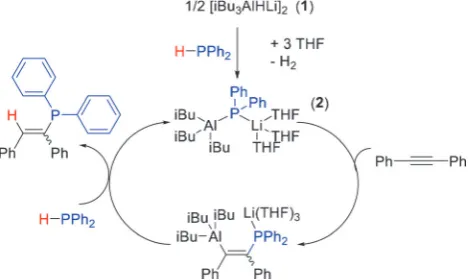
spectrum (d=@52 ppm) further reinforcing the view that2is the catalytically active species. We propose a catalytic cycle (Scheme 1) that begins by deprotonation of HPPh2 by
[iBu3AlHLi]2, releasing H2and forming compound2. Next,
a substrate molecule inserts into the Al@P bond. Subsequent protonolysis by a second equiv of HPPh2 accesses the
hydrophosphinated product whilst regenerating the active catalytic species2.
Since after the facile room temperature deprotonation step, alkyne insertion and protonolysis are the other key steps, we performed a deuterium labeling study to investigate the cycle further. Catalytic hydrophosphination between PhC/
CPh and DPPh2favored formation of theE-stereoisomer and
deuterium was incorporated into the vinyl phosphine product, Ph(Ph2P)C=C(D)Ph, as confirmed by2H NMR spectra and
GC-MS (Supporting Information). Also, in a stoichiometric reaction between [iBu3AlHLi]2and DPPh2, HD was detected
in the 1H NMR spectrum (triplet at d=4.45 ppm, 1J=
42.8 Hz), confirming the initial deprotonation step.
A kinetic isotope effect experiment (KIE) was conducted for the hydrophosphination of diphenylacetylene by record-ing the reaction profile in duplicate for HPPh2and DPPh2at
10088C, in [D8]toluene, with 10 mol% of2. By monitoring the
consumption rate of phosphine by 31P NMR, rates were
obtained, and in each case the overall reaction rate is pseudo first order. From these rates a KIE of 1.38:0.13 was determined (Supporting Information). This is a small value, compared with previous reports, and suggests that cleavage of the P@H bond is only involved to a minor extent in the rate determining step.[7b]This also indicates that alkyne insertion
into2is rate-determining, which given the rather congested structure of2and bulky nature of the alkyne is unsurprising. Next, we conducted a kinetic analysis of the reaction using the variable time normalization analysis (VTNA) method reported by Bur8s, allowing us to obtain valuable mechanistic detail under synthetically relevant conditions to three half-lives (Figure 3 and the Supporting Information).[18] The
reaction order with respect to [catalyst] was determined by conducting reactions using different catalyst concentrations, while keeping [alkyne] and [phosphine] constant. These data showed the reaction rate increases with increasing [catalyst], and that the order in catalyst is one. This situation is consistent with the reaction proceeding via a monomeric rate determining step during the reaction. Variation of [phos-phine] under synthetically relevant conditions revealed that increasing concentration of phosphine inhibits the reaction, giving a phosphine order of@1. This inhibition likely results from pre-coordination of the phosphine, blocking off the alkyne for insertion. Also, we have already established that bulky mono- and bidentate phosphines slow down reactivity in our Lewis donor study (see above). Lastly, variation of [alkyne] revealed a first order dependence in [alkyne], indicating that the alkyne is involved in the rate-limiting step. Finally, to reinforce our experimental insight, we turned to DFT calculations. Run on the full system with the internal
[image:4.595.55.291.307.447.2]Scheme 1.Proposed reaction mechanism for hydrophosphination of diphenylacetylene by pre-catalyst1, showing formation of active species2.
alkyne, diphenylacetylene, used as the model substrate, the calculations were performed at the B3LYP-D3/[19]
6-311G-(d,p)[20]level of theory employing a continuum solvent with
the dielectric constant of toluene within the IEFPCM model.[21]The relative stability of the formation of 2 from
[iBu3AlHLi]2with 2 HPPh2and 6 THF molecules was initially
investigated. Formation of the catalyst (2) is thermodynami-cally favorable despite the entropic penalty associated with THF coordination, with a [email protected] kcalmol@1
([email protected] kcalmol@1). The activation barrier for the
formation of the catalyst was challenging to isolate as a result of the complex potential energy surface associated with the large dimer species. However, a bond scan along the coordinate associated with the formation of H2provided an
indicative barrier (DE*) of about 38 kcalmol@1, which would
be achievable under the reaction conditions and lead irreversibly to2given the exothermic nature of this step. In contrast to the induction step, the first step in the catalytic cycle (adding diphenylacetylene to2) is mildly endergonic for both the E and Z isomers of the intermediate shown in Scheme 1. However, the E isomer is more stable in the intermediate state of the reaction (DG=6.9 kcalmol@1), with
theZ-isomer (DG=8.3 kcalmol@1) being further destabilized
by 1.4 kcalmol@1relative to theE-isomer. Finally, generation
of the product and reformation of the catalytic species occurs in an exergonic reaction. In this step, the formation of theZ -isomer ([email protected] kcalmol@1) is favored over theE-isomer
([email protected] kcalmol@1). The reversal of the relative
stabil-ities of the isomers in the intermediate state versus the product state suggests that the formation of the intermediate is deterministic for the final product distribution, which favors the experimentally determined E-isomer. The rate-limiting step for the reaction could not be located as the calculation of transition states proved elusive for these bulky compounds. However, the relative stabilities of the intermediates and products determined for this pathway indicate that the mechanism proposed is achievable under the reaction con-ditions employed.
Conclusion
Previously lithium aluminates have been shown to be active catalysts for hydroboration of aldehydes, ketones, imines, and acetylenes. This new study extends the catalytic chemistry of these bimetallic main-group compounds by reporting the first example of Al-catalyzed hydrophosphina-tion of alkynes, alkenes, and carbodiimides, using the lithium aluminate (pre)catalyst [iBu3AlHLi]2. A mechanism is
pro-posed for the alkyne catalysis, elucidated by stoichiometric reactions, thought to proceed via formation of the crystallo-graphically defined lithium aluminum phosphide, iBu3AlPPh2Li(THF)3(2), followed by insertion of the alkyne
into the Al@P bond, then protonolysis of a second equiv of the phosphine to generate the vinylphosphine product and regenerate the catalyst. While intuitively the formation of an anionic aluminum center saturated by four anionic ligands as in an aluminate might be expected to have insufficient Lewis acidity to engage in hydrophosphination processes, it is
clear from the different results obtained using a number of Lewis donor solvent molecules that the presence of the lithium helps to circumvent this apparent handicap so pointing to bimetallic synergistic behavior.
Experimental Section
Full experimental characterization and synthetic procedures are described in the Supporting Information.
Synthesis of iBu3AlPPh2Li(THF)3 (2): Method (a): HPPh2
(0.34 mL; 2 mmol) was added to a stirred solution of [iBu3AlHLi]2
(0.412 g; 1 mmol) in hexane (10 mL) and the reaction stirred 1 h. THF (0.5 mL; 6 mmol) was added and then the volatiles were removed. The residue was taken up in hexane (5 mL) and toluene (1 mL). Subsequent cooling to@3088C yielded the desired product as pale-yellow crystals. Crystalline yield 0.494 g; 0.82 mmol; 41%. Meth-od(b): nBuLi (0.63 mL; 1.6m/hexane; 1 mmol) was added dropwise to a stirred solution of HPPh2(0.17 mL; 1 mmol) in hexane (5 mL)
and the resulting bright yellow suspension stirred for 1 h. Addition of iBu3Al (1 mL; 1m/hexane; 1 mmol) generated a clear pale-yellow
solution, which was stirred for 1 h. THF (0.3 mL; 3 mmol) was added and the pale-yellow solution cooled at@3088C overnight. Crystalline yield 0.150 g; 0.25 mmol; 24%.1H NMR (400.1 MHz, [D
8]toluene,
300 K):d=0.48 (d of d,J=6.93 Hz, 2.88 Hz, 6H, iBu CH2); 1.31 (d,
J=6.29 Hz, 18H, iBu CH3); 1.41 (m, 12H, THF CH2); 2.26 (m, 3H,
iBu CH); 3.44 (m, 12H, THF CH2); 7.00 (m, 2H (overlapping
solvent), Ph); 7.17 (m, 4H (overlapping solvent), Ph); 7.14 (m, 4H, Ph) ppm.31P NMR (104.2 MHz, [D
8]toluene, 300 K):[email protected] ppm. 13C{1H} NMR (151 MHz, [D
8]toluene, 300 K):d=25.4 (THF CH2);
25.5+25.6 (iBu CH2); 28.3 (iBu CH); 29.5 (iBu CH3); 68.6 (THF
CH2); 124.9 (Ar C@H); 127.3 (d,J=6.17 Hz, Ar C@H); 134.0 (d,J=
13.04 Hz, Ar C@H); 144.1 (d,J=13.08 Hz,ipsoAr) ppm.7Li NMR
(155.5 MHz, [D8]toluene, 300 K): d=0.21 (s) ppm. 27Al NMR: no
signal was observed.
General catalytic reaction: The desired catalyst loading was added to 0.5 mL of [D8]toluene solution (unless alternative solvent
specified) containing the substrate precursor (0.6 mmol) and HPPh2
(0.5 mmol, 0.09 mL). The reaction mixture was transferred to a sealed J. YoungQs tap NMR tube and the reaction was regularly monitored by
1H and31P NMR spectroscopy until the formation of the products was
completed as determined by integration versus an internal capillary standard (hexamethylcyclotrisiloxane). For alkynes and alkenes, the hydrophosphination catalysis was performed at 11088C with 10 mol% [Al] catalyst loading. For carbodiimides the hydrophosphination catalysis was performed at room temperature with 5 mol% [Al] catalyst loading. The yields reported are based on1H NMR and31P
relative to the internal standard. In all cases, the bulk of the NMR solution can be attributed to either product compounds or starting materials. Yields of isolated product are provided for example substrates, isolated via either recrystallization methods or column chromatography, as reported in the Supporting Information.
Acknowledgements
Conflict of interest
The authors declare no conflict of interest.
Keywords: aluminate · homogeneous catalysis · hydrophosphination · lithium · phosphines
How to cite:Angew. Chem. Int. Ed.2019,58, 12291–12296
Angew. Chem.2019,131, 12419–12424
[1] K. B. Dillon, F. Mathey, J. F. Nixon,Phosphorus: The carbon copy, Wiley, Chichester,1998.
[2] a) D. S. Glueck, in C-X Bond Formation (Ed.: A. Vigalok), Springer, Berlin, Heidelberg,2010, pp. 65 – 100; b) V. Koshti, S. Gaikwad, S. H. Chikkali,Coord. Chem. Rev.2014,265, 52 – 73; c) C. A. Bange, R. Waterman,Chem. Eur. J.2016,22, 12598 – 12605.
[3] a) H. Hu, C. Cui,Organometallics2012,31, 1208 – 1211; b) B. Liu, T. Roisnel, J.-F. Carpentier, Y. Sarazin,Chem. Eur. J.2013,
19, 13445 – 13462; c) M. R. Douglass, T. J. Marks,J. Am. Chem. Soc.2000,122, 1824 – 1825.
[4] Y. Moglie, M. J. Gonz#lez-Soria, I. Mart&n-Garc&a, G. Radivoy, F. Alonso,Green Chem.2016,18, 4896 – 4907.
[5] a) P. P. Power,Nature 2010,463, 171 – 177; b) M. S. Hill, D. J. Liptrot, C. Weetman,Chem. Soc. Rev.2016,45, 972 – 988. [6] a) W.-X. Zhang, M. Nishiura, Z. Hou,Chem. Commun.2006,
3812 – 3814; b) N. T. Coles, M. F. Mahon, R. L. Webster,Chem. Commun.2018,54, 10443 – 10446; c) M. R. Crimmin, A. G. M. Barrett, M. S. Hill, P. B. Hitchcock, P. A. Procopiou, Organo-metallics 2007, 26, 2953 – 2956; d) M. R. Crimmin, A. G. M. Barrett, M. S. Hill, P. B. Hitchcock, P. A. Procopiou, Organo-metallics2008,27, 497 – 499; e) T. M. A. Al-Shboul, H. Gçrls, M. Westerhausen,Inorg. Chem. Commun. 2008, 11, 1419 – 1421; f) M. De Tullio, A. Hern#n-Glmez, Z. Livingstone, W. Clegg, A. R. Kennedy, R. W. Harrington, A. AntiÇolo, A. Mart&nez, F. Carrillo-Hermosilla, E. Hevia,Chem. Eur. J.2016,22, 17646 – 17656; g) J. Pahl, T. E. Stennett, M. Volland, D. M. Guldi, S. Harder,Chem. Eur. J.2019,25, 2025 – 2034.
[7] a) K. A. Erickson, L. S. H. Dixon, D. S. Wright, R. Waterman,
Inorg. Chim. Acta 2014, 422, 141 – 145; b) J. P. W. Stelmach, C. A. Bange, R. Waterman,Dalton Trans.2016,45, 6204 – 6209. [8] R. L. Melen,Chem. Soc. Rev.2016,45, 775 – 788.
[9] a) W. Li, X. Ma, M. G. Walawalkar, Z. Yang, H. W. Roesky,
Coord. Chem. Rev.2017, 350, 14 – 29; b) G. I. Nikonov, ACS Catal. 2017, 7, 7257 – 7266; c) S. Dagorne, R. Wehmschulte,
ChemCatChem2018,10, 2509 – 2520; d) C. Weetman, S. Inoue,
ChemCatChem2018,10, 4213 – 4228.
[10] a) Z. Yang, M. Zhong, X. Ma, S. De, C. Anusha, P. Para-meswaran, H. W. Roesky, Angew. Chem. Int. Ed. 2015, 54, 10225 – 10229; Angew. Chem. 2015, 127, 10363 – 10367; b) Z. Yang, M. Zhong, X. Ma, K. Nijesh, S. De, P. Parameswaran, H. W. Roesky,J. Am. Chem. Soc.2016,138, 2548 – 2551; c) R. J. Less, H. R. Simmonds, D. S. Wright, Dalton Trans. 2014, 43,
5785 – 5792; d) A. Bismuto, M. J. Cowley, S. P. Thomas, ACS Catal.2018, 8, 2001 – 2005; e) A. Bismuto, S. P. Thomas, M. J. Cowley,Angew. Chem. Int. Ed.2016,55, 15356 – 15359;Angew. Chem. 2016, 128, 15582 – 15585; f) H. Elsen, C. F-rber, G. Ballmann, S. Harder, Angew. Chem. Int. Ed.2018,57, 7156 – 7160;Angew. Chem. 2018, 130, 7274 – 7278; g) J. A. Hatnean, J. W. Thomson, P. A. Chase, D. W. Stephan,Chem. Commun.
2014,50, 301 – 303.
[11] L. Keweloh, N. Aders, A. Hepp, D. Pleschka, E.-U. Wgrthwein, W. Uhl,Dalton Trans.2018,47, 8402 – 8417.
[12] a) P. Merino, E. Marqu8s-Llpez, R. P. Herrera, Adv. Synth. Catal.2008,350, 1195 – 1208; b) S. M. H-rling, B. E. Fener, S. Krieck, H. Gçrls, M. Westerhausen,Organometallics2018,37, 4380 – 4386.
[13] a) R. E. Mulvey, S. D. Robertson,Top. Organomet. Chem.2013,
47, 129 – 158; b) S. D. Robertson, M. Uzelac, R. E. Mulvey,
Chem. Rev.2019, DOI 10.1021/acs.chemrev9b00047.
[14] a) L. E. Lemmerz, R. McLellan, N. R. Judge, A. R. Kennedy, S. A. Orr, M. Uzelac, E. Hevia, S. D. Robertson, J. Okuda, R. E. Mulvey,Chem. Eur. J.2018,24, 9940 – 9948; b) V. A. Pollard, M. A. Fuentes, A. R. Kennedy, R. McLellan, R. E. Mulvey,
Angew. Chem. Int. Ed.2018,57, 10651 – 10655;Angew. Chem.
2018,130, 10811 – 10815; c) V. A. Pollard, S. A. Orr, R. McLel-lan, A. R. Kennedy, E. Hevia, R. E. Mulvey,Chem. Commun.
2018,54, 1233 – 1236.
[15] R. Neufeld, D. Stalke,Chem. Sci.2015,6, 3354 – 3364.
[16] a) S. G. Thangavelu, K. E. Hocker, S. R. Cooke, C. N. Muhoro,J. Organomet. Chem.2008,693, 562 – 566; b) B. R. Nichols, N. G. Akhmedov, J. L. Petersen, B. V. Popp,Dalton Trans.2018,47, 8456 – 8465.
[17] S. A. Sangokoya, W. T. Pennington, G. H. Robinson, D. C. Hrncir,J. Organomet. Chem.1990,385, 23 – 31.
[18] a) J. Bur8s,Angew. Chem. Int. Ed.2016,55, 2028 – 2031;Angew. Chem.2016,128, 2068 – 2071; b) J. Bur8s,Angew. Chem. Int. Ed.
2016,55, 16084 – 16087;Angew. Chem.2016,128, 16318 – 16321; c) C. D. T. Nielsen, J. Bur8s,Chem. Sci.2019,10, 348 – 353. [19] a) A. D. Becke, Phys. Rev. A 1988, 38, 3098 – 3100; b) A. D.
Becke,J. Chem. Phys.1993,98, 5648 – 5652; c) C. Lee, W. Yang, R. G. Parr,Phys. Rev. B1988,37, 785 – 789; d) S. H. Vosko, L. Wilk, M. Nusair, Can. J. Phys. 1980, 58, 1200 – 1211; e) P. J. Stephens, F. J. Devlin, C. F. Chabalowski, M. J. Frisch,J. Phys. Chem.1994,98, 11623 – 11627; f) R. H. Hertwig, W. Koch,Chem. Phys. Lett. 1997, 268, 345 – 351; g) S. Grimme, J. Antony, S. Ehrlich, H. Krieg,J. Chem. Phys.2010,132, 154104.
[20] a) A. D. McLean, G. S. Chandler,J. Chem. Phys.1980,72, 5639 – 5648; b) R. Krishnan, J. S. Binkley, R. Seeger, J. A. Pople, J. Chem. Phys.1980,72, 650 – 654; c) M. J. Frisch, J. A. Pople, J. S. Binkley,J. Chem. Phys.1984,80, 3265 – 3269.
[21] J. Tomasi, B. Mennucci, R. Cammi,Chem. Rev.2005,105, 2999 – 3094.

![Table 2: Effect of Lewis donor upon hydrophosphination catalysis ofdiphenylacetylene.[a]](https://thumb-us.123doks.com/thumbv2/123dok_us/1350048.88645/3.595.73.271.556.699/table-effect-lewis-donor-hydrophosphination-catalysis-ofdiphenylacetylene.webp)