City, University of London Institutional Repository
Citation
:
White, M. ORCID: 7744-1993, Read, M. G. ORCID: 0000-0002-7753-2457 and Sayma, A. I. ORCID: 0000-0003-2315-0004 (2018). Using a cubic equation of state to identify optimal working fluids for an ORC operating with two-phase expansion using a twin-screw expander. Paper presented at the 17th International Refrigeration and Air Conditioning Conference, 09 - 12 July 2018, Purdue University, West Lafayette, USA.This is the accepted version of the paper.
This version of the publication may differ from the final published
version.
Permanent repository link: http://openaccess.city.ac.uk/20095/
Link to published version
:
Copyright and reuse:
City Research Online aims to make research
outputs of City, University of London available to a wider audience.
Copyright and Moral Rights remain with the author(s) and/or copyright
holders. URLs from City Research Online may be freely distributed and
linked to.
City Research Online: http://openaccess.city.ac.uk/ [email protected]
Using a cubic equation of state to identify optimal working fluids for an
ORC operating with two-phase expansion using a twin-screw expander
Martin T. WHITE1*, Matthew G. READ2, Abdulnaser I. SAYMA3
Department of Mechanical Engineering and Aeronautics, City, University of London, Northampton Square, London, EC1V 0HB, UK.
* Corresponding author
ABSTRACT
For waste-heat recovery applications, operating an organic Rankine cycle (ORC) with two-phase expansion has been shown to increase the utilisation of the waste-heat stream, leading to a higher power output compared to a conventional ORC with single-phase expansion. However, unlike the conventional ORC, working-fluid selection for an ORC operating with two-phase expansion has not been explored in detail within the literature. Therefore, the aim of this paper is to explore which working-fluid parameters make a particular working fluid suitable for this type of cycle. This is conducted by coupling a thermodynamic model of the cycle with the Peng-Robinson cubic equation of state. Moreover, the effect of the expander volumetric ratio on the expander isentropic efficiency is accounted for using a performance model for a twin-screw expander. Ultimately, the adopted approach allows the effect of the working-fluid parameters, namely the critical temperature and ideal specific-heat capacity, on both the expander performance and the cycle to be evaluated in a generalised way. For the investigation, 15 theoretical working fluids are defined, covering five different critical temperatures, with a negatively-sloped, vertical and positively-sloped saturated vapour line respectively. The 15 working fluids are selected as they represent the feasible design space occupied by existing ORC working fluids. For each fluid, a cycle optimisation is completed for different heat-source temperatures ranging between 80 and 200 °C. The objective is to identify the optimal cycle operating conditions that result in maximum power output from the system. By analysing the results, the optimal characteristics of a working fluid are obtained, and this information can be used to identify physical working fluids which are good candidates for a particular heat-source temperature. In the final part of this paper, the cycle optimisation is repeated for the physical working fluids identified, thus validating the suitability of the approach developed. Ultimately, the results can help to narrow down the search space when considering working fluids for an ORC operating with two-phase expansion.
1. INTRODUCTION
The organic Rankine cycle (ORC) is widely considered to be a suitable technology for the conversion of low-temperature heat into power. However, due to low heat-source low-temperatures the conversion efficiency of an ORC system is generally low, while system costs are relatively high, which means high payback periods remain a stumbling block for the technology. Therefore, a large amount of research concerning cycle innovation has been conducted over recent years with a view to identifying systems with improved performance, both from the point of view of thermodynamics and economics.
working fluid to be achieved, thus leading to less irreversibility in the heat-transfer process and higher power outputs.
From a theoretical perspective, the thermodynamic benefits of operating an ORC with two-phase expansion have been well reported within the literature (Smith, 1993; Fischer, 2011; Read et al., 2017). However, the major challenge to successfully achieving two-phase expansion within ORC systems is the identification and development of suitable expander technologies. Existing research activities have focussed on volumetric expanders for two-phase expansion since turbo-expanders are not designed for two-phase conditions at the expander inlet. For power outputs exceeding a few tens of kW, screw expanders can be considered one of the most suitable technologies and have been the subject of previous research activities (Smith et al., 1996; Öhman & Lundqvist, 2013; Bianchi et al., 2017; Bianchi et al., 2018). Moreover, ORC systems operating with twin-screw expanders are already commercially available in the range of 35 to 110 kWe (Electratherm, 2015). However, one disadvantage of twin-screw
expanders is that the maximum built-in volume ratio of the machine is limited by mechanical design constraints, such as thermal distortion and bearing loads. Therefore, as the volumetric expansion ratio (i.e., the ratio of the fluid density at the inlet and outlet of the expander) increases beyond a certain value, the isentropic efficiency of the expander reduces (Read et al., 2014). Therefore, when modelling two-phase expansion within ORC systems it is important to implement a suitable expander model to account for the effect of the expansion volumetric ratio on the expander efficiency.
Another important area of research into ORC systems remains in the identification of optimal working fluids. In particular, the use of computer-aided molecular design (CAMD) methods to simultaneously optimise the working fluid alongside the thermodynamic cycle has recently become more prevalent (Schilling et al., 2016; Cignitti et al., 2017; White et al., 2017). Such methods allow the properties of an optimal working fluid to be studied more generally than would otherwise be possible using programs such as NIST REFPROP (Lemmon et al., 2013). However, compared to fluid selection for ORC systems operating with superheated expansion, the identification of optimal fluids for two-phase expansion has not been studied in detail. Moreover, it cannot be immediately assumed that the characteristics that make one fluid the optimal choice for superheated expansion will also mean it is an optimal choice for two-phase expansion.
The aim of this paper is to attempt to study the characteristics of an optimal fluid for ORC systems operating with a twin-screw expander to achieve two-phase expansion. The working fluid is modelled using the Peng-Robinson equation of state, which in turn allows a potential working fluid to be modelled by six adjustable parameters, and the effects of these parameters to be studied. Moreover, a suitable expander performance model is implemented to account for the effect of the expansion volumetric ratio on the overall performance of the system.
2. MODELLING
2.1 Peng-Robinson equation of state
To model the working fluid the Peng-Robinson equation of state is used:
𝑝 = 𝑅𝑇
𝑉&− 𝑏−
𝑎𝛼(𝑇) 𝑉&-+ 2𝑏𝑉&− 𝑏- ,
(1)
where 𝑝 is the pressure in Pa, 𝑅 is the universal gas constant in J/(mol K), 𝑇 is the temperature in K and 𝑉& is the
molar volume in m3/mol. The parameters 𝑎 and 𝑏 are fluid-specific parameters, which depend on the critical
temperature 𝑇23 and critical pressure 𝑝23 of the fluid. The function 𝛼(𝑇) introduces a temperature dependence to
the term on the right-hand side of Equation 1, and this term is dependent on the acentric factor 𝜔. The full details of these parameters can be found in Poling et al. (2001). To be able to compute the single-phase enthalpy ℎ in J/mol, and entropy 𝑠 in J/(mol K), an expression for the ideal specific-heat capacity is required. This is defined using a second-order polynomial function of the form:
𝑐8,9:(𝑇) = 𝑐;+ 𝑐<𝑇 + 𝑐-𝑇- , (2)
where 𝑐;, 𝑐< and 𝑐- are constants for a particular fluid.
The formation described allows a working fluid to be fully defined by six parameters (𝑇23, 𝑝23, 𝜔, 𝑐;, 𝑐<, 𝑐-). This
2.2 Thermodynamic modelling
An ORC with two-phase expansion can be modelled by three design variables, namely the condensation temperature 𝑇<, the reduced evaporation pressure 𝑝= (𝑝-/𝑝23 where 𝑝23 is the critical pressure) and the
expander-inlet vapour quality 𝑞@. The heat-source temperature drop (𝑇A9− 𝑇AB) is an additional design variable which is
used to determine the working-fluid mass-flow rate:
𝑚̇ =E𝑚̇𝑐8FA(𝑇A9− 𝑇AB)
ℎ@− ℎ- ,
(3)
where E𝑚̇𝑐8FA is the heat-source heat-capacity rate in W/K, and ℎ- and ℎ@ are the enthalpies of the working fluid
at the inlet and outlet of the evaporator. The heat-source temperature drop is expressed in non-dimensional form:
𝜃 =𝑇A9− 𝑇AB
𝑇A9− 𝑇29 , (4)
where 𝑇A9, 𝑇AB and 𝑇29 are the heat-source inlet temperature, heat-source outlet temperature and heat-sink inlet
temperatures respectively.
Alongside these four variables, the pump is modelled by assuming a fixed isentropic efficiency of 70%, and energy balances are applied to the evaporator and condenser to obtain the temperature profiles of the heat source, heat sink and working fluid. These are checked to ensure that imposed minimum evaporator and condenser pinch points, denoted, 𝑃𝑃A and 𝑃𝑃2, are not violated.
2.3 Twin-screw expander modelling
Following the rationale described in the introduction, it is assumed within this paper that two-phase expansion can be achieved using a twin-screw expander. When considering a particular twin-screw expander for a defined application the two parameters of primary interest are the volumetric expansion ratio 𝑉3,IJK, and the expander
built-in volume ratio 𝑉3,L9. The former is defined as the ratio of the fluid densities at the expander inlet and the
expander outlet (i.e., 𝜌@/𝜌N), whilst the latter is the ratio of the chamber volume at the inlet and outlet of the
machine and this is fixed for a given machine.
Figure 1: Relationship between the expansion ratio (𝑅IJK= 𝑉3,L9/𝑉3,IJK ) and the isentropic efficiency of a
[image:4.595.307.500.463.613.2]twin-screw expander (Read et al., 2014).
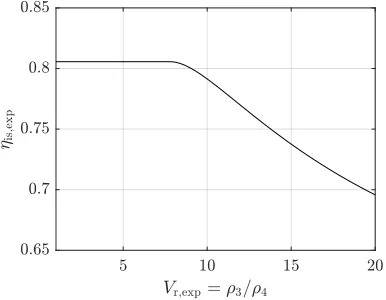
Figure 2: Twin-screw expander isentropic efficiency
𝜂9P,IJK as a function of expansion volume ratio 𝑉3,IJK,
assuming a maximum built-in volume ratio of 5
Previously, Read et al. (2014) have shown that the isentropic efficiency of a twin-screw expander is related to the ratio of these volume ratios, defined as 𝑅IJK= 𝑉3,L9/𝑉3,IJK. This relationship is shown in Figure 1, and it is
observed that an optimal expander isentropic efficiency is obtained for 𝑅IJK≅ 0.65. The maximum built-in
[image:4.595.81.291.466.603.2]an expression for the expander isentropic efficiency as a function of the volumetric expansion ratio. For
𝑉3,IJK≤ 7.7 it is assumed that a twin-screw expander can be selected, or designed, that has an optimal built-in
volume ratio such that 𝑅IJK= 0.65. For 𝑉3,IJK> 7.7, the expander isentropic efficiency can be estimated using a
second-order polynomial curve fit for the data shown in Figure 1. This is expressed mathematically as follows:
𝜂9P,IJK= T
𝜂9P,&UJ , 𝑉3,IJK≤ 7.7
−0.7205𝑅IJK- + 0.9230𝑅IJK+ 0.5100 , 𝑉3,IJK> 7.7 (5)
and this correlation is shown graphically in Figure 2 for an assumed maximum built-in volume ratio of 5. Alongside Equation 5, the screw expander is modelled assuming a mechanical efficiency of 90%.
3. CASE STUDY DEFINITION
3.1 Working-fluid definition
Combining the Peng-Robinson equation of state with the thermodynamic and expander models it is possible to investigate the optimal characteristics of working fluid intended for ORC applications operating with two-phase expansion. Following from a previous study conducted by the authors (White & Sayma, 2018), the values for 𝑝23
and 𝜔 do not have a significant effect on the cycle behaviour, and these are fixed to values of 30 bar and 0.3 respectively. Therefore, the main fluid parameters are the critical temperature and the coefficients for the second-order polynomial that describes the ideal specific-heat capacity.
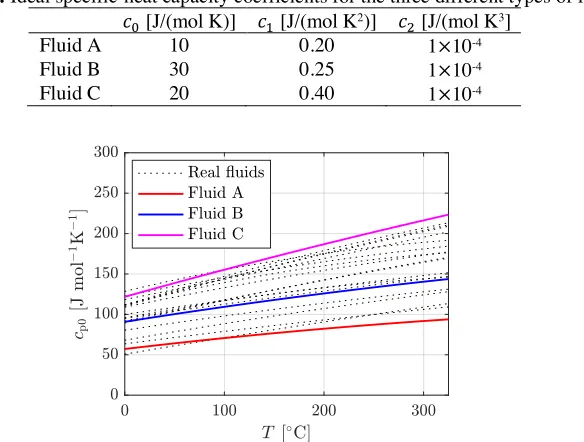
[image:5.595.160.452.428.649.2]The variation in the ideal specific-heat capacity with temperature for a range of fluids is shown by the black dotted lines in Figure 3. These lines correspond to typical working fluids for low-temperature ORC systems, and the data has been obtained using NIST REFPROP. Based on this data, three different fluid types can be defined, denoted Fluid A, Fluid B and Fluid C respectively. The coefficients for the ideal specific-heat capacity for these three fluid types are listed in Table 1, and the resulting variation in the ideal specific-heat capacity with temperature is also shown in Figure 3. Ultimately, these three fluids are defined in such a way as to effectively capture the range of behaviour observed for physical working fluids.
Table 1: Ideal specific-heat capacity coefficients for the three different types of fluid
𝑐; [J/(mol K)] 𝑐< [J/(mol K2)] 𝑐- [J/(mol K3]
Fluid A 10 0.20 1×10⁻⁴
Fluid B 30 0.25 1×10⁻⁴
Fluid C 20 0.40 1×10⁻⁴
Figure 3: Variation in the ideal specific-heat capacity with temperature for the three fluid types defined (Fluid A, Fluid B and Fluid) in addition to physical working fluids available in REFPROP
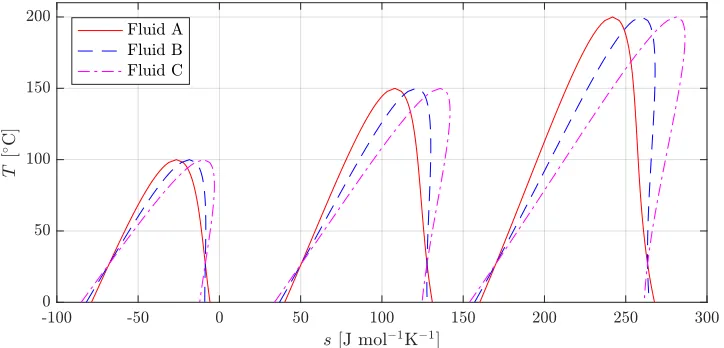
Alongside defining the coefficients for the ideal specific-heat capacity polynomial, five different critical temperatures are defined, namely 100, 125, 150, 175 and 200 °C respectively. This results in a total of 15 defined working fluids. The saturation domes for nine of these 15 fluids are shown in Figure 4 (the fluids with 𝑇23 = 125 °C
3.2 Optimisation setup
For the 15 defined working fluids, an ORC system operating with two-phase expansion can now be optimised, and the characteristics of an optimal working fluids identified. In this paper, the aim of the optimisation is to identify fluids that result in the maximum power output from the system, although other objectives such as minimising specific-investment costs should be considered in future. Therefore, since the fluid parameters are fixed, the optimisation consists of optimising four cycle variables (𝑇<, 𝑝3, 𝑞@ and 𝜃), subject to the imposed
evaporator and condenser pinch points (𝑃𝑃A = 𝑃𝑃2= 10 K). Moreover, the condensation pressure is constrained
to avoid sub-atmospheric condensation (i.e., 𝑝<≥ 1 bar). Since this study is focussed on thermodynamic
optimisation and working-fluid selection, which are independent of the size of the system, the heat source is defined with an arbitrary heat-capacity rate of 𝑚̇𝑐8= 1 kW/K. The heat sink is assumed to be water at a
[image:6.595.114.476.224.398.2]temperature of 15 °C, with a mass-flow rate of 5 kg/s.
Figure 4: Nine of the 15 defined working fluids shown on a temperature-entropy (𝑇 − 𝑠) diagram
The optimisation is formulated in MATLAB and solved using the sequential-programming algorithm. For each working fluid the optimisation is repeated for four different heat-source temperatures, namely 𝑇A9= 80, 120, 160
and 200 °C. Moreover, to enable a comparison between theoretically optimal cycles in which the maximum expansion volumetric ratio is unconstrained, and physical cycles in which high expansion volumetric ratios result in a reduced expander efficiency, the optimisation is first conducted for a fixed expander isentropic efficiency (unconstrained) and then repeated using Equation 5 to model the twin-screw expander (constrained).
4. RESULTS
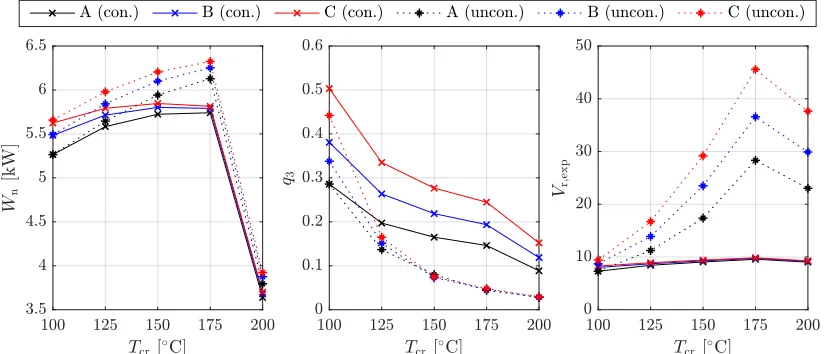
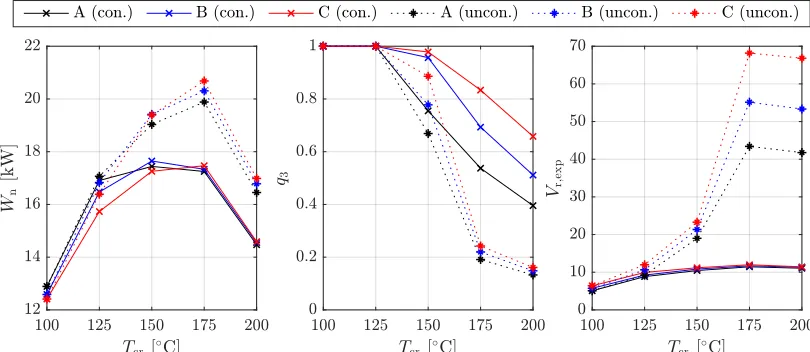
The results from all of the optimisation studies are shown in Figures 5—8, with each figure corresponding to a particular heat-source temperature. In each figure, the results are shown in terms of the optimal net power output
𝑊̇a, expander-inlet vapour quality 𝑞@ and expansion volume ratio 𝑉3,IJK for the 15 working fluids defined in
Section 3.1. Moreover, each figure also shows the results for the constrained and unconstrained cases.
Starting first with the results for the 80 °C heat source (Fig. 5), it is observed that Fluid C with a critical temperature of 150 °C results in the maximum net power output for both the constrained and unconstrained cycles, which correspond to 1.82 and 1.86 kW respectively. The percentage reduction 𝑊̇a for the constrained cycle is
only 2.1% compared to the unconstrained cycle, although there is a significant reduction in 𝑉3,IJKfrom 17.3 to
8.5. Moreover, the constrained cycle results in a higher expander inlet vapour quality (0.083) compared to the unconstrained cycle (0.032). In fact, these observations are found for most of the working fluids, with the exception of the 𝑇23 = 100 °C fluids, suggesting that constraining the expansion volumetric ratio will generally
lead to an optimal system with a higher expander-inlet vapour quality compared to the unconstrained cycle.
Considering the effect of the critical temperature on the optimal cycles (Fig. 5), it is observed that a higher-critical temperature leads to a lower expander-inlet vapour quality, and in the case of the unconstrained cycles a much higher expansion volumetric ratio. The sudden drop in both 𝑊̇a and 𝑉3,IJK for 𝑇23= 200 °C occurs due to the
was removed an unconstrained cycle operating with a fluid with 𝑇23= 200 °C would result in an even
high-volumetric ratio. It is also interesting to compare the trend in 𝑉3,IJK as 𝑇23 is increased for the different fluid types
[image:7.595.96.508.216.394.2]for the unconstrained cases. Clearly, for a given critical temperature, Fluid C results in the highest expansion volumetric ratio, followed by Fluid B and then Fluid A. This is easily understood by referring to Figure 4 and considering an isentropic expansion from a given evaporation pressure and vapour quality for the three different fluid types. As the gradient of the saturated vapour line becomes more positive, the expander outlet conditions following an isentropic expansion will have a higher vapour quality. Since the density of liquid is much greater than the density of vapour, and a higher vapour quality corresponds to a higher percentage of vapour present within the fluid, it is clear that the more positive the saturated vapour line is, the lower the density of the fluid at the expander outlet, and the higher the expansion volume ratio. With this in mind, one might have expected that for the constrained cases Fluid C would be the least favourable; however, this does not appear to be the case.
Figure 5: Optimal cycles for Fluid A, B and C with different critical temperatures for 𝑇A9= 80 °C. Results are
shown in terms of the optimal net power output (left), expander-inlet vapour quality (middle) and expansion volume ratio (right). The constrained (con.) and unconstrained (uncon.) cases refer modelling the expander using Eq. (5) and assuming a constant expander efficiency respectively.
Figure 6: Optimal cycles for Fluid A, B and C with different critical temperatures for 𝑇A9= 120 °C. Results are
shown in terms of the optimal net power output (left), expander-inlet vapour quality (middle) and expansion volume ratio (right). The constrained (con.) and unconstrained (uncon.) cases refer modelling the expander using Eq. (5) and assuming a constant expander efficiency respectively.
With regards to the remaining heat-source temperatures (Figs. 6—8), many of the same observations are made, with Fluid C generally resulting in the highest power output, higher expander-inlet vapour qualities, and higher expansion volumetric ratios. Moreover, 𝑞@ reduces as 𝑇23 increases, and in the case of the unconstrained cycles
[image:7.595.95.510.463.640.2]for the constrained cycles compared to the unconstrained cycles increases as the heat-source temperature increases. This was to be expected since a higher heat-source temperature generally facilitates a higher pressure ratio, and therefore expansion volumetric ratio, and a better thermodynamic performance. However, in the case of the constrained cycles, expansion volumetric ratios above 7.7 are penalised by a reduced expansion efficiency. Moreover, as the critical temperature of the working fluid is increased, and the difference between the unconstrained expansion volumetric ratio and the constrained volumetric expansion ratio increases, the relative reduction in power increases. This may suggest that when considering the limitations of twin-screw expanders, it may not be suitable to select working fluids with higher critical temperatures as the heat-source temperature increases. For example, for the 80 and 120 °C heat sources the constrained cycle that results in the highest power output operates with a fluid with 𝑇23= 150 °C. However, for the 160 °C heat source, the constrained cycle that
results in the highest power output operates with a fluid that actually has a lower critical temperature (𝑇23=
[image:8.595.97.510.262.441.2]125 °C). This result is contrary to the authors’ previous study which showed that for an ORC operating with superheated expansion the critical temperature and heat-source temperature are proportional to each other (White & Sayma, 2018). This demonstrates the role that the expander has on fluid selection, particularly for two-phase expansion.
Figure 7: Optimal cycles for Fluid A, B and C with different critical temperatures for 𝑇A9= 160 °C. Results are
shown in terms of the optimal net power output (left), expander-inlet vapour quality (middle) and expansion volume ratio (right). The constrained (con.) and unconstrained (uncon.) cases refer modelling the expander using Eq. (5) and assuming a constant expander efficiency respectively.
Figure 8: Optimal cycles for Fluid A, B and C with different critical temperatures for 𝑇A9= 200 °C. Results are
[image:8.595.98.503.509.685.2]Considering the relationship between the heat-source temperature and the expander-inlet vapour quality as the heat-source temperature increases, it is found that increasing the heat-source temperature will generally result in a cycle with a higher expander-inlet vapour quality. Moreover, for none of the studies was it found that a vapour quality of zero (i.e., a trilateral cycle) resulted in an optimal power output, suggesting there may be some benefit to two-phase expansion compared to expansion from a saturated liquid.
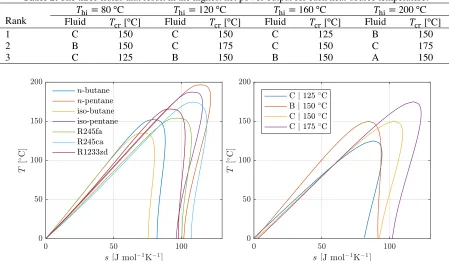
The three fluids that result in the highest net power output for each heat-source temperature are summarised in Table 2. It is found that, with the exception of the third fluid for 𝑇A9= 200 °C, there are four working fluids that
result in optimal thermodynamic performance, namely Fluid B with 𝑇23= 150 °C and Fluid C with 𝑇23= 125,
150 and 175 °C. This suggests that these four fluids could be broadly suitable for two-phase expansion using twin-screw expanders. Therefore, if physical fluids can be identified that have similar properties to these four theoretical fluids, it stands to reason that good thermodynamic performance can be expected from the cycle.
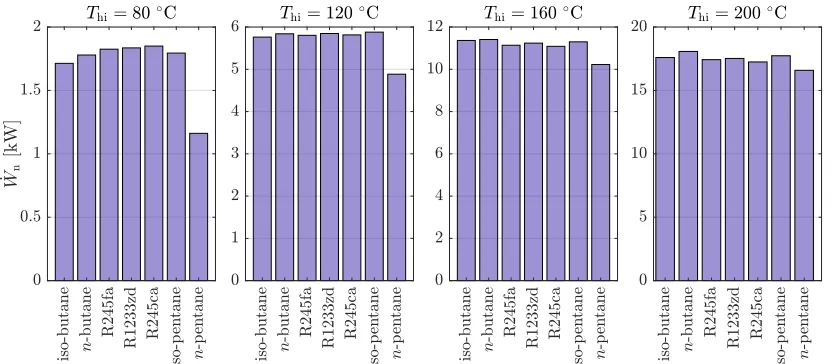
[image:9.595.72.521.325.586.2]By inspecting fluids available within the REFPROP program, seven physical working fluids have been identified that have critical temperatures ranging between 134.8 °C (iso-butane) and 196.7 °C (n-pentane). The saturation dome for these seven fluids are compared to the saturation dome for the theoretical fluids in Figure 9. Ultimately, it is observed that the four theoretical fluids exhibit similar behaviour to physical working fluids. For each of these physical working fluids, the optimisation of the thermodynamic cycle for each heat-source temperature can be repeated, this time using these defined fluids and using NIST REFPROP to determine the fluid properties. The net power output predicted by these additional optimisations are shown in Figure 10.
Table 2. The three fluids that result in the highest net power output for each heat-source temperature.
Rank
𝑇A9= 80 °C 𝑇A9= 120 °C 𝑇A9= 160 °C 𝑇A9= 200 °C
Fluid 𝑇23 [°C] Fluid 𝑇23 [°C] Fluid 𝑇23 [°C] Fluid 𝑇23 [°C]
1 C 150 C 150 C 125 B 150
2 B 150 C 175 C 150 C 175
3 C 125 B 150 B 150 A 150
Figure 9: Comparison between the saturation domes for seven physical working fluids (left) and the four theoretical working fluids identified within this study.
the small differences between the two models confirms that the model, based on the Peng-Robinson equation of state, can be used to identify working fluids for ORC systems operating with two-phase expansion.
Figure 10: Optimal net power output for ORC systems operating with two-phase expansion for different working fluids. Results are obtained using NIST REFPROP to model the fluid properties. Results are plotted with critical temperature of the working fluid increasing from left to right.
5. CONCLUSIONS
This paper has detailed the development of a methodology to investigate the optimal characteristics of working fluids for ORC systems operating with two-phase expansion using a twin-screw expander. The method is comprised of a thermodynamic system model, the Peng-Robinson equation of state and a simple correlation to account for the effect of the expansion volumetric ratio on the expander isentropic efficiency. After defining 15 theoretical working fluids, an optimisation study was completed for heat-source temperatures ranging between 80 and 200 °C. From the results a number of conclusions can be made. Firstly, for all the cases considered it is found that the optimal expander inlet vapour quality reduces as the critical temperature is increased, but on the whole increases as the heat-source temperature is increased. Moreover, when considering the limitation in the expansion volumetric ratio, imposed by using a twin-screw expander, the optimal expander inlet vapour quality increases further. Secondly, it is observed that for a given heat-source temperature there is an optimal critical temperature at which power output will be obtained. Above this optimum there is a reduction in power output which is caused by increasing the condensation pressure to avoid sub-atmospheric condensation pressures. In general, it is observed that for heat-source temperatures ranging between 80 and 200 °C, the optimal critical temperature ranges between 125 and 175 °C. The results also suggest that there may be a slight thermodynamic benefit in employing a working fluid with a saturated vapour line that has a slightly positive gradient (when viewed on a 𝑇 − 𝑠) diagram. Finally, using the results obtained for the theoretical working fluids to identify physical working fluids, it is found that R245ca, iso-pentane and n-butane are good candidates for the heat-source temperatures considered.
NOMENCLATURE
𝑎, 𝑏 fluid-specific parameters
𝑐;, 𝑐<, 𝑐- ideal specific-heat capacity coefficients
𝑐8 specific heat-capacity at constant pressure (J/(mol K))
𝑚̇ mass-flow rate (kg/s)
𝑝 pressure (Pa)
𝑝3 reduced evaporation pressure
𝑃𝑃A, 𝑃𝑃2 evaporator and condenser pinch points (K)
𝑞 vapour quality
𝑅 universal gas constant (J/(mol K))
𝑅IJK expansion ratio
𝑇 temperature (K)
𝑉& molar volume (m3/mol)
[image:10.595.90.507.110.292.2]𝑊̇a net power output (kW)
𝜂9P isentropic efficiency
𝜃 non-dimensional heat-source temperature drop
𝜌 density (kg/m3)
𝜔 acentric factor
Subscripts
1—4 ORC state points
bi built-in
c heat-sink (cold)
ci heat-sink inlet cr critical point
exp expander
h heat-source (hot)
hi heat-source inlet ho heat-source outlet
REFERENCES
Bianchi, G., McGinty, R., Oliver, D., Brightman, D., Zaher, O., Tassou, S., Miller, J., & Jouhara, H. (2017). Development and analysis of a packaged trilateral flash cycle system for low grade heat to power conversion applications. Thermal Science and Engineering Progress, 4, 113-121.
Bianchi, G., Kennedy, S., Zaher, O., Tassou, S.A., Miller, J., & Jouhara, H. (2018). Numerical modelling of a two-phase twin-screw expander for trilateral flash cycle applications. International Journal of Refrigeration, In-press. doi: https://doi.org/10.1016/j.ijrefrig.2018.02.001.
Cignitti, S., Andreasen, J. G., Haglind, F., Woodley, J. M., & Abildskov, J. (2017). Integrated working fluid- thermodynamic cycle design of organic Rankine cycle power systems for waste heat recovery. Applied Energy, 203, 442–453.
Electratherm, 2015, Available at: https://electratherm.com/ [Last accessed: 19th March 2018].
Fischer, J. (2011). Comparison of trilateral cycles and organic Rankine cycles. Energy, 36, 6208-6219.
Lemmon, E.W., Huber, M.L., & McLinden, M.O. (2013). NIST Standard Reference Database 23: Reference Fluid Thermodynamic and Transport Properties-REFPROP. Version 9.1, National Institute of Standards and Technology, Standard Reference Data Program, Gaithersburg, USA.
Öhman, H., & Lundqvist, P., (2013). Experimental investigation of a Lysholm Turbine operating with superheated, saturated and 2-phase inlet conditions. Applied Thermal Engineering, 50, 1211–1218.
Poling, B. E., Prausnitz, J. M., & O’Connell, J. P. (2001). The Properties of Gases and Liquids, 5th Ed., McGraw-Hill,
New York, USA.
Read M. G., Smith, I., & Stosic, N. (2014). Effect of air temperature variation on the performance of wet vapour organic Rankine cycle systems. Geothermal Resources Council Transactions, 38, 705—712.
Read, M. G., Smith, I. K., & Stosic, N. (2017). Optimisation of power generation cycles using saturated liquid expansion to maximise heat recovery. P I Mech Eng E-J Pro, 231(1), 57-69.
Schilling, J., Lampe, M., & Bardow, A. (2016). 1-stage CoMT-CAMD: An approach for integrated design of ORC process and working fluid using PC-SAFT. Chemical Engineering Science, 159, 217–230.
Smith, I. K. (1993). Development of the Trilateral Flash Cycle System: Part 1: Fundamental Considerations. P I Mech Eng A-J Pow, 207(3), 179—194.
Smith, I. K., Stošič, N., & Aldis, C.A. (1996). Development of the Trilateral Flash Cycle System: Part 3: The Design of High-Efficiency Two-Phase Screw Expanders. P I Mech Eng A-J Pow, 210(1), 75—93.
White, M., Oyewunmi, O., Haslam, A., & Markides, C. (2017). Industrial waste-heat recovery through integrated computer-aided working-fluid and ORC system optimisation using SAFT-γ Mie. Energy Conversion and Management, 150, 851–869.
White, M. T., & Sayma, A. I. (2018), A generalised assessment of working fluids and radial turbines for non-recuperated subcritical organic Rankine cycles, Energies, 11(4), 800. doi: 10.3390/en11040800.