City, University of London Institutional Repository
Citation
:
Floris, M., Grant, D. and Oswick, C. (2019). A discourse perspective on creating organizational knowledge: the case of strategizing. Research in the Sociology ofOrganizations, 59, pp. 141-156. doi: 10.1108/S0733-558X20190000059008
This is the accepted version of the paper.
This version of the publication may differ from the final published
version.
Permanent repository link: http://openaccess.city.ac.uk/id/eprint/21191/
Link to published version
:
http://dx.doi.org/10.1108/S0733-558X20190000059008Copyright and reuse:
City Research Online aims to make research
outputs of City, University of London available to a wider audience.
Copyright and Moral Rights remain with the author(s) and/or copyright
holders. URLs from City Research Online may be freely distributed and
linked to.
City Research Online: http://openaccess.city.ac.uk/ [email protected]
Page 1
A DISCOURSE PERSPECTIVE ON CREATING ORGANIZATIONAL
KNOWLEDGE: THE CASE OF STRATEGIZING
MAURIZIO FLORIS, DAVID GRANT, CLIFF OSWICK
Maurizio Floris, University of Sydney, John Grill Centre for Project Leadership
David Grant, Griffith University, Griffith Business School
Cliff Oswick, City University London, Cass Business School
Authors Biographies:
Maurizio Floris is Director of Leadership Programs at the John Grill Centre for Project Leadership (University of Sydney). His research focuses on leadership, team dynamics, stakeholder engagement, particularly in the context of complex projects. He is particularly interested in discourse, knowledge and practice, how these shape our social and
organizational reality, and how this can be used to deliver practical outcomes and social impact. Prior to his academic career, Maurizio was in industry for nearly 20 years, contributing to or leading strategy reviews, reorganizations, ICT projects, and engineering projects. Being Dutch-Italian by birth, he still loves a mean pasta and a good windmill.
David Grant is Pro Vice Chancellor, Griffith Business School, Australia. His research focuses on how language and other symbolic media influence the practice of leadership and organization-wide, group and individual level change. He has published in a range of peer-reviewed journals and co-edited several books including the Sage Handbook of Organizational Discourse (2004, with Cynthia Hardy, Cliff Oswick, and Linda Putnam) and Discourse and Organization (1998, with Cliff Oswick and Tom Keenoy). He was elected a Fellow of the Academy of Social Sciences in Australia in 2008 and is an elected member of the National Training Laboratory. A lifelong Arsenal supporter, he has come to understand the true meaning of resilience.
Cliff Oswick is Professor of Organization Theory at Cass Business School, City University of London (and previously served as Deputy Dean between 2011 and 2016). His research interests focus on the study of organizing processes and organizational change. He has published over 140 academic articles and contributions to edited volumes. He has previously served as an Associate Editor for Journal of Change Management and Journal of Organizational Change Management. He is a member of the Chartered Institute of Personnel and
Page 2
trustees for the Tavistock Institute of Human Relations, and chair-elect of the Organization Development and Change Division of the Academy of Management. More generally, he has recently become a grandparent and he is a lifelong QPR supporter.
Abstract:
This chapter outlines a discursive epistemology of knowledge production through an analysis
of the role of time and context in the social construction of organizational insights, outcomes
and theories. While the role of time and context has been widely acknowledged in
organizational discourse analysis, it has remained unclear what is specific to knowledge
generation. Drawing upon a case study of an attempted company acquisition, we illustrate
how knowledge is discursively produced and consumed during a process of strategizing. Our
analysis shows how knowledge producing processes (e.g. strategizing, theorizing,
conceptualizing and hypothesizing) extend both the time horizon of discourses that relate to
the future, and the context horizon for discourse(s) that relate to the broader context. This
reconstructs the tapestry of interwoven discourses that make up a local discourse and enable
new managerial knowledge to be produced.
Keywords:
1. Discourse 2. Theorizing 3. Time horizon 4. Context horizon 5. Strategizing
Introduction
This chapter will show how organizational knowledge is discursively produced and
Page 3
specifically, the purpose of this chapter is to provide insights into how aspects of time and
context within discursive events are germane to the production and consumption of
knowledge in an organizational setting. By taking a discursive approach, we are able to show
how production of knowledge is neither merely an individual endeavor nor an intellectual
analysis of objective facts. Rather, it is a social and constructive organizational practice that
creates and negotiates new insights and outcomes for the organization. We further show how
knowledge is created by extending time and context horizons for discourses that are woven
into the discourse, and argue that this is what is different and specific to knowledge
production, as opposed to other organizational practices.
In order to explore the discursive production knowledge, we present a case study. The case
focuses on the attempted acquisition of Rio Tinto by BHP Billiton between 2008 and 2009. It
demonstrates how knowledge is created when strategizing. For us, strategizing is just one
form of generating knowledge. However, we believe some important facets of understanding
strategizing, as a particular domain of discursive activity, can be carried over to other areas of
knowledge production. In particular, we would posit that strategizing is closely related to
other cognate forms of future-oriented activities associated with the development of
knowledge (e.g. theorizing, hypothesizing, and postulating). Indeed, we would go as far as to
say that, to a certain extent, ‘theorizing’ and ‘strategizing’ can be perceived as synonymous
knowledge-related processes (i.e. strategizing is a form of theorizing and vice versa). And, as
such, the case study on strategizing provides a good vehicle for drawing wider inferences
about the discursive production of knowledge.
There are four main parts to this chapter. In the next section we consider how perspectives on
Page 4
production and consumption. This is followed by thecase study which offers a grounded
example of how, via discursive processes, knowledge is created in practice when strategizing.
In the penultimate section we reflect on the broader discursive features of producing new
knowledge and what this might tell us about the discursive construction of temporality and
context. Finally, we conclude by considering the wider implications of treating knowledge
production as a discursive process and highlight possible directions for further research.
A Discursive Perspective on Organizing, Theorizing and Knowledge Production
A discursive approach to organizing and theorizing is firmly based on a social constructionist
epistemology and fights a ‘two front war’ (Alvesson & Deetz, 1999, p.199). On the one front
discourse analysis faces an objectivist epistemology of much of traditional, mainstream theory,
which locates knowledge in accurate observations of the external environment or
organization. On the other front, it must deal with subjectivism, which locates such knowledge
in unique observations of phenomena by individuals. In contrast, a discourse approach sees
organizational phenomena as neither independent of human experience, nor as the exclusive
domain of individual subjective experiences. Instead, they are the outcomes of ongoing social
negotiations, and as such are intersubjective (Hardy & Phillips, 2004).
There is an extensive body of work that explores organizations and organizing through
discourse analysis. Overall, it suggests that organizations only exist ‘insofar as their members
create them through discourse’ (Mumby & Clair, 1997, p.181) (For an overview of this work
see for example: Grant, Hardy, Oswick and Putnam, 2004). Some of the main concepts of
discourse analysis and how they apply to processes of organizing and theorizing include
discourse,text, context, and meaning.Discourse, the first of these, is defined as ‘instantiated
Page 5
structure’ (Grant and Marshak, 2011, p.208). It comprises a set of interrelated texts that, along
with its production, dissemination and consumption, brings an object or idea into being
(Fairclough, 1992; Hardy, Lawrence, & Grant, 2005; ). Discourse analysis takes a critical look at
how, through discourse, particular ways of framing organizational phenomena become
broadly accepted. For example, ‘shareholder value’ has become such a dominant frame to
evaluate corporate performance (Lok, 2010) that other frames, which may highlight the
interests of other stakeholders (e.g. employees, community, government), are often
considered secondary.
While early discourse analysis research saw text as limited to written and spoken words,
discourse analysis scholars have since expanded this definition to include other modes of
communication (Hardy et al., 2005). This perspective on discourse may include a wide variety
of visual representations, cultural artefacts and other modes of meaning making that are used
in the realization of social goals and purposes (Iedema, 2007; Kress, 2010). Indeed, Roberts et
al. (2006) suggest that even the tone, gestures or mood of a messenger are in themselves
modes of discursive practice that can convey meaning. The displacement of language as the
sole or primary focus of study ‘amounts to a profound reorientation’ (Kress, 2010, p.79) of our
understanding of what discourse is, how it is used to express, negotiate and influence meaning
and how we should approach the study of multi-modal discourse. A multi-modal perspective
on discourse also opens the opportunity to encapsulate broader insights from culture studies
in relation to the construction of social reality and interactions between inhabitants of that
social reality.
Owing to the social nature of meaning making, discourse analysis looks at bodies of
Page 6
can provide an example or material manifestation of a discourse, it cannot be extrapolated
beyond its particular instance. The absence of an objective, invariable reality that is reflected
in the text means that in a different ‘context’ the meaning of the text is not anchored in
reality, but depends on somewhat different interpretations by different actors with potentially
different frames and interests. Furthermore, the discourses in which we partake at different
points in time also shape each other in ongoing dynamic patterns of interaction and meaning
making. In sum then, when analyzing an organization’s discourse, it is essential to understand
the context and point in time in which organizationaltexts come into existence.
Context and time
The context of a particular discourse can be seen to be embedded within a landscape of
broader discourses. A broader discourse can be defined as a discourse that is shaped
predominantly by actors beyond the organization, and has been variously described as
‘macro’, ‘meta’, ‘grand’, ‘capital D’ or ‘mega’ discourses (Alvesson & Karreman, 2000; Keenoy
& Oswick, 2004; ). For example, Vaara et al’s (2004) study of strategy-related discourses in the
airline industry illustrates how a discourse regarding the necessity of airline alliances can be
understood as a particular instance of a broader societal discourse on ‘corporatization’ and
‘globalization’. Broader discourses do not imply that they are a given for organizational
leadership. While one actor or group of organizational actors may not be able to significantly
change a broader discourse in which they are not one of the main or dominant actors, they do
have some control over the context of their local discourse by choosing or framing what is
seen as the most relevant broader discourses (Fairhurst, 2009). This construction of a context
Page 7
and these interests may shape the discursive practices of actors, including which broader
discourses are made relevant, and ultimately what meaning is assigned to organizational
phenomena.
In addition to drawing on broader discourses, a particular discourse may also draw on sets of
texts that relate to either the past or the future. Paying attention to ‘time’ is important in the
processes of theorizing and generating knowledge. We can illustrate this by looking at the
field of strategy as a case in point. Within all the major schools of thought, strategy is
generally positioned as anticipating or forecasting the future and acting accordingly (Baghai,
Coley, & White, 1999; Kaplan & Orlikowski, 2013). The dominant design, positioning and ways
of thinking about strategizing (Mintzberg et al., 1998) see the future external environment as
more knowable and predictable, and the internal environment as more rational in anticipating
and acting on future changes in that environment compared to other schools.
Time also plays a role where studies of strategy see the future as less predictable, less rational
and more complex and organic, and hence more difficult to anticipate (Mintzberg et al., 1998).
Here strategizing, as with other knowledge generating forms of discourse, is less about a
long-term vision and more about trying to shape patterns of organizational practices, which would
allow a preferred future to emerge from those patterns. In a complex environment, this
requires a constant monitoring of, and adaptation to, those patterns.
The future orientation that defines knowledge generation is captured in the concept of a time
horizon (Baghai et al., 1999; Das, 1987; Taschdjian, 1977). Taschdjian (1977) defines a ‘horizon
[as] a boundary which moves back as we move towards it’ (in Das, 1991, p.53). What
Page 8
someone’s role or seniority in an organization: while a frontline manager may have to consider
the next 3 to 12 months, a Group CEO’s time span might extend to 10 to 20 years or beyond.
While the concept of time has been explored in the discourse analysis literature, this has
typically been an exploration of how a particular discourse is reiterated or adapted over time
as part of organizational change. In contrast, the discussion above suggests that during
processes of knowledge production and consumption (e.g. when strategizing) the concept of
time is used somewhat differently. Instead of emphasizing how a particular discourse changes
over time, it now refers to how that discourse at a particular moment in time draws on sets of
texts that refer to other (mainly future) moments in time. In sum, ‘looking forward’ in time is a
matter of drawing on texts that relate to a future point in time. By becoming part of the
real-time, unfolding discourse, future-oriented texts play a role in shaping coherent, plausible and
acceptable connections between the past, present and future. This is needed to create an
account that enables actors to agree on a particular outcome or action and move forward
when producing management knowledge.
The next section adopts a discursive perspective in order to examine and explain a failed
acquisition strategy. Using the example of strategizing as an explanatory vehicle, it illustrates
how managerial knowledge – specifically in relation to time and context - is produced and
consumed.
Case study: BHP Billiton’s attempted acquisition of Rio Tinto
In 2007-08 BHP Billiton (BHP) tried to acquire Rio Tinto to create the world’s largest mining
company. After twelve months of a very public and hostile discourse, BHP walked away from
Page 9
Financial Crisis, which created additional risks for the transaction. Here, we analyze BHP’s
acquisition discourse in order to show how time and context were enacted in the discourse
(for more details on the research underlying this case, see Floris, 2014; Floris, Grant, &
Cutcher, 2013). The discourse was structured around three key constructs that would
determine if the acquisition would proceed. First, this was whether BHP’s leadership and
shareholders could agree on the distribution of a presumed additional value pool through a
mutually acceptable fair share exchange ratio, and whether key regulators would substantially
agree with BHP on what the acquisition would mean for competition; that is, that the impact
on competition was acceptable in their area of jurisdiction.
Enacting time in strategy discourse
The additional value pool was constituted through the discursive construction of the future
cost and revenue synergies resulting from the acquisition. The role of time was
straightforward in that it was about future savings and revenue. BHP explicitly talked about
time horizons and indicated actual years when savings and revenue increases were expected:
‘Cost savings can be achieved relatively quickly and the full run rate of $1.7
billion can be achieved by year three. The revenue benefits will make a major
contribution from year four and essentially by year seven we will have the full
run rate of $2 billion per year. One-off implementation costs would be in the
order of $0.65 billion and they would be incurred in the first two years.’ (CEO
Kloppers, BHP Billiton and Rio Tinto: Unlocking Value, 12th November 20107).
The annual revenue enhancements were $2.0B, which would build up from year 4 to year 7.
Page 10
synergies and discounting their future value in order to translate expected future value into
today’s dollars. The valuation of this pool depended not only on the size of cost savings and
additional revenues, but also where the strategy discourse located them in time due to the
increased discounting of more distant additional profits.
Time also permeated the construction and negotiation of the meaning of the fair share
exchange ratio, which indicated how future value would be distributed across shareholders of
each company. The ratio was influenced by relative future capability, including new mining
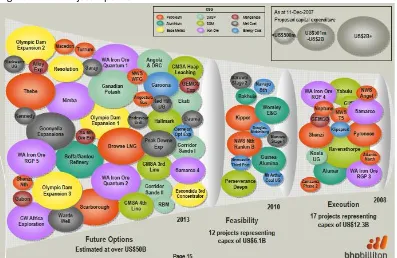
projects in the pipeline. For example, each bubble in Figure 1 represented a separate project
[image:11.595.73.470.392.650.2]in BHP’s pipeline where the size reflected the value and the colour the mined commodity.
Figure 1: BHP Project Pipeline
Page 11
Projects enter the funnel on the left and move to the right from future options, to feasibility
stage, to execution. These future projects of both companies were of critical importance to
the discursive construction of relative value of each company as they symbolised future profit
streams, and hence what was under negotiation as a fair share exchange rate.
Time also played a major role in the negotiation of meaning of the fair share exchange ratio
through expectations of demand and price trends in commodity markets. For example, Rio
was much more sensitive to the discursive construction of trends in the aluminium market
than BHP. This provided Rio the opportunity to influence the negotiation of what was consider
a fair exchange ratio by emphasising positive trends in that particular market:
‘Global aluminium demand is growing strongly, currently about 7% per year and
forecast to remain so, given the expected double-digit growth rate in China.’
(Dick Evans - CEO Rio Tinto Alcan, Investment Seminar, 26/11/07)
The significance of time can further be seen in the construction of the meaning of the third key
construct: impact on competition. Much of the additional value pool depended on an
acceleration of tonnage by optimising key mineral basins, assets and infrastructure in the
discursive construction of the acquisition strategy. Importantly, an accelerated tonnage
suggested that the acquisition would have a positive effect on supply and hence the future
competition in, for example, iron ore, coal and diamond markets. In addition, the emergence
of new iron ore producers also played a role in the discursive construction of the future. BHP
had argued that emerging iron ore producers would erode its future market share and
therefore any impact on competition of the acquisition was minimal and temporary. However,
Page 12
‘it is uncertain whether the threat of new entry is an enduring and effective
competitive constraint .. few alternative suppliers capable of supplying
significant quantities of iron ore lump and iron ore fines at a cost that would be
likely to impose an effective competitive constraint on the merged firm.’ (ACCC,
Statement of Issues — BHP Billiton Ltd’s proposed acquisition of Rio Tinto Ltd
and Rio Tinto plc, 22nd August 2008)
As a result, BHP committed to a 15-year supply contract to remove the perception of a
negative impact on competition for the next 15 years, paving the way for the regulator to
accept the proposed acquisition.
These examples illustrate that the discursive construction of the future was a critical feature of
the acquisition discourse. The examples that related to the additional value pool and the fair
share exchange ratio show how strategizing that promoted a future state in which both
companies were merged and created more and better opportunities. A time horizon that
would only have included short-term cost and revenue synergies, or even the synergies over
the initial three years, would not have offered adequate additional value to justify the upfront
cost of the transaction. Similarly, a more limited time horizon could influence the perceived
fair share exchange ratio, as the expected future profits of both companies developed at a
different pace. Lastly, the examples above also showed how the time horizon influenced the
perceived impact on competition. Only the extension of the time horizon of supply contracts
to 15 years made the acquisition a viable strategic option. The next section shows how actors
discursively constructed and drew on broader discourses that provided a context for the
Page 13
Enacting context in strategy discourse
When, in November 2007, the then BHP CEO Marius Kloppers first presented the case for
acquiring Rio Tinto, he articulated a number of broader discourses, including the primacy of
shareholder value; long-term demand from China and India; and the importance of
competition in markets. The first two were of particular importance to the negotiation of
meaning of the additional value pool and the fairshare exchange ratio. The importance of
competition to create healthy functioning markets was of particular interest to the meaning of
the impact on competition.
The ‘primacy of shareholder value’ discourse implies that managers are agents of
shareholders, and that a company’s strategy - above all else – must maximize value to
shareholders (Lok, 2010). This perspective was deeply embedded in all communications. For
example, the title of BHP’s press release was ‘BHP Billiton’s proposed combination with Rio
Tinto to unlock value’ (BHP Billiton, 2007d). This document, and the subsequent analyst
presentations (BHP Billiton, 2007a, 2007c) made it clear that value in this context meant
shareholder value, and suggested that the driver behind the acquisition was the creation of
such value. Similarly, Rio Tinto’s then CEO Tom Albanese and its leadership had to appeal to
the same audience and weave in the same broader contextual discourses. They did so by
arguing that rejecting BHP’s offer was ‘all about value’ in their formal response:
‘… the three themes of my discussions this morning were all about today
Page 14
Tinto, the value to Rio Tinto shareholders …’ (Rio CEO Tom Albanese, Investor
Seminar, 26th November, 2007).
Both the arguments in favor and against the proposed acquisition were constructed
consistently by BHP’s and Rio’s leadership in terms of superiority in shareholder value delivery.
At the time of the press release, there was a general expectation and consensus that there
would be a multi-decade high economic growth of two of the largest countries in the world,
China and India, which would generate a strong demand for mining commodities. BHP CEO
Kloppers emphasized that ‘In order to understand the most fundamental reason why we are
interested in this combination [of BHP and Rio] we have to start with the demand for our
products.’ (BHP Billiton, 2007b). Other actors throughout the episode corroborate that they
also accepted the broader discourse of extensive future economic growth in China and India.
The example of long-term demand also illustrates that broader contextual discourses can
simultaneously draw on time horizons.
From the initial announcement of its intent to acquire Rio, BHP’s leadership acknowledged the
need to satisfy key competition regulators by referring to its ‘thorough analysis of the
anti-trust implications of this combination and… [its being ] …confident … that any possible
regulatory concerns can be readily addressed’ (BHP Billiton, 2007c, pp., p.4). In short, BHP
wove the importance of competition and the other broader discourses into the fabric of the
acquisition discourse.
The broader discourses that were identified above show how the acquisition discourse was
substantively shaped, or even constituted by, discourses that existed beyond BHP and even
Page 15
importance of competition can be regarded as institutionalised discourses. Accordingly, actors
in the acquisition discourse did not deviate significantly from articulating these so as to add
legitimacy to their arguments. That said, other broader discourses pertained more narrowly to
mining and opened up the opportunity for actors to construct and communicate broader
discourses in novel ways in relation to the acquisition discourse. Combining BHP and Rio in full
could only emerge as a strategic option if the context was extended enough to include the
broadest discourses described earlier.
Our analysis of this case showed that the concepts of time and context were thoroughly
anchored in the acquisition discourse. As we will argue next, in the discussion, together they
indicate what differentiates knowledge creation when strategizing from other managerial
activities that also create organizational knowledge.
Producing and Consuming Managerial Knowledge: A Discursive Epistemology
This chapter set out to develop a discursive perspective on how knowledge is created and
re-created during the process of organizational theorizing and theory formation. While a
discourse perspective on organisations is well developed, it is less clear what is specific about
knowledge production and consumption. The case study has demonstrated the important role
of time and context in this. Time and context are well recognized in the discourse literature
(e.g. Keenoy & Oswick, 2004). However, it is not clear why these dimensions are important or
how they are enacted when strategizing, as in the case study, or more generally when engaged
in organizational theorizing and/or producing new managerial knowledge.
To develop a more specific answer, we draw on the concepts of interweaving (Fairclough &
Page 16
connect this with the concept of horizon; that is, ‘a boundary which moves back as we move
towards it’ (Taschdjian (1977) in Das, 1991, p.53). In the next section we discuss time and
context horizons from a discursive perspective and how these impact on an epistemology of
theorizing and knowledge production.
Extending the time horizon: bringing the future-in-the-present
Examination of BHP’s failed acquisition discourse demonstrated that strategizing, as a distinct
form of knowledge production, could not realistically be conceived without a temporal
dimension. Each of the examples we have provided of the discourse were permeated by and
depended on references to the future of the industry, the company’s future vision and future
profits. This confirms previous research that argues that, while temporal work in strategizing
involves weaving accounts of the past, current and future into strategic accounts (Kaplan &
Orlikowski, 2013; Keenoy & Oswick, 2004), strategizing is foremost a future-oriented activity
(Das, 1987; Kaplan & Orlikowski, 2013; Mosakowski & Earley, 2000).
Attention to this temporal dimension can be seen in most forms of knowledge production
insofar as they are future-oriented (Baghai et al., 1999; Kaplan & Orlikowski, 2013; Mintzberg
et al., 1998). However, from a constructionist perspective theorizing the future is interpretive
(Weick, 1979) in that it is about constructing ‘imaginings of what might be possible’ (Kaplan &
Orlikowski, 2013, p.966). Accounts of other times that are considered when theorizing can be
seen as discursive practices that construct a past or future, which we weave into the fabric of
the current discourse. Keenoy and Oswick (2004) refer to this as ‘temporality-in-the-present’,
that is, ‘the past, the present, and future are simultaneously embedded within a discursive
event (i.e. the ‘past-in-the-present’, the ‘present-in-the-present’ and the
Page 17
how we now recall the past or imagine the future (Kaplan & Orlikowski, 2013), in this
‘discursive moment’ (Keenoy & Oswick , p.138). These should not be seen as accurate histories
or forecasts of other times but as (re-) constructions of that past or future. Each subsequent
instance of reconstructing the past or the future is neither an exact replica nor completely
divorced from previous constructions. It always combines both recursivity and adaptation. As
such, each instance implies a connection of past, current and future patterns (Fairclough &
Wodak, 1997; Giddens, 1986; Phillips & Hardy, 2002).
The concept of time horizon is critical in the process of the social construction of meaning as it
occurs as part of theorizing and hypothesizing which, in turn, are integral parts of producing
new knowledge. It also connects with the idea of a ‘textscape’ (Keenoy & Oswick, 2004), which
considers how texts that relate to another time are woven into the current discourse of an
organization. This involves weaving together different discourses to negotiate meanings of key
constructs that appear ‘coherent, plausible, and acceptable’ (Kaplan and Orlikowski, 2013,
p.965) through persuasion and negotiation (Floris et al., 2013). Discursive practices that relate
to a more distant future have a greater potential to recast current discourse and explore
‘barely conceivable alternatives’ (Kaplan & Orlikowski, 2013, p.991). For example, in the BHP
case study, the acquisition could only be conceived of as a potential strategic option if the time
horizon were set out far enough to include sufficiently realized annual cost and revenue
synergies to warrant the effort and risk of this strategic option. While previous studies
acknowledge the importance of time and temporal work (Kaplan & Orlikowski, 2013; Keenoy
& Oswick, 2004), this chapter argues that it is not enough to say that discourse associated with
theorizing and knowledge production draw on discursive practices that relate to time. What is
Page 18
organization (or about an organization), and this may require extending the time horizon
beyond what would be considered in the day-to-day discourse in order to draw on additional
discursive practices that may help recast the existing discourse in the organization sufficiently
to allow new insights, options and outcomes to be imagined.
While the processes of knowledge production are socially constructed, it would be
problematic to argue that time only emerges as an influencing factor because of social
processes. In all the situations discussed, time remains sequential, and while there may be a
perception of cyclicality, a particular event or discursive moment in time, once passed, cannot
be undone or cycled back but – at most – forgotten or reinterpreted. Also, we cannot
discursively produce knowledge without at least an implicit notion of time and, more broadly,
we are incapable of perceptions that are not conditioned by time. All our perceptions, that is,
all phenomena are shaped by time as a primary category (Kant, 1976), without which we
cannot perceive or think about something. Kant’s second transcendental form of perception is
space. Space, as will be argued, is echoed in the second discursive facet of the knowledge
production horizon: context.
Extending the context horizon: bringing the context-in-what-is-present
To date, the term ‘horizon’ has been used to designate a horizon for time only (Baghai et al.,
1999; Das, 1987; Taschdjian, 1977). We extend the use of this term use to encompass a
context horizon. The case study illustrated how key actors in the acquisition discourse
discursively constructed a number of broader discourses in the local acquisition discourse
throughout the period under investigation. Some of the key broader discourses that were
Page 19
primacy of shareholder value; the demand of global markets; and the importance of
competition.
From a discursive perspective, the context of a particular text or discourse is primarily
constituted by other sets of texts. Such ‘contexts are not simply a backdrop to text, they are
actually embedded within it’ (Keenoy & Oswick, 2004, p.140). In this chapter, a deliberate
differentiation was made between a local discourse and broader discourses, variously
described in previous research as ‘macro’, ‘meta’, ‘grand’, ‘capital D’ or ‘mega’ (Alvesson &
Karreman, 2000; ; Keenoy & Oswick, 2004; Phillips et al., 2008). These broader discourses are
interwoven with, and have a critical role in shaping, local discourses. The discursive
construction of contextual discourses in the local discourse is fundamental to any
organizational activity and the process of knowledge generation. This context of discourses
relates to increasingly distant locales (Keenoy & Oswick, 2004) or discourse created by actors
increasingly removed from the local discourse (Law & Hassard, 1999). For example, was the
proposed acquisition of Rio by BHP sensible in the context of broader discourse of long-term
demand for mining commodities? If strategizing by extending the contextual horizon is done
successfully, then such reinterpretations may create new strategic options that did not seem
possible previously.
The contextual horizon within a given discourse can be extended or decreased in a number of
ways, and can zoom out or in (Latour, Jensen, Venturini, Grauwin, & Boullier, 2012), or scale
up or down (Hardy, 2004) interconnected discourses. While this suggests that actors might
have some choice in selecting broader discourses to frame their local discourse, this choice is
Page 20
acceptable) worldviews. This restricts what is seen as the appropriate context horizon for a
local discourse.
The horizon of the discursive production and consumption of knowledge can also be
generalized for different hierarchical levels of an organization. As with time horizons, a
broader contextual horizon is relative, and the highest levels of an organization’s hierarchy can
be expected to draw on the broadest discourses. For example, in the case of BHP’s attempted
acquisition of Rio the two CEOs involved, Kloppers and Albanese, drew on broad societal
discourses of shareholder value to argue for or against the proposed acquisition strategy while
division heads for petroleum and iron ore drew on market discourses for their respective
commodities. From a discursive perspective the local discourse is a point or space where other
(‘broader’) discourses overlap and are combined, and vice versa: those other discourses exist
in other local discourses. Every individual text or discursive practice may be part of a local
discourse and a broader discourse simultaneously. For example, BHP’s profit and loss
statement is part of its local strategy discourse, but at the same time it enacts a broader
discourse on accounting standards. Further, whether a discourse is seen as local or broader is
not an objective characteristic, but depends on the perspective of the actors: if they are main
actors who shape the discourse then it is their locale and their local discourse. From the outset
of BHP’s attempted acquisition of Rio, it informed the definition and analysis of broader
discourse and suggests that the terms ‘mega’ or ‘big D’ discourses are problematic (Alvesson
& Karreman, 2011), as these suggest a hierarchical logic in the relationship between a local
and a broader discourse. If external actors predominantly shape a discourse that is woven into
Page 21
After the above discussion, it seems self-evident that producing knowledge by extending the
contextual perspective of the local discourse is a social activity. The external environment is
not objectively given. It is constructed in the local discourse by drawing on, selecting,
connecting and interpreting other socially constructed discourses. Even if the local discourse
appears to be relatively self-contained, the process involves a continuous drawing on and
interweaving of broader discourses that have been created and disseminated by others.
This extension of horizon, imagined as an extension into broader discourses, echoes Kant’s
second transcendental form of perception of space (Kant, 1976). While a discursive space
differs from a Euclidian space, these other discourses or other actors appear logically
positioned predominantly outside the local discourse. They can be brought into the local
discourse, but will largely continue to exist and develop outside the local discourse. Traces or
echoes of space as a form of perception also reside in the use of terms like ‘into’ and ‘outside’
when talking about the connection between local discourse and broader discourses. Do we
use such spatial terms because, as Kant argued, we cannot perceive without imposing space,
or does space emerge from the use of the terms? There is no intent or possibility to consider
this question as Kant did at a metaphysical level in the context of this chapter. The aim here is
far more modest: whether space (and earlier in the discussion, time) is a transcendental form
of perception or simply a category of sense making that we must use when theorizing may not
matter for a discursive epistemology of knowledge production. In either case, they do
however remain essential to better understand how moving towards these horizons creates
knowledge.
Page 22
The discussion of a time and context horizon showed how meaning in a local discourse is
constructed, in part, by interweaving discourses that relate to other times and broader
contexts. The temporal or contextual work that comes with extending the time and context
horizon changes the tapestry of interwoven discourses that make up a local discourse and
provide the opportunity to construct knowledge that was previously not considered or
marginalized. A social constructionist and discourse theoretical framework sees the world
come into being and carved from an undifferentiated flux of sensory experience (Chia, 2000).
Constructs, objects or concepts emerge from ‘bracketing’ (Weick, 1979) those carvings.
Knowledge generation is therefore about looking beyond the bracketing we take for granted
on a day-to-day basis. It is about deconstructing taken-for-granted truths and meanings, and
questioning conceptual fixedness, in order to create a fluidity that will enable recombining
that which was bracketed in a different way. The more we succeed in changing the tapestry of
interwoven discourses, the greater the potential to negotiate new managerial knowledge.
Often, this is complex and difficult to achieve. The negotiation of meaning in relation to the
temporal and contextual horizons of a local discourse is achieved through constructions of the
future (i.e. the future-in-the-present) and broader context (i.e. context-in-what-is-present). If
these constructions are similar to enactments in the many other discourses in which they play
a role, then actors may be able to agree relatively quickly on parts of the local discourse. If
though they are dissimilar, then tensions arise between the local discourse and other
discourses. Such tensions may have to be resolved in order to gain support from
decision-makers, either by adapting the interpretation of a particular local discourse or by reshaping
widely accepted discourses of the future and the context. The difficulty with such
Page 23
typically interpreted across other local discourses, and create tension between
interpretations. Consequently, these reinterpretations are more likely seen as incoherent,
implausible and unacceptable (Kaplan & Orlikowski, 2013).
We would contend that the discursive production of knowledge is multi-modal, that is, it
includes not just what is said or written but any mode that contributes to meaning making. We
also see knowledge production as a creative, constructionist practice that requires negotiation
of meaning rather than the identification of objective facts. In the case of BHPs failed
acquisition, this involves ‘looking further ahead in time and considering a broader context’ to
increase strategic options, that is, alternatives to a future that would otherwise unfold. This
can be understood as follows: in order to change an unfolding future, it is necessary to bring
about a change in the patterns of actions from which this future will emerge. From a discourse
perspective we can change patterns of actions by changing the discourse. We suggest two
distinct ways of changing how we construct and negotiate meanings that are specific and
essential to a given discourse. Attempting to look further ahead in time is about increasing the
time available to create a preferred future or set of responses to bring it about. This is
achieved by weaving texts that relate to a more distant future into the present discourse.
Similarly, considering a broader context occurs when weaving texts that relate to a more
distant context into the discourse. This extends the visibility of opportunities or threats in the
creation of a preferred future and set of responses. Lastly, what is ‘seen’ is the outcome of
habituated practices and frames that are used to construct the world in which we live. By
deconstructing that world and reconstructing alternative futures and contexts, new
Page 24
Our discursive epistemology has used a case study, based upon the notion of strategizing, to
elucidate how knowledge is created. That said, it is important to stress that strategizing is
presented as an illustration of how aspects of time horizon and context horizon can
meaningfully be carried over to other areas of knowledge production. Indeed as indicated
earlier, we would contend that strategizing is a form of theorizing (and vice versa) and both
are integral parts of the discursive processs of knowledge generation. Hence, we might expect
the twin discursively embedded concepts of ‘time horizon’ and ‘context horizon’ to be present
in a variety other knowledge production events and processes in organizations albeit that they
may well be configured in slightly different ways to strategizing. For example, in the case of
‘organizational audits’ and ‘process reviews’, as knowledge producing processes, the notion of
time horizon is still likely to be an important discursive component. However, one would
anticipate that the time horizon plays out differently in ‘auditing’ and ‘reviewing’ when
compared to ‘strategizing’. As indicated earlier, the emphasis in strategizing is predominantly
future-oriented which in discursive exchanges (both talk and text) manifests itself as an
overriding focus on the “future-in-the-present”. By contrast, ‘process reviews’ are concerned
with making sense of past events and, as such, the retrospective temporal privileging in
discourse is the “past-in-the-present”. Equally, ‘organizational audits’ are typically concerned
with taking stock of ‘where we are now’ and they therefore accord discursive primacy to the
“present-in-the-present”. In addition to time horizon differences in the social construction of
knowledge in these examples, there are undoubtedly also differences in terms of the context
horizon (e.g. location, material context, relational context, and so on). Indeed, there may also
be other significant discursive features to take into consideration beyond the time horizon and
Page 25
In conclusion, our interrogation of discursive phenomena that produce organizational
knowledge is not intended to provide definitive insights into the processes of knowledge
production per se. Instead, we offer a tentative protocol for the discursive analysis of
knowledge producing organizational processes; one that opens up the possibility of developing
new and deeper understandings of how these processes play out. In this regard, we would
encourage other researchers to adopt our approach to exploring organizational texts and
discursive events as a means of revealing the features and peculiarities of other aspects and
areas of knowledge production in relation to organizations and, more generally, the field of
organizational studies.
References:
Alvesson, M., & Deetz, S. (1999). Critical Theory and Postmodernism: Approaches to
Organizational Studies. In S. R. Clegg & C. Hardy (Eds.), Studying Organisation: Theory and Method. London: Sage Publications.
Alvesson, M., & Karreman, D. (2000). Varieties of discourse: On the study of organizations through discourse analysis. Human Relations, 53(9), 1125-1149.
Alvesson, M., & Karreman, D. (2011). Decolonializing discourse: Critical reflections on organizational discourse analysis. Human Relations, 64(9), 1121-1146.
Baghai, M., Coley, S., & White, D. (1999). The Alchemy of Growth. New York: Perseus Publishing.
BHP Billiton. (2007a). BHP Billiton and Rio Tinto: A Matter of Value. In M. Kloppers (Ed.),
Analyst briefing 12 December.
BHP Billiton. (2007b). BHP Billiton and Rio Tinto: Unlocking Value Transcript of Analyst presentation 12 Nov 2007 (pp. 19): BHP Billiton.
BHP Billiton. (2007c). BHP Billiton and Rio Tinto: Unlocking Value Analyst presentation 12 November: BHP Billiton.
Page 26
BHP Billiton. (2008). Petroleum CSG Briefing. In M. Kloppers & J. M. Yaeger (Eds.), 7 May.
Chia, R. (2000). Discourse Analysis as Organizational Analysis. Organization, 7(3), 513-518.
Chia, R., & MacKay, B. (2007). Post-processual challenges for the emerging strategy-as-practice perspective: Discovering strategy in the logic of practice. Human Relations, 60(1), 217-242.
Das, T. K. (1987). Strategic Planning and Individual Temporal Orientation. Strategic Management Journal, 8(2), 203-209.
Das, T. K. (1991). Time: The hidden dimension in strategic planning. Long Range Planning, 24(3), 49-57.
Fairclough, N. (1992). Discourse and Social Change. Cambridge, MA: Polity Press.
Fairclough, N., & Wodak, R. (1997). Critical Discourse Analysis. In T. Van Dijk (Ed.), Discourse as social interaction (Discourse studies: a multidisciplinary introduction, Volume 2). London: Sage Publications.
Fairhurst, G. T. (2009). Considering context in discursive leadership research. Human Relations, 62(11), 1607-1633.
Floris, M. (2014). Strategizing as Multi-Modal and Rhetorical Discursive Practice: a case study of BHP Billiton’s failed acquisition of Rio Tinto. (Doctor of Philosophy), The University of Sydney Business School (Organisational Studies).
Floris, M., Grant, D., & Cutcher, L. (2013). Mining the Discourse: Strategizing During BHP Billiton's Attempted Acquisition of Rio Tinto. Journal of Management Studies, 50(7), 1185-1215.
Giddens, A. (1986). The Constitution of Society: Outline of the Theory of Structuration (First paperback ed.). Berkeley and Los Angelos: University of California Press.
Hardy, C. (2004). Scaling up and bearing down in discourse analysis: Questions regarding textual agencies and their context. Organization, 11(3), 415-425.
Hardy, C., Lawrence, T. B., & Grant, D. (2005). Discourse and collaboration: the role of
conversations and collective identity. Academy of Management Review, 30(1), 58-77.
Hardy, C., & Phillips, N. (2004). Discourse and power. In D. Grant, C. Hardy, C. Oswick, & L. Putnam (Eds.), The Sage Handbook of Organizational Discourse (pp. 299-316). London: Sage.
Iedema, R. (2007). On the Multi-modality, Materiality and Contingency of Organization Discourse. Organization Studies, 28(6), 931-946.
Johnson, G., Whittington, R., & Scholes, K. (2011). Exploring Strategy: FT PrenticeHall.
Page 27
Kaplan, S., & Orlikowski, W. (2013). Temporal work in strategy making. Organization Science, 24(4), 965-995.
Keenoy, T., & Oswick, C. (2004). Organizing Textscapes. Organization Studies, 25(1), 135.
Kress, G. (2010). Multimodality: A social semiotic approach to contemporary communication. London and New York: Routledge.
Latour, B., Jensen, P., Venturini, T., Grauwin, S., & Boullier, D. (2012). The whole is always smaller than its parts: a digital test of Gabriel Tardes' monads. The British journal of sociology, 63(4), 590-615.
Law, J., & Hassard, J. (Eds.). (1999). Actor Network and After. Oxford: Blackwell.
Lok, J. (2010). Institutional logics as identity projects. Academy of Management Journal, 53(6), 1305-1335.
Mintzberg, H., Ahlstrand, B., & Lampel, J. (1998). Strategy safari : a guided tour through the wilds of strategic management. New York: Free Press, a Division of Schuster & Schuster, Inc.
Mosakowski, E., & Earley, P. C. (2000). A Selective Review of Time Assumptions in Strategy Research. Academy of Management Review, 25(4), 796-812.
Phillips, N., & Hardy, C. (2002). Discourse Analysis: Investigating Processes of Social Construction: SAGE Publications.
Riad, S., Vaara, E., & Zhang, N. (2012). The Intertextual Production of International Relations in Mergers and Acquisitions. Organization Studies, 33(1), 121-148.
Rio Tinto. (2007). Delivering Exceptional Growth Investor Seminar 26 Nov 2007: Rio Tinto.
Roberts, J., Sanderson, P., Barker, R., & Hendry, J. (2006). In the mirror of the market: The disciplinary effects of company/fund manager meetings. Accounting, Organizations and Society, 31, 277-294.
Taschdjian, E. (1977). Time horizon: the moving boundary. Behavioural Science, 22(41).
Weick, K. E. (1979). The Social Psychology of Organizing (2nd ed.). Reading, MA: Addison-Wesley.