Looking into Knowledge Management from Organizational
Structure Perspective
PARVANEH GELARD
Assistant Professor and Faculty Member of Management Islamic Azad University South Tehran Branch, Iran
Email: [email protected]
KOROSH EMAMISALEH
Member of Islamic Azad University Saveh Branch, Iran
Email: [email protected]
MASOUD HASSANABADI
Department of Business Management, Islamic Azad University South Tehran Branch, Tehran, Iran
Email: [email protected]
MOSTAFA SHAKOURI RAD
Department of Business Management, Islamic Azad University South Tehran Branch, Tehran, Iran
Email: [email protected]
Abstract
As the knowledge based economy grows exponentially, the knowledge assets become invaluable to the organizations. Effective use of knowledge has been crucial to the organization’s survival and success in competitive global markets and has a strong potential to problems solving, decision making, organizational performance enhancements and innovation. To manage knowledge effectively organizations need knowledge based structure. The organizational structure should align with organization strategies, fit existing organizational knowledge and lead to continuous improvement and organizational learning. In this paper the effect of organizational structure on knowledge creation, knowledge sharing and knowledge utilization is evaluated. The results support the view that organizational structure affects knowledge sharing and knowledge creation, organic structure can improve knowledge management in the organization. The population is built on firms of Kaveh Industrial City in Iran and the statistical method is use in this study.
Keywords: Organizations, Knowledge, Strategies, Continuous improvement and Iran.
Introduction
In today’s competitive business environment, knowledge management (KM) is increasingly recognized as a significant factor in gaining a competitive advantage. To obtain such a competitive advantage, companies must know how to manage organizational knowledge by expanding, disseminating, and exploiting it effectively. Meanwhile a knowledge based view of a company has emerged as an important topic in strategic management. It provides a theoretical basis on why knowledge based resources play an important role in increasing the sustainable competitiveness of the fir (Choi &Lee, 2003; Spender, 1996). A resource based view of a company promotes a knowledge based perspective, which postulates that competitive advantage builds upon those privately developed resources, tacit and explicit, inside the firm. Similarly, the knowledge based view of the firm assumes that the knowledge assets existing at any given time provide an opportunity for sustainable competitive advantage (Hendriks & Vriens, 1999).
Those assets tend to be created, accumulated, shared, and utilized among individuals more easily by employing information technology (IT) and information system. In this era of IT, a knowledge based view of the firm can explain convincingly why certain firms are more competitive under the same market conditions. The knowledge assets are dependent upon the quality of organizational knowledge and intangible assets in general (Grant, 1996).
Prior research has explored which factors are essential for managing knowledge effectively. Most studies of them have examined the relationships of knowledge management capabilities, processes, and performance. Some research has focused on the relationship between capabilities and processes (Hansen, 1999; Szulanski, 1996; Zander & Kogut, 1995); the other studies have focused on the relationship between capabilities and organizational performance (Becerra-Fernandez & Sabherwal, 2001; Gold et al., 2001; Simonin, 1997). So a key to understanding the success and failure of knowledge management within organizations is the identification and assessment of various factors that are necessary for the knowledge management system (Sun &Young, 2007).
It should be mentioned that organizational structure plays an important role in the organizations. Organizational structure is the power and responsibility structure formed in the managing process. This power and responsibility structure can find expression in the policy making structure, the leading structure, the controlling structure and the information structure. Organizational competence is the result of the perennial learning and accumulating, and it is becoming one of the most important core competences of a company. It is affirmed that in the twenty-first century the only way for a successful company to maintain its competitive excellence is to be quicker in learning than its competitors (Chen et al., 2004). The operational process, which ensures a company to complete its various operational tasks, is the most effective of working methods and processes after a long-term accumulation and deposition. The information system includes the storage, disposal and transmission of the inner information of a company. A favorable information system and knowledge management enables a company to quicken the flow of the inner information, heighten the operational efficiency, and hasten learning within the company (Ramezan, 2011).
So the importance of knowledge management in the knowledge based organization show that the organizational structure not only is an important factor to organizations but also it should be an effective factor for improving knowledge management system in the knowledge based organizations. In this paper, organizational structural from various factors of the knowledge management such as knowledge sharing, knowledge creation and knowledge utilization perspective has been examined and useful guidelines has been provided for knowledge scholars and managers.
Literature Review
In the last decade, management literature has paid significant attention to the knowledge management for global competitiveness in the 21st century. Previous studies of KM built on multiple disciplines; e.g., management, computer science, and information systems theory (Kun chang et al, 2005).
Santoro and Gopalakrishnan (2000) noted people work within the organizational structure that supports organizational processes to accomplish the overall business strategy. While organizational structure and corporate culture are interrelated, both have been identified as necessary elements for knowledge management initiative success.
Krogh et al. (2001) define knowledge management infrastructure as ―organizational mechanism to create knowledge constantly and intentionally in organization,‖ and presented five factors of knowledge management infrastructure such as (a) the will to generate knowledge, (b) conversation between employees, (c) organizational structure, (d) relationships between employees, and (e) human resources.
Figallo (2002) showed the knowledge sharing between organizations needs more trust to drive the knowledge exchange and also more protection on security. Trustable laws, policies and regulations are powerful tools to protect people’s right and to ensure no harmful impact of knowledge sharing action.
Most of time, shared knowledge is not present in a neat and official format, so under control of laws and policies will make it more convincible and avoid problems.
Lee and Choi (2003) emphasized that knowledge management consists of processes to manage knowledge and enablers (or capabilities) to support these processes. They also argue that knowledge management enablers consist of organizational culture, structure, people, and information technology support.
Walczak (2005) proposed knowledge management organizational structure and the structure itself have been implemented in parts at various organizations located both in the USA and internationally. While the full management structure model has not been evaluated, the portions implemented in various organizations have enabled these organizations to assume leading roles in their respective industries. Walczak proposed knowledge sharing management structure is organized around knowledge-based teams of knowledge workers, but further extends this concept to include larger knowledge groups to transform an organization into a knowledge based organization.
Ravishankar and Pan (2008) looked at how members’ identification with two organizations, their own and their client organization, influences their compliance with an organizational KM initiative. The findings showed that KM managers use the help of middle level managers in the business units in their efforts to
improve members’ compliance with organizational KM.
Ramezan (2011) investigated the relationship between organizational organic structure and intellectual capital improvement. Researches show that the organic structure and intellectual capital have a strong relationship but this relationship has not been examined systematically. This paper reviewed the important theoretical work in both streams of research, highlighting the fundamental similarities and differences. Also the knowledge based organizational structure were presented by him facilitates the development of a ―knowledge culture‖ within an organization by first supporting the decision making of knowledge workers through collaboration in knowledge teams.
Knowledge Management
Knowledge Management (KM) is a process in which organizations formulate ways to recognize and archive knowledge assets within the organization that are derived from the employees of various departments or faculties and in some cases, even from other organizations that share the similar area of interests or specialization (Firestone,2001). It is also defined as the process of transforming information and intellectual assets into persisting value. It connects people with the knowledge that they need to take action, when they need it (Kidwell, 2000). KM is concerned with making the right knowledge available to the right processor such as human or computer, at the right time in the right presentations for the right cost (Aranganathan, 2010). The general purpose of KM is to make knowledge usable for more than one individual, e.g. for an organization as a whole; that is, to share it (Kucza, 2001).
Organizational Structure
An effective organizational structure shall facilitate working relationships between various entities in the organization and may improve the working efficiency within the organizational units. The organization shall retain a set order and control to enable the monitoring of processes. Organization shall support command for coping with a mix of orders and a change of conditions while performing work. Organizations shall allow for the application of individual skills to enable high flexibility and apply creativity. When a business expands, the chain of command will lengthen and the spans of control will widen. When an organization comes of age, the flexibility will decrease and the creativity will fatigue. Therefore organizational structures shall be altered from time to time to enable recovery. If such alteration is prevented internally, the final escape is to turn down the organization to prepare for a re-launch in an entirely new set up. Organizational structure depends on the product to be developed. Wheelwright and Clark define a continuum of organizational structures between two extremes, functional organizations and project organizations (Wheelright & Clark, 1992).
Functional organizations are organized according to technological disciplines. Senior functional managers are responsible for allocating Senior functional managers are responsible for allocating resources. The responsibility for the total product is not allocated to a single person. Coordination occurs through rules and procedures, detailed specifications, shared traditions among engineers and meetings (ad hoc and structured). Products that need a high level of specialized knowledge require a functionally organized structure. A project organization exists of product oriented flows: project and teams. The project members leave their functional department and devote all their time to the project. They share the same location. The professionals are less specialized and have broader tasks, skills and responsibilities. The functional manager is responsible for personnel development and the more detailed technology research in the functional groups resources (Ramezan, 2011).
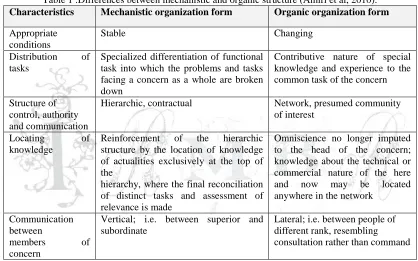
This study focuses on Organic and Mechanistic organizational structure. The Differences between mechanistic and organic structure are shown in the table 1.
Table 1 .Differences between mechanistic and organic structure (Amiri et al, 2010).
Characteristics Mechanistic organization form Organic organization form
Appropriate conditions
Stable Changing
Distribution of
tasks
Specialized differentiation of functional task into which the problems and tasks facing a concern as a whole are broken down
Contributive nature of special knowledge and experience to the common task of the concern
Structure of control, authority and communication
Hierarchic, contractual Network, presumed community
of interest
Locating of
knowledge
Reinforcement of the hierarchic
structure by the location of knowledge of actualities exclusively at the top of the
hierarchy, where the final reconciliation of distinct tasks and assessment of relevance is made
Omniscience no longer imputed to the head of the concern; knowledge about the technical or commercial nature of the here
and now may be located
anywhere in the network
Communication between
members of
concern
Vertical; i.e. between superior and subordinate
Lateral; i.e. between people of different rank, resembling consultation rather than command
Knowledge Management and Organizational Structure
Nonaka (1994) defines types of knowledge as tacit or explicit. Tacit knowledge is knowledge that is internal to a person, including cognitive learning, mental models, and technical skills. Explicit knowledge is knowledge that has been encoded into some media external to a person including paper documents, electronic databases and files, and the operating procedures of an enterprise. So this knowledge should be managed in the organization by using special methods. Walczak, (2005) presented a knowledge management structure and compare traditional hierarchical management structures and knowledge organization hierarchy.
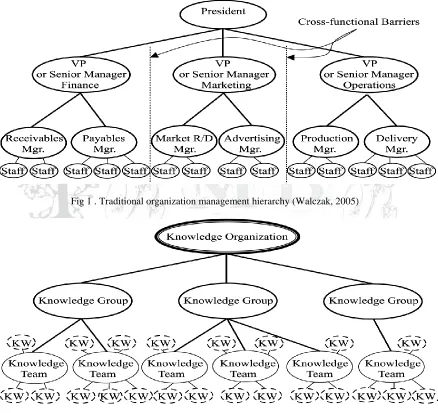
Traditional hierarchical management structures, as displayed in Fig. 1, allow vertical knowledge transfer through typical chain-of-command, but inhibit horizontal knowledge transfer that must cross the organization’s functional boundaries. Increasing competition and ever shortening rates of technological change necessitate better transfer of knowledge across organizational boundaries (Gopalakrishnan & Santoro, 2004), Therefore, organizations need the knowledge based structure which facilitate transferring and sharing knowledge across the organization.
A knowledge based organizational structure is displayed in Fig. 2. The knowledge organization of Fig. 2 is composed of knowledge groups that are composed of knowledge teams, which are built from knowledge workers selected for participation on a knowledge team due to their tacit knowledge and skills. Ideally, the knowledge workers on any knowledge team come from different organizational backgrounds and will bring a diversity of tacit knowledge and skills to the team. Adoption of a new organizational structure (the ―knowledge organization‖) or managerial methodology faces resistance within the organization. Resistance to change may be minimized by reducing the perception of change for the stakeholders. Initially, the knowledge team management structure may be aligned to an existing hierarchical management structure by aligning the knowledge groups with the existing functional areas of the organization including: accounting, marketing, production, and research similar to the idea of communities of practice (Ramezan, 2011).
Fig 1 . Traditional organization management hierarchy (Walczak, 2005)
Fig 2. Elements of the knowledge organization hierarchy (Walczak, 2005)
However, the scope of teams is limited to the organizational problem assigned to the team and results in limited knowledge sharing throughout the organization. The idea of teams and knowledge sharing must be extended to include all aspects of the organization. So based above discussion:
H1: organizational structure affects knowledge sharing.
On the other hand knowledge sharing between knowledge workers should give them some opportunities to create new knowledge so:
H2: organizational structure affects knowledge creation.
Because the role of a knowledge worker may be a new role within the organization, the development of a knowledge culture for sharing, dissemination, and utilization of knowledge will take some time. Motivating the desired knowledge culture and corresponding knowledge sharing behavior is facilitated through evaluating entire knowledge teams within the proposed knowledge management structure as a unit without reverting to individual praise or blame. Those teams that achieve a knowledge community approach to problem solving must be rewarded and acknowledged throughout the new ―knowledge organization‖ (O’Reilly and Pfeffer, 2000).knowledge utilization should be provided by managers in the organization. Organizational structure can help managers to create good condition for knowledge utilization in the organization. Structure of control, authority and communication should be important factors to develop knowledge utilization in the organization.
So based above discussion:
H3: organizational structure affects knowledge utilization.
Research Methodology
Sample and Data Collection
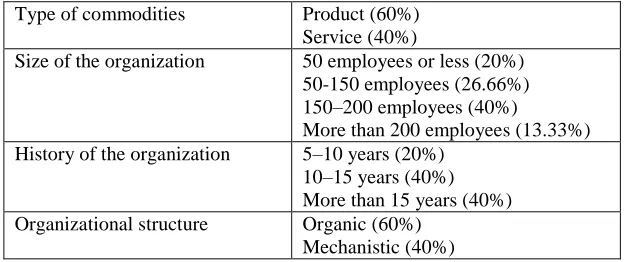
The population of this study is built on firms of Kaveh Industrial City. Kaveh Industrial City, measuring 3000 hectares, located 100 kilometer far from Tehran is one of the biggest industrial cities of Iran. This Industrial city has been converted to an international large pole of country for the settlement of 500 producing factories and residential complexes in this area with the population of 10000 persons as well as its geographical and strategic location, closeness to Tehran, simple access to other parts of Iran and transit roads, enjoying special infrastructural installations ,adjacency to Imam Khomeini airport and Salafchegan free zone, access to overall railroad & adjacency to Tehran-Saveh highway. In this study we chose a sample of 15 firms of this industrial city. These firms have knowledge management system and they are started their activities for more than five years. We chose a group of top and middle managers of different firms, the number of this group is 150 persons i-e. That the population of this study is 150 person. The youngest manager in the sample is 38 years old and the oldest manager is about 57 years of age. The managers are 42 years old on average. 70 of them are female and others are male. Other information about the sample is shown in the table 2.
Table 2. Distribution of sample
Type of commodities Product (60%)
Service (40%)
Size of the organization 50 employees or less (20%)
50-150 employees (26.66%) 150–200 employees (40%)
More than 200 employees (13.33%)
History of the organization 5–10 years (20%)
10–15 years (40%) More than 15 years (40%)
Organizational structure Organic (60%)
Mechanistic (40%)
Measurement
This study is a questionnaire study. The number of questions in the questionnaire is 17. We measured all variables on a five point Likert-scale with the levels 1 = ―strongly disagree‖ to 5 =―strongly agree‖. Because participants were Iranian, all the scales used were first translated into Farsi by a translator and then back translated into English by a bilingual, native English translator. The specific measures used in the analysis, along with sample items of the relevant constructs, are outlined.
Knowledge Sharing
Degree of sharing knowledge depends on constructs such as core knowledge sharing and knowledge sharing. Knowledge sharing was measured by four items: (1) We share information and knowledge necessary for the tasks, and (2) We improve task efficiency by sharing information and knowledge, (3) We promote sharing of information and knowledge with other teams, and (4) We developed information systems like intranet and electronic bulletin boards to share information and knowledge (Kun chang et al, 2005).
Knowledge Creation
To measure knowledge creation, seven items were needed. (1) I often use an electronic bulletin board to analyze tasks, and (2) My predecessor adequately introduced me to my tasks, (3) I fully understand the core knowledge necessary for my tasks, (4) I obtain useful information and suggestions from brainstorming meetings without spending too much time, (5) I am ready to accept new knowledge and apply it to my tasks when necessary, (6) I understand computer programs needed to perform the tasks and use them well, and (7) I search information for tasks from various knowledge sources administered by organization (Kun chang et al, 2005).
Knowledge Utilization
To measure knowledge utilization, six items were needed: (1) Team work is promoted by utilizing organization-wide information and knowledge, (2) EDI is extensively used to facilitate processing tasks, and (3) Work flow diagrams are required and used in performing tasks, (4) There exists a culture encouraging knowledge sharing, (5) There exist incentive and benefit policies for new idea suggestions through utilizing existing knowledge, and (6) There exist research and education programs (Kun chang et al, 2005).
Organizational Structure
In this study organizational structure classified to Organic and Mechanistic structure. The main question is ―how we classified the sample firms to organic and Mechanistic structure‖. For this purpose the top manager’s of each firm were interviewed to find out the organizational structure of the firms. We are according to obtain information of these interviews classified these firms.
Measurement Model
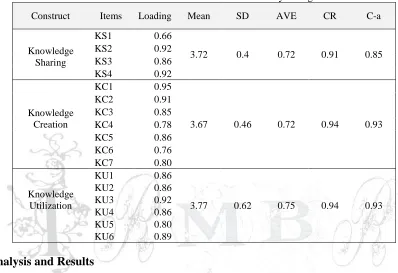
Measurement items in this research were adapted from prior research. Furthermore, we had five academics and five practitioners examine the measurement items for any possible problems concerning the measurement items. They did not report any problems. Thus, the measurement items in this research had verified content validity. For the next procedure we firstly performed a confirmatory factor analysis (CFA) to evaluate the overall measurement model. In order to evaluate the validity of measurement model, convergent validity was assessed. Convergent validity is the degree to which factors that are supposed to measure a single construct, agree with each other. We tested convergent validity by assessing factor loadings which should be significant and exceed 0.5, composite reliabilities which should exceed 0.6, and the average variance extracted (AVE) that should be more than 0.5 for all constructs (Fornell & Larcker,
1981). In our model, all the factor loadings and composite reliabilities fall in the acceptable ranges and are significant at the 0.01 level. Factor loadings range from 0.77 to 0.93. Composite reliabilities (CR) range from 0.88 to 0.97. AVE ranges from 0.67 to 0.81. The results show that our model meets the convergent validity criteria. We evaluated the internal reliability of scales by Cronbach’s alpha (C-a); this statistic ranges from 0.89 to 0.97, which are all higher than 0.7 (Nunnly & Bernstein, 1994). Table 3 shows the means, SD, factor loading, AVE, CR and C-a of every constructs.
Table 3 .Results of CFA and internal reliability testing
Construct Items Loading Mean SD AVE CR C-a
Knowledge Sharing
KS1 0.66
3.72 0.4 0.72 0.91 0.85
KS2 0.92
KS3 0.86
KS4 0.92
Knowledge Creation
KC1 0.95
3.67 0.46 0.72 0.94 0.93
KC2 0.91
KC3 0.85
KC4 0.78
KC5 0.86
KC6 0.76
KC7 0.80
Knowledge Utilization
KU1 0.86
3.77 0.62 0.75 0.94 0.93
KU2 0.86
KU3 0.92
KU4 0.86
KU5 0.80
KU6 0.89
Analysis and Results
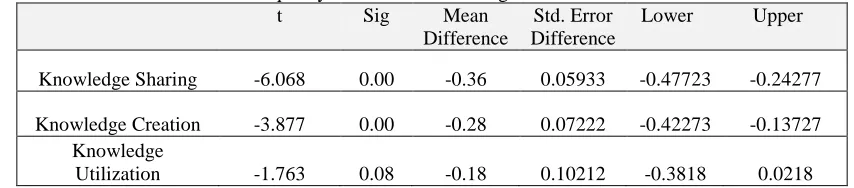
In this section the hypotheses were tested by statistical method, for this purpose we get benefit from SPSS program. Hypotheses 1, 2, 3 were tested by independent samples T test. The results were reported in the table 4 and 5. According to these tables mean of knowledge sharing and knowledge creation in the organic structure is more than mean of these variables in mechanistic structure, so we can say that organizational structure affects knowledge sharing and knowledge creation (P<0.05).So hypotheses H1 and H2 were
supported. The most important point is that t-test for Equality of Means was performed and it showed that there is no significant difference between organic and mechanistic structure in knowledge utilization. It means that H3 was not supported (P>0.05).
Table 4. Profiles of variables
organizational
structure
Mean Std.
Deviation
Std. Error Mean
Knowledge Sharing Mechanistic 3.54 0.45651 0.05271
Organic 3.90 0.23572 0.02722
Knowledge Creation Mechanistic 3.53 0.50115 0.05787
Organic 3.81 0.37428 0.04322
Knowledge Utilization Mechanistic 3.68 0.59069 0.06821
Organic 3.86 0.65819 0.076
Table 5. T-test for equality of means between organic and mechanistic structure
t Sig Mean
Difference
Std. Error Difference
Lower Upper
Knowledge Sharing -6.068 0.00 -0.36 0.05933 -0.47723 -0.24277
Knowledge Creation -3.877 0.00 -0.28 0.07222 -0.42273 -0.13727
Knowledge
Utilization -1.763 0.08 -0.18 0.10212 -0.3818 0.0218
Discussion
An important issue in adaption of knowledge management activities is preparation of the organization to create, adapt, utilize and share new knowledge in the organization. Preparing an organization for knowledge management initiatives means changing or adapting the organizational culture and structure to facilitate, support, and encourage the sharing, utilization, and creation of knowledge. Organizational culture is composed of business strategy, people, processes, and structure (Sanchez, 2004). So creating knowledge based organizational structure is very important for knowledge management process. The knowledge organization management structure presented in this article according to previous studies (Walczak, 2005; Ramezan, 2011) and it was tested in the knowledge based organization. The results show that organizational structure affects knowledge sharing and organic structure is better than mechanistic structure for sharing knowledge in the organization.
Considerable work is emerging on the science of knowledge flow within organizations. Nonaka (1994) considers knowledge flow through four steps. Since he states new knowledge is created only by individuals and is necessarily tacit in nature, this flow occurs through a process of socialization, with members of a community sharing their experiences and perspectives. In organic structure omniscience no longer imputed to the head of the concern; knowledge about the technical or commercial nature of the here and now may be located anywhere in the network (Amiri et al, 2010). Organic structure should give more facilities to workers to share their knowledge among knowledge teams than mechanistic structure.
Knowledge creation deals with a variety of knowledge, whether tacit or explicit and is accelerated by encouraging synergistic interrelations of individuals from diverse backgrounds. Choo & Bontis (2002) showed that knowledge creating is a process of knowledge conversion, knowledge integration and knowledge transfer also they believed that this process is dynamics.
The findings show that organizational structure affects knowledge creation and organic structure provides good condition for knowledge creation in the organization. In organic structure communication between members of different rank is lateral interaction and resembling consultation rather than command. So these interactions between workers can improve knowledge creation. On the other hand combining knowledge and acquiring or transferring knowledge across boundaries in the organic structure should create knowledge conversation and it increases creativity and innovation among employees to product new products. Meanwhile knowledge creation leads to intellectual capital improvement (Ramezan, 2011) it should be mentioned that intellectual capital has vital role in the knowledge based organization to sustain their organizational goals.
Findings noticed that there is no significant difference between organic and mechanistic organization in the
knowledge utilization and the H3 was not supported. Utilization of knowledge is very important factor for
all organizations and the mangers try to get benefit from existing knowledge in the organization. Team work activities, facilitate processing tasks, flow diagrams and new idea suggestions and education programs are performed in all organizations and it seems that organizational structure has not significant effect on these activities. It should be mentioned that all organizations traditionally spend a lot of money to
increase such activities in the organization. The most important point is that mechanistic organizations improve knowledge utilization by the location of knowledge of actualities exclusively at the top of the hierarchy, where the final reconciliation of distinct tasks and assessment of relevance is made.
Finally looking into the knowledge management from the organizational perspective showed organizational structure should facilitate knowledge sharing, knowledge creation and knowledge utilization to manage tacit knowledge.
To manage knowledge effectively having organic organizational structure is better than mechanistic one. On the other hand to better implement KM, the organizations should place the positions entitled with, for instance, chief knowledge officer (CKO), knowledge engineer, knowledge analyst, knowledge manager, knowledge steward to administrate knowledge management (KM). And along with the development of information technology (IT), Knowledge Management System (KMS) has been integrated in organizational structure to assist in managing knowledge through intranet or internet. Meanwhile these positions should work together as a network and they have to open new line of communications to create, share and utilize knowledge in different rank of organization.
Conclusion
Organizational knowledge is increasingly recognized as an important strategic asset for sustainable corporate competitive advantages. Our study provide evidence that organizational structure affect knowledge management process and improving knowledge management depend on organic structure facilitate knowledge creation and sharing. So we can expand our findings and conclude that organic structure leads to innovation, organizational learning and new capabilities for the firm. It should not be unmentioned that enhancing teamwork, decentralization of power and control and a higher level of informality should be useful for develop knowledge management activities. Knowledge Management is a systematical process which needs unique hardware and software so organizational strategies should be align with organizational structure to support this process.
Implications
Our findings should be very useful for all managers who plan knowledge management process such as chief knowledge officer (CKO), knowledge engineer and knowledge analyst. It should be also applicable for scholars and top managers who design organizational structure and determine organizational strategies. The managers of knowledge based organizations have to notice that facilitating the exchange of knowledge between deference ranks of organization is very important factor for running knowledge sharing and creation in the organization.
Suggestions
According to results to impalement successful knowledge management in the firms we suggest that:
- The organization structure should be networked to provide opportunities for employees to interact and
communicate with others, and support knowledge based actions. So human factors should be evaluated by managers in the organization and of employees’ organizational behavior from difference ranks of organizational structure should be studied.
- Organizational structure should be in line with the organization strategies, goals, mission and vision, and encourage employee to share information and create new knowledge. In the organizational structure, there should be a connection between individual improvement and organization improvement. System thinking approaches should be integrated into the structure.
- Educational programs should be run and enhancing team work abilities among employees.
References
Amiri, A. N., Ramezan, M., & Omrani, A. (2010). Studying the impacts of organizational organic structure on knowledge productivity effective factors case study: Manufacturing units in a domestic large industrial group. European Journal of Scientific Research, 40(1), 91–101.
Aranganathan, J. Lakshmi (2010). Knowledge Management in Indian Information Technology (IT) Organizations in Teaching Jobs. India, Cited 2010 Aug 15.
Becerra-Fernandez, I., & Sabherwal, R. (2001). Organizational knowledge management: A contingency perspective. Journal of Management Information Systems, 18(1), 23–55.
Choi, B., Lee, H (2003). An empirical investigation of KM styles and their effect on corporate performance, Information & Management 40,403–417.
Chen, J., Zhu, Z., & Xie, H. Y. (2004). Measuring intellectual capital: A new model and empirical study. Journal of Intellectual Capital, 5(1), 195–212.
Figallo,C. (2002). Building the Knowledge Management Network—best Practices: Tools and Techniques for Putting Conversation to Work. New York: John Wiley& Sons, Inc.
Fornell, C., & Larcker, D. F. (1981). Evaluating structural equation models with unobservable variables and measurement error. Journal of Marketing Research, 18, 39–50.
Firestone (2001). Key Issues in Knowledge Management, Knowledge and Innovation. Journal of the KMCI; 1(3), 8-38.
Gold, A.H., Malhotra, A., & Segars, A.H. (2001). Knowledge management: An organizational capabilities perspective. Journal of Management Information Systems, 18(1), 185–214.
Grant, R.M. (1996). Prospering in dynamically-competitive environments: organizational capability as knowledge integration, Organization Science 7 (4), 375–387.
Grant ,R.M. (1996) Toward a knowledge-based theory of the firm, Strategic Management Journal 17 (Winter Special Issue), 109–122.
Hendriks, P.H.J., D.J. Vriens (1999). Knowledge-based systems and knowledge management: friends or foes? Information & Management 35,113–125.
Hansen, M.T. (1999). The search-transfer problem: The role of weak ties in sharing knowledge across organization subunits. Administrative Science Quarterly, 44(1), 82–111.
Kucza (2001). Knowledge Management Process Model. VTT Electronics, Technical Research Centre of Finland p.11.
Krogh, G.V., Nonakam, I., &Aben, M. (2001). Making the most of your companies’ knowledge: A strategic framework. Long Range Planning, 34, 421– 439.
Kidwell, K.M. Vander Linde, and S.L. Johnson (2000). Applying corporate knowledge management practices in higher education, Journal of Educause Quarterly 4 , 28-33.
KunChang, Lee. Sangjae, Lee. In Won Kang (2005). KMPI: measuring knowledge management performance, Information & Management 42, 469–482.
Lee, H., & Choi, B. (2003). Knowledge management enablers, processes, and organizational performance: An integrative view and empirical examination. Journal of Management Information Systems, 20(1), 179–228.
Nunnly, J., & Bernstein, I. (1994). Psychometric theory (3rd ed.). New York: McGraw- Hill.
Nonaka, I. (1994), ―A dynamic theory of organizational knowledge creation‖, Organization Science, Vol. 5 No. 1, pp. 14-37.
O’Reilly, C.A. III and Pfeffer, J. (2000), Hidden Value: How Great Companies Achieve Extraordinary Results with Ordinary People, HBS Press, Boston, MA.
Ravishankar, M.N., Pan , Shan L.( 2008).The influence of organizational identification on organizational knowledge management (KM), Omega 36, 221 – 234.
Ramezan, Majid (2011). Intellectual capital and organizational organic structure in knowledge society: How are these concepts related?, International Journal of Information Management 31, 88–95.
Santoro, M, Gopalakrishnan, S.(2000). The institutionalization of knowledge transfer activities within industry-university collaborative ventures, Journal of Engineering Technology Management, Vol. 17, 299-319.
Szulanski, G. (1996). Exploring internal stickiness: Impediments to the transfer of best practice within the company. Strategic Management Journal, 17(10), 27– 43.
Simonin, B. (1997). The importance of collaborative know-how: An empirical test of the learning organization. Academy of Management Journal, 40(5), 509–533.
Sanchez, P. (2004), ―Defining corporate culture‖, Communication World, Vol. 21 No. 6, pp. 18-21.
Spender, J.C. (1996). Making knowledge the basis of a dynamic theory of the firm, Strategic Management Journal 17, 45–62.
Young-Chan, Lee & Sun-Kyu, Lee (2007). Capabilities, Processes, and Performance of Knowledge Management: A Structural Approach, Human Factors and Ergonomics in Manufacturing, Vol. 17 (1) 21–41.
Zander, D., & Kogut, B. (1995). Knowledge and the speed of the transfer and imitation of organizational capabilities: An empirical test. Organization Science, 6(1), 76–92.
Walczak, S. (2005). Organizational knowledge management structure, The Learning Organization, 12(4), 330–339.
Wheelright Steven, C., & Kim, B. C. (1992). Creating project plans to focus product development, Harvard Business Review, March–April.