Freedericksz transition threshold in nematic liquid crystals filled with ferroelectric nano-particles
V.Yu. Reshetnyaka, S.M. Shelestiuka and T.J. Sluckinb aPhysics Faculty, Kyiv National Taras Shevchenko University
Prospekt Glushkova, 03680 Kyiv, Ukraine phone : +38044 5264477, fax +38044 5250830, e-mails: [email protected], [email protected]
bSchool of Mathematics, University of Southampton,
Southampton SO17 1BJ, UK
phone: +4423 8059 3680, fax: +4423 8059 5147,
e-mail: [email protected]
Abstract
A key liquid crystalline property for electro-optic applications is the Frederiks threshold electric field. There has been recent experimental interest in liquid crystal-based colloidal suspensions in
which the colloidal nanoparticles both possess a permanent electric polarization and provide strong director anchoring on the particle surface. Such suspensions are sometimes known as Filled Liquid
Crystals. Our calculations suggest, in qualitative agreement with experiment, that filling the nematic liquid crystal with ferroelectric nanoparticles can significantly decrease the electric Frederiks transi-tion threshold field.
1. INTRODUCTION
In recent years there has been much interest in the physics and possible technological applications
of colloidal suspensions in a liquid crystal host [1]. As early as 1970, Brochard and de Gennes [2] pointed out that if the colloidal particles possess a permanent magnetic moment, then the orientation
of the local moments and the nematic director would be coupled, and this would give rise to some new and interesting physical effects. These systems are known as ferronematics, and further work, both experimental and theoretical, seems to confirm the picture predicted by Brochard and de
Gennes [3-5].
A system analogous to this, but in which potentially much more dramatic effects might be expected, involves ferroelectric rather than ferromagnetic colloidal particles. Such systems have
been fabricated by Reznikov et al [6], who have shown that at low concentrations, at least in some cases, these submicron colloids appear similar to a pure liquid crystal. In particular, the colloidal
particles do not scatter light in the manner that we might expect, and are therefore invisible. The particles are engineered so as to anchor the liquid crystal director strongly at the surface. It is this mechanism which seems to permit the intrinsic properties of the colloidal particles to influence the
liquid crystal matrix. A further unexpected observation is that in these suspensions the Frederiks transition threshold voltage decreases. If this phenomenon could be replicated, there would be
sig-nificant implications for the manufacture of very low power liquid crystal displays.
In this brief report we present a very simple theoretical model for electric Frederiks transi-tion threshold in the ferroelectric liquid crystal suspension. The theory uses the following minimal
postulates: (a) the colloidal particles do not affect the elastic and dielectric properties of liquid crys-talline host; (b) each particle possesses a permanent polarization which can only be parallel or
relaxed in a complete theory. Nevertheless they contain sufficient physics that they may be regarded as a sensible starting point. Our simple theory predicts that filling the nematic liquid crystal with
ferroelectric nanoparticles may significantly decrease the electric Fredericks transition threshold voltage.
2. BASIC EQUATIONS
We consider a uniform colloidal suspension of ferroelectric submicron particles embedded in a
liq-uid crystalline host. The liqliq-uid crystal is placed in a cell of thickness L with identical homogeneous (i.e. planar and uniform) boundary conditions at each wall. A voltage V is applied across the cell. We assume the coupling between the permanent polarization of the colloidal particle and the liquid
crystalline director to be sufficiently strong that the particle orientation is restricted to directions parallel or antiparallel to the local director. The theory is an extension of the basic ideas used by de
Gennes and coworkers [2], and is related to an analogous theory for ferronematics [5], with an addi-tional complication of local field effects.
A free energy functional for the suspension is minimized with respect to relevant variables.
The functional includes elastic, electric and entropy terms and takes the form:
el E entr
F =F +F +F , (1)
where
(
)
(
)
[
]
(
∫
+ ⋅ + ×= L
el K n K n n K n n dz
F
0
2 3
2 2
2
1 div curl curl 2
1 r r r r r
)
,
0 0
0 0
1 2
L L
E
F = −
∫
D E dzr r⋅ −∫
P Er r⋅ dz,(
)
0 ln ln
L entr
kT
F f
v ρ+ ρ+ ρ− ρ−
=
∫
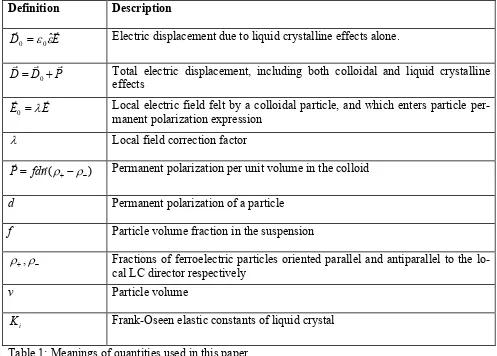
+ dz.Definition Description
E
Dr0 =ε0εˆr Electric displacement due to liquid crystalline effects alone.
0
D Dr = r +Pr Total electric displacement, including both colloidal and liquid crystalline
effects
0
Er =λEr Local electric field felt by a colloidal particle, and which enters particle
per-manent polarization expression λ Local field correction factor
(
Pr= fdnr ρ+−ρ−) Permanent polarization per unit volume in the colloid
d Permanent polarization of a particle
f Particle volume fraction in the suspension
ρ+,ρ− Fractions of ferroelectric particles oriented parallel and antiparallel to the lo-cal LC director respectively
v Particle volume
i
[image:4.595.63.560.71.427.2]K Frank-Oseen elastic constants of liquid crystal
Table 1: Meanings of quantities used in this paper.
The problem here is to minimize the functional (1) subject to the constraint of given voltage V ap-plied across the cells:
(2)
( )
∫
=LEz z dz V
0
Supposing the nematic to be an ideal dielectric, we write divDr =0 or Dz 0 z
∂ =
∂ (there is no
dependence on x and y coordinates.) Solving this, we obtain D=Dz =const. Likewise, combining
the conditions curlEr =0 the boundary conditions Ex =Ey =0 at the cell walls, yields the
intui-tively obvious Er =
(
0,0,E( )
z)
.( )
(
)
( )
(
)
(
( )
)
exp exp expdv E n
dv E n dv E n
λ β ρ
λ β λ β
±
± ⋅
=
⋅ + − ⋅
r r
r r r r , (3)
here 1 kT
β = .
Now we consider the splay Frederiks transition in the electric field. In this case the director
field is given by nr=
(
cos , 0,sinθ θ)
. From Table 1, the dielectric displacement can be written as:(
2)
( )
(
)
0 asin z sin
D=ε ε⊥+ε θ E θ + fd ρ+−ρ− θ (4)
Combining expressions (3) and the free energy functional (1) gives the following explicit
expression for the free energy functional (1), as a functional of the local director θ(z) and the local
electric field Ez
( )
z :(
)
(
)
( )
( )
(
)
(
( )
)
2 2 2 2 2
1 3 0
0
1 1
cos sin sin
2 2
ln exp sin exp sin
a z
L
z z
K K E
F d
f
dv E dv E
v
θ θ θ ε ε ε θ θ
λ β θ θ λ β θ θ
β ⊥ + ′ − + = − + −
∫
z − , (5)where eq.(2) connects the field Ez
( )
z to the voltage constraint.In what follows we assume that ferroelectric particles are small enough, so that λdvβE<<1.
Then the total free energy functional (5) to be minimized becomes
(
2 2)
2(
2)
2( )
1 3 0
0
1 1
cos sin sin
2 2
L
a z
F = K θ+K θ θ′ − ε ε⊥+ε θ E θ dz const
∫
% + , (6)where
(
)
2
0
1
a a
fd v
λ λ β
ε ε
ε
+
= +
% is the effective dielectric function anisotropy.
Using eq. (4) we rewrite the constraint (2) in the form
(
)
∫
+ + = ⊥ L a dz v fd D V 0 2 2 20 ε ε sin θ λ βsin θ
ε . (7)
( )
2 20 0
1 a
z
D fd v
E θ ε λ β θ
ε ε⊥ ε⊥ ε ε⊥
≈ − +
. (8)
The free energy functional simplifies to:
(
)
22 2 1 0 0 0 1 1 1 2 2 L
a fd v
K D
F θ ε λ λ β dz const
ε ε⊥ ε⊥ ε ε⊥
− ′ = − − − +
∫
θ2 , (9)
subject to the constraint:
∫
+ − = ⊥ ⊥ ⊥ La fd v dz
D V 0 2 0 2 0 1 θ ε ε β λ ε ε ε
ε . (10)
Trivially, eq. (10) also gives an expression for the displacement field as a function of V and the di-rector profile: + + =
∫
⊥ ⊥⊥ a fd v L dz
L L V D 0 2 0 2
0 1 1 θ
ε ε β λ ε ε ε ε (11)
We now substitute D into the free energy functional (9) and minimize the total free energy
func-tional with respect to the angle θ. The corresponding first integral of Euler-Lagrange equation has
the form:
const L
V
K a =
+ ′ 2 0 2 2
1θ ε ε~θ ; (12)
the additional conditions on the mid-plane of the cell, max
2 L
θ = θ
and 2 0
L
θ′ =
, are due to the
cell reflection symmetry of the cell with respect to z=L/2. The standard method of solving such
problems is to change the integration over the variable z in (10) to integration over θ using eq. (12).
The result is the following formula for the applied voltage:
∫
− + − = ⊥ ⊥ ⊥ max0 max2 2
where D is given by (11) with the same change in the integration variable. The Frederiks transition
threshold voltage is obtained by taking the limit θmax →0. It is easy to evaluate the integrals, find
the limit and obtain:
(
1)
~ 2
0
1 0
1
+ +
= =
λ βλ ε
ε π ε ε π
v fd
K K
V
a a
thr (13)
We note that, as we expect, in the absence of ferroelectric particles, and we then
re-cover the classical formula for Frederiks transition threshold voltage [7]:
0 f =
a classical
thr
K V
ε ε π
0 1
= (14)
3. ESTIMATES
We use experimental data for ferroelectric particles of Sn [6] diluted in the LC mixture
ZLI4801 (Merck) to make some estimates. Reznikov et al [6] report that their Sn colloidal
particles possess a spontaneous polarization of 14 µC/cm
6 2 2PS
1 . 5 = LC a
ε
3 26
10− m
6 2 2PS
2 at room temperature. For the liquid
crys-tal mixture ZLI4801, the dielectric function anisotropy . Substituting these parameters
into eqs. (13) and (14) yields V for a ferroelectric liquid crystal suspension with
particle volume fraction , particle volume , and supposing a local field
cor-rection factor
7 . 2 / thr ≈ classical
thr V
0.3 %
f = v=
1
λ= .
CONCLUSIONS
In this paper we have presented a simple theory of the Frederiks transition in a nematic liquid
crys-tal filled with ferroelectric nanoparticles. In our simple model, in the ferroelectric liquid cryscrys-tal sus-pension, the dependence of the angular distortion on the electric field is similar to that in the pure
system with effective dielectric function anisotropy given by
(
)
2
0
1
a a
fd v
λ λ β
ε ε
ε
+
= +
% . The theory
voltage [6]. We shall present elsewhere a more complete general effective medium theory for ferro-electric liquid crystal suspension. This theory takes account of the shape, polarizability and local
field anisotropy associated with ferroelectric particles. ACKNOWLEDGMENT
This work has been partially supported by the Royal Society of London through a joint
Anglo-Ukrainian cooperation grant.
REFERENCES
[1] Stark, H., Phys. Rep. 351, 387-474 (2001).
[2] Brochard F. and de Gennes P.-G., J. Physique (France), 31, 691 (1970)
[3] Liang, B.J., Chen, S.-H., Phys. Rev. A, 39, 1441 (1989).
[4] Burylov, S.V. , Zadorozhnii, V.I., Pinkevich, I.P., Reshetnyak, V.Yu. and Sluckin, T.J. JMMM,
252, 153 (2002).
[5] Zadorozhnii, V.I., Vasil’ev, A.N, Reshetnyak, V.Yu., Thomas K.S. and Sluckin, T.J. Europhys-ics Lett. (to be published 2006)
[6] Reznikov, Yu., Buchnev, O., Tereshchenko, O., Reshetnyak, V., Glushchenko, A. and West, J., Applied Physics Letters, 82, 1917-1919, (2003)