P A R T - O F - S P E E C H
T A G G I N G
U S I N G
A V A R I A B L E
M E M O R Y
M A R K O V
M O D E L
H i n r i c h S c h i i t z e C e n t e r for t h e S t u d y of L a n g u a g e a n d I n f o r m a t i o n
S t a n f o r d , C A 94305-4115 I n t e r n e t : s c h u e t z e ~ c s l i . s t a n f o r d . e d u
Y o r a m
S i n g e rI n s t i t u t e of C o m p u t e r S c i e n c e a n d C e n t e r for N e u r a l C o m p u t a t i o n H e b r e w U n i v e r s i t y , J e r u s a l e m 91904
I n t e r n e t : s i n g e r @ c s . h u j i . a c . i l
A b s t r a c t
We present a new approach to disambiguating syn- tactically ambiguous words in context, based on
Variable Memory Markov (VMM) models. In con- trast to fixed-length Markov models, which predict based on fixed-length histories, variable memory Markov models dynamically adapt their history length based on the training data, and hence may use fewer parameters. In a test of a VMM based tagger on the Brown corpus, 95.81% of tokens are correctly classified.
INTRODUCTION
Many words in English have several parts of speech
(POS). For example "book" is used as a noun in "She read a book." and as a verb in "She didn't book a trip." Part-of-speech tagging is the prob- lem of determining the syntactic part of speech of an occurrence of a word in context. In any given English text, most tokens are syntactically am- biguous since most of the high-frequency English words have several parts of speech. Therefore, a correct syntactic classification of words in context is important for most syntactic and other higher- level processing of natural language text.
Two stochastic methods have been widely used for POS tagging: fixed order Markov models and Bidden Markov models. Fixed order Markov models are used in (Church, 1989) and (Charniak et al., 1993). Since the order of the model is as- sumed to be fixed, a short memory (small order) is typically used, since the number of possible combi- nations grows exponentially. For example, assum- ing there are 184 different tags, as in the Brown corpus, there are 1843 = 6,229,504 different or- der 3 combinations of tags (of course not all of these will actually occur, see (Weischedel et al., 1993)). Because of the large number of param- eters higher-order fixed length models are hard to estimate. (See (Brill, 1993) for a rule-based approach to incorporating higher-order informa- tion.) In a Hidden i a r k o v Model (HMM) (Jelinek,
1985; Kupiec, 1992), a different state is defined for each POS tag and the transition probabilities and the output probabilities are estimated using the EM (Dempster et al., 1977) algorithm, which guarantees convergence to.a local minimum (Wu, 1983). The advantage of an HMM is that it can be trained using untagged text. On the other hand, the training procedure is time consuming, and a fixed model (topology) is assumed. Another dis- advantage is due to the local convergence proper- ties of the EM algorithm. The solution obtained depends on the initial setting of the model's pa- rameters, and different solutions are obtained for different parameter initialization schemes. This phenomenon discourages linguistic analysis based on the output of the model.
We present a new method based on vari- able memory Markov models (VMM) (Ron et al., 1993; Ron et al., 1994). The VMM is an approx- imation of an unlimited order Markov source. It can incorporate both the static (order 0) and dy- namic (higher-order) information systematically, while keeping the ability to change the model due to future observations. This approach is easy to implement, the learning algorithm and classifica- tion of new tags are computationally efficient, and the results achieved, using simplified assumptions for the static tag probabilities, are encouraging.
VARIABLE MEMORY MARKOV
MODELS
appears in information theory is the description length, as measured by the statistical predictabil- ity via the Kullback-Leibler (KL) divergence.
T h e VMM learning algorithm is based on min- imizing the statistical prediction error of a Markov model, measured by the instantaneous KL diver- gence of the following symbols, the current statisti- cal surprise of the model. T h e m e m o r y is extended precisely when such a surprise is significant, until the overall statistical prediction of the stochastic model is sufficiently good. For the sake of sim- plicity, a POS tag is termed a symbol and a se- quence of tags is called a string. We now briefly de- scribe the algorithm for learning a variable mem- ory Markov model. See (Ron et al., 1993; Ron et al., 1994) for a more detailed description of the algorithm.
We first introduce notational conventions and define some basic concepts. Let ]E be a finite al- phabet. Denote by ]~* the set of all strings over ]E. A string s, over L TM of length n, is denoted by s = s l s 2 . . . s n . We denote by • the e m p t y string. T h e length of a string s is denoted by Isl and the size of an alphabet ]~ is denoted by []~1. Let P r e f i x ( s ) = S l S 2 . . . S n _ l denote the longest prefix of a string s, and let P r e f i x * ( s )
denote the set of all prefixes of s, including the e m p t y string. Similarly, S u f f i x ( s ) = s 2 s z . . . s ,
and S u f f i x * (s) is the set of all suffixes of s. A set of strings is called a suffix (prefix) free set if, V s E
S : S N S u f f i z * ( s ) = $ ( S N P r e f i z * ( s ) = 0).
We call a probability measure P , over the strings in E* proper if P ( o ) = 1, and for every string s,
Y ~ , e r P(sa) = P(s). Hence, for every prefix free set S, ~'~,es P(s) < 1, and specifically for every integer n > O, ~'~se~, P(s) = 1.
A prediction suffix tree T over ]E, is a tree of degree I~l. T h e edges of the tree are labeled by symbols from ~E, such that from every internal node there is at most one outgoing edge labeled by each symbol. T h e nodes of the tree are labeled by pairs ( s , % ) where s is the string associated with the walk starting from t h a t node and end- ing in the root of the tree, and 7s : ~ ---* [0,1] is the output probability function of s satisfying )"]~o~ 7s (a) = 1. A. prediction suffix, tree. induces probabilities on arbitrarily long strings m the fol- lowing manner. T h e probability t h a t T gener- ates a string w = w t w 2 . . . w n in E~, denoted by PT(w), is IIn=l%.i-,(Wi), where s o = e, and for 1 < i < n - 1, s J is the string labeling the deep- est node reached by taking the walk corresponding to w l . . . w i starting at the root of T. By defini- tion, a prediction suffix tree induces a proper mea- sure over E*, and hence for every prefix free set of strings { w X , . . . , w m } , ~ = ~ PT(w i) < 1, and specifically for n > 1, then ~ , E ~ , PT(S) = 1.
A Probabilistic Finite Automaton (PFA) A is a 5-tuple (Q, E, r, 7, ~), where Q is a finite set of
n states, ~ is an alphabet of size k, v : Q x E --~ Q is the transition function, 7 : Q × E ~ [0,1] is the
output probability function, and ~r : Q ~ [0,1] is the probability distribution over the start states.
T h e functions 3' and r must satisfy the following requirements: for every q E Q, )-'~oe~ 7(q, a) = 1, and ~ e ~ O rr(q) = 1. T h e probability t h a t
A g e n e r a t e s a s t r i n g s = s l s 2 . . . s . E En
0 n
is PA(s) = ~-~qoEq lr(q ) I-Ii=x 7(q i-1, sl), where q i + l ~_ r(qi,si). 7" can be extended to be de- fined on Q x E* as follows: 7"(q, s t s 2 . . . s t ) =
7"(7"(q, s t . . . s t - x ) , s t ) = 7"(7"(q, P r e f i z ( s ) ) , s t ) .
T h e distribution over the states, 7r, can be re- placed by a single start state, denoted by e such that r(¢, s) = 7r(q), where s is the label of the state q. Therefore, r(e) = 1 and r ( q ) = 0 if q # e.
For POS tagging, we are interested in learning a sub-class of finite state machines which have the following property. Each state in a machine M belonging to this sub-class is labeled by a string of length at most L over E, for some L _> O. T h e set of strings labeling the states is suffix free. We require that for every two states qX, q2 E Q and for every symbol a E ~, if r(q 1,or) = q2 and qt is labeled by a string s 1, then q2 is labeled by a string s ~ which is a suffix of s 1 • or. Since the set of strings labeling the states is suffix free, if there exists a string having this property then it is unique. Thus, in order t h a t r be well defined on a given set of string S, not only must the set be suffix free, but it must also have the property, that for every string s in the set and every symbol a, there exists a string which is a suffix of scr. For our convenience, from this point on, if q is a state in Q then q will also denote the string labeling that state.
A special case of these a u t o m a t a is the case in which Q includes all I~l L strings of length L. These a u t o m a t a are known as Markov processes of order L. We are interested in learning a u t o m a t a for which the number of states, n, is much smaller than IEI L, which means that few states have long m e m o r y and most states have a short one. We re- fer to these a u t o m a t a as variable memory Markov
(VMM) processes. In the case of Markov processes of order L, the identity of the states (i.e. the iden- tity of the strings labeling the states) is known and learning such a process reduces to approximating the o u t p u t probability function.
stage we can transform the tree into a variable m e m o r y Markov process. The key idea is to iter- atively build a prediction tree whose probability measure equals the empirical probability measure calculated from the sample.
We start with a tree consisting of a single node and add nodes which we have reason to be- lieve should be in the tree. A node as, must be added to the tree if it statistically differs from its parent node s. A natural measure to check the statistical difference is the
relative entropy
(also known as the Kullback-Leibler (KL) divergence) (Kullback, 1959), between the conditional proba- bilitiesP(.Is)
andP(.las).
Let X be an obser- vation space and P1, P2 be probability measures over X then the KL divergence between P1 andP1 x
P2 is, D L(PIlIP )= • In
our case, the KL divergence measures how much additional information is gained by using the suf- fix ~rs for prediction instead of the shorter suffix s. There are cases where the statistical difference is large yet the probability of observing the suffix a s itself is so small that we can neglect those cases. Hence we weigh the statistical error by the prior probability of observing as. T h e statistical error measure in our case is,
Err(as, s)
=
P(crs)DgL (P(.las)llP(.ls))
= P ( a s ) P ( a ' l a s ) log
:
~,0,~ P(asa')log
p(P/s°;p'() ) Therefore, a nodeas
is added to the tree if the sta- tistical difference (defined byErr(as, s))
between the node and its parrent s is larger than a prede- termined accuracy e. The tree is grown level by level, adding a son of a given leaf in the tree when- ever the statistical error is large. The problem is that the requirement that a node statistically dif- fers from its parent node is a necessary condition for belonging to the tree, but is not sufficient. The leaves of a prediction suffix tree must differ from their parents (or they are redundant) but internal nodes might not have this property. Therefore, we must continue testing further potential descen- dants of the leaves in the tree up to depth L. In order to avoid exponential grow in the number of strings tested, we do not test strings which belong to branches which are reached with small prob- ability. T h e set of strings, tested at each step, is denoted by S, and can be viewed as a kind of frontier of the growing tree T.U S I N G A V M M F O R
P O S
T A G G I N GWe used a tagged corpus to train a VMM. T h e syntactic information, i.e. the probability of a spe-
cific word belonging to a tag class, was estimated using
maximum likelihood
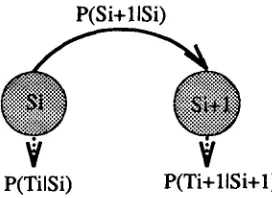
estimation from the in- dividual word counts. T h e states and the transi- tion probabilities of the Markov model were de- termined by the learning algorithm and tag out- put probabilities were estimated from word counts (the static information present in the training cor- pus). T h e whole structure, for two states, is de- picted in Fig. 1.Si
andSi+l
are strings of tags cor- responding to states of the automaton.P(ti[Si)
is the probability that tag
ti
will be o u t p u t by state Si andP(ti+l]Si+l)
is the probability that the next tagti+l
is the o u t p u t of stateSi+l.
P(Si+llSi)
V
7
P(TilSi) P ( T i + I l S i + I ) Figure 1: T h e structure of the VMM based POS tagger.
When tagging a sequence of words Wl,,, we want to find the tag sequence
tl,n
that is most likely forWl,n.
We can maximize the joint proba- bility of wl,, and tl,n to find this sequence: 1T(Wl,n)
= argmaxt,, P(tl,nlWl,n)
P(t,..,~,,.)
= arg maxt~,. P(wl,.) = arg
maxt~,.P(tl,.,wl,. )
P(tl,.,
Wl,.) can be expressed as a product of con- ditional probabilities as follows:P ( t l , . , Wl,.) =
P(ts)P(wl Itl)P(t~ltl, wl)e(w21tl,2, wl)
... P(t.
It 1,._ 1,Wl,.-1)P(w.
It1,., w l , . - 1)= f i P(tiltl,i-1, wl,i-1)P(wiltl,i,
Wl,/-1)
i = 1
With the simplifying assumption that the proba- bility of a tag only depends on previous tags and that the probability of a word only depends on its tags, we get:
P(tl,n, wl,.) = fix P(tiltl,i-1) P(wilti)
i = 1
Given a variable m e m o r y Markov model M,
[image:3.612.361.497.206.305.2]Si = r(e, tx,i), since the dynamics of the sequence are represented by the transition probabilities of the corresponding automaton. The tags tl,n for a sequence of words wt,n are therefore chosen ac- cording to the following equation using the Viterbi algorithm:
t%
7-M(Wl,n) -- arg maxq.. H P ( t i l S i - l ' M)P(wilti)
i=1
We estimate P(wilti) indirectly from P(tilwi) us-
ing Bayes' Theorem:
P(wilti) = P(wi)P(tilwi)
P(ti)
The terms P(wi) are constant for a given sequence
wi and can therefore be omitted from the maxi- mization. We perform a maximum likelihood es- timation for P(ti) by calculating the relative fre- quency of ti in the training corpus. The estima- tion of the static parameters P(tilwi) is described in the next section.
We trained the variable memory Markov model on the Brown corpus (Francis and Ku~era, 1982), with every tenth sentence removed (a total of 1,022,462 tags). The four stylistic tag modifiers "FW" (foreign word), "TL" (title), "NC" (cited word), and "HL" (headline) were ignored reduc- ing the complete set of 471 tags to 184 different tags.
The resulting automaton has 49 states: the null state (e), 43 first order states (one symbol long) and 5 second order states (two symbols long). This means that 184-43=141 states were not (statistically) different enough to be included as separate states in the automaton. An analy- sis reveals two possible reasons. Frequent symbols such as "ABN" ("half", "all", "many" used as pre- quantifiers, e.g. in "many a younger man") and "DTI" (determiners that can be singular or plu- ral, "any" and "some") were not included because they occur in a variety of diverse contexts or often precede unambiguous words. For example, when tagged as "ABN .... half", "all", and "many" tend to occur before the unambiguous determiners "a",
"an" and "the".
Some rare tags were not included because they did not improve the optimization criterion, min- imum description length (measured by the KL- divergence). For example, "HVZ*" ("hasn't") is not a state although a following "- ed" form is al- ways disambiguated as belonging to class "VBN" (past participle). But since this is a rare event, de- scribing all "HVZ* VBN" sequences separately is cheaper than the added complexity of an automa- ton with state "HVZ*". We in fact lost some ac- curacy in tagging because of the optimization cri- terion: Several "-ed" forms after forms of "have" were mistagged as "VBD" (past tense).
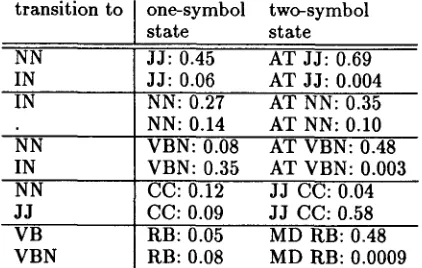
transition to one-symbol two-symbol state state NN JJ: 0.45 AT JJ: 0.69 IN JJ: 0.06 AT JJ: 0.004
IN NN: 0.27 AT NN: 0.35
NN: 0.14 AT NN: 0.10 NN
IN NN JJ
V B V B N
VBN: 0.08 AT VBN: 0.48 VBN: 0.35 AT VBN: 0.003 CC: 0.12 JJ CC: 0.04 CC: 0.09 JJ CC: 0.58 RB: 0.05 MD RB: 0.48 RB: 0.08 MD RB: 0.0009 Table 1: States for which the statistical predic- tion is significantly different when using a longer suffix for prediction. Those states are identified automatically by the VMM learning algorithm. A better prediction and classification of POS-tags is achieved by adding those states with only a small increase in the computation time.
The two-symbol states were "AT JJ", "AT NN", "AT VBN", "JJ CC", and "MD RB" (ar- ticle adjective, article noun, article past partici- ple, adjective conjunction, modal adverb). Ta- ble 1 lists two of the largest differences in transi- tion probabilities for each state. The varying tran- sition probabilities are based on differences be- tween the syntactic constructions in which the two competing states occur. For example, adjectives after articles ("AT JJ") are almost always used attributively which makes a following preposition impossible and a following noun highly probable, whereas a predicative use favors modifying prepo- sitional phrases. Similarly, an adverb preceded by a modal ("MD RB") is followed by an infinitive ("VB") half the time, whereas other adverbs oc- cur less often in pre-infinitival position. On the other hand, a past participle is virtually impossi- ble after "MD RB" whereas adverbs that are not preceded by modals modify past participles quite often.
While it is known that Markov models of order 2 give a slight improvement over order-1 models (Charniak et al., 1993), the number of parameters in our model is much smaller than in a full order-2 Markov model (49"184 = 9016 vs. 184"184"184 -- 6,229,504).
E S T I M A T I O N O F T H E S T A T I C
P A R A M E T E R S
[image:4.612.333.544.44.178.2]to use the m a x i m u m likelihood estimator:
p(ti[w j) = C( ti, w i)
c(w )
where
C(t i, w j)
is the n u m b e r of times t i is tagged as w~ in the training text and C(wJ) is the num- ber of times w/ occurs in the training text. How- ever, some form of s m o o t h i n g is necessary, since any new text will contain new words, for which C ( w j) is zero. Also, words t h a t are rare will only occur with some of their possible parts of speech in the training text. One solution to this p r o b l e m is G o o d - T u r i n g estimation:p(tilwj) _ C(t', wJ) + 1
c(wJ) + I
where I is the n u m b e r of tags, 184 in our case. It turns out t h a t G o o d - T u r i n g is not appropri- ate for our problem. T h e reason is the distinction between closed-class and open-class words. Some syntactic classes like verbs and nouns are produc- tive, others like articles are not. As a consequence, the probability t h a t a new word is an article is zero, whereas it is high for verbs and nouns. We need a s m o o t h i n g scheme t h a t takes this fact into account.
Extending an idea in (Charniak et al., 1993), we e s t i m a t e the probability of
tag conversion
to find an adequate s m o o t h i n g scheme. Open and closed classes differ in t h a t words often add a tag from an open class, but rarely from a closed class. For example, a word t h a t is first used as a noun will often be used as a verb subsequently, but closed classes such as possessive pronouns ( " m y " , "her", "his") are rarely used with new syntactic categories after the first few thousand words of the Brown corpus. We only have to take stock of these "tag conversions" to m a k e informed predictions on new tags when confronted with unseen text. For- mally, let W] ' ' ~ be the set of words t h a t have been seen with t i, but not with t k in the training text up to word wt. Then we can estimate the probability t h a t a word with tag t i will later be seen with tag t ~ as the proportion of words allowing tag t i but not t k t h a t later add tk:P~m(i --* k) =
I { n l l < n < m ^ w n E W I" i ~ k OW,,- t , ~ k
^t~=t~}l
iw~'.-kl
This formula also applies to words we h a v e n ' t seen so far, if we regard such words as having occurred with a special tag "U" for "unseen". (In this case, W ~ '-'k is the set of words t h a t h a v e n ' t occurred up to
l.) PI,n(U ---* k)
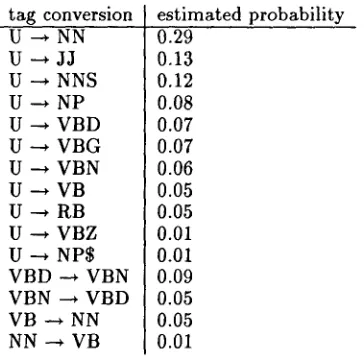
then estimates the probability t h a t an unseen word has tag t k. Table 2 shows the estimates of t a g conversion we derived from our training text for 1 = 1 0 2 2 4 6 2 - 100000, m =1022462, where 1022462 is the n u m b e r of words in the training text. To avoid sparse d a t a problems we assumed zero probability for types of tag con- version with less than 100 instances in the training set.
tag conversion U --* NN U ~ J J U --~ NNS U --* NP U ~ VBD U ~ V B G U --~ VBN U --~ VB U---, RB U ~ VBZ U --* N P $ VBD -~ VBN VBN --* VBD VB --* NN NN ~ VB
estimated probability 0.29
0.13 0.12 0.08 0.07 0.07 0.06 0.05 0.05 0.01 0.01 0.09 0.05 0.05 0.01
Table 2: E s t i m a t e s for tag conversion
Our s m o o t h i n g scheme is then the following heuristic modification of Good-Turing:
C(t i, W j) -k
~k,ETi
Rim(k1 --+ i)
g(tilwi) = C(wi) + Ek,ETi,k2E T Pam(kz --" ks)
where Tj is the set of tags t h a t w / h a s in the train- ing set and T is the set of all tags. This scheme has the following desirable properties:
• As with Good-Turing, s m o o t h i n g has a small ef- fect on estimates t h a t are based on large counts. • T h e difference between closed-class and open- class words is respected: T h e probability for conversion to a closed class is zero and is not affected by smoothing.
• Prior knowledge a b o u t the probabilities of con- version to different t a g classes is incorporated. For example, an unseen word w i is five times as likely to be a noun t h a n an adverb. Our esti- m a t e for P ( t i ] w j ) is correspondingly five times higher for "NN" t h a n for "RB".
A N A L Y S I S O F R E S U L T S
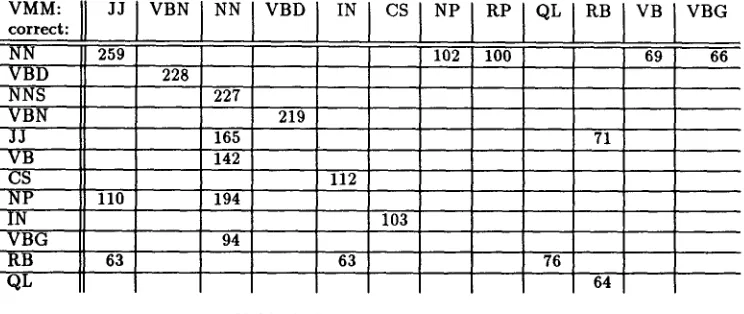
Our result on the test set of 114392 words (the tenth of the Brown corpus not used for training) was 95.81%. Table 3 shows the 20 m o s t frequent errors.
[image:5.612.335.517.96.274.2]VMM:
c o r r e c t :
N N V B D N N S V B N JJ V B "'CS ' N P
IN VBG RB QL
]1 JIVBNI NIVB°I INI °sI
259 102
110
63
227 165 142 194 94
219
112
63 103
RPIQLI B
100
71
76
Table 3: Most c o m m o n errors.
VB I VBG
69 66
* the Cuban fiasco and the Communist military victories in Laos
• to increase public awareness of the movement • the best h o m e r u n hitter
T h e words "public" and "communist" can be used as adjectives or nouns. Since in the above sen- tences an adjective is syntactically more likely, this was the tagging chosen by the VMM. T h e noun "homerun" didn't occur in the training set, therefore the priors for unknown words biased the tagging towards adjectives, again because the po- sition is more typical of an adjective than of a
n o u n .
Two examples of the second most common er- ror (tagging past tense forms ( " V B D " ) as past participles ( " V B N " ) ) are "called" and "elected" in the following sentences:
• the p a r t y called for government operation of all utilities
• When I come back here after the November elec- tion you'll think, you're my m a n - elected. Most of the V B D / V B N errors were caused by words t h a t have a higher prior for "VBN" so that in a situation in which both forms are possible ac- cording to local syntactic context, "VBN" is cho- sen. More global syntactic context is necessary to find the right tag "VBD" in the first sentence. T h e second sentence is an example for one of the tagging mistakes in the Brown corpus, "elected" is clearly used as a past participle, not as a past tense form.
C o m p a r i s o n w i t h o t h e r R e s u l t s
Charniak et al.'s result of 95.97% (Charniak et al., 1993) is slightly better than ours. This difference is probably due to the omission of rare tags that permit reliable prediction of the following tag (the case of " H V Z . " for "hasn't").
Kupiec achieves up to 96.36% correctness (Kupiec, 1992), without using a tagged corpus for training as we do. But the results are not eas- ily comparable with ours since a lexicon is used that lists only possible tags. This can result in in- creasing the error rate when tags are listed in the lexicon t h a t do not occur in the corpus. But it can also decrease the error rate when errors due to bad tags for rare words are avoided by looking them up in the lexicon. Our error rate on words that do not occur in the training text is 57%, since only the general priors are used for these words in decod- ing. This error rate could probably be reduced substantially by incorporating outside lexical in- formation.
D I S C U S S I O N
While the learning algorithm of a VMM is efficient and the resulting tagging algorithm is very simple, the accuracy achieved is rather moderate. This is due to several reasons. As mentioned in the intro- ductory sections, any finite m e m o r y Markov model cannot capture the recursive nature of natural lan- guage. T h e VMM can a c c o m m o d a t e longer sta- tistical dependencies than a traditional full-order Markov model, but due to its Markovian nature long-distance statistical correlations are neglected. Therefore, a VMM based tagger can be used for pruning m a n y of the tagging alternatives using its prediction probability, but not as a complete tag- ging system. Furthermore, the VMM power can be better utilized in low level language process- ing tasks such as cleaning up corrupted text as demonstrated in (Ron et al., 1993).
[image:6.612.128.500.36.193.2]Another drawback of the current tagging scheme is the independence assumption of the un- derlying tags and the observed words, and the ad- hoc estimation of the static probabilities. We are pursuing a systematic scheme to estimate those probabilities based on Bayesian statistics, by as- signing a discrete probability distribution, such as the Dirichlet distribution (Berger, 1985), to each tag class. The a-posteriori probability estimation of the individual words can be estimated from the word counts and the tag class priors. Those priors can be modeled as a mixture of Dirichlet distribu- tions (Antoniak, 1974), where each mixture com- ponent would correspond to a different tag class. Currently we estimate the state transition prob- abilities from the conditional counts assuming a uniform prior. The same technique can be used to estimate those parameters as well.
A C K N O W L E D G M E N T
Part of this work was done while the second au- thor was visiting the Department of Computer and Information Sciences, University of California, Santa-Cruz, supported by NSF grant IRI-9123692. We would like to thank Jan Pedersen and Naf- tali Tishby for helpful suggestions and discussions of this material. Yoram Singer would like to thank the Charles Clore foundation for supporting this research. We express our appreciation to faculty and students for the stimulating atmosphere at the 1993 Connectionist Models Summer School at which the idea for this paper took shape.
R e f e r e n c e s
N. Abe and M. Warmuth, On the computational complexity of approximating distributionsby probabilistic automata, Machine Learning, Vol. 9, pp. 205-260, 1992.
C. Antoniak, Mixture of Dirichlet processes with applications to Bayesian nonparametric prob- lems, Annals of Statistics, Vol. 2, pp. 1152- 174, 1974.
J. Berger, Statistical decision theory and Bayesian analysis, New-York: Springer-Verlag, 1985.
E. Brill. Automatic grammar induction and pars- ing free text: A transformation-based ap- proach. In Proceedings of ACL 31, pp. 259- 265, 1993.
E. Charniak, Curtis Hendrickson, Neil Jacobson, and Mike Perkowitz, Equations for Part-of- Speech Tagging, Proceedings of the Eleventh National Conference on Artificial Intelligence, pp. 784-789, 1993.
K.W. Church, A Stochastic Parts Program and Noun Phrase Parser for Unrestricted Text,
Proceedings of ICASSP, 1989.
A. Dempster, N. Laird, and D. Rubin, Maximum Likelihood estimation from Incomplete Data via the EM algorithm, J. Roy. Statist. Soc., Vol. 39(B), pp. 1-38, 1977.
W.N. Francis and F. Ku~era, Frequency Analysis of English Usage, Houghton Mifflin, Boston MA, 1982.
F. Jelinek, Robust part-of-speech tagging using a hidden Markov model, IBM Tech. Report, 1985.
M. Kearns, Y. Mansour, D. Ron, R. Rubinfeld, R. Schapire, L. Sellie, On the Learnability of Discrete Distributions, The 25th Annual ACM Symposium on Theory of Computing, 1994. S. Kullback, Information Theory and Statistics,
New-York: Wiley, 1959.
J. Kupiec, Robust part-of-speech tagging using a hidden Markov model, Computer Speech and Language, Vol. 6, pp. 225-242, 1992.
L.R. Rabiner and B. H. Juang, An Introduction to Hidden Markov Models, IEEE ASSP Mag- azine, Vol. 3, No. 1, pp. 4-16, 1986.
J. Rissanen, Modeling by shortest data discription,
Automatica, Vol. 14, pp. 465-471, 1978. J. Rissanen, Stochastic complexity and modeling,
The Annals of Statistics, Vol. 14, No. 3, pp. 1080-1100, 1986.
J. Rissanen and G. G. Langdon, Universal model- ing and coding, IEEE Trans. on Info. Theory, IT-27, No. 3, pp. 12-23, 1981.
D. Ron, Y. Singer, and N. Tishby, The power of Amnesia, Advances in Neural Information Processing Systems 6, 1993.
D. Ron, Y. Singer, and N. Tishby, Learning Probabilistic Automata with Variable Memory Length, Proceedings of the 1994 Workshop on Computational Learning Theory, 1994. Y. Singer and N. Tishby, Inferring Probabilis-
tic Acyclic Automata Using the Minimum Description Length Principle, Proceedings of IEEE Intl. Symp. on Info. Theory, 1994. R. Weischedel, M. Meteer, R. Schwartz, L.
Ramshaw, and :I. Palmucci. Coping with am- biguity and unknown words through prob- abilistic models. Computational Linguistics,
19(2):359-382, 1993.