MIMO-Assisted Space-Code-Division
Multiple-Access: Linear Detectors and Performance
Over Multipath Fading Channels
Lie-Liang Yang
, Senior Member, IEEE
Abstract—In this contribution, we propose and investigate a multiple-input–multiple-output space-division, code-division multiple-access (MIMO SCDMA) scheme. The main objec-tive is to improve the capacity of the existing direct-sequence (DS)-CDMA systems, for example, for supporting an increased number of users, by deploying multiple transmit and receive antennas in the corresponding systems and by using some ad-vanced transmission and detection algorithms. In the proposed MIMO SCDMA system, each user can be distinguished jointly by its spreading code signature and its unique channel impulse response (CIR) transfer function referred to as spatial signature. Hence, the number of users might be supported by the MIMO SCDMA system and the corresponding achievable performance are determined by the degrees of freedom provided by both the code signatures and the spatial signatures, as well as by how efficiently the degrees of freedom are exploited. Specifically, the number of users supported by the proposed MIMO SCDMA can be significantly higher than the number of chips per bit, owing to the employment of space-division. In this contribution, space–time spreading is employed for configuring the transmitted signals. Three types of low-complexity linear detectors, namely, correlation, decorrelating, and minimum mean-square error (MMSE) are considered for detecting the MIMO SCDMA signals. The bit-error rate performance of the MIMO SCDMA system associated with these linear detectors are evaluated by simulations, when assuming that the MIMO SCDMA signals are transmitted over multipath Rayleigh-fading channels. Our study and simu-lation results show that MIMO SCDMA assisted by multiuser detection is capable of facilitating joint space–time despreading, multipath combining, and receiver diversity combining, while simultaneously suppressing the multiuser interfering signals.
Index Terms—Code-division multiple access (CDMA), multi-path-fading channels, multiple-input–multiple-output (MIMO), multiuser detection, space-division multiple access (SDMA), space–time spreading (STS).
I. INTRODUCTION
I
N WIRELESS communications, multiple-input–mul-tiple-output (MIMO) systems equipped with multiple antennas at both the transmitter and receiver hold the promise of attaining substantial spectral efficiency improvements rela-tive to what is achieved today [1]–[6]. Recently, MIMO systems have attracted intense research interests in the context of both MIMO theory and applications, as indicated, for example, by the special issues of [7]–[9] and the references therein. It is widely recognized that MIMO systems can be employed forManuscript received September 29, 2004; revised June 12, 2005.
The author is with the School of Electronics and Computer Science, Univer-sity of Southampton, SO17 1BJ, U.K. (e-mail: [email protected]).
Digital Object Identifier 10.1109/JSAC.2005.858892
achieving a high capacity [3], [5], [6] and a high diversity order [10], [11], for mitigating the effects of various types of interfering signals [12]–[14], and for supporting space-division multiple-access (SDMA) [14]–[17].
In wireless communications direct-sequence code-division multiple access (DS-CDMA) has been a typical multiple-access scheme in the second and third generations of wireless com-munications systems, and without any doubt, it will constitute an important candidate in the future generations of wireless communications systems. Hence, in this contribution, the ap-plication of MIMO principles in conjunction with DS-CDMA is investigated. Specifically, in the considered MIMO assisted DS-CDMA system, each of the mobile users employs multiple transmit antennas for achieving transmit diversity, with the aid of the space–time spreading (STS) schemes proposed in [18]. The common base-station (BS) receiver also employs multiple receive antennas, which might be functioned for multiple objectives, such as to achieve receiver diversity, to suppress various types of interfering signals, to support SDMA, etc. In the MIMO DS-CDMA system considered, each user is in corre-spondence with a unique DS spreading code, which is referred to as code signature, and also with a unique MIMO channel impulse response (CIR) transfer function referred to as spatial signature. Hence, a mobile user signal can be jointly distin-guished by its code signature and spatial signature. Therefore, MIMO DS-CDMA can be termed as a multiple-access scheme using both code-division and space-division and, hence, we use the abbreviation of MIMO SCDMA for simplicity.
In [18], it has been demonstrated that the STS scheme is an open-loop transmit diversity scheme designed specifically for the CDMA systems employing DS spreading [18], [19]. The downlink performance of the CDMA systems using STS has been investigated in [18], when assuming orthogonal spreading codes and when the channel is modeled either as a flat or as a frequency-selective Rayleigh-fading channel in the absence of multiuser interference. By contrast, in [19], a broadband mul-ticarrier DS-CDMA (MC DS-CDMA) scheme using STS has been proposed for downlink transmission and its performance has been investigated, when communicating over frequency-se-lective fading channels. Furthermore, in [20], a STS assisted downlink transmission scheme has been designed, which con-siders jointly the degrees of freedom provided by both the time-domain and the space-time-domain in a MIMO DS-CDMA systems. The performance of the proposed scheme has been investigated associated with various detection schemes, when the channel from any of the transmit antennas to any of the receive antennas
is modeled as independent flat fading channel. The analysis and results in [18]–[20] show that the STS scheme constitutes an at-tractive transmit diversity scheme, which is capable of attaining the maximal achievable transmit diversity gain without using extra spreading codes and without an increased transmit power. In this contribution, the MIMO SCDMA system using STS is investigated, when considering the uplink transmis-sion in a cellular-style system, since DS-CDMA has been mainly deployed in cellular systems. Specifically, the perfor-mance of a range of linear single-user and multiuser detectors (MUDs), namely, correlation, decorrelating, and minimum mean-square error (MMSE) detectors [21], for the synchronous MIMO SCDMA systems is investigated, when communicating over multipath Rayleigh-fading channels. Furthermore, it is well-recognized that, when multipath fading channel is consid-ered, the DS-CDMA system using orthogonal spreading codes performs not as good as the system using some other types of nonorthogonal spreading codes, such as Gold sequences [1]. This is because, except the purely synchronous case, orthogonal spreading codes have an unsatisfactory correlation properties. Therefore, instead of using orthogonal spreading codes for the STS in the context of downlink case, in this contribution Gold sequences [22] are used for the STS in the considered MIMO SCDMA system.
The remainder of this contribution is organized as follows. Section II describes the MIMO SCDMA system using STS and the representation of the MIMO space–time DS-CDMA signal. Section III considers the linear detection of the MIMO SCDMA signals, where three linear detectors, namely, correlation, decor-relating, and MMSE that have been widely investigated in the literature, are extended for detecting the MIMO SCDMA sig-nals. In Section IV, we provide a range of simulation results and, finally, in Section V, we present our conclusions.
II. SYSTEMDESCRIPTION
A. Transmitted Signal
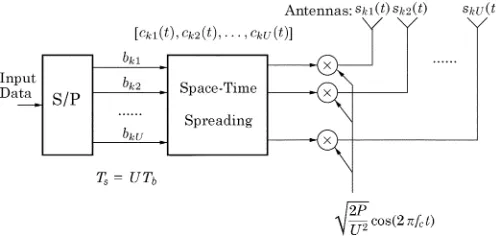
The MIMO system considered in this paper consists of transmit antennas and receive antennas. The transmitter schematic diagram of the th user is shown in Fig. 1, where real-valued data symbols using binary phase-shift keying (BPSK) baseband modulation and real-valued spreading [18] were assumed. Note that the analysis in this contribution can be extended to the MIMO SCDMA systems using complex-valued data symbols, as well as complex-valued spreading. As shown in Fig. 1, at the transmitter side, the binary input data stream having a bit duration of is serial-to-parallel (S-P) converted to parallel substreams. The new bit duration of each parallel substream or the symbol duration becomes . After S-P conversion, the parallel bits are direct-sequence spread using the STS schemes proposed in [18] with the aid of pseudo-noise (PN) spreading sequences having a period of
[image:2.594.303.551.64.184.2], where represents the number of chips per bit time-duration and is the chip-duration of the PN spreading sequence. As seen in Fig. 1, following STS, the parallel signals are mapped to the transmit antennas, where the parallel signals are carrier modulated and transmitted by the corresponding antennas.
Fig. 1. Transmitter block diagram of the MIMO SCDMA system using space–time spreading.
As described above, we have assumed that the number of par-allel data substreams, the number of PN spreading sequences used by the STS block of Fig. 1, and the number of transmit antennas are the same value, namely, . These assumptions are supported by the research in [18], which shows that the STS scheme satisfying the above-mentioned conditions is capable of providing maximal transmit diversity without requiring extra STS spreading codes. Note that for the specific values of , 4, the above mentioned attractive STS schemes have been spec-ified in [18]. In this contribution, we only investigate these at-tractive STS schemes.
For the sake of easy to follow, below the MIMO SCDMA system using two transmit antennas is first used as an example, in order to describe the principles of the MIMO SCDMA sys-tems using STS. This special example is then extended to the general cases, where transmit antennas are employed by the MIMO SCDMA system.
Based on the philosophy of STS as discussed in [18] and by referring to Fig. 1, for transmit antenna case, the trans-mitted signal of the th user within a data block of symbol durations can be expressed as
transmit antennas [18]. In this contribution, since frequency-lective multipath fading channels are considered, the STS se-quences may be assumed the periodic PN sese-quences having a period of . The STS sequence waveform can be expressed in the form of
, , where assumes values of 1 or 1, while is the chip waveform, which is defined over the interval and has the property of . Fi-nally, in (1), represents the carrier frequency and , , 2 represents the initial phase with respect to the th antenna of the th user.
B. Channel Model
The parallel subsignals in
seen in (1) are transmitted over frequency-selective fading chan-nels, where signal transmitted from any transmit antenna to any receive antenna experiences independent frequency-selective Rayleigh fading. We assume that the channel is time-invariant over a data block time-duration, while experiences independent fading for different data blocks. Consequently, for a given data block, the complex low-pass equivalent representation of the CIR corresponding to the th transmit antenna of user and the th receive antenna is given by [23]
(2) where and repre-sent the attenuation factor and delay of the th multipath com-ponent, respectively, while is the total number of resolvable multipath components and is the Kronecker Delta-func-tion. We assume that the phases in (2) are indepen-dent iindepen-dentically distributed (i.i.d.) random variables uniformly distributed in the interval , while the multipath atten-uations are independent Rayleigh random variables with a probability density function (pdf) of [23]
(3) where is the second moment of .
We assume that the MIMO SCDMA system supports number of users, which transmit signals synchronously on the block time-duration basis. Furthermore, we assume that the long-term average power received from each user’s space–time signal is the same. Consequently, when the users’ signals obeying the form of (1) are transmitted over the MIMO channels conflicting frequency-selective fading characterized by (2), the received complex low-pass equivalent signal by the th receive antenna can be expressed as
[image:3.594.307.543.67.174.2](4)
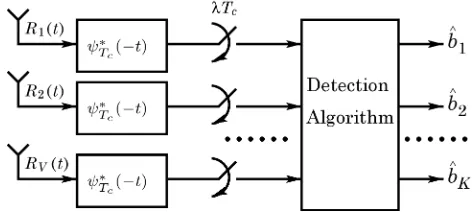
Fig. 2. Receiver schematic block diagram of the MIMO SCDMA systems.
where , is the complex-valued additive white Gaussian noise (AWGN) received by the th receive an-tenna, which has zero-mean and a single-sided spectrum density of per dimension. Note that, without loss of any generality, the initial phases seen in (1) have been absorbed into and
in (4), respectively.
C. Representation of the Received Signals
The receiver structure for detection of the MIMO SCDMA signal is shown in Fig. 2. As shown in Fig. 2, the receiver com-prises of receive antennas. For each of the receive antennas, the received signal is first passed through a filter matched to the transmitted chip-waveform of . Then, the output of the matched-filters are sampled at a rate of . Hence, in a gen-eral MIMO SCDMA system using transmit antennas, each receive antenna branch provides samples cor-responding to a data block, where is the result of channel delay, and the detector can collect a total of
samples from the receive antennas. As shown in Fig. 2, the an-tenna output samples are sent to a detector, where the data trans-mitted by the users is detected based on linear detection algo-rithms, which will be investigated in detail in our forthcoming discourse. Let us first derive the representation of the received MIMO space–time signal.
In the context of the th receive antenna, as shown in Fig. 2, the th sample obtained by sampling the chip-waveform matched-filter’s output at the time-instant of can be expressed as
(5) where represents the complex conjugate.
Let
(6)
the users. According to (5), it can be shown that the element in can be expressed as
(8)
which is a complex Gaussian random variable with zero-mean and a variance of per dimension, where
represents the energy per chip. Upon substituting the received signal in the form of (4) into (5) and expressing in vector and matrix forms, it can be shown that can be expressed as
(9)
(10)
(11) where is given by (12) shown at the bottom of the page, which is a -dimensional matrix con-taining the STS sequences of user associated with the multipath components. is corresponding to the current STS symbol received from user . In (10) and (11),
is given by (13) shown at the bottom of the page, which is a -dimensional matrix constituted by the STS sequences of user associated with the previous STS symbol of user , but within its current symbol observation du-ration. In (13), represents a zero matrix. Due to , the current STS symbol of user conflicts interference from the previous STS symbols of the users in the system. In (9) and (10), can be expressed as
..
. . .. ... ... . .. ... . .. ... ... ...
(14) which is also a -dimensional matrix due to the following STS symbol of user . Due to , the current STS symbol of user conflicts interference from the following STS symbols of the whole users.
In (9)–(11), the CIR matrix with respect to the th user and the th receive antenna can be expressed as
(15) where for are determined by the STS scheme employed. Specifically, for and 4 and for real transmitted symbols, we have [18]
(16)
..
. . .. ... ... . .. ... . .. ... . .. ... ..
. . .. ... ... . .. ... . .. ..
. . .. ... ... . .. ... . .. ... . .. ...
..
. . .. ... ... . .. ... . .. ... . .. ...
(12)
..
. . .. ... ... . .. ... . .. ... . .. ...
(17) which are the STS schemes that will be used in our simulations in Section IV. Note that the representations of (9)–(11) can be readily extended to the cases, when using complex-valued data symbols, as well as complex-valued spreading.
Finally, in (9)–(11), is given by
(18) which is the th STS symbol transmitted by the th user.
Let
(19) represents the collection of all the samples of the receive an-tennas. This collection contains the samples related to the sym-bols transmitted by the users within the th symbol duration. Then, can be expressed as
(20) where represents theKronecker product[24] operation
(21) represents a -length noise vector, which has zero-mean and a covariance matrix
(22) and, furthermore, we have
(23) which is a matrix corresponding to the CIRs con-necting the th user to the receive antennas.
Let
(24)
(25)
(26) (27)
(28)
Then, (20) can also be written as
(29) for . Note that, for , the second com-ponent related to on the right-hand side of (29) should be removed. By contrast, for the third compo-nent containing on the right-hand side of (29) should be removed. Let us now consider the linear detection of the STS assisted MIMO SCDMA signals.
III. LINEARDETECTORS FORMIMO SCDMA SYSTEMS
USINGSPACE–TIMESPREADING(STS)
In this section, we focus on the linear MUDs and their char-acteristics without imposing on any complexity restrictions, i.e., the detectors can be provided any information required. It is noteworthy that the received vector in (20) or (29) has some properties that are insightful for deriving efficient detection al-gorithms. These properties are summarized as follows.
1) The matrices , and in (24)–(26) are constituted by the DS spreading sequences of the users, which represent the code signatures of the MIMO SCDMA system. By contrast, the matrix in (27) is due to the CIRs of the MIMO system, which can be treated as the spatial signatures of the MIMO SCDMA system. Hence, each user in the MIMO SCDMA system considered can theoretically be distinguished by its corresponding code signature and/or spatial signature. Consequently, the number of users supported or the number of interferes suppressed by the MIMO SCDMA system is determined by the degrees of freedom, which is defined by the product of the number of chips per bit , the number of transmit antennas , and the number of receive antennas , i.e., by .
2) , and in (24)–(26) are time invariant ma-trices, while in (27) is a time-variant matrix.
3) Since we assumed that the fading from each transmit an-tenna to any of the receive anan-tennas was independent, the rank of is, hence, column full with a probability one, i.e., we have . Furthermore, it can be shown that we can design a , so that it obeys
rank (30)
Hence, based on , the detector is capable of distin-guishing up to number of users, provided that
or .
4) The ranks of and obey rank rank
(31) and the ranks of and satisfy
rank rank
The intersymbol interference (ISI) due to the delay-spread of the fading channels can be suppressed, provided that there are sufficient degrees of freedom in the received vector seen in (20) or (29).
5) The matrix has the property of
(33) where
(34) Furthermore, for the given by (16) and (17), we have, respectively
(35)
(36) where represents the real part of .
Based on the above-listed properties associated with MIMO SCDMA, let us now discuss the linear detection of the MIMO SCDMA signals. Let the output of a linear detector be expressed by
(37) (38) which consists of the decision variables for the data-bits trans-mitted by the users during the th symbol duration, contains the decision variables for in (18) and
. For a linear detector, the received space–time vector given in (20) or (29) is linearly processed to form the decision variables , which can be expressed as
(39) where the processing matrix can be derived based on the specific constraints imposed on the detector, as shown below. Note that, in our forthcoming discourse, we often refer to the first user as the reference user and our objective is to detect the information transmitted by this reference user.
A. Correlation Detector
The correlation detector is derived, when assuming that the receiver is only capable of obtaining the knowledge of the de-sired user, including the STS sequences (code signature) and the CIRs (spatial signature) of the desired user. Specifically, for the correlation detector, the decision variable is obtained by despreading the received space–time signal using
, i.e., we have
(40)
which first carries out the despreading in the time-domain using the code signature of , followed by the despreading in the space-domain using the spatial signature .
The correlation detector is a single-user detector, which treats both multiuser signals and ISI signals simply as background noise. The correlation detector usually conflicts severe interfer-ence generated by the other users in the system, as well as by the transmission delay of wireless channels. This becomes ex-plicit when we express the decision variable , which is corresponding to , in detail as
(41) where represents the first element of the vector . Upon substituting (20) into (41), we obtain
(42) According to the properties of theKronecker Product,1(42) can
be written as
(43) which implies that the space–time signals received by the receive antennas can be despread separately. Let be the matrix obtained by setting the diag-onal elements in to be zeros. Then, (43) can be expressed as
(44)
Furthermore, it can be shown that, when the STS scheme using transmit antennas is employed, the decision variable for
is given by
(45) which implies that the correlation detector is in fact a space–time RAKE-like receiver using the maximal-ratio combining (MRC). The diversity order achieved is , where the factor of two is contributed by two transmit antennas indicated in (45) by the sum of . Ad-ditionally, in (45), the factor is due to the STS using two transmit antennas.
B. Decorrelating Multiuser Detector (MUD)
The decorrelating MUD is capable of suppressing the mul-tiuser interference (MUI), as well as the ISI [21]. For the pro-posed MIMO SCDMA system, the decorrelating MUD may be implemented as follows. First, when the ISI associated with and in (29) is ignored in the detection, in order that the effective degrees of freedom can be saved, for example, for the sake of supporting more users. The decorlating detector can be implemented by first despreading the re-ceived vector using both the code signature and the spatial signature . The resulted signal is expressed by (40). Then, the decision variable is obtained by multiplying the de-spread signal using the inverse of space–time correlation matrix
. Hence, we have
(46) and, correspondingly, the weight matrix in (39) is given by
(47) Second, when the MIMO SCDMA system has sufficient de-grees of freedom, the decorrelating MUD can also be imple-mented by suppressing both the MUI and ISI simultaneously. We may also need to suppress the MUI and ISI jointly, when the delay-spread of wireless channels is high, which results in high ISI. When the decorrelating detector attempts to suppress both the MUI and ISI, the received space–time signal vector in (29) can be expressed as
(48) where
(49) (50) (51) As shown in (13) and (14), the matrices and con-tain many correlated columns. Hence, the rank of in (48)
obeys rank . In this case, the weight matrix corresponding to the decorrelating MUD is given by [21, pp. 241–242]
(52) where represents the pseudo-inverse or the Moore–Penrose
generalized inverse [25]. Let the singular value decomposition (SVD) of be expressed as
(53) where and are -by- and -by- unitary matrices, respectively, so that we have
(54) and is a diagonal matrix containing the singular values of
(55) where are the eigenvalues of the Hermitian matrix
.
Upon substituting (53) into (52), we obtain
(56) where
(57) Finally, the decision variable vector is given by
(58) where the first elements are chosen for detecting the STS symbols, , transmitted by the users within the th STS symbol duration.
C. MMSE Detector
In the context of the MMSE detector, we assume that the first user is the desired user or reference user. The objective of the MMSE detector is to detect symbol transmitted by the desired user within the th symbol duration. When the MMSE detector is considered, the weight matrix is chosen such that the mean-square error (MSE) between the transmitted symbol vector and its estimate is minimized. It is well known that the optimum solution in MMSE sense can be ex-pressed as [26]
(59) where is the autocorrelation matrix of the received space–time vector , while is the cross-correlation matrix between the received space–time vector and the desired symbol vector . They can be expressed, respec-tively, as
When the channel information in terms of the spatial-signature and the code signature are available at the receiver, the autocorrelation matrix can be obtained by sub-stituting (20) into (60) and by considering that all information symbols are transmitted independently, which yields
(61) where includes the autocorrelation of the MUI, ISI, as well as the background noise. The cross-correlation matrix between the received space–time vector and the desired symbol vector
can be expressed as
(62) Consequently, the optimum weight matrix can be expressed as
(63) When invoking thematrix inverse lemma[24, pp. 1348], it can be shown that we have
(64) Define the normalized MMSE as
(65) Then, it can be shown that we have
(66) In comparison with the correlation detector in Section III-A and the decorrelating detector in Section III-B, the MMSE MUD is capable of suppressing both the MUI and ISI, provided that the MIMO SCDMA system has sufficient degrees of freedom. The MMSE MUD can also efficiently suppress the background noise. Furthermore, the MMSE scheme can readily be imple-mented using adaptive techniques [24], [26]. Let us now show some performance results for the proposed MIMO SCDMA system.
IV. PERFORMANCEEXAMPLES
[image:8.594.306.552.65.257.2]In this section. we provide a range of simulation results, in order to illustrate and compare the achievable performance of
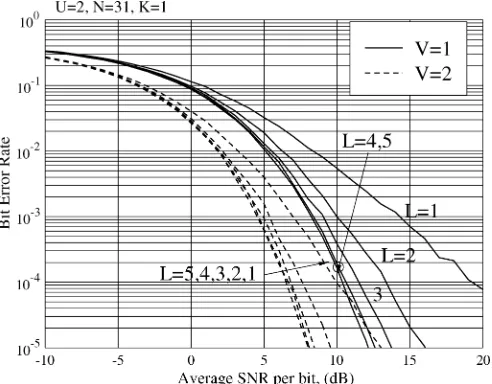
Fig. 3. BER performance of the single-user MIMO SCDMA system using
U = 2transmit antennas,V = 1or two receive antennas, andN = 31chips per bit duration, when communicating over Rayleigh-fading channels having
L = 1,2,3,4,5 multipath components.
the MIMO SCDMA system in conjunction with various detec-tion schemes, as considered in Secdetec-tions III. In our simuladetec-tion examples, we assumed that the Gold sequences having a pe-riod of were employed for implementing the STS. Since the total number of Gold sequences having the period of is [22], and also since the MIMO SCDMA system may support up to users, the same Gold sequence may be assigned to more than one users, when the number of users supported exceeds . Additionally, as shown in Section II, the length of the STS sequences required is and each user requires STS codes. In our simula-tion examples, these -length STS sequences of a given user were obtained by concatenating the assigned -length Gold se-quence with the -length Walsh Hadamard codes. Specifically, let be the Gold sequence assigned to the th user. Then, for
and 4, the STS sequences of the th user are given by
(67)
In Figs. 3 and 4. the bit-error rate (BER) performance of the single-user MIMO SCDMA systems was evaluated, when assuming various number of transmit antennas of , various number of multipath components of and various number of receive antennas of . In principles, the single-user BER per-formance represents the upper-bound perper-formance achievable, when multiple users are supported by the MIMO SCDMA system and, correspondingly, when multiuser detection is employed. Specifically, Fig. 3 shows the BER performance of the MIMO SCDMA system with respect to different number of multipath components, when assuming or
Fig. 4. BER performance of the single-user MIMO SCDMA system using
U = 2, 4 transmit antennas,V = 1, two receive antennas, andN = 31chips per bit duration, when communicating over Rayleigh-fading channels having
L = 1, 2 multipath components.
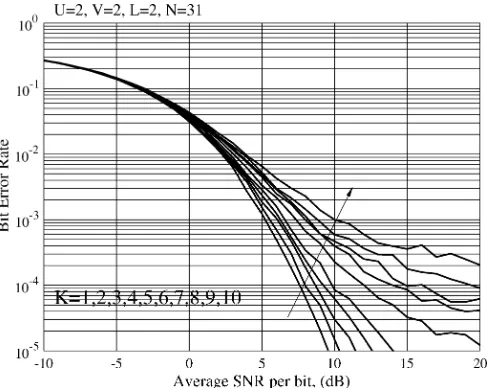
Fig. 5. BER performance of the multiuser MIMO SCDMA system when using
correlation detectorand when communicating over multipath Rayleigh-fading channels.
of using receive antenna, the multipath diversity gain is about 8 dB, when the channel has multipath components instead of . By contrast, when using receive antennas, the multipath diversity gain reduces to about 3 dB for the same scenario.
[image:9.594.42.289.65.258.2]In Fig. 4, the BER performance of the MIMO SCDMA system was evaluated and compared associated with various number of transmit antennas, multipath components, and re-ceive antennas. From the results of Fig. 4, as well as the results in Figs. 3, we can be implied that the big-gap performance improvement can be achieved by deploying more receive antennas, especially, when the diversity order is already high. Furthermore, it can be shown from the results of Fig. 4 that both the transmit diversity and the multipath diversity have the same order of importance. As shown in Fig. 4, the BER performance of the cases corresponding to , ,
Fig. 6. BER performance of the multiuser MIMO SCDMA system when using decorrelating detector and when communicating over multipath Rayleigh-fading channels.
Fig. 7. BER performance of the multiuser MIMO SCDMA system when using
MMSE detectorand when communicating over multipath Rayleigh-fading channels.
, and , , are the same as that of the cases corresponding to , , , and ,
, , respectively.
Fig. 5 shows the BER performance of the MIMO SCDMA system with respect to the number of users , when the single-user correlation detector was considered. Since the correlation detector does not utilize the information from the other users including their code signatures and spatial signatures, explic-itly, the BER performance becomes worse, when the MIMO SCDMA system supports more users. Furthermore, error-floors are observed in Fig. 5.
[image:9.594.305.549.311.506.2] [image:9.594.42.286.320.514.2]Fig. 8. BER performance comparison for the multiuser MIMO SCDMA system, when using correlation,decorrelating, andMMSEdetectors and when communicating over multipath Rayleigh-fading channels.
of enhancing the BER performance, even when the MIMO SCDMA system supports only one user. This is because there exists multipath interference, when the MIMO SCDMA signal is transmitted over multipath fading channels. Furthermore, as noted in Section III, the decorrelating detection algorithm can be designed by either or not invoking the ISI signals. From the results of Figs. 6 and 7, we can find that, in comparison with the results of Fig. 5, both the decorrelating and MMSE detectors significantly outperform the correlation detector, and the error-floors existed in Fig. 5 can be efficiently removed by employing multiuser detection instead of single-user detection. Both the decorrelating and MMSE detectors are capable of achieving the near single-user performance bound, even the MIMO SCDMA system supports users. Furthermore, from the results of Fig. 6, we observe that, when the ISI due to multipath transmission is invoked in the decorrelating detection, a better BER performance can be achieved, provided that the MIMO SCDMA signal has sufficient degrees of freedom for the ISI suppression.
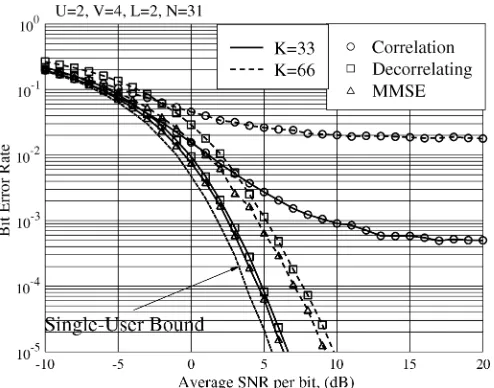
Finally, in Fig. 8, we compared the BER performance of the three types of detectors, namely, correlation, decorrelating, and MMSE, considered in this contribution, when the MIMO SCDMA supported a relatively high number of users, which is or 66. As we indicated at the beginning of this section, there are only 33 Gold sequences for a period of . Hence, when the MIMO SCDMA system supported users, in our simulation each of the Gold sequences was assigned to two users. However, due to the independence of the spatial signatures of the two users sharing the same Gold sequence, as shown in Fig. 8, these two users can be successfully distinguished at a cost of about 3-dB SNR gain for both the decorrelating and the MMSE detectors. The reason for the loss of the 3-dB SNR gain is that the receiver has to use one receive antenna for suppressing the interfering signal sharing the same Gold sequence. Consequently, the receiver diversity order is reduced by one. The above observation implies that we can simply deploy more receiver antennas at the BS of an existing DS-CDMA system and treat the extended system as
a SCDMA system, in order to increase the number of users supportable, while maintaining a similar BER performance of the existing DS-CDMA system. Additionally, from the results of Fig. 8, as in the literature [21], the MMSE MUD slightly outperforms the decorrelating detector.
V. CONCLUSION
In this contribution, we have proposed and investigated a MIMO SCDMA system, which combines both space-division and code-division, associated with using the STS transmit diversity scheme. Three low-complexity linear detectors have been considered. The BER performance of the MIMO SCDMA system associated with these linear detectors has been provided. From our study and simulation results, it can be shown that the MIMO SCDMA assisted by multiuser detection constitutes a highly promising multiple-access scheme, which is capable of efficiently exploiting the system resources and providing a high-flexibility. Furthermore, owing to its signaling structure, the proposed MIMO SCDMA constitutes one of the schemes that can be deployed in an existing DS-CDMA system with a relatively low-cost, in order to increase its capacity without demanding extra bandwidth. Our future work will endeavor to investigate low-complexity adaptive and blind adaptive MUDs for the MIMO SCDMA systems.
ACKNOWLEDGMENT
The author would like to acknowledge with thanks the finan-cial assistance from EPSRC of UK, and professor Hsiao-Hwa Chen as well as the anonymous reviewers for their helpful com-ments.
REFERENCES
[1] L. Hanzo, L.-L. Yang, E.-L. Kuan, and K. Yen,Single- and Multi-Car-rier DS-CDMA. New York: Wiley, 2003.
[2] J. H. Winters, “On the capacity of radio communication systems with diversity in a Rayleigh fading environment,” IEEE J. Select. Areas Commun., vol. SAC-5, no. 5, pp. 871–878, Jun. 1987.
[3] I. E. Telatar, “Capacity of multiantenna Gaussian channels,”Eur. Trans. Telecommun., vol. 10, no. 6, pp. 585–595, Nov./Dec. 1999.
[4] D. Gesbert and M. Shafiet al., “From theory to practice: An overview of MIMO space-time coded wireless systems,” IEEE J. Sel. Areas Commun., vol. 21, no. 3, pp. 281–302, Apr. 2003.
[5] A. Goldsmith, S. A. Jafar, N. Jindal, and S. Vishwanath, “Capacity limits of MIMO channels,”IEEE J. Sel. Areas Commun., vol. 21, no. 5, pp. 684–702, Jun. 2003.
[6] A. J. Paulraj, D. A. Gore, R. U. Nabar, and H. Bolcskei, “An overview of MIMO communications—A key to Gigabit wireless,”Proc. IEEE, vol. 92, no. 2, pp. 198–218, Feb. 2004.
[7] “Special issue on MIMO systems and applications,”IEEE J. Sel. Areas Commun., vol. 21, no. 3, pp. 277–473, Apr. 2003.
[8] “Special issue on MIMO systems and applications,”IEEE J. Sel. Areas Commun., vol. 21, no. 4, pp. 481–673, May 2003.
[9] “Special issue on MIMO wireless communications,”IEEE Trans. Signal Process., vol. 51, no. 11, pp. 2709–2881, Nov. 2003.
[10] S. M. Alamouti, “A simple transmit diversity technique for wireless communications,”IEEE J. Sel. Areas Commun., vol. 16, no. 8, pp. 1451–1458, Oct. 1998.
[11] V. Tarokh, N. Seshadri, and A. R. Calderbank, “Space-time codes for high data rate wireless communication: Performance criterion and code construction,”IEEE Trans. Inf. Theory, vol. 44, no. 2, pp. 744–765, Mar. 1998.
[13] A. F. Naguib, A. Paulraj, and T. Kailath, “Capacity improvement with base-station antenna arrays in cellular CDMA,” IEEE Trans. Veh. Technol., vol. 43, no. 3, pp. 691–698, Aug. 1994.
[14] A. F. Naguib and R. Calderbank, “Space-time coding and signal pro-cessing for high data rate wireless communications,”Wireless Commun. Mobile Comput., vol. 1, no. 1, pp. 13–34, Jan.–Mar. 2001.
[15] J. M. F. Xavier, V. A. N. Barroso, and J. M. F. Moura, “Closed-form blind channel identification and source separation in SDMA systems through correlative coding,”IEEE J. Sel. Areas Commun, vol. 16, no. 8, pp. 1506–1517, Oct. 1998.
[16] L.-L. Yang and L. Hanzo, “Performance of space-division multiple-ac-cess systems communicating over Nakagami-fading channels,” inProc. IEEE Veh. Technol. Conf.-Spring, Milan, Italy, May 2004, pp. 275–279. [17] , “Minimum mean square error single-user detection of SDMA sig-nals transmitted over Nakagami fading channels,” inProc. IEEE Int Commun. Conf., Paris, France, Jun. 2004, pp. 2511–2515.
[18] B. Hochwald, T. L. Marzetta, and C. B. Papadias, “A transmitter diversity scheme for wideband CDMA systems based on space-time spreading,”IEEE J. Sel. Areas Commun., vol. 19, no. 1, pp. 48–60, Jan. 2001.
[19] L.-L. Yang and L. Hanzo, “Performance of broadband multicarrier DS-CDMA using space-time spreading-assisted transmit diversity,”
IEEE Trans. Wireless Commun., vol. 4, no. 3, pp. 885–894, May 2005. [20] R. Doostnejad, T. Lim, and E. Sousa, “Space-time spreading codes for
a multiuser MIMO system,” inProc. 36 Asilomar Conf. Signals, Syst., Comput., Nov. 2002, pp. 1374–1378.
[21] S. Verdu,Multiuser Detection. Cambridge, U.K.: Cambridge Univ. Press, 1998.
[22] R. E. Ziemer and R. L. Peterson,Digital Communications and Spread Spectrum Systems. New York: Macmillan, 1985.
[23] J. G. Proakis,Digital Communications, 3rd ed. New York: McGraw-Hill, 1995.
[24] H. L. V. Trees,Optimum Array Processing. New York: Wiley, 2002.
[25] Y.-P. Cheng, K.-Y. Zhang, and Z. Xu,Matrix Theory, 2nd ed. Xi’an, China: Northwesten Polytechnical Univ. Press, 2002.
[26] S. Haykin,Adaptive Filter Theory, 3rd ed. Upper Saddle River, NJ: Prentice-Hall, 1996.
Lie-Liang Yang(M’98–SM’02) received the B.Eng. degree in communication engineering from Shanghai TieDao University, Shanghai, China, in 1988, and the M.Eng. and Ph.D. degrees in communications and electronics from Northern Jiaotong University, Bei-jing, China, in 1991 and 1997, respectively.
From 1997 to 1997, he was a Visiting Scientist at the Institute of Radio Engineering and Electronics, Academy of Sciences of the Czech Republic. Since 1997, he has been with the Communications Re-search Group, School of Electronics and Computer Science, University of Southampton, Southampton, U.K., where he is a Member of the Academic Staff. He is currently an Editor for theJournal of Communications and Networks(JCN). He has published over 100 papers in journals and conference proceedings, coauthored one book, and published several book chapters. His research has covered a wide range of areas in telecommunications, which include error control coding, modulation and demodulation, spread-spectrum communications and multiuser detection, syn-chronization, smart antennas, adaptive wireless systems, as well as wideband, broadband, and ultra-wideband code-division multiple access (CDMA).