This is a repository copy of
A randomised controlled trial to assess the effectiveness of
offering study results as an incentive to increase response rates to postal questionnaires
[ISRCTN26118436]
.
White Rose Research Online URL for this paper:
http://eprints.whiterose.ac.uk/1025/
Article:
Cockayne, S. orcid.org/0000-0002-1288-5497 and Torgerson, D.J.
orcid.org/0000-0002-1667-4275 (2005) A randomised controlled trial to assess the
effectiveness of offering study results as an incentive to increase response rates to postal
questionnaires [ISRCTN26118436]. BMC Medical Research Methodology. ISSN
1471-2288
https://doi.org/10.1186/1471-2288-5-34
[email protected] https://eprints.whiterose.ac.uk/ Reuse
Items deposited in White Rose Research Online are protected by copyright, with all rights reserved unless indicated otherwise. They may be downloaded and/or printed for private study, or other acts as permitted by national copyright laws. The publisher or other rights holders may allow further reproduction and re-use of the full text version. This is indicated by the licence information on the White Rose Research Online record for the item.
Takedown
If you consider content in White Rose Research Online to be in breach of UK law, please notify us by
Methodology
Open Access
Research article
A randomised controlled trial to assess the effectiveness of offering
study results as an incentive to increase response rates to postal
questionnaires [ISRCTN26118436]
Sarah Cockayne* and David J Torgerson
Address: University of York, York Trials Unit, Department of Health Sciences, Area 4 Seebohm Rowntree Building, York, UK
Email: Sarah Cockayne* - [email protected]; David J Torgerson - [email protected] * Corresponding author
Abstract
Background: Postal questionnaires are widely used to collect outcome data on participants. However, a poor response to questionnaires will reduce the statistical power of the study and may introduce bias. A meta analysis of ten trials offering study results, largely in the fields of education and marketing, was shown to be ineffective, with the odds ratio for response with offering research findings is 0.92 (95% CI 0.75 to 1.11). However uncertainty still exists as it is uncertain whether results from such trials can be extrapolated to that of a health care setting. The aim of this study was to assess whether offering participants study results increases the response rates to postal questionnaires.
Methods: 1038 women aged over 70 years were remotely randomised by computer in a 3:1 ratio. 250 participants did not receive the offer of knowing the results of the trial and 788 participants were offered the results of the trial in a postal questionnaire. The main outcome measure was response rate. Chi square test was used to evaluate the overall differences in response rate between the two groups. An adjusted analysis, adjusting for whether the participant was taking calcium and age was also undertaken.
Results: The response rates were not significantly different Odds Ratio 0.88 (95% confidence intervals 0.48 to 1.63) p = 0.69.
Conclusion: Offering study results to women living in the community aged over 70 does not increase response rates to postal questionnaires. Although researchers have an ethical obligation to offer participants study results, since 10% of women did not wish to receive the results, investigators should give participants the option to opt out of receiving the study's results.
Background
Postal questionnaires are widely used to collect data on participants in health research. They are an attractive means of collecting data, because they are easy to admin-ister and may be the only economically viable method of collecting data on large numbers of participants who may
be geographically dispersed. However, if there is a poor response rate to these questionnaires the validity of the study may be at risk for two main reasons. First, the statis-tical power of the study will be reduced. Second, bias may be introduced if non-responders differ significantly from those who do respond. In other words low response can
Published: 26 October 2005
BMC Medical Research Methodology 2005, 5:34 doi:10.1186/1471-2288-5-34
Received: 04 May 2005 Accepted: 26 October 2005
This article is available from: http://www.biomedcentral.com/1471-2288/5/34
© 2005 Cockayne and Torgerson; licensee BioMed Central Ltd.
BMC Medical Research Methodology 2005, 5:34 http://www.biomedcentral.com/1471-2288/5/34
threaten the internal validity of randomised trials as bias can be introduced and the external validity of surveys are undermined as non-response will prevent random sam-pling. Identifying effective strategies to increase response rates to postal questionnaires is therefore highly relevant to researchers since it could improve the quality of their research.
Offering participants the chance of being informed of the results of the study in which they are participating could improve response rates for three reasons. First it demon-strates the researcher's goodwill and sincerity [1,2]. Sec-ond, it adds greater credibility and importance to the respondent's efforts and third, it could act as a non-mon-etary incentive. In 2002 Edwards [3] identified 75 differ-ent strategies for increasing response rates including non-monetary incentives versus no incentive, which were shown to be effective (odds ratio of 1.19 95% confidence interval 1.11 to 1.28). In 2004 the same review group reported the results of a meta analysis of ten trials offering study results as an incentive which included 13 642 par-ticipants [4]. When the results of these trials were pooled in a random effects meta analysis the odds ratio for response with research findings was 0.92 (95% CI 0.75 to 1.11). However, uncertainty still exists as to the effective-ness of this strategy in a health care setting. This is because only one of these trials [5] was undertaken in a health care setting. The results of this study showed no evidence to suggest that promising study results to participants increases response rates. However, participants were hos-pital chief executives who were sent questionnaires regarding managerial issues such as expenditure and not items directly relating to their health. The effectiveness of this strategy has yet to be tested in a setting related directly to the population's health and it is uncertain whether tri-als conducted in other areas such as marketing and educa-tion can be extrapolated to a health care setting. The aim of this study therefore was to assess whether offering to tell participants the results of the study would increase the response rates to postal questionnaires in a health care setting
Methods
Study population
The subjects in this study were community dwelling women aged over 70 living in the York and Cumbria area. These women were due to be sent a final follow-up ques-tionnaire as part of a multi-centred randomised control-led trial of calcium and vitamin D supplementation for fracture prevention. Participants had been originally assigned to one of two groups. The intervention group received daily oral supplementation of 1,000 mg of cal-cium with 800 IU vitamin D3 with a patient information leaflet on dietary calcium intake and falls prevention. The control group received the patient information leaflet
only. Further details of this trial have been reported else-where [6].
Inclusion/exclusion criteria and randomisation
Women were eligible for this trial if they had been recruited from the York centre and were due to receive their final follow-up questionnaire in March 2004. Women were excluded if they had withdrawn from the trial or if notification of the participant's death had been received. An independent researcher from the York Trials Unit randomised eligible women in a 3:1 ratio in favour of offering the results of the trial, by computer. An une-qual randomisation ratio was used for two reasons. First, there was an issue of administrative convenience. The 'standard' letter to trial participants was to offer them the study results and this letter was going out to all centres including those not participating in this study. Therefore, it was less costly with lower administrative input to pro-duce a smaller separate batch of letters to send out than if we had used equal allocation. Second, although we had some uncertainty with respect to the direction of the effect (hence the trial) on balance we expected that the response rates would be lower in the group assigned to 'not offered the results.' If this had been the case and more participants were assigned to this group, then the overall response rate to the final follow-up would have been reduced.
Control
[image:3.612.313.555.100.265.2]250 women assigned to the group 'not offered the results' of the trial received a one-page questionnaire asking whether the participant had had a fracture in the past three years, how much calcium and vitamin D supple-ment they were taking and if applicable the reason for stopping the supplement, along with a request to give per-mission to send details of future research. However, all
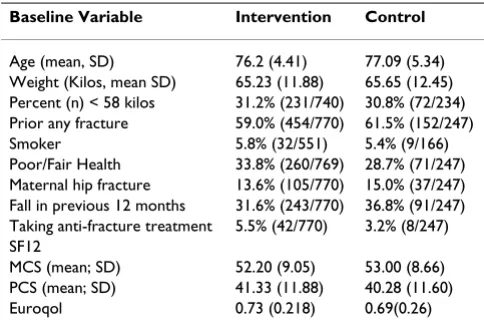
Table 1: Baseline characteristics of participants
Baseline Variable Intervention Control
Age (mean, SD) 76.2 (4.41) 77.09 (5.34) Weight (Kilos, mean SD) 65.23 (11.88) 65.65 (12.45) Percent (n) < 58 kilos 31.2% (231/740) 30.8% (72/234) Prior any fracture 59.0% (454/770) 61.5% (152/247) Smoker 5.8% (32/551) 5.4% (9/166) Poor/Fair Health 33.8% (260/769) 28.7% (71/247) Maternal hip fracture 13.6% (105/770) 15.0% (37/247) Fall in previous 12 months 31.6% (243/770) 36.8% (91/247) Taking anti-fracture treatment 5.5% (42/770) 3.2% (8/247) SF12
participants returning their questionnaire would be informed of the trial's results.
Intervention
788 women assigned to 'offered the results' received the same questionnaire but with an additional question ask-ing whether they would like to be notified of the results of the trial.
Both groups received a personalised cover letter showing university sponsorship, along with a business reply enve-lope. Those participants not returning a questionnaire within three weeks were sent up to two reminder letters, questionnaires and business reply envelopes, three and six weeks after the initial mailing. Administration of the questionnaire was not blind to group allocation.
Ethical approval for the study was obtained from the Northern and Yorkshire multicentre research ethics com-mittee and relevant local research ethics comcom-mittees.
Outcome
The primary outcome was return of final follow-up ques-tionnaire or reminder by the participant.
Sample size and statistical analysis
The sample size for this study was calculated to give 95% power (5% two sided significance) to detect a 10% differ-ence in response rates. We assumed that the baseline response rate would be approximately 80%, a figure based on work from a previous trial conducted by the authors on women of a similar age and risk of fracture [7]. Results were analysed using SPSS 11. All participants were included in the analysis (intention to treat). We used Chi square test to evaluate the overall differences in response rate between the two groups. We also undertook an adjusted analysis, adjusting for whether the participant was taking calcium and age. Statistical analysis was not undertaken blind to group allocation.
Results
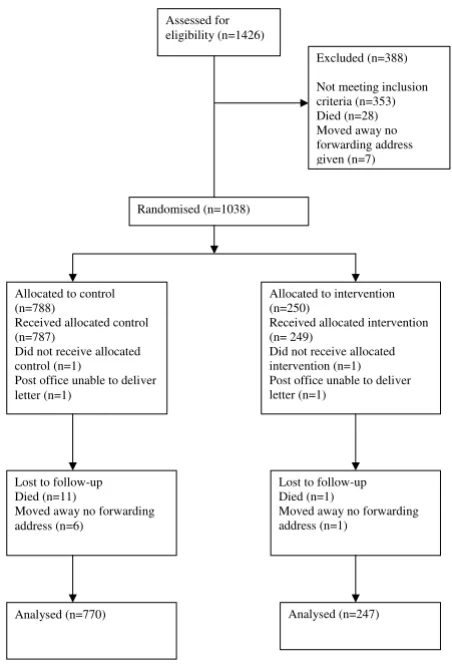
The baseline characteristics for the participants are shown in table 1 whilst figure 1 describes the participant recruit-ment profile. The overall response rates are shown in table 2. A total of 153 participants were sent reminder question-naires,112 of which were in the intervention group and 41 in the control group. 63 participants (56%) in the inter-vention group and 27 participants (66%) in the control group returned a reminder. These response rates were not significantly different. Chi square = 0.16 df = 1 p = 0.69 Odds Ratio (OR) 0.88 (95% Confidence Intervals [CI] 0.48 to 1.63). As the study was a factorial design, the data were tested to ensure there was no interaction between taking calcium and being allocated to being either offered/not offered the results of the trial. Adjusted OR for returning the postal questionnaire showed no association between offering the results of the trial and the return of the questionnaire (OR 0.81 [CI 0.44 to 1.51] p = 0.51) whilst taking calcium significantly predicted (OR 5.10 [CI 2.02 to 12.84] p = 0.001) the return of the questionnaire as did increasing age, but to a lesser degree (OR 1.05 [CI 1.00 to 1.11] p = 0.05).
Of the 721 participants returning questionnaires in the group offered the results of the trial, 647 (89.7.%)
[image:4.612.65.291.89.424.2]Origin and flow of participants in trial
Figure 1
Origin and flow of participants in trial. Assessed for eligibility (n=1426)
Excluded (n=388)
Not meeting inclusion criteria (n=353) Died (n=28) Moved away no forwarding address given (n=7)
Randomised (n=1038)
Allocated to control (n=788)
Received allocated control (n=787)
Did not receive allocated control (n=1)
Post office unable to deliver letter (n=1)
Allocated to intervention (n=250)
Received allocated intervention (n= 249)
Did not receive allocated intervention (n=1) Post office unable to deliver letter (n=1)
Analysed (n=770) Lost to follow-up Died (n=11)
Moved away no forwarding address (n=6)
Lost to follow-up Died (n=1)
Moved away no forwarding address (n=1)
Analysed (n=247)
Table 2: Response rate to final follow up questionnaire
Intervention Control
Replied 721 233
Not replied 49 14
[image:4.612.313.554.100.172.2]BMC Medical Research Methodology 2005, 5:34 http://www.biomedcentral.com/1471-2288/5/34
requested the results of the study and three women in the group 'not offered the results' pro-actively asked to be sent a copy of the results. The baseline characteristics of partic-ipants who did and did not request the study's results are reported in table 3. Adjusted OR showed taking calcium (OR 4.00 [CI 1.88 to 8.51]) p < 0.05) significantly pre-dicted whether participants requested trial results, how-ever age (OR 0.96 [CI 0.91 to 1.01]) p = 0.12) and fair or poor health (OR 0.66 [CI 0.40 to 1.10]) p = 0.11) did not predict whether participants requested trial results.
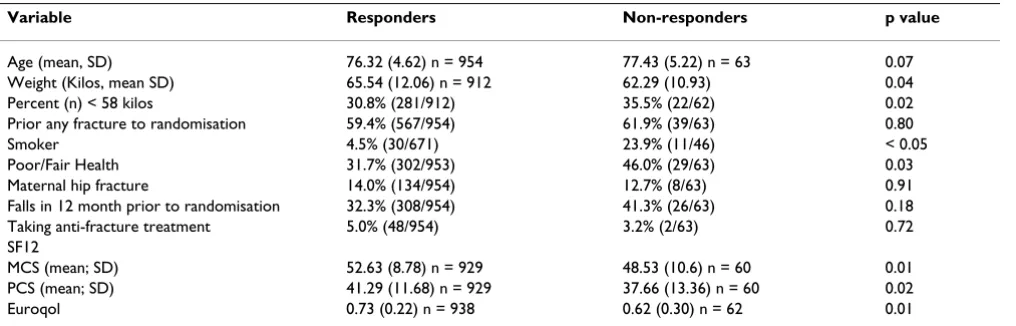
The characteristics of those who did and did not respond to the questionnaire are reported in table 4.
Discussion
This study found no evidence that offering study results to participants increased the response rate to a postal ques-tionnaire. There are two possible reasons for this strategy
being ineffective. First, offering results of the trial may not act as an incentive to participants to respond because it appeals only to those interested in the trial and who were likely to respond anyway. If this were the case then offer-ing the results of the trial was insufficient incentive to motivate non-responders. Second, the following strategies were adopted which are known to increase response rate; a short, one-sided, straightforward questionnaire designed to be of interest to participants but not contain-ing sensitive questions, reminders with a second copy of the questionnaire and university sponsorship. This com-bination of strategies produced a high response rate of over 93% and it may be that any strategy would struggle to significantly increase the response rate further (i.e., a ceiling effect).
This study was undertaken among women over 70 living independently in the community therefore it is not
possi-Table 3: Baseline characteristics of participants who did and did not request the trial's results
Baseline Variable Requested trial results Did not request trial results
Age (mean, SD) 76.00 (4.30) n = 647 76.80 (4.68) n = 74 Weight (Kilos, mean SD) 65.59 (11.94) n = 618 64.28 (11.77) (n = 71) Percent (n) < 58 kilos 30.7% (190/618) 32.4% (23/71) Prior any fracture 59.2% (383/647) 53.4% (39/73)
Smoker 4.5% (21/463) 3.8% (2/52)
Poor/Fair Health 31.9% (206/646) 41.7% (30/72) Maternal hip fracture 13.3% (86/647) 16.7% (12/72) Fall in previous 12 months 31.1% (201/647) 31.9% (23/72) Taking anti-fracture treatment 5.9% (38/647) 4.2% (3/73) SF12
[image:5.612.54.558.100.265.2]MCS (mean; SD) 52.61 (8.49) n = 629 50.98 (11.5) n = 70 PCS (mean; SD) 41.73 (11.8) n = 629 39.65 (11.20) n = 70 Euroqol 0.74 (0.21) n = 640 0.75 (0.19) n = 71
Table 4: Baseline characteristics of responders and non-responders
Variable Responders Non-responders p value
Age (mean, SD) 76.32 (4.62) n = 954 77.43 (5.22) n = 63 0.07 Weight (Kilos, mean SD) 65.54 (12.06) n = 912 62.29 (10.93) 0.04 Percent (n) < 58 kilos 30.8% (281/912) 35.5% (22/62) 0.02 Prior any fracture to randomisation 59.4% (567/954) 61.9% (39/63) 0.80
Smoker 4.5% (30/671) 23.9% (11/46) < 0.05
Poor/Fair Health 31.7% (302/953) 46.0% (29/63) 0.03
Maternal hip fracture 14.0% (134/954) 12.7% (8/63) 0.91 Falls in 12 month prior to randomisation 32.3% (308/954) 41.3% (26/63) 0.18 Taking anti-fracture treatment 5.0% (48/954) 3.2% (2/63) 0.72 SF12
MCS (mean; SD) 52.63 (8.78) n = 929 48.53 (10.6) n = 60 0.01 PCS (mean; SD) 41.29 (11.68) n = 929 37.66 (13.36) n = 60 0.02
[image:5.612.55.563.324.487.2]Publish with BioMed Central and every scientist can read your work free of charge
"BioMed Central will be the most significant development for disseminating the results of biomedical researc h in our lifetime."
Sir Paul Nurse, Cancer Research UK
Your research papers will be:
available free of charge to the entire biomedical community
peer reviewed and published immediately upon acceptance
cited in PubMed and archived on PubMed Central
yours — you keep the copyright
Submit your manuscript here:
http://www.biomedcentral.com/info/publishing_adv.asp
BioMedcentral ble to generalise these results to either men, women
younger than 70 or to those living in nursing homes or other forms of residential care. Also because the partici-pants had already agreed to take part in a randomised con-trolled trial the results may not apply to the wider population of women over 70 years. The incentive of 'offering trial results' was tested in combination with other strategies known to increase response rates, which together produced an excellent response rate, which any strategy would find difficult to improve upon. It may be that this incentive is effective in a different combination of strategies.
Conclusion
Although offering the results of the study did not increase the response rates, researchers do have an ethical obligation to offer participants the results of study if they wish to receive them. Our results show that 90% of women did want to know the results of our trial however, 10% did not wish to receive the results, which emphasises the need for investigators to give participants the option to 'opt out of' receiving the trial's results. Within the UK, for new studies the issue of disseminating study results will have to be addressed since the introduction of the new Research Ethics Committee (REC) form in 2004. The investigator is asked whether the study's results will be dis-seminated to participants and details of what will happen to the results of the research, when the results are likely to be published and how participants can obtain a copy of the results needs to be stated on the patient information leaflet.
Competing interests
Professor David Torgerson Director of the York Trials Unit (PhD) has received funding from SHIRE and other pharmaceutical companies for research and sponsorship to attend conferences and meetings.
Authors' contributions
SC was a trial coordinator and was responsible for data entry and cleaning, combining the datasets, undertaking the analysis and wrote the first draft of the report.
DJT principal investigator, drafted the trial protocol and helped obtain funding for the main study, helped to draft the manuscript and is guarantor for the paper.
Acknowledgements
We thank Ben Cross for undertaking the randomisation of participants onto this trial.
References
1. Fernandez CV, Kodish K, Weijer C: Informing study participants of research results: an ethical imperative. Ethics and Human Research 2003, 3:12-19.
2. Partridge AH: Informing Clinical Trial Participants About Study Results. JAMA 2002, 288:363-365.
3. Edwards P, Roberts I, Clarke M, DiGuiseppi C, Pratap S, Wentz R, Kwan I: Increasing response rates to postal questionnaires: systematic review. BMJ 2002, 324:1183-1185.
4. Edwards P, Cooper R: Previous trials of dissemination were identified. J Epidemiol Community Health 2004, 58:354-355.a. 5. Mullner RM, Levy PS, Byre CS, Matthews D: Effects on
character-istics of the survey instrument on response rates to a mail survey of community hospitals. Public Health Rep 1982, 97:465-9. 6. Porthouse J, Cockayne S, King C, Saxon L, Steele E, Aspray T, Baver-stock M, Birks Y, Dumville J, Francis R, Iglesias C, Puffer S, Sutcliffe A, Watt I, Torgerson DJ: Randomised Controlled Trial of Calcium and Vitamin D Supplementation for Fracture Prevention in Primary Care. BMJ 2005, 330:1003-1008.
7. Birks YF, Porthouse J, Addie C, Loughney K, Saxon L, Baverstock M, Francis RM, Reid DM, Watt I, Torgerson DJ, Primary Care Hip Pro-tector Trial Group: Randomized controlled trial of hip protec-tors among women living in the community. Osteoporosis International 2004, 9:701-6.
Pre-publication history
The pre-publication history for this paper can be accessed here: