Article
The Combination of Calcium Oxide and Cu/ZrO
2
Catalyst and their Selective Products for CO
2
Hydrogenation
Soipatta Soisuwan
1,a,b,*
, Wilasinee Wisaijorn
1, Chalida Nimnul
1,
Orawan Maunghimapan
1, and Piyasan Praserthdam
21 Department of Chemical Engineering, Faculty of Engineering, Burapha University, 169 Long-Hard
Bangsaen Road, Saensuk Sub-District, Muang District, Chonburi, 20130, Thailand
2 Center of Excellence in Catalysis and Catalytic Reaction Engineering, Department of Chemical
Engineering, Faculty of Engineering, Chulalongkorn University, Phayathai Road, Pathuwan District, Bangkok 10330, Thailand
E-mail: a[email protected] (Corresponding author), b[email protected]
Abstract. The catalytic activities of Cu/ZrO2_CaO catalysts were investigated on CO2 hydrogenation. The CO2 hydrogenations were carried out over combination of calcium oxide and Cu/ZrO2 catalyst. Two calcination temperatures were chosen at 300 and 650 oC according to thermal decomposition results. The catalysts were characterized by means of N2 adsorption-desorption, H2 temperature programmed reduction and X-ray diffraction. The CO2 hydrogenation under atmospheric pressure and at 250 oC was carried out over copper-based catalysts combined with calcium oxide namely i.e. Cu/ZrO2_CaO300, Cu/ZrO2_CaO650, Cu/ZrO2_Cu/CaO and Cu/ZrO2+CaO. The catalytic activities over all catalysts were consistent for 4 hours. The catalytic reaction rates over copper-based catalysts were in the range of 21.8 – 47.4 mol L-1 s-1 g cat-1. The modification of calcium oxide can improve the catalytic activity of copper-based catalysts to 47.4 mol L-1 s-1 g cat-1. The calcination temperature can cause a difference in active species that impact on product selectivity. The CaO consisting in copper-based catalysts, i.e. Cu/ZrO2_CaO650, facilitate the growth of long chain hydrocarbon, whereas Cu/ZrO2_CaO300 favors the formation of carbon monoxide plausibly arising from reverse water gas shift reaction. Directly combined calcium oxide with Cu/ZrO2 via physically mixing, i.e. Cu/ZrO2+CaO, can improve the rate of methanol production.
Keywords: Calcium oxide, copper-based catalyst, CO2 hydrogenation.
ENGINEERING JOURNAL Volume 20 Issue 2
1.
Introduction
The increasing rate of energy consumption is one of the severe impacts on environmental topics nowadays because of large population growth and their demand for sustenance, transportation and novel technology which are an exploitation of natural resources, such as fossil fuel that can directly convert to energy with emission of greenhouse gas i.e. CO2. The incremental amount of carbon dioxide impacts highly on global environment owning to high heat capacity of CO2 that can rise the global temperature up and change the global climate [1]. The CO2 utilization is thus of interest for many researchers. The conversion of CO2 to energy source molecules can considerably benefit both in reduction of CO2 and production of clean energy source. The hydrogenation of carbon dioxide can occur essentially over catalytic surface of metal to produce the molecules of long chain hydrocarbon and/or alcohol [2–5]. The complete combustion of these fuels emits only carbon dioxide, non hazardous gas, and this carbon dioxide compensates carbon content in ecosystem [1]. The principle catalyst widely used in CO2 hydrogenation is copper based catalyst since it was selective towards methanol and hydrocarbon. The coupling copper catalyst with special oxide such as ZnO [6–8], or support such as Al2O3 [7] or ZrO2 [7, 9, 10], can effectively increase the hydrogenation rates. Zirconium oxide was employed as catalytic promoter or support because of its notable chemical stability giving good active metal size dispersion and resulting in high production rate [11, 12]. The use of zirconium oxide as copper catalyst support can enhance the catalyst stability while prolonging CO2 hydrogenation as it can prevent sintering of active metal sites. F. Arena et.al. found textural and chemical effects of zirconia support that conferred superior performance on Cu-ZnO/ZrO2 system compared with Al2O3- and CeO2-systems because the oxide carriers can control texture and metal surface exposure and adsorption property of CO2 and H2 [13]. The primary role of metal/oxide interface in copper-based catalysts on CO2 to CH3OH hydrogenation arises from a synergism of metal Cu hydrogenation and oxide basic sites [14]. The hydrogenation of CO2 to methanol was preferable apparently owning to La addition in ZrO2 supported copper based catalysts [15]. Additional La existing in Cu/ZrO2 can improve the number of strong base which facilitates adsorption of CO2 contributing the formation of methanol. The hydrogenolysis strongly depends on the basicity of Cu-based catalysts and performance of hydrogen spill over [16]. By this reason, we are interested to elucidate a role of basic sites existing in Cu/ZrO2 for CO2 hydrogenation selectively convert to products, calcium oxide derived from natural material, i.e. oyster shell, therefore was employed as additional oxide in zirconium oxide supported copper catalysts. The CO2 hydrogenation was carried out under atmospheric pressure and low temperature 250 oC. The selective products of CO2 hydrogenation to methanol and hydrocarbon were investigated.
2.
Experimental
2.1. The Catalyst Preparation and Characterization
2.2. Catalyst Nomenclature
The copper based catalyst supported by ZrO2 or CaO was namely Cu/ZrO2 or Cu/CaO, respectively. The copper-based catalysts combined with 10% wt calcium oxide calcined at given temperature i.e. xxx oC was designated Cu/ZrO2_CaOxxx. The combination of Cu/ZrO2 with 10% wt Cu/CaO by mechanically mixing was designated Cu/ZrO2_Cu/CaO. The direct combination of Cu/ZrO2 with 10% wt CaO by mechanically mixing was namely Cu/ZrO2+CaO.
2.3. CO2 Hydrogenation Testing
1 gram of fresh oxide catalyst was mounted to tubular reactor and CO2 hydrogenation was carried out under atmospheric pressure at 250 oC, the catalyst was fully oxidized under pre-treating oxygen gas at 350oC for 3 hours. The flow rate of CO2/H2/N2 was at 30/10/10 ml/min. Nitrogen was used as internal standard gas for gas chromatography. The reactants and products were analyzed by VARIAN gas chromatography connecting with automatic ten-port sampling valves. The influent stream was separated by consecutive two columns i.e. i) molecular sieve for N2, CO, CO2 and CH4 and the long chain HC column for hydrocarbon and methanol. The stepwise influent flow to those columns was automated via STAR software. The effluent stream was consecutively analyzed by thermal conductivity detector (TCD) and flame ionization detector (FID). The conversion of carbon dioxide, rate of reaction and product selectivity were calculated as follows.
̇ - ̇ - - ̇ - - (1) ̇ (2) (3)
3.
Results and Discussions
3.1. Thermal Decomposition of the Catalysts Before Calcination
The decomposition of fresh copper precursor loading on various supports, i.e. Tosoh ZrO2, CaO and ZrO2-CaO, were investigated under flowing oxygen gas. The gravimetric analysis was observed during ramping temperature to 1000 oC. Pure copper precursor (Cu(NO3)2.3H2O) was clearly decomposed at 180 and 265 oC ascribed to dehydration and decomposition of nitrate [18]; however nitrate precursor–support interaction plausibly can cause a difference in decomposition temperature of pre-calcined Cu/ZrO2, Cu/CaO and Cu/ZrO2-CaO catalysts. The copper nitrate was decomposed only at 240 oC over zirconia support and the weight decomposition ended before 300 oC, while broad decomposition peaks were given apparently at 400 and 475oC over Cu/CaO. These two decomposition steps may possibly own to decomposition of copper precursors loaded on chemically unstable CaO support consisting slightly of Ca(OH)2; however, the weight was found to be thermally stable after 650oC. The results are in good accordance with the decomposition peaks obtained from Cu/ZrO2-CaO possessing the synergetic effects of copper loaded on ZrO2 and CaO at 212 oC and 480 oC, respectively. Two interesting calcination temperature were therefore chosen according to the decomposition behaviours of copper precursor loaded on ZrO2 and CaO supports, i.e. 300 and 650 oC.
3.2. Physicochemical Properties of the Catalysts
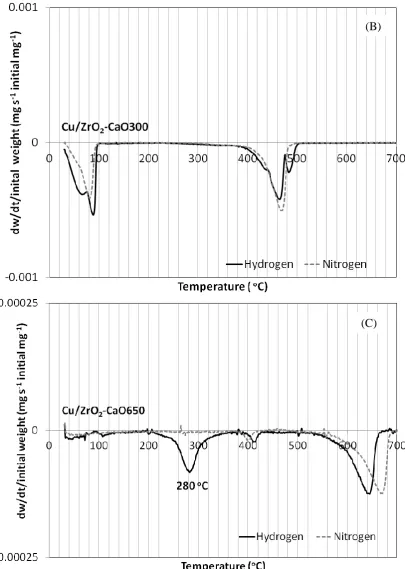
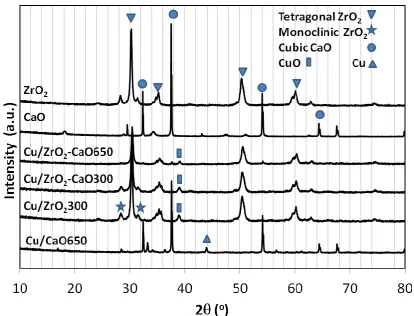
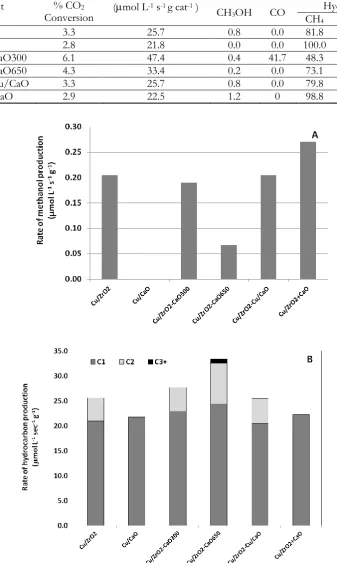
Cu/ZrO2-CaO650 and this is in good agreement with availability of the thermodynamically stable tetragonal phase at higher temperature [19]. The diffraction patterns of commercial calcium oxide revealed cubic phase which sharply remained after calcination at 650oC for Cu/CaO650, whereas 10 percentage of additional cubic calcium oxide in copper-based catalyst was unnoticeable for Cu/ZrO2-CaO300. Two small peaks of cubic CaO were found slightly at 2 = 32o and 54o in the diffraction pattern of Cu/ZrO2-CaO650. The cubic calcium oxide is likely to facilitate a formation of small copper metal peak at 2 = 44o, while the copper-based catalyst mainly supported by ZrO2 possessed the small diffraction patterns of CuO at 2 = 39o [20]. The weight decompositions representing as the behaviour of temperature programmed reduction over Cu/ZrO2, Cu/CaO and Cu/ZrO2_Cu/CaO were found at temperature lower than 400 oC as shown in Fig. 1(A), while the weight loss due to water evaporation of unstable catalyst over Cu/ZrO2_CaO300 gave at 100 oC and plausibly at 470oC as shown in Fig. 1(B), these were not the reduction behavior since these decomposition results concurrently appeared under the conditions of inert nitrogen and 5% hydrogen in nitrogen gases. The profiles of hydrogen consumption derived from the weight decomposition over Cu/ZrO2, Cu/CaO and Cu/ZrO2_Cu/CaO was illustrated in Figure 2. The Cu/ZrO2_CaO650 gave weight decomposition resulting from the hydrogen reduction at 280 oC as shown in Fig. 1(C), although it was very small peak compared to other catalysts in Fig. 2. According to low ability of the hydrogen reduction, it may note that the hydrogen reduction may not take place during CO2 hydrogenation and copper oxide species were the main active species possibly over Cu/ZrO2_CaO650. The Cu/CaO, Cu/ZrO2 and Cu/ZrO2_Cu/CaO exhibited the hydrogen reduction peaks especially at low temperature as shown in Fig. 2 (<400 oC). These catalysts are likely to give active metal sites during CO2 hydrogenation. It may note that Cu/ZrO2 combined with calcium oxide in different routes gave the difference in the reduction behaviour. The catalyst prepared at high calcination temperature 650 oC was hardly reduced according to the strong interaction between metal and support formed at the high temperature calcination [21], likewise the reduction peak was unidentified over the copper based catalyst supported by close combination of ZrO2 and calcium oxide which was fired at 300 oC (Cu/ZrO2_CaO300) in Fig. 1(B). The reduction behaviour of Cu/ZrO2_Cu/CaO was similar to maternal Cu/ZrO2 and Cu/CaO catalysts when directly combining Cu/ZrO2 and Cu/CaO catalysts via physically mixing as shown in Fig. 2, while the close combination of calcium oxide to Cu/ZrO2 catalyst via wetness impregnation route, calcined at different temperature, seems not to urge the hydrogen reduction.
3.3. Effect of Calcium Oxide on CO2 Hydrogenation
combination on CO2 hydrogenation presenting high selectivity to CO [22]. The close combination of calcium oxide in copper based catalysts can cause the formation of methanol, but directly mixing calcium oxide at 10% wt to copper-based catalyst, Cu/ZrO2, gave a superior formation of methanol as shown in Fig. 4(a), strongly emphasizing the activity of La modified copper-based catalysts [15] and a dual site L-H mechanism proposed by Arena F. et al. [13], involving hydrogenation and basic oxide sites at the surfaces of metal and oxide phase.
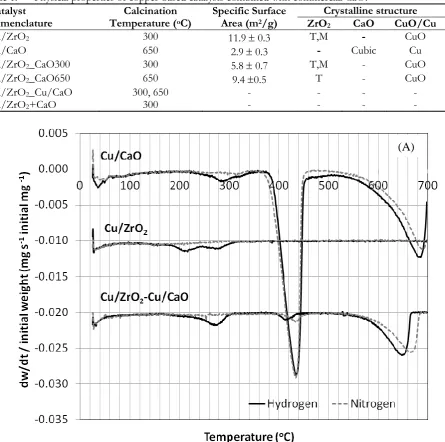
Table 1. Physical properties of copper-based catalysts combined with commercial CaO. Catalyst
nomenclature Temperature (Calcination oC)
Specific Surface Area (m2/g)
Crystalline structure
ZrO2 CaO CuO/Cu
Cu/ZrO2 300 11.9 0.3 T,M - CuO
Cu/CaO 650 2.9 0.3 - Cubic Cu
Cu/ZrO2_CaO300 300 5.8 0.7 T,M - CuO
Cu/ZrO2_CaO650 650 9.4 0.5 T - CuO
Cu/ZrO2_Cu/CaO 300, 650 - - - -
Cu/ZrO2+CaO 300 - - - -
Fig. 1. (A) The rate of weight decomposition by TGA under 5% H2 in N2 flowing gas i.e. Cu/CaO, Cu/ZrO2 and Cu/ZrO2-Cu/CaO.
Fig. 1. (Cont.) The rate of weight decomposition by TGA under 5% H2 in N2 flowing gas i.e. (B) Cu/ZrO2-CaO300 and (C) Cu/ZrO2-CaO650.
[image:6.595.107.513.82.652.2]Fig. 2. Hydrogen temperature programmed reduction profiles.
[image:7.595.120.493.82.348.2] [image:7.595.87.502.379.695.2]Table 2. The catalytic activities and selectivity of products for all catalysts at initial.
Catalyst % CO2
Conversion
Rate of Reaction (mol L-1 s-1 g cat-1 )
(%) Product Selectivity
CH3OH CO CH4 Hydrocarbon C2H6 C3+
Cu/ZrO2 3.3 25.7 0.8 0.0 81.8 18.1 0.0
Cu/CaO 2.8 21.8 0.0 0.0 100.0 0.0 0.0
Cu/ZrO2_CaO300 6.1 47.4 0.4 41.7 48.3 10.1 0.0
Cu/ZrO2_CaO650 4.3 33.4 0.2 0.0 73.1 24.4 2.4
Cu/ZrO2_Cu/CaO 3.3 25.7 0.8 0.0 79.8 19.6 0.0
Cu/ZrO2+CaO 2.9 22.5 1.2 0 98.8 0.0 0.0
Fig. 4. (A) & (B) The rate of methanol and hydrocarbon produced over copper-based catalysts.
4.
Conclusions
oxygen flowing gas at 350 oC. The product distribution of longer chain hydrocarbon, i.e. CH4, C2H6 and C3H8, formed at 33.4 mol L-1 s-1 g-1 over the catalyst with high calcination temperature 650 oC. The majority of product was carbon monoxide (19.8 mol L-1 s-1 g-1) and methane (22.9 mol L-1 s-1 g-1) over the catalyst with low calcination temperature 300 oC. The methanol production was improved over copper-based catalyst directly mixing to calcium oxide (Cu/ZrO2+CaO).
Acknowledgements
The authors would like give their gratitude to the financial support from the Faculty of Engineering, Burapha University (Grant No. 23/2556), Centre of Excellence in Catalysis and Catalytic Reaction Engineering, Chulalongkorn University according to the laboratory support and Department of Chemical Engineering, Burapha University for the facilities.
References
[1] G. A. Olah, G. K. Surya Prakash, and A. Goeppert, “Anthropogenic chemical carbon cycle for sustainable future,” J Am Chem Soc, vol. 133, pp. 12881–12898, May 2011.
[2] K. W. Jun, W. J. Shen, K. S. R. Rao, and K. W. Lee, “Residual sodium effect on the catalytic activity of Cu/ZnO/Al2O3 in methanol synthesis from CO2 hydrogenation,” Appl Catal A : General, vol. 174, no. 1–2, pp. 231–238, Nov. 1998.
[3] M. Saito, M. Takeuchi, T. Watanabe, J. Toyir, S. Luo, and J. Wu, “Methanol synthesis from CO2 and H2 over A Cu/ZnO-based multicomponent catalyst,” Energy Convs Mgmt, vol. 38, pp. S403–S408, 1997. [4] R. Satthawong, N. Koizumi, C. Song, and P. Prasassarakich, “Light olefin synthesis from CO2
hydrogenation over K-promoted Fe-Co bimetallic catalysts,” Catal Today, vol. 251, pp. 34–40, Aug. 2015.
[5] R. W. Dorner, D. R. Hardy, F. W. Williams, and H. D. Willauer, “C2-C5+ olefin production from CO2 hydrogenation using ceria modified Fe/Mn/K catalysts,” Catal Commun, vol. 15, no. 1, pp. 88–92, Nov. 2011.
[6] A. Karelovic, A. Bargibant, C. Fernandez, and P. Ruiz, “Effect of the structural and morphological properties of Cu/ZnO catalysts prepared by citrate method on their activity toward methanol synthesis from CO2 and H2 under mild reaction conditions,” Catal Today, vol. 197, no. 1, pp. 109–118, Dec. 2012.
[7] M. Saito and K. Murata, “Development of high perforamance Cu/ZnO-based catalysts for methanol synthesis and water-gas shift reaction,” Catal Surv Asia, vol. 8, no. 4,pp.285–294, Dec. 2004.
[8] H. Y. Chen, S. P. Lau, L. Chen, J. Lin, C. H. A. Huan, K. L.Tan, and J. S. Pan, “Synergism between Cu and Zn sites in Cu/Zn Catalysts for methanol synthesis,” Appl Surf Sci, vol. 152, no. 3–4, pp. 193– 199, Nov. 1999.
[9] D Zh F B X M Z F Y “Structure and performance of Cu/ZrO2 catalyst for the synthesis of methanol from CO2 hydrogenation,” J Fuel Chem Tech, vol. 38, no.4, pp. 462–467, Aug. 2010.
[10] X. Guo, D. Mao, G. Lu, S. Wang, and G. Wu, “CO2 hydrogenation to methanol over Cu/ZnO/ZrO2 catalysts prepared via a route of solid-state reaction,” Catal Commun, vol. 12, no.12, pp. 1095–1098, Jul. 2011.
[11] F. Arena, K. Barbera, G. Italiano, G. Bonura, L. Spado, and F. Frusteri, “Synthesis, characterization and activity pattern of Cu-ZnO/ZrO2 catalysts in the hydrogenation of carbon dioxide to methanol,” J Catal, vol. 249, no. 2, pp. 185–194, Jul.2007.
[12] F. Song, Y. Tan, H. Xie, Q. Zhang, and Y. Han, “Direct synthesis of dimethyl ether from biomass-derived syngas over Cu-ZnO-Al2O3-ZrO2(x)/
-Al2O3 bifunctional catalysts: Effect of Zr-loading,” Fuel Process Technol., vol. 126, pp. 88–94, Oct. 2014.[13] F. Arena, G. Mezzatesta, G. Zafarana, G. Trunfio, F. Frusteri, and L. Spadaro, “Effects of oxide carriers on surface functionality and process performance of the Cu-ZnO system in the synthesis of methanol via CO2 hydrogenation,” J. Catal, vol. 300, pp. 141–151, Apr. 2013.
[15] X. Guo, D. Mao, G. Lu, S. Wang, and G. Wu, “The influence of La doping on the catalytic behavior of Cu/ZrO2 for methanol synthesis from CO2 hydrogenation,” J. Mol Catal A Chem, vol. 345, no. 1–2, pp. 60–68, Jul.2011.
[16] S. Xia, R. Nie, X. Lu, L. Wang, P. Chen, and Z. Hou, “Hydrogenolysis of glycerol over Cu0.4/Zn5.6-xMgxAl2O8.6 catalysts: The role of basicity and hydrogen spillover,” J. Catal, vol. 296, pp. 1–11, Dec. 2012.
[17] L. Kundakovi and M. Flytzani-Stephanopoulos,“Reduction characteristics of copper oxide in cerium and zirconium oxide systems,” Appl Catal A : General , vol. 171, no. 1, pp. 13–29, Jun. 1998.
[18] I. V. Morozov, K. O. Znamenkov, Yu. M. Korenev, and O. A. Shlyakhtin, “Thermal decomposition of Cu(NO3)2.3H2O at reduced pressures,” Thermochemi Acta, vol. 403, no. 2, pp. 173–179, Jul. 2003. [19] W. Callister, Jr., and D. G. Rethwisch,“Properties and Application of ceramics,” in Materials Science and
Engineering, 9th ed. Asia : John Wiley & Sons (Asia) Pte Ltd, 2015, ch.14, sec. 14.4 , pp. 463–464 [20] H. Mai, L. Mengfei, and F. Ping, “Characterization of CuO species and thermal solid-solid interaction
in CuO/CeO2-Al2O3 catalyst by in-situ XRD, Raman spectroscopy and TPR,” J. Rare Earths, vol. 24, no.2, pp. 188–192,Apr.2006.
[21] R. X. Zhou, T. M. Yu, X. Y. Jiang , F. Chen, and X. M. Zheng,“Temperature-programmed reduction and temperature-programmed desorption studies of CuO/ZrO2 catalysts,” Appl Surf Sci, vol. 148, no. 3–4, pp. 263–270, Jul. 1999.