DELIBERATE PRACTICE 1
Deliberate Practice: Is That All It Takes To Become An Expert?
David Z. Hambrick1, Frederick L. Oswald2, Erik M. Altmann1, Elizabeth J. Meinz3,
1
Michigan State University
2
Rice University
3
Southern Illinois University Edwardsville
Fernand Gobet4 & Guillermo Campitelli5
4
Brunel University
5
Edith Cowan University
Author Note
David Z. Hambrick and Erik M. Altmann, Department of Psychology, Michigan State University; Frederick L. Oswald, Department of Psychology, Rice University; Elizabeth J. Meinz, Department of Psychology, Southern Illinois University Edwardsville; Fernand Gobet, Department of Psychology, Brunel University; Guillermo Campitelli, School of Psychology and Social Science, Edith Cowan University.
This work is a collaboration between two research groups: the first through fourth authors, and the fifth and sixth authors. We are very grateful to David Lane, Lauren Harris, and Tom Carr for
comments, and to Ramey Soukup for assistance in preparing the manuscript.
DELIBERATE PRACTICE 2
Abstract
Twenty years ago, Ericsson, Krampe, and Tesch-Römer (1993) proposed that expert performance reflects a long period of deliberate practice rather than innate ability, or “talent.”Ericsson et al. found that elite musicians had accumulated thousands of hours more deliberate practice than less
accomplished musicians, and concluded that deliberate practice provides “a sufficient account of the major facts about the nature and scarcity of exceptional performance” (p. 392). The deliberate practice view has since gained popularity as a theoretical account of expert performance, but here we show that deliberate practice is not sufficient to explain individual differences in performance in the two most widely studied domains in expertise research—chess and music. For researchers interested in advancing the science of expert performance, the task now is to develop and rigorously test theories that take into account as many potentially relevant explanatory constructs as possible.
Deliberate Practice: Is That All It Takes To Become An Expert?
Psychologists have been intensely interested in how people become experts in music, the arts, science, games, sports, and professions for as long as psychology has been a field. Sir Francis Galton (1869) analyzed genealogical records of scientists, musicians, writers, poets, painters, athletes, and other men of “eminence” and found that they tended to be biologically related. He noted, for example, that there were more than twenty eminent musicians in the Bach family. Acknowledging a role for “zeal” and “an adequate power of doing a great deal of very laborious work” (p. 37), Galton concluded that “genius” arises from innate ability. John Watson (1930), the founder of behaviorism, famously captured the opposing view:
Give me a dozen healthy infants, well-formed, and my own specified world to bring them up in and I'll guarantee to take any one at random and train him to become any type of specialist I might select–doctor, lawyer, artist, merchant-chief and, yes, even beggar-man and thief, regardless of his talents… (p. 104).
Watson added that “practicing more intensively than others…is probably the most reasonable explanation we have today not only for success in any line, but even for genius” (p. 212). Thus the pendulum has swung between nature and nurture—the view that experts are “born” and the view that they are “made.”
More recently, K. Anders Ericsson and his colleagues (Ericsson, Krampe, & Tesch-Römer, 1993) sided with Watson when they proposed that expert performance—consistently superior performance in a domain—reflects a long period of deliberate practice rather than innate ability, or “talent.” Ericsson et al. defined deliberate practice as engagement in highly structured activities that are specifically designed to improve performance in a domain through immediate feedback, that require a high level of
Work includes public performance, competitions, services rendered for pay, and other activities directly motivated by external rewards. Play includes activities that have no explicit goal and that are inherently enjoyable. Deliberate practice includes activities that have been specially designed to improve the current level of performance. (p. 368)
To test their theory, Ericsson et al. (1993) asked violinists at a Berlin music academy to rate various activities on relevance to improving violin performance, on effort, and on enjoyableness. Then they asked the violinists to provide estimates of the time they had devoted to the activities for each age since starting violin. Ericsson et al. found that the students whom the faculty had nominated as the “best” violinists had accumulated an average of over 10,000 hours of deliberate practice by age 20, which was about 2,500 hours more than the average for the “good” violinists and about 5,000 hours more than the average for the least accomplished “teacher” group. In a second study, Ericsson et al. (1993) found that “expert” pianists had similarly accumulated an average of over 10,000 hours of deliberate practice by age 20, compared to not even 2,000 hours for “amateur” pianists.
Applying their framework to several domains, Ericsson et al. (1993) concluded that “high levels of deliberate practice are necessary to attain expert level performance” (p. 392)—and in the next sentence added:
Our theoretical framework can also provide a sufficient account of the major facts about the nature and scarcity of exceptional performance. Our account does not depend on scarcity of innate ability (talent)….We attribute the dramatic differences in performance between experts and amateurs-novices to similarly large differences in the recorded amounts of deliberate practice. (p. 392, emphasis added)
differences between expert performers and normal adults reflect a life-long period of deliberate effort to improve performance in a specific domain” (p. 400).
Ericsson et al. (1993) allowed that genes may contribute to individual differences in people’s willingness to engage in deliberate practice over a long period of time, and thus may indirectly contribute to individual differences in performance, but as the preceding quotations make clear, they explicitly rejected the view that innate ability can account for why some people become experts and other fail to do so. Ericsson, Nandagopal, and Roring (2005) recently reiterated this perspective:
…individual differences in genetically determined capacities and fixed structures required for the development of elite performance appear to be quite limited, perhaps even restricted, to a small number of physical characteristics, such as height and body size. The expert-performance framework attempts to explain the large individual differences in performance in terms of individual differences in sustained deliberate practice. (p. 305)
Similarly, Ericsson (2007) argued that “it is possible to account for the development of elite performance among healthy children without recourse to unique talent (genetic endowment)—excepting the innate determinants of body size” (p. 4) and that “distinctive characteristics of elite performers are adaptations to extended and intense practice activities that selectively activate dormant genes that all healthy children’s DNA contain” (p. 4). Ericsson, Prietula, and Cokely (2007) wrote more simply that “The only innate differences that turn out to be significant—and they matter primarily in sports—are height and body size” (p. 1, emphasis added).
Impact and Criticisms of the Deliberate Practice View
described the opportunity to practice as the major theme of the biographies of Bill Gates and The Beatles. Ericsson and colleagues’ research is discussed in a number of other popular books, including Daniel Levitin’s (2006) This is Your Brain on Music, Geoff Colvin’s Talent is Overrated (2010), Daniel Pink’s Drive (2009), Daniel Coyle’s The Talent Code (2009), David Shenk’s The Genius in All of Us (2010), Matthew Syed’s Bounce (2010), andDavid Brooks’ The Social Animal (2011).
The Ericsson et al. (1993) article has been cited in the scientific literature over a thousand times (Source: Web of Science), making it a “citation classic” many times over, and Ericsson and colleagues have been praised for advancing scientific understanding of expert performance. Freeman (2007) observed that “The field of gifted and talented research is in serious need of scientific work of this calibre, as distinct from theories, models and anecdotes” (p. 65), and Kaufman (2007) commented that “The expert performance approach championed by Ericsson et al. provides a scientific way forward for research on giftedness, and offers exciting new ways to further our understanding of the determinants of high ability within a particular domain of expertise” (p. 71).
At the same time, Ericsson and colleagues’ view has been roundly criticized on conceptual and methodological grounds. Gardner (1995) commented that the deliberate practice view “requires a blindness to ordinary experience” (p. 803), and Sternberg (1996) observed that “Most people who want to become experts—whether violinists, skiers, physicists, or whatever—do not make it. They drop out along the way” (p. 350). Schneider (1998) questioned “the basic assumption that progress in a given domain is solely a function of deliberate practice” (p. 424), and Detterman, Gabriel, and Ruthsatz (1998) predicted that deliberate practice “will not equalize outcome despite the best of intentions” (p. 412). Anderson (2000) concluded that “Ericsson and Krampe’s research does not really establish the case that a great deal of practice is sufficient for great talent” (p. 324), and Winner (2000) observed that
surprising ways” but that “it would be a logical error to infer from the importance of practice that talent is somehow irrelevant, as if the two were in mutual opposition” (p. 95), and Ackerman (2012) added that factors other than deliberate practice “must clearly play a role in the demonstration of expert performance….” (p. 9). Finally, both Hambrick and Meinz (2011) and Campitelli and Gobet (2011) concluded that deliberate practice is necessary but not sufficient to account for individual differences in performance. There is widespread skepticism, then, over Ericsson and colleagues’ strong claims
regarding the importance of deliberate practice for acquiring expert performance. Present Research
Here, we evaluated the deliberate practice view on empirical grounds. The fundamental question that we set out to address is whether deliberate practice is as important for explaining
individual differences in performance as Ericsson and colleagues have argued it is. That is, can individual differences in performance largely be accounted for by individual differences in deliberate practice? Is deliberate practice all it takes to become an expert?
To answer this question, we reanalyzed findings from research on the two must widely studied domains in expertise research: chess and music. There were two criteria for including a study in the reanalysis: (a) continuous measures of performance and of cumulative amount of deliberate practice were collected, and (b) a correlation between these measures was reported. For a given study, our question was how much of the variance in performance deliberate practice explained.
General Method
As Spearman (1904) first observed, accurate empirical tests of theories are not possible without controlling for the distorting effect of measurement error variance—that is, the unreliability of the measures (see Schmidt & Hunter, 1999, for an excellent review). This critical point is reflected in the general formula for a correlation in classical measurement theory: rxy = rxtyt(rxxryy)1/2, where rxy is the observed correlation between any two measures x and y,rxtyt is the correlation between the true scores underlying the measures, and rxx and ryy are the reliabilities of x and y, respectively (Hunter & Schmidt, 1990). This formula is called the attenuation formula because it shows how measurement error variance (i.e., unreliability) in one or both measures reduces the observed correlation below the true-score correlation. Solving algebraically for rxtyt yields the standard disattenuation formula for correcting correlations for measurement error variance: rxtyt= rxy / (rxxryy)1/2. We used the disattenuation formula to correct correlations for measurement error variance in both deliberate practice and performance. For a given study, we report the observed correlation and corrected correlation (rˆ), with 95% confidence intervals.
but past levels of practice as well” (p. 379), and in a study of musicians, Tuffiash (2002) found a test-retest correlation of .89 between estimates of cumulative deliberate practice. de Bruin, Rikers, and Schmidt (2007) found a correlation of .60 between diary-based and retrospective estimates for a current typical week, and Bilalid, McLeod, and Gobet (2007) found correlations of .99 and .98 between diary-based and retrospective estimates of chess practice over two school terms.
Based on this evidence, we assumed reliability of .80 for cumulative deliberate practice, in line with Ericsson and colleagues’ estimates (Ericsson, 2012; Tuffiash et al., 2007), but we also tested the sensitivity of our analyses to different reliability assumptions. We discuss the reliability of measures of chess and music performance separately by domain below.
I. Chess Studies
Chess has been called the Drosophila—the model “organism”—for research on expertise because it offers an objective measure of performance in the Elo rating, and because it is possible to develop representative tasks for laboratory research (e.g., choose-a-move tasks). We identified six studies, listed in Table 1, that met the criteria for our reanalysis.1 Except where noted, participants in these studies completed a survey to assess chess-related experience in which they provided information such as the age they started playing chess seriously and the number of years of instruction, and for each age since taking up the game estimated the number of hours per typical week they had spent studying chess alone—the activity that expertise researchers have identified as meeting the theoretical
description of deliberate practice for chess (e.g., Ericsson & Charness, 1994; Ericsson, 2007). In each study, the measure that can be interpreted as reflecting cumulative deliberate practice was obtained by summing across annual estimates (i.e., hours for a typical week x 52); this measure was log-transformed to normalize the data and allow for a linear test of the relationship between deliberate practice and
1
performance. The measure of performance was chess rating, which the authors of the studies verified against published ratings lists whenever possible.
Charness et al.’s (2005) participants were chess players recruited from Canada, Germany, Russia, and the United States; in Study 1 there was no restriction on participation in terms of chess rating, whereas in Study 2 the minimum chess rating was 1600. Bilalid, McLeod, and Gobet’s (2007) participants included youth chess players. (The measure of practice in this study was the amount of time spent playing chess.) Gobet and Campitelli’s (2007) participants were Argentine chess players recruited from a prestigious chess club in Buenos Aires. de Bruin et al.’s (2007) participants were youth who had been selected for a national chess training program run by the Dutch Chess Federation. Howard’s (2012) participants were chess players who had completed an online survey with two questions about chess practice, which was advertised on chess websites and was available in several languages.2 (The measure of practice in this study was simply studying chess, instead of studying chess alone.) The standard deviation (SD) for chess rating in these studies was in most cases close to the theoretical SD of 200 for chess rating (Elo, 1986) and the actual SD (of 239) for the January, 2012, World Chess Federation rating list.3 The average SD across studies was 212.7, and thus there was no overall indication of range
restriction in chess skill.
To obtain an estimate of the reliability of chess rating, we computed correlations between expected outcome in chess tournaments and actual outcome. We used the past five Chess Olympiads and the past five European Individual Championships. For the Chess Olympiads (Ns = 128 to 156), we correlated team rating (i.e., the average rating of each teams’ five members) with tournament outcome. Similarly, for the European Individual Championship (Ns = 303 to 402), we correlated player rating with
2
The sample in Charness et al.’s (2005) Study 1 included a smaller sample described in a chapter by Charness, Krampe, and Mayr (1996); we do not include this sample in our reanalysis given that it was a subset of the later sample. Gobet and Campitelli (2007) distinguished between and measured two types of deliberate practice, individual practice and group practice; we include only the results for individual practice because of the focus on this activity in the expertise literature as a form of deliberate practice.
3
tournament outcome. Consistent with Charness et al.’s (2005) comment that chess rating is highly reliable, and with reports of strong correlations between chess rating and other measures of chess performance (e.g., Bilalid et al., 2007; Burns, 2004; van der Maas & Wagenmakers, 2005), the
correlations were strongly positive, ranging from .93 to .96 for the Chess Olympiads (avg. r = .94) and from .83 to .93 for the European Individual Championships (avg. r = .88). We used the overall average of .91 as the reliability coefficient for chess rating in our reanalysis.4
Results of Chess Reanalyses
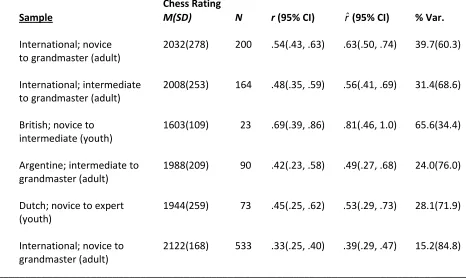
Correlations between deliberate practice and chess performance, with 95% confidence intervals (CIs), are displayed in Table 1. On average, deliberate practice explained 34% of the variance in
performance after correcting for measurement error variance (avg.rˆ= .57), leaving 66% of the variance unexplained and potentially explainable by other factors (see Figure 1). The 95% CI included 1.0 in Bilalid et al. (2007), but the confidence interval was very wide (rˆ= .81, 95% CI, .46, 1.0) due to a small sample size (N = 23).5 (Note also that the correlation between practice and chess performance dropped from .69 to .60 after Bilalid et al. statistically controlled for IQ, which yields rˆ= .70, 95% CI, .29, .95.)
There was a wide range of ages in some of the studies (e.g., Charness et al., 2005), which could represent a confound. To control for age differences, we computed partial correlations (pr) reflecting the relationship between deliberate practice and chess performance controlling for age. We then corrected the partial correlations for the unreliability of deliberate practice and chess rating (assuming reliability of .80 for deliberate practice and .91 for chess rating). The average corrected partial
correlation was nearly the same as the average corrected correlation (avg. prˆ = .64 vs. avg. rˆ = .60).
4
We deleted players that abandoned the tournament three rounds before the end or earlier (at most 3% of players, and usually less than 1%). We chose the Chess Olympiad and European Individual Championship to compute the reliability estimate, because in other Open tournaments the rate of forfeit is much higher.
5
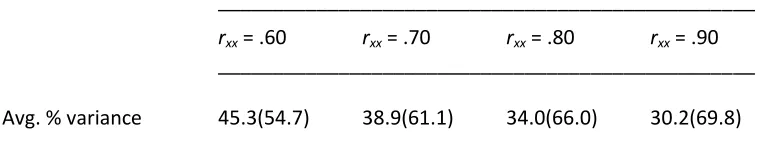
Our analyses would have underestimated the contribution of deliberate practice if reliability of this measure was lower than .80, as it may have been in (for example) Howard’s (2012) study given the use of a brief internet survey (Ericsson & Moxley’s, 2012), or overestimated this contribution if it was higher than .80, as it may have been in Charness et al.’s (2005) exemplary studies. Therefore, we performed a sensitivity analysis in which we assumed different levels of reliability for deliberate practice. Results are shown in Table 2. Even assuming a low level of reliability (rxx = .60), deliberate
practice left a very large proportion of the variance in chess performance unexplained (54.7%). Discussion of Chess Reanalyses
On average, deliberate practice accounted for 34% of the reliable variance in chess
performance, leaving 66% unexplained and potentially explainable by other factors. We conclude that deliberate practice is not sufficient to account for individual differences in chess performance.
than the mean of the expert group, one skill level up, and 12.9% (n = 4) had even more deliberate practice than the mean of the master group, two skill levels up.
Howard’s (2011) case study of the three Polgár sisters provides further support for our
conclusion. Beginning at a young age, the three Polgár sisters received several hours of chess instruction every day from chess grandmasters and their father, a chess teacher and author of several chess books. Using practice estimates obtained from biographical and autobiographical accounts, Howard found that the sisters differed both in the highest rating they achieved and in the amount of practice they
accumulated to reach that rating. For example, one sister’s peak rating was 2,735 in an estimated 59,904 hours of practice, whereas another sister’s was 2,577—more than a standard deviation lower— in an estimated 79,248 hours of practice. Howard also found that the two sisters who became
grandmasters had accumulated a great deal more practice by the time they reached their peak rating than had the eight grandmasters in his sample who reached top-ten in the world (M = 14,020.5 hours, SD = 7,373.96 hours). Deliberate practice is clearly not sufficient to account for individual differences in chess performance.
II. Music
Music is another popular domain for psychological research on expertise. In fact, although chess has been called the Drosophila for research on expertise, at least as many articles have been published on music expertise (see Hambrick & Meinz, 2012, for a review). We identified eight studies, listed in Table 3, that met the criteria for our reanalysis.6 Participants in these studies completed a survey to assess music-related experience in which they provided information such as the age they started playing music seriously and number of years of lessons, and for each age since taking up their instrument estimated the number of hours per typical week they had spent practicing alone—the activity that
6
Ericsson et al. (1993) identified as meeting the theoretical description of deliberate practice for music. In each study, the measure that can be interpreted as reflecting cumulative deliberate practice was
obtained by summing across annual estimates (i.e., hours for a typical week x 52). The deliberate practice measure was log-transformed in Lehmann and Ericsson (1996) and Meinz and Hambrick (2010). No transformation was performed in the other studies, but there is evidence that log-transformations have only small effects on amount of variance explained (Macnamara, Hambrick, & Oswald, 2013).
Five studies in Table 3 used piano sight-reading as a task, with various performance measures. Meinz’s (2000) and Meinz and Hambrick’s (2010) participants were pianists with a wide range of skill levels (beginning to advanced), and the measure of performance was the average of expert ratings of test performances across pieces. Our reliability estimates (.96 and .99, respectively) were the coefficient alphas for these measures. Tuffiash’s (2002) participants were college undergraduates, including music majors and non-majors, and the performance measure was the highest level of difficulty at which a participant received a high rating (8/10 or higher) by both expert rater. Our reliability estimate (.80) was test-retest reliability for the first level of difficulty, which was based on the entire sample. Lehman and Ericsson’s (1996) participants were highly skilled accompanists or piano soloists; an additional task was accompanying, and the performance measure for both tasks was the number of correctly played notes. Our reliability estimate (.88) was the correlation of number of correctly played notes with expert ratings of performance reported by Lehmann and Ericsson (1993). Kopiez and Lee’s (2008) participants were current or past piano majors from a music institute, and the performance measure was again the number of correctly played notes. Reliability was not reported, and therefore our reliability estimate (.88) was the same as for Lehman and Ericsson (1996).
The remaining three studies in Table 3—Study 1, Study 2A, and Study 2B of Ruthsatz,
Study 2A, participants were music institute students, and the performance measure was audition score. In Study 2B, participants were undergraduate music majors and the performance measure was faculty rating of musical achievement. Our reliability estimate (.80) was based on previous demonstrations of internal consistency, test-retest, and inter-rater reliability of .80 or higher for similar measures of musical achievement (e.g., Bergee, 2003; Hash, 2012; Kinney, 2009; Lien & Humphreys, 2001). (Note that in the Ruthsatz et al. studies deliberate practice included practice alone and lessons.)
There is no standardized measure of performance in music as there is in chess, but there was an extremely wide range of music skill in some of the studies. Tuffiash’s (2002) sample included both non-music majors recruited from an introductory psychology course and non-music majors from one of the top colleges of music in the U.S., and Meinz’s (2000) and Meinz and Hambrick’s (2010) participants ranged from beginner to professional.
Results of Music Reanalyses
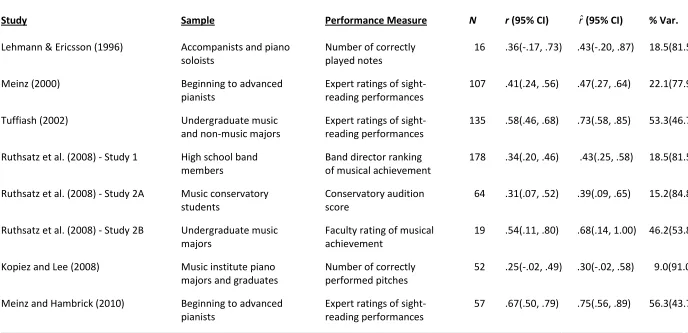
Correlations between deliberate practice and music performance, with 95% confidence intervals (CIs), are displayed in Table 3. On average, deliberate practice explained 28.9% of the variance in
performance after correcting for measurement error variance (avg.rˆ= .54), leaving 71.1% of the
variance unexplained and potentially explainable by other factors (see Figure 3). The 95% CI included 1.0 in Ruthsatz et al. (2007), Study 2B, but the confidence interval was extremely wide (rˆ= .68, 95% CI, .14, 1.0) due to a small sample size (N = 19). Note also that the correlation was much smaller in Ruthsatz et al.’s Study 2A (rˆ= .39, 95% CI, .09, .65), which used the same method but a larger sample (N = 64).
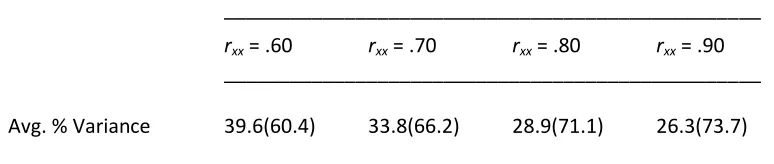
We again performed an analysis in which we assumed different levels of reliability for deliberate practice. Results are shown in Table 4. As for chess, even assuming a low level of reliability (rxx = .60), deliberate practice left a very large proportion of the variance unexplained (60.4%).
Discussion of Music Reanalyses
On average across studies, deliberate practice accounted for about 29% of the reliable variance in music performance, leaving about 71% unexplained and potentially explainable by other factors. We conclude that deliberate practice is not sufficient to account for individual differences in music
performance.
Results of other studies provide further support for this conclusion. Simonton (1991) found a large amount of variability in the amount of time it took famous classical composers to have their first “hit,” and that the interval between the first composition and the first hit correlated significantly and negatively with maximum annual output, lifetime productivity, and posthumous reputation. Composers who rose to fame quickly—the most “talented”—had the most successful careers. Furthermore, Sloboda, Davidson, Howe, and Moore (1996) noted that although students at a selective music school (“high achievers”) had accumulated more “formal practice” than students who were learning an instrument at a non-music school (“pleasure players”), there were some individuals at each skill level who did “less than 20 per cent of the mean amount of practice” and others who did “over four times as much practice than average…” (p. 301).
Ericsson et al.’s (1993) findings provide further support for our conclusion. Ericsson et al. did not report variability statistics for deliberate practice—no standard deviations, variances, or ranges.7
However, the log-transformed values in their Figure 15 indicate that deliberate practice in their study of
7
pianists (Study 2) ranged from about 10,000 to 30,000 hours in the expert group.8 The most practiced expert could have been no more than 11 years older than the least practiced expert (i.e., age 31 vs. 20), and yet the difference in deliberate practice between these subjects was about 20,000 hours.9 At 4 hours a day, 365 days a year, it would take nearly 14 years to accumulate this amount of deliberate practice, suggesting that some of Ericsson et al.’s pianists required much less deliberate practice than others to become experts.
General Discussion
Deliberate practice does not account for all, nearly all, or even most of the variance in performance in chess and music, the two most widely studied domains in expertise research. Put another way, deliberate practice accounts for a considerable amount of the variance in performance, but leaves a much larger amount of the variance unexplained. The bottom line is that deliberate practice is necessary to account for why some people become experts in these domains and others fail to do so, but not sufficient. So what else matters?
Starting Age
Starting at a young age may be one factor. Ericsson et al. (1993) argued that starting age influences performance insofar as it relates to the amount of deliberate practice an individual has accumulated: “An individual starting at an earlier age would have accumulated more deliberate practice and thus have acquired a higher level of performance” (p. 388). A testable prediction that follows from this idea is that the effect of starting age on performance should be mediated through deliberate
8
We digitized the three graphs in Ericsson et al.’s (1993) Figure 15, extracted the values using Dagra’s graphical extraction software, and back-transformed log accumulated hours of practice to accumulated hours of practice. With respect to Figure 15, Ericsson et al. (1993) report very high correlations (rs > -.85) between cumulative deliberate practice and latency measures from a complex movement task—but these would have been highly inflated by the use of extreme-groups design in Study 2 (i.e., experts vs. amateurs).
9
practice. However, Gobet and Campitelli (2007) and Howard (2012) found that the effect of starting age on chess rating was not mediated through deliberate practice. That is, starting age correlated negatively with chess rating even after statistically controlling for deliberate practice, indicating that the players who started young tended to have an advantage as adult chess players independent of how much deliberate practice they had accumulated. Furthermore, in the study of composers mentioned earlier, Simonton (1991) found that compared with less eminent composers, the greatest composers started music lessons and composition lessons at a younger age than did less eminent composers and took less time to start making contributions to the repertoire. Taken together, this evidence suggests that there may be a critical period for acquiring complex skills just as there is for acquiring language.
Intelligence
performance at all but the most difficult level of music (Levels 1 – 4, rs = .23 to .32; Level 5, r = .08).10 Thompson (1987) did not find a significant correlation between letter recall and sight-reading performance in flutists was not significant, but letter recall is more a test of short-term storage than working memory capacity (see, e.g., Engle, Tuholski, Kane, & Laughlin, 1999). Overall, it appears that working memory capacity has at least limited importance for musical expertise. An important question for future research is whether it plays a role in other musical skills (e.g., memorizing music).
Global measures of intelligence (IQ) have also been found to correlate with performance in chess and music, which is consistent with the possibility that a relatively high level of intelligence is necessary for success in these domains. Frydman and Lynn (1992) found that young chess players had an average performance IQ of 129, compared to a population average of 100, and that the average was higher for the best players (top-third avg. = 131) in the sample than the weakest players (bottom-third avg. = 124). Furthermore, Grabner, Neubauer, and Stern (2006) found that, even in highly rated players, IQ positively predicted performance on representative chess tasks (e.g., next best move). Bilalid et al. (2007) found that IQ was not a significant predictor of chess rating in the sample of elite young chess players listed in Table 1 after statistically controlling for deliberate practice. However, the sample size for the elite group was only 23, and mean IQ was significantly higher for the elite group (M = 133) than for an “average” group (M = 114). It has been suggested that chess training may transfer to IQ tests, but there is currently no compelling evidence for this (see Gobet & Campitelli, 2006, for a review). Instead, the effects of chess training appear to be domain-specific. For example, Schneider, Gruber, Gold, and Opwis (1993) found that children who played chess outperformed adults in a chessboard memory task, whereas the adults outperformed the children in a digit recall task.
10
IQ correlates positively with music performance, as well. Luce (1965) found a correlation of.53 (p < .01) between IQ and sight-reading performance in high school band members, and Salis (1977) reported a correlation of .58 between these variables in a university sample. Gromko (2004) found positive correlations between both verbal ability and spatial ability (rs = .35 - .49) and sight-reading performance in high school wind players, and Hayward and Gromko (2009) found a significant positive correlation (r = .24) between a measure of spatial ability based on three ETS tests and sight-reading performance in university wind players. Ruthsatz et al. (2008) found that Raven’s scores correlated positively and significantly with musical achievement in high school band members (r = .25). This correlation was non-significant in a sample of more highly accomplished conservatory students and music majors, but this could have been due to a ceiling effect on Raven’s, as these participants had been heavily selected for cognitive ability.
Ruthsatz and Detterman (2003) documented the case of a 6-year old piano prodigy named “Derek,” who at the time of the study had played in numerous concerts, appeared on national
television, and released two CDs of his music. Derek scored at or above the 95th percentile on a test of musical aptitude, and had not engaged in any activity that would qualify as deliberate practice. Derek did, however, score well above the average on subsets of the Stanford-Binet Intelligence Scale: verbal reasoning (130), abstract reasoning (114), quantitative reasoning (120), and short-term memory (158). More recently, Ruthsatz and Urbach (2012) administered a standardized IQ test (the Stanford-Binet) to eight child prodigies, six of whom were musical prodigies. Despite full-scale IQs that ranged from 108 to 147—just above average to above the conventional cutoff for “genius”—all of the prodigies were at or above the 99th percentile for working memory (indeed, six scored at the 99.9th percentile).
identified as “gifted” and tracked over the next two decades. Remarkably, individual differences in test scores—even within this highly restricted range of ability—predicted individual differences in scientific achievements. For example, compared to participants who were “only” in the 99.1percentile for overall SAT score—which largely reflects general intelligence (Frey & Detterman, 2004)—those participants who had scored in the 99.9 percentile—the profoundly gifted—were 3.6 times more likely to have earned a Ph.D. in a Science, Technology, Engineering, & Mathematics (STEM) discipline, 5 times more likely to have published an article in a STEM journal, and 3 times more likely to have registered a patent (Lubinski, 2009).
General intelligence does not always predict performance. In a study of football players, Lyons, Hoffman, and Michel (2009) found that scores on the Wonderlic Personnel Test, a widely administered group intelligence test, correlated essentially zero with success in the National Football League, even in the quarterback position, which is believed to place the highest demand on information processing. Furthermore, Hambrick et al. (2012) found that spatial ability positively predicted success in a complex geological problem solving task in novice geologists, but not in experts. There is a clear need to develop theories of expert performance that take into account how the contribution of cognitive ability factors to performance vary across domains (e.g., cognitive vs. physical domains), and across situations or tasks in a given domain.
Personality
Ericsson et al. (1993) hypothesized that personality factors may have an indirect effect on the acquisition of expert performance through deliberate practice:
There is now evidence to support this part of the deliberate practice view. In a study of Spelling Bee contestants, Duckworth, Kirby, Tsukayama, Berstein, and Ericsson (2012) found that the effect of
“grit”—a personality factor reflecting persistence in accomplishing long-term goals—positively predicted deliberate practice, which in turn positively predicted spelling performance. Similarly, in a study of classical musicians, Bonneville-Roussy et al. (2011) found that “passion” positively predicted “mastery goals,” which in turn positively predicted deliberate practice, which in turn positively predicted music performance.
This evidence suggests that personality is an important part of the expert performance puzzle. But, critically, this evidence does not suggest that personality is one of the “other” factors that accounts for the variance in performance that deliberate practice leaves unexplained (see the dark gray region of Figures 1 and 3). That is, effects of the personality factors on performance in these studies were, as Ericsson (2012) stressed in a discussion of the Duckworth et al. (2012) study, fully mediated through and thus completely explained by individual differences in deliberate practice. So, personality factors may explain why some people engage in more deliberate practice than others, but they do not appear to independently explain individual differences in performance.
Genes
There is also evidence for genetic effects on creativity. Based on correlations between scientific training/performance variables and both personality and intellectual traits, Simonton (2008) found nontrivial (lower-bound) heritability estimates for scientific training/performance variables—for example, about 25% for comprehensive exam scores and about 10% for faculty ratings. An important goal for future behavior genetic research on expert performance is to investigate whether there are genetic effects on objective measures of performance (e.g., music tasks, scientific problem solving tasks), and to investigate whether such effects on performance are accounted for by intelligence, personality, or both.
Popular Myths about Expert Performance
Two myths regarding deliberate practice and expert performance have taken root in the public’s imagination. The first myth is that people require very similar amounts of deliberate practice to acquire expert performance. Gladwell (2008) wrote in Outliers that Ericsson et al.’s (1993) “research suggests that once a musician has enough ability to get into a top music school, the thing that distinguishes one performer from another is how hard he or she works. That’s it.” (p. 39). Similarly, Syed (2010) wrote in Bounce that
Top performers had devoted thousands of additional hours to the task of becoming master performers. But that’s not all. Ericsson also found that there were no exceptions to this pattern: nobody who had reached the elite group without copious practice, and nobody who had worked their socks off but failed to excel. (p. 16)
These categorical claims are incorrect. The evidence is quite clear that some people do reach an elite level of performance without copious practice, while other people fail to do so despite copious practice.
training before they win international competitions” (p. 5, emphasis added). Subsequently, Gladwell (2008) proposed in Outliers that “Ten thousand hours is the magic number of greatness” (p. 41). More recently, the Nobel laureate Daniel Kahneman (2011) wrote in his book Thinking, Fast and Slow that “Studies of chess masters have shown that at least 10,000 hours of dedicated practice…are required to attain the highest levels of performance” (p. 238). But the data indicate that there is an enormous amount of variability in deliberate practice—even in elite performers. One player in Gobet and Campitelli’s chess sample took 26 years of serious involvement in chess to reach a master level, while another player took less than 2 years to reach this level.
Some normally functioning people may never acquire expert performance in certain domains, regardless of the amount of deliberate practice they accumulate. In Gobet and Campitelli’s (2007) chess sample, three participants estimated more than 10,000 hours of individual practice, and yet remained intermediate-level players. This conclusion runs counter to the egalitarian view that anyone can achieve most anything he or she wishes, with enough hard work. The silver lining, we believe, is that when people are given an accurate assessment of their abilities and of the likelihood of achieving certain goals given those abilities, they may gravitate towards domains in which they have a realistic chance of acquiring expert performance through deliberate practice.
Beyond the Deliberate Practice View
The debate over why and how some people become experts and other fail to do so has been a topic of intense debate in psychology for well over a century, and it will remain so for many years to come. The intensity of the debate to this point likely reflects a clash between what Cronbach (1957) called the two “disciplines” of scientific psychology—experimental psychology and differential
But as Simonton (1999) advises, “psychology must endeavor to identify all of the significant causal factors behind exceptional performance rather than merely rest content with whatever factor happens to account for the most variance” (p. 454). For researchers seriously interested in advancing the science of expert performance, the task now is to rise above disciplinary and ideological differences and develop and rigorously test theories that take into account as many potentially relevant explanatory factors as possible—including not only deliberate practice and other environmental variables, but heritable traits such as general intelligence, and task and situational factors that may moderate effects of individual-difference variables on performance.
References
Ackerman, P. L. (2012, May). Nonsense, common sense, and science of expert performance: Talent and individual differences. Invited presentation for the “The Talent Myth and the 10,000 Hour Rule” symposium presented at the annual meeting of the American College of Sports Medicine (ACSM), San Francisco, CA.
Anderson, J. R. (2000). Learning and memory: An integrated approach (2nd Ed.). New York: John Wiley and Sons.
Bergee, M. J. (2003). Faculty interjudge reliability of music performance evaluation. Journal of Research in Music Education, 51, 137-150. doi: 10.2307/3345847
Bilalid, M., McLeod, P., & Gobet, F. (2007). Does chess need intelligence? A study with young chess players. Intelligence, 35, 457-470. 10.1016/j.intell.2006.09.005
Bonneville-Roussy, A., Lavigne, G. L., & Vallerand, R. J. (2011). When passion leads to excellence: the case of musicians. Psychology of Music, 39, 123-138. doi: 10.1177/0305735609352441
Brooks, D. (2011). The social animal: The hidden sources of love, character, and achievement. New York: Random House.
Burns, B. (2004). The effects of speed on skilled chess performance. Psychological Science, 15, 442-447. doi: 10.1111/j.0956-7976.2004.00699.x
Campitelli, G., & Gobet, F. (2011). Deliberate practice: Necessary but not sufficient. Current Directions in Psychological Science, 20, 280-285. doi: 10.1177/0963721411421922
Charness, N., Krampe, R. Th., & Mayr, U. (1996). The role of practice and coaching in entrepreneurial skill domains: An international comparison of life-span chess skill acquisition. In K. A. Ericsson (Ed.) The Road to Excellence: The acquisition of expert performance in the arts and sciences, sports and games (pp. 51-80). Mahwah, NJ: Erlbaum.
practice in chess expertise. Applied Cognitive Psychology, 19, 151-165. doi: 10.1002/acp.1106 Colvin, G. (2010). Talent is overrated. What really separates world-class performers from everybody else.
New York: Penguin.
Coon, H., & Carey, G. (1989). Genetic and environmental determinants of musical ability in twins. Behavior Genetics, 19, 183-193. doi: 10.1007/BF01065903
Coyle, D. (2009). The talent code: It’s born. It’s grown. Here’s how. New York: Bantam.
Cronbach, L. J. (1957). The two disciplines of scientific psychology. American Psychologist, 12, 671-684. doi: 10.1037/h0043943
Cronbach, L. J. (1990). Essentials of psychological testing (5th Ed.). New York: HarperCollins.
Detterman, D. K., Gabriel, L. T., & Ruthsatz, J. M. (1998). Absurd environmentalism. Behavioral and Brain sciences, 21, 411-412. doi: 10.1017/S0140525X98271238
de Bruin, A. B. H., Rikers, R. M. J. P., & Schmidt, H. G. (2007). The influence of achievement motivation and chess-specific motivation on deliberate practice. Journal of Sport & Exercise Psychology, 29, 561-583.
Duckworth, A. L., Kirby, T. A., Tsukayama, E., Berstein, H., & Ericsson, K. A. (2012). Deliberate practice spells success: Why grittier competitors triumph at the National Spelling Bee. Social
Psychological and Personality Science, 2, 174-181. doi: 10.1177/1948550610385872 Elo, A. E. (1986). The rating of chessplayers, past and present (2nd ed.). New York: Arco.
Engle, R. W. (2002). Working memory capacity as executive attention. Current Directions in Psychological Science, 11, 19-23. doi: 10.1111/1467-8721.00160
Ericsson, K. A. (2006). The influence of experience and deliberate practice on the development of superior expert performance. In K. A. Ericsson, N. Charness, P. J. Feltovich, & R. R. Hoffman (Eds.). The Cambridge handbook of expertise and expert performance (pp. 683-703). New York: Cambridge University Press.
Ericsson, K. A. (2007). Deliberate practice and the modifiability of body and mind: Toward a science of the structure and acquisition of expert and elite performance. International Journal of Sport Psychology, 38, 4-34.
Ericsson, K. A. (2012). Training history, deliberate practice and elite sportsperformance: An analysis in response to Tucker and CollinsReview - What makes champions? British Journal of Sport
Medicine. doi: 10.1136/bjsports-2012-091767
Ericsson, K. A. (2012). The danger of delegating education to journalists: Why the APS Observer needs peer review when summarizing new scientific developments. Unpublished manuscript. Retrieved from http://www.psy.fsu.edu/faculty/ericsson/ericsson.hp.html
Ericsson, K. A., & Charness, N. (1994). Expert performance: Its structure and acquisition. American Psychology, 49, 725-747. doi: 10.1037/0003-066X.49.8.725
Ericsson, K. A., & Delaney, P. F. (1999). Long-term working memory as an alternative to capacity models of working memory in everyday skilled performance. In A. Miyake & P. Shah (Eds.), Models of working memory (pp. 257-297). Cambridge, MA: Cambridge University Press.
Ericsson, K. A., & Kintsch, W. (1995). Long-term working memory. Psychological Review, 102, 211-245. doi: 10.1037/0033-295X.102.2.211
Ericsson, K. A., Krampe, R. Th., & Tesch-Römer, C. (1993). The role of deliberate practice in the acquisition of expert performance. Psychological Review, 100, 363-406. doi: 10.1037/0033-295X.100.3.363
Ericsson, K. A., Nandagopal, K., & Roring, R. W. (2005). Giftedness viewed from the expert-performance perspective. Journal for the Education of the Gifted, 28, 287-311. doi: 10.4219/jeg-2005-335 Ericsson, K. A., Prietula, M. J., & Cokely, E. T. (2007). The making of an expert. Harvard Business Review,
85, 146-147.
Freeman, J. (2007). If you can’t measure it—it doesn’t exist. High Ability Studies, 18, 65-66. doi: 10.1080/13598130701350726
Frey, M. C., & Detterman, D. K. (2004). Scholastic assessment or g? The relationship between the scholastic assessment test and general cognitive ability. Psychological Science, 15, 373-378. doi: 10.1111/j.0956-7976.2004.00687.x
Frydman, M., & Lynn, R. (1992). The general intelligence and spatial abilities of gifted young Belgian chess players. British Journal of Psychology, 83, 233-235. doi:
10.1111/j.2044-8295.1992.tb02437.x
Galton, F. (1869). Hereditary genius. London: Macmillan.
Gardner, H. (1995). “Expert performance: Its structure and acquisition”: Comment. American Psychologist, 50, 802-803. doi: 10.1037/0003-066X.50.9.802
Gladwell, M. (2008). Outliers: The story of success. New York: Little, Brown, and Co.
Gobet, F., & Campitelli, G. (2007). The role of domain-specific practice, handedness, and starting age in chess. Developmental Psychology, 43, 159-172. doi: 10.1037/0012-1649.43.1.159
Grabner, R. H., Neubauer, A. C., & Stern, E. (2006). Superior performance and neural efficiency: The impact of intelligence and expertise. Brain Research Bulletin, 69, 422-439. doi:
10.1016/j.brainresbull.2006.02.009
Grabner, R. H., Stern, E., & Neubauer, A. C. (2007). Individual differences in chess expertise: A
psychometric investigation. Acta Psychologica, 124, 398-420. doi: 10.1016/j.actpsy.2006.07.008 Gromko, J. E. (2004). Predictors of music sight-reading ability in high school wind players. Journal of
Research in Music Education, 52, 6-15. doi: 10.2307/3345521
Hambrick, D. Z., Libarkin, J. C., Petcovic, H. L., Baker, K. M., Elkins, J., Callahan, C. N., Turner, S. P., Rench, T. A., & LaDue, N. D. (2012). A test of the circumvention-of-limits hypothesis in scientific
problem solving: The case of geological bedrock mapping. Journal ofExperimental Psychology: General, 141, 397-403. doi: 10.1037/a0025927
Hambrick, D. Z., & Meinz, E. J. (2011). Limits of the predictive power of domain-specific experience. Current Directions in Psychological Science, 20, 275-279. doi: 10.1177/0963721411422061 Hambrick, D. Z., & Meinz, E. J. (2011, November 20). Sorry, strivers. Talent matters. The New York Times.
Sunday Review, 12.
Hambrick, D. Z., & Meinz, E. J. (2012). Working memory capacity and musical skill. In T. P. Alloway and R. G. Alloway (Eds.), Working memory: The connected intelligence (pp. 137-155). New York:
Psychology Press.
Hash, P. M. (2012). An analysis of the ratings and interrater reliability of high school band contests. Journal of Research in Music Education, 60, 81-100. doi: 10.1177/0022429411434932 Hayward, C. M., & Gromko, J. E. (2009). Relationships among music sight-reading and technical
Howard, R. W. (2011). Does high-level intellectual performance depend on practice alone? Debunking the Polgár sisters case. Cognitive Development, 26, 196-202. doi: 10.1016/j.cogdev.2011.04.001 Howard, R. W. (2012). Longitudinal effects of different types of practice on the development of chess
expertise. Applied Cognitive Psychology, 26, 359-369. doi: 10.1002/acp.1834
Hunter, J. E., & Schmidt, F. L. (1990). Methods of meta-analysis: Correcting error and bias in research findings. Newbury Park: Sage.
Kahneman, D. (2011). Thinking, fast and slow. New York: Farrar, Straus, and Giroux.
Kaufman, S. B. (2007). Investigating the role of domain general mechanisms in the acquisition of domain specific expertise. High Ability Studies, 18, 71-73. doi: 10.1080/13598130701350767 Kinney, D. W. (2009). Internal consistency of performance evaluations as a function of music expertise
and excerpt familiarity. Journal of Research in Music Education, 56, 322-337. doi: 10.1177/0022429408328934
Kline, R. B. (2010). Structural equation modeling: Principles and practice of structural equation modeling (3rd ed). New York: Guilford Press.
Kopiez, R., & Lee, J.I. (2006). Towards a dynamic model of skills involved in sight reading music. Music Education Research, 8, 97-120. doi: 10.1080/14613800600570785
Kopiez, R. & Lee, J.I. (2008). Towards a general model of skills involved in sight reading music. Music Education Research, 10, 41-62. doi: 10.1080/14613800701871363
Krampe, R. Th. (1994). Maintaining excellence: Cognitive-motor performance in pianists differing in age and skill level. Max-Planck-Institut für Bildungsforschung. Berlin, Germany.
Krampe, R. Th., & Ericsson, K. A. (1996). Maintaining excellence: Deliberate practice and elite
performance in young and older pianists. Journal of Experimental Psychology: General, 125, 331-359. doi: 10.1037/0096-3445.125.4.331
accompanying. Psychomusicology: A Journal of Research in Music Cognition, 12, 182-195. doi: 10.1037/h0094108
Lehmann, A. C., & Ericsson, K. A. (1996). Performance without preparation: Structure and acquisition of expert sight-reading and accompanying performance. Psychmusicology: A Journal of Research in Music Cognition, 15, 1-29. doi: 10.1037/h0094082
Levitin, D. J. (2006). This is your brain on music: The science of a human obsession. New York: Penguin. Lien, J. L., & Humphreys, J. T. (2001). Relations among selected variables in the South Dakota all-state
band auditions. Journal of Research in Music Education, 49, 146-155. doi: 10.2307/3345866 Lipsey, M. W., & Wilson, D. B. (2001). Practical meta-analysis. Thousand Oaks: Sage.
Lubinski, D. (2009). Exceptional cognitive ability: The phenotype. Behavior Genetics, 39, 350-358. doi: 10.1007/s10519-009-9273-0
Luce, J. R. (1965). Sight-reading and ear-playing abilities as related to instrumental music students. Journal of Research in Music Education, 13, 101-109. doi: 10.2307/3344447
Lyons, B., Hoffman, B., & Michel, J. (2009). Not much more than g? An examination of the impact of intelligence on NFL performance. Human Performance, 22, 225-245.
doi:10.1080/08959280902970401
Marcus, G. (2012). Guitar zero: The science of becoming musical at any age. New York: Penguin.
Macnamara, B., Hambrick, D. Z., & Oswald, F. L. (2013). The relationship between deliberate practice and performance in music, sports, games, and professions: A meta-analysis and critical review.
Manuscript in preparation.
Meinz, E. J. & Hambrick, D. Z. (2010). Deliberate practice is necessary but not sufficient to explain individual differences in piano sight-reading skill: The role of working memory capacity. Psychological Science, 21, 914-919. doi: 10.1177/0956797610373933
Pink, D. H. (2009). Drive. The surprising truth about what motivates us. New York: Riverhead Books. Plomin, R., DeFries, J. C., McClearn, G. E., & McGuffin, P. (2008). Behavioral genetics (5th ed.). New York:
Worth Publishers.
Robertson, K. F., Smeets, S., Lubinski, D., & Benbow, C. P. (2010). Beyond the threshold hypothesis: Even among gifted and top math/science graduate students, cognitive abilities, vocational interests, and lifestyle preferences matter for career choice, performance, and persistence. Current Directions in Psychological Science, 19, 346-351. doi: 10.1177/0963721410391442
Ruthsatz, J., & Detterman, D. K. (2003). An extraordinary memory: The case study of a musical prodigy. Intelligence, 31, 509-518. doi: 10.1016/S0160-2896(03)00050-3
Ruthsatz, J., & Urbach, J. B. (2012). Child prodigy: A novel cognitive profile places elevated general intelligence, exceptional working memory and attention to detail at the root of prodigiousness. Intelligence, 40, 419-426. doi: 10.1016/j.intell.2012.06.002
Ruthsatz, J., Detterman, D. K., Griscom, W. S., & Cirullo, B. A. (2008). Becoming an expert in the musical domain: It takes more than just practice. Intelligence, 36, 330-338. doi:
10.1016/j.intell.2007.08.003
Salis, D. L. (1977). The identification and assessment of cognitive variables associated with reading of advanced music at the piano (Unpublished doctoral dissertation). University of Pittsburgh, Pittsburgh, PA.
Schneider, W. (1998). Innate talent or deliberate practice as determinants of exceptional performance:
Schneider, W., Gruber, H., Gold, A., & Opwis, K. (1993). Chess expertise and memory for chess positions in children and adults. Journal of Experimental Child Psychology, 56, 328-349.
Schmidt, F., & Hunter, J. (1999). Theory testing and measurement error. Intelligence, 27, 183-198. doi: 10.1016/S0160-2896(99)00024-0
Shenk, D. (2010). The genius in all of us. Why everything you’ve been told about genetics, talent, and IQ is wrong. New York: Doubleday.
Simonton, D. K. (1991). Emergence and realization of genius: The lives and works of 120 classical composers. Journal of Personality and Social Psychology, 61, 829-840. doi: 10.1037/0022-3514.61.5.829
Simonton, D. K. (1999). Talent and its development: An emergenic and epigenetic model. Psychological Review, 106, 435-457. doi: 10.1037/0033-295X.106.3.435
Simonton, D. K. (2008). Scientific talent, training, and performance: Intellect, personality, and genetic endowment. Review of General Psychology, 12, 28-46. doi: 10.1037/1089-2680.12.1.28 Sloboda, J. A., Davidson, J. W., Howe, M. J. A., & Moore, D. G. (1996). The role of practice in the
development of performing musicians. British Journal of Psychology, 87, 287-309. Spearman, C. (1904). General intelligence, Objectively determined and measured. The American
Journal of Psychology, 15, 201–292. doi: 10.2307/1412107
Sternberg, R. J. (1996). Costs of expertise. In K. A. Ericsson (Ed.), The road to excellence: The acquisition of expert performance in the arts and sciences, sports, and games (pp. 347-354). Mahwah, NJ: Lawrence Erlbaum.
Syed, M. (2010). Bounce: Mozart, Federer, Picasso, Beckham, and the science of success. New York: HarperCollins.
Tuffiash, M. (2002). Predicting individual differences in piano sight-reading skill: Practice, performance, and instruction (Unpublished master’s thesis). Florida State University, Tallahassee, FL.
Tuffiash, M., Roring, R. W., & Ericsson, K. A. (2007). Expert performance in SCRABBLE: Implications for the study of the structure and acquisition of complex skills. Journal of Experimental Psychology: Applied, 13, 124-134. doi: 10.1037/1076-898X.13.3.124
van der Maas, H. L., & Wagenmakers, E. J. (2005). A psychometric analysis of chess expertise. The American Journal of Psychology, 118, 29-60.
Vinkhuyzen, A. E., van der Sluis, S., Posthuma, D., & Boomsma, D. I. (2009). The heritability of aptitude and exceptional talent across different domains in adolescents and young adults. Behavior Genetics, 39, 380-392. doi: 10.1007/s10519-009-9260-5
Watson, J. B. (1930). Behaviorism. Chicago, IL: The University of Chicago Press.
Winner, E. (2000). The origins and ends of giftedness. American Psychologist, 55, 159-169. doi:
Table 1
Correlations Between Deliberate Practice and Chess Performance
Chess Rating
Study Sample M(SD) N r (95% CI) rˆ(95% CI) % Var.
Charness et al. (2005) - Study 1 International; novice 2032(278) 200 .54(.43, .63) .63(.50, .74) 39.7(60.3) to grandmaster (adult)
Charness et al. (2005) - Study 2 International; intermediate 2008(253) 164 .48(.35, .59) .56(.41, .69) 31.4(68.6) to grandmaster (adult)
Bilalid et al. (2007) British; novice to 1603(109) 23 .69(.39, .86) .81(.46, 1.0) 65.6(34.4) intermediate (youth)
Gobet & Campitelli (2007) Argentine; intermediate to 1988(209) 90 .42(.23, .58) .49(.27, .68) 24.0(76.0) grandmaster (adult)
de Bruin et al. (2007) Dutch; novice to expert 1944(259) 73 .45(.25, .62) .53(.29, .73) 28.1(71.9) (youth)
Howard (2012) International; novice to 2122(168) 533 .33(.25, .40) .39(.29, .47) 15.2(84.8) grandmaster (adult)
______________________________________________________________________________________________________________________
Note. Studies are in chronological order. r, correlation between cumulative deliberate practice and chess performance.rˆ, corrected correlation.
% var., percentage of variance in chess performance explained by deliberate practice (vs. unexplained) after correction for measurement error variance (rˆ2). Reliability coefficient for deliberate practice (rxx), .80. Reliability for chess rating (ryy), .91. For Bilalid et al., the upper-bound of the
Table 2
Results of Reliability Analysis for Chess Performance
Reliability of Deliberate Practice (rxx)
Table 3
Correlations Between Deliberate Practice and Music Performance
Study Sample Performance Measure N r (95% CI) rˆ(95% CI) % Var.
Lehmann & Ericsson (1996) Accompanists and piano Number of correctly 16 .36(-.17, .73) .43(-.20, .87) 18.5(81.5)
soloists played notes
Meinz (2000) Beginning to advanced Expert ratings of sight- 107 .41(.24, .56) .47(.27, .64) 22.1(77.9)
pianists reading performances
Tuffiash (2002) Undergraduate music Expert ratings of sight- 135 .58(.46, .68) .73(.58, .85) 53.3(46.7) and non-music majors reading performances
Ruthsatz et al. (2008) - Study 1 High school band Band director ranking 178 .34(.20, .46) .43(.25, .58) 18.5(81.5)
members of musical achievement
Ruthsatz et al. (2008) - Study 2A Music conservatory Conservatory audition 64 .31(.07, .52) .39(.09, .65) 15.2(84.8)
students score
Ruthsatz et al. (2008) - Study 2B Undergraduate music Faculty rating of musical 19 .54(.11, .80) .68(.14, 1.00) 46.2(53.8)
majors achievement
Kopiez and Lee (2008) Music institute piano Number of correctly 52 .25(-.02, .49) .30(-.02, .58) 9.0(91.0) majors and graduates performed pitches
Meinz and Hambrick (2010) Beginning to advanced Expert ratings of sight- 57 .67(.50, .79) .75(.56, .89) 56.3(43.7)
pianists reading performances
________________________________________________________________________________________________________________________________________________________ ____
Note. Studies are in chronological order. r, correlation between cumulative deliberate practice and skill.rˆ, corrected correlation. % var., percentage of
variance in music performance explained by deliberate practice after correction for measurement error variance (rˆ2). Reliability for deliberate practice (rxx),
Table 4
Results of Reliability Analysis for Music Performance
Reliability of Deliberate Practice (rxx)
Figure Captions
Figure 1. Average percentage of variance in chess performance accounted for by deliberate practice, correcting for measurement error variance.
Figure 2. Histograms showing accumulated hours of deliberate practice for “master” (n=16), “expert” (n=31), and “intermediate” (n=43) chess players (Gobet & Campitelli, 2007). Deliberate practice refers to serious study alone.
Chess
Deliberate Practice
Other
34.0%
66.0%
Figure 1
Average percentage of variance in chess performance explained by deliberate practice correcting for
Figure
1.
Average
percentage
of
variance
in
chess
performance
explained
by
deliberate
practice,
correcting
for
30 35 40
in
Skill
Gr
oup
Master
Expert
Intermediate
15 20 25
of
Pla
yer
s
With
0 5 10
0 2,500 5,000 7,500 10,000 12,500 15,000 17,500 20,000 22,500 More
%
Figure 2
Histograms showing accumulated hours of deliberate practice for “master” (
n
=16) “expert” (
n
=31) and
Accumulated No. Hours of Deliberate Practice
Figure
2.
Histograms
showing
accumulated
hours
of
deliberate
practice
for
master
(
n
=16),
expert
(
n
=31),
and
[image:42.612.202.580.159.431.2]
Deliberate Practice
Other