City, University of London Institutional Repository
Citation
:
MacFarlane, A., Lu, W. and Robertson, S. E. (2006). Field-Weighted XML
Retrieval Based on BM25. In: Advances in XML Information Retrieval and Evaluation.
Lecture Notes in Computer Science, 3977. (pp. 161-171). Springer Berlin Heidelberg. ISBN
9783540349624
This is the accepted version of the paper.
This version of the publication may differ from the final published
version.
Permanent repository link:
http://openaccess.city.ac.uk/5224/
Link to published version
:
http://dx.doi.org/10.1007/978-3-540-34963-1_12
Copyright and reuse:
City Research Online aims to make research
outputs of City, University of London available to a wider audience.
Copyright and Moral Rights remain with the author(s) and/or copyright
holders. URLs from City Research Online may be freely distributed and
linked to.
Field-Weighted XML Retrieval Based on BM25
Wei Lu1, Stephen Robertson2
, Andrew Macfarlane3
1 Center for Studies of Information Resources
School of Information Management Wuhan University, China
2 Microsoft Research
Cambridge, U.K. [email protected]
3 Centre for Interactive Systems Research
Department of Information Science City University London
Abstract. This is the first year for the Centre for Interactive Systems Research participation of INEX. Based on a newly developed XML indexing and retrieval system on Okapi, we extend Robertson’s field-weighted BM25F for document retrieval to element level retrieval function BM25E. In this paper, we introduce this new function and our experimental method in detail, and then show how we tuned weights for our selected fields by using INEX 2004 topics and assess-ments. Based on the tuned models we submitted our runs for CO.Thorough, CO.FetchBrowse, the methods we propose show real promise. Existing prob-lems and future work are also discussed.
1. Introduction
Being an important data exchange and information storage standard, XML is now widely used, especially for scientific data repositories, Digital Libraries and on the Web, which has brought about an explosion in the research of information retrieval for XML. Many sophisticated systems [1, 2, 3, 4, 5] and retrieval models [6, 7, 8, 9, 10] for XML documents have been proposed.
and Myaeng et al [15] combine terms found in different document representations using Bayesian inference networks. Robertson et al [11] give a more detailed review of this area in their paper.
In practice, many systems use a linear combination of the scores obtained from scoring every field due to the complexity of the ranking algorithms deployed. Robert-son et al [11] discuss the dangers of linear combination in detail and propose an alter-native solution, the linear combination of term frequencies based on BM25 (BM25F will be used in the rest of the paper instead of “field-weighted models based on BM25”), to extend standard ranking functions to multiple weighted fields. Their ex-periment based on two existing collection Reuters vol. I collection and the 2002 TREC Web-Track crawl of the .gov for document level retrieval shows that the method was beneficial. Some related work using Okapi, BM25 or field combination in INEX 2004 are documented in [16, 17, 18, 19, 20].
In this paper, we extend this method further to element level XML retrieval based on INEX 05 collections. In section 2, we discuss in detail the field-weighted models. Sec-tion 3 further illustrates the experiment of this method on INEX 05 and EvaluaSec-tion results are reported in section 4. A conclusion and further work to be undertaken are described at the end.
2. BM25F model
In this section we describe BM25F model in detail. We first introduce the models for document level weighting in section 2.1. And then we further discuss the implementa-tion of the model to XML element level retrieval.
2.1 BM25F for document level weighting
BM25F is the field-weighted version of BM25. It is derived from Robertson et al [11] for document level retrieval. For ad-hoc retrieval, and ignoring any repetition of terms in the query, BM25 can be simplified to [11]:
where C denotes the document collection,
tf
j is the term frequencyof the jth term ind , df jis the document frequency of term j, dl is the document length, avdl is the
av-erage document length across the collection, and k1 and b are tuning parameters. Then the document score is obtained by term weights of terms matching the query q:
)
1
(
5
.
0
5
.
0
log
)
)
1
((
)
1
(
)
,
(
1 1+
+
−
+
+
−
+
=
j j j j jdf
df
N
tf
avdl
dl
b
b
k
tf
k
C
d
w
∑
⋅
=
j j jd
C
q
w
c
q
d
W
(
,
,
)
(
,
)
(
2
)
Being a linear weighted combination of term frequency of in these fields, function BM25F is shown as follows:
where
tf
'
j denotes the weighted term frequency of the jth term in d ,dl
'
is the weighted document length,avdl
'
is the weighted average document length acrossthe collection.
k
'1 is the weighted free parameter.Suppose we have nF fields f = 1, . . . , nF. In a given document d, term t has fre-quency
tf
d,t,fin field f. There are various ways of defining the length of fields or documents, but the simplest way is to use the number of indexed terms (tokens). This means that the length of the field in this document iswhere V is the vocabulary, i.e. all indexed terms.
With no field weighting, the term frequency of t in the whole document is
and the document length is
Average document length is
With field weights Wf,, these are modified as follows:
∑
∈=
v t f t d ftf
dl
,,∑
=
f f t d t dtf
tf
, ,,∑∑
∑
∑
=
=
=
f t t
t d f t d f
f
tf
tf
dl
dl
,, ,∑
=
dl
N
avdl
1
∑
=
f f t d f td
w
tf
and
where atf is the average term frequency.
Function (3) is used for document weighting. However XML retrieval requires not only document level but also element level retrieval. This means an algorithm for ele-ment weighting is required. In section 2.2, we further discuss the field-weighted weighting function for element level retrieval (BM25E) derived from function (3).
2.2 Proposed model BM25E for element weighting
From function (3), we can see that linear combination of weighted field frequencies is used instead of original term frequency in specified document. We hypothesize that this method could also be applied to element retrieval. Our basic view is that an ele-ment is to be treated like a docuele-ment, except that it may inherit information from other elements in the document. Thus each element has (in addition to its own text, which is treated as one field) extra fields consisting of text inherited from other elements. The details of our idea are as follows:
Suppose we have nE elements e = 1, . . . , nE in given collection C. Term t has fre-quency tfd,t,e in element e. el is the element length and avel is the average element
length. Then we simply extend BM25 to element retrieval as follows:
Accordingly, Function BM25E would be,
∑
∑∑
∑
=
=
=
t t d f t f t d f f ff
d
l
w
tf
tf
w
dl
' ,, ' ,where
tf
'
e,j denotes the weighted term frequency of jth term t in e,el
'
is the weighted element length,avel
'
is the weighted average element length across thecollection.
k
'1 is the weighted free parameter. Similar to those parameters in section 2.1,given a field weights Wf to elements which contributes to a given element’s Weight,
and
where M is the total number of element in collection C.
(5) implies that given an element e in collection C, if it exists some fields(element) f contributing to the weight of the element, then a linear combination of field-weighted term frequency of field are applied based on BM25F. Theoretically, f could be any element in collection C. In fact, if all elements in a document d contribute to a given element in this document, then we come back to BM25F (3). And if all Wf equal 1, then
we further come back to BM25 (1).
What we need to say is that this statement does not in any way define the imple-mentation, but merely the principle of how elements are to be treated. Detail implementation of our experiment is further discussed in section 3.
3 Experiment of BM25E on INEX 2005
In this section, INEX collection and its structure will be introduced. We will then describe the assumptions we used for our experiments. Finally, our experiment envi-ronment and procedures are introduced.
∑
∈
=
e ft f f t
f
w
tf
tf
' , ,∑
∑∑
∑
=
=
=
∈
∈ ft
t f e
f t
t f f e
f
f
el
w
tf
tf
w
el
, , ' ,
'
∑
=
''
1
el
M
avel
avel
avel
k
atf
atf
k
k
unweighted weighted
'
1 1
1
3.1 Data sets
There are 2 data sets have been used for our experiment: INEX 1.4 and INEX 1.7. Both of these two collections are from IEEE Computer Society publications.
Inex 1.4: This data set is INEX collection for 2004 which contains12107 articles of IEEE Computer Society publications from 1995 to 2002.
Inex 1.6: This data set is INEX collection for 2005 which contains 16819 articles of IEEE Computer Society publications from 1995 to 2004.
[image:7.596.120.473.487.606.2]More details of these collections can be found in table 1.
Table 1: figures of INEX collections
Data sets INEX 1.4 INEX 1.6
Size of Data(MB) 494 705
# of elements 8,239,873 11,411,135
# of attributes 2,204,688 4,669,699
# of Articles 12,107 16,819
Avg. Path Level 8 8
3.2 Data structures
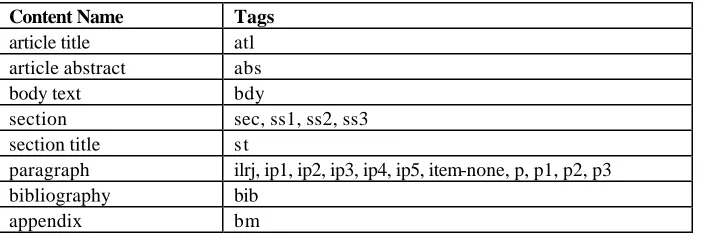
As stated in section 1, being academi c collections, most of the articles in it contain elements tags which represent article’s title, abstract, body text, section, section title, paragraph, bibliography and appendix etc. These tags in INEX collection are shown in Table 2:
Table 2: INEX important tags and its meaning
Content Name Tags
article title atl article abstract abs
body text bdy
section sec, ss1, ss2, ss3 section title st
paragraph ilrj, ip1, ip2, ip3, ip4, ip5, item-none, p, p1, p2, p3
bibliography bib
appendix bm
As it’s discussed in [11], Wf, needs to be tuned for each selected field which
con-tributes to the document’s weight in BM25F. The same method should also be used for BM25E. Although in theory, every context element would contribute to given ele-ment e, in practice, there are more than about ten-million eleele-ments in each INEX collec-tions and it is very difficult to tune every element’s Wf. The problem then lies in what
Robertson et al [11] chose title as the tuned field. In this experiment, consider the data structures of INEX, we choose atl, abs and st as the tuned elements. We believe that title and abstract in some extent reflect the content of an article, and section title in some extent tells us the section and its sub-elements’content. We believe these ele-ments could contribute to the weight of relevant eleele-ments. This issue will be dis-cussed in more detail in section 3.3.
3.3 Some assumptions for BM25E on INEX 2005
Due to the costs of implementation and some other factors such as time limitations, we declare our assumptions for the experiments on the elements which should be
in-herited for other retrievable ones and the ways to compute
avel
'
andk
'1. They areas follows:
Assumption 1: elements in one document do not have effect on elements in other documents. Elements except atl, abs and st also don't have effect on other elements which are not their ancestors in the same document.
Assumption 2: Elements atl and abs contributes to the weight of elements bdy, bm
and their child elements. Elements st contributes to the weight of the section it be-longs to, and also of the section’s child elements and article element. All st elements have the same Wf without considering the level they belong to.
Assumption 3: Due to the complexity to compute parameters
avel
'
andk
'1, webe-lieve the values of the article level can be used instead of them for all elements. Assumption 1 is simple and easy to understand. In Assumption 2, the question may lie in that what role element st plays in the relevant section’s other parent elements except article element. And the question in Assumption 3 is that whether the simple replace-ment of the parameters would affect much of the result. These issues will be tackled in further research.
3.4 Experiment environment and procedures
This is the first year that the CISR has taken part in INEX. We largely conduct our work on Okapi in a Linux environment (using Red Hat 9). Being a traditional retrieval experiment system, Okapi undertake all the processing which was required by INEX experimentation. We have therefore done significant development work for both XML indexing and element level XML retrieval in order to participating in INEX.
Our experimental procedure is as follows: firstly, we tune Wf for selected elements atl,
abs and st; secondly, we use Okapi’s Basic Search System (BSS) to get a document result set; and finally we use a newly designed XML element weighting and displaying interface to get our final submissions required by INEX, among which, selected Wf
parameters are used to get optimized runs. We should also state that only article, abs,
some small irrelevant elements are filtered at the same time. In the next section, we report our evaluation result for INEX 05.
4. Evaluation
In order to examine the new data structures and algorithms build for our INEX ex-periments, we used INEX 04 ad-hoc topics and assessment to tune Wf for atl, abs and
st on document level by using the average precision score, (we did not evaluate using the INEX methodology at the element level). Our method shows that tuning Wf for
these selected elements contributes to an improvement in retrieval performance on the INEX 04 collection. The tuning values for Wf are all integers. We first tuned Wf {atl, abs
st} from {1, 1, 1} to {10, 10, 10} using increments of 1. Result shows that the values of{10, 3, 10} for Wf get the highest average precision score. The best tuning results
were obtained when the tuning values for atl and st areboth 10 and tuning values for
abs are all between 3 to 6, we therefore investigated the tuning scope for atl and st. We then tried to tune Wf {atl, abs st} from {1, 1, 1} to {50, 10, 50} in increments of 1.
The results shows that a higher value for atl yielded better results, the best scope for
st is from 12 to 25, while the best scope for abs was about the same for the first set of tuning experiments conducted. We conducted some further tuning experiments with a larger scope for atl and the ranges for abs and st set to between 1~10 and 10~30 re-spectively. In these experiments we tuned atl from 1 to 300 using increments of 10 and then used increments of 50 for atl, to a maximum value of 3000.. We believed that there was no point in investigating larger values. The best average precision score was recorded when the tuned value for atl is around 2400. Finally, we tuned atl from 2100 to 2700 in increments of 1 in order to obtain the best optimized results. Our experiment shows when using the values of 2356, 4 and 22 for Wf in elements atl,abs and st
re-spectively we obtained the highest performance for article level retrieval on INEX 04 data. We are a little surprised that the best tuned value for atl is so high. The implica-tion is that the selected elements, particularly atl and st contributed much to the document level XML retrieval in the INEX collection. See table 3 for some of our tuned result for INEX 04.
Table 3: tuned results for INEX 04 on document level
Wf {atl, abs, st} Sum of
(Avg precision for co all topics)
2356, 4, 22 0.143698
2416, 5, 22 0.143678
2668, 5, 25 0.143435
10, 4, 9 0.129819
1, 1, 1 0.124023
r-ence between document level retrieval and element level retrieval, and also being con-cerned that tuned Wf values for atl and st would be to high, we choose 3 sets of tuning
constants of values for Wf {atl, abs, st}, namely {2356, 4, 22}, {1000, 4, 22} and {15, 4,
8} , for submitting CO.Thorough runs; and chose another 3 sets of tuning constants of values for Wf {atl, abs, st}, namely {1000, 4, 22}, {300, 4, 18} and {98, 4, 13}, for
submitting CO.FetchBrowse runs.
Though we tuned Wf in document level, we are still pleased to see that our official
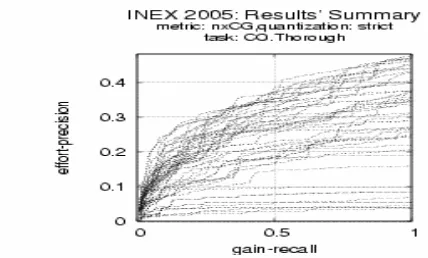
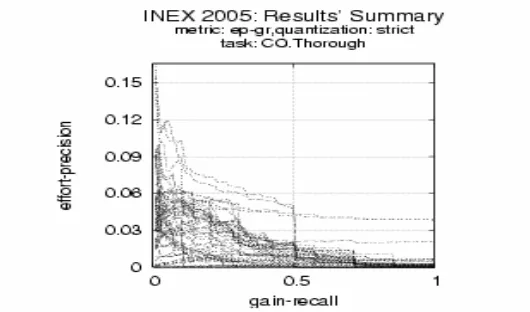
runs for CO.Thorough rank at the top of the total 39 official runs, especially for “Met-ric: nxCG(25), Quantization: strict, Overlap=off”, our 3 runs ranks 1st, 2nd and 22nd respectively; for “Metric: nxCG(50), Quantization: strict, Overlap=off”, our 3 runs ranks 1st, 2nd and 10th respectively; and for “Metric: ep-gr, Quantization: strict,Overlap=off”, our 3 runs ranks 1st, 5th and 13th respectively. See Fig. 1, Fig. 2 and Fig. 3 [21] for more information. We also tried to use metric nxCG to compare our 3 official runs for CO.Thorough with the non field-weighted runs whose Wf{ atl, abs, st }
is {0, 0, 0}. Result shows that non field-weighted one ranks at the last while the former two runs rank at the top.
Fig. 1 Metric nxCG(25), Quantization: strict, Overlap=off
[image:10.596.169.389.352.478.2] [image:10.596.175.389.516.645.2]Fig. 3 Metric ep-gr, Quantization: strict,Overlap=off
The experiment shows that the first two sets of tuning constants, Wf {1000, 4, 22}
and Wf {2356, 4, 22}, ranks better than the third groups Wf (15, 4, 8). The evidence is
that atl and st does contribute to retrieval performance and it also implies that combin-ing field-weighted term frequencies of selected elements is a beneficial method. Tuncombin-ing constant set Wf {1000, 4, 22} rank first for Metric “nxCG(25 and 50), Quantization: strict,
Overlap=off” also suggests that it may be better if Wf is tuned on element level. This
behaviour may also be caused by the difference of the topics and data sets between INEX 2004 and INEX 2005 etc. It is worth doing a further set of tuning experiments on the INEX 2005 topics and data sets.
Results also show that our method performs better for models which consider only fully specific and highly exhaustive components than those models which considering varying levels of relevant components. The reason may be because the selection of elements we chose to submit for our experiments. We intend to investigate this issue further.
5 Conclusion
We extend document level field-weighted retrieval function BM25F to element level retrieval function BM25E. We have applied this method to INEX 2005 CO XML re-trieval and results show that our method is beneficial.
However there are still some limitations in our element level retrieval function. Firstly,
values for
avel
'
andk
'1 are used at the article level, not element level. The creation [image:11.596.165.430.148.304.2]sub-mit runs for CO.Thorough and CO.FetchBrowse tasks, so more tasks need to be done to test our method. And also our system for XML element retrieval needs to be up-graded. We will investigate these problems in further research.
Acknowledgements
Thanks to Chinese Scholarship Council (CSC) for funding the visitor of the first author to City Univesity, London in order to conduct this research.
References
[1] A. Deutsch, M. Fernandez and D. Suciu. Storing semistructured data with STORED. In Proc. SIGMOD, 1999.
[2] J. Harding, Q. Li, B. Moon. XISS/R: XML Indexing and Storage System Using RDBMS. In Proceedings of the 29th VLDB Conference, 2003
[3] Software AG. Tamino XML database. http://www.softwareag.com/tamino/. [4] XYZFind. XML Database. http://www.xyzfind.com.
[5] HYREX. http://ls6-www.cs.uni-dortmund.de/ir/projects/hyrex/.
[6] N. Fuhr and K. Großjohann. XIRQL: A Query Language for Information Retrieval in XML Documents. In Research and Development in Information Retrieval, 2001.
[7] J. E. Wolff, H. Florke, and A. B. Cremers. Searching and Browsing Collections of Structural Information. In Proc. IEEE Forum on Research and Technology Advances in Digital Librar-ies, 2000.
[8] T. Schlieder and H. Meuss. Querying and Ranking XML Documents. Special Topic Issue Journal American Society for Informations Systems on XML and Information Retrieval, 2002.
[9] T. Schlieder. Similarity Search in XML Data using Cost-Based Query Transformations. In Proc. 4th Intern. Workshop on the Web and Databases, 2001.
[10] A. Theobald and G. Weikum. The Index-Based XXL Search Engine for Querying XML Data with Relevance Ranking. In Proc. 8th Internation Conf. on Extending Database Tech-nology, 2002.
[11] S. Robertson, H. Zaragoza, M. Taylor. Simple BM25 Extension to Multiple Weighted Fields. CIKM’04, 2004.
[12] R. Wilkinson. Effective retrieval of structured documents. In Research and Development in Information Retrieval, 1994.
[13] P. Ogilvie and J. Callan. Combining document representations for known item search. In Proceedings of the 26th Annual International ACM SIGIR Conference on Research and De-velopment in Information Retrieval (SIGIR 2003), 2003.
[14] W. Kraaij, T. Westerveld, D. Hiemstra. The importance of prior probabilities for entry
page search. In Proceedings of the 25th Annual International ACM SIGIR Conference on
[15] S.Myaeng, D. Jang, M. Kim, Z. Zhoo. A flexible model for retrieval of SGML documents. In Proceedings of the 21st Annual International ACM SIGIR Conference on Research and Development in Information Retrieval,1998.
[16] L. A. Clarke, L. Tilker. MultiText Experiments for INEX 2004. In INEX 2004 Proceedings, 2004.
[17] J. Vittaut, B. Piwowarski, Patrick Gallinari. An algebra for Structured Queries in Bayesian Networks. In INEX 2004 Workshop Proceedings, 2004.
[18] J. Kekäläinen, M. Junkkari, P. Arvola. TRIX 2004 – struggling with the overlap. In INEX 2004 Workshop Proceedings, 2004.
[19] R. Larson. Cheshire II at INEX ’04: Fusion and Feedback for the Adhoc and Heterogene-ous Tracks. In INEX 2004 Workshop Proceedings, 2004.
[20] P. Ogilvie, J. Callan. Hierarchical Language Models for XML Component Retrieval. In INEX 2004 Workshop Proceedings, 2004.