1
Faculty of Electrical Engineering,
Mathematics & Computer Science (EEMCS)
Services, Cybersecurity and Safety (SCS)
Security Risks Surrounding Cryptocurrency Usage:
A Study on the Security Risks of Cryptocurrencies
and How Security Perception Affects Usage
Janina Roppelt M.Sc. Thesis
August 2019
Graduation Committee: dr. A Peter prof.dr. M.D.T. de Jong S. Barth, M.Sc. S.R. Jansma, M.Sc.
Security Risks Surrounding Cryptocurrency Usage:
A Study on the Security Risks of Cryptocurrencies
and How Security Perception Affects Usage
Janina Roppelt
University of Twente EEMCS
Abstract—Since 2017, cryptocurrencies are known to nearly everyone. Their popularity, vast variety, and financial nature raise questions about the security risks that surround them. Just as important as the actual risks are risk awareness of people and to which extent their security risk perception does influence the decision to use cryptocurrencies. In this paper, two studies are conducted to identify security risks associated with cryptocurrencies, their perception by (possible) users and the effect this perception has on the decision to use cryptocurrencies. Conducting these studies will identify risks to address in cryptocurrencies and help to understand hurdles in the adoption process. Study one is a literature study that describes cryptocurrency vulnerabilities and their associated risks. Results show that risks for users are especially found in the cryptocurrency environment. Study two focuses on how a persons’ security perception influences their cryptocurrency usage through a questionnaire. It is found that participants who own cryptocurrencies perceive them as less risky, have more trust in them and higher knowledge. The results show that the largest threat to cryptocurrency usage is the environment around cryptocurrencies, as it does not only hold technical risks but is also perceived as highly impacting. We conclude that (1) security risk perception does play a role in the adaption of cryptocurrencies and that (2) the involvement of unregulated third parties in the environment hinders widespread cryptocur-rency usage.
1. Introduction
In 2014, five years after the launch of Bitcoin, private users, as well as the management of important stakeholders in the financial field, believed cryptocurrencies to be a possi-ble disruption through easier and quicker payment possibil-ities around the globe, possibly leading to cryptocurrencies as the only method of payment [1], [2]. More recent research has shown, that the shift into a broadly used currency has not happened yet, but that cryptocurrencies are still mainly used for investment purposes [3].
Nevertheless, cryptocurrencies gained a lot of popularity especially in late 2017. The market price of Bitcoin went
from e1,000 per Bitcoin to nearly e20,000 within six
months, before falling back to e3,000 within ten months.
Alternative cryptocurrencies (altcoins) also followed the
trends observed in Bitcoin, especially when values fell [4]. After the value decrease in 2018, media attention around cryptocurrencies decreased; the hype was over. Nevertheless, the market price of Bitcoin is recovering and rising again in 2019.
A technology hype is typically a marketing tool utilized to further a user basis. Although there is no one company behind cryptocurrencies, the quick value developments in 2017/2018 followed the hype cycle quite well. Broad media coverage and issued warnings for consumers indicate that the user basis indeed grew in the critical month. One of the most pressing questions from a security point of view is whether this hype led to less security risk considera-tions before using cryptocurrencies. In a broader sense, the question arises to what extent the individual perception of security influences the decision to use cryptocurrencies. While foremost being interested in the effect of security risk awareness, this research will also include the concepts of knowledge, trust, and attitude and their effect on the decision to use cryptocurrencies.
Knowing how security influences users is relevant, as the concept of a blockchain as the basis of a currency is just around ten years old and might impose new, unknown security concerns. The security of a specific cryptocurrency is not only dependent on the security of the blockchain technology, but also on its developers and algorithms used. Flaws once in the source code are hard to rectify, which makes cryptocurrencies more vulnerable than normal soft-ware when flaws are discovered. Therefore, it is important to know which vulnerabilities exist. For users, it is just as important to know how vulnerabilities translate to risks for them personally. Additionally to risks originating from a specific cryptocurrency, trading and using cryptocurrencies cannot be done without a third party, which is not bound to the blockchain and therefore does not have the security stan-dards a user might expect when handling cryptocurrencies.
We call these parties theenvironmentof cryptocurrencies.
awareness. The research will be split into two parts. The first part is a technical literature study that establishes which vulnerabilities can be found in cryptocurrencies and which risks these vulnerabilities hold for users. The second part is a questionnaire study on the use of cryptocurrencies and how security perception affects the usage decision. We formulate the overall research question and subquestions per study:
What are the security risks of cryptocurrencies and how does their perception influence usage of the technology?
Study 1 - Security risks in cryptocurrencies.
T1:Which cryptocurrency vulnerabilities do exist?
T2: How big are the risks associated with the found vulnerabilities?
Study 2 - Cryptocurrency usage and security risk per-ception.
S1:How do people use cryptocurrencies?
S2:To which extent does security risk perception influ-ence the usage decisions?
S3:To which extent did the hype influence security risk awareness?
... By conducting these two studies, we can extract the
biggest risks to cryptocurrencies, both technical and in people’s perceptions. Knowing these risks is essential from a technical point of view to mitigate them according to the risk they pose. On the other hand, knowing which risks are perceived as the highest threats by (possible) users helps to understand the adoption of cryptocurrencies. We also include further concepts of security perception that might have an impact on the usage of cryptocurrencies, such as knowledge and trust. These results can be used to address the critical points to further widespread adaption of the technology.
On the other hand, knowing the influence a hype has on the risk considerations before using a technology can help to protect consumers from impulsive decisions, by using warnings that address the right issues.
Finally, we will give an overview of the population of people that use, used or considered using cryptocurrencies. This is not helpful to better understand the results of this study but can also serve as a basis for further studies.
2. Theoretical Framework / Related Work
This section starts with an overview of how cryptocur-rency works technically and which components are needed to use them. This part furthers understanding of the results of study one. Second, we discuss security risk awareness, as well as other concepts related to how a person perceives the security around cryptocurrencies. This part will form the theoretical basis for the user study.
2.1. The Cryptocurrency Technology
Cryptocurrencies are built on blockchain technology. A blockchain is a series of data records (called blocks) tied to each other by incorporating a unique identification code (hash) of the previous block in the following one. By doing so, it is impossible to delete or change a block in the chain, without changing every block thereafter as well. Consequently, blocks that are added to the blockchain last are least secure, as an attacker would only have to change a few consecutive blocks. Changing a block is not trivial, as the majority of the distributed network has to agree on the creation of a new block [5]–[7].
In the following subsections, the cryptocurrency tech-nology is described, starting with the technological com-ponents of the blockchain: hashes, blocks, and the consen-sus protocol, and how they help to establish a distributed ledger. Afterward, differences between cryptocurrencies are discussed. Finally, the environment around cryptocurrencies and its role in risks associated with using cryptocurrencies is introduced.
2.1.1. Hashes. Hashes are used to ensure the integrity of the data in the blockchain. Generally, they are digests of an unspecified amount of data. Most cryptocurrencies hashes are calculated with the SHA-256 algorithm which gives back a hash of 256 bits. Hashes are easily computed from any data, but it is computationally infeasible to compute the reverse of the hash (the data). Another characteristic is that even a small change in the original data will result in a completely different hash value. Furthermore, the possibility of two hashes from different data to be the same when produced with a secure hash function of bit-length 256
is 1/2128. This gives a negligible chance of collision and
is called uniqueness. All these properties are important to
secure the data integrity in the blockchain.
2.1.3. Consensus protocols. A consensus protocol is used to reach consensus about new blocks in the network, and to slow down the creation of new blocks. The most common consensus protocol is the Proof of Work (PoW). As the name states, someone aspiring to publish a new block must proof that he put work, in this case computation power, into it. This is done by solving a computationally difficult ’puzzle’. A common puzzle is to lay restrictions on the hash value that is calculated as a fingerprint for each block. Since even a small change in the hashed data results in a completely different hash, producing a valid hash will take trial and error. The difficulty of a puzzle can be seen as the number of hashes one would be expected to try before finding a valid one. It can be adjusted to increase or decrease the average time in which a new block is published. At the moment, a Bitcoin proof of work will take around ten minutes, while an Ethereum proof of work takes around 15 seconds. As an incentive, a reward is given for each correct solution. The
processing of blocks to receive a reward is calledmining.
There are alternatives to the PoW. The most common alternative is the proof of stake (PoS). In a proof of stake, one has to have a certain amount of resources in a specific cryptocurrency. Based on the amount and time the amount is held, users gain more right to vote for new blocks. Other alternatives are proof of elapsed time (PoeT), a byzantine fault-tolerance protocol, and hybrids of different proofs.
2.1.4. Distributed ledger. The distributed ledger ensures that the blockchain ledger is available and consistent throughout the network. That means that there is a network of nodes that all have the latest version of the blockchain. This adds extra security in terms of availability as even when a big part of the network fails, no data will be lost. Every node can publish a new block like described above. It then broadcasts that block and the rest of the network verifies it. If more than 50% agree, the block is added to the blockchain. Dependent on the underlying protocol the local chain might only be permanently updated after a specific amount of consecutive blocks are collected. In some cases, two blocks may be published at the same time. In this case, a fork is created. The forking continues until one of the branches becomes bigger than the other, as the main blockchain is always defined as the longest branch from the root note.
2.1.5. Differences between cryptocurrencies. The main technical differences between popular cryptocurrencies is
whether a cryptocurrency is based on a fixed vs. a
pro-grammable blockchain. Bitcoin, Litecoin, and Monero are examples for fixed blockchains. These blockchains can only be used for the creation and exchange of the coin connected to it.
The first and most popular programmable blockchain is used by Ethereum. Programmable blockchains are also
called platforms. In contrast to Bitcoin, Ehtereum can not
only be used for money transactions and token creation but also to execute code. This creates new opportunities like running distributed applications or the implementation of
smart contracts. Smart contracts are intended to digitally verify or enforce actions that should be done according to a contract. By using such a computer protocol, a trusted third party is omitted without raising insecurity for the contract parties. A programmable blockchain can be seen as a distributed supercomputer. To use the computation power of the Ethereum blockchain, you have to pay with
the Ethereum currencyEther.
Another difference is based on whether a cryptocurrency
uses its ownnativeblockchain, or is built on a platform and
therefore uses anon-nativeblockchain. A native blockchain
means that there is a dedicated blockchain for this one cryptocurrency. When a cryptocurrency is non-native, it is built on a platform like Ethereum. The advantages of such a currency are quick set-up time and no need for their own network and contributors. Disadvantages are little freedom in implementation and no self-sufficiency. For such a currency, a fixed amount of tokens is created before it is launched. This is useful for purposes like crypto securities and real-world asset tokens, that should not be awarded for computational effort, but only to a limited amount of people or when a specific event happens.
2.1.6. The broader cryptocurrency environment. Each cryptocurrency has an environment around its source code and network, which provides information and the utilities to acquire, sell and store coins. We include the environment in this research as previous research suggests that there are significant risks for users in them, as they add an (unregulated) third party [8], [9].
Acquiring a cryptocurrency can be done in different ways. Besides mining, cryptocurrencies can also be acquired through online exchanges. These exchanges sell cryptocur-rencies for real money or other cryptocurcryptocur-rencies based on the market value of the moment. This is the way an in-vestor would choose, while mining is mostly done by tech-enthusiasts.
When someone owns a cryptocurrency he owns a private and public key. The public key can be seen as the address to an account on which cryptocurrencies are sent to, stored at, and paid from. The private key is proof that someone owns the amount of cryptocurrency stored at a specific address. Consequently, the private key should be kept a secret while the public key can be disclosed to anyone. The keys are
usually kept secure in so-calledwallets.
A wallet is a piece of hardware or software that holds the key data. Hardware wallets are usually USB sticks or custom made cryptocurrency solutions. The most common forms of software wallets are programs running on a personal device and online wallets. When running a software wallet on a device, both keys are stored on this device and there is no third party that has to be trusted. With online wallets, key management is delegated to a third party. To retrieve a private key the user has to log-in to the service with a password.
or more shared wallets that are managed by the exchange. So rather than receiving a private key, they will only have a password for the exchange. Exchanges act as a trusted third party and have their own backlog ledger independent of cryptocurrency blockchains. This, in turn, means that transaction made between users of the exchange will not appear in a cryptocurrency ledger, but only in the exchanges’ administration. Real blockchain actions are only made when cryptocurrencies are transferred in or out of the exchange. As every third party involvement, this adds new risks to cryptocurrency trading.
2.2. Cryptocurrency users
Although we know about the possibilities cryptocurren-cies offer, there is little literature about how people use them. In the following, we will discuss social aspects of cryptocurrencies. Security perception will be defined and discussed based on its components. As cryptocurrencies are primarily financial, we will also investigate investment re-search, combined with possible explanations of demographic aspects. For every discussed concept we give the hypothesis at the end of the paragraph. They are marked with Hx.
2.2.1. Security perception. We define the construct of security perception as a combination of knowledge, attitude, trust, and risk awareness. These concepts have either already shown to have some effect on (intended) cryptocurrency usage or were relevant in general investment research.
Knowledge. In finances, higher knowledge was found to be related to higher risk tolerance [10]. In fintech research, knowledge was found to have a significant influ-ence on the participants’ security perception. Participants with higher levels of financial knowledge perceived fintech technologies as more secure [11].
There is one study [12] about knowledge in the context of cryptocurrencies in the United States. They focus on the gender gap they found in cryptocurrency knowledge, but their results can also be used as a basis for present knowledge around cryptocurrencies. The study consisted of six questions about knowledge, which had to be answered on a true/false scale. Participants scored a 3.013 of 6, with men scoring slightly higher, and women slightly less high. Interesting is that the overall score is not much better than a score we would expect from blind guessing. There also is a clear separation between correct answers to the questions. While participants were good in answering questions about third parties, government insurance and the existence of a central repository, they were bad at answering questions on the existence of a public ledger, whether or not the supply of coins is fixed and if transactions are reversible. It seems that questions which got media attention and are more political get answered correctly, while knowledge of primarily technical subjects is not present. In this research, we will focus on technical knowledge.
H0:High knowledge is expected to result in higher cryptocurrency usage.
Attitude. Attitude is the way one thinks or feels about something [13]. In this research, we choose to define attitude as the way people classify cryptocurrencies in fi-nancial terms. Using money to create value without precise knowledge of the outcome can be divided into three ac-tions: investment, speculation, and gambling. A conceptual and empirical study found the concepts of gambling and investment to be different, for example on the risk of loss, time frame, and winning margin. Speculation has conceptual similarities to both gambling and investment. The empirical part of that study focused on cognitive, motivational and per-sonality attributes. They found that all three concepts have users with similar attributes, with the strongest relationship between gambling and speculating [14].
Because of the high volatility of cryptocurrencies, it is hard to distinctly classify them in one of the categories. Therefore, people might have different perceptions of what they are dealing with and might act differently from each other. Several studies [2], [14] [15] showed that people use cryptocurrencies both for long term investment and short term speculation. Regarding the findings on similar attributes in gambling and speculating as well as news cover-age on cryptocurrencies, it seems that gambling motivations are also relevant when it comes to cryptocurrencies. The five motivation dimensions of gambling are: hitting the jackpot, social rewards, intellectual challenges, mood change, and winning [16]. Most, if not all of these dimensions can be seen in media reports on cryptocurrencies. In conclusion, the classification of cryptocurrency into one of the three concepts is not clear, and they are used in all contexts. This is why we include a users’ attitude as part of security percep-tion. A positive attitude is defined as the classification into an investment, while a negative attitude is a classification of cryptocurrencies as gambling.
H1:A positive attitude is expected to result in higher cryptocurrency usage.
Trust. The ecosystem of cryptocurrencies is estab-lished to decentralize trust (in third parties). But at least the components around the actual currency like exchanges and information website still involve third parties into the cryptocurrency trading. From the developer of a cryptocur-rency over the exchanges’ employees to the trading parties, essentially all actions that have a connection to the physical world bare risks and could, therefore, raise trust issues.
com-pany involvement in cryptocurrencies.
The characteristics found in [15] hint that there is more trust in technology than in institutions. This is more explic-itly stated in a 2015 study [17] that focuses on algorithmic authorities. The main findings were that people prefer to trust a decentralized algorithm over conventional institu-tions. These institutions lost trust in the 2008 financial crisis and the actions in Greece during the Euro-crisis. Although trust in technology is high in comparison, the authors argue that there is no blind trust in algorithms, but that most users also want human judgment to be involved. In relation to this, the participants of the study were divided in their answers to the question of whether or not cryptocurrencies should be regulated.
Trust seems to be one of the key concepts of why cryptocurrencies might be chosen over traditional money. This is especially interesting when looking into security risks because trust in technology might lead to a less critical view of possible flaws.
H2:Higher trust is expected to result in higher cryptocurrency usage.
Risk awareness. Awareness is knowing something exists and seeing it as important [13]. Therefore, we define risk awareness as a combination of knowledge about risks and the importance a user gives to it. Previous research intended to find a negative effect of perceived security risks on intended cryptocurrency usage were not able to find such an effect [18]–[20]. Nevertheless, they agree that risk aware-ness should play an important role in cryptocurrency usage and the negative findings might be due to methodological choices. Walton and Johnston [20] found an effect of risks that related to trust rather than security, which means that people were hesitant to adopt cryptocurrencies as the elim-ination of the trusted third party also means the elimelim-ination of a party to take the risk. In this research, we aim to include risk awareness, both on security and trust, in a different way. By using technical understanding and a scenario approach to measure risk awareness, rather than questionnaires, we hope to overcome the problems of previous researches. Another difference will be that all discussed articles only looked at the intention to use cryptocurrencies, rather than to actual behavior. In our study, we will research actual behavior.
H3: A higher risk awareness is expected to result in less cryptocurrency usage.
Amongst others, one reason to study cryptocurrencies was the high attention in 2017/2018, which was called a hype. One of the reactions to the hype was issued warnings from consumer protection institutions about the dangers of cryptocurrencies. This is why, for the question of whether the hype did influence risk awareness to a point that people disregard their security concerns, we formulate the following hypothesis:
H4:We expect to find a difference in risk awareness based on cryptocurrency acquisition time.
2.2.2. Demographics and general investment research.
Research on investment and personality agree that there is a significant effect of demographics on investment. [21]–[24]. Men generally invest more capital, while women in-vest more successful, meaning that they lose less money. This is explained by the fact that men are generally more trusting than their female counterparts [25]. Although, the difference found between genders might be less significant than thought due to the proportion of men that are highly optimistic and therefore invest a lot [26]. The effect of gender on investment was also found in the context of trading cryptocurrencies. Women are less likely to engage in cryptocurrency trading, are less active, but do get higher returns [27].
H5a:We expect a higher prevalence of male cryptocurrency users.
Hasso et. al. [27] found an effect of age on cryptocur-rency trading. Contrary to gender, the age effect was not a consistent finding. It was only found to have a positive effect in some phases of the developments in late 2017. Age is also found to have an influence on other financial concepts, like expectations about inflation [28].
H5b:Higher age is expected to result in higher cryptocurrency usage.
Although there is not yet an indication that education also has an impact on cryptocurrency usage, Grable et. al [10] found that higher education is connected to higher risk tolerance. As cryptocurrencies are generally seen as risky [18], education is also included in this research.
[image:7.612.314.553.485.577.2]H5c:Higher education is expected to result in higher cryptocurrency usage.
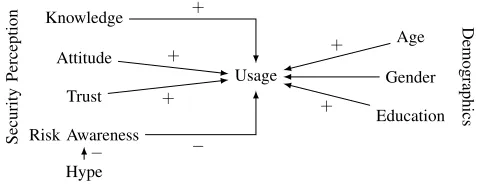
Figure 1 shows a model of the expected effects extracted from the literature.
Knowledge
Attitude
Trust
Risk Awareness
Hype
Security
Perception Usage Gender
Age
Education
Demographics
+ +
+
− −
+
+
Figure 1. Model of the security perception construct and the expected effect of its dimensions on cryptocurrency usage
3. Study 1 - Method
vulnerabilities were selected for further analysis based on their effect on users. Similar attacks were grouped. Attacks concerning the environment rather than the blockchain tech-nology were added based on technical blog posts and media articles.
In the next step, risks were allocated to different attacks. Risk was defined as:
risk=likelihood×impact
Likelihood and impact were scored from low to high. Likelihood was determined by past events and theoretical likelihood/ease of attack. We chose three main impacts to analyze:
• Impact on finances
• Impact on reputation
• Impact on trust
As trust is a more complex concept, it was split into dimensions, based on the findings of Sas et. al. [3] [15]. They found seven dimensions impacting a cryptocurrency
users’ trust:blockchain’s embedded expertise,decentralized
blockchain, unregulated blockchain, easy and quick trans-actions,low-cost transactions,transparent transactions, and
blockchain’s reputation. In our analysis, we combined them into four dimensions:
• Trust in technology
• Trust in decentralization (decentralized blockchain,
un-regulated blockchain)
• Trust in transactions (Easy and quick transactions,
low-cost transactions, transparent transactions)
• Reputation of the blockchain
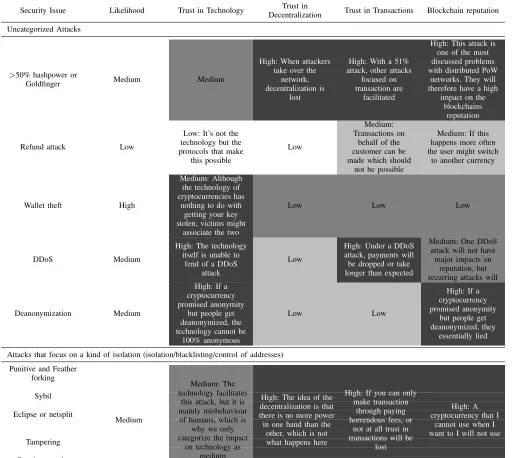
The scoring was visualized with a heat map as seen in table 1. As risk was defined as likelihood times impact, the darker the color of a cell, the higher the risk for a user.
TABLE 1. HEATMAP FOR RISK CODING
LH
IM Low Medium High
Low Medium
High
LH = Likelihood, IM = Impact
4. Study 1 - Results
4.1. Cryptocurrency vulnerabilities
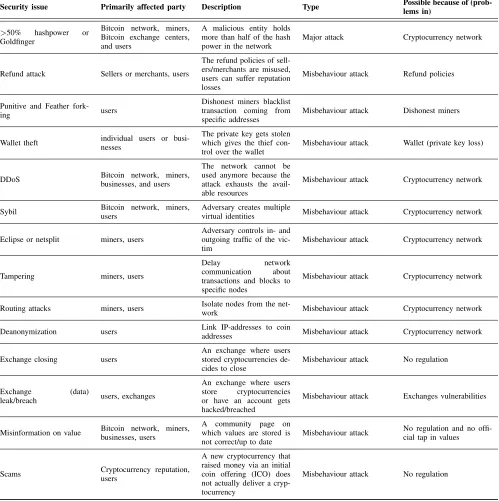
The literature study yielded ten direct and one envi-ronmental vulnerability for users. Three vulnerabilities of the cryptocurrency environment were added through further research. An overview of the resulting 14 vulnerabilities
is given in table 2. The >50% hash power attack is the
only mayor attack affecting users. A major attack means it directly uses a vulnerability in the technology rather than misusing protocols.
Seven out of ten attacks on cryptocurrencies itself are issues related to the distributed network, making the network
the biggest attack vector. Most of these attacks harm the user by isolating him or controlling his traffic in different ways. Those attacks are sybil, tampering, eclipse or netsplit, and routing attacks. The other two attacks on the network are DDoS attacks which prevent usage of the network by overloading it, and deanonymization of users.
The remaining three attacks are wallet theft, refund at-tacks, and punitive feather forking. Wallet theft and punitive feather forking are both attacks that are aimed at a specific user. A refund attack is mainly targeting sellers of products, but also harm users in their reputation.
There were four vulnerabilities found in the environ-ment: the closing of an exchange, a data leak or breach of an exchange, misinformation on the value a cryptocur-rency should be exchanged at, and scams which sell new cryptocurrencies that will never exist. Out of these four vulnerabilities found in the environment of cryptocurrencies, three were possible because of no regulations.
4.2. Associated risk
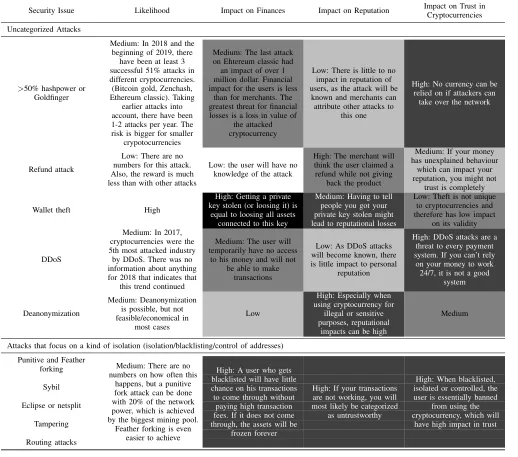
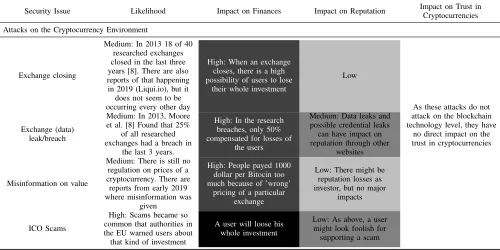
The risks defined in this research can be found in table 3, 4 and 5. In the first two tables, likelihood, as well as impacts on finances, reputation, and overall trust, were defined per attack. The overall impact on trust was derived from table 5, where all four dimensions of trust and the impact of an attack on them were explored.
The two attacks associated with the most risks for a user were wallet theft and initial coin offering (ICO) scams. Refund attacks, on the other hand, are the least harmful for a private cryptocurrency owner. Punitive and feather forking, sybil, eclipse, tampering, and routing attacks are grouped into ‘attacks that concentrate on the isolation of a user in any way’. These attacks had similar impacts, as well as likelihoods. All risks associated with the environment around cryptocurrencies also form a group. This group was left out of the detailed trust analysis, as it had no direct impact on trust. This is because attacks in this domain affect a third party, rather than a cryptocurrency itself.
We found that direct attacks on cryptocurrencies have a high impact on finances when they are targeted at a specific user. Targeted attacks are isolation attacks and wallet theft. Impact on finances for attacks on the environment was high throughout. This is not surprising, as attacks on the infrastructure around cryptocurrencies would be expected to be primarily financial in motive.
TABLE 2. SECURITYVULNERABILITIES
Security issue Primarily affected party Description Type Possible because of (prob-lems in)
>50% hashpower or Goldfinger
Bitcoin network, miners, Bitcoin exchange centers, and users
A malicious entity holds more than half of the hash power in the network
Major attack Cryptocurrency network
Refund attack Sellers or merchants, users
The refund policies of sell-ers/merchants are misused, users can suffer reputation losses
Misbehaviour attack Refund policies
Punitive and Feather
fork-ing users
Dishonest miners blacklist transaction coming from specific addresses
Misbehaviour attack Dishonest miners
Wallet theft individual users or busi-nesses
The private key gets stolen which gives the thief con-trol over the wallet
Misbehaviour attack Wallet (private key loss)
DDoS Bitcoin network, miners,
businesses, and users
The network cannot be used anymore because the attack exhausts the avail-able resources
Misbehaviour attack Cryptocurrency network
Sybil Bitcoin network, miners,
users
Adversary creates multiple
virtual identities Misbehaviour attack Cryptocurrency network
Eclipse or netsplit miners, users
Adversary controls in- and outgoing traffic of the vic-tim
Misbehaviour attack Cryptocurrency network
Tampering miners, users
Delay network
communication about transactions and blocks to specific nodes
Misbehaviour attack Cryptocurrency network
Routing attacks miners, users Isolate nodes from the
net-work Misbehaviour attack Cryptocurrency network
Deanonymization users Link IP-addresses to coin
addresses Misbehaviour attack Cryptocurrency network
Exchange closing users
An exchange where users stored cryptocurrencies de-cides to close
Misbehaviour attack No regulation
Exchange (data)
leak/breach users, exchanges
An exchange where users store cryptocurrencies or have an account gets hacked/breached
Misbehaviour attack Exchanges vulnerabilities
Misinformation on value Bitcoin network, miners, businesses, users
A community page on which values are stored is not correct/up to date
Misbehaviour attack No regulation and no offi-cial tap in values
Scams Cryptocurrency reputation,users
A new cryptocurrency that raised money via an initial coin offering (ICO) does not actually deliver a cryp-tocurrency
TABLE 3. ANALYSIS OF RISKS ASSOCIATED WITH ATTACKS
Security Issue Likelihood Impact on Finances Impact on Reputation Impact on Trust in Cryptocurrencies
Uncategorized Attacks
>50% hashpower or Goldfinger
Medium: In 2018 and the beginning of 2019, there
have been at least 3 successful 51% attacks in different cryptocurrencies. (Bitcoin gold, Zenchash, Ethereum classic). Taking
earlier attacks into account, there have been 1-2 attacks per year. The risk is bigger for smaller
crypotocurrencies
Medium: The last attack on Ehtereum classic had an impact of over 1 million dollar. Financial impact for the users is less
than for merchants. The greatest threat for financial losses is a loss in value of
the attacked cryptocurrency
Low: There is little to no impact in reputation of users, as the attack will be
known and merchants can attribute other attacks to
this one
High: No currency can be relied on if attackers can
take over the network
Refund attack
Low: There are no numbers for this attack. Also, the reward is much less than with other attacks
Low: the user will have no knowledge of the attack
High: The merchant will think the user claimed a refund while not giving
back the product
Medium: If your money has unexplained behaviour
which can impact your reputation, you might not
trust is completely
Wallet theft High
High: Getting a private key stolen (or loosing it) is
equal to loosing all assets connected to this key
Medium: Having to tell people you got your private key stolen might lead to reputational losses
Low: Theft is not unique to cryptocurrencies and therefore has low impact
on its validity
DDoS
Medium: In 2017, cryptocurrencies were the 5th most attacked industry by DDoS. There was no information about anything for 2018 that indicates that
this trend continued
Medium: The user will temporarily have no access
to his money and will not be able to make
transactions
Low: As DDoS attacks will become known, there is little impact to personal
reputation
High: DDoS attacks are a threat to every payment system. If you can’t rely
on your money to work 24/7, it is not a good
system
Deanonymization
Medium: Deanonymization is possible, but not feasible/economical in
most cases
Low
High: Especially when using cryptocurrency for
illegal or sensitive purposes, reputational
impacts can be high
Medium
Attacks that focus on a kind of isolation (isolation/blacklisting/control of addresses)
Punitive and Feather forking
Sybil
Eclipse or netsplit
Tampering
Routing attacks
Medium: There are no numbers on how often this
happens, but a punitive fork attack can be done with 20% of the network power, which is achieved by the biggest mining pool.
Feather forking is even easier to achieve
High: A user who gets blacklisted will have little chance on his transactions to come through without
paying high transaction fees. If it does not come through, the assets will be
frozen forever
High: If your transactions are not working, you will most likely be categorized
as untrustworthy
High: When blacklisted, isolated or controlled, the user is essentially banned
from using the cryptocurrency, which will
TABLE 4. CONTINUEDANALYSIS OF RISKS ASSOCIATED WITH ATTACKS
Security Issue Likelihood Impact on Finances Impact on Reputation Impact on Trust inCryptocurrencies
Attacks on the Cryptocurrency Environment
Exchange closing
Medium: In 2013 18 of 40 researched exchanges closed in the last three years [8]. There are also reports of that happening in 2019 (Liqui.io), but it
does not seem to be occurring every other day
High: When an exchange closes, there is a high possibility of users to lose
their whole investment
Low
Exchange (data) leak/breach
Medium: In 2013, Moore et al. [8] Found that 25%
of all researched exchanges had a breach in
the last 3 years.
High: In the research breaches, only 50% compensated for losses of
the users
Medium: Data leaks and possible credential leaks
can have impact on reputation through other
websites
As these attacks do not attack on the blockchain technology level, they have
no direct impact on the trust in cryptocurrencies
Misinformation on value
Medium: There is still no regulation on prices of a cryptocurrency. There are
reports from early 2019 where misinformation was
given
High: People payed 1000 dollar per Bitocin too much because of ’wrong’
pricing of a particular exchange
Low: There might be reputation losses as investor, but no major
impacts
ICO Scams
High: Scams became so common that authorities in the EU warned users about that kind of investment
A user will loose his whole investment
TABLE 5. THE DETAILED ANALYSIS OF ATTACK IMPACT ON TRUST
Security Issue Likelihood Trust in Technology Trust in
Decentralization Trust in Transactions Blockchain reputation
Uncategorized Attacks
>50% hashpower or
Goldfinger Medium Medium
High: When attackers take over the
network, decentralization is
lost
High: With a 51% attack, other attacks
focused on transaction are
facilitated
High: This attack is one of the most discussed problems with distributed PoW
networks. They will therefore have a high
impact on the blockchains
reputation
Refund attack Low
Low: It’s not the technology but the protocols that make
this possible
Low
Medium: Transactions on
behalf of the customer can be made which should
not be possible
Medium: If this happens more often the user might switch
to another currency
Wallet theft High
Medium: Although the technology of cryptocurrencies has
nothing to do with getting your key stolen, victims might
associate the two
Low Low Low
DDoS Medium
High: The technology itself is unable to
fend of a DDoS attack
Low
High: Under a DDoS attack, payments will be dropped or take longer than expected
Medium: One DDoS attack will not have major impacts on
reputation, but recurring attacks will
Deanonymization Medium
High: If a cryptocurrency promised anonymity
but people get deanonymized, the technology cannot be
100% anonymous
Low Low
High: If a cryptocurrency promised anonymity
but people get deanonymized, they
essentially lied
Attacks that focus on a kind of isolation (isolation/blacklisting/control of addresses)
Punitive and Feather forking
Sybil
Eclipse or netsplit
Tampering
Routing attacks
Medium
Medium: The technology facilitates
this attack, but it is mainly misbehaviour
of humans, which is why we only categorize the impact
on technology as medium
High: The idea of the decentralization is that there is no more power in one hand than the
other, which is not what happens here
High: If you can only make transaction
through paying horrendous fees, or
not at all trust in transactions will be
lost
High: A cryptocurrency that I
5. Study 2 - Method
5.1. Design
The goal of study 2 is to research security risk perception of (possible) cryptocurrency users, how these translate into usage decisions, and if risk awareness was influenced by the hype-like value developments. To do so, a questionnaire on cryptocurrency usage and the different aspects of security risk perception is conducted and analyzed. In the following section, we discuss the instrumentalization of the concepts as well as the means of analysis used on the resulting data.
5.2. Instruments
The questionnaire consisted of three parts displayed in this order: Demographics, cryptocurrency usage, and ques-tions about security risk perception.
5.2.1. Demographics.Besides the age, nationality, and gen-der, subjects are asked for their education level and field of study/profession.
5.2.2. Cryptocurrency usage and motives.This part of the survey was used to gain an overview of how and why people use cryptocurrencies. The first question evaluated the current cryptocurrency status of the participant. The status was
either I own cryptocurrencies, I owned cryptocurrencies, I
considered owning cryptocurrencies, or I never considered owning cryptocurrencies. The grouping based on the first three answers was later used as the dependent variable. If the participant stated to never have considered owning cryptocurrencies, the survey ended. Based on the other three options, participants were asked questions on
• which cryptocurrencies they own(ed)
• how they store(d) them
• when they bought/sold their cryptocurrencies
• how much money they used to buy cryptocurrencies
• why they own or do not own cryptocurrencies
(any-more)
5.2.3. Security risk perception. In the following, we will discuss the measurements of security risk perception per concept, as introduced in the theory section.
Knowledge
Three questions were asked to establish basic cryptocur-rency knowledge:
• All cryptocurrencies use the same blockchain
technol-ogy - yes/no/I don’t know
• All cryptocurrencies have their own blockchain
-yes/no/I don’t know
• Which consensus protocols do you know? - 6 options,
one false
When answering ‘Yes’ on the first question, the remaining questions were skipped. The third question was only displayed to a participant if he answered at least one of the
first two questions correctly. The reason this was done was to prevent participants to get frustrated when confronted with questions they do not understand.
Attitude/Classification
Classification of cryptocurrencies was measured
with one slider from zero to 100. A score of zero is a classification into pure gambling, a score of 100 a pure investment classification. We chose not to explicitly include speculation, as it has characteristics of both gambling and investment.
Trust
General trust in cryptocurrencies was also measured
with one slider from zero to 100, zero meaningno trust at
alland 100complete trust.
Risk awareness
To measure the risk awareness construct, seven scenarios are established from the attacks found in study one (see table 2). Isolation attacks were bundled into one attack and only
the two environment attacks Scams and Exchange closing
were chosen. From the uncategorized attacks, the Refund
attack was excluded, which leaves the 50% attack, Wallet theft, DDoS, and Deanonymization. Excluding the refund attack was done because it mainly impacts reputation, but the questionnaire only measured impacts on finances and trust to reduce complexity. Because of the same reason, trust was reduced from 4 to 2 dimensions (impact on trust in the cryptocurrency technology and impact on trust in cryptocur-rencies as a functioning currency.). This was possible as 3 dimensions were close to each other in impacts (see table 5.
Risk awareness was measured on matrix questions. As
risk is defined by likelihood×trust, participants had to score
likelihood and impact of different attacks on anone - low
-medium -high scale. Scenarios which were perceived as easy in the pretest were displayed first to prevent discour-agement of participants with less technical knowledge.
5.3. Procedure
After a pretest, participants were recruited via snowball sampling. The researcher asked people who were known to own cryptocurrencies or expressed interest in them to take part in the study. While recruiting, participants were also asked to forward the survey to any other people they knew who at least showed an interest in cryptocurrencies. Additionally, the link to the survey was posted on LinkedIn and Reddit (r/samplesize).
TABLE 6. DEMOGRAPHICS OF THE PARTICIPANTS
Characteristic Count Percentage
Gender (n=81)
Male 66 81.5%
Female 12 14.8%
Prefer not to say 3 3.7%
Nationality (n=80)
Dutch 53 66.3%
German 8 10.0%
Other European 9 11.3%
American 7 8.8%
Other 3 3.8%
Level of Education (n=81)
High School or less 20 24.7%
Bachelor’s or Professional Degree 35 43.2% Master’s Degree or higher 26 32.1%
Field of study (n=76)
Computer Science 33 43.4%
Engineering 19 25%
Other STEM study 9 11.8%
HASS 15 19.7%
Age (n=80) Mean SD. Deviation
28.63 8.98
5.4. Participants
The target audience of this study was everybody that owns, owned or considered owning cryptocurrencies at some point in time. There were no restrictions on gender or nationality. The only restriction for age was that the partici-pant had to be older than 18 for reasons of consent. The survey reached around 100 people, 91 participants filled in the survey past the informed consent. More than 50% of the responses came from people that were approached personally. The majority of participants were male. The age of the participants ranged from 18 to 66 years. There were 12 distinct nationalities. Most participants were Dutch, followed by German. The majority studied and/or worked in computer science or another technical field. For an overview of the demographics see table 6.
5.5. Analysis
The data conducted from the questionnaire was analyzed with SPSS. After data sanitation, scores were calculated where necessary. After that, we used descriptive analyses to explore cryptocurrency usage. Security risk perception is analyzed on the differences between the three usage decision groups via ANOVA. Risk awareness is analyzed as a whole, but also in its dimensions: likelihood, impact on finances, and impacts on trust. The hypothesis on the effect of security risk perception and demographics are tested via a multinomial logistic regression. To check whether the hype affected security risk awareness, a MANOVA is used. In the following sections, the steps are described in detail.
5.5.1. Data sanitation. There were 91 responses to the survey that were filled in past the informed consent form. From these 91 responses, 73 are finished. Finished and unfinished Responses were kept if the participant either completed at least 4 of the 7 scenarios (2 responses) or everything but the security perception block (6 responses). The latter responses were only used for the analysis of cryptocurrency usage and motives, not for the analysis of security perception on the usage decision. Furthermore, 8 responses were discarded from the sample as the participants stated to have never considered owning cryptocurrencies. This left 81 valid responses for the descriptive analysis of cryptocurrency usage and 75 valid responses for the whole analysis.
5.5.2. Score calculation. While the scores for trust and classification could be used without further work, knowledge and risk awareness needed calculation.
Knowledge Knowledge was measured with the three questions stated above. For the first two questions, one
point was given for the right answer (No). Yes andI don’t
know both were awarded no points. For the consensus
protocols, one point per checked protocol was awarded. If a participant checked the false protocol (proof of transparency), she received no points for this question. With this scoring, the minimum knowledge score is 0, and the maximum score 7.
Risk awareness We calculated two scores for risk awareness. One for accuracy, which related to knowing something exists, and one for over-/underestimation of risks to measure the importance a participant gave to a risk. Both scores compared the participants’ answers to the results of study one as can be seen in table 3, 4 and 5.
For accuracy, the closer the participant reached this baseline, the better her awareness. A participant got 0 points when she reached the baseline, and the number of steps she was off for other answers. For example, a participant that
filled inlowon an item that washighin study 1 was given
two points. This means that 0 points stand for a perfect score, while the maximum offset can be 71. Missing values
were filled with the expected values (1.5 fornoneandhigh,
1 forlowandmedium).
To see if participants over- or underestimate risks, a second score (estimation direction) with positive as well as negative points was calculated. Positive points were given for overestimating, negative points for underestimating. For
example, if a participant filled innone, while the baseline
value ishigh, she was given -3 points. The other way round,
she would have been given 3 points. Based on the scoring, the lowest score one could achieve was -55 (extremely un-derestimating risk), the highest 30 (extremely overestimating risks). To have equal intervals, the positive scores were scaled to have a maximum of 55. Perfect estimation had a score of 0. Missing values were filled with the expected
values (1.5 fornone, 0.5 forlow, -0.5 formedium, and -1.5
Besides the overall score, we explored differences be-tween likelihood, impact on finances, and the two impacts on trust (in the technology and in cryptocurrencies as a functioning currency). This gave a better insight into which impacts are most pressing for the participants. To do so, we calculated the 4 dimension scores for both accuracy and estimation direction as described above. As, due to different baselines established in study one, all accuracy scores have different maximum scores per dimension they were scaled to 100. The same is true for the estimation direction dimensions. They were scaled to a scale ranging from -10 to 10. The ranges of the scales were arbitrary and chosen based on ease of understanding.
5.5.3. Logistic regression. To answer the main research question, we used a multinomial logistic regression model. The dependent variable was cryptocurrency usage,
which was separated into three groups: present, past, and
considered. The independent variables came from two constructs: demographics, and security perception. The following variables will be used per construct:
Demographics
• Age
• Gender (nominal)
• Level of education (ordinal)
Security perception
• Cryptocurrency knowledge
• Attitude (classification)
• Trust in cryptocurrencies
• Risk awareness scores (accuracy, estimation direction)
5.5.4. MANOVA. A MANOVA was used to test whether the hype around cryptocurrencies influenced risk awareness. Two groups were established as the independent variable. Present and past cryptocurrency users were classified as either hype users (18) or non-hype users (30). As a hype is not a scientific concept, we chose to use the coin value of Bitcoin as a hype indicator. The classification was done
by median value in a month. The cut value was set toe5000
for one Bitcoin, as this is approximately the value at which the steep incline in October 2017 started. The independent variables are the two dimensions of security risk awareness: accuracy and estimation direction.
6. Study 2 - Results
6.1. Cryptocurrency usage
From the 81 participants, 40 own cryptocurrencies, 14 owned cryptocurrencies in the past, and 27 considered own-ing cryptocurrencies at some point in time. Current users are
grouped under the wordpresent, past users under the word
past, and people that considered owning cryptocurrencies
under the wordconsidered.
[image:15.612.314.567.91.166.2]As expected, the most common cryptocurrency was Bit-coin, followed by Etherium. Table 7 shows the preferred
TABLE 7. DISTRIBUTION OF DIFFERENTCRYPTOCURRENCIES
Bitcoin EtheriumXRP BitcoinCash Litecoin Cardano EOS Stellar IOTA
72 42 20 11 21 3 9 8 5
Monero NEO Nano Dodge
coin Stratis TRON GAS other
3 3 3 3 2 2 2 24
TABLE 8. DISTRIBUTION OF DIFFERENTSTORAGEMETHODS
Online exchange
Online wallet
Offline (software)
wallet
Hardware wallet
Paper wallet
29 19 21 18 2
cryptocurrencies. Theother category only holds
cryptocur-rencies that were named exactly once. The number of dif-ferent cryptocurrencies owned per participant ranged from one to more than 57 with a mean of 3.8 (SD=6.53).
6.1.1. Acquisition and storage. From the 54 participants that own or owned cryptocurrencies, 30 bought them, 3 mined for them and 18 did both. The remaining three earned them for work they did.
Table 8 shows the different storage methods used by the participants. It is interesting to see, that offline methods are nearly as popular as online methods (48 vs. 41). Out of the 51 participants, 26 used one storage methods, while 21 used two and 6 more than two. From the 21 people using two methods, 85% used both an online as well as an offline storage. The distribution between methods for people who only used one is 50/50 for online/offline wallets.
6.1.2. Motives.Participants checked more than one motive on average. Because of this is it was not possible to assign one major motive to a participant. The main reason to own
cryptocurrencies was making profit, which was named by
36 of the 53 people that answered this question. From the remaining 17 responses, five also had financial motives. Only nine people had a purely financial motive, four owned cryptocurrencies for fun only, and one for idealistic reasons. In general, idealistic reasons were the third most important motive to own cryptocurrencies.
Participants that own or owned cryptocurrencies were asked their motives to choose a specific currency. The main motives were the specific technology behind a cryptocur-rency and popularity, followed by more financial motivation like coin value. The developers’ vision was more important than security and privacy together, showing that idealism was also a theme when choosing a currency.
[image:15.612.315.566.198.247.2]TABLE 9. MOTIVES OF CRYPTOCURRENCY USAGE
Motives to own cryptocurrencies Count
For profit 36
For fun 30
Idealistic reasons 14
As a security 6
To use as currency 5
For work/research 3
Other 2
Motives to own a specific cryptocurrency
Technology 27
Popularity 23
Coin value 18
Previous value developments 16
Developers vision 14
Market Cap 13
Security 6
Privacy 5
Other 9
Motives not to earn cryptocurrencies anymore
Reached required profit 6
Not useful enough as currency 5
I spent them 4
I needed money 3
Too much value loss 2
Sold at break even point 1
Too little value gain 1
I lost them 1
Time commitment 1
Motives to never own cryptocurrencies
Too much risk 15
Too much knowledge required 8
Too much effort 8
Not enough money 5
Not useful as currency 4
Too technical 2
Not allowed to 1
The primary motive of the participants that only con-sidered cryptocurrencies, but never bought them, was the risk involved with the usage of cryptocurrencies. Other
important reasons were restrictions liketoo little knowledge,
too little money, ortoo much effortneeded to be able to own cryptocurrencies. All motives can be seen in table 9.
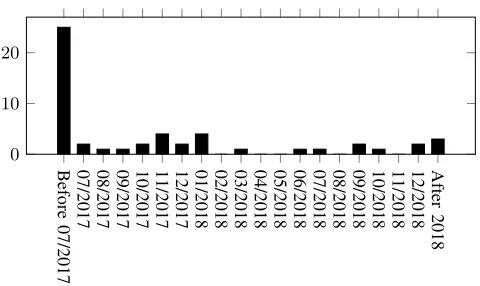
6.1.3. Timing. Contrary to the expectation that the media hype around cryptocurrencies led to new users, a significant amount of people (25, 46.3%) acquired cryptocurrencies before July 2017. In figure 2 we can see only a small rise at the end of 2017 and the beginning of 2018. At this point, cryptocurrencies were at their highest value.
Four of the people not owning cryptocurrencies anymore (n = 14) bought and sold them before July 2017. The rest sold, lost, or spend their cryptocurrencies between October 2017 and October 2018. There was a slight indication of more activity at the end of 2017 and the beginning of 2018. Interestingly, the trend became more clear when also includ-ing users who still have cryptocurrencies on the question when they spent their cryptocurrencies. This is possible as
Before
07/2017
07/2017 08/2017 09/2017 10/2017 11/2017 12/2017 01/2018 02/2018 03/2018 04/2018 05/2018 06/2018 07/2018 08/2018 09/2018 10/2018 11/2018 12/2018 After
2018
[image:16.612.77.278.88.464.2]0 10 20
Figure 2. When respondents bought their cryptocurrencies (n = 49)
the question was mistakenly also shown to users who did not yet sell all of their cryptocurrencies. We also observed that the total amount invested in cryptocurrencies was higher when cryptocurrencies were bought while the coin value was high.
6.2. Security perception
In the following, the parts of the security perception con-struct are described and analyzed for differences between the
cryptocurrency usage groupspresent,past, and considered
(dependent variable).
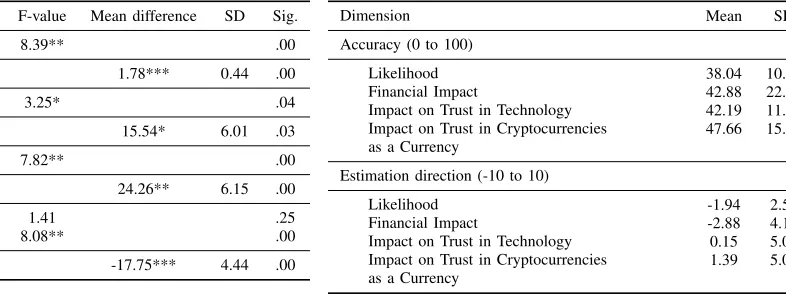
6.2.1. General cryptocurrency knowledge. Knowledge was measured on a scale from 0 to 7. The maximum score achieved by a participant was 6. The mean score was 2.36 (SD=1.94). The more technical the question, the worst participants performed. In the third question, eleven people chose the fake consensus protocol (proof of transparency), which is 17% of all people who answered the question. Three of these ten only checked the fake consensus protocol. Also, more people chose the false protocol than the existing ‘proof of elapsed time’, which was only checked by two peo-ple with valid answers. An ANOVA on the means between groups showed that the present group scored significantly better in knowledge compared to the considered group (see table 10).
6.2.2. Classification into gambling/investment. The clas-sification score had a mean value of 44.01 (SD=24.79), meaning participants were slightly leaning towards the gambling classification (mean difference= -5.99; t=-2.13
*P<.04). There was a significant difference between groups
in the ANOVA analysis (see table 10). The present group scored significantly higher than the considered group.
TABLE 10. ANOVARESULTS FOR THE SECURITY PERCEPTION DIMENSIONS
Dimension F-value Mean difference SD Sig.
Knowledge 8.39** .00
present-considered 1.78*** 0.44 .00
Classification 3.25* .04
present-considered 15.54* 6.01 .03
Trust 7.82** .00
present-considered 24.26** 6.15 .00
Accuracy 1.41 .25
Estimation Direction 8.08** .00
present-considered -17.75*** 4.44 .00
those who never owned them, although only the difference between the present and considered group was statistically significant (see table 10).
6.2.4. Risk awareness. In this part, the results for two dimensions of risk awareness are given.
Accuracy On the 0-71 accuracy score, the mean score for all participants was 31.01 (SD=7.17). This mean was slightly better than the expected value for guessing (35.5),
with a mean difference of -4.38 (t=-5.29; ***P<.001).
There were no significant difference in the accuracy score between groups (see table 10).
Estimation Direction On the scale reaching from -55 to -55 participants scored a mean of -5.88 (sd=18.26). The highest score was 44, the lowest -47. The whole
sample underestimated risks (mean difference=-5.88;
t=-2.19; **P<.01). People who own cryptocurrencies, as
well as those who owned them tended to underestimate risks while people who only considered them slightly overestimated the risks. A comparison of means per group can be found in table 10. Contrary to the accuracy score, the differences between the present and the considered group were significant.
Detailed analysis of the risk awareness dimension
Next to the overall risk awareness scores the four dimensions of it were invested to gain detailed insight in which impacts weigh most for users. The dimensions were: likelihood, impact on finances, impact on trust in the technology, and impact on trust in cryptocurrencies as a functioning currency.
Table 11 shows the mean scores per dimension. Ac-curacy of likelihood was best and acAc-curacy for impact on cryptocurrencies as a currency worst. At the estimated direc-tions, likelihood and financial impacts were underestimated and the impact on trust as cryptocurrencies as a currency overestimated. The impact on trust in the cryptocurrency technology was the only one not significantly different from 0 (P=.68), which means that it was estimated correctly on
TABLE 11. MEANS AND RANGE OF ALL ACCURACY AND ESTIMATION DIRECTION DIMENSIONS
Dimension Mean SD
Accuracy (0 to 100)
Likelihood 38.04 10.91
Financial Impact 42.88 22.14
Impact on Trust in Technology 42.19 11.14 Impact on Trust in Cryptocurrencies 47.66 15.19 as a Currency
Estimation direction (-10 to 10)
Likelihood -1.94 2.50
Financial Impact -2.88 4.12
Impact on Trust in Technology 0.15 5.06 Impact on Trust in Cryptocurrencies 1.39 5.06 as a Currency
average.
Next, a dependent sample t-test was used to check whether the different accuracy dimensions and estimation directions are scored significantly different per subject. This is done to check whether the likelihood and different impacts were perceived as different concepts. This is the case for all comparisons but the one between accuracy of financial impact and accuracy of impact on trust in the cryptocurrency technology.
An ANOVA for differences between groups showed that the dimensions mostly behave like the global scores. Only the accuracy scores of impact on fiances were significant
(F=3.20; *P<.05). The difference is between the present
and considered group (mean difference=14.21; SD=5.71; *P=.04). While all other estimate direction scores were lowest for the present group and highest for the considered group, likelihood was underestimated worst by the consid-ered group. It was the only estimation direction dimension that did not show a significant difference between the present and considered users. The differences of the other groups were significant for impact on finances (mean difference: -3.25; SD=1.04; *P=0.01), impact on trust in the technology
(mean difference: -5.19; SD=1.21; ***P<.001) and trust in
cryptocurrencies as a functioning currency (mean difference: -4.70; SD=1.24; **P=.001).
6.3. Multinomial Logistic Regression
A multinomial logistic regression was run to test the effects of security risk perception and demographics on the decision to use cryptocurrencies. All variables were entered at the same time. The regression model fitted the data with
a significance of ***P<.001. 57.7% of the variance was
explained by the model. There were three univariate outliers in estimation direction and one in accuracy. As removing these outliers did only slightly better the significances of the already significant variables as reported in table 13, they are not removed from the dataset. There were no multivariate outliers.
[image:17.612.54.305.99.239.2]distin-TABLE 12. CLASSIFICATION TABLE OF THE LOGISTIC REGRESSION
(N=69)
Observed Predicted
Present Past Considered Correct
Present 33 0 3 91.7%
Past 3 5 4 41.7%
Considered 2 3 16 76.2%
Overall 55.1% 11.6% 33.3% 78.3%
guished nearly perfect, while the past group in between was not classified very well. See table 12.
The results of the regression are shown in table 13. Between the present and past group, knowledge was the only significant contributor, with higher knowledge in the present group. There were more significant differences between the present and the considered group. The only demographic variable that contributed significantly to the model was age. Participants that were older decided to use cryptocurrency more often than younger participants. From the five security risk perception variables knowledge, trust, and risk estima-tion direcestima-tion were significant. Current cryptocurrency users tended to have higher knowledge, more trust in cryptocur-rencies, and are underestimating risks compared to partici-pants that only considered owning them. The contributions of risk accuracy and classification were not significant.
Because of the earlier indications that classification in-fluenced cryptocurrency usage, its high significance value in the regression was surprising. Further analysis showed that classification was significantly correlated with trust
(.68; ***P<.001). Rerunning the regression without trust,
changed the effect of classification into a significant one (B=-0.31; *P=.03; Exp(B)=0.96), meaning that participants that had cryptocurrencies during the study were more likely to classify them as an investment than those participants that did never own cryptocurrencies. The significance of the other variables remained unchanged, but correct classifica-tion into the three groups dropped to 70.4%.
6.4. MANOVA on the influence of the hype on security risk awareness
A MANOVA was run to see whether the hype around cryptocurrencies did have an impact on security risk aware-ness. There was a statistically significant difference in se-curity risk awareness based on the acquisition time, F (2,
44) = 3.27, *P<.05; Wilk’s λ = 0.87, partial η2 = .13.
The hype groups were the only groups in the analysis that had a significant difference on accuracy. The mean score of participants that bought cryptocurrencies during the hype
was 3.43 (SD=2,02; t=-1.71, *P<0.05) points higher than
the score of participants who bought them before or after the hype.
6.5. Revisiting Hypothesis and Model
[image:18.612.315.545.90.410.2]After the analysis of the influences of security perception and demographics on cryptocurrency usage, we reject the
TABLE 13. VARIABLE EFFECTS OF THE LOGISTIC REGRESSION(N=69)
Group1 Parameter B Sig. Exp(B)
‘Past’ Intercept 3.93 .25
Knowledge* -0.45 .05 0.64
Classification -0.01 .47 0.99
Trust -0.02 .48 0.99
Accuracy -0.07 .38 0.93
Estimation direction 0.03 .46 1.03
Age -0.16 .13 0.85
Gender (male) 1.52 .21 4.57
Gender (female) 02 . .
Education (less than
High School) 0.99 .49 2.71 Education (Bachelors’
or Professional De-gree)
-0.33 .77 0.72
Education (Masters’ Degree or higher) 0
2 . .
‘Considered’ Intercept 5.04 .11 Knowledge** -0.65 .01 0.52 Classification -0.01 .64 0.99
Trust* -0.06 .02 0.95
Accuracy 0.02 .83 1.02
Estimation direction* 0.07 .04 1.08
Age* -0.14 .02 0.87
Gender (male) 0.97 .32 2.64
Gender (female) 02 . .
Education (less than
High School) -0.38 .79 0.69 Education (Bachelors’
or Professional De-gree)
-1.56 .11 0.21
Education (Masters’ Degree or higher) 0
2 . .
1The reference group is: ‘Present’
2This parameter is set to zero because it is redundant
hypothesis that gender (H5a) and level of education (H5c) affect cryptocurrency usage. We found indications for effects of classification (H1), so we accept their influence with the remark that their effect also seems to be explained by general trust. We accept the hypothesis that knowledge (H0), trust (H2), risk estimation (H3), and age (H5b) influence cryptocurrency usage. The hypothesis that the hype affected security risk awareness (H4) is also accepted. See table 14 for an overview. Figure 3 shows the revised model based on our findings. Gender and education are no longer included in the model. Attitude based on classification is still present, but they are affected by trust and therefore their own effect on the usage decision can be omitted in favor of trust. Risk awareness is split into its two dimensions. Estimation direction which does have an effect on usage, and accuracy which was impacted by the hype.