Word-representability of triangulations of
rectangular polyomino with a single domino
tile
Marc Glen
∗and Sergey Kitaev
†September 10, 2015
Abstract
A graphG= (V, E) is word-representable if there exists a word
wover the alphabetV such that lettersxandyalternate inwif and only if (x, y) is an edge inE.
A recent elegant result of Akrobotu et al. [1] states that a trian-gulation of any convex polyomino is word-representable if and only if it is 3-colourable. In this paper, we generalize a particular case of this result by showing that the result of Akrobotu et al. [1] is true even if we allow a domino tile, instead of having just 1×1 tiles on a rectangular polyomino.
Keywords:word-representability, polyomino, triangulation, domino
1
Introduction
Suppose thatwis a word andxandy are two distinct letters inw. We say thatxandyalternateinwif the deletion of all other letters from the word
wresults in eitherxyxy· · · or yxyx· · ·.
A graphG= (V, E) is word-representable if there exists a word wover the alphabetV such that lettersxandyalternate inwif and only if (x, y) is an edge inE. For example, the cycle graph on 4 vertices labeled by 1, 2, 3 and 4 in clockwise direction can be represented by the word 14213243.
∗School of Computer and Information Sciences, University of Strathclyde, Glasgow, G1 1HX, UK.
Email: [email protected]
†School of Computer and Information Sciences, University of Strathclyde, Glasgow, G1 1HX, UK.
There is a long line of research on word-representable graphs, which is summarized in the upcoming book [3].
A graph is k-colourable if its vertices can be coloured in at most k
colours so that no pair of vertices having the same colour is connected by an edge.
Theorem 1([2]). All3-colourable graphs are word-representable.
We note that, for k≥4, there are examples of non-word-representable graphs that arek-colourable, but not 3-colourable. For example, the wheel
W5 on 6 vertices is such a graph.
Apolyomino is a plane geometric figure formed by joining one or more equal squares edge to edge. Letting corners of squares in a polyomino be vertices, we can treat polyominoes as graphs. In particular, well-known
grid graphsare obtained from polyominoes in this way. A particular class of graphs of our interest is related toconvex polyominoes. A polyomino is said to becolumn convexif its intersection with any vertical line is convex (in other words, each column has no holes). Similarly, a polyomino is said to berow convexif its intersection with any horizontal line is convex. Finally, a polyomino is said to be convex if it is row and column convex.
We are interested in triangulations of a polyomino. Note that no tri-angulation is 2-colourable – at least three colours are needed to colour properly a triangulation, while four colours are always enough to colour any triangulation, as it is a planar graph well-known to be 4-colourable.
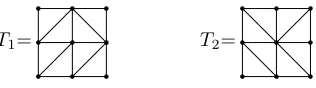
[image:2.612.140.298.358.402.2]T1= T2=
Figure 1: Non-3-colourable and non-word-representable graphsT1 andT2.
Not all triangulations of a polyomino are 3-colourable: for example, see Figure 1 coming from [1] for non-3-colourable triangulations, which are the only such triangulations, up to rotation, of a 3×3 grid graph. The main result in [1] is the following theorem.
Theorem 2([1]).A triangulation of a convex polyomino is word-representable if and only if it is3-colourable. In particular, this result holds for polyomi-noes of rectangular shape.
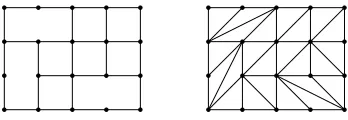
Inspired by the elegant result recorded in Theorem 2, in this paper we consider the following variation of the problem. Polyominoes are objects formed by 1×1 tiles, so that the induced graphs in question have only (chordless) cycles of length 4. A generalization of such graphs is allowing domino (1×2 or 2×1) tiles to be present in polyominoes, so that in the respective induced graphs (chordless) cycles of length 6 would be al-lowed. We call these graphspolyominoes with domino tiles. The problem is then in characterizing those triangulations of such graphs that are word-representable. See Figure 2 for an example of a polyomino (of rectangular shape) with domino tiles (to the left) and one of its triangulations (to the right).
Figure 2: A polyomino with domino tiles (to the left) and one of its trian-gulations (to the right).
In this paper, we are interested in triangulations of rectangular poly-ominoes with a single domino tile. Our main result is the following gener-alization of the case of rectangular shapes in Theorem 2.
Theorem 3. A triangulation of a rectangular polyomino with a single domino tile is word-representable if and only if it is3-colourable.
The first observation to make is that without loss of generality, we can assume that the single domino tile is horizontal, since otherwise, we can always rotate our rectangular polyomino 90 degrees; rotation of a shape, or taking the mirror image of it with respect to a line are called by ustrivial transformations. While the strategy below to prove Theorem 3 is similar to proving Theorem 2, we have to deal with many more cases resulting in 12 (non-equivalent up to trivial transformations) non-3-colourable and non-word-representable minimal graphs (which include the graphsT1 and
T2in Figure 1) instead of just two. All these graphs, except forT1andT2,
are listed in Figure 3.
Non-word-representability of graphs in Figure 3 follows from the fol-lowing observations. First note that it follows from [4] that all oddwheel graphsW2t+1 fort≥2 are non-word-representable, where the wheel graph
Wnis the graph obtained by adding an all-adjacent vertex to a cycle graph
non-A1= A2= A3= A4= A5=
[image:4.612.92.378.69.119.2]A6= A7= A8= B1= B2=
Figure 3: All minimal (equivalent up to trivial transformations) non-3-colourable and non-word-representable graphs (except for T1 and T2 in
Figure 1) for triangulations of rectangular polyominoes with a single hori-zontal domino tile.
word-representable, as they all contain such odd wheel graphs as induced subgraphs:
• A1 contains W9 (obtained by removing the leftmost vertex on the
middle horizontal line);
• A2,A3,A6 andA7 all containW7; and • A4,A5,A8,B1andB2all containW5.
The paper is organized as follows. In Section 2 we will prove our main result, Theorem 3, and in Section 3 we will discuss some directions of further research.
It was pointed out to us by the anonymous referee that it should be possible to reduce the number of cases in this paper to consider by using the following easy to see fact. Any triangulation involving the horizontal domino can be 3-coloured if and only if the triangulation obtained by giving the domino its other possible triangulation, leaving all other triangles un-changed, can be 3-coloured. However, we have decided to keep our original approach that has a transparent structure of all the cases that need to be considered.
2
Triangulations of a rectangular polyomino
with a single domino tile
LetS be the set of all graphs formed by rotations of the graphs in Figure 1 by degrees multiple to 90◦and rotations of the graphs in Figure 3 by degrees multiple to 180◦ (only horizontal domino tiles are of interest to us).
Lemma 1. A triangulation T of a rectangular polyomino with a single domino tile is3-colourable if and only if it does not contain a graph from
Proof. If T contains a graph from S as an induced subgraph, then it is obviously not 3-colourable.
For the opposite directions, suppose thatT is not 3-colourable. We note that fixing colours of the left-most top vertex in T and the vertex right below it determines uniquely colours in the top two rows of T (a row is a horizontal path) if we are to use colours in {1,2,3} and keep all other vertices ofT uncoloured. We continue to colour all other vertices ofT, row by row, from left to right using any of the available colours in{1,2,3}. At some point, colour 4 must be used (T is not 3-colourable) to colour, say, vertexv.
S1=
1 2
4 3
S2=
1 2
4 1 3
?
S3=
1 3
4 2 3
?
S4=
2 3
1 1 2
4
S5=
2 1
3 2 1
4
S6=
2 3
1 2 1
4
S7=
3 2 1 1 2 4 3 ?
S8=
4 ?
? ? ?
[image:5.612.69.390.213.387.2]?
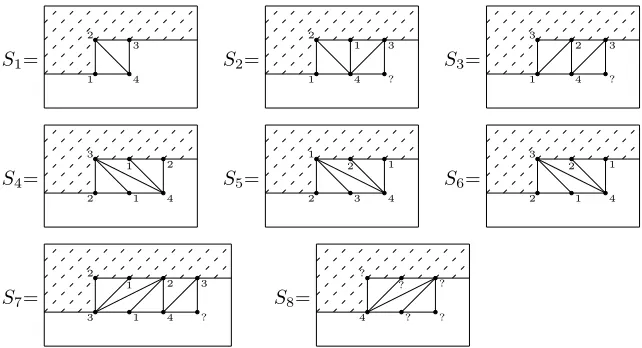
Figure 4: Eight possible cases of appearance of colour 4 in colouring ofT.
There are only eight possible different situations when this can happen, which are presented in Figure 4 (numbers in this figure are colours). In that figure, the shaded area indicates schematically already coloured vertices of
T, the question mark shows a still non-coloured vertex, and the colours adjacent to v are fixed in a particular way without loss of generality (we can re-name already used colours if needed). A particular property in all cases is that among the colours of neighbours ofv, we meet all the colours in{1,2,3}. Also, by our procedure,v must be in row ifrom above, where
i ≥ 3, since the first two rows of any triangulation in question can be coloured in three colours. Note that the situations S1–S3 exhaust all the
possibilities when the domino tile is not connected to v (these cases are the same as in [1]) possibly except forS1, whileS4–S8cover the remaining
More precisely, the situations S4–S6 describe all the possibilities when
vis the right-bottom vertex of the domino tile with the specified triangula-tion of it. Herev is connected to four vertices, so that exactly two of them must be coloured in the same colour, giving the three cases. The situation
S7is clearly the only one representing the other triangulation of the domino
tile withvbeing the right-bottom vertex. Further,vcannot be the middle-bottom vertex in the domino tile, as such a vertex is connected to only two already coloured vertices, so that usage of colour 4 was not required. Finally, the SituationS8represents all cases ofvbeing the left-bottom
ver-tex in the domino (there is no need for us to specify colours to obtain the desired result). Note that the other triangulation of the domino tile placed as in S8 does not bring any new cases (because this is considered in the
situationS1), and thus, it is omitted.
Situation S1.We can assume that the vertices coloured 1 and 2 are not
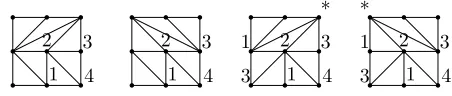
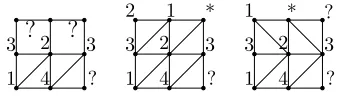
in the leftmost column, because otherwise instead of colour 1 we could use colour 3, and there would be no need to use colour 4 for colouring v. Further, note that in the case when the vertexv is involved in a subgraph presented schematically to the left in Figure 5 (the question marks there indicate that triangulations of respective squares are unknown to us), such a subgraph must be eitherT1 orT2. Indeed, otherwise, the subgraph must
be one of the four graphs presented in Figure 5 to the right of the leftmost graph. However, in each of the four cases, we have a vertex labeled by * that would require colour 4 contradicting the fact thatvis supposed to be the only vertex coloured by 4. This completes our considerations of eight of subcases in the situationS1out of 36. The remaining subcases are to be
considered next.
2 3 1 4
?
?
?
* 3 11 2 3 3 1 4
? 1 2 * 2 3 3 1 4
2 1 * 3 2 3 2 1 4
[image:6.612.78.356.397.447.2]1 * ? 3 2 3 2 1 4
Figure 5: Impossible subcases in the situationS1 in Figure 4.
It follows that the domino tile must share a vertex with the square coloured by 1, 2, 3 and 4 in Figure 4 and there are 28 possible subcases to consider:
• Eight subcases, A1—A8, presented in Figure 3, where the colours
of vertices are omitted (in each of these graphs, the vertex v is the rightmost vertex on the bottom row);
because in each of them there exists a vertex, labeled by *, that requires colour 4.
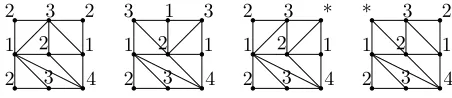
• Four subcases presented in Figure 9, where colouring of vertices is shown; and, finally,
• Four subcases presented in Figure 10, where colouring of vertices of interest is shown.
However, the graphs in Figure 9, from left to right, are, respectively:
• A3 flipped with respect to a horizontal line; • A1 flipped with respect to a horizontal line; • A1 rotated 180 degrees;
• A3 rotated 180 degrees.
2 1 * 2 3 2 3 1 3 1 4
1 * ? 2 3 2 3 1 3 1 4
* 1 2 2 3 2 3 1 3 1 4
[image:7.612.74.364.273.323.2]? 3 1 ? * 2 3 ? ? 1 4
Figure 6: Four impossible subcases in the situationS1 in Figure 4.
1 3 1 2 2 3 2 3 * 1 4
1 3 1 2 2 3 2 3 * 1 4
? ? 3 1 ? * 2 3 ? 1 4
[image:7.612.70.362.367.418.2]* 1 3 1 ? 3 2 3 2 1 4
Figure 7: Four impossible subcases in the situationS1 in Figure 4.
? * ? ? 1 2 3 ? 3 1 4
2 3 1 * 1 2 3 ? 3 1 4
1 3 1 * 3 2 3 ? 2 1 4
[image:7.612.68.363.461.510.2]1 * ? ? 3 2 3 ? 2 1 4
Figure 8: Four impossible subcases in the situationS1 in Figure 4.
Moreover, the leftmost two graphs in Figure 10 are, respectively,B2
ro-tated 180 degrees andB1flipped with respect to a horizontal line. Finally,
by * that would require colour 4 contradicting the fact thatv is supposed to be the only vertex coloured by 4.
3 1 3 1 2 1 2 3 3 1 4
3 1 3 1 2 1 2 3 3 1 4
3 1 3 1 1 2 3 2 3 1 4
[image:8.612.68.363.111.160.2]3 1 3 1 1 2 3 2 3 1 4
Figure 9: Four subcases in the situationS1 in Figure 4.
2 3 1 4
2 3 1 4
* 1 2 3 3 1 4
*
[image:8.612.106.332.202.250.2]1 2 3 3 1 4
Figure 10: Four more subcases in the situationS1 in Figure 4.
Situation S2. Note that in the case when the vertex v is involved in a
subgraph presented schematically to the left in Figure 11 (the question marks there indicate that triangulations of respective squares are unknown to us), such a subgraph must be either T1 or T2. Indeed, otherwise, the
subgraph must be one of the two graphs presented in Figure 11 to the right of the leftmost graph. However, in each of the two cases, we have a vertex labeled by * that would require colour 4 contradicting the fact that
v is supposed to be the only vertex coloured by 4. Similarly, the subcases presented in Figure 12 are impossible since they contain a vertex, labeled by *, that requires colour 4.
2 1 3 1 4 ?
?
?
? *? 2 1 3 1 4 ?
3 2 * 2 1 3 1 4 ?
Figure 11: Impossible subcases in the situationS2 in Figure 4.
But then we have four possible subcases to be considered, which are presented in Figure 13, where colouring of vertices is shown. However, the graphs in Figure 13, from left to right, are, respectively:
[image:8.612.136.302.417.464.2]? ? * 2 1 3 1 4 ?
[image:9.612.167.272.60.110.2]* ? ? 2 1 3 1 4 ?
Figure 12: Two more impossible subcases in the situationS2 in Figure 4.
• A4 rotated 180 degrees; • A2 rotated 180 degrees.
3 2 3 2 1 2 1 3 1 4 ?
3 2 3 2 1 2 1 3 1 4 ?
3 2 3 2 2 1 3 1 1 4 ?
[image:9.612.73.361.157.243.2]3 2 3 2 2 1 3 1 1 4 ?
Figure 13: Four subcases in the situationS2in Figure 4.
Situation S3. Note that in the case when the vertex v is involved in a
subgraph presented schematically to the left in Figure 14 (the question marks there indicate that triangulations of respective squares are unknown to us), such a subgraph must be either T1 or T2. Indeed, otherwise, the
subgraph must be one of the two graphs presented in Figure 14 to the right of the leftmost graph. However, in each of the two cases, we have a vertex labeled by * that would require colour 4 contradicting the fact that v is supposed to be the only vertex coloured by 4.
3 2 3 1 4 ?
?
?
2 1 *3 2 3 1 4 ?
1 * ? 3 2 3 1 4 ?
Figure 14: Impossible subcases in the situationS3 in Figure 4.
But then we have six possible subcases to be considered: Four subcases are presented in Figure 15, where colouring of vertices is shown, and two subcases correspond toB1rotated 180 degrees, andB2flipped with respect
to a horizontal line;B1andB2are presented in Figure 3, where the colours
of vertices are omitted (the vertex v corresponds to the middle vertex on the top row in each of the graphs). However, the graphs in Figure 15 are, respectively,A7,A8,A6 andA5 flipped with respect to a vertical line.
Situation S4. In this case, we have only two subcases, namely, B1 and
[image:9.612.134.308.379.427.2]im-1 3 1 2 2 3 2 3 1 4 ?
1 3 1 2 2 3 2 3 1 4 ?
2 1 3 1 3 2 3 2 1 4 ?
[image:10.612.71.367.63.115.2]2 1 3 1 3 2 3 2 1 4 ?
Figure 15: Four subcases of the situationS3 in Figure 4.
possible (the vertices labeled by * there require colour 4 contradicting our choice ofv).
? * ? 3 1 2 2 1 4
[image:10.612.166.272.196.247.2]2 3 * 3 1 2 2 1 4
Figure 16: Impossible subcases in the situationS4 in Figure 4.
SituationS5.In this case, we have two possible and two impossible
sub-cases presented in Figure 17. The rightmost two graphs in that figure are impossible because the vertices labeled by * require colour 4. On the other hand, the leftmost two graphs are 3-colourable, which forces us to consider their extensions, namely, larger subgraphs in the situationS5.
2 3 2 1 2 1 2 3 4
3 1 3 1 2 1 2 3 4
2 3 * 1 2 1 2 3 4
[image:10.612.105.331.348.397.2]* 3 2 1 2 1 2 3 4
Figure 17: Possible and impossible subcases in the situationS5in Figure 4.
in Figure 18, from left to right, contain, respectively, the following graphs from Figure 3 as induced subgraphs:
[image:11.612.78.364.188.231.2]• A7 flipped with respect to a horizontal line; • A1 flipped with respect to a vertical line; • A2 flipped with respect to a vertical line; • A6 rotated 180 degrees.
Figure 18: Possible extensions in the situationS5 in Figure 4.
? 2 3 2 * 1 2 1 3 2 3 4
3 2 3 2 * 1 2 1 ? 2 3 4
2 3 1 3 3 1 2 1 * 2 3 4
[image:11.612.75.368.274.325.2]? 3 1 3 * 1 2 1 ? 2 3 4
Figure 19: Impossible extensions in the situationS5 in Figure 4.
Situation S6. This situation is the same as situation S4, since in both
cases we have the same graph with three different colours in the top row.
SituationS7.Note that the subcases in Figure 20 are not possible in this
case, because the vertices labeled by * require usage of colour 4 contradict-ing the choice of the vertex v. Thus, in this situation, we only have two subcases obtained from A6 and A7 in Figure 3, respectively, by flipping
with respect to a horizontal line, and rotating 180 degrees.
? * ? 2 1 2 3 3 1 4 ?
3 1 * 2 1 2 3 3 1 4 ?
Figure 20: Impossible subcases in the situationS7 in Figure 4.
SituationS8.We either have a copy ofB1orB2flipped with respect to a
[image:11.612.140.278.471.521.2]that we can assume in Figure 21 that the vertices coloured by 1 (without loss of generality) are indeed of the same colour, since otherwise we would have the situation similar to that in Figure 16, which is impossible. However, that means that the vertexvcoloured in 4 is not in the leftmost column, and we can consider eight subcases of extending the graphs in Figure 21 to the left: four extensions of the leftmost (resp., rightmost) graph are presented in Figure 22 (resp., Figure 23).
? ? ? 1 ? 1 4 ? ?
[image:12.612.166.272.157.204.2]? ? ? 1 ? 1 4 ? ?
Figure 21: Subcases of interest in the situationS8in Figure 4.
Regarding the four graphs in Figure 22 considered from left to right one by one:
• Contains a copy ofA8 flipped with respect to a horizontal line. • Contains a copy ofA3 flipped with respect to a vertical line.
• Contains a vertex marked by * that requires colour 4; thus this situ-ation is impossible because of our choice of the vertex v.
• If the bottom leftmost vertex coloured by 2 would be in the leftmost column, we could colour it by 1, and usage of colour 4 for colouring
v would be unnecessary. Thus, the graph can be extended to the left, and out of four possible extensions, two contain (rotated) copies of T1 or T2, while the other two presented in Figure 24 are simply
impossible, because they contain a vertex, marked by *, requiring colour 4.
1 2 * ? 3 1 3 1 2 4 ? ?
2 3 2 3 3 1 3 1 2 4 ? ?
Figure 22: All possible extensions to the left of the leftmost graph in Fig-ure 21.
Regarding the four graphs in Figure 23 considered from left to right one by one:
[image:12.612.76.369.443.491.2]• Contains a copy ofA5 rotated 180 degrees.
• Contains a vertex marked by * that requires colour 4; thus this situ-ation is impossible because of our choice of the vertex v.
• If the bottom leftmost vertex coloured by 2 would be in the leftmost column, we could colour it by 1, and usage of colour 4 for colouring
v would be unnecessary. Thus, the graph can be extended to the left, and out of four possible extensions, two contain (rotated) copies of
T2, while the other two presented in Figure 25 are simply impossible,
because they contain a vertex, marked by *, requiring colour 4.
2 * 1 2 3 1 3 1 2 4 ? ?
[image:13.612.76.370.208.256.2]1 2 1 2 3 1 3 1 2 4 ? ?
Figure 23: All possible extensions to the left of the rightmost graph in Figure 21.
3 2 3 2 3 1 3 1 3 1 * 2 4 ? ?
[image:13.612.139.311.310.362.2]* 2 3 2 3 1 3 1 3 1 3 2 4 ? ?
Figure 24: PossibleT1, T2-avoiding extensions to the left of the rightmost
graph in Figure 22.
* 1 2 1 2 2 3 1 3 1 1 2 4 ? ?
? 1 2 1 2 * 3 1 3 1 ? 2 4 ? ?
Figure 25: PossibleT2-avoiding extensions to the left of the rightmost graph
in Figure 23.
Thus, we proved, that if a triangulation of a rectangular polyomino with a single domino tile is not 3-colourable, then it must contain a graph from
S as an induced subgraph.
[image:13.612.138.311.418.467.2]3
Directions of further research
Natural directions of further research are as follows.
• Does Theorem 3 hold if we allow more than one domino tile? Note that using current approach, the analysis involved seems to require too many cases to be considered. In either case, the problem has the following particular subproblem:
– Does Theorem 3 hold if we allow just horizontal domino tiles (equivalently, just vertical domino tiles)?
• Does Theorem 3 hold if the domino tile is placed on other, not nec-essarily rectangular, convex polyominoes? What about allowing more than one domino tile to be used? Note that the same counterexam-ple as in [1] can be used to show that Theorem 3 does not hold for non-convex polyominoes.
Acknowledgements
The authors are grateful to the anonymous referee for providing very useful comments that improved the presentation of the paper.
References
[1] P. Akrobotu, S. Kitaev, Z. Masarova, On word-representability of poly-omino triangulations,Siberian Adv. Math.25(2015) 1, 1–10.
[2] M. Halld´orsson, S. Kitaev, A. Pyatkin, Semi-transitive orientations and word-representable graphs,Discrete Applied Mathematics, to appear. [3] S. Kitaev and V. Lozin: Words and graphs, Springer-Verlag, to appear. [4] S. Kitaev and A. Pyatkin, On representable graphs, Journal of