Coalescing Idle Workstations as a Multiprocessor
System using JavaSpaces and Java Web Start
by
Alistair Kenneth Atkinson, BComp.
A dissertation submitted to the School of Computing
in partial fulllment of the requirements for the degree of
Bachelor of Computing with Honours
Declaration
I, Alistair Kenneth Atkinson, certify that this thesis contains no material which has been accepted for the award of any other degrees or diploma in any tertiary institution, and that, to the best of my knowledge and belief, this thesis contains no material previously published or written by another person except where due reference is made in the text of this thesis.
Abstract
Many of an organisation's workstations spend the majority of their time either unused or relatively idle. If the wasted processing capacity of these workstations could be aggregated, it could be used to provide processing for computationally intensive applications. Such a system could potentially provide an inexpensive alternative to costly custom built parallel computers or clusters.
This thesis presents the design, development and evaluation of a system which aims to meet this goal. There are two main parts to the system: a distributed environment to which users can submit jobs for execution, and a development framework which can be used to build distributed applications suitable for de-ployment on the system.
The development framework greatly eases the development of applications for the system, and also provides general coordination mechanisms to control the execution of reasonably complex applications.
The distributed environment is based on the master/worker distributed sys-tem architecture. This allows large, computationally-intensive tasks to be divided up into smaller subtasks and distributed out to worker computers, in this case idle workstations, for processing. This generally results in increased performance for the application.
Acknowledgements
I rstly wish to thank Dr Vishv Malhotra for supervising this research over the course of the year. His assistance, guidance, and helpful suggestions were invalu-able, and really helped to improve this dissertation.
Also, I would like to thank everyone at the School of Computing for making the place such an enjoyable place to study. In particular, I would like to acknowledge the work done by Jacky Hartnett and Dr Mike Cameron-Jones in coordinating the course. Their advice and encouragement were a great help. Thankyou also to my fellow Honours students, who have made the year a very enjoyable one.
Contents
Declaration i
Abstract ii
Acknowledgements iii
1 Introduction 1
1.1 Motivation . . . 1
1.2 Overview . . . 2
1.3 Benets System Delivers . . . 2
1.4 Thesis Structure . . . 3
2 Literature Review 4 2.1 Distributed Systems . . . 4
2.1.1 Desired Properties of Distributed Systems . . . 5
2.1.1.1 Reliability . . . 5
2.1.1.2 Scalability . . . 5
2.1.1.3 Security . . . 6
2.1.1.4 Transparency . . . 7
2.1.1.5 Performance & Eciency . . . 7
2.1.2 Motivation for Distributing Systems . . . 8
2.2 Distributed Computing Technologies . . . 8
2.2.1 Remote Procedure Call . . . 8
2.2.2 CORBA . . . 10
2.2.3 DCOM . . . 11
2.2.4 Linda . . . 11
2.3 Java Distributed Computing . . . 12
2.3.2 Jini . . . 14
2.3.3 JavaSpaces . . . 16
2.3.4 Servlets . . . 18
2.3.5 Applets . . . 19
2.3.6 Web Start . . . 20
2.4 Research in Distributed Computing . . . 21
2.4.1 Utilising Idle Workstations . . . 21
2.4.2 Networks of Web Browsers . . . 22
2.4.3 Adaptive Cluster Computing using JavaSpaces . . . 23
2.4.4 Distributed Middle Tier . . . 24
2.4.5 Distributed JVMs . . . 25
2.5 Summary . . . 26
3 Methodology 28 3.1 System Overview . . . 28
3.1.1 Goals . . . 29
3.1.2 Application Development . . . 29
3.1.3 Architecture . . . 29
3.2 Core Components . . . 31
3.2.1 Master . . . 31
3.2.2 Worker . . . 32
3.2.2.1 Task Executor . . . 34
3.2.2.2 Interface . . . 36
3.2.3 Coordination . . . 37
3.2.3.1 Entries . . . 37
3.2.3.2 Execution Control & Data Dependencies . . . 38
3.3 Applications . . . 40
3.3.1 The n-Queens Problem . . . 40
3.3.1.1 Overview . . . 40
3.3.1.2 Implementation . . . 41
3.3.2 Shear Sort . . . 42
3.3.2.1 Overview . . . 42
3.3.2.2 Implementation . . . 42
4 Results & Discussion 47
4.1 Overview . . . 47
4.2 Testing Environment . . . 48
4.3 Performance Measurement . . . 48
4.4 The n-Queens Problem . . . 48
4.5 Shearsort . . . 51
4.6 Discussion . . . 54
4.7 Summary . . . 58
5 Conclusion & Further Work 59 5.1 Further Research . . . 59
5.1.1 Non-Intrusiveness . . . 59
5.1.2 Scalability . . . 60
5.1.3 Transparency . . . 60
5.2 Summary . . . 61
References 63
A Generic Master & Worker 67
B Entries 84
C Coordination 87
D n-Queens Application 95
Chapter 1
Introduction
This chapter provides an introduction and overview of the research that has been carried out, including the motivation for the research and also the benets of the solution that was developed.
1.1 Motivation
The traditional means of supplying high performance computing have been with custom-built parallel computers, or perhaps clusters of computers, among other alternatives. Organisations that required access to this kind of processing power had the choice to either build their own supercomputer or cluster, or lease time on an existing system. Either choice has serious cost implications.
1.2 Overview
This thesis presents research into the design and development of a suitable dis-tributed system to allow computers to be easily donated by their users to a pool of other underutilised computers. Computers may be added to and removed from the system dynamically, without aecting its correct operation. The soft-ware required for a computer to join the system is automatically downloaded and launched when the user clicks on an appropriate hyperlink on a web page, avoiding the need for the software to be installed and congured manually.
A development framework is also provided to facilitate the implementation of applications for deployment on the system. The framework allows the pro-grammer to specify the structure of an application, including which parts can be parallelised and which should execute sequentially. It is also possible to specify any data dependencies between each part of the application.
An evaluation of the system is performed to determine whether it is successful in meeting its stated goals, namely whether it is capable of eectively putting to use the wasted processing power of underutilised computers on a network.
1.3 Benets System Delivers
The benets provided by this system can be summarised as providing potentially large amounts of processing capacity at very low cost. The system takes advan-tage of infrastructure that is generally already in place, generally workstations connected by a local area network. The systems is able to leverage this (possibly heterogeneous) environment, and aggregate the wasted processing capacity for the processing of computationally intensive tasks.
As the system is able to use an organisation's existing infrastructure, the cost of accessing this potentially large amount of processing capacity would be only a small fraction of the amount of, say, a custom-built parallel machine, or a cluster of computers.
in a doubling of processing capacity). This is in contrast to custom-built machines or clusters, which must be upgraded to increase the available processing capacity. This upgrade generally requires a complete system shutdown, during which time no processing will be performed.
Finally, the process a user must follow in order to join their workstation to the system is very simple, due mostly to the client-side software being deployed as a Java Web Start application. Similarly, a user can also easily remove their workstation from the system at any time they wish. It is hoped that this ease of use would encourage users to take part in the system were it ever deployed.
1.4 Thesis Structure
Chapter 2 explores the relevant literature for this research, including an overview of the basic concepts of distributed computing, and also specic distributed puting technologies. We will also detail the various Java based distributed com-puting frameworks, focusing particularly on those pertinent to this research. Fi-nally, we will discuss some current research in distributed computing, with a spe-cic emphasis on dynamic utilisation of computers, and Java based distributed computing.
In Chapter 3, we present the system that was developed, including an overview of its architecture and details of its operation. We also detail the development framework that can be used to build parallel applications suitable for deployment on the system. Finally, we look at two example applications that were developed for the system using this development framework.
Chapter 4 details some performance results and analysis of some testing con-ducted using the two example applications that were developed for the system. An analysis of the meaning and consequences of these results is also given.
Chapter 5 discusses the conclusions that can be drawn from the research presented, particularly whether or not the proposed system successfully meets its stated goals, and can eectively make use of the wasted processing capabilities of underutilised computers. This chapter also discusses some worthwhile future directions for research in this area.
Chapter 2
Literature Review
The potential processing power of distributed systems has resulted in much re-search eort in the area of distributed computing. Distributed systems can pro-vide an eective alternative to expensive high-performance computers, an option that businesses and organisations are beginning to take advantage of.
This review will explore the fundamental aspect of distributed computing, along with some important technologies in use. The Java platform from Sun Mi-crosystems will be discussed, specically its distributed computing technologies, as it is widely used in distributed computing. Finally, past and current research in distributed computing will be detailed.
2.1 Distributed Systems
Coulouris et al (1994, p. 1) dene a distributed system as a collection of au-tonomous computers linked by a network, with software designed to produce an integrated computing facility.
The advances made in microprocessor design and the emergence of high speed networks have seen distributed systems' emerge as a solution to many computa-tionally intensive problems. Massively distributed systems have been made pos-sible by the rise of the Internet, some systems growing as large as hundreds of thousands of computers. Also, many large organisations have realised the benets of utilising the unused CPU cycles of their idle workstations.
2.1.1 Desired Properties of Distributed Systems
The development of distributed systems is a complex task. The increased com-plexity involved raises many issues which are not often as critical when developing a traditional, non-distributed system. Nonetheless, if these issues can be dealt with, distributed systems can provide numerous advantages over traditional, stan-dalone systems.
2.1.1.1 Reliability
Applications can benet from the potentially increased reliability of a distributed system relative to a standalone system. Tel (1994, pp. 3-4) states that this is due to distributed systems' partial failure property, also known as graceful degrada-tion. This property allows some nodes in the system to fail, and their tasks taken over by the other correctly-operating nodes. In contrast, a standalone application will experience complete failure if the computer, on which it is running, crashes. The reliability of a distributed system is not only determined by the reliability of its nodes but also the reliability of the network by which it is connected. For systems implemented on a local area network (LAN) this may not be a critical issue, as a LAN typically provides highly reliable communications. However for systems that use the Internet as its underlying network it must be taken into consideration, and also it must handle issues such as higher latency and reduced bandwidth.
2.1.1.2 Scalability
Tanenbaum & Steen (2002, p. 10) state that with widespread connectivity avail-able through the Internet, scalability is one of the most important design goals for developers of distributed systems. However, they also add that scalable systems often exhibit some performance loss as a consequence. Therefore it is desirable to minimise the overhead associated with achieving scalability.
administer even if the system spans multiple organisations, something especially important in decentralised systems.
2.1.1.3 Security
Security is one of the most dicult properties to instill into a system, because it must be pervasive throughout the entire system (Tanenbaum & Steen 2002, p. 413). A single vulnerability could be used to compromise the entire system. The security requirements for any given distributed system will vary depending on the environment in which it will be deployed. Obviously, a dynamic Internet-based system with thousands of nodes will have dierent security risks than a system consisting of three computers connected by a LAN. There are, however, some security threats that are common to all networked systems. Stallings (2001, pp. 6-7) identies interception, interruption, modication and fabrication as threats which should be considered.
An interception attack involves some unauthorised party gains access to sys-tem resources, compromising the condentiality of the syssys-tem. An example of such an attack would be someone, whether a person, program or computer, cap-turing data packets o the network.
Interruption occurs when a system resource becomes unavailable or is rendered unusable for some reason, aecting the availability of the system. The highly publicised denial of service attacks perpetrated on the Internet are an example of interruption, as are hardware failures and loss of network communications.
Modication involves an unauthorised party tampering with or corrupting a system resource, usually data, thus compromising the integrity of the system. Examples include modication of data les or the contents of network messages. Fabrication attacks are similar to modication attacks, however they involve new objects being inserted into the system instead of existing objects being modied. Such an example would be the transmission of bogus messages on the network.
2.1.1.4 Transparency
A fully transparent distributed system is dened by Tanenbaum & Steen (2002, p. 5) as one that is able to present itself to users and applications as if it were only a single computer system. They also suggest that there are several aspects of transparency, including access, location, migration, relocation, replication, con-currency, failure and persistence.
While transparency is certainly an important goal when designing a dis-tributed system, total transparency is not always desired, or in fact possible. The exact nature of a distributed system will dictate the degree of transparency possible for each of the criteria listed above. For example, a distributed le sys-tem may be almost fully transparent to the end user, however in the occurrence of a disk crash the le systems may become unusable. Therefore this system could not be classed as being failure transparent.
An important note is made by Tel (1994, p. 2), who suggests that the imple-mentation of this transparency requires the development of intricate distributed control algorithms, inferring that the inclusion of transparency as a required property of a distributed system is too restrictive. Tanenbaum & Steen (2002, p. 7) state that there is also a trade-o between a high degree of transparency and the performance of a system. Therefore it seems prudent to stay mindful of these trade-os when designing a distributed system, along with the benets that it can provide.
2.1.1.5 Performance & Eciency
For many applications, a distributed approach can result in signicant perfor-mance gains. Parallelisation is often a natural consequence of a distributed sys-tem, which can be viewed as a collection of interconnected processors each able to perform computation concurrently. Distributed applications can be designed to take advantage of this feature by dividing up large tasks into smaller subtasks and sending each subtask to a processor in the system for computation.
2.1.2 Motivation for Distributing Systems
There are many possible motivating factors for using a distributed system, the most obvious being performance. As mentioned in Section 2.1.5, distributed sys-tems allow the parallelisation of applications which often results in performance gains. There are many applications that could use this property to harness the processing power of a number of computers to perform some computation, par-ticularly in large organisations where workstations are idle for large periods of time.
Carriero & Gelernter (1990, p. 1) claim that parallelism is the natural way for humans to solve complex problems. They suggest the example of a watch or a steam engine, which are built out of many components acting simultaneously. Therefore, it can be said that many complex problem solving tasks could be aided by a distributed system.
Applications may also wish to exploit the scalability and reliability of a dis-tributed system. These factors were discussed in previous sections.
2.2 Distributed Computing Technologies
There are numerous technologies which can aid in the development of a dis-tributed system, from basic interprocess abstractions such as sockets through to elaborate enterprise-level component systems. Distributed systems can generally be classied, based on their communication mode, as message passing, remote procedure calling, remote method invocation, or shared memory systems.
This section details some notable distributed computing technologies, signi-cant because of either their widespread use or historical signicance.
2.2.1 Remote Procedure Call
The idea of RPC was rst proposed by Andrew Birrell and Bruce Nelson (1984). The basic concept is to allow programs to call procedures on another computer. They reasoned that procedure calls were a well understood concept for the transfer of control in a program, and therefore could be extended for use over a communications network. RPC successfully hides the underlying message passing from the programmer, making calls to remote procedures indistinguishable from calls to local procedures, and thus transparent.
Tanenbaum & Steen (2002, p. 69) suggest, however, that subtle problems exist with this idea. Firstly, the calling and called procedures in an RPC are on dierent machines, and hence in dierent address spaces. This complicates the passing of parameters and accessing return values to and from procedures. For example, consider parameters that are pointers. Also, it is inevitable that either one of the computers will crash or the network connection will be lost during a remote procedure call, thereby causing the system to experience partial failure.
The concept introduced by RPC to address these problems and enable RPC to to work eectively are stubs. Stubs on a client machine act as a proxy for a remote procedure, providing a local interface for the programmer to use to make a remote procedure call. The client stub will handle all of the details of sending messages over the network, including packing parameters into valid network messages (known as marshalling) and unpacking (unmarshalling) any values returned. Once the remote procedure call has been made, the stub will wait for a response from the corresponding server stub (Tanenbaum & Steen 2002, pp. 71-72).
A server stub is analogous to a client stub, characterised by Tanenbaum & Steen (2002, p. 71) as a piece of code that transforms requests coming in over the network into local procedure calls. A server stub unmarshalls any parameters needed for the procedure call, makes the actual procedure call, and then marshalls any values returned before sending them over the network back to the client stub. The client and server stubs provide conversion facilities if they are situated on incompatible systems. For example, if one system interprets bytes using the big endian format, and the other uses little endian. These compatibility issues are handled by the stubs on either machine. Stubs also handle the problem of passing pointers as parameters mentioned earlier; usually the pointers are dereferenced and passed by value.
de-veloping a distributed system. It introduced many concepts that are still in use in many current distributed technologies, including remote method invocation systems such as Java RMI.
2.2.2 CORBA
The Common Object Request Broker Architecture is a distributed systems spec-ication developed by the Object Management Group (OMG), a group of more than 800 members, many from within the commercial computing eld. CORBA was developed to address the issue of interoperability between networked systems. It is an open standard, and as a consequence vendors are free to make their own changes and extensions if they wish.
The central component of any CORBA system is the Object Request Broker (ORB). Brose et al (2001, p. 31) state that
It acts as a message bus between objects that may be located on any machine in a network, implemented in any programming language, and executed on any hardware or operating system platform. The caller needs only an Object Reference and well-formed arguments in the language mapping of choice to invoke an operation as if it were a local function and receive results.
Another core piece of the CORBA specication is the Interface Denition Lan-guage (IDL). IDL is a lanLan-guage-independent way to produce well dened inter-faces between object in the system. Brose et al (2001, p. 34) IDL is used to inform clients of an object oering an interface exactly what operations an ob-ject supports, the types of their parameters, and what return types to expect. Compiled IDL produces stubs, similar to those seen in RPC, that allow the pro-grammer to invoke methods in another object in a very transparent way.
2.2.3 DCOM
The Distributed Component Object Model is an object based distributed system from the Microsoft Corporation. DCOM is an extension of COM, which is used extensively throughout the Microsoft Windows 9x and NT operating systems. DCOM supports communication among objects located on dierent computers, similar in many ways to CORBA.
DCOM is an example of a component architecture, whereby individual compo-nents are specied that can interact and be dynamically activated (Tanenbaum & Steen 2002, p. 526). Components can take the form of a dynamically linkable library or an executable program.
The remote-object model common to most object-based distributed systems can also be found in DCOM. DCOM is programming language independent, due to the use of the Microsoft Interface Denition Language (MIDL). This is very similar to the IDL found in CORBA, except DCOM uses binary interfaces which eliminate the requirement for language-specic bindings (Tanenbaum & Steen 2002, p. 527).
One major dierence between DCOM and CORBA is the fact that it is a pro-prietary technology, whereas CORBA is an open standard designed by committee. As a result, DCOM has little support for interoperability between dierent plat-forms. The popularity of the Windows operating system has placed DCOM as one of the most widespread distributed computing technologies in use.
2.2.4 Linda
The Linda coordination language is an example of a space-based distributed sys-tem. This style of system was rst proposed by David Gelernter (1985) at Yale University. Linda diers from all previous distributed computing technologies in that it is distributed not only in space but also in time (Gelernter 1985, p. 81). Its notable features included a persistent shared memory which could be used to store tuples, along with operations to read from and write to the mem-ory. Another characteristic of Linda is the loose coupling of processes; instead of communicating directly via message passing, processes communicate through the persistent tuple space. This feature was referred to by Gelernter (1985, p. 80) as generative communication, and it formed the basis of the Linda system.
Linda was implemented in many languages, including C, Prolog and Fortran. Rather, it was a model that could be used to implement parallel algorithms and develop distributed data structures in a very simple and elegant way. The model also resulted in very robust and scalable distributed systems.
The development of Linda introduced an innovative new paradigm for dis-tributed computing. Space-based simplify the implementation of otherwise com-plex parallel algorithms. Recent systems such as JavaSpaces and TSpaces are based heavily on Linda.
2.3 Java Distributed Computing
Sun Microsystems' Java platform was designed to be an Internet programming language, and as a result it incorporates strong support for networking, secu-rity and multi-threading (Farley 1998, p. 6). These important features, along with Java's inherent architecture neutrality, make it a platform ideally suited for distributed computing.
Distributed systems that are built with the Java platform are somewhat dif-ferent than non-Java systems. Instead of a collection of cooperating computers, processes or processors, we instead have a collection of cooperating Java Virtual Machines (JVMs). This gives a distributed system the important property of homogeneity; all nodes are JVMs, and all objects in the system are pure Java ob-jects. This removes many of the problems that found in heterogeneous systems, where interoperation between nodes can be much more dicult.
Another advantage of Java's architecture neutrality is the powerful notion of code and object mobility. Once a class has been compiled into byte code, it can migrate and be executed on any host JVM (Farley 1998, p. 8). Furthermore, actual instantiated objects can be dynamically loaded into a running program as long as the object's byte code is available to the recipient JVM. This is made possible by Java's powerful object serialisation capabilities (Sun Microsystems 2001), of which all Java distributed computing technologies can take advantage. The dynamic loading of objects allows the function of a program to be changed or extended while it is running, by executing the dynamically loaded object. This feature was rst used to execute Applets in web browsers, and it is also extremely useful in distributed systems.
security concerns. Originally, Java handled this problem by using a sandbox security model, whereby untrusted code executed with no privileges on the host machine. However, Java 2 (versions later than 1.2) has a ne-grained security model which allows specic rights to be granted or revoked, along with code signing (McGraw & Felten 1999, pp. 22-25) which should prevent the execution of malicious code and ease user concerns. Java also has APIs that provide various encryption and hashing algorithms.
The Java platform oers several distributed computing technologies, each one roughly corresponding to one of the broad categories of distributed systems out-lined in Section 2. They are discussed in more detail below.
2.3.1 RMI
Java's RMI (Remote Method Invocation) technology provides a simple and trans-parent way to invoke the methods of remote objects, even if the objects involved in this interaction may be in dierent JVMs and potentially on dierent hosts (Öberg 2001, p. 32). It is conceptually very similar to RPC, however it has been adapted for use in distributed object systems (Sun Microsystems 2002, p.1), and it takes advantage of the capabilities that a homogeneous Java-based sys-tem oers, such as object serialisation, ne-grained security and dynamic class loading.
RMI has been a part of the core Java API since version 1.1. Before its in-clusion, the only distributed computing capabilities that Java had were sockets. Sockets are relatively low-level, and require the programmer to implement custom application-level protocols for communication. Wollrath et al (JavaSoft 1996), the designers of RMI, identied this as a cumbersome and error-prone process, and it was the goal of RMI to simplify matters and make the development of reliable distributed systems easier.
The procedures that must be followed to invoke methods of remote objects is not entirely transparent to the programmer. This is intentional, as the designers of RMI identied the need to deal with distributed objects in dierent ways than local objects for reasons such as latency, memory access, concurrency and partial failure (Waldo et al 1994).
java.rmi.Remote interface. Remote objects are treated dierently than non-remote objects in an RMI system. Non-non-remote objects are passed by copy between JVMs (as long as they can be serialised) when included as method arguments or return values, whereas remote objects have a stub object transferred in their place (Sun Microsystems 2002, pp. 10-11).
A stub object acts as a proxy for a remote object. They serve a similar purpose as the RPC client/server stubs discussed in Section 2.1. Once the stub object has been transferred to the recipient JVM, it can be used to invoke the methods of its corresponding remote object. The stub object is treated just like any normal local object, and therefore calls to remote objects are practically transparent to the programmer. The stub object takes care of all of the details of the actually communication, including initiating the connection and marshalling and unmarshalling of parameters and return values (Sun Microsystems 2002, pp. 15-16). One factor that dierentiates stubs from ordinary local objects is that their methods throw a java.rmi.RemoteException if an error occurs when communicating with its corresponding remote object.
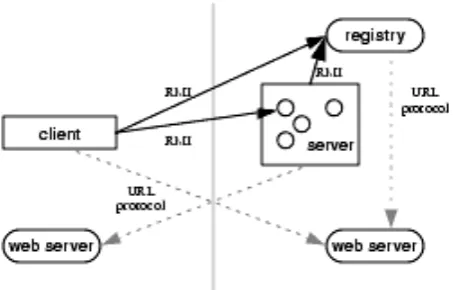
The nal major requirement for the RMI system is some mechanism to obtain stubs objects. Öberg (2001, p. 69) suggests that this can be achieved in numerous dierent ways due to the convenience of Java serialisation. An eective naming service is included with the Java Software Development Kit, called rmiregistry. This program is used to bind stubs to names, and then lookup stubs using the known names (Öberg 2001, p. 69). A web server can be used to deliver the actual class code.
An overall view of a simple RMI system is shown in Figure 2.1.
2.3.2 Jini
Jini allows individual services, whether they are hardware devices or software, to be grouped into a network, or federation, and have their services oered to other members of the federation. Jim Waldo (1999, p. 77), the lead Jini architect, states that
Figure 2.1: Overview of a basic RMI system. (Sun Microsystems 2002)
things we traditionally think of as computers but also most of the things we think of as peripherals, such as printers, storage devices, and specialised hardware.
One of Jini's key strengths is its ability to adapt to a dynamic network environ-ment. It assumes a changing network, and supports the incremental upgrading of network components (Waldo 1999, p. 76). Adding and removing services to and from a Jini federation is very straightforward, and does not eect the operation of the rest of the network.
Jini is built on top of RMI, and as such there are some similar concepts in both systems. Jini has a lookup service, similar to RMI's naming service, which allows entities to register a service that they are oering and to nd services that other entities are oering. Jini's lookup service stores service objects, and these serve a similar purpose to the stub objects in RMI. However, Jini also provides features not found in RMI, such as transactions and distributed events.
The central part of a Jini system are three protocols; discovery, join and lookup. A brief overview of these protocols is given below; for more detail refer to the Jini Architecture Specication (Sun Microsystems 2001, pp. 12-15).
When an entity wishes to join a Jini network, or federation, it rst needs to nd the lookup service(s) in the network using the discovery protocol. This is basically a broadcast request on a local network, to which any existing lookup services should respond and inform the requester of their existence.
service object must be sent to the lookup service. A copy of the service object will be sent to any other entity in the federation who requests the service. The service object acts as a proxy to the actual service, just like a stub does for a remote object in RMI.
Finally, the lookup protocol is used by entities in a Jini federation to nd services, via the lookup service, being oered by other entities. The lookup is done by matching a service with its Java type, along with specic attributes. For example, if we wanted to nd a printer on a Jini network that has at least one hundred pages left, we might use the lookup protocol to nd an object of type PrinterService with an attribute pages >= 100. If a match is found, the PrinterService object will be transferred to the requester. This object can be used to invoke the actual service, in this case a printer.
2.3.3 JavaSpaces
JavaSpaces is a distributed computing technology that provides a persistent shared memory and simple yet powerful object exchange mechanisms. It is very closely related to Jini in that a JavaSpace is a specic Jini service. Hence, many similar concepts can be found between the two technologies. This allows JavaS-paces to take advantage of all of the features provided by Jini, and therefore RMI, such as object serialisation, code mobility, distributed events and transactions.
Freeman et al (1999, p. 4-5) states that
(JavaSpaces) is a departure from conventional distributed tools, which rely on passing messages between processes or invoking methods on remote objects. JavaSpaces technology provides a fundamentally dif-ferent programming model that views an application as a collection of processes cooperating via the ow of objects into and out of one or more spaces.
and JavaSpaces refer to the JavaSpaces Specication (Sun Microsystems 2002, p. 6-8).
The JavaSpaces shared memory is provided by a service called a space. A space is used to hold entries, that is, a Java object that implements the net.jini.core-.entry.Entry interface. A space has some useful properties, namely persistence, and the ability to be associatively searched. Entries stored in a space remain there until they are explicitly removed or their lease expires, even if the process that placed the object there ceases to exist. Furthermore, it is possible to locate objects stored within a space by performing a search based on an objects type and values of its attributes (Freeman et al 1999, p. 31-32). This method of object location is the same as for the Jini lookup service detailed in the previous section. There are four fundamental operations that can be performed on a JavaSpaces service; read, write, take and notify.These operations are very simple, and yet expressive enough to facilitate the development of complex distributed systems. (Sun Microsystems 2002, p. 11) states that write is a store operation, read and take are combination search and fetch operations, and notify sets up repeated search operations as entries are written to the space.
Multiple operations can be performed across multiple JavaSpace services atom-ically, a feature based on the transactions model provided by Jini. The use of transactions results in either all or none of the operations being applied, even if the operations modify multiple spaces. This feature ensures that the system remains in a consistent state and can help to protect against certain problems caused by partial failures, as discussed in Section 2.1.1.
The standard Java programming language facilitates an event-based style of programming. Events may occur when certain designated objects, called event sources, react to some internal state change, and it is possible to listen for these events, using event listeners, and handle them accordingly. Events are assumed to be delivered reliably and instantaneously in a single-JVM system, however this is not always the case in a distributed system. (Sun Microsystems 2001, pp. 55-56) suggests that notication of events may arrive to clients out of order or not at all, or notication may take an indeterminate amount of time due to latency. These issues are dealt with by the distributed events features of JavaSpaces.
the template is written into the space, an event is red to notify the object that registered interest (Freeman et al 1999, p. 219).
JavaSpaces is described by (Sun Microsystems 2001, p. 4) as a tool for building distributed protocols, and for distributed applications that can be modelled as ows of objects through one or more servers. Its use can greatly decrease the complexity inherently encountered when developing a distributed system.
2.3.4 Servlets
Java has great potential for use as a server-side development platform, and this is supported by the Java 2 Enterprise Edition (J2EE). Servlets are one of the cen-tral technologies in the J2EE platform, and they provide a powerful and exible platform for building server applications or producing dynamic web content.
Hunter & Crawford (2001, p. 1) dene a Servlet as a small, pluggable exten-sion to a server that enhances the server's functionality. Servlets are, when used as an add-on to a web server, an alternative to the Common Gateway Interface (CGI) web technology. They oer many advantages over CGI, including perfor-mance and portability. However, Servlets can be used for a wide variety of other purposes, including client/server applications.
A servlet container is required to execute a servlet. There are three types of servlet container: standalone, add-on and embedded. These are described in more detail below:
• Standalone - A standalone container is a server with built-in servlet support
(Hunter & Crawford 2001, p. 7). An example is the Apache Tomcat server, an ocial reference implementation for servlet containers.
• Add-on - An add-on servlet container acts as a pluggable module for an
existing server, often a web server. These containers add servlet support to servers with a poor, outdated or non-existent servlet implementation (Hunter & Crawford 2001, p. 9). There are add-on containers for most web servers, including Apache and Microsoft's Internet Information Server.
• Embedded - Servlet containers can be embedded into an application,
embed-ded container, as it can be modied without restriction and thus adapted for many purposes.
There are a number of features which make servlets suited to client/server ap-plications, including portability, eciency, simplicity, integration with the server, along with all the capabilities provided by the core Java APIs.
Servlets are portable between servlet containers, as long as the containers supports the required version of the Servlet API. Like any Java program, servlets can execute on any JVM without recompilation, and are thus truly portable. Also like any Java program, servlets can take advantage of the capabilities provided by the Java platform API, such as networking, object serialisation, and database connectivity.
Multithreading is an inherent property of servlets; each servlet request is handled by a separate thread, as opposed to CGI where are new process has to be spawned to handle each request. Furthermore, once a servlet has been loaded into memory, it remains there are an object instance (Hunter & Crawford 2001, p. 12). Hence, a servlet maintains its state between requests, and therefore hold onto resources which might otherwise takes time to obtain. These features make servlets highly ecient and scalable.
Servlets are highly extensible and exible, and can be easily adapted for spe-cic tasks. They are relatively simple, as the Servlet API handles many of the routine tasks of development. Servlets are therefore a very powerful solution for a wide variety of client/server applications.
2.3.5 Applets
Applets are small Java programs that are embedded into a web page. When the web page is loaded into a web browser, the Java byte-code is downloaded and executed within the web browser. The Java Runtime Environment plugin is required for a web browser to run applet code.
Applets are a useful technology for use in distributed systems, as they oer a simple method to download and execute code on on worker computers without any software installation or conguration overhead. This is especially true considering that Java-enabled web browsers are practically ubiquitous on general-purpose workstations.
2.3.6 Web Start
Java Web Start is a technology that allows standalone Java applications to be deployed over the world wide web. A Web Start applications can be launched simply by clicking on a hyperlink embedded in a web page, and spares the user from having to install and congure the software manually (Sun Microsystems 2003).
Web Start technology is enabled by the Java Network Launching Protocol (JNLP). This protocol allows Java applications to be packaged for deployment on a web server, and species how the application should be downloaded and launched (Sun Microsystems 2001, p. 8). The JNLP also allows incremental updates and local caching of an application. The core component of a JNLP application is its descriptor le; this is an XML-based le that is used to specify all of an application's attributes, such as the location of the Java class code, and the security model employed.
The Web Start software is installed as a plugin to a web browser, and is launched when the user click on a hyperlink to a JNLP descriptor le. Web Start acts mainly as a JNLP client, and takes care of the downloading and launching of the application.
2.4 Research in Distributed Computing
Distributed computing has been the focus of much research in the past from those in the elds of parallel and high-performance computing. The widespread adoption of the Internet has sparked interest in so-called massively distributed systems, which could harness the power of potentially huge numbers of comput-ers to form a supercomputer with unprecedented processing capabilities. On a slightly smaller scale, many are recognising the potential for exploiting the wasted processing power of idle workstations within an organisation.
This section will examine some of the research that has been done in these areas.
2.4.1 Utilising Idle Workstations
Many organisations have large numbers of computers that, for the vast majority of the time, are performing very little computation. This is the case when users are only running a word processor or web browser on their machine, and especially at night when the computers might be doing nothing at all. The amount of wasted processing power could potentially equal that of very expensive high performance computers. Phillips (1997) identied this as the idle-workstations problem, and put forth several ideas about how the problem could be addressed.
system, but also some of the issues such as releasing resources back to users and controlling how and where the worms can spread.
Phillips (1997, pp. 3-8) identies several other models which may be applied to the idle-workstations problem. Four of these model are detailed briey be-low, along with some example systems, to give an idea of some of the available approaches.
• Processor pool - Avoid idle workstation problem by logically decoupling the
processor from the desktop platform. Examples include the Amoeba, Plan 9 and Clouds systems.
• Supervisor-worker model - Divides tasks into a supervisor process and
mul-tiple worker processes. Workers are given subproblems to complete, and results are merged by the supervisor. Example include the SETI@Home and distributed.net systems.
• Location-transparent execution - Processes may appear to be executing on
a single machine but may in fact be distributed, however their behaviour remains unchanged whether executing locally or remotely. For example, the Sprite operating system.
• Process migration - Allows processes to migrate between machines; more
general than remote execution mentioned above. Examples include the V, Locus and Accent operating systems.
Organisations could reap huge benets from harnessing their wasted computing resources, and one feels that if a general purpose platform were available to enable this then it would be a much more widespread practice.
2.4.2 Networks of Web Browsers
Fletcher and Tan used Java Servlets and Java RMI as the underlying technol-ogy in their respective systems to facilitate communications between an Applet in a web browser and the server. Both systems conformed to the supervisor-worker model described in Section 4.1; the Applets were workers who request jobs from the server, complete the jobs and return the results. Fletcher successfully devel-oped a crossword program to run on his system, and achieved an almost linear performance increase up to three computers. Tan achieved similar results for a sorting program. Neither system scaled well with more than ve computers, however Fletcher & Malhotra (2003, p. 4) suggest that some of the scalability problems are due to server saturation and could be addressed using well known strategies. They also suggest that robustness, fault tolerance and a suitable in-terface for submitting tasks to the system would be needed to make the systems more general purpose.
Networking web browsers to form a distributed system is an innovative idea, with a lot of potential when one considers the massive numbers of computers connected to the Internet. In fact, Fletcher & Malhotra (2003, p. 1) describe the system as a network of browsers that combines available free computers into a huge multi-processor supercomputer.
2.4.3 Adaptive Cluster Computing using JavaSpaces
Batheja & Parashar (2001) propose a framework for an opportunistic, adaptive distributed system using the JavaSpaces technology. Their aim was the exploit the idle processing resources on a cluster of workstations in a non-intrusive man-ner. The homogeneity provided by a purely Java system assisted them in meeting their goals, however issues such as intrusiveness, system management and adapt-ability were still encountered.
8) refer to this as the bag-of-tasks model. They assert that this model provides natural load balancing, in that workers will be kept busy as long as there are tasks to be completed, however each workers will only do as much work as it is capable of. They also note that this model is naturally scalable, and consequently additional workers will provide improved performance. The bag-of-tasks model is suitable for coarse-grained applications that can be partitioned into relatively independent subtasks.
One of the key characteristics of this system was its ability to be both oppor-tunistic and non-intrusive at the same time. The system was opporoppor-tunistic so far as it took advantage of any available processing capabilities of idle workstations on the network. However, it did not intrude on users' access the these resources when they were needed. Batheja & Parashar (2001, p. 2) suggest that a local user should not be able to perceive that local resources are being stolen for for-eign computations. The system achieved its goal of non-intrusiveness by using the Simple Network Management Protocol (SNMP) along with the Java Native Interface (JNI) to monitor the state of the network and of the worker machines. Several real-world applications were used to test this system, including a nancial simulation program, a scientic ray tracing application and a web page pre-fetching optimisation application. Each application had dierent character-istics, such as varying memory, task dependency and scalability requirements. The results of these tests revealed good scalability, at least for up to ve workers, and performance increase for coarse-grained tasks, along with minimal intrusive-ness upon the cluster. The performance gains were most apparent for extremely parallel applications such as the ray tracing program.
This system demonstrates that the idle resources of a network of workstations can be exploited to form a powerful distributed system in a dynamic and non-intrusive manner. It also demonstrates that the space-based paradigm can be used for applications with varied requirements.
2.4.4 Distributed Middle Tier
partitioned and distributed to workers in this pool for computation.
A straightforward way to partition tasks is also suggested by Chuang & Cheng. A simple interface, Split-and-Merge, can be implemented by a program to spec-ify how it should be partitioned, executed and nally merged. This method of task partitioning separates the policy and the method of partitioning (Chuang & Cheng 1999, p. 1): the application programmer species how a task should be divided, and the system does the actual partitioning accordingly.
The distributed middle tier system was developed using standard Java tech-nologies, including Applets and Servlets, similar to the system described in Sec-tion 4.2. An example applicaSec-tion was developed for the system which distributed the computation of a Mandelbrot fractal set over several workers (Chuang & Cheng 1999, p. 5). These workers were Java Applets running on a number of computers. Test runs of this program showed results of almost linear speedup for up to four machines.
Chuang & Cheng successfully demonstrated the feasibility of web-based dis-tributed systems, along with a simple method for a programmer to specify how a task should be divided. Their system did not allow, however, for any relation-ship between sub-tasks, and did not consider issues such as fault tolerance and robustness.
2.4.5 Distributed JVMs
An alternative approach to distributed computing which is currently experiencing considerable research eort are distributed Java Virtual Machines (JVMs). Dis-tributed JVMs aim to make the distribution of an application implicit by creating a JVM that spans multiple computers, whilst making it appear to the application that it is running on a single system, in essence a multi-processor computer.
Their KaRMI system forms the basis of the JavaParty platform.
Various approaches have been taken to developing a distributed JVM. Some systems introduce new keywords to the Java language and have developed their own preprocessors or compilers, such as the JavaParty system. Other system, such as JavaNOW (Thiruvathukal et al, 2000), used freely available Java libraries to construct a framework for parallel applications. Unfortunately, such systems require the application programmer to explicitly tailor the application for these systems, thus limiting the transparency provided.
However, there is a system developed by IBM called the Cluster Java Virtual Machine (cJVM) that can potentially provide total transparency (Aridor et al 1999). The cJVM provides a single system image to an application, allowing it to execute unmodied using the entire resources of a cluster of computers. The objects and threads of an applications are automatically managed by the cJVM, being distributed around the cluster to achieve scalability and performance ben-ets. A Java application containing over ten-thousand lines of code was suc-cessfully executed on a cluster using the cJVM without any code modications whatsoever, obtaining promising scalability and performance results (Aridor et al 2000). Currently the cJVM is not very exible in terms of network conguration or hardware platforms, however if these issues could be addressed then this style of distributed computing could prove extremely eective.
2.5 Summary
This review has explored the fundamental concepts of distributed computing, and looked at various tools which can be used when developing a distributed system. We have detailed some of the past and current research in the eld, focusing particularly on eorts that utilise idle computers or systems that are deployed on the web using the Java platform.
The wasted processing potential of idle workstations has long been known to be a problem. Carriero & Gelernter (1990, p. 6) stated that
If this reasoning is extended to include the total computing power of all nodes on the Internet, obviously the potential processing power is massive; even a tiny portion of it would suce for a powerful supercomputer. There have been many attempts to harness this wasted processing capability for a worthwhile cause, with varying levels of success. The ability to access a large untapped pool of processing power for an extremely small cost is ample justication for further research into the area.
Chapter 3
Methodology
This chapter presents the design and implementation of a dynamic distributed system to which users may easily donate their computer; the unused CPU cycles of each computer are aggregated to produce a potentially very powerful distributed processing system.
The rst part of this chapter presents such a system, which will allow a large, computationally intensive task to be divided and distributed among whichever computers have joined the system. This system provides a complete framework for the development and deployment of a wide variety of distributed applications. The second part of this chapter details two sample applications that were developed for the system for testing purposes; namely the n-Queens problem and a parallel sorting (shearsort) application.
3.1 System Overview
There are two main parts to the system: a distributed environment to which users can submit jobs for execution, and a development framework which can be used to build distributed applications suitable for deployment on the system.
3.1.1 Goals
The goal of this research, as alluded to in Section 1.1, is to develop a distributed system that attempts to utilise the wasted CPU cycles of workstations in an organisation. As such, the system should be as ecient as possible, in order to maximise performance and scalability and thus realise the full benet of adding extra computers to the system.
Furthermore, the system should be robust and reliable, and be able to han-dle partial failure in the case of one or more computers unexpectedly becoming unavailable to the system. For example, there may be a program crash or loss of network connectivity. In these instances, the system should be able to recover and still produce the correct result of the task.
The process of joining the system should be as simple as possible for a user, and ideally not require any software to install or congure. The system must be dynamic; it should be possible to add computers to the system at any time and at any stage of the execution of a task. Also, a user should be able to end their computer's participation in the system at any time they wish.
3.1.2 Application Development
A development framework is provided to facilitate the creation of applications suitable for execution using the distributed environment. Whilst the software running on the client workstations is generic, the process of preparing jobs for submission to the system for execution will be unique for each application. At the same time, there will be many function that will be common to all applications. Several classes are provided from which a programmer should inherit, namely GenericMaster, TaskEntry and ResultEntry. An implementation must be pro-vided by every application for each of these classes. The purpose of each of these classes will be explained in subsequent sections. The full source code for these classes can be found in the appendices.
3.1.3 Architecture
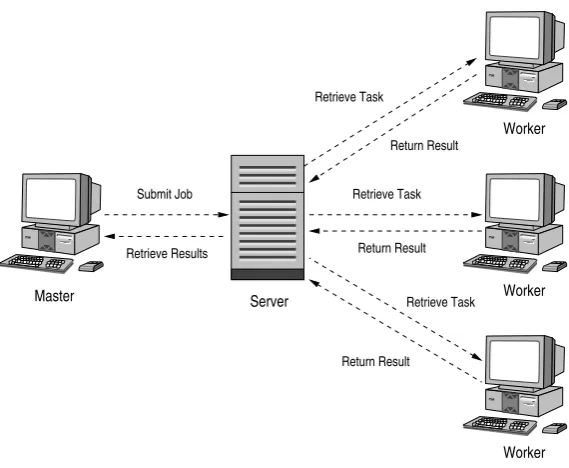
In such a system, a master process will divide a large task into multiple smaller sub-tasks. These sub-tasks are distributed out to however many worker processes are available. The worker processes will execute the sub-task, and return the results of the computation back to the master. Once all of the sub-tasks have been executed and the results returned, the master will merge the results into a meaningful result of the original large task. An arrangement such as this is illustrated in Figure 3.1.
Master
Worker
Worker
Worker
Server Retrieve Task
Return Result
Return Result Retrieve Task
Return Result Retrieve Task
Submit Job
Retrieve Results
[image:37.595.177.462.256.490.2]
Figure 3.1: An example master/worker system.
The distinguishing characteristics of master/worker systems are discussed in Section 2.2.4. The most notable advantages are natural load balancing, a loose coupling of processes, and a generative communication model which allows tem-poral as well as spatial distribution.
To allow users to easily join the system and donate their unused CPU cycles, the client-side software was deployed using Java Web Start. This allows a user to launch the client-side application, which acts as a worker in the system, by simply clicking a hyperlink in a web browser. It is assumed that a Java Runtime Environment (JRE) is installed on the majority of computers, thus sparing the user from installing any software and making the system open to a large number of computers. Web Start applications oer many advantages over Java Applets, as they are not tied to the browser after being launched, and don't have be repeatedly downloaded each time the user runs the program. More details on Web Start were given in Section 2.3.6.
3.2 Core Components
This section will discuss the core components of the system, including the master and worker programs and the coordination mechanisms that are employed to control their operation.
3.2.1 Master
It is the role of the master process to split a large task into multiple smaller sub-tasks and distribute these sub-sub-tasks to whatever worker processes are available. The sub-tasks are not distributed directly to individual workers, but rather simply written into the JavaSpace, and workers will take sub-tasks themselves. Once the master has written the subtask objects into the JavaSpace, it will wait until all of the sub-tasks have been successfully executed, at which time it will take all of the resulting result objects from the JavaSpace and assemble them into some meaningful result. Further details of the task and result objects are given in Section 3.2.3.1.
The basic operation of the master process is illustrated in Figure 3.2.
Lookup Service
JavaSpace Service
Master
3. Read results (when available) 2. Submit tasks
1. Find a JavaSpace
[image:39.595.175.470.125.233.2]
Figure 3.2: Basic operation of the master process.
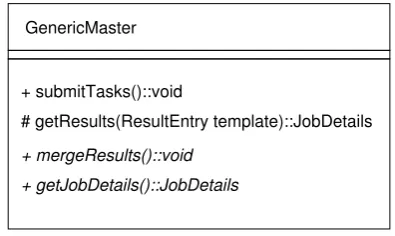
The GenericMaster class is represented, along with its most notable methods, by the class diagram in Figure 3.3.
GenericMaster
+ submitTasks()::void
# getResults(ResultEntry template)::JobDetails
+ getJobDetails()::JobDetails + mergeResults()::void
Figure 3.3: The core.master.GenericMaster class.
The submitTasks() and getResults() methods are used to write tasks and take results from the JavaSpace respectively. The submitTasks() method calls the abstract methods getJobDetails() to obtain the set of sub-tasks for a par-ticular application, as well as other required objects such as those discussed in Section 3.2.3. The other abstract method, mergeResults(), should also be im-plemented by the programmer to combine the set of result objects obtained from getResults() into a meaningful result for that particular application.
The source code for GenericMaster can be found in Appendix A.
3.2.2 Worker
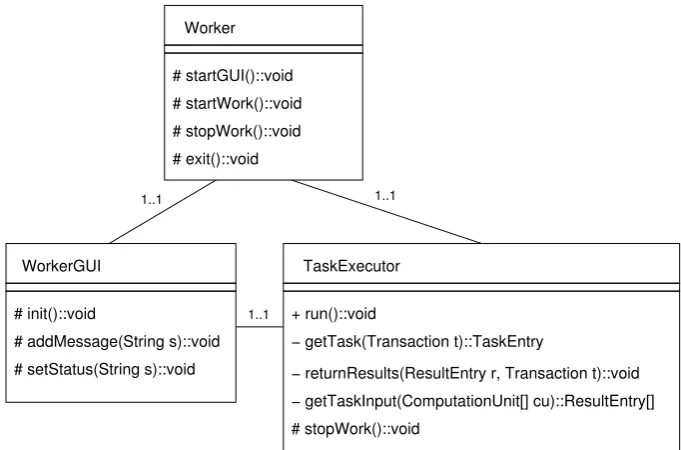
[image:39.595.219.417.350.468.2]possible that the execution of the task will produce additional further tasks. The worker program in this system is a Java Web Start application, the main class of which is core.worker.Worker. The core functionality of Worker is to obtain the service objects for the JavaSpace and a Transaction Manager services, and then to initialise its graphical interface and also create a new thread which will carry out the actual execution of tasks. These are dened in core.worker.WorkerGUI and core.worker.TaskExecutor respectively, as il-lustrated in Figure 3.4.
Worker
# startGUI()::void # startWork()::void # stopWork()::void # exit()::void
WorkerGUI
# init()::void
# addMessage(String s)::void # setStatus(String s)::void
TaskExecutor
+ run()::void
− getTask(Transaction t)::TaskEntry
− returnResults(ResultEntry r, Transaction t)::void − getTaskInput(ComputationUnit[] cu)::ResultEntry[] # stopWork()::void
1..1
1..1
[image:40.595.147.488.277.502.2]1..1
Figure 3.4: Classes from the core.worker package.
3.2.2.1 Task Executor
The TaskExecutor runs as a separate thread, after being started by the Worker, and it is responsible for carrying out almost all of the work completed by the application. It is completely general-purpose, and can be used to execute any component of the application as long as it conforms to the coordination interface discussed in Section 3.2.3.
Fault Tolerance
The Transaction Manager is utilised by the TaskExecutor to maintain the con-sistency of the system in the event of partial failure. All objects taken from or written to the JavaSpace are done so under a transaction. All transactions are leased from the transaction manager for a given period of time; this lease time is specic when the transaction is created. If a transaction's lease expires, the transaction is automatically aborted, thus cancelling all operations performed under it.
The use of transactions becomes especially important in cases where a worker process fails for some reason after having after having acquired some object from the JavaSpace. Instead of these objects being lost indenitely, they are instead only rendered unavailable until the expiry of the transaction under which they were taken from the JavaSpace, at which time they will be made available once more to other worker processes. The use of transactions also gives the system the added advantage of preventing potential deadlocks from occurring, as objects are only acquired for a nite amount of time. For more details on the Jini transaction model or distributed leasing refer to (Sun Microsystems 2003).
Execution
The TaskExecutor's cycle of obtaining a task, executing it, and then return the results that was discussed previously is, in fact, slightly over simplied. The rst operation actually performed is to obtain a dependency graph from the JavaSpace. For now, a dependency graph can be thought of simply as an object specifying the order in which tasks could be executed; more detail will be provided in Section 3.2.3.
af-ter returning the dependency graph to the JavaSpace for any other workers in the system to use. Furthermore, not all tasks will produce results, hence the TaskExecutor will only return results to the JavaSpace when they are produced.
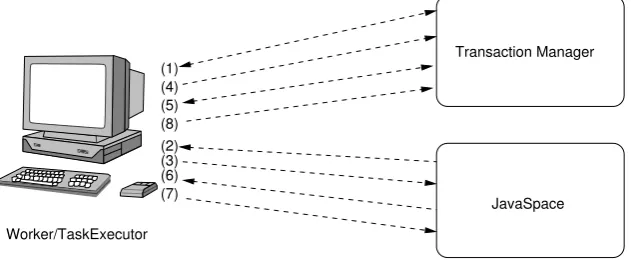
The operation of the TaskExecutor is illustrated in Figure 3.5.
Transaction Manager
JavaSpace Worker/TaskExecutor
(2) (8) (5) (4) (1)
(3) (6) (7)
[image:42.595.163.479.210.340.2]
Figure 3.5: Operation of TaskExecutor.
A description of the operations performed in Figure 3.5 are as follows:
1. Create a new transaction, which we will call transaction A.
2. Take dependency graph using transaction A.
3. Determine which task can be next executed by invoking the dependency graph's next() method; mark the corresponding computation unit in the graph as in progress.
4. Write the dependency graph back into the JavaSpace, and commit transac-tion A.
5. Create a new transaction, which we will call transaction B.
6. Take the task specied by the dependency graph using transaction B.
7. If this task has data dependencies, obtain the relevant result entries to full these requirements using getTaskInput().
8. Execute the task.
10. Take the dependency graph from the JavaSpace using transaction C.
11. Update the dependency graph by marking the computation unit correspond-ing to the current task as executed.
12. Write the dependency graph back into the JavaSpace using transaction C.
13. Write the result object that was produced into the JavaSpace using trans-action B.
14. Finally, commit both transaction B and transaction C.
Note that steps 2 and 10 will block if the dependency graph is currently held by another worker. Also, step 6 involves satisfying the data dependencies of a task; this function is discussed further in Section 3.2.3.
3.2.2.2 Interface
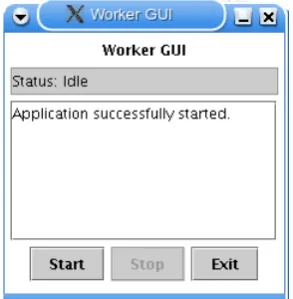
[image:43.595.246.393.465.615.2]A simple, user-friendly graphical user interface was designed for the Worker pro-gram, as shown in Figure 3.6. The interface is dened in the core.worker.WorkerGUI class, and uses Java Swing GUI components.
Figure 3.6: The Worker graphical interface.
terminates the TaskExecutor thread, as soon as all current operations have com-pleted. The Exit button terminates the Worker application. The current status of the application (eg. idle, running etc) is displayed in the status bar, and messages can be printed to the text area below.
3.2.3 Coordination
We have seen the details of how the master and worker each operate. However, for any meaningful computation to be carried out, there must be a way to co-ordinate the activities of each independent worker in the system, and to ensure that the computation will produce a correct result. Many applications designed for execution on a master/worker system will have dependencies between its sub-tasks, either requiring that some particular tasks are executed sequentially, or the results of some tasks may be needed as input for other tasks.
This section explores the components provided in the core.coordination package which can be used to coordinate applications with a reasonable level of complexity.
3.2.3.1 Entries
Entries are the name given to objects that can be stored in a JavaSpace, and accessed by other processes through the JavaSpace's write, read and take op-erations. The two fundamental units of communication in the system are task entries, which are used to represent a computation to be performed, and result entries, which are used to store the resultant data produced by the computation. There are two classes provided, core.entry.TaskEntry and core.entry.Re-sultEntry, which can be used to implement entries suitable for an individual ap-plication. In particular, TaskEntry contains an execute() method which denes the function to be carried out by each individual task. When a Worker ob-tains a TaskEntry object, it will invoke this method, which will in turn return a ResultEntry object that will be written back into the JavaSpace. A ResultEntry will simply act as a wrapper class for some data.
re-quired ResultEntry objects. These features are discussed further in the next section.
Although both TaskEntry and ResultEntry will be inherited from and be implemented dierently for each individual application, a Worker process makes no distinctions between the entries of each application, and will simply invoke the execute() method and write the resultant ResultEntry back to the JavaSpace, if there is one produced.
3.2.3.2 Execution Control & Data Dependencies
One of the major diculties of distributed systems is the lack of a global state. For applications with even a low level of complexity, it is imperative that each worker process knows the current status of execution. The system provides a solution to this problem in the form of a dependency graph.
Dependency Graph
The dependency graph is used to coordinate the execution of, and specify the relationships between the many sub-tasks that make up an application. By using a dependency graph, it is possible to specify the order in which sub-tasks should be executed, along with the data dependencies between these sub-tasks.
The dependency graph is represented by the core.coordination.Dependenc-yGraph class, and the graph itself is made up of computation units, which are de-ned in the core.coordination.ComputationUnit class. There is exactly one computation unit in the graph for each sub-task in the application; they are associated via a shared identication number.
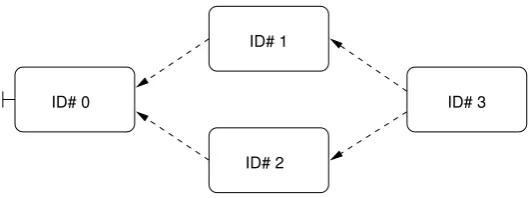
The graph itself is a directed acyclic graph, with vertices represented by com-putation units, and edges denoting the data dependencies between them. Each computation unit contains a vector which is used to hold references to other com-putation units denoting the sub-tasks on which it is depending for input data.
An example dependency graph for a small application consisting of four sub-tasks is shown in Figure 3.7.
ID# 3
ID# 2 ID# 1
[image:46.595.186.451.123.222.2]ID# 0
Figure 3.7: An example dependency graph.
changed to scheduled only when all of its data dependencies are satised. These dependencies are known to be satised when all of the computation unit nodes contained in a given computation unit's preceding tasks vector are marked as ex-ecuted. The ComputationUnit class provides a method canSchedule() which will determine if this is the case, and the DependencyGraph's scheduleUnits() method is called at regular intervals to set the status of schedulable units to scheduled.
The numerous computation units that form the dependency graph are stored in an array; the next() method iterates through this array and return the rst scheduled unit that it nds. Therefore, if there are multiple scheduled com-putation units, it is the one that appears rst in the array that will be executed next.
After a worker process retrieves the next computation unit from the depdency graph, the unit will be marked as in-progress. Similarly, after a result en-try is produced by the execution of a task enen-try and returned to the JavaSpace, the corresponding computation unit will be marked as executed. It is important to note that this sequence (unscheduled/scheduled/in-progress/executed) is not strict, and if a task does not complete its execution then it's associated computation unit should be reset to unscheduled. It is also entirely possible for the dependency graph to be modied directly by an application if required, as we will see later.
Usage
next scheduled computation unit. Once the dependency graph has been returned to the JavaSpace, the worker uses the computation unit to retrieve the associated task entry.
On completion of a task's execution, the worker will again retrieve the de-pendency graph from the JavaSpace. Assuming that the task produced a result entry when executed, the task's corresponding computation unit will be marked as executed. Following this, the dependency graph and result entry are both written back into the JavaSpace.
3.3 Applications
Two applications were implemented using the framework presented in Section 3.2 to test the suitability and eectiveness of the design that was adopted. Each application has contrasting characteristics in terms of data and communication requirements. The details of their implementation are discussed below.
3.3.1 The n-Queens Problem
3.3.1.1 Overview
The n-queens problem is a generalisation of the well known eight-queens problem. The basic premise of the problem is this: nd the number of ways that n queens
can be arranged on an n×n chess board so that no two queens can attack each
other, according to the rules of the game. One of the ninety-two possible solutions to the eight-queens problem is shown in Figure 3.8.
. . . Q . .
. . . Q . . . .
. . . Q .
Q . . . .
. . . Q
. Q . . . .
. . . . Q . . .
[image:47.595.247.392.573.686.2]. . Q . . . . .