Iteratively Decoded Irregular Variable Length Coding and Trellis Coded Modulation
R. G. Maunder, J. Wang, S. X. Ng, L-L. Yang and L. Hanzo
School of ECS, University of Southampton, SO17 1BJ, UK.
Tel: +44-23-8059 3125, Fax: +44-23-8059 4508
Email:
{
rm02r,jw02r,sxn,lly,lh
}
@ecs.soton.ac.uk, http://www-mobile.ecs.soton.ac.uk
Abstract– In this paper we propose a novel Irregular Variable Length Coding (IrVLC) scheme for near-capacity joint source and channel coding. We employ a number of Variable Length Coding (VLC) component codebooks hav-ing different codhav-ing rates for encodhav-ing appropriately cho-sen fractions of the input source symbols. These fractions may be designed With the aid of EXtrinsic Information Transfer (EXIT) charts so that the EXIT curve shape of the IrVLC codec may be matched to that of a serially con-catenated channel codec as closely as possible. In this way, an open EXIT chart tunnel may be created even at low Eb/N0 values that are close to the channel capacity. We
detail the proposed serially concatenated and iteratively decoded IrVLC and Trellis Coded Modulation (TCM) de-signs that are capable of operating within 0.6 dB of the un-correlated narrowband Rayleigh fading channel’s capacity at an effective bandwidth efficiency of 1.56 bit/s/Hz, assum-ing ideal Nyquist filterassum-ing. By contrast, the equivalent-rate VLC-based bench-marker schemes were found to be capa-ble of operating at 1.1 dB from capacity, which is nearly double the discrepancy of the proposed IrVLC-TCM sche-me.
1. INTRODUCTION
Irregular Convolutional Coding (IrCC) [1] has been proposed for employment in iteratively decoded joint channel coding and pre-coded equalisation [2]. The IrCC scheme amalgamates a number of component Convolutional Codes (CC) having dif-ferent coding rates, each of which encodes an appropriately selected fraction of the input bit stream. More specifically, the appropriate fractions may be selected with the aid of EXtrin-sic Information Transfer (EXIT) chart analysis [3], by ensuring that the EXIT curve of the composite IrCC may be accurately matched to that of a pre-coded equaliser. In this way, an open EXIT chart tunnel [4] may be created at lowEb/N0 values
using iterative-decoding. As a result, a low Bit Error Ratio (BER) may be achieved atEb/N0 values within 1 dB of the
Inter Symbol Interference (ISI) contaminated Additive White Gaussian Noise (AWGN) channel’s capacity [5].
The financial support of the EPSRC, Swindon UK and the EU under the auspices of the PHOENIX and NEWCOM projects is gratefully acknowl-edged.
In this contribution we apply the irregular coding concept to joint source and channel coding. We employ a novel Irregu-lar Variable Length Coding (IrVLC) scheme, which is serially concatenated [6] [7] with a bandwidth-efficient Trellis Coded Modulation (TCM) [8] scheme for the sake of exchanging ex-trinsic information.
In conventional Variable Length Coding (VLC), the source symbols are represented by binary codewords of varying len-gths. Short VLC codewords are assigned to frequently occur-ring source symbol values, whilst long codewords are mapped to infrequently occurring values. In this way the average VLC codeword lengthLapproaches the source entropyE. How-ever, any unintentional residual or intentionally introduced re-dundancy results in a discrepancy betweenL andE, which may be exploited to provide an additional error correcting ca-pability during decoding [9]. This error correcting caca-pability is related to and hence may be quantified by the VLC coding rate ofR=E/L∈[0,1], with lower rates corresponding to a higher error correcting capability.
In analogy to joint channel coding and pre-coded equal-isation [2], the proposed IrVLC scheme employs a number of VLC codebooks having different coding rates, which are used for encoding appropriately selected fractions of the in-put source symbols. In this way, the resultant composite EXIT curve may be shaped for the sake of matching that of the chan-nel codec. As in joint chanchan-nel coding and pre-coded equalisa-tion, this approach allows the amalgamated scheme to operate close to the channel capacity.
The rest of this paper is outlined as follows. In Section 2, we introduce the proposed serially concatenated and iteratively decoded IrTCM scheme and the appropriate regular VLC-TCM bench-mark scheme. The design and EXIT chart aided characterisation of these schemes is detailed in Section 3. In Section 4, we quantify the attainable performance improve-ments offered by the proposed IrVLC-TCM arrangeimprove-ments com-pared to the VLC-TCM bench-marker schemes. Finally, we offer our conclusions in Section 5.
2. SYSTEM OVERVIEW
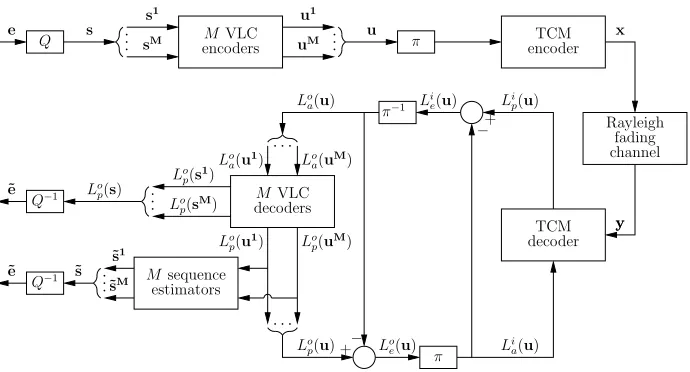
is constituted by TCM [8], which accommodates redundancy by increasing the number of modulation levels, instead of in-creasing the bandwidth required. The schemes considered dif-fer in their choice of the outer source codec. Specifically, we consider a novel IrVLC codec and an equivalent regular VLC-based bench-marker in this role. In both cases we employ both Symbol-Based (SB) and Bit-Based (BB) VLC decoding, re-sulting in a total of four different configurations. We refer to these four schemes as the SBIrVLC-, BBIrVLC-, SBVLC- and BBVLC-TCM arrangements, as appropriate. A schematic that is common to each of these four considered schemes is pro-vided in Figure 1.
The schemes considered are designed for facilitating the near-capacity detection of source samples received over an un-correlated narrowband Rayleigh fading channel. We consider the case of independent identically distributed (i.i.d.) source samples, which may represent the prediction residual error that remains following the predictive coding of audio, speech [10], image or video [11] information, for example. A Gaussian source sample distribution is assumed, since this has wide-spread applications owing to the wide applicability of the cen-tral limit theorem. Note however that with the aid of suitable adaptation, the techniques proposed in this treatise may be just as readily applied to arbitrary source sample distributions.
In the transmitter of Figure 1, the real-valued source sam-ples are quantized toK number of quantization levels in the blockQ. The resultant frame of quantized source samples is synonymously referred to as the frame of source symbols s here. Each source symbol in this frame indexes the particular quantization levele˜k,k ∈ [1. . . K], that represents the cor-responding source sample in the frameewith the minimum squared error. Owing to the lossy nature of quantization, dis-tortion is imposed upon the reconstructed source sample frame ˜e that is obtained by the receiver of Figure 1, following in-verse quantization in the blockQ−1. The total distortion ex-pected depends on both the original source sample distribution as well as on the number of quantization levelsK. This distor-tion may be minimised by employing Lloyd quantizadistor-tion [12]. Here, aK= 16-level Lloyd quantization scheme is employed, which achieves an expected Signal to Quantization Noise Ra-tio (SQNR) of about 20 dB for a Gaussian source [12]. Note however that with suitable adaptation, the techniques advo-cated in this treatise may be just as readily applied to arbitrary quantisers. Also note that Lloyd quantization results in a large variation in the occurrence probabilities of the resultant source symbol values. In the case of our K = 16-level quantizer, the source symbol values’ occurrence probabilities range from 0.0082 to 0.1019.
In the transmitter of the proposed scheme, the Lloyd-quant-ized source symbol frames is decomposed into M = 150
sub-frames{sm}Mm=1, as shown in Figure 1. This decomposi-tion is necessary for the sake of limiting the receiver complex-ity, since this employs an exponentially increasing number of trellis states as the number of sub-frames reduces [13]. Each
source symbol sub-framesmcomprisesJ = 100source sym-bols. Hence, the total number of source symbols in a source symbol frame becomesM·J = 15,000. As described above, each Lloyd-quantized source symbol in the sub-framesmhas aK-ary valuesmj ∈[1. . . K], where we havej∈[1. . . J].
The large differences in the source symbol values’ occur-rence probabilities provided by Lloyd quantization motivate the employment of VLCs. As described in Section 1, we em-ployNnumber of VLC codebooks, where we opted forN = 15for the SBIrVLC and BBIrVLC schemes andN= 1for the regular SBVLC and BBVLC schemes.
Each Lloyd-quantized source symbol subframesmis VLC-encoded using a single VLC codebookVLCn, where we have
n∈[1. . . N]. In the case of the SBIrVLC and BBIrVLC sche-mes, the particular fractionCnof the set of source symbol sub-frames that is encoded by the specific VLC codebookVLCn is fixed and will be derived in Section 3. The specific Lloyd-quantized source symbols having the value of k ∈ [1. . . K]
and encoded by the specific VLC codebookVLCnare repre-sented by the codewordVLCn,k, which has a length ofIn,k
bits. TheJ= 100VLC codewords that represent theJ= 100
Lloyd-quantized source symbols in each source symbol sub-framesm are concatenated to provide the transmission sub-frameum={VLCn,smj }J
j=1.
Owing to the variable lengths of the VLC codewords, each of theM = 150transmission sub-frames typically comprises a different number of bits. In order to facilitate the VLC de-coding of each transmission sub-frameum, it is necessary to explicitly convey its lengthIm=Jj=1In,smj to the receiver.
Furthermore, this highly error sensitive side information must be reliably protected against transmission errors. This may be achieved using a low rate block code, for example. For the sake of avoiding obfuscation, this is not shown in Figure 1. Note that the choice of the specific number of sub-framesMin each frame constitutes a trade-off between the computational com-plexity of VLC decoding and the amount of side information that must be conveyed.
In the scheme’s transmitter, theM= 150number of trans-mission sub-frames{um}Mm=1are concatenated. As shown in Figure 1, the resultant transmission frameuhas a length of
M
m=1Imbits.
In the proposed scheme, the VLC codec is protected by a serially concatenated TCM codec. Following VLC encod-ing, the bits of the transmission frameuare interleaved in the blockπof Figure 1 and TCM encoded in order to obtain the channel’s input symbolsx, as shown in Figure 1. These are transmitted over an uncorrelated narrowband Rayleigh fading channel and are received as the channel’s output symbolsy, as seen in Figure 1.
SB-MVLC decoders
π
decoder TCM π
Lo
p(u1) Lop(uM) ˜s1
estimators Msequence
Q−1 ˜sM
˜e ˜s
Q−1
˜e
Lo
p(sM)
Lo
p(s1)
Lo
p(s)
Lo
a(u1) Loa(uM)
+ Loe(u)
Lo
p(u) −
Lo
a(u) π−1
+
Li
a(u)
y
−
Li
e(u) Lip(u)
y Q
e
encoderTCM
MVLC
encoders
x s s
1
sM
u1 uM u
[image:3.612.138.483.69.255.2]Rayleigh fading channel
Figure 1: Schematic of the SBIrVLC-, BBIrVLC-, SBVLC- and BBVLC-TCM schemes.
VLC [13] [15] decoding, whilst BBIrVLC and BBVLC decod-ing rely on bit-level trellises [16]. All BCJR calculations are performed in the logarithmic probability domain and using an eight-entry lookup table for correcting the Jacobian approxi-mation in the Log-MAP algorithm [17].
Soft information, represented in the form of Logarithmic Likelihood Ratios (LLRs) [18], is iteratively exchanged be-tween the TCM and VLC decoding stages for the sake of as-sisting each other’s operation. Upon each successive decoding iteration, the reliability of this soft information increases, until iterative decoding convergence is achieved. In Figure 1,L(·)
denotes the LLRs of the bits concerned (or the L-values of the specific symbols as appropriate), where the superscripti indi-cates inner TCM decoding, whileocorresponds to outer VLC decoding. Additionally, a subscript denotes the dedicated role of the LLRs (or L-values), witha,pandeindicatinga priori, a posterioriand extrinsic information, respectively.
During each decoding iteration, the inner TCM decoder is provided witha prioriLLRs pertaining to the transmission frameLia(u), as shown in Figure 1. These LLRs are obtained
from the most recent operation of the outer VLC decoding stage, as will be highlighted below. In the case of the first decoding iteration, no previous VLC decoding has been per-formed and hence thea prioriLLRsLia(u)provided for TCM
decoding are all zero-valued, corresponding to a probability of 0.5 for both ‘0’ and ‘1’. Given the channel’s output symbols yand thea prioriLLRsLia(u),, the BCJR algorithm is
em-ployed for obtaining thea posterioriLLRsLip(u), as shown in
Figure 1.
During iterative decoding, it is necessary to prevent the re-use of already exploited information, since this would limit the attainable iteration gain [17]. This is achieved following TCM decoding by the subtraction ofLia(u)from Lip(u), as
shown in Figure 1. The resultant extrinsic LLRsLie(u)are
de-interleaved in the blockπ−1and forwarded asa prioriLLRs
for VLC decoding.
As stated above, M = 150separate VLC decoding pro-cesses are employed in the proposed scheme’s receiver. Simi-larly to the decomposition of the bit-based transmission frame uinto sub-frames, thea prioriLLRsLoa(u)are decomposed
into M = 150 sub-frames, as shown in Figure 1. This is achieved with the aid of the explicit side information that con-veys the number of bits Im in each transmission sub-frame um. Each of theM = 150VLC decoding processes is pro-vided with the a priori LLR sub-frame Loa(um) and in
re-sponse it generates thea posterioriLLR sub-frameLop(um),
m ∈ [1. . . M]. Thesea posterioriLLR sub-frames are con-catenated in order to provide thea posterioriLLR frameLop(u),
as shown in Figure 1. Following the subtraction of thea pri-oriLLRsLoa(u), the resultant extrinsic LLRsLoe(u)are
inter-leaved and forwarded asa prioriinformation to the next TCM decoding iteration.
In the case of SBIrVLC and SBVLC decoding, each of theM = 150VLC decoding processes additionally provides a posteriori L-values pertaining to the corresponding source symbol sub-frameLop(sm). This comprises a set ofK
num-ber of L-values for each source symbolsmj in the sub-frame
sm, wherej ∈[1. . . J]. Each of these L-values provides the logarithmic probability that the corresponding source symbol
smj has the particular valuek ∈ [1. . . K]. In the receiver of
Figure 1, the source symbols’ L-value sub-frames are concate-nated to provide the source symbol L-value frameLop(s). By
inverse-quantising this soft information in the block Q−1, a Minimum Mean Squared Error (MMSE) source sample frame estimate ˜e can be obtained. More specifically, each recon-structed source sample is obtained by using the corresponding set ofKsource symbol value probabilities to find the weighted average of theKnumber of quantization levels{˜ek}Kk=1.
case, the source symbol subframesmmust be estimated from thea posterioribit-level outputLop(um). This may be achieved
by employing symbol-level sequence estimation, as shown in Figure 1. This exploits the explicit knowledge that the sub-framesmcomprisesJ = 100source symbols, in order to ob-tain a hard decision estimate˜sm. Following concatenation, the source symbol frame estimate˜smay be inverse-quantised, in order to obtain the source sample frame estimate˜e. Note that since this approach relies on hard source symbol decisions prior to inverse-quantization, a higher level of source distor-tion may be expected than that attained, when employing the soft decisions of the SBIrVLC and SBVLC decoders. How-ever, this reduced performance benefits us in terms of a re-duced complexity, because a high number of transitions would have to be considered by the symbol-level VLC decoding trel-lis for generating the related soft-decisions.
In the next section we detail the design of our IrVLC scheme and characterise each of the SBIrVLC-, BBIrVLC-, SBVLC-and BBVLC-TCM schemes with the aid of EXIT chart analy-sis.
3. SYSTEM PARAMETER DESIGN
As described in Section 1, the SBIrVLC and BBIrVLC sche-mes may be constructed by employing a number of VLC code-books having different coding rates, each of which encodes an appropriately chosen fraction of the input source symbols. We opted for using N = 15 VLC codebooks VLCn, n ∈
[1. . . N], that were specifically designed for encoding K = 16-level Lloyd-quantized Gaussian i.i.d. source samples. More specifically, theN = 15VLC codebooks comprised 13 Vari-able Length Error Correcting (VLEC) designs having various minimum block-, convergence- and divergence-distances [19], complemented by a symmetric- and an asymmetric- Reversible Variable Length Coding (RVLC) design [19]. In all code-books, a minimum free distance of least df = 2 was
em-ployed, since this supports convergence to an infinitesimally low BER [20]. The resultant average VLC codeword lengths ofLn=Kk=1P(k)·In,k,n∈[1. . . N], were found to range from 3.94 to 12.18 bits. When compared to the source symbol entropy ofE=−Kk=1P(k)·log2(P(k)) = 3.77, these cor-respond to coding rates ofRn=E/Lnspanning the range of 0.31 to 0.96.
As will be detailed below, our SBIrVLC and BBIrVLC schemes were designed under the constraint that they have an overall coding rate ofR = 0.52. This value was chosen, since it is the coding rate of the VLC codebookVLC10, which we employ in our SBVLC and BBVLC bench-markers using
N = 1codebook. This coding rate results in an average in-terleaver length ofM ·J ·E/R = 108,750bits for all the schemes considered.
In-phase Quadrature-phase (IQ)-interleaved TCM having eight trellis-states per symbol along with 3/4-rate coded 16-Level Quadrature Amplitude Modulation (16QAM) is employ-ed, since this is appropriate for transmission over uncorrelated
narrowband Rayleigh fading channels. Ignoring the modest bi-trate contribution of conveying the side information, the band-width efficiency of the schemes considered is thereforeη = 0.52·0.75·log2(16) = 1.56bit/s/Hz, assuming ideal Nyquist filtering having a zero excess bandwidth. This value corre-sponds to the channel capacity of the uncorrelated narrowband Rayleigh fading channel at an Eb/N0 value of 2.6 dB [21].
Given this point on the corresponding channel capacity curve, we will be able to quantify, how closely the proposed schemes may approach this ultimate limit.
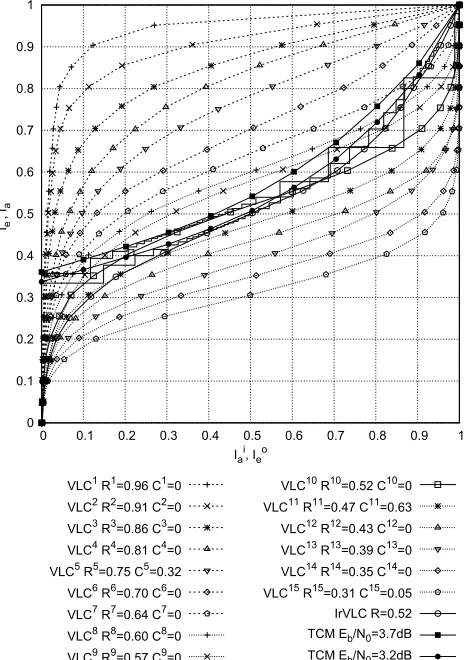
In Figure 2, we provide the EXIT curvesIei(Iai, Eb/N0)
of the TCM scheme for a number ofEb/N0values above the channel capacity bound of 2.6 dB. The inverted EXIT curves
Iao,n(Ieo)plotted for the N = 15VLC codebooks, together
with their coding ratesRn, are also given in Figure 2. Note that these curves were obtained using bit-based VLC decoding, but similar curves may be obtained for symbol-based decoding.
0 0.1 0.2 0.3 0.4 0.5 0.6 0.7 0.8 0.9 1
0 0.1 0.2 0.3 0.4 0.5 0.6 0.7 0.8 0.9 1 Ie
i, I
a
o
Iai, Ieo
VLC1 R1=0.96 C1=0 VLC2 R2=0.91 C2=0 VLC3 R3=0.86 C3=0 VLC4 R4=0.81 C4=0 VLC5 R5=0.75 C5=0.32 VLC6 R6=0.70 C6=0 VLC7 R7=0.64 C7=0 VLC8 R8=0.60 C8=0 VLC9 R9=0.57 C9=0
VLC10 R10=0.52 C10=0 VLC11 R11=0.47 C11=0.63 VLC12 R12=0.43 C12=0 VLC13 R13=0.39 C13=0 VLC14 R14=0.35 C14=0 VLC15 R15=0.31 C15=0.05 IrVLC R=0.52 TCM Eb/N0=3.7dB
[image:4.612.321.553.318.648.2]TCM Eb/N0=3.2dB
Figure 2: Inverted VLC EXIT curves and TCM EXIT curves.
The inverted EXIT curve of an IrVLC schemeIao(Ieo)can
N= 15component VLC codebooks’ EXIT curves,
Iao(Ieo) = N
n=1
αnIao,n(Ieo), (1)
whereαn is the fraction of the transmission frameuthat is generated by the specific component codebookVLCn. Note that the values ofαnare subject to the constraints
N
n=1
αn= 1, αn≥0∀n∈[1. . . N]. (2)
The specific fraction of source symbol subframessmthat should be encoded by the specific component codebookVLCnin or-der that it generates a fractionαnof the transmission frameu, is given by
Cn=αn·Rn/R, (3) whereR= 0.52is the desired overall coding rate. Again, the specific values ofCnare subject to the constraints
N
n=1 Cn=
N
n=1
αn·Rn/R= 1, Cn≥0∀n∈[1. . . N].
(4) Beneficial values ofCn may be chosen by ensuring that there is an open EXIT tunnel between the inverted IrVLC EXIT curve and the EXIT curve of TCM at anEb/N0value that is
close to the channel capacity bound. This may be achieved us-ing the iterative EXIT-chart matchus-ing process of [1] to adjust the values of{Cn}Nn=1under the constraints of (2) and (4) for
the sake of minimising the error function 1
0 e(I)
2dI, (5)
where
e(I) =Iei(I, Eb/N0)−Iao(I) (6)
is the difference between the inverted IrVLC EXIT curve and the EXIT curve of TCM at a particular target Eb/N0 value.
Note that in order to ensure that the design results in an open EXIT tunnel, we must impose the additional constraint of
e(I)>0∀I ∈[0,1]. (7) Open EXIT tunnels were found to be achievable for both the SBIrVLC- and the BBIrVLC-TCM schemes at anEb/N0 of 3.2 dB, which is just 0.6 dB from the channel capacity bound of 2.6 dB. The corresponding values ofCnare provided in Fig-ure 2 and we note that all but three of these are zero-valued. This implies that a low-complexity three-component IrVLC design is capable of approaching the channel’s capacity.
By contrast, the corresponding EXIT-tunnel only becomes open for the SBVLC- and BBVLC-TCM bench-markers for
Eb/N0values in excess of 3.7 dB, which is 1.1 dB from the
channel capacity bound of 2.6 dB. We can therefore expect our SBIrVLC- and BBIrVLC-TCM schemes to be capable of operating at nearly half the distance from the channel capacity in comparison to our bench-markers, achieving a gain of about 0.5 dB.
4. RESULTS
The transmission of a single frame ofM·J = 15,000source samplesewas simulated over a range ofEb/N0values, when
communicating over an uncorrelated narrowband Rayleigh fad-ing channel. For each value of Eb/N0 we consider the
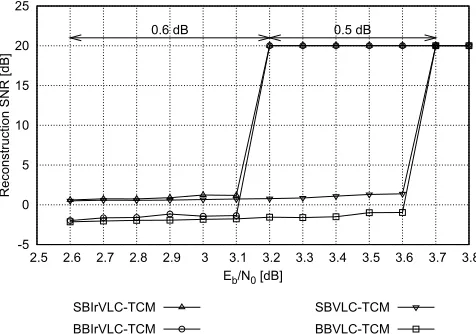
re-constructed source sample frame˜eand evaluate the Signal to Noise Ratio (SNR) associated with the ratio of the source sig-nal’s energy and the reconstruction error that may be achieved following iterative decoding convergence. This relationship is plotted for each of the SBIrVLC-, BBIrVLC-, SBVLC- and BBVLC-TCM schemes in Figure 3.
-5 0 5 10 15 20 25
2.5 2.6 2.7 2.8 2.9 3 3.1 3.2 3.3 3.4 3.5 3.6 3.7 3.8
Reconstruction SNR [dB]
Eb/N0 [dB]
SBIrVLC-TCM BBIrVLC-TCM
SBVLC-TCM BBVLC-TCM
[image:5.612.317.555.222.389.2]0.6 dB 0.5 dB
Figure 3: Reconstruction SNR versus Eb/N0 for a
Gaus-sian source using a K = 16-level Lloyd quantization for the SBIrVLC-, BBIrVLC-, SBVLC- and BBVLC-TCM sche-mes communicating over an uncorrelated narrowband Ray-leigh fading channel.
At sufficiently high Eb/N0 values, all considered
sche-mes are capable of obtaining an error-free reconstructed source sample frame˜econtaining only quantization noise, correspond-ing to an SNR of 20 dB. In the case of the SBIrVLC- and BBIrVLC-TCM schemes, this is achieved for Eb/N0values
above 3.2 dB, which is just 0.6 dB from the channel capacity bound of 2.6 dB. Again, this represents a 0.5 dB gain in com-parison to the performance of the SBVLC- and BBVLC-TCM bench-markers, which achieve an error-free reconstruction for
Eb/N0values in excess of 3.7 dB.
Note that these findings confirm the EXIT chart predictions of Section 3. Recall that Figure 2 provides decoding trajec-tories for the BBIrVLC-TCM and BBVLC-TCM schemes at
Eb/N0 values of 3.2 dB and 3.7 dB, respectively. Note that
owing to the high interleaver length ofM·J·E/R= 108,750
At lowEb/N0values, the corresponding TCM EXIT cur-ves cross the inverted IrVLC/VLC EXIT curcur-ves and the open EXIT chart tunnel disappears. In these cases, iterative decod-ing convergence to unity mutual information cannot be ach-ieved, resulting in the poor reconstruction quality that may be observed at low values of Eb/N0 in Figure 3. It is in this
lowEb/N0region that the SBIrVLC- and SBVLC-TCM sche-mes outperform the BBIrVLC- and BBVLC-TCM schesche-mes. The improved performance of the SBIrVLC and SBVLC de-coders is a benefit of their ability to provide symbol-level soft-decision outputs instead of hard-soft-decisions. However, this is at-tained at the cost of a complexity that was found to be an order of magnitude higher than that of the BBIrVLC and BBVLC de-coders, when considering the number of Add-Compare-Select (ACS) operations, which is one of the most pertinent complex-ity metrics in the context of systolic-array-type silicon chips. In the light of this, the employment of the SBIrVLC-TCM scheme instead of the BBIrVLC-TCM scheme appears unattrac-tive.
5. CONCLUSIONS
In this paper we have introduced a novel IrVLC design for near-capacity joint source and channel coding. In analogy to IrCC coding invoked for joint channel coding and pre-coded equalisation [2], IrVLC employs a number of component VLC codebooks having different coding rates in appropriate propor-tions. More specifically, with the aid of EXIT chart analysis, the appropriate fractions of the input source symbols may be chosen for directly ensuring that the EXIT curve of the IrVLC codec may be matched to that of a serially concatenated chan-nel codec. In this way, an open EXIT chart tunchan-nel facilitat-ing near-capacity high quality source reconstruction may be achieved.
We have detailed the construction of an IrVLC scheme that is suitable for the encoding of 16-level Lloyd quantized Gaus-sian i.i.d. source samples and for use with IQ-interleaved TCM and 16QAM over uncorrelated narrowband Rayleigh fading channels. For the purposes of comparison, we also selected a regular VLC bench-marker, having a coding rate equal to that of our IrVLC scheme. Serially-concatenated and iteratively decoded SBIrVLC-, BBIrVLC-, SBVLC- and BBVLC-TCM schemes were characterised with the aid of EXIT chart analy-sis. These schemes have a bandwidth efficiency of 1.56 bits per channel symbol, which corresponds to a Rayleigh fading chan-nel capacity bound of 2.6 dB. The SBIrVLC- and BBIrVLC-TCM schemes were found to offer high-quality source recon-struction at anEb/N0value of 3.2 dB, which is just 0.6 dB
from capacity. This compares favourably with the SBVLC-and BBVLC-TCM bench-markers, which require an Eb/N0
value of 3.7 dB. Owing to the higher computational complexity of the SBIrVLC-TCM scheme, the BBIrVLC-TCM arrange-ment was identified as our preferred scheme.
6. REFERENCES
[1] M. T¨uchler and J. Hagenauer, “EXIT charts of irregular codes,” in Con-ference on Information Sciences and Systems, (Princeton, NJ), pp. 748– 753, March 2002.
[2] J. Wang, S. X. Ng, A. Wolfgang, L.-L. Yang, S. Chen, and L. Hanzo, “Near-capacity three-stage MMSE turbo equalization using irregular convolutional codes,” inInternational Symposium on Turbo Codes, (Mu-nich, Germany), April 2006.
[3] S. ten Brink, “Convergence of iterative decoding,”Electronics Letters, vol. 35, no. 10, pp. 806–808, 1999.
[4] A. Ashikhmin, G. Kramer, and S. ten Brink, “Extrinsic information transfer functions: model and erasure channel properties,”IEEE Trans-actions on Information Theory, vol. 50, pp. 2657–2673, November 2004.
[5] C. E. Shannon, “The mathematical theory of communication,”Bell Sys-tem Technical Journal, vol. 27, pp. 379–423, July 1948.
[6] S. Benedetto and G. Montorsi, “Serial concatenation of block and convo-lutional codes,”Electronics Letters, vol. 32, no. 10, pp. 887–888, 1996.
[7] S. Benedetto and G. Montorsi, “Iterative decoding of serially con-catenated convolutional codes,” Electronics Letters, vol. 32, no. 13, pp. 1186–1188, 1996.
[8] G. Ungerboeck, “Channel coding with multilevel/phase signals,”IEEE Transactions on Information Theory, vol. 28, no. 1, pp. 55–67, 1982.
[9] V. Buttigieg and P. G. Farrell, “Variable-length error-correcting codes,”
IEE Proceedings on Communications, vol. 147, pp. 211–215, August 2000.
[10] L. Hanzo, F. C. A. Somerville, and J. P. Woodard,Voice Compression and Communications: Principles and Applications for Fixed and Wire-less Channels. IEEE Press-John Wiley & Sons., 2001.
[11] L. Hanzo, P. J. Cherriman, and J. Streit,Wireless Video Communications: Second to Third Generation and Beyond. Piscataway, NJ: IEEE Press-John Wiley & Sons, 2001.
[12] S. Lloyd, “Least squares quantization in PCM,”IEEE Transactions on Information Theory, vol. 28, no. 2, pp. 129–137, 1982.
[13] R. Bauer and J. Hagenauer, “Symbol by symbol MAP decoding of vari-able length codes,” in3rd ITG Conference on Source and Channel Cod-ing, (Munich, Germany), pp. 111–116, January 2000.
[14] L. Bahl, J. Cocke, F. Jelinek, and J. Raviv, “Optimal decoding of linear codes for minimizing symbol error rate (Corresp.),”IEEE Transactions on Information Theory, vol. 20, no. 2, pp. 284–287, 1974.
[15] J. Kliewer and R. Thobaben, “Iterative joint source-channel decoding of variable-length codes using residual source redundancy,”IEEE Transac-tions on Wireless CommunicaTransac-tions, vol. 4, no. 3, pp. 919–929, 2005.
[16] R. Bauer and J. Hagenauer, “On variable length codes for iterative source/channel decoding,” inData Compression Conference, (Snowbird, UT), pp. 273–282, March 2001.
[17] L. Hanzo, T. H. Liew, and B. L. Yeap,Turbo Coding, Turbo Equalisa-tion and Space Time Coding for Transmission over Wireless Channels. Chichester, UK: Wiley, 2002.
[18] J. Hagenauer, E. Offer, and L. Papke, “Iterative decoding of binary block and convolutional codes,”IEEE Transactions on Information Theory, vol. 42, no. 2, pp. 429–445, 1996.
[19] J. Wang, L.-L. Yang, and L. Hanzo, “Iterative construction of reversible variable-length codes and variable-length error-correcting codes,”IEEE Communications Letters, vol. 8, pp. 671–673, November 2004.
[20] R. Thobaben and J. Kliewer, “Low-complexity iterative joint source-channel decoding for variable-length encoded Markov sources,”IEEE Transactions on Communications, vol. 53, pp. 2054–2064, December 2005.