THE ROLE OF TECHNOLOGY BASED APPROACHES IN GLOBALIZING
EDUCATION
Mehryar Nooriafshar Senior Lecturer, Faculty of Business
University of Southern Queensland, Toowoomba, Australia
ABSTRACT
Students from diverse linguistic and cultural backgrounds choose English speaking countries for the tertiary studies in popular fields such as Business. It would certainly help this group of students if teaching materials were designed in such a way that dependency and reliance on language was kept to minimum. Technology plays an important role in achieving this objective.
Current Information Technology provides ideal opportunities for development of Visually Rich (VR) learning environments. Future information technology products may also facilitate capturing, digitising, storing and transferring human thoughts as an independent medium directly to other sources. Imagine the ability of directly transferring an animation of a concept to a learner in a thought file. After all, the language of thought is probably universal and is not based on a particular type of language. In a strictly natural way, we do not have to pronounce words in our thoughts to describe ideas. Our ideas can be “seen” in our thoughts like Plato's Forms (Plato’s Republic) or Aristotles' Essences (De-Anima). Although using visually enhanced multimedia teaching materials is not quite like a direct transfer of ideas to others, it is a step in the right direction.
This paper investigates how the latest technologies can be used in creating learning environments with a lower text dependency to suit students from different linguistic backgrounds. Therefore, by incorporating appropriate visual features, educational multimedia materials can be developed in a generic language like English, and be available to students whose native tongue is another language. Examples and strategies for development of such systems are provided and discussed in this paper.
Key Words: Globalization, Education, Technology, Visually Rich
This is the Author’s accepted manuscript version of:
INTRODUCTION
By adopting the classic systems approach, education can be modeled as an Input, Process and Output system. Input in the form of resources is entered into the system and after a conversion processes, an output is achieved. This output may be in the form of quality education and/or research findings. The process phase may be completed in the form of a cycle which consists of plan, organise, control and improve. At a higher level this system can be regarded as a service type which provides mainly intangible output.
Like any operating system, the main objectives will be to produce or provide the right goods or services in the right quantities at the right time. If we further analyse the main sub-objectives, we would realise that quality, required quantity and timeliness are the main features. The three components of input, process and output are just like the main links of a chain. Although these links are separate entities, they can overlap with each other. For example, input and process can interface with each other in an overlapping fashion. Similar to any closed loop system, a feedback loop should provide the necessary feedback from the output to the initial phase (input) part of the system.
Depending on the ultimate goals, appropriate resources would be entered into the system. For instance, specially designed course materials would enter the system if the purpose was to provide education to students from different linguistic and cultural backgrounds. This paper presents and explores innovative ways of designing visually enhanced multimedia teaching materials.
VISUAL WAYS OF STORING AND TRANSFERRING INFORMATION
A very important achievement for human beings was the devising of the means of recording information so that it could be archived for future reference or transferred to others. Writing was a significant step in the right direction. The earliest form of writing dates back to about 8000 years ago. Symbolic and pictographic writings such as hieroglyphics were gradually replaced by alphabetic ones, which were based on sounding out or pronouncing words.
Text-based learning was the main approach until the Second World War when the US military introduced audiovisual learning. Its main applications included the use of maps, graphs and recorded sound. When it became possible to incorporate sound and video features into computers, a new generation of audiovisual instruction was born. This was interactive multimedia-based teaching and learning.
When Aristotle said that without images thinking is not possible, he was probably referring to virtual images created in human mind. So, perhaps the visual feature of our mind is the most active part in creating thoughts. The human brain is capable of creating the most sophisticated thought-based multimedia sessions for any topic. In our mind, we have access to an unlimited amount of resources.
Business students. These students were selected from the University of Southern Queensland (USQ) in Australia and the University of Texas in Arlington (UTA) in the United States. For details on WEMLE, see (http://www.usq.edu.au/course/material/MGT2102/).
Figure 1 – Tertiary Students’ Preferences for Different Types of Media
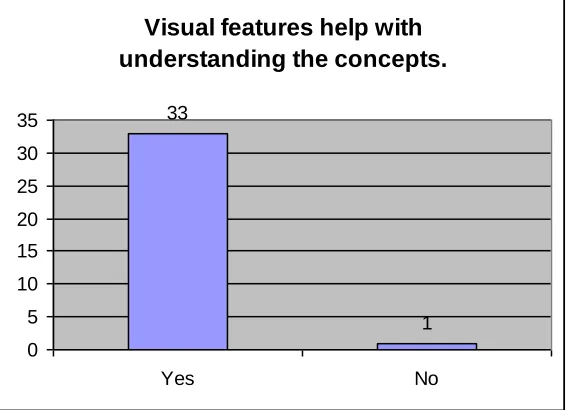
In December 2003, the author conducted another formal survey on 34 students at the Insituto Tecnologico Autonomo de Mexico (ITAM) in Mexico City. WEMLE was used as an instrument in this study. After receiving a seminar on introductory project management, students were interviewed on their experience with the visually rich multimedia system. As illustrated in Figure 2, a vast majority (97%) of them indicated that the visual features played a very important role in understanding the concepts.
Visual features help with understanding the concepts.
33
1 0
5 10 15 20 25 30 35
Yes No
Figure 2 – The visual features’ role with understanding the Project management
In 2004, a group of twenty first-year undergraduate Business students at USQ were selected for the purposes of an experiment on the effectiveness of teaching basic mathematics concepts via visual teaching aids. These
20%
9%
29% 38%
4%
Animations Voiceovers Interactive tools All
students were from different mathematical backgrounds and the majority did not have a very strong background in quantitative fields.
These students were taught the basic principles of identifying and plotting graphs of polynomial equations of different degrees. It should be mentioned that these basic skills form the foundations of understanding, learning and using more advanced techniques in quantitative subjects. Curve fitting, regression, linear programming and its derivatives are some of the examples. The students were taught the main concepts in a very practical manner. The adopted method relied on the use of a flexi-curve, protractor and very basic scientific calculator.
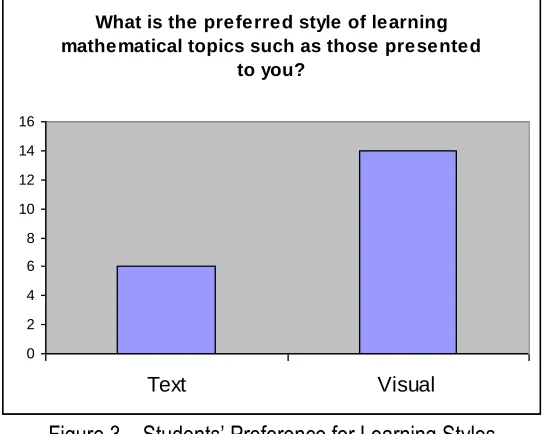
As Figure 3 illustrates, a large proportion of these students have reported that they would have a preference for seeing relationships and patters demonstrated to them visually. This finding is compatible with recent research findings that students prefer and benefit from visually rich methods of teaching (Nooriafshar et al., 2004; Nooriafshar and Todhunter, 2004). It is interesting to note that the use of analogies and visuals in teaching materials are identified as ways of encouraging learners to become “whole-brained” (Funderstanding, n.d.). In other words right brain is invoked through creative activities such as the visual features. Hence, we would not just use the part of the brain which is referred to as “50% of brain’s mighty toolkit” by Buzon (2002).
What is the preferred style of learning mathematical topics such as those presented
to you?
0 2 4 6 8 10 12 14 16
[image:4.612.170.444.295.512.2]Text Visual
Figure 3 – Students’ Preference for Learning Styles
Based on these findings, further research was carried out to investigate the possibilities of creating even richer visual learning environments. The objective was to explore the learning effectiveness of virtual reality educational multimedia systems.
Using the virtual reality multimedia, students from two different backgrounds (Nursing and Business) were given a tutorial on topics related to basic human anatomy. After the completion of this tutorial, each student was interviewed and invited to provide comments and feedback. It was concluded that virtual reality multimedia could enhance learning by providing much more realistic images and visual features. Both groups of students found the virtual reality multimedia teaching to be very effective in terms of ease of learning and its very close relationship with the real world.
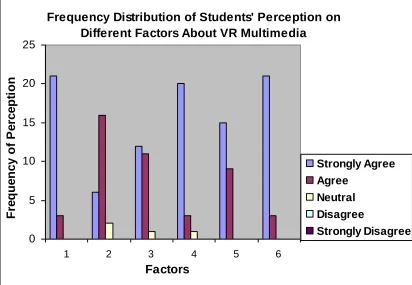
1. I enjoyed my VR learning experience. 2. My learning experience speed was very fast. 3. My learning experience was very easy.
4. The learning materials were related strongly to the real world.
5. The VR method helped me greatly with my understanding of the concepts.
6. I would very much like to have VR multimedia incorporated into my learning materials.
Frequency Distribution of Students' Perception on Different Factors About VR Multimedia
0 5 10 15 20 25
1 2 3 4 5 6
[image:5.612.99.511.192.477.2]Factors F re q u e n c y o f P e rc e p ti o n Strongly Agree Agree Neutral Disagree Strongly Disagree
Figure 4 - Frequency Distribution of Factors (1 to 6) as Provided by Students
According to the above experiment, it was reported that visually rich multimedia could provide a very effective teaching and learning environment. A virtual reality multimedia can even further enhance learning by incorporating more realistic images and visual features.
PROPOSED MODEL – VISUALLY RICH MULTIMEDIA LEARNING ENVIRONMENT (VRMLE)
We have access to unlimited amounts of resources for creation of the most sophisticated images in our mind. We can, consciously or sub-consciously (as in dreams) create vivid images of people, objects, events and situations. These images can be virtually real. Any medium, even a piece of text and audio which can help us to create images on our mind’s “sketch pad” would promote right brain activities. Therefore, a Visually Rich Multimedia Leaning Environment (VRMLE) would certainly be ideal for this purpose.
Virtual World
Learner
Options
Action
Reaction
The findings strongly support that the learning effectiveness is influenced by factors such as Visual Features and Linkage with the Real World. In other words:
Learning Effectiveness = f {Visual features, Linkage with Real World}
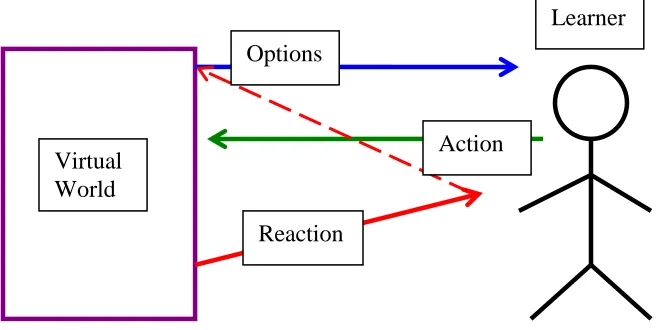
Figure 5 is a diagrammatical representation of an environment which can provide very rich and realistic visual features. In this proposed model, the learner interacts with an almost real scenario (Virtual World). The learner is presented with a number of options to which he/she should give a response (Action). The real world then provides feedback (Reaction). The process can then be cycled back to Options for further Action and Reaction. This cycle may repeat until satisfactory or planned outcome is achieved.
Figure 5 – Proposed Visually Rich Learning Environment
As an example, let us investigate how a Virtual Reality multimedia can be implemented and used in Business education. The learners will be provided with Virtual Reality goggles, gloves and shoes. The gloves and shoes can be in the form of micro-sensors placed in appropriate body parts for input/output and interaction purposes. After wearing and attaching the goggles and the sensors, the learner can visualise, feel and hear him/herself in an actual location. For instance, he/she can, virtually, be on the factory floor of a manufacturing company and physically (in a virtual manner) approach a virtual worker (avatar). They can then virtually communicate, in a language of their choice. They can even include movement of their hands and arms, and their usual facial expression (smile, worried and desperate). So, the learner can receive all the necessary information about this plant and its products. This scenario can be extended to a virtual simulation too. For instance, the learner will be able to instantly reposition the facilities on the factory floor to find out the effect on the system. For example, will there be a reduction in the total material movement costs if facility A and facility B were placed close to each other? These costs can then be shown on the screen of the learner’s Virtual Reality goggles.
[image:6.612.122.451.247.412.2]The proposed environment encourages a constructivist approach to learning. It should be noted that under constructivism, the learner is guided to find the solution by constructing his/her own understanding. Obviously this process is assisted by the guidance. An enhanced computer multimedia as in this case provides the necessary guidance. It should be noted that a rich learning environment such as an interactive multimedia would satisfy a major objective of the constructivist approach (Phillips, 1998). See Bruner (n.d.), Dougiamas (1998) and Mahoney (2004) for some examples of introduction to constructivism.
CONCLUSION
Research findings support the students’ preference for visually rich teaching and learning environments which have real life linkages. Computer multimedia offers ideal opportunities for creating and presenting visually enriched learning environments. The latest technologies associated with virtual reality will also play an important role in a not too distant future.
Hence, by incorporating appropriate visual features, educational multimedia materials can be developed in a generic language like English, and be available to students whose native tongue is another language. Although this is not quite like a direct transfer of ideas to others, it is a step towards reducing dependency and reliance on text-based and language-specific teaching materials.
In order to encourage further research and development work, a Visually Rich Multimedia Learning Environment (VRMLE) model was proposed and presented.
REFERENCES
Aristotle, De Anima (On the Soul), Penguin Classics, 1986.
Beier K.P. (2004) Virtual Reality: A Short Introduction Retrieved February 2, 2004 from http://www-vrl.umich.edu/intro/
Bruner J. (n.d.), Constructivism Theory Retrieved August 15, 2004 from http://www.artsined.com/teachingarts/Pedag/Constructivist.html
Buzon T. (2002), How to Mind Map, Thorsons, London.
Dougiamas M. (1998), A journey into Constructivism Retrieved September 15, 2004 from http://dougiamas.com/writing/constructivism.html#intro
Funderstanding: Right Brain vs. Left Brain (n.d.) Retrieved November 11, 2003 from http://www.funderstanding.com/constructivism.cfm
Phillips R. (1998), Models of learning appropriate to educational applications of information technology Retrieved October 4, 2004 from http://lsn.curtin.edu.au/tlf/tlf1998/phillips.html
Nooriafshar M. and Todhunter B. (2004), "Designing a Web Enhanced Multimedia Learning Environment (WEMLE) for Project Management ", Journal of Interactive Learning Research (JILR), (2004) 15(1), 33-41.