AAEE2016CONFERENCE
Coffs Harbour, Australia
Building Capability to Teach Humanitarian Engineering: A
Reflection
Andrew Drain, Jane Goodyer and Aruna Shekar
School of Engineering and Advanced Technology, Massey University, New Zealand Corresponding Author Email: [email protected]
CONTEXT
Massey University has been running the first year engineering design project Engineers Without Borders (EWB) Design Challenge for five years. In this time a number of faculty and curriculum changes have been made to ensure the project provides meaningful project-based-learning for students as well as providing realistic experience in humanitarian engineering. This article describes the challenges faced in facilitating this unique style of project-based-learning and successes, which have led to our teams winning multiple regional and international prizes.
PURPOSE
The purpose of this article is firstly, to provide a structured reflection of the EWB Design Challenge, as an integral part of the first-year engineering program, and secondly to provide insights and recommendations for other universities currently undertaking the Design Challenge or looking to implement it as part of their curriculum.
APPROACH
This study utilised the reflective model of Hatton and Smith (1995), as well as a number of reflective studies already published, to develop a script to guide self-moderated reflection. This script was then used to facilitate a reflection session with three of the engineering faculty directly involved in the implementation, teaching, and development of the EWB Design Challenge at Massey University. Thematic analysis was utilised to identify common themes related to successes and challenges over the past five years as well as differences in course delivery across the two Massey University campuses.
RESULTS
This reflective study shows that while technical competencies may not be explicitly developed in the course at Massey University, the focus on simple solutions allows students to use their current technical knowledge effectively. Furthermore the importance of recruiting a cohesive teaching and supervision team, who understand the importance of end-user consideration, sustainability and ethics, is critical to supporting the development of the competencies highlighted in this article.
CONCLUSIONS
This study shows that the implementation of the EWB Design Challenge has been successful in providing a project-based-learning course, which introduces students to a number of ethically-driven social competencies required by the global engineer. We propose that universities should focus on recruiting the right faculty as a key driver for effective facilitation of competency development in humanitarian contexts.
KEYWORDS
Introduction
Over the past five years Massey University, in New Zealand, has designed and implemented a first-year engineering design project utilising the Engineers Without Borders (EWB) Design Challenge as a brief for humanitarian engineering design. This project was initially implemented to engage first year students in a real world project-based-learning course and to help build skills which allow for effective project work in the future (Mills & Treagust, 2003). While this goal is still viewed as important, a secondary goal of engaging students with humanitarian engineering and sustainable practice has also become a driver behind the use of the EWB Design Challenge as a first year project.
An understanding of socio-environmental impacts of a project, as well as technical and economic understanding, has become increasingly important as engineers look to address complex socially-driven challenges around the world (Dym et al., 2005; Gilbert et al., 2015). Campbell (2013) uses the term ‘care’ to describe the missing dimension in traditional engineering experience and agrees with Gilbert et al. (2015) that empathy and a concern for the environment surrounding a project are key to sustainable engineering practice.
With many articles being published on university involvement with EWB organisations (Murray & Horn, 2012; Buys et al., 2013; Shekar, 2015) there is now little doubt in the benefit of exposing students to humanitarian engineering projects during their undergraduate degrees. Stein and Schmalzbauer (2012) have even stated that “EWB-MSU has become a mechanism for Montana State to recruit, retain, and engage nationally recognised students of the highest caliber” (pg. 203). However, insights into the challenges faced in implementing the EWB Design Challenge, or similar humanitarian projects, are not well documented. This has meant faculty involved in project co-ordination must rely on personal experience, informal networks and EWB for support (Sandekian et al., 2014). The experience and competence of faculty to support humanitarian engineering learning must be reflected upon as it is in other areas of engineering education (Kagaari & Munene, 2007).
This article aims to use relevant literature about reflective practice in teaching and university engagement with humanitarian engineering programs to develop a number of themes used to guide meaningful reflection by staff personally involved with the EWB Design Challenge at Massey University. The reflection will add qualitative insights for other universities looking to run similar humanitarian-themed engineering education.
Literature Review
As the purpose of this study is to utilise reflections, from staff involved in the teaching of humanitarian engineering, to generate insights for the wider engineering education community the literature review will be divided into two sections. Firstly, an overview of approaches to reflection will be given. This will provide justification for the style of reflection used as well as a theoretical underpinning for any future reflective work in this area. Secondly, a review of relevant literature will be outlined in the development of a structure to assist in reflection. This will center on the identification of key student competencies and use them as a means of critically reviewing the individual staff member’s contribution to the course.
Approaches to reflection
ones, thought process during the events, objective review of inner states and finally the utilisation of this reflection to adjusts ones’ frame of reference, or point of view, respectively. This depth-based approach to reflection is also supported by Hatton and Smith (1995) who propose a three level model of reflection in which an individual begins to reflect on technical rationality, reflection-on-action and finally reflection-in-action. Of note to this study is the level of reflection-on-action in which Hatton and Smith suggest a descriptive, dialogic and critical approach.
A reflective study looking at ten years of development of humanitarian engineering education at University of Colorado Boulder (Sandekian et al., 2014) provides an insight into the efforts of the faculty to design and sustain a programme in this area. The article provides a detailed overview of activities and discusses ongoing challenges such as staffing and funding. The trade-off between development experience and academic credibility is highlighted as a major challenge as course legitimacy can be questioned due to the fact that it “relies heavily on adjunct faculty, even if those individuals possess specialised and relevant experiences that the typical tenure-track faculty member lacks” (Sandekian et al., 2014, p. 70). This conflicting paradigm is furthered by categorising humanitarian project learning as a sub-set of service learning (Tucker et al., 2014). This categorisation shows facilitators must also have experience in facilitating reflective tasks to enable students to generate meaning from the experiences they have had in the project (Ravel et al., 2015). This reflective skillset is not generally found in engineering educators (Tsang, 2002), which is attributed to a strong focus on technical aspects of engineering in faculty education as well as a lack of support materials to assist with reflective activity development.
Focus of reflection
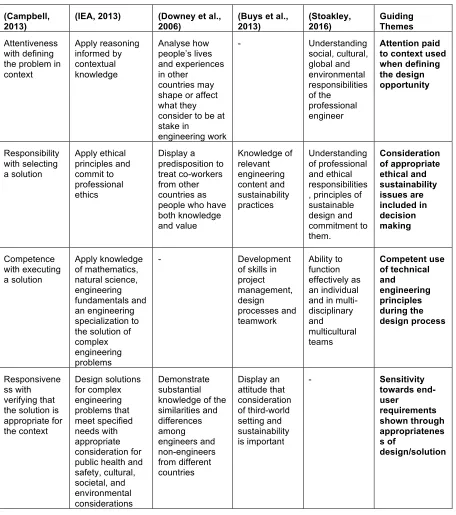
In order to facilitate a structured reflection on the undergraduate engineering project mentioned above a specific focus was required. From investigating existing reflective studies (Sandekian et al., 2014; Tucker et al., 2014; Ravel et al., 2015) it was decided to focus on the development of student competencies, as this is arguably the goal of engineering education, as a way of generating meaningful discussion. While no universally agreed set of competencies for humanitarian engineering is evident in literature there are a number of studies that present competencies. While it is outside of the scope of this paper to look to define a ‘universal set of competencies’ it was important to use current literature to develop a number of competency-based themes with which to guide discussion. A summary of important competencies can be found in Table 1.
Aside from humanitarian engineering, the effectiveness of exposing first year engineering students to project-based-learning is highlighted in a number of articles (Michael et al., 2012; Shekar et al., 2015) and focuses on a range of benefits including the development of critical thinking, ability to solve ill-defined problems, time-management and interpersonal skills such as team work and communication (Kember et al., 2007). Michael et al. (2012) also highlight the use of first year design projects as a way of increasing self-efficacy in engineering students. Self-efficacy is viewed as the confidence, and awareness of, the ability to complete a goal and is well aligned with a number of the characteristics identified by Campbell (2013), such as attentiveness with defining a problem in context.
[image:4.595.67.523.248.763.2]Due to the scope of this article a short summary table will be used to synthesise a number of competencies into the four themes which were used to guide reflective discussion in this study.
Table 1 - Development of guiding themes
(Campbell,
2013) (IEA, 2013) (Downey et al., 2006) (Buys et al., 2013) (Stoakley, 2016) Guiding Themes
Attentiveness with defining the problem in context Apply reasoning informed by contextual knowledge Analyse how people’s lives and experiences in other countries may shape or affect what they consider to be at stake in
engineering work
- Understanding
social, cultural, global and environmental responsibilities of the professional engineer Attention paid to context used when defining the design opportunity Responsibility with selecting a solution Apply ethical principles and commit to professional ethics Display a predisposition to treat co-workers from other countries as people who have both knowledge and value Knowledge of relevant engineering content and sustainability practices Understanding of professional and ethical responsibilities , principles of sustainable design and commitment to them. Consideration of appropriate ethical and sustainability issues are included in decision making Competence with executing a solution Apply knowledge of mathematics, natural science, engineering fundamentals and an engineering specialization to the solution of complex engineering problems
- Development
of skills in project management, design processes and teamwork Ability to function effectively as an individual and in multi-disciplinary and multicultural teams Competent use of technical and engineering principles during the design process Responsivene ss with verifying that the solution is appropriate for the context Design solutions for complex engineering problems that meet specified needs with appropriate consideration for public health and safety, cultural, societal, and environmental considerations Demonstrate substantial knowledge of the similarities and differences among engineers and non-engineers from different countries Display an attitude that consideration of third-world setting and sustainability is important
While Table 1 should not be viewed as an exhaustive collection of proposed student competencies it does highlight the similarities of underlying themes across literature. It should also be noted that many of these competencies are interchangeable and that the direct link between adjacent definitions is merely one way of presenting the research field. As this study focuses on faculty reflections and not on developing a universal definition of the humanitarian engineer the final definitions will be effective in generating discussion.
Methodology
This study utilised the four themes outlined in Table 1 as guidance for a self-moderated reflection session between the three authors of this paper. As each author had experience in coordinating the same first year EWB Design Challenge project, across five years and two campus locations, it was assumed that each author had undertaken experiential learning through observation of students, experience with developing and facilitating content as well as marking of student assessments. This research can therefore be viewed as a micro-ethnographic study in which the researchers act as overt, complete participants in a closed setting, as defined by Bryman (2015). This essentially states the researchers were all known to be researchers, were actively involved in the study environment and that the environment was deemed to be a closed setting due to the insulated nature of university courses.
The three participants are described below:
A – Senior Lecturer in Product Development at Massey University, Albany
B – Associate Professor in Industrial Management and Innovation at Massey University, Palmerston North
C – Lecturer in Product Development at Massey University, Albany
The script was developed with input from all three participants (the authors of this study) and then piloted with a consultant at the Centre for Teaching and Learning, Massey University. From this pilot a number of questions were changed to better enable reflection. Participants were then sent the finalized script, before the reflection session, and were asked to complete the sections independently using any resources deemed helpful (i.e. class schedules, assignments and student log books). This independent stage of reflection was aligned with content-based reflection (Grossman, 2009) and enabled staff to take appropriate time to recall events and to begin to self-critique their contributions to student learning. This again aligns with Hatton and Smith (1995) and the descriptive phase of reflection-on-action. A Likert scale was also used to record the participant’s opinions of the effectiveness of themselves, and the involved teaching team in developing each student competency. This was included purely to aid in discussion during the reflection session and not as a standalone response for analysis.
A self-moderated reflection session was then used to facilitate discussion around each of the themes and the individual reflections previously attempted. This session was guided by the same script and aimed for dialogic reflection to occur naturally through sharing and discussing each participants individual reflections and finally to engage in a critical reflection of each individuals experiences and contributions to the course (Hatton & Smith, 1995). See Appendix 1 for a sample of the script used.
Discussion
This section will use the four previously stated themes as a structure for initial discussion before looking at the findings holistically. While the findings from this study only reflect the three participants involved, they may well shed light on wider issues for future research.
Attention paid to context used when defining the design opportunity
The discussion which occurred under this theme centered on defining the role that the EWB Challenge plays in ‘defining the design opportunity’ and in particular if the Challenge already defines the opportunities for the students. While Participant B stated “EWB are a translator of context into a design problem” and highlighted that the in-country work which EWB do before the challenge is launched is really when the opportunities are defined, Participant C stated that allowing students time at the beginning of the process to research and scope before defining their project was important. With the exact same course running on two campuses, with two different coordinators, there were also some interesting differences in the way the project was introduced. Participant B framed the challenge as if the scoping and discovery phases had been completed by EWB and it was the students’ role to utilise this research in the design project, while Participant C emphasized the discovery and scoping phases as important for students to complete themselves before aligning with a project.
It was agreed that a barrier to students performing their own detailed scoping was the lack of available information specific to the context, and the reliance students placed on either the content provided by EWB or inferences and assumptions from other contexts. This point was further supported by Participant A, who stated “some things you can make assumptions on but not everything, it’s dangerous”. It could be argued this barrier is mitigated by aligning with the process Participant B suggested above as it places emphasis on EWB as the field experts who have firsthand research in context.
While this competency was agreed to be important there was debate about how well this project aligned with its development. The discussion centered on whether defining the opportunity was to be considered as a front-end activity or an iterative process that occurred throughout idea generation and screening. It was agreed that this particular project tended to present the competency in terms of idea generation and screening and less as a front end activity. This was due to the fact that most student teams seemed to refine their opportunity throughout idea generation. Overall the structure of the course played an important role in facilitating this process as a literature review before idea generation forced students into in-depth research of the context and technical area of design.
Consideration of appropriate ethical and sustainability issues are included in
decision making
The EWB challenge was a great tool for the introduction of ethics and sustainability concepts with the triple-bottom-line criteria (TBL) being used to guide meaningful discussions on both campuses. Participant B stated that the teaching team at the Palmerston North campus were experts in this area and as such could deliver effective facilitation in both formal lecturers and informal meetings with students. This sentiment was not fully supported at the Albany campus as a lack of expertise, and potentially motivation, of the involved staff meant the underlying concepts were not delivered effectively. As such Participant C stated that one-on-one sessions with students as well as exercises using examples became the most effective tools for facilitating this competency. Similar Participant C felt some of the student teams did not engage well with TBL content and in turn did not show meaningful considerations in their final design reports. Participant A agreed with the use of examples but highlighted that she “would like more examples of sustainable resources from the relevant context”.
and sustainability during informal interactions with students was also viewed as being both helpful and a function of a cohesive teaching team.
Competent use of technical and engineering principles during the design
process
All participants agreed that this competency was not a focus of the project, and as such was not stated in the learning outcomes for this course. While a lack of time to facilitate this competency was viewed as a barrier Participants A and C agreed that the focus on simple processes and solutions meant students found it easy to apply their current level of technical knowledge. This was further supported through using the students’ other lecturers as expert consultants for workshops aimed at developing their technical solutions.
The skills needed to complete the EWB Challenge were diverse and not necessarily linked to technical knowledge with Participant B commenting that some students are strong in technical papers but “completely different people” when involved in this course. This shift in skillset, from technically focused, to human-centered, seems difficult for some students and can be further restricted by auxiliary staff who provide supervisory advice without fully understanding the socio-economic aspects of the project. One method for addressing some of these barriers was the introduction of external experts, through ‘consultation sessions’ with students. These sessions allowed for student to present their ideas, and implementation plans, to industry engineers who then provided feedback on the feasibility of the project. Both students and engineers seemed to enjoy these interactions with a number of the engineers asking to read or attend the final presentations.
Sensitivity towards end-user requirements shown through appropriateness of
design/solution
Finally, this competency was deemed well supported by the formal structure of the course as the assessment order required students to develop user requirements and use these as input for idea generation, screening, development and implementation. This requirement meant students needed to at least show basic sensitivity towards end-user requirements. Similar to the first reflection theme, Participant B stated that it was the reiteration of importance during informal student meetings that really helped with the development of the competency.
The use of quantitative screening techniques, such as decision matrices, were helpful for guiding students through their first design project at university however Participant C did state that some of the criteria seemed somewhat ‘token’ as no detail about the local community could be found to address the criteria. For example a number of teams had the criteria “must be easy to use for locals” but could not use this to effectively differentiate between concepts during screening.
Key Findings
Through this discussion a number of repeating themes emerged. While some of these focused on the design of formal content, such as assessments, which required students to consider user requirements, others highlighted the importance of informal interactions with students. These interactions, such as group meetings and one-on-one guidance, were used to reiterate key messages about sustainable and human-focused solutions. It was found in a number of situations that informal interactions were perceived as more effective for competency development in this course (for example in the development of sustainability considerations) than traditional lecture-style content delivery.
making’. While only anecdotal the above point does highlight the need for meaningful consideration when recruiting faculty to assist in facilitating this process. While Albany campus auxiliary staff were effective in both project management and in assisting with technical development the same reiteration of TBL and ethics was not present.
Finally all authors agreed that the use of the EWB Design Challenge was an effective way of introducing students to sustainability, ethics and socially focused engineering development as well as aspects of teamwork and project management important for future projects.
Conclusion
In summary this article has aimed to construct an effective reflection tool for use when discussing humanitarian engineering education. The use of the three-level reflection model by Hatton and Smith (1995) was helpful in guiding individual and group reflection. Utilising a number of existing studies in this area (Downey et al., 2006; Buys et al., 2013; Campbell, 2013) a list of four competencies for a humanitarian engineer were synthesised. While not intended to be viewed as universal competencies, the list does highlight some of the differences and similarities in current literature.
This reflective study shows that while technical competencies may not be explicitly developed in the course at Massey University, the focus on simple solutions allows students to use their current technical knowledge effectively. Furthermore the importance of recruiting a cohesive teaching and supervision team, who understand the importance of end user consideration, sustainability and ethics, is critical to supporting the development of the competencies highlighted in this article.
References
Bryman, A. (2015). Social research methods: Oxford university press.
Buys, L., Miller, E., Buckley, M., & Jolly, L. (2013). The “Engineers without Borders” Challenge: does it engage Australian and New Zealand students with sustainability? Paper presented at the Proceedings of Ireland International Conference on Education (IICE-2013).
Campbell, R. C. (2013). How Can Engineering Students Learn to Care? How Can Engineering Faculty Teach to Care? Engineering Education for Social Justice (pp. 111-131): Springer.
Downey, G. L., Lucena, J. C., Moskal, B. M., Parkhurst, R., Bigley, T., Hays, C., . . . Ruff, S. (2006). The globally competent engineer: Working effectively with people who define problems differently. Journal of Engineering Education, 95(2), 107-122.
Dym, C., Agogino, A., Eris, O., Frey, D., & Leifer, L. (2005). Engineering Design Thinking, Teaching, and Learning. Journal of Engineering Education, 103 - 120.
Gilbert, D. J., Held, M. L., Ellzey, J. L., Bailey, W. T., & Young, L. B. (2015). Teaching ‘community engagement’in engineering education for international development: Integration of an interdisciplinary social work curriculum. European Journal of Engineering Education, 40(3), 256-266.
Grossman, R. (2009). Structures for facilitating student reflection. College Teaching, 57(1), 15-22. Hatton, N., & Smith, D. (1995). Reflection in teacher education: Towards definition and
implementation. Teaching and teacher education, 11(1), 33-49.
IEA. (2013). Graduate Attributes and Professional Competencies (Vol. 3): International Engineering Alliance.
Kagaari, J. R. K., & Munene, J. C. (2007). Engineering lecturers' competencies and organisational citizenship behaviour (OCB) at Kyambogo University. Journal of European Industrial Training, 31(9), 706-726.
Kember, D., Leung, D., & Ma, R. (2007). Characterizing learning environments capable of nurturing generic capabilities in higher education. Research in Higher Education, 48(5), 609-632. Michael, J., Booth, J., & Doyle, T. E. (2012). Importance of first-year engineering design projects to
self-efficacy: Do first-year students feel like engineers? Proceedings of the Canadian Engineering Education Association.
Mills, J. E., & Treagust, D. F. (2003). Engineering education—Is problem-based or project-based learning the answer. Australasian Journal of Engineering Education, 3(2), 2-16.
Murray, P., & Horn, R. (2012). A global curriculum and a global working environment. Innovation, Practice and Research in Engineering Education.
Ravel, M. K., Linder, B., Oakes, W. C., & Zoltowski, C. B. (2015). Evolving engineering education for social innovation and humanitarian impact??? Lessons learned across a range of models. Paper presented at the Global Humanitarian Technology Conference (GHTC), 2015 IEEE. Sandekian, R., Chinowsky, P., & Amadei, B. (2014). Engineering for Developing Communities at the
University of Colorado Boulder: A Ten Year Retrospective. International Journal for Service Learning in Engineering, Humanitarian Engineering and Social Entrepreneurship, 62-77. Shekar, A. (2015). Global perspectives: First-year engineering students’ views on social engineering
projects. International Journal of Mechanical Engineering Education, 43(2), 102-109. Shekar, A., Goodyer, J., Drain, A., Iskander, P., & Georgy, M. (2015). Introduction to Needs Analysis
for increasing first year engineering students’ ability in conceptual design. Paper presented at the 26th Annual Conference of the Australasian Association for Engineering Education, Geelong, Australia.
Stein, O. R., & Schmalzbauer, L. (2012). Engineers without borders at Montana State University: Student-Led engagement and transnational collaboration. Journal of Higher Education Outreach and Engagement, 16(3), 187-210.
Stoakley, A. (2016). The Challenge: Innovation for sustainability, access and opportunity. Retrieved from Engineers Without Borders Australia
Tronto, J. C. (1993). Moral boundaries: A political argument for an ethic of care: Psychology Press. Tsang, E. (2002). Use Assessment to Develop Service-Learning Reflection Course Materials. Paper
presented at the Frontiers in Education, 2002. FIE 2002. 32nd Annual.
Appendix 1
Please see below for a sample of one of the competencies used to guide individual reflection and the reflection session.
How well has the development of the student competency ‘attentiveness with using contextual knowledge to define the design opportunity’ been facilitated?
1. Overall (course content and teaching staff)
1=Poor 2=Fair 3=Good 4=Excellent 5=Not sure/not
applicable
Comments:
2. Your individual contribution (experiential input and facilitation)
1=Poor 2=Fair 3=Good 4=Excellent 5=Not sure/not
applicable
Comments:
3. On reflection what do you think worked and didn’t work at both an individual and team level
MASSEY UNIVERSITY
MASSEY RESEARCH ONLINE http://mro.massey.ac.nz/
Massey Documents by Type Conference Papers
Building capability to teach humanitarian
engineering: A reflection
Drain, AR
2016-12-07