City, University of London Institutional Repository
Citation
:
Kyle, F. E. & Cain, K. (2015). A Comparison of Deaf and Hearing Childrenʼs Reading Comprehension Profiles. Topics in Language Disorders, 35(2), pp. 144-156. doi: 10.1097/TLD.0000000000000053This is the accepted version of the paper.
This version of the publication may differ from the final published
version.
Permanent repository link:
http://openaccess.city.ac.uk/13088/Link to published version
:
http://dx.doi.org/10.1097/TLD.0000000000000053Copyright and reuse:
City Research Online aims to make research
outputs of City, University of London available to a wider audience.
Copyright and Moral Rights remain with the author(s) and/or copyright
holders. URLs from City Research Online may be freely distributed and
linked to.
City Research Online: http://openaccess.city.ac.uk/ [email protected]
Kyle F.E., & Cain K. (2015). A comparison of deaf and hearing children's reading comprehension profiles. Topics in Language Disorders, 35, 144–156, doi:
10.1097/TLD.0000000000000053. Available at:
http://journals.lww.com/topicsinlanguagedisorders/Abstract/2015/04000/A_Comparison_of_ Deaf_and_Hearing_Children_s.5.aspx
A comparison of deaf and hearing children’s reading comprehension profiles
Fiona E. Kyle1 and Kate Cain2
1
Dr Fiona E Kyle, Ph.D.
Division of Language and Communication Science, City University London
2
Prof Kate Cain, Ph.D.
Department of Psychology, Lancaster University
Address for correspondence:
Dr Fiona Kyle
Division of Language and Communication Science
City University London
Northampton Square
London
EC1V 0HB
Abstract
Purpose: Although deaf children typically exhibit severe delays in reading achievement, there
is a paucity of research looking at their text level comprehension skills. We present a
comparison of deaf and normally hearing readers’ profiles on a commonly used reading
comprehension assessment: the Neale Analysis of Reading Ability (NARA-II).
Methods: Comprehension questions were coded into three types: literal questions; local
cohesion questions; and global coherence questions. Deaf children were matched to three
groups of hearing children: chronological age matched controls, reading age matched
controls; and a group of poor comprehenders.
Results: Deaf children had significantly weaker reading comprehension skills than both
chronological and reading-age matched controls but their skills were commensurate with
poor comprehenders. All groups found it easier to make inferences to establish local
cohesion than those required to establish global coherence.
Discussion/conclusions: These results suggest that deaf children’s reading comprehension
profiles are remarkably similar to those of poor comprehenders. These findings are discussed
in light of the potential differences in underlying causes of reading difficulties in these two
A comparison of deaf and hearing children’s reading comprehension profiles
The ultimate goal of reading is to understand the meaning conveyed in the text. Large-scale
studies into the reading achievements of deaf children report huge delays between their
comprehension abilities and those of their hearing peers (e.g., Qi & Mitchell, 2011; Wauters,
van Bon & Tellings, 2006). These delays culminate in deaf adolescents leaving school with
reading comprehension levels equivalent to those of nine-year-old hearing children (e.g.,
Allen, 1986; Conrad, 1979; Qi & Mitchell, 2011).
Our aim in this paper is to consider the deaf child’s reading comprehension profile in
relation to another group of children who experience reading comprehension problems, that
is, hearing children whose reading comprehension is unexpectedly poor given their
age-appropriate word reading ability. In order to do this we present a re-analysis of some existing
reading comprehension datasets from deaf and hearing children. We use this comparison to
provide insights into the reasons for deaf children’s literacy difficulties and the sources of
support needed by deaf readers to achieve their full educational potential.
Deaf children exhibit reading problems across multiple aspects of reading, including
word recognition, decoding, sentence-level processing, and text comprehension. The Simple
View of Reading (Gough & Tunmer, 1986) provides a useful framework for considering the
deaf reader’s profile in relation to other groups with reading difficulties. According to this
framework, reading comprehension is the product of word decoding skills and listening
comprehension. As a result, reading comprehension can fail because of poor word decoding,
poor listening comprehension, or weaknesses in both components. Deaf children typically
present with difficulties in both components of the reading process. As a result, their poor
because children with slow, inaccurate, or inefficient word reading have fewer cognitive
resources available to devote to the processing of the text for meaning (Perfetti, 1985).
The reading profile of children who are deaf can be contrasted with a group of hearing
children often referred to as poor comprehenders. These are children who lag behind their
typically developing peers in terms of reading comprehension skills (Cain & Oakhill, 2006).
An important distinction between these two groups is that poor comprehenders usually have
age appropriate word-level reading skills and demonstrate specific delays at the text
comprehension level, whereas deaf children’s reading difficulties are not confined simply to
reading comprehension. By matching groups of good and poor comprehenders for word
reading age, poor word reading has been ruled out as the source of poor comprehenders’
difficulties with text (e.g., Cain & Oakhill, 1999; Cain, Oakhill, Barnes, & Bryant, 2001;
Oakhill, 1984, ). In addition, children with unexpectedly poor reading comprehension also
have poor listening comprehension, a further indication that word reading difficulties are not
the source of their failure to fully comprehend what they read (Cain, Oakhill, & Bryant,
2000).
Although deaf children’s poor reading attainment is extremely well documented (e.g.,
Conrad, 1979; Kyle & Harris, 2010; Wauters et al., 2006) there is comparatively little
research looking in detail at their text comprehension skills. Most of the large scale surveys
that have looked at reading comprehension as the outcome have tended to simply document
attainment gaps rather than detail where specific difficulties lie (e.g. Allen, 1986; Conrad,
1979), and most of the small-scale experimental reading research has focused at the word
level and on the role of phonological skills (e.g., Colin, Magnan, Ecalle, & Leybaert, 2007;
Dyer, MacSweeney, Szczerbinski, & Green, 2003). It is well known that deaf children have
problems with fundamental skills that will affect word recognition, such as phonology and
skills that influence sentence comprehension, such as syntax and grammar (e.g. Bishop, 1983;
Kelly, 1996; Lillo-Martin, Hanson, & Smith, 1991). As noted, because deaf children
demonstrate poor word reading, it is plausible to expect that their reading comprehension
skills will also be poor because they will devote their cognitive resources to word processing
rather than the higher-level integrative skills that aid reading for meaning (Perfetti, Stafura, &
Adlof, 2013).
An interesting question is whether deaf children have reading comprehension skills
that are appropriate for their word reading level. The few studies that have included measures
of both word reading and text comprehension have found, perhaps unsurprisingly, that the
most severe reading delays are usually exhibited in reading comprehension (Kyle & Harris,
2010; Harris & Moreno, 2006). Several authors (e.g. Merrills, Underwood, & Wood, 1994;
Vermeulen, van Bon, Schreuder, Knoors & Snik, 2007; Wauters et al, 2006) argue that deaf
children’s reading comprehension delays are not simply a consequence of their poor visual
word recognition skills. For example, both Wauters et al. (2006) and Vermeulen et al. (2007)
reported that visual word recognition scores (from lexical decision tasks) only accounted for
between 32% and 52% of the variation in reading comprehension skills in deaf children with
and without cochlear implants. However, it is important to note that visual word recognition
skills and word level reading ability are not the same thing. Therefore, investigating the role
of visual word recognition in deaf children’s reading comprehension ability is different from
examining whether deaf children’s reading comprehension skills are appropriate for their
word reading level. To the best of our knowledge, no previous studies have addressed the
explicit aim to answer this question in deaf children, that is do deaf children have reading
comprehension skills that are appropriate for their word reading level? Further, the huge
heterogeneity in deaf children’s reading and comprehension levels makes it difficult to know
Successful reading comprehension results in a coherent and integrated representation
of the state of affairs described in the text. Much of the information that a reader needs to
understand a text is explicitly stated. Comprehension of this information requires the reader
to access the word meanings and syntactic structure of the individual sentences, but does not
require additional processing. However, not all information is explicitly stated in text and,
more often than not, the reader must be able to understand and make sense of information
that is stated only implicitly. The process that enables this is inference making. There are
different types of inferences that readers are required to make. Readers make inferences
when they combine or integrate the meanings of different propositions in the text. Consider
the following example: ‘Tom loved his new pet. The puppy was very playful’ (inference: the
new pet was the puppy). This type of inference is known as a local cohesion inference.
Inferences can also require readers to bring their external knowledge (that is general
knowledge and vocabulary knowledge) to understand fully the text, for example: ‘The
children paddled in the warm water and built sandcastles. When the light started to fade, they
packed up their things and went home.’ (inference: the setting of the story is the beach). This
type of inference is known as a global coherence inference.
Studies of hearing poor comprehenders suggest that one of the main causes of their
text level reading difficulties are poor inference making skills: they make fewer inferences
than same-age good comprehenders matched for word reading ability (Cain & Oakhill, 1999;
Cain et al., 2001; Oakhill, 1984).
Research examining deaf children’s ability to make inferences when reading text is
fairly scarce and it is even more limited concerning deaf children of primary-school age. The
handful of studies that have examined deaf individuals’ inference making skills have found
that they tend to experience greater difficulties when processing inferential information than
1998). The main areas of interest have been the comparison of deaf and hearing individuals
and the processing of literal information contrasted with the processing of information that
must be inferred. Doran and Anderson (2003) found that deaf adolescents could make causal
inferences when reading passages for comprehension but they were poorer than a group of
hearing adolescents broadly matched for chronological age. Children were required to read a
short passage and then asked a simple yes or no question to test their comprehension of the
passage. Their accuracy and reading rate were virtually identical regardless of whether the
information that the comprehension question was testing was stated explicitly or implicitly
(therefore requiring an inference) (79% vs. 80% correct). Unfortunately, interpretation of the
results from this study are constrained by the small sample size (n = 20), the considerable age
range of the deaf participants (12 through to 18 year olds), and the limited testing format.
Similarly, Davey, LaSasso and Macready (1983) reported that deaf 12- to
18-year-olds made fewer correct inferences when reading passages for comprehension than a group of
hearing children matched for approximate reading comprehension levels. The students were
asked to read a series of passages and to answer four literal and four inferential questions
about each passage. Based upon the authors’ description of the inferential questions, the
questions required inferences to be made at the level of text cohesion. They were not
designed to assess world knowledge, the purpose, tone or mood of the stories, or the authors’
point of view, which would have required global coherence inference. It should be noted
that, although the groups were matched for reading comprehension ability, the deaf
participants were less accurate on both literal and inferential questions than the hearing.
In the largest study of inferential skills in deaf children to date, Walker, Munro and
Rickards (1998) sampled 195 severely and profoundly deaf children aged between 9-19
years. They found that deaf children were more accurate on literal questions than inferential
level. Poor deaf readers struggled more with inferential questions but there was no difference
between performance on literal and inferential questions in deaf children with average or
above average reading skill. In contrast, Pinhas (1991) found that even relatively skilled deaf
readers were slower and less accurate when answering inferential questions compared to
literal questions about a text. However, although they were slower than reading-grade
matched hearing peers when answering inferential questions, the skilled deaf readers did not
differ in accuracy. Unfortunately, the author did not provide any information about the types
of inferential questions that were asked, so it is not known if they required local cohesion
inferences or global coherence inferences to be made.
The evidence suggests that deaf children can draw inferences from text but generally
do so less efficiently than hearing children. However, due to the comparatively lenient
matching methods, it is not clear whether their inference making skills are necessarily poorer
than would be expected for their reading level or whether their inference making skills are in
fact appropriate for their word reading ability. The lack of studies with a primary school-age
sample limits our understanding of inference making in that age group. More importantly,
little is known about deaf children’s performance across different types of inference
questions. We wanted to know whether deaf children would find particular types of
inferences harder than others. More specifically, we asked, can deaf children make both local
cohesion inferences at the text level and global coherence inferences requiring knowledge
beyond the text? We hypothesized that, given deaf children’s well documented language
delays (e.g. Kyle & Harris, 2010; Musselman, 2000; Paul, 1996), their ability to make global
coherence inferences and integrate world information with the information in the text might
be particularly impaired compared to local cohesion inferences.
Unlike research with hearing children, where studies have carefully matched groups
abilities, no equivalent studies have been conducted with deaf children. Research is needed
comparing the reading comprehension abilities and inference making skills of deaf children
to hearing children who have been stringently matched for chronological age, word reading
level or reading comprehension. In the current study we sought to close this gap by
re-analysing some existing datasets in order to investigate deaf children’s reading
comprehension and inference making skills. The following research questions were
addressed: (1) Are deaf children’s comprehension skills consistent with their word reading
ability? (2) Can deaf children draw inferences from text and do they show a similar profile to
hearing children across different types of comprehension questions; specifically, do they have
greater problems with global coherence inferences than with local cohesion inferences? and
(3) Are deaf children’s reading comprehension profiles similar to profiles for hearing poor
comprehenders?
Method
Participants
Forty-seven 10- and 11-year-old deaf children participated in the current study (mean
age 10 years 11 months, SD=6.48; 25 males). They all had a severe or profound hearing loss
greater than 85db in the better ear and fifteen of them were fitted with cochlear implants. The
mean age of implantation was 42 months (SD = 15.1). The remaining 32 children wore
digital hearing aids and the mean age of amplification was 19 months (SD = 17.8). The
children had a range of language backgrounds: seventeen preferred to communicate through
spoken language, 25 preferred to use sign language (British Sign Language or Sign Supported
English), and five used a combination of both. They were educated in five deaf schools and
eleven hearing impaired units attached to mainstream schools. The data for the deaf children
Coleman, and MacSweeney (2013), and Kyle, MacSweeney, Mohammed and Campbell
(2009).
The deaf children were matched to two groups of typically developing hearing
children: (1) a chronological-age match control group; and (2) a word reading-age match
control group. The chronological-age match group consisted of nineteen 10- and 11-year-old
children (mean age = 10 years 10 months, SD = 7.37; 7 males). The word reading-age match
control group consisted of 47 typically developing children ranging in age from 5 to 11 years
old (mean age = 7 years 9 months, SD = 13.0; 18 males). Children in the deaf and word
reading-age match (hearing) group were matched on a one-to-one basis for word reading
accuracy on the Neale Analysis of Reading II (NARA II; Neale, 1997) (t(92) = -0.19, ns, d =
0.04). As expected, the deaf children were significantly older than this control group (t(92) =
18.23, p<.001, d = 3.76). The data for these two groups of typically developing hearing
children were taken from studies reported in Cain and Oakhill (2006), Kyle et al. (2009),
Silva and Cain (in press), and an unpublished dataset.
A subset of the deaf children (n=27) also was matched to a group of poor
comprehenders for reading comprehension ability (n=27). The poor comprehenders had a
delay of at least 6 months between their word reading accuracy and reading comprehension,
and their reading comprehension was significantly lower than expected for their
chronological age (mean chronological age = 8 years 2 months, SD = 7.56; mean
comprehension age = 7 years 2 months, SD = 8.44; t(26) = 7.73, p < .001, d = 2.10). The two
groups were matched individually on a one-to-one basis for reading comprehension ability
(t(52) = 0.42, ns, d = 0.09). The mean age for the subset of deaf children was 10 years 10
months (SD = 6.84; 14 males) and the hearing poor comprehenders ranged in age from 7
years 3 months to 10 years 2 months (mean age = 8 years 2 months, SD = 7.56; 15 males).
by Cain and Oakhill (2006) and Silva and Cain (in press), and who were represented in an
unpublished dataset.
Materials
All children had completed the Neale Analysis of Reading II (NARA II; Neale, 1997).
It is a standardized assessment of word reading accuracy and reading comprehension. They
read aloud a series of short story passages (up to six) of increasing difficulty and were asked
to answer open-ended comprehension questions after each passage. The comprehension
questions are a mixture of literal and inferential questions, including questions that require
both local cohesion inferencing and global coherence inferencing. Children receive a
separate score for reading accuracy (word reading) and reading comprehension. As detailed
in the manual for the test, children were only asked the relevant comprehension questions if
they made less than fifteen errors whilst reading the passage.
Procedure
All children were individually tested in a quiet room at school. Ethical approval had
been granted by the relevant university ethics committees and parental permission was
received for all participating children. The NARA II was administered according to the
manual guidelines for the hearing children. The only modifications that were made for the
deaf children were that instructions and comprehension questions were delivered in their
preferred communication method, and they were allowed to read the stories and answer the
comprehension questions in their preferred communication (e.g. spoken English, British Sign
Language or a combination of the two). To generate a word reading score, deaf children
were asked to read aloud the stories in their preferred communication method, e.g. read it
aloud in spoken English, produce a translation of it in BSL or use a combination of the two.
Similarly, the test administrator asked the comprehension questions in the child’s preferred
into English. This is a well-established method of administering this type of test to deaf
children.
We categorized the comprehension questions for the first three stories from the
NARA II into three types: literal questions, and two sub-types of inferential questions-local
cohesion and global coherence. There were 20 questions in total. Four questions were
categorized as literal questions, because they assessed memory for information that was
explicitly stated in the text. Ten questions were categorized as local cohesion inferential
questions, because they required inferences to be made at the text level, either pronoun
resolution for sentence integration or interpreting a synonym between question and text. The
remaining six questions were categorized as global coherence inferential questions and
required the reader to incorporate general knowledge with the story to understand an event or
emotional response. The authors plus an additional third rater independently categorized the
questions into the three types and discussed any differences before agreeing on the final
categorisation. The initial agreement between the two authors was .80.
Results
The results addressing the three research questions are presented in turn, below. The
first asked about relationships of comprehension and word reading ability; the second about
similarities in profiles for different types of inferential questions; and the third about
similarities between profiles for deaf children and hearing poor comprehenders.
Question 1. Are deaf children’s comprehension skills consistent with their word reading
ability?
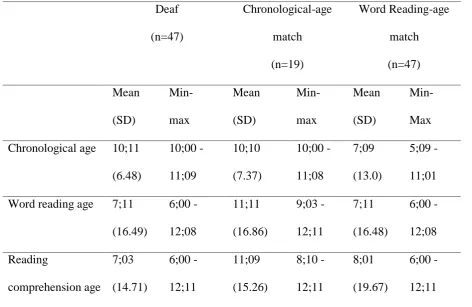
Themeans and standard deviations for the reading scores of the three groups are
presented in Table 1. In comparison with the chronological age-match hearing controls, the
reading comprehension t(63) = -13.19, p < .001, d = 3.59). As reported in the methods
section, the deaf children were matched to the other hearing control group for word reading
accuracy, so the two groups did not differ on that measure (t(52) = 0.42, ns, d = .09).
However, when compared to this younger (hearing) group, a significant difference in reading
comprehension was evident: the deaf children had significantly poorer reading
comprehension than the word reading-age match group (t(92) = -2.77, p = .007, d = 0.57).
Clearly, the deaf children’s comprehension skills were not appropriate for either their
chronological age or their level of word reading skill.
Question 2. Can deaf children draw inferences from text and do they show a similar
profile to hearing children across different types of comprehension questions?
This second research question concerned deaf children’s comprehension profiles
across the three different types of comprehension questions, with particular interest in the two
types of inferential questions. We again compared the deaf children’s comprehension profiles
with those of both chronological-age and word reading-age controls. However, this analysis
was conducted with a smaller subset of children from each group who had each answered the
comprehension questions for the first three stories (deaf n = 33; chronological-age controls n
= 19; reading-age controls n = 33). Children who had answered questions only for one or two
of the passages were excluded from this analysis. In this way, we could compare
comprehension performance across the same set of stories (see Cain, Oakhill, & Bryant,
2000, for a similar approach). The reading age controls and deaf children were again matched
on a one-to-one basis.
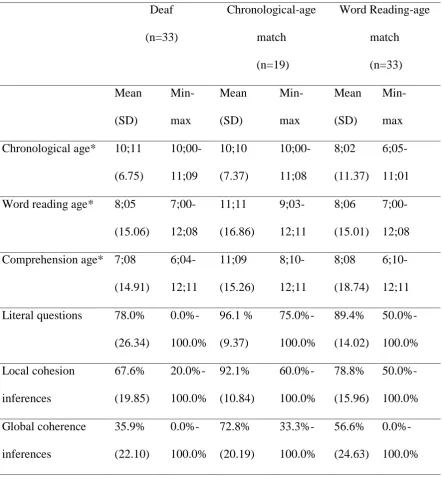
The characteristics of this smaller sample of deaf children and the two controls groups
and also the performance for each group are reported in Table 2. A two-way ANOVA
Each group differed significantly from each other (all ps < .05) in the following order: the
chronological-age control group achieved the highest scores, followed by the reading-age
control group and then the deaf children. There was also a main effect of question type,
F(1.8, 164) = 79.64, p<.001 (the exact degrees of freedom are reported as sphericity was not
assumed). This arose because children were most accurate on the literal questions and least
accurate on the global coherence inference question. There was no significant interaction
between group and question type, F(3.5, 164) = 2.14, ns. The lack of an interaction
demonstrates that all three groups showed a similar profile across the three different question
types. Critically, the deaf children were able to make both local and global inferences, but
they were significantly poorer at doing so than both chronological and word reading-age
controls.
Are deaf children’s reading comprehension profiles similar to hearing poor
comprehenders?
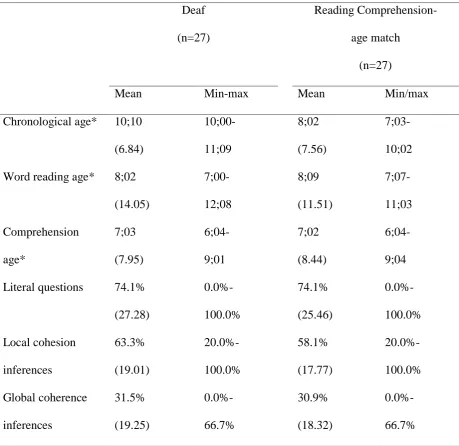
In order to address this third research question, a smaller subset of deaf children was
compared with a group of hearing poor comprehenders matched on reading comprehension
level (t(52) = 0.42, ns, d = 0.09). Table 3 shows the mean and standard deviations for the
group characteristics and performance across the three question types.
A two-way ANOVA revealed a main effect of question type, F(2,104) = 59.77,
p<.001 ηp² = 0.53, whereby children in all three groups were more accurate on
comprehension questions that required literal answers rather than inferential, and were also
more accurate on inferential questions that required drawing local cohesion inferences rather
than global coherence inferences. There was no main effect of group, F(1,52) = 0.29, ns, ηp²
= 0.01 and there was no significant interaction, F(2,104) = 0.25, ns, ηp² = 0.01. Deaf
showed an almost identical pattern of performance across the different comprehension
question types.
Effects of background factors on reading comprehension in deaf children
The deaf children were a heterogeneous group in terms of their mode of amplification,
degree of hearing loss, and preferred mode of communication. The data were examined to see
what impact these factors had on their levels of reading comprehension. There was no
significant difference in reading comprehension ability between deaf children with cochlear
implants and those with digital hearing aids, t(17) = -1.62, ns. Likewise, there were no
significant differences between deaf children with severe hearing losses rather than profound
hearing losses, t(45) = 0.62, ns. There was a significant within-group difference between
children in terms of their preferred communication mode; children who preferred to
communicate through spoken language had higher reading comprehension scores (t(20) =
2.92, p = .009) than children who communicated through sign language or a combination of
spoken and signed language. However, these results should be interpreted with caution as the
subgroups were fairly unequal in numbers and the classification for the preferred mode of
communication was rather rudimentary.
Discussion
This secondary data analysis provided a unique opportunity to examine the reading
comprehension profiles and inference-making skills of deaf children. Critically, it enabled us
to determine if the deaf children’s comprehension and inference skills were weaker than
would be expected given their word reading age. Unsurprisingly, the deaf children had
weaker reading comprehension skills than hearing children matched for chronological age;
however, they also were less accurate in answering comprehension questions than younger
hearing children matched for word reading ability. On the other hand, the deaf children’s
comprehender profile. Taken together, these findings suggest that deaf children’s poor
reading comprehension is not in line with their word reading accuracy and that their reading
comprehension difficulties cannot simply be attributed to difficulties at the word reading
level. We discuss the theoretical implications of these findings first, followed by the
educational implications.
An important contribution of this work is the finding that deaf children’s poor reading
comprehension is not wholly attributable to their weak word reading skills. Poor reading
comprehension in hearing children has been attributed to a lack of resources available for
higher-level comprehension processing caused by a bottleneck in the system due to poor
word reading (Perfetti, 1985). That explanation was not supported by these results for the
deaf children. Instead, our analysis indicates that deaf children are more likely to have both
poor word reading and poor reading comprehension, which might be attributed to separate
sources of underlying difficulty. This profile is in line with the simple view of reading, in
which the independent influences of word reading and listening comprehension combine to
determine reading comprehension (Gough, Hoover, & Peterson, 1996).
Our analysis of performance on the different question types provides a unique insight
into the strengths and weaknesses of deaf children’s comprehension. First, it is important to
note that the deaf children did more poorly on all question types: literal, local cohesion
inferences, and global coherence inferences. The findings reveal that deaf children can make
both local cohesion inferences and global coherence inferences when reading text, but they
are less efficient than hearing children matched for either chronological age or word reading
age. Deaf children’s comprehension skills do not appear to be qualitatively different from that
of hearing children: All three groups showed the same profile of performance across the
different comprehension questions, with accuracy highest on the literal questions, followed
with previous findings from studies with deaf adolescents (Doran, 2003; Pinhas, 1991;
Walker et al, 1998). Our results extend findings to younger deaf children and across different
types of inference making skills. Further, by careful pairwise matching of the deaf children to
a hearing poor comprehenders, we were able to show that the deaf child’s comprehension
profile is almost identical to that of a poor comprehender.
Poor comprehenders’ difficulties with inference-making have been related to poor
working memory (Cain, Oakhill, & Lemmon, 2004) rather than poor memory for the text
(Cain & Oakhill, 1999; Oakhill, 1984), particularly when processing demands of the task are
high (Cain et al., 2004). Deaf children typically have poorer short-term memory and working
memory spans than their hearing peers (e.g. Campbell & Wright, 1990; Harris & Moreno,
2004). Specific working memory problems that have been identified include slower subvocal
rehearsal and issues concerning the phonological loop (e.g. Burkholder & Pisoni, 2003;
Pisoni & Cleary, 2003). Short term memory and working memory skills have been found to
be predictive of individual differences in reading ability in deaf children (e.g. Daneman,
Nemeth, Stainton, & Huelsmann, 1995; Geers, 2003; Harris & Moreno, 2004), although it
should be noted that stronger relationships tend to be reported in teenagers rather than
younger deaf children, as in the current study. Thus, further research is needed to clarify the
underlying mechanisms between working memory and reading comprehension in deaf
children and to determine the possible impact of working memory on their inference-making
skills.
Another factor that we need to consider is world knowledge (see Jackson, Paul &
Smith, 1997). Clearly, general knowledge, including critical vocabulary skills, is important
for some types of inference, particularly the global coherence inferences in this study (Cain &
Oakhill, in press). It is well established that many deaf children have severe language delays
2000). Previous research has established that deaf children typically have poorer expressive
and receptive vocabulary skills than their hearing peers (Geers & Moog, 1989; Kyle &
Harris, 2006, 2011; and see Lederberg, Schick, & Spencer, 2013, for a review) and language
skills, including vocabulary knowledge, are the strongest and most consistent predictor of
reading ability in deaf children (Easterbrooks, Lederberg, Miller, Bergeron & Connor, 2008;
Hermans, Knoors, Ormel, & Verhoeven, 2008; Kyle & Harris, 2010, 2011). Moreover,
language skills accounted for 35% of the variance in deaf reading ability in a recent
meta-analysis (Mayberry, del Giudice & Lieberman, 2011).
It is possible that deaf children’s poor language skills are an additional source of their
inference-making difficulties, and indeed, deaf children who exhibit a poor comprehender
profile could in fact be those with weaker vocabulary and language skills. Unfortunately, we
were not able to determine the effect of poor language skills in the current study, as
vocabulary data were not available for all the deaf children. As both working memory and
language skills are known to affect typically-developing hearing children’s reading
comprehension abilities, and deaf children usually exhibit deficits in both these skills, future
studies should investigate the impact of both weak memory and vocabulary on deaf
children’s comprehension ability as these may identify interesting and important predictors of
reading comprehension outcomes.
Our analysis demonstrates that not only do deaf children have weak word reading
skills, but they also have weak reading comprehension. The pattern of performance was
similar to that of the poor comprehenders; however, we note two critical differences between
the two groups. First, the deaf readers were two years older than the reading
comprehension-age match group. Second, in light of deaf children’s typically significant langucomprehension-age delays, it
language than the deaf children. Thus, it is not clear if the poor inference skills in each group
arose for the same or different reasons (Cain et al., 2004; Nation & Snowling, 1999).
To take these ideas forward, we recommend the comparison of inference-making
skills of deaf and hearing children matched for language ability to determine if the groups
show same or different reading comprehension profiles. Matching deaf and hearing children
on language ability would provide a means to investigate the effect of deaf children’s
language delay upon their reading comprehension and particularly upon their inference
making skills. It is plausible that deaf children might show similar inference-making skills
and reading comprehension levels to hearing children matched for language ability.
A limitation of the current study is that we compared deaf and hearing children’s
performance on a well-known test of reading comprehension rather than on a
purpose-designed test. This meant there were not equal numbers of the different question types,
because this was not a feature of that test. Despite this, the results are quite clear. They
suggest that deaf children’s comprehension skills are delayed in comparison with their word
reading accuracy, and they are remarkably similar to poor comprehenders. At first glance, the
finding that deaf children and poor comprehenders were similar could be considered
relatively unsurprising as these two groups were matched for comprehension levels.
However, in spite of the two groups being matched for overall comprehension scores, it was
possible that they could show a different profile across different question types and still
achieve the same overall score. For example, because deaf children typically have language
challenges, it was unknown whether they would be particularly impaired on the global
coherence questions compared to the poor comprehenders. Further research with a specially
controlled reading assessment, where the texts are written to support particular
comprehension question types rather than categorizing the types, is needed to investigate this
The current study focused on inferencing skills in deaf children and while these are
known to be very important for reading comprehension, they are not the only skills known to
be impaired in children with poor reading comprehension. Future studies should investigate
the role of story structure and text monitoring to uncover the role that these skills may play in
deaf children’s reading comprehension difficulties. Certainly, these other higher-level
language skills are weak in hearing poor comprehenders (Cain, 1996; Cain & Oakhill, 2006;
Oakhill, Hartt, & Samols, 2005).
Several educational implications stem directly from these findings. Teachers should
be aware that the reading comprehension difficulties experienced by deaf children may not be
always or wholly attributable to their word reading difficulties; rather, our findings
demonstrate that comprehension might be poorer than predicted from word reading skills. A
direct consequence of this finding is the need to examine both word reading and reading
comprehension for stories that are within the child’s word reading ability to determine if this
is the case. In addition, while our findings demonstrate that deaf children can draw inferences
from text, it should be noted that they were especially poor at integrating outside knowledge
with information in the text. Deaf children are therefore likely to benefit from guidance when
answering these particular types of questions to help them utilize more efficient
comprehension strategies and encourage them to incorporate different sources of information.
In summary, we have shown that deaf children’s reading comprehension is similar in
profile to that of the well-documented difficulties of poor comprehenders. Critically, their
reading comprehension is poorer than would be expected given their word reading level, and
their inference making is weak. We note that these findings need to be replicated, in
particular with bespoke materials constructed specifically to assess inference making.
However, this study provides clear avenues for future research that we believe will lead to
References
Allen, T. E. (1986). Patterns of academic achievement among hearing impaired students:
1974 and 1983. In A. N. Schildroth & M. A. Karchmer (Eds.), Deaf children in
America (pp. 161- 206). San Diego, CA: College-Hill Press.
Bishop, D. V. M. (1983). Comprehension of English syntax by profoundly deaf children.
Journal of Child Psychology and Psychiatry, 24(3), 415-434.
Burkholder, R. A., & Pisoni, D. B. (2003). Speech timing and working memory in
profoundly deaf children after cochlear implantation. Journal of Experimental Child
Psychology, 85(1), 63-88.
Cain, K. (1996). Story knowledge and comprehension skill. In C. Cornoldi & J. Oakhill
(Eds.), Reading comprehension difficulties: processes and remediation (pp. 167-192).
Mahwah, NJ: LEA.
Cain, K., & Oakhill, J. V. (1999). Inference making and its relation to comprehension failure.
Reading and Writing. An Interdisciplinary Journal, 11, 489-503.
Cain, K., & Oakhill, J. (2006). Profiles of children with specific reading comprehension
difficulties. British Journal of Educational Psychology, 76, 683-696.
Cain, K., & Oakhill, J. (in press). Reading comprehension and vocabulary: Is vocabulary
more important for some aspects of comprehension? L'Année psychologique.
Cain, K., Oakhill, J. V., Barnes, M. A., & Bryant, P. E. (2001). Comprehension skill,
inference making ability and their relation to knowledge. Memory and Cognition, 29,
850-859.
Cain, K., Oakhill, J., & Bryant, P. E. (2000). Investigating the causes of reading
comprehension failure: The comprehension-age match design. Reading and Writing,
Cain, K., Oakhill, J., & Lemmon, K. (2004). Individual differences in the inference of word
meanings from context: the influence of reading comprehension, vocabulary
knowledge, and memory capacity. Journal of Educational Psychology, 96, 671-681.
Campbell, R., & Wright, H. (1990). Deafness and immediate memory for pictures:
Dissociations between ‘‘inner speech’’ and the ‘‘inner ear’’? Journal of Experimental
Child Psychology, 50, 259–286.
Colin, S., Magnan, A., Ecalle, J., & Leybaert, J. (2007). Relation between deaf children’s
phonological skills in kindergarten and word recognition performance in first grade.
Journal of Child Psychology and Psychiatry, 48, 139-146.
Conrad, R. (1979). The Deaf School Child: Language and Cognitive Function. London:
Harper & Row.
Daneman, M., Nemeth, S., Stainton, M., & Huelsmann, K. (1995). Working memory as a
predictor of reading achievement in orally educated hearing-impaired children. Volta
Review, 97, 225–241.
Davey, B., LaSasso, C., & Macready, G. (1983). Comparison of reading comprehension task
performance for deaf and hearing readers. Journal of Speech and Hearing Research,
26, 622-628.
Doran, J., & Anderson, A. (2003). Inferencing skills of adolescent readers who are hearing
impaired. Journal of Research in Reading, 26(3), 256-266.
Dyer, A., MacSweeney, M., Szczerbinski, M., & Green, L. (2003). Predictors of reading
delay in deaf adolescents: the relative contributions of rapid automatized naming
speed and phonological awarenesss and decoding. Journal of Deaf Studies and Deaf
Easterbrooks, S.R., Lederberg, A.R., Miller, E.M., Bergeron, J.P., & Connor, C.M. (2008).
Emergent literacy skills during early childhood in children with hearing loss:
Strengths and weaknesses. The Volta Review, 108(2), pp. 91-114.
Geers, A. E. (2003). Predictors of reading skill development in children with early cochlear
implantation. Ear and Hearing, 24(1), 59S-68S.
Geers, A., & Moog, J. (1989). Factors predictive of the development of literacy in profoundly
hearing-impaired adolescents. The Volta Review, 91, pp. 69-86.
Gough, P. B., Hoover, W. A., & Peterson, C. L. (1996). Some observations on a simple view
of reading. In C. Cornoldi & J. Oakhill (Eds.), Reading comprehension difficulties:
Processes and interventions (pp. 1-13). Mahwah, NJ: Erlbaum.
Gough, P.B., & Tunmer, W.E. (1986). Decoding, reading, and reading disability. Remedial
and Special Education, 7(1), pp. 6-10.
Harris, M., & Moreno, C. (2004). Deaf children's use of phonological coding: evidence from
reading, spelling and working memory. Journal of Deaf Studies and Deaf Education,
9(3), 253-268.
Hermans, D., Knoors, H., Ormel, E., & Verhoeven, L. (2008a). The relationship between the
reading and signing skills of deaf children in bilingual education programs. Journal of
Deaf Studies and Deaf Education, 13(4), pp. 518-530.
Jackson, D. W., Paul, P. V., & Smith, J. C. (1997). Prior Knowledge and Reading
Comprehension Ability of Deaf Adolescents. Journal of Deaf Studies and Deaf
Education, 2(3), 172-184.
Kelly, L. P. (1996). The interaction of syntactic competence and vocabulary during reading
by deaf students. Journal of Deaf Studies and Deaf Education, 1(1), 75-90.
Kyle, F.E., Campbell, R., Mohammed, T., Coleman, M., & MacSweeney, M. (2013).
Child Speechreading. Journal of Speech, Language and Hearing Research, 56(2), pp.
416-426.
Kyle, F.E., & Harris, M. (2006). Concurrent Correlates and Predictors of Reading and
Spelling Achievement in Deaf and Hearing School Children. Journal of Deaf Studies
and Deaf Education, 11(3), 273-288.
Kyle, F.E., & Harris, M. (2010). Predictors of reading development in deaf children: A 3-year
longitudinal study. Journal of Experimental Child Psychology, 107(3), pp. 229-243.
Kyle, F. E., & Harris, M. (2011). Longitudinal Patterns of Emerging Literacy in Beginning
Deaf and Hearing Readers. Journal of Deaf Studies and Deaf Education, 16(3),
289-304.
Kyle, F., MacSweeney, Mohammed, T., & Campbell, R. (2009). The development of
speechreading in deaf and hearing children: introducing a new Test of Child
Speechreading (ToCS). Proceedings of the eighth International Conference on
Auditory-Visual Speech Processing (AVSP2009) (pp.28-31), Norwich, UK,
September.
Lederberg, A. R., Schick, B., & Spencer, P. E. (2013). Language and literacy development of
deaf and hard-of-hearing children: Successes and challenges. Developmental
Psychology, 49(1), 15-30.
Lillo-Martin, D. C., Hanson, V. L., & Smith, S. T. (1991). Deaf readers' comprehension of
complex syntactic structure. In D. S. Martin (Ed.), Advances in Cognition, Education,
and Deafness (pp. 146-151). Washington, DC.: Gallaudet University Press.
Mayberry, R.I., del Giudice, A.A., & Lieberman, A.M. (2011). Reading achievement in
relation to phonological coding and awareness in deaf readers: A meta-analysis.
Merrills, J. D., Underwood, G., & Wood, D. J. (1994). The word recognition skills of
profoundly, prelingually deaf children. British Journal of Developmental Psychology,
12, 365-384.
Musselman, C. (2000). How do children who can't hear learn to read an alphabetic script? A
review of the literature on reading and deafness. Journal of Deaf Studies and Deaf
Education, 5(1), pp. 9-31.
Nation, K., & Snowling, M. J. (1999). Developmental differences in sensitivity to semantic
relations among good and poor comprehenders: Evidence from semantic priming.
Cognition, 70, 81- 83.
Neale, M. D. (1997). The Neale analysis of reading ability II (NARA II). Windsor, Berks:
NFER-Nelson.
Oakhill, J. (1984). Inferential and memory skills in children's comprehension of stories.
British Journal of Educational Psychology, 54, 31-39.
Oakhill, J., Hartt, J., & Samols, D. (2005). Levels of comprehension monitoring and working
memory in good and poor comprehenders. Reading and Writing, 18, 657-713.
Paul, P. V. (1996). Reading vocabulary knowledge and deafness. Journal of Deaf Studies
and Deaf Education, 1(1), 3-15.
Perfetti, C. A. (1985). Reading Ability. New York: Oxford University Press.
Perfetti, C. A., Stafura, J. Z., & Adlof, S. M. (2013). Reading comprehension and reading
comprehension problems: a word-to-text integration perspective. In B. Miller, L. E.
Cutting & P. McCardle (Eds.), Unravelling reading comprehension: behavioral,
neurobiological, and genetic components (pp. 22-32). Baltimore: Paul Brookes
Pinhas, J. S. Constructive processing in skilled deaf and hearing readers. In D. S. Martin
(Ed.), Advances in cognition, education, and deafness (pp. 296-301). Washington,
DC.: Gallaudet University Press.
Pisoni, D. B., & Cleary, M. (2003). Measures of working memory span and verbal rehearsal
speed in deaf children after cochlear implantation. Ear and Hearing, 24(1), 106S-
120S.
Qi, S., & Mitchell, R.E. (2011). Large-scale academic achievement testing of deaf and
hard-of-hearing students: Past, present, and future. Journal of Deaf Studies and Deaf
Education, 17(1), pp. 1-18.
Silva, M. T., & Cain, K. (in press). The relations between lower- and higher-level oral
language skills and their role in prediction of early reading comprehension.
Walker, L., Munro, J., & Rickards, F. W. (1998). Literal and Inferential Reading
Comprehension of Students Who Are Deaf or Hard of Hearing. The Volta Review,
100(2), 87-103.
Wauters, L. N., van Bon, W. H. J., & Tellings, A. E. J. M. (2006). Reading comprehension of
Dutch deaf children. Reading and Writing, 19, 49-76.
Waters, G. S., & Doehring, D. G. (1990). Reading Acquisition in Congentially Deaf Children
Who Communicate Orally: Insights from an Analysis of Component Reading,
Language, and Memory Skills. In T. H. Carr & B. A. Levy (Eds.), Reading and its
Development: Component Skills Approaches (pp. 323-373): Academic Press.
Vermeulen, A. M., van Bon, W., Schreuder, R., Knoors, H., & Snik, A. (2007). Reading
Comprehension of Deaf Children With Cochlear Implants. J. Deaf Stud. Deaf Educ.,
Table 1: Means and SD for the reading scores for the initial three groups Deaf (n=47) Chronological-age match (n=19) Word Reading-age match (n=47) Mean (SD) Min- max Mean (SD) Min- max Mean (SD) Min- Max
Chronological age 10;11
(6.48) 10;00 -11;09 10;10 (7.37) 10;00 -11;08 7;09 (13.0) 5;09 -11;01
Word reading age 7;11
(16.49) 6;00 -12;08 11;11 (16.86) 9;03 -12;11 7;11 (16.48) 6;00 -12;08 Reading comprehension age 7;03 (14.71) 6;00 -12;11 11;09 (15.26) 8;10 -12;11 8;01 (19.67) 6;00 -12;11
Table 2: Means (and SD) for group characteristics and performance on different question types Deaf (n=33) Chronological-age match (n=19) Word Reading-age match (n=33) Mean (SD) Min-max Mean (SD) Min-max Mean (SD) Min- max
Chronological age* 10;11
(6.75) 10;00- 11;09 10;10 (7.37) 10;00- 11;08 8;02 (11.37) 6;05- 11;01
Word reading age* 8;05
(15.06) 7;00- 12;08 11;11 (16.86) 9;03- 12;11 8;06 (15.01) 7;00- 12;08
Comprehension age* 7;08
(14.91) 6;04- 12;11 11;09 (15.26) 8;10- 12;11 8;08 (18.74) 6;10- 12;11
Literal questions 78.0%
(26.34) 0.0%- 100.0% 96.1 % (9.37) 75.0%- 100.0% 89.4% (14.02) 50.0%- 100.0% Local cohesion inferences 67.6% (19.85) 20.0%- 100.0% 92.1% (10.84) 60.0%- 100.0% 78.8% (15.96) 50.0%- 100.0% Global coherence inferences 35.9% (22.10) 0.0%- 100.0% 72.8% (20.19) 33.3%- 100.0% 56.6% (24.63) 0.0%- 100.0%
Table 3: Means and SD for deaf children and hearing poor comprehenders Deaf (n=27) Reading Comprehension- age match (n=27)
Mean Min-max Mean Min/max
Chronological age* 10;10
(6.84) 10;00- 11;09 8;02 (7.56) 7;03- 10;02
Word reading age* 8;02
(14.05) 7;00- 12;08 8;09 (11.51) 7;07- 11;03 Comprehension age* 7;03 (7.95) 6;04- 9;01 7;02 (8.44) 6;04- 9;04
Literal questions 74.1%
(27.28) 0.0%- 100.0% 74.1% (25.46) 0.0%- 100.0% Local cohesion inferences 63.3% (19.01) 20.0%- 100.0% 58.1% (17.77) 20.0%- 100.0% Global coherence inferences 31.5% (19.25) 0.0%- 66.7% 30.9% (18.32) 0.0%- 66.7%