INTERNATIONAL CONFERENCE ON ENGINEERING DESIGN ICED 01, GLASGOW, AUGUST 21–23, 2001
USING SITUATION THEORY TO MODEL INFORMATION FLOW IN
DESIGN
1Zhichao Wu and Alex Duffy
Keywords: design information management, information representation, ontology
1 Introduction
Information is vitally important to our life. Devlin (1991) [1] stated:
“...that there is such a thing as information cannot be disputed, can it? After all, our very lives depend upon it, upon its gathering, storage, manipulation, transmission, security, and so on. Huge amounts of money change hands in exchange for information. People talk about it all the time. Lives are lost in its pursuit. Vast commercial empires are created in order to manufacture equipment to handle it. Surely then it is there….”
Information flow is intensive during a design process, where delivering timely and appropriate information is required. Sonnenwald [2] identified 13 communication roles that emerged during four multidisciplinary design situations in the USA and Europe. She stated that participants from different disciplines, organisations and cultures come to the design situation with pre-existing patterns of working activities, and specialised work languages. Different methods to represent information flow activities are used, varying in different companies, different disciplines, and different teams, which may cause misunderstandings particularly among design teams composed of different organisations. In this sense, it is important to present information flow in a rigorous way. Eastman and Shirley [3] developed a model of design information flow. The model dealt with design information management, reflecting entities, constraints, design states, design document accessed modes, transactions, and version identifiers. But, the development of their model was not based upon a theoretical foundation. In this paper, we develop an alternative model to present information flow in design based on a foundation of situation theory. The model may serve to analysis design information system and provide a basis for investigating the situatedness of design information flow.
To be able to represent information flow we should firstly study its phenomena. Based on Sim’s formalism of design activities [4], the theory of Speech Acts [5,6], Computer Supported Cooperative Work (CSCW) [7], and other works [3, 8, 9] studying information flow, an example model for information flow in design is developed. A discussion of the strengths and weaknesses of this representation method is carried out.
1
2
Situation theory
Situation theory has been described as a mathematical theory designed to provide a framework for the study of information [1]. It grew out of work on semantics of natural language by Barwise and Perry, and initially stated in their book Situations and Attitudes
(1983) [10].
The basic ontology of situation theory consists of entities [11]: spatial locations, temporal locations, individuals, relations, situations, types, and a number of other ‘higher-order’ entities. The objects (known as uniformities) in this ontology include the following [11]:
• individuals - objects such as people, drawings, computers, etc.; denoted by a, b, c…
• relations - uniformities individuated or discriminated by the agent (human or computer system, or machine) that hold, or link together specific numbers of, certain other uniformities; denoted by P, Q, R…
• spatial locations - regions of space; they may overlap in time or space, or one location may wholly precede another in time; denoted as l0, l1, l2 …
• temporal locations - points in, or regions of, time; denoted by t0, t1, t2 …
• situations - structured parts of the world (concrete or abstract) discriminated by the agent; denoted by s0, s1, s2 …
• types - higher order uniformities discriminated (and possibly individuated) by the agent, such as (TIM the type of a temporal location), LOC (the type of a spatial location), and IND (the type of an individual).
• parameters - indeterminates that range over objects of the various types; denoted by , , …
Information is always taken to be information about some situation [11], and is taken to be in the form of discrete items known as infons (infon is denoted by ) [11]. It takes the form:
<<R, a0, …, an, 1 or 0>>,
where R is an n-place relation, a0, …, anare individuals appropriate for R (often including
spatial and/or temporal locations), and 1 or 0 reflect that individuals a0, …, an do (1), or, do
not (0), stand in the relation to R. Infons are ‘items of information’, which are not things that in themselves are true or false. Rather a particular item of information may be true or false about a ‘situation’. Given a situation, s, and an infon, , we write s to indicate that infon is ‘made factual by’ the situation s, or is an item of information that is true of s. Thus, s supports . In future work, the criteria will be defined to evaluate whether ssupports .
3
A example model for information flow in design
Design is concerned with processing information [8]: external information is in the form of codes of practice, design guides, product specifications, etc., that is used, along with the knowledge of the design team, to create another “internal” information set which forms the design. Within the context of collaborative design, Sonnenwald [2] explored the communication roles in the design process. She stated that different specialists build on their past experience with artefact contexts, design contexts, or situations, and technical and
.
s
.
scientific knowledge, and that specialists, from varied disciplines, explore and integrate knowledge about the current (and evolving) artefact context, design context, and technical and scientific knowledge, and create new artefact, technical and scientific knowledge, and design experience [2].
Giarratano and Riley [12] developed a hierarchy of knowledge from low level to high level: noise, data, information, knowledge and meta-knowledge, which indicates the difference between knowledge and information. They defined information as processed data, and knowledge as special form of information. In this work, the focus is upon information flow, but there are intrinsic links between information and knowledge. It is suggested that knowledge in agents change while participating in information flow.
In the domain of CSCW, there is considerable work studying information flow in design. The word “co-operation” suggests two or more participants communicating with one another. They carry out studies from different perspectives to improve the performance of communication. However, there is no generic model for information flow reflecting the phenomena of knowledge increment. This paper attempts to develop a model of information flow reflecting the phenomena of knowledge increment in agents, with consideration of senders and receivers, input information, goals and the knowledge state changes (See figure 2).
Sim developed a formalism for design activities based on the corpus of published research work (see Figure 1) [4]. In his formalism, design knowledge, domain knowledge and knowledge of the current state of the design serve as input knowledge (Ik) to a design activity
(Da) through which a new state of the design results and output knowledge (Ok) are modified
or generated. The general goal of the design activity (Dg) is to reduce the complexity of the
design problem. But, Sim’s work focused on only a single agent. Information flow involves two or more agents. Sim’s formalism for a design activity does not generalise the phenomena of information flow in design. However, it can provide a starting base. During the process of information flow, both sender(s) and receiver(s)2 may provide information to each other, and after interaction, their knowledge states may change. In a collaborative design context, both sender(s) and receiver(s) may include one or more agents.
[image:3.612.235.392.493.560.2]
Figure 1: Formalism for a design activity [4]
Dix [7] argued that co-operation couldn’t be seen as communication3 alone, but as communication with a purpose. That is, goals exist in agents in information flow. It is suggested that not only there should be a goal or a need for interaction4, but also goals for agents to participate in the interaction. Take for example during the design process agent a, a
2
After receiver(s) get the information from sender(s), reply(ies) may be required in some occasions and may not be required in other occasions.
3
In the process of communication it is assumed that information flow takes place. 4
The concept of “interaction” is used here instead of “information flow”. The reason is that it is consistent with the concept used in Sim’s model, and interaction is a broader concept than “information flow”.
D
gD
adesign agent, receives information from agent b, a manufacturing agent, and agent c, a disposal agent. Both agent b and c provide their need or goal to the product design. In this case, agent a, b, and c’s goals are to provide an optimal design in the perspectives of product design, manufacturing, and disposal, while the goal of interaction is to providing an overall optimal product design with consideration of these three perspectives. It is suggested that there are sender(s) and receiver(s) in information flow. That is, sender(s) provide(s) information to receiver(s). Agents can be senders and receivers. From interaction between agents, output knowledge (known as the change of knowledge states in agents) may be produced. In this example, the senders are agent b and c and the receiver is agent a. They have their own goals. The goal of interaction is fulfilled by compromise of its participants’ goals if their goals conflict. Given this, a simple model of information flow can be developed as shown Figure 2. The model includes input information of sender(s) (Iis), input information
of receiver(s) (Iir), interaction between agents (INTa), output knowledge of agents (Ok), the
goal of interaction (Gint), the goal(s) of sender(s) (Gs), and the goal(s) of receiver(s). Output
knowledge serves as input knowledge for current or future design of sender(s) and receiver(s).
[image:4.612.129.497.387.543.2]Given such a model one may ask what agents may be involved in interaction? Sonnenwald [2] identified 13 communication roles in multidisciplinary design situations: sponsor, inter-organisational star, inter-group star, intra-inter-organisational star, intra-group star, inter-task star, intra-task star, interdisciplinary star, intra-disciplinary star, interpersonal star, mentor, etc. Morse and Hendrickson [8] considered five communication modes within the context of traditional engineering design. Through their work [2,8], it can be concluded that participants in communication may be agents from different or the same organisation(s), design group(s), design task(s), and discipline(s).
Figure 2 An example of model in information flow in design
What are the input information in sender(s) and receiver(s)? In this paper, we study the input information based on the theory of Speech Acts [5, 6], which studies the philosophy of language. In studying the problem of how many ways of using language, Searle found that there are generally five ways, that is, five general categories of illocutionary acts [5]:
• Assertives. Speaker states something being the case.
• Directives. Attempts by the speaker to get the hearer to do something.
• Commissives. Commits the speaker to some future course of action.
• Expressives. Expresses the psychological state specified in the sincerity condition about a state of affairs or a statement.
Interaction among agents
INTa
Output knowledge Ok Goal of Sender(s)
Gs
Goal of Receiver(s) Gr Goal of interaction
Gint
Sender(s): input knowledge
Iis
Receiver(s): Input knowledge
• Declarations. Brings about the correspondence between the proposition content and reality. For example, if a designer successfully performs the act of finishing the design of a component, then the component has been designed.
Based on these basic categories of illocutionary acts, we can categorise the input information of both sender(s) and receiver(s) (Iis, Iir), the goals of sender(s) and receiver(s) (Gs, Gr,), the
goal of interaction (Gint), and the change of knowledge that may be derived from them (see
Table 1).
4
Representation of information flow with Situation Theory
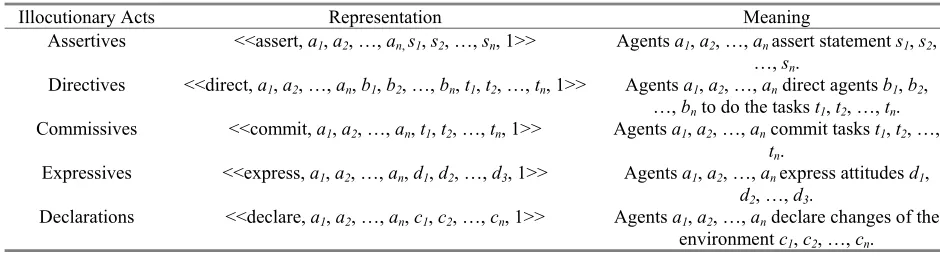
In this section we use situation theory to represent information flow based upon the model presented in section 3. As there are five illocutionary acts in conversation, every agent’s communication with other agents may fall into such illocutionary acts. Suppose there are a group of agents (more than two) involved in a communication then the representation of information flow with situation theory may be summarised by a formalism as shown in Table 2, from which other representations may be derived. For example, the expression “Agent a1
believes that agent a2 can do the task b1,” based on derived Assertives, may be represented as:
<<believe, a1, <<do, a2, b1, 1>>, 1>>
If we consider the time and location in making this expression, that is, “Agent a1believes that
agent a2 can do the task at time t and in location l”, it can be represented as:
<<believe, a1,<<do, a2, b1, t, l, 1>>, 1>>
And we suppose that situation ssupport this expression, it can be further represented as:
s <<believe, a1,<<do, a2, b1, t, l, 1>>,1>>
Other representations may be derived similar to this example. Thus, using situation theory, we can represent other complicated information flow in the design process, such as:
<<know, c, <<believe, a, <<know, b, i, l, t, 0>>, 1>>, 1>>
where agent c knows that agent a believes agent b does not know information i at time t and in location l.
Table 1. Knowledge increment in agents through information flow5 Input information Sender(s) Iis Receiver(s) Iir
Goal of sender(s) Gs
Goal of interaction Gint
Goal of receiver(s) Gr
Knowledge change
• Assertives • Assertives • Input assertives • Compromising different assertives
• Evaluate or/and input assertives
• New assertives
• Directives • Their (its) capability
• Assigning the right tasks to the right agents.
• Optimising assignment of tasks
• Informing sender(s) its capability
• New knowledge of task assignment
• Commissive s
• Evaluate sender(s) intention
• Informing intention(s)
• Sharing and evaluating intention(s)
• Knowing sender(s) intention and providing evaluation to its (their) intention(s)
• Sharing intention(s)
• Expressives • Expressives • Providing expressives
• Compromising different expressives
• Providing its(their) expressives or evaluating sender(s) expressives
• Sharing expressives
• Declarations • Evaluation to the declarations
• Sending declarations
• Sharing declarations
• Sending feedbacks to the declarations
• Knowledge of the changing design environment
Table 2. Representation of information flow with situation theory
Illocutionary Acts Representation Meaning
Assertives <<assert, a1, a2, …, an, s1, s2, …, sn, 1>> Agents a1, a2, …, an assert statement s1, s2, …, sn.
Directives <<direct, a1, a2, …, an, b1, b2, …, bn, t1, t2, …, tn, 1>> Agents a1, a2, …, an direct agents b1, b2, …, bn to do the tasks t1, t2, …, tn. Commissives <<commit, a1, a2, …, an, t1, t2, …, tn, 1>> Agents a1, a2, …, an commit tasks t1, t2, …,
tn.
Expressives <<express, a1, a2, …, an, d1, d2, …, d3, 1>> Agents a1, a2, …, an express attitudes d1,
d2, …, d3.
Declarations <<declare, a1, a2, …, an, c1, c2, …, cn, 1>> Agents a1, a2, …, an declare changes of the environment c1, c2, …, cn.
5
Strengths and weaknesses
Situation theory is a formal tool to study information flow in linguistics. The advantage of using this theory is it provides a well founded way to model information flow in design. It can serve as a tool to minimise misunderstandings of design information flow. It may also provide a way to represent and analysis an information flow system. Such a representation system may provide a clear understanding of the input and output knowledge of the agents and where the knowledge comes from and goes to. What’s more, it serves as a basis for investigating the situatedness of information flow. Different situations will result in different information flow. Consequently, the study and modelling of information flow is only valid if put in relation to its situation. With consideration of time t, location l and situation s, the information flow changes as time, location and situation change. One situation may support certain type of information flow. But another situation may not support the same type of information flow. It is intended that the relationships of situations will be studied and the links between the change of situations and the change of information flow developed.
Although the method of situation theory may bring some benefits, a weakness of this method is also identified: the theory is not widely known. Situation theory is originally developed in the domain of linguistics. Most researchers and design engineers may not know this method.
In future work, the evaluation of the model and methodology will be carried out design practice. But, it is suggested that the model and theory developed in this paper may act as a conceptual framework for modelling information flow and developing CSCW systems.
6 Conclusion
The representation of information flow with situation theory is based upon the example model for information flow and illocutionary acts. A formalism of representation is provided and an example is used to explain it. Other representations can be derived from this formalism. The strengths and weaknesses of using this representation method were discussed.
7 Acknowledgement
We are indebted to Professor John Gero, Key Centre of Design Computing, University of Sydney for bringing to our attention his work on situatedness in design which stimulated our interest in this area.
References
[1] Devlin, K., Logic and information. 1991, Cambridge University Press.
[2] Sonnenwald, D., Communication roles that support collaboration during the design process. Design Studies, 1996, 17: p 277-301.
[3] Eastman, C., and Shirley, G., Management of Design Information Flows, in
Management of Engineering and Management Perspectives, S. Dasu and C. Eastman editors. 1994, Kluwer Acacemic Publishers. p255-277
[4] Sim, S. K., Modelling Learning in Design, in CAD Centre, DMEM. Ph.D Thesis. 2000, University of Strathclyde, 75 Montrose Street, Glasgow, G1 1XJ, U.K.
[5] Searle, J., Expression and meaning: studies in the theory of speech acts. 1979, Cambridge University Press.
[6] Searle, J., Speech acts: an essay in the philosophy of language. 1969, Cambridge University Press.
[7] Dix, A., Computer support cooperative work: a framework, in Design Issues in CSCW, C.H. Duska Rosenberg editors. 1993, Springer-Verlag. p. 9-26.
[8] Morse, D., and Hendrickson, C., A communication model to aid knowledge-based design systems. AI EDAM, 1990. 4(2): p. 99-115.
[9] Macleod, A., and McGregor, D., Accessing of information for engineering design.
Design Studies, 1994. 15(3), p 260-269.
[10] Barwise, J., and Perry, J., Situations and Attitudes. 1983, The MIT Press.
[11] Devlin, K., and Rosenberg, D., Situation theory and cooperative action, in Situation theory and its application, Vol 3, David Israel, Peter Aczel, Yasuhiro Katagiri, Stanley Peters editors. 1993, Stanford University, p 213-264.
[12] Giarratano, J., and Riley, G., Expert Systems: Principles and Programming. 1998, PWS Publishing Company.
Zhichao Wu
![Figure 1: Formalism for a design activity [4]](https://thumb-us.123doks.com/thumbv2/123dok_us/1732605.126728/3.612.235.392.493.560/figure-formalism-for-a-design-activity.webp)