Sheepdrove
Organic Farm
Does the Source of Chicks
have an Impact on
Performance of Birds within
Organic Table Bird Production
Systems (Part 1)?
Vanessa Pegg, Bruce Pearce.
Abstract.
1. Sheepdrove Organic Farm wanted to know whether the source of day old chicks and brooding and production period would have an impact on their enterprise.
1.1. An experiment was undertaken using two different sources of day old chicks and on two sites. 1000 day old chicks from Maurice Millard were exchanged with 1000 organic chicks from Devon Foods. These chicks were then put through the Sheepdrove (SOF) and Devon Foods Bradbury Barton (BB) organic production systems and weighed every week until depletion.
1.2. The two systems were not identical and there were slight variations between the SOF and BB systems. BB had 500 bird flocks compared to SOFs 1000, BB had a brooding period of four weeks to SOFs three and BB total production period was 11 weeks to SOFs 10 weeks.
1.3. The conclusions from the study are;
1.3.1. There is no significant difference between the performances of the birds from the two different sources, although the experiment has highlighted the importance of high stockmanship at all times.
1.3.2. There is no overall benefit in brooding the chicks for four weeks but there does appear to be short-term benefits in not brooding for four weeks as the three week brooded birds performed better over the weeks they were introduced to the field (there is a caveat to this that the experiment was undertaken under warm summer conditions).
1.3.3. Increasing the production period from 10 to 11 weeks could be beneficial as the final weights of the birds at 11 weeks on the BB site were at or above SOFs optimum weight.
Objective.
2. There were two objectives of the study;
2.1. Are there differences between the performances of the difference sources of chicks?
2.2. Does an increase in the brooding period for three to four weeks improve the final performance of the birds?
Background.
3. Sheepdrove Organic Farm sources its day old chicks from Maurice Millard. It was suggested that a different source of day old chicks could result better performance over the production period.
3.2. Devon Foods have a different production system with a longer production period due to longer brooding. It was envisaged that this experiment would give an indication of whether the longer brooding period is of benefit.
Methods.
4. The experiment was undertaken using two different sources of day old chicks and on two sites.
4.1. The chicks were sources from;
4.1.1. Maurice Millard (SOF supplier) 4.1.2. Devon Food Organic Chicks.
4.2. The experiment was split between two sites.
4.2.1. Sheepdrove Organic Farm.
4.2.2. Devon Foods site in Bradbury Barton (BB) Devon.
4.3. There were 1000 MM birds exchanged with 1000 Devon food birds at day old. The birds were then put through the production on SOF and the Bradbury Barton site. A description of the key features of the production system can be found in Table 1.
Table 1. Key features of SOF and Devon Food production systems.
SOF BB
Brooding period 22-24 days 33 days
Full production period 68-70 days 77 days
Flock size 1000 500
4.4. Birds were weighed on arrival (a Monday) and then each Monday in the following weeks. Thirty birds were weighed from each batch each week. The data was analysed and mean values produced for each week and at depletion.
Results.
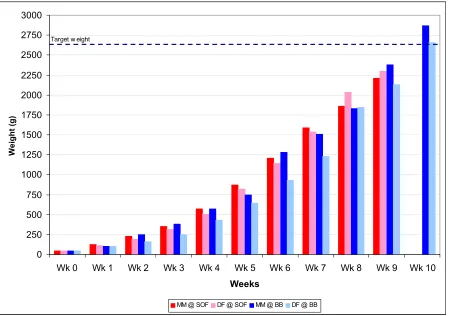
5. Birds weights can be found in Table 2 and Figure 1.
5.1. The birds all started at a similar weight as 1-day old chicks.
5.2. MM birds were generally heavier on both sites but this is not significant.
Table 2: Weekly average weights of 30 birds from Maurice Millard (MM) and Devon Food (DF) on Sheepdrove Organic Farm (SOF) and Devon Foods Bradbury Barton (BB) site.
SOF site BB site
Age MM DF MM DF
Day Old 41.8g 41.8g 41.8g 41.8g
Wk 1 129.7g 107.9g n/a n/a
Wk 2 223.2g 190.5g 248.0g 160.3g
Wk 3 349.5g 318.1g 380.0g 246.6g
Wk 4 570.8g 507.5g 570.0g 430.0g
Wk 5 870.5g 816.4g 750.0g 646.6g
Wk 6 1209.5g 1140.4g 1280.0g 926.6g
Wk 7 1589.7g 1536.3g 1510.0g 1226.6g
Wk 8 1860.4g 2037.7g 1830.0g 1843.3g
Wk 9 2210.8g 2296.2g 2380.0g 2126.6g
Wk 10 - - 2870.0g 2653.3g
5.4. By comparing the weigh gain between sites in weeks 3 and 4 and 4 and 5 it should be possible to get an idea of the impact of brooding for an extra week at the BB site. Figure 2a and Figure 2b show the weight gains during these periods.
Figure 1: Weekly average weights of 30 birds from Maurice Millard (MM) and Devon Food (DF) on Sheepdrove Organic Farm (SOF) and Devon Foods Bradbury Barton (BB) site.
0 250 500 750 1000 1250 1500 1750 2000 2250 2500 2750 3000
Wk 0 Wk 1 Wk 2 Wk 3 Wk 4 Wk 5 Wk 6 Wk 7 Wk 8 Wk 9 Wk 10
Weeks
Weight (g)
[image:4.595.75.524.423.739.2]Figure 2a: Weight gains comparison of transfer week of Maurice Millard birds at SOF and BB.
0 50 100 150 200 250 300 350
Wk 3-4 Wk 4-5
Weeks
We
ights
(g)
Maurace Millard Sheepdrove Maurace Millard Bradbury
Figure 2b: Weight gain comparison of transfer week of Devon Food birds at SOF and BB.
0 50 100 150 200 250 300 350
Wk 3-4 Wk 4-5
Weeks
We
ight (g)
Devon Food Sheepdrove Devon Food Bradbury
[image:5.595.79.476.386.668.2]Discussion.
6. The experiment can answer two questions;
6.1. Are there differences between the performances of the difference sources of chicks?
6.2. Does an increase in the brooding period from three to four weeks improve the final performance of the birds?
Are there differences between the performances of the difference sources of day old chicks?
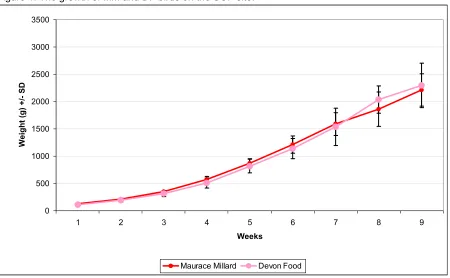
6.3. Figures 3 and 4 show the growth of the birds on SOF and BB. On both sites MM were generally heavier throughout the growth period. However, the differences were small. Also due to the way the data was supplied from BB it has not been possible analyse the variation within the data and so we are unable to say whether the differences in the BB data is significant.
Figure 3: The growth of MM and DF birds on the Devon Food BB site.
0 500 1000 1500 2000 2500 3000 3500
Wk 0 Wk 1 Wk 2 Wk 3 Wk 4 Wk 5 Wk 6 Wk 7 Wk 8 Wk 9 Wk10 Weeks
Weights (g)
Maurace Millard Devon Food
Figure 4: The growth of MM and DF birds on the SOF site.
0 500 1000 1500 2000 2500 3000 3500
1 2 3 4 5 6 7 8 9
Weeks
Weight (g) +/- SD
Maurace Millard Devon Food
Does an increase in the brooding period from three to four weeks improve the final performance of the birds?
6.5. Figures 2a and 2b show the increase in growth of both sources of birds on both sites in the weeks following movement to the field sheds.
6.5.1. On the SOF site MM birds gained 221.3g, while the DF birds gained 189.4g the week they were moved to the field (week 4). The corresponding gains on the BB site where the birds were still in the brooder were 190.0g for MM and 183.4g for BB. Therefore the SOF birds in the field sheds out performed the BB birds in the brooder.
6.5.2. The following week when the BB birds were moved to the field sheds the growth of the birds in the field at SOF was 299.7g for MM and 308.9g for DF. The growth of the BB for this period was 180g for MM and 216.6g for DF. Therefore the SOF birds in their second week in the field out performed the BB birds that had just been introduced.
6.5.3. These results would question the benefit of brooding for the extra week.
Conclusions and future
7. This study has been informative and has brought out some important conclusions.
7.2. With the differences within the production systems between SOF and BB it is possible to make some judgement on the impact of brooding for four weeks rather than three, as a four week brooding period has been suggested for SOF.
7.3. The data presented here show that there is no benefit in brooding for four weeks.
7.3.1. The birds raised within the SOF production system out performed those within the BB system during the weeks of transition from brooder to field.
7.3.2. There was no overall significant difference in the final weights of the birds.
7.3.3. A caveat needs to be added to these statements as the experiment was undertaken in summer with a warm climate. We cannot guarantee that this will be the case in a colder winter climate.
7.4. The production system at BB was a week longer than the system that has been used at SOF (BB = 11 weeks, SOF = 10).
7.4.1. The extra week appears to give a benefit as the final weight of the birds were close to the optimum for SOFs marketing (1.83 kg).
7.4.2. There is a possibility that the birds will become too heavy. The mean weight of the MM birds on BB was 2.87 kg which converts to an over 2.0 kg processed bird. This is too heavy for SOF.
7.4.3. This system of brooding for four weeks and then a further seven in the field does not conform to organic standards as the birds are spending too short a period within the free range field system.
7.5. This experiment does indicate that the SOF breed of bird (257) is capable of achieving the optimum processed weight of 1.83 kg within an 11 week production period. However, there is always a welfare issue with heavier birds and we did not get any information from BB about the welfare of these animals ie had they become too heavy and gone off their legs? With the new 11 week production system now introduced to SOF this will be able to be monitored on site.