promoting access to White Rose research papers
White Rose Research Online
[email protected]
Universities of Leeds, Sheffield and York
http://eprints.whiterose.ac.uk/
This is a copy of the final published version of a paper published via gold open access
in
Frontiers in Neuroscience
.
This open access article is distributed under the terms of the Creative Commons
Attribution Licence (
http://creativecommons.org/licenses/by/3.0
), which permits
unrestricted use, distribution, and reproduction in any medium, provided the
original work is properly cited.
White Rose Research Online URL for this paper:
http://eprints.whiterose.ac.uk/83585
Published paper
When natural selection should optimize speed-accuracy
trade-offs
Angelo Pirrone1,2, Tom Stafford1and James A. R. Marshall2,3*
1
Department of Psychology, University of Sheffield, Sheffield, UK
2
Kroto Research Institute, University of Sheffield, Sheffield, UK
3
Department of Computer Science, University of Sheffield, Sheffield, UK *Correspondence: [email protected]
Edited by:
Dominic Standage, Queen’s University, Canada
Reviewed by:
Joshua I. Gold, University of Pennsylvania, USA Kenway Louie, New York University, USA
Keywords: decision-making, value, reward, error, Bayes risk, drift-diffusion, mechanism, evolution
1. INTRODUCTION
In psychology and neuroscience, and in other disciplines studying decision-making mechanisms, it is often assumed that optimal decision-making means statistical optimality. This is attractive because statistically optimal decision procedures are known, can be simply implemented in biologically-plausible
models, and because such models
have been shown to give good fits to behavioural as well as neural data. Here we question when statistical optimality is the kind of optimality we should expect natural selection to aim towards, by con-sidering what kinds of loss function should be optimised under different behavioural scenarios. In laboratory settings subjects are often rewarded only on making a cor-rect choice, so optimisation of a zero-one loss function is appropriate, and this is achieved by implementing a statistically-optimal decision procedure that gives the best compromise between speed and accuracy of decision-making. Many nat-uralistic decisions may also be described by such a loss function; however others, such as selecting food items of potentially different value, appear to be different since the animal is rewarded by the value of the item it chooses regardless of whether it was the best available. We argue that most naturalistic decisions are value-based. Mechanisms that optimise speed-accuracy trade-offs need to be parameterised, using information about the decision problem, in order to deal with value-based decision-making. Mechanisms for value-sensitive decision-making have been described,
however, which adaptively change between decision-making strategies without the need for continual re-parameterisation.
2. SPEED-ACCURACY TRADE-OFFS
It is usually assumed that decision-makers have to decide to be either fast or accu-rate. When speed is important mistakes are more frequent, while when accu-racy is needed decisions are slower. This obvious problem is defined as the speed-accuracy trade-off and is a distinctive fea-ture of many types of decision making (Wickelgren, 1977).
The speed-accuracy trade-off can be explained within the theoretical frame-work of sequential sampling models of decision making that have been shown to fit behavioral and neural data from human and animal choice tasks (Ratcliff and Rouder, 2000; Ratcliff et al., 2003, 2004; Ratcliff and Smith, 2004; Busemeyer et al., 2013). In particular, the Drift Diffusion Model (DDM; Ratcliff, 1978) describes choice between two alternatives (see Smith and Ratcliff, 2004; Bogacz et al., 2006; Basten et al., 2010) and recently has been shown also to be quan-titatively accurate in describing trinary choices (Krajbich and Rangel, 2011) and value-based choices (Krajbich et al., 2010; Milosavljevic et al., 2010; Krajbich and Rangel, 2011; Krajbich et al., 2012), sug-gesting that the DDM can be thought of as a unifying computational framework for describing decision making (Basten et al., 2010). Moreover,Bogacz et al.(2006) have demonstrated that several connectionist decision-making models can approximate
the DDM under specific conditions. The DDM is a special case of the statistically-optimal Sequential Probability Ratio Test (SPRT;Wald, 1947; Wald and Wolfowitz, 1948). In the DDM noisy sensory evi-dence supporting the alternatives is inte-grated over time until the net evidence in favor of one alternative exceeds a cer-tain positive or negative threshold value, precipitating a decision for the corre-sponding alternative. These thresholds can be varied to compromise optimally between the average speed and accuracy of decisions.
3. SPEED-VALUE TRADE-OFFS
Pirrone et al. Natural selection and decision optimization
The SPRT/DDM can be optimized to take account of the value of the alterna-tives but, as we discuss here, doing so requires knowledge of the decision prob-lem faced. The thresholds for an optimal decision depend on the goals of the deci-sion maker and are task specific. By way of example, one route to accounting for the values associated with different deci-sion outcomes is to minimize an extended version of the Bayes Risk (BR). BR is a linear combination of expected deci-sion delay and expected terminal decideci-sion loss, first proposed byWald and Wolfowitz (1948), and assumes that decision mak-ers seek to minimize a cost function that is the weighted sum of decision times (DTs) and error rate (ERs). This was sub-sequently extended by Edwards to also account for non-zero rewards for incorrect decisions (Edwards, 1965; Bogacz et al., 2006). Formally Edwards’ extension of BR, which implements Wald and Wolfowitz’s version as a special case, can be defined as
BRE=c1DT+c2
ER 1−ER
(1)
wherec1is the cost of observing the stim-ulus per unit time, whilec2is a row-vector specifying the payoffs from incorrect and correct choices (Bogacz et al., 2006). If c2=(k 0), where k>0 is a constant, then Wald and Wolfowitz’s original BR is recovered. Several studies demonstrate that, under specific circumstances, sub-jects choose decision thresholds close to those that minimizeBRE(Busemeyer and Rapoport, 1988; Mozer et al., 2002). Bayes risk is not the only criterion pro-posed to date that decision-makers might optimize. Bogacz et al. survey alterna-tives, such as reward-rate, however, these alternatives are all calculated based on decision-accuracy, which requires explicit parameterizations based on the values of correct and incorrect choices (Bogacz et al., 2006). We therefore concentrate our analysis on Bayes risk. Bayes risk can be used to optimize value-sensitive decision-making; for example in a decision between two equal alternatives, each having value vif chosen, we would set the vectorc2=
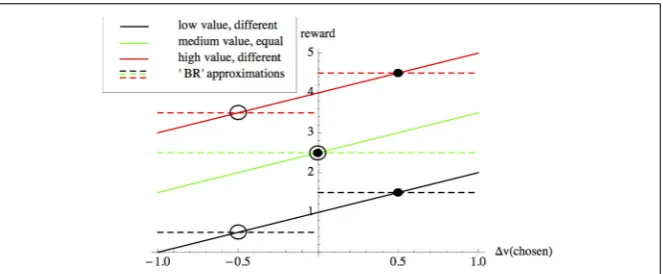
(v v)(e.g., dashed green line inFigure 1), thus simplifying Equation (1) above to
[image:3.595.219.551.60.197.2]BRE=c1DT+v. (2)
FIGURE 1 | The accuracy-based component of Bayes Risk (BREas defined by Equation 1) can
be used to approximate a value-based reward scheme.In value-based decisions individuals are rewarded according to the value|v| +vof the option they choose (solid lines), where|v|is the average value of the alternatives under consideration, andvis the deviation from this average of the value of the option chosen by the subject. With knowledge of the values of the alternatives,
BREcan be used to optimize value sensitive decision-making as described in the main text; for example the dashed lines show payoffs used inBREfor: options having values of 0.5 and 1.5 units (black), options having equal values of 2.5 and 2.5 units (green) and options having values of 3.5 and 4.5 units (red). Intersections between payoffs selected forBRE(dashed lines) with value-based reward (solid lines of matching colors) correspond to choice scenarios between different-valued options for whichBREimplements reward-by-value of the selected option; these intersections represent choice scenarios involving “poor” (hollow circles) and “good” (filled circles) options having particular values. However, the cost parameters forBREneed to be recalculated according to the values of the options under consideration; for example, although the difference in the values of the alternatives does not change from the low-value (black) to the high-value (red) scenarios, since their absolute values change theBREpayoffs need to be recalculated in each case. As described in the text, value-sensitive decision-mechanisms have been described that are able adaptively to deal with a variety of such decision scenarios, without re-parameterizations.
Equation (2) shows us that, intuitively, an optimal decision-maker in our equal-alternatives scenario should minimize decision-time DT, since doing so incurs no penalty as the error rateERno longer features. However, using Bayes risk in this way requires the values of the alterna-tives to be known on a case by case basis, as shown in Figure 1. Subjects might learn the values of incorrect and cor-rect choices over time, for example when trials are blocked in psychophysical exper-iments (seeBogacz et al., 2006). However, in the following we argue that in most naturalistic decision scenarios decision-makers will not have this opportunity, and will therefore use other mechanisms that directly optimize speed-value trade-offs, rather than optimizing decisions indirectly via optimization of the speed-accuracy trade-off with an appropriate payoff vectorc2.
4. NATURALISTIC DECISIONS ARE USUALLY VALUE-BASED
We argue that most naturalistic decisions faced by animals, including humans, are value-based, in that the animal is rewarded
kind of decisions animals, and their neu-ral circuitry, have typically evolved to deal with. Even in the value-based decision experiments cited above, which are ana-lyzed using the DDM, it is typical to only present subjects with a choice between options known to have different values. Moreover, even though some studies have looked at how reward information is inte-grated (Rorie et al., 2010; Gao et al., 2011), much of this work has not yet focused on the tradeoff between value and speed. While usually in the decision-making liter-ature the optimal behavior is to optimize speed-accuracy trade-offs, and subjects can apparently do this (Busemeyer and Rapoport, 1988; Bogacz et al., 2006), we argue that these scenarios are not repre-sentative of many naturalistic settings, and that there is great value in considering how subjects make value-sensitive deci-sions and how these should be optimized. In the following section we discuss theory that may be useful for this.
At least one important class of natural-istic decisions does require optimization of speed-accuracy trade-offs; these are life-or-death decisions. If we analyze for exam-ple the case of an animal attempting to forage while avoiding predators (Trimmer et al., 2008), a slow-but-accurate decision would mean being killed by the preda-tor, a maximal loss. On the other hand if the decision is fast-but-inaccurate the animal would escape even when the stim-ulus is not a predator, and this would mean losing food. The best strategy for the animal is thus that which optimizes the speed-accuracy trade-off, taking into account the payoffs arising from the dif-ferent decision outcomes; hence Trimmer et al.’s hypothetical animal is modeled with a single-threshold DDM, with evidence sufficient to cross that single decision threshold leading to the animal taking anti-predator action such as running away.
5. MECHANISMS FOR VALUE-SENSITIVE DECISION-MAKING
Recent modeling work inspired by
studying another value-sensitive decision-making system, collective nest-site selection by honeybees (Seeley et al., 2012), has described a very simple mech-anism able to adaptively account for the value of different decision outcomes, with minimal parameter tuning (Pais et al.,
2013). This simple model implements a variety of sophisticated decision-making strategies; for example, when equal but low-value alternatives are presented, a decision deadlock is maintained that can be broken should a third, higher-value alternative, be made available. However, if equal-but-high-value alternatives are pre-sented, or sufficient time passes, deadlock is spontaneously and randomly broken (Pais et al., 2013). This is particularly inter-esting, since the classic DDM is insensitive to the absolute value of the alternatives under consideration, and only integrates the difference in their values. When dif-ferences between alternative values are sufficient, the value-sensitive mechanism of Pais et al. becomes closer to a classic DDM, allowing speed-accuracy trade-offs to be managed, although not optimized, through modification of decision thresh-olds. All of the different behavioral regimes of the model arise without direct parameterizations regarding alternatives’ values, simply through the dependence of the model’s dynamics on the mean values of inputs to its integrator popula-tions; this allows the model to adaptively respond to different decision scenarios on a trial-by-trial basis, which cannot be achieved in pure DDM models without the decision-maker having access to explicit information on the decision-task at hand. Modifications to DDM-type models have been proposed to deal with trial-by-trial variability such as online estimation of task parameters (Deneve, 2012) or the use of time-dependent change in parameters such as decision-thresholds, urgency sig-nals or asymmetry of inhibition (Ditterich, 2006; Hanks et al., 2011; Drugowitsch et al., 2012; Thura et al., 2012); funda-mentally, however, these modifications are still interpreted under the assumption that decision speed vs accuracy is the trade-off to be maximized, unlike the model of Pais et al. (2013) in which the dynam-ics are naturally interpreted in terms of value vs time trade-offs. Pais et al.’s mech-anism also exhibits other characteristics of natural value-discrimination systems, such as Weber’s law of just-noticeable dif-ference; interestingly Weber’s law arises from the deterministic dynamics of the mechanism rather than from noise pro-cesses (Pais et al., 2013) (cf. Deco and Rolls, 2006; Deco et al., 2007). Finally,
it is important to note that the DDM cannot account for the non-linearity that characterizes many decision mak-ing dynamics (e.g., food recruitment by social insects; Nicolis and Deneubourg, 1999) while the model ofPais et al.(2013) is non-linear.
6. CONCLUSION
The study of speed-accuracy trade-offs has been tremendously fruitful for psychol-ogy, neuroscience and animal behavior, and will doubtless prove fruitful for many years to come. Yet as we have argued here most naturalistic decisions, which animals’ brains should have evolved to optimize, are value-based rather than accuracy-based. This leads us to argue that the drift-diffusion model, which optimizes speed-accuracy trade-offs, is not an ideal computational framework to describe value-based decision-making; although it has had some success in describing particular experiments on value-based decision-making, discussed in the sec-tion “Speed-Accuracy Trade-Offs,” as we have shown here the DDM requires special case-by-case parameterizations to imple-ment true value-based decision-making. We suggest that this limits the generality of the DDM as a unifying framework for all ecologically-relevant decision-making problems. However, recent theory has presented mechanisms that can manage value-sensitive decision problems without the additional informational requirements of the DDM. At the same time, experi-mental and theoretical psychologists and neuroscientists have started to tackle prob-lems of value-based decision-making. We have presented our arguments for value in terms of animal decision-making, but unicellular organisms and individual cells also make decisions (e.g., Perkins and Swain, 2009; Latty and Beekman, 2011), and value is likely to be simi-larly important for these. We believe that the evolutionary perspective we have presented here should motivate fur-ther research into value-sensitivity and decision-making.
AUTHOR CONTRIBUTIONS
Pirrone et al. Natural selection and decision optimization
the formal argument; Angelo Pirrone and James A. R. Marshall drafted the paper and all authors approved its content.
FUNDING
Angelo Pirrone is supported by the University of Sheffield Studentship Network in Neuroeconomics.
ACKNOWLEDGMENTS
We thank Jochen Ditterich, Ian Krajbich, and Konstantinos Tsetsos for helpful com-ments on the manuscript.
REFERENCES
Basten, U., Biele, G., Heekeren, H. R., and Fiebach, C. J. (2010). How the brain integrates costs and benefits during decision making. Proc. Natl. Acad. Sci. U.S.A. 107, 21767–21772. doi: 10.1073/pnas.0908104107
Bogacz, R., Brown, E., Moehlis, J., Holmes, P., and Cohen, J. D. (2006). The physics of optimal decision making: a formal analysis of models of performance in two-alternative forced-choice tasks.Psychol. Rev. 113:700. doi: 10.1037/0033-295X.113.4.700
Busemeyer, J., Diederich, A., Heathcote, A., Rangel, A., Rieskamp, J., and Usher, M. (2013). “Sequential sampling models representing a unifying frame-work of human decision making,” inSymopsium, COGSCI Annual Meeting(Berlin).
Busemeyer, J. R., and Rapoport, A. (1988). Psychological models of deferred decision making. J. Math. Psychol. 32, 91–134. doi: 10.1016/0022-2496(88)90042-9
Cassey, T. C., Evens, D. R., Bogacz, R., Marshall, J. A. R., and Ludwig, C. J. H. (2013). Adaptive sampling of information in perceptual decision-making.PLoS ONE8:e78993. doi: 10.1371/jour-nal.pone.0078993
Davies, N. B., Krebs, J. R., and West, S. A. (2012).
An Introduction to Behavioural Ecology, 4th Edn. Hoboken, NJ: John Wiley & Sons.
Deco, G., and Rolls, E. T. (2006). Decision-making and weber’s law: a neurophysiological model.
Eur. J. Neurosci.24, 901–916. doi: 10.1111/j.1460-9568.2006.04940.x
Deco, G., Scarano, L., and Soto-Faraco, S. (2007). Weber’s law in decision making: integrating behav-ioral data in humans with a neurophysiological model. J. Neurosci. 27, 11192–11200. doi: 10.1523/JNEUROSCI.1072-07.2007
Deneve, S. (2012). Making decisions with unknown sensory reliability. Front. Neurosci. 6:75. doi: 10.3389/fnins.2012.00075
Ditterich, J. (2006). Stochastic models of decisions about motion direction: behavior and physiology.
Neural Netw.19, 981–1012. doi: 10.1016/j.neunet. 2006.05.042
Drugowitsch, J., Moreno-Bote, R., Churchland, A. K., Shadlen, M. N., and Pouget, A. (2012). The cost of accumulating evidence in perceptual deci-sion making. J. Neurosci. 32, 3612–3628. doi: 10.1523/JNEUROSCI.4010-11.2012
Edwards, W. (1965). Optimal strategies for seeking information: models for statistics, choice reaction
times, and human information processing. J. Math. Psychol. 2, 312–329. doi: 10.1016/0022-2496(65)90007-6
Gao, J., Tortell, R., and McClelland, J. L. (2011). Dynamic integration of reward and stimulus information in perceptual decision-making.
PLoS ONE6:e16749. doi: 10.1371/journal.pone. 0016749
Gold, J. I., and Shadlen, M. N. (2003). The influ-ence of behavioral context on the representation of a perceptual decision in developing oculo-motor commands.J. Neurosci.23, 632–651. doi: 10.1146/annurev.neuro.29.051605.113038 Hanks, T. D., Mazurek, M. E., Kiani, R., Hopp,
E., and Shadlen, M. N. (2011). Elapsed deci-sion time affects the weighting of prior proba-bility in a perceptual decision task.J. Neurosci.
31, 6339–6352. doi: 10.1523/JNEUROSCI.5613-10.2011
Hare, T. A., Schultz, W., Camerer, C. F., O’Doherty, J. P., and Rangel, A. (2011). Transformation of stimulus value signals into motor commands dur-ing simple choice.Proc. Natl. Acad. Sci. U.S.A.108, 18120–18125. doi: 10.1073/pnas.1109322108 Kable, J. W., and Glimcher, P. W. (2009). The
neu-robiology of decision: consensus and controversy.
Neuron63, 733–745. doi: 10.1016/j.neuron.2009. 09.003
Krajbich, I., Armel, C., and Rangel, A. (2010). Visual fixations and the computation and comparison of value in simple choice. Nat. Neurosci. 13, 1292–1298. doi: 10.1038/nn.2635
Krajbich, I., Lu, D., Camerer, C., and Rangel, A. (2012). The attentional drift-diffusion model extends to simple purchasing decisions.
Front. Psychol. 3:193. doi: 10.3389/fpsyg.2012. 00193
Krajbich, I., and Rangel, A. (2011). Multialternative drift-diffusion model predicts the relationship between visual fixations and choice in value-based decisions.Proc. Natl. Acad. Sci. U.S.A.108, 13852–13857. doi: 10.1073/pnas.1101328108 Latty, T., and Beekman, M. (2011). Speed–accuracy
trade-offs during foraging decisions in the acellu-lar slime mould physarum polycephalum.Proc. R. Soc. B Biol. Sci.278, 539–545. doi: 10.1098/rspb. 2010.1624
Louie, K., and Glimcher, P. W. (2012). Efficient cod-ing and the neural representation of value.Ann. N.Y. Acad. Sci.1251, 13–32. doi: 10.1111/j.1749-6632.2012.06496.x
Milosavljevic, M., Malmaud, J., Huth, A., Koch, C., and Rangel, A. (2010). The drift diffusion model can account for value-based choice response times under high and low time pressure.Judge. Decis. Making5, 437–449. doi: 10.2139/ssrn.1901533 Mozer, M. C., Colagrosso, M. D., and Huber, D. E.
(2002). “A rational analysis of cognitive control in a speeded discrimination task,” inAdvances in Neural Information Processing Systems, Vol. 11, eds T. Dietterich, S. Becker, and Z. Ghahramani (Cambridge, MA: MIT Press), 51–57.
Nicolis, S. C., and Deneubourg, J.-L. (1999). Emerging patterns and food recruitment in ants: an ana-lytical study. J. Theor. Biol. 198, 575–592. doi: 10.1006/jtbi.1999.0934
Padoa-Schioppa, C., and Assad, J. A. (2006). Neurons in the orbitofrontal cortex encode economic value.
Nature441, 223–226. doi: 10.1038/nature04676
Pais, D., Hogan, P. M., Schlegel, T., Franks, N. R., Leonard, N. E., and Marshall, J. A. R. (2013). A mechanism for value-sensitive decision-making. PLoS ONE 8:e73216. doi: 10.1371/journal.pone.0073216
Perkins, T. J., and Swain, P. S. (2009). Strategies for cel-lular decision-making.Mol. Syst. Biol.5, 1–15. doi: 10.1038/msb.2009.83
Philiastides, M. G., Biele, G., and Heekeren, H. R. (2010). A mechanistic account of value com-putation in the human brain.Proc. Natl. Acad. Sci. U.S.A. 107, 9430–9435. doi: 10.1073/pnas. 1001732107
Platt, M. L., and Glimcher, P. W. (1999). Neural corre-lates of decision variables in parietal cortex.Nature
400, 233–238. doi: 10.1038/22268
Rangel, A., Camerer, C., and Montague, P. R. (2008). A framework for studying the neurobiology of value-based decision making.Nat. Rev. Neurosci.9, 545–556. doi: 10.1038/nrn2357
Ratcliff, R. (1978). A theory of memory retrieval.
Psychol. Rev. 85:59. doi: 10.1037/0033-295X. 85.2.59
Ratcliff, R., Gomez, P., and McKoon, G. (2004). A diffusion model account of the lexical decision task. Psychol. Rev. 111:159. doi: 10.1037/0033-295X.111.1.159
Ratcliff, R., and Rouder, J. N. (2000). A diffusion model account of masking in two-choice let-ter identification. J. Exp. Psychol. 26:127. doi: 10.1037/0096-1523.26.1.127
Ratcliff, R., and Smith, P. L. (2004). A comparison of sequential sampling models for two-choice reac-tion time.Psychol. Rev.111:333. doi: 10.1037/0033-295X.111.2.333
Ratcliff, R., Thapar, A., and Mckoon, G. (2003). A dif-fusion model analysis of the effects of aging on brightness discrimination.Percept. Psychophys.65, 523–535. doi: 10.3758/BF03194580
Rorie, A. E., Gao, J., McClelland, J. L., and Newsome, W. T. (2010). Integration of sensory and reward information during perceptual decision-making in lateral intraparietal cortex (lip) of the macaque monkey.PLoS ONE 5:e9308. doi: 10.1371/jour-nal.pone.0009308
Seeley, T. D., Visscher, P. K., Schlegel, T., Hogan, P. M., Franks, N. R., and Marshall, J. A. R. (2012). Stop signals provide cross inhibition in collective decision-making by honeybee swarms.Science335, 108–111. doi: 10.1126/science.1210361
Smith, P. L., and Ratcliff, R. (2004). Psychology and neurobiology of simple decisions.Trends Neurosci.
27, 161–168. doi: 10.1016/j.tins.2004.01.006 Stroeymeyt, N., Jordan, C., Mayer, G., Hovsepian, S.,
Giurfa, M., and Franks, N. (2014). Seasonality in communication and collective decision-making in ants.Proc. R. Soc. B. Biol. Sci.281:20133108. doi: 10.1098/rspb.2013.3108
Sugrue, L. P., Corrado, G. S., and Newsome, W. T. (2004). Matching behavior and the representa-tion of value in the parietal cortex.Science304, 1782–1787. doi: 10.1126/science.1094765 Thura, D., Beauregard-Racine, J., Fradet, C.-W.,
and Cisek, P. (2012). Decision making by urgency gating: theory and experimental sup-port. J. Neurophysiol. 108, 2912–2930. doi: 10.1152/jn.01071.2011
value computation improves predictions of eco-nomic choice.Proc. Natl. Acad. Sci. U.S.A.110, E3858–E3867. doi: 10.1073/pnas.1304429110 Trimmer, P. C., Houston, A. I., Marshall, J. A. R.,
Bogacz, R., Paul, E. S., Mendl, M. T., et al. (2008). Mammalian choices: combining fast-but-inaccurate and slow-but-accurate decision-making systems.Proc. R. Soc. B Biol. Sci.275, 2353–2361. doi: 10.1098/rspb.2008.0417
Tsetsos, K., Chater, N., and Usher, M. (2012). Salience driven value integration explains decision biases and preference reversal. Proc. Natl. Acad. Sci. U.S.A. 109, 9659–9664. doi: 10.1073/pnas.1119 569109
Wald, A. (1947).Sequential Analysis. New York, NY: Wiley and Sons.
Wald, A., and Wolfowitz, J. (1948). Optimum char-acter of the sequential probability ratio test.Ann. Math. Stat.19, 326–339. doi: 10.1214/aoms/1177 730197
Wickelgren, W. A. (1977). Speed-accuracy trade-off and information processing dynamics.Acta Psychol. 41, 67–85. doi: 10.1016/0001-6918(77) 90012-9
Conflict of Interest Statement:The authors declare that the research was conducted in the absence of any commercial or financial relationships that could be construed as a potential conflict of interest.
Received: 21 January 2014; accepted: 26 March 2014; published online: 10 April 2014.
Citation: Pirrone A, Stafford T and Marshall JAR (2014) When natural selection should optimize speed-accuracy trade-offs. Front. Neurosci.08:73. doi: 10.3389/fnins.2014.00073