This is a repository copy of
Observing, performing, and understanding actions : revisiting
the role of cortical motor areas in processing of action words
.
White Rose Research Online URL for this paper:
http://eprints.whiterose.ac.uk/79434/
Version: Published Version
Article:
Rueschemeyer, Shirley-Ann orcid.org/0000-0001-6432-0917, Ekman, Matthias, van
Ackeren, Markus et al. (1 more author) (2014) Observing, performing, and understanding
actions : revisiting the role of cortical motor areas in processing of action words. Journal of
Cognitive Neuroscience. pp. 1644-1653. ISSN 0898-929X
https://doi.org/10.1162/jocn_a_00576
[email protected] https://eprints.whiterose.ac.uk/ Reuse
Items deposited in White Rose Research Online are protected by copyright, with all rights reserved unless indicated otherwise. They may be downloaded and/or printed for private study, or other acts as permitted by national copyright laws. The publisher or other rights holders may allow further reproduction and re-use of the full text version. This is indicated by the licence information on the White Rose Research Online record for the item.
Takedown
If you consider content in White Rose Research Online to be in breach of UK law, please notify us by
Uncorrected
Proof
Observing, Performing, and Understanding Actions:
Revisiting the Role of Cortical Motor Areas
in Processing of Action Words
Shirley-Ann Rueschemeyer
1,2, Matthias Ekman
1, Markus van Ackeren
2,
and James Kilner
3Abstract
■ Language content and action/perception have been shown to activate common brain areas in previous neuroimaging stud-ies. However, it is unclear whether overlapping cortical activa-tion reflects a common neural source or adjacent, but distinct, sources. We address this issue by using multivoxel pattern analy-sis on fMRI data. Specifically, participants were instructed to engage in five tasks: (1) execute hand actions (AE), (2) observe hand actions (AO), (3) observe nonbiological motion (MO), (4) read action verbs, and (5) read nonaction verbs. A classifier was trained to distinguish between data collected from neural motor areas during (1) AE versus MO and (2) AO versus MO. These two algorithms were then used to test for a distinction between data collected during the reading of action versus nonaction
verbs. The results show that the algorithm trained to distinguish between AE and MO distinguishes between word categories using signal recorded from the left parietal cortex and pre-SMA, but not from ventrolateral premotor cortex. In contrast, the algorithm trained to distinguish between AO and MO dis-criminates between word categories using the activity pattern in the left premotor and left parietal cortex. This shows that the sensitivity of premotor areas to language content is more similar to the process of observing others acting than to acting oneself. Furthermore, those parts of the brain that show com-parable neural pattern for action execution and action word comprehension are high-level integrative motor areas rather than low-level motor areas. ■
INTRODUCTION
In the past decade, many studies have shown that con-ceptual information activates percon-ceptual and motor areas of the brain. For example, words denoting actions acti-vate the neural motor system (Rueschemeyer, Rooij, Lindemann, Willems, & Bekkering, 2010; Postle, McMahon, Ashton, Meredith, & de Zubicaray, 2008; Rueschemeyer, Brass, & Friederici, 2007; Hauk, Johnsrude, & Pulvermueller, 2004), whereas language denoting motion (“the car approaches”) activates parts of the visual processing stream responsive to visually perceived motion (Rueschemeyer, Glenberg, Kaschak, Mueller, & Friederici, 2010; Saygin, McCullough, Alac, & Emmorey, 2010). In the past decade, converging evidence from behavioral, neuroimaging, and patient data all point consistently to the idea that language comprehension involves sensory-motor areas in a content-specific manner (reviews by Binder, Desai, Graves, & Conant, 2009; Aziz-Zadeh & Damasio, 2008; Zwaan & Fischer, 2008).
It should be noted that the automaticity and consistency with which lexical forms activate sensory-motor areas re-main a topic of open debate. Several studies have
demon-strated that embodied language effects are highly sensitive to linguistic and pragmatic context as well as to task demands. For example, words with motor meaning used in idiomatic phrases or nonliteral sentences, which are largely devoid of motor content (e.g., “he kicked the bucket”), have been shown to elicit less or no activation in sensory-motor areas (Schuil, Smits, & Zwaan, 2013; Van Dam, van Dijk, Bekkering, & Rueschemeyer, 2012; Raposo, Moss, Stamatakis, & Tyler, 2009; Rueschemeyer et al., 2007; but see also Boulenger, Hauk, & Pulvermuller, 2009). Likewise, words with no motor meaning, which are used to imply a request for action (e.g.,“it is hot in here”spoken in the context of a closed window), do acti-vate sensory-motor areas reliably (Van Ackeren, Casasanto, Hagoort, Bekkering, & Rueschemeyer, 2012), suggesting that lexical forms are not necessary to elicit motor activa-tion. Finally, words presented in the context of a motor task are more likely to elicit activation patterns consistent with an embodied framework of words presented in non-motoric contexts (e.g., Tomasino & Rumiati, 2013; Papeo, Rumiati, Cecchetto, & Tomasino, 2012). Thus, the re-cruitment of sensory-motor areas appears to be a flexible enterprise that is affected by linguistic and pragmatic context as well as task demands.
A wide range of theoretical accounts are offered to explain the link between language and sensory-motor
1Radboud University, Nijmegen, The Netherlands,2University of
Uncorrected
Proof
processing (for reviews, see Kiefer & Pulvermueller, 2012; Meteyard, Cuadrado, Bahrami, & Vigliocco, 2012; Barsalou, 2008). On one side, sensory-motor involvement in language processing is thought to be epiphenomenal (e.g., Mahon & Caramazza, 2008; Patterson, Nestor, & Rogers, 2007). Such accounts argue that semantic infor-mation is instantiated in an abstract format distinct from modality-specific cortical areas. Any activation of sensory-motor areas during language processing tasks is thought to reflect late mental imagery, morphological, and/ or ortho-phonological statistical properties of lexical items rather than the locus of semantic content (see also De Zubicaray, Arciuli, & McMahon, 2013; Papeo, Pascual-Leone, & Caramazza, 2013). On the other extreme are accounts proposing that semantic information is stored in sensory-motor code (Pulvermueller, 2005; Glenberg & Kaschak, 2002). This reenactment view proposes that modality-specific activations during language processing are representational in nature. Between the two extremes lie theories proposing that features of semantic content are represented in sensory-motor codes but that abstrac-tion of these features and integraabstrac-tion across multiple perceptual and cognitive domains are necessary during language comprehension (e.g., Kiefer & Pulvermueller, 2012; Barsalou, 2008; Vigliocco, Vinson, Lewis, & Garrett, 2004). This integrative view proposes that modality-specific areas reflect general representation of content; however, the temporal and spatial characteristics of modality-specific activations differ for language and action experiences.
In this experiment, we use a pattern classification approach to distinguish between these three accounts (Mur, Bandettini, & Kriegeskorte, 2009). Whereas pre-vious neuroimaging studies have demonstrated that words with specific content modulate modality-specific brain areas, we aim to assess whether cortical pro-cesses in motor areas share the same neural basis for motor experience and language comprehension. To this end, a classifier was trained to distinguish between neural activity associated with (1) action execution (AE) versus nonbiological motion and (2) action observation (AO) versus observation of nonbiological motion. The classi-fiers trained to make these two distinctions were then tested on patterns of neural activity elicited by words denoting actions versus words denoting nonbiological motion. If the classifier trained on neural activity elicited by actual action experience can distinguish between ac-tivity elicited by the comprehension of different word categories, this bolsters the claim that previously reported results indeed reflect a common neural mechanism for language and action (note that this stands in contrast to the prediction of integration theories). If the classifier fails to distinguish between activity elicited by the differ-ent word categories, this will show that the mechanisms underlying action and language processing are not the same (note: in contrast to the prediction of reenactment theories).
METHODS
Participants
Twenty-two participants (seven men, M= 22.22 years,
SD = 1.99 years) took part in this study after giving informed consent. Participants were recruited through the Radboud University participant pool and were re-imbursed financially or with course credit for their time. All participants were native speakers of Dutch, had no history of neurological disorder, and had normal or corrected-to-normal eyesight.
Stimuli
Participants were presented with stimuli in five conditions: AE, AO, nonbiological motion observation (MO), action words (AW), and nonaction words (NW). Word stimuli were matched across conditions with respect to word length (t(118) =−1.61,p> .1), frequency per million (t(118) =
1.01,p> .1), and motion imageability (t(118) = .05,p> .1; for means per condition, please see below). For a com-plete list of the word stimuli used, please see Appendix 1.
• AE: Participants watched a short film clip (2 sec) in which they saw a hand executing a simple intransitive action (e.g., extending and flexing the fingers). After 2 sec, the video disappeared completely. Participants then executed the instructed action continuously for 30 sec. Onset and offset of the participants movement were marked with a button press. Twelve different hand ac-tions were executed. The AE condition is for all intents and purposes an action imitation condition, but critically, it involves explicit execution of a hand motor act.
• AO: Participants observed an intransitive hand action for 30 sec. In total, 12 video clips showing different hand actions were used.
• MO: Participants observed mechanical toys (i.e., non-biological agents) in motion. Film clips lasted 30 sec. In total, 12 video clips showing three different mecha-nical toys were used.
• AW: Participants read 10 verbs depicting hand actions (e.g., “to grasp,” “to pinch”); each word was presented for 3 sec. In total, 60 words were presented (mean length = 7.45, SE= 0.19; mean frequency = 36.57,
SE= 6.24; mean motion imageability = 0.43,SE= 0.02).
• NW: Participants read 10 verbs depicting highly image-able but nonbiological events (e.g., “to snow,” “to melt”); each word was presented for 3 sec. As in the case of the action verbs, 60 words were presented in total (mean length = 7.88,SE= 0.19; mean frequency = 24,SE= 10.8; mean motion imageability = 0.428,SE= 0.03; for a complete list of words, please see Appendix 1).
Task
Participants were asked to watch stimuli carefully. Follow-ing the presentation of five experimental blocks (e.g., one
Uncorrected
Proof
instance of each condition), participants were shown three stimuli (e.g., words or videos) and asked to indicate whether each stimulus had appeared in the previous set of stimuli. Participants responded via button press. The purpose of the task was (1) to ensure that participants attended to stimuli and (2) to provide an overt hand movement temporally independent from any experimental stimulus to use as a hand action localizer.
Stimulus Presentation
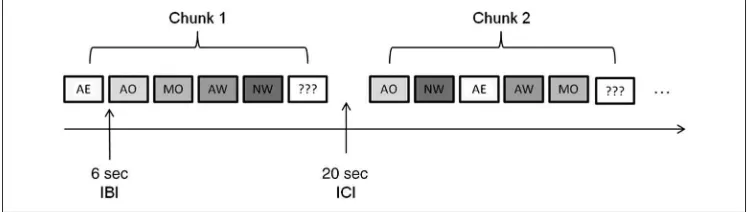
Stimuli were presented in 12 chunks, each consisting of five 30-sec blocks separated by a 6-sec interblock interval (see Figure 1). Chunks were made temporally independent from one another by including a 20-sec interchunk interval. Each block contained stimuli from one of each of the five conditions (AE, AO, MO, AW, NW). The order of blocks within each chunk was pseudorandomized, so that each chunk had a unique order of block presentation. Following each chunk, participants were presented with three stim-uli (e.g., video clips, word stimstim-uli) and asked to indicate whether the stimuli were included in the preceding chunk.
Data Acquisition
MRI data acquisition was performed on a Siemens Magnetom Trio scanner (Siemens Medical System, Erlangen, Germany) with a magnetic field strength of 3 T. The func-tional scans were acquired using a multiecho gradient pulse sequence (repetition time = 2390 msec; echo time = 9.4, 21.17, 32.94, 44.71, and 56.48 msec; flip angle = 90°). Each volume consisted of 31 transversal slices with a thickness of 3 mm. The voxel resolution was 3.5 mm × 3.5 mm × 3.5 mm. After the collection of functional data, a structural scan was performed for each individual participant. The image was a T1-weighted 3-D magnetization prepared rapid gradient echo sequence comprising 192 sagittal slices (repetition time = 2300 msec, echo time = 3.03 msec, slice thickness = 1 mm).
Data Analysis fMRI Preprocessing
SPM8 was used to initially transform DICOM images into NIFTI images for further processing. Subsequently, six movement parameters (three translations and three rota-tions) were extracted from the first echo of each volume and subsequently used to correct for small head move-ments in all five echoes of each volume. All five echoes were then combined into a single volume using a weighted average (Poser, Versluis, Hoogduin, & Norris, 2006). Further preprocessing and data analysis were carried out using FMRIBʼs Software Library 4.1.9 (Smith et al., 2004). A high-pass temporal filter using a 100-sec cutoff was ap-plied, and images were normalized into a 2-mm standard stereotaxic space (Montreal Neurological Institute). No spatial smoothing was performed to preserve local voxel information.
Functional Localizer
Motor areas were defined using a general linear model and carried out using fMRI Expert Analysis Tool 5.92. A cano-nical gamma function was used to model the BOLD re-sponse. The model contained six regressors, the button press plus five task conditions. The contrast was calculated as button press versus baseline. Statistical maps were computed using FMRIBʼs Local Analysis of Mixed Effects stage 1 (Woolrich, Behrens, Beckmann, Jenkinson, & Smith, 2004) and thresholded with azvalue of 2.56 and a corrected cluster significance threshold ofp< .05 (Worsley, 2001).
Multivoxel Pattern Classification
[image:4.612.187.562.557.663.2]Two types of pattern classification analyses were per-formed. First, the classifier was trained and tested on the same conditions, namely, (1) AE versus MO and (2) AO versus MO. This ensures that the classifier successfully learned to distinguish between task conditions. ROIs were
Figure 1.Stimulus
Uncorrected
Proof
only included in the second level of analysis if the classi-fier was successful in learning to distinguish between the initial task conditions. In ROIs in which the first level of pattern classification was successful, the trained classifiers were used to test between the reading of action versus nonaction verbs (AW vs. NW). Importantly, this was done without any further training of the initial classifier.
Each task condition was modeled with a general linear model containing a separate regressor for every chunk. Note that the chunk for AE condition was the time be-tween button presses, during which participants repeat-edly executed the action they had been shown in the 2-sec video clip. Resulting beta estimates (12 × 5 per par-ticipant) werezscored to a mean of 0 and to a standard deviation of 1. In each fold, a linear support vector machine (C= 1) was trained on the extracted voxel pattern for all but one participant. The remaining participant was used as an independent test set. This procedure (leave-one-participant-out cross-validation withN= 22 folds; Clithero, Smith, Carter, & Huettel, 2011) was repeated until every participant was used in the test set once. The classification analysis was performed separately for seven ROIs iden-tified by the functional localizer and two taken from the literature, which correspond to the putative location of mirror neurons in the lateral pFC (Oosterhof, Tipper, & Downing, 2012; Kilner, Neal, Wiskopf, Friston, & Frith, 2009). Note that the classification tests a common spatial pattern across participants as opposed to between trials.
A statistical test of the classification accuracy was performed using a nonparametric permutation analysis (Nichols & Holmes, 2002). To this end, we repeated each
classification 10.000 times with shuffled task labels. The
pvalue was calculated as the amount of times the per-muted classification reached an accuracy level higher or equal to the original classification accuracy without permu-tation, divided by the total number of permutations. All classification analyses were performed using the PyMVPA software package (Hanke et al., 2009).
RESULTS
Functional Localizer
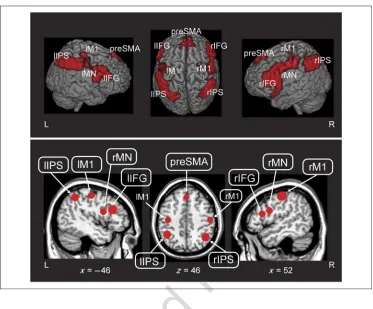
[image:5.612.178.551.58.367.2]The results of the functional localizer show brain areas that were activated when participants performed an action with their right hand (i.e., pushed a button). Importantly, this hand action was not performed in conjunction with any of the critical experimental conditions; thus, the data from this condition are temporally independent from the experimental data in this experiment. The results of the functional localizer show activation in conjunction with button presses in seven large regions. These included bilateral inferior frontal gyrus (part of the ventral pre-motor cortex; e.g., Binkofski & Buccino, 2006), bilateral inferior parietal cortex, bilateral primary motor cortex (M1), and the pre-SMAs (preSMAs). In addition, we in-cluded two additional ROIs in the bilateral ventral pre-motor cortex, which target specific areas in the prepre-motor cortex that have been described previously as potential sites for mirror neurons in humans (Oosterhof et al., 2012; Kilner et al., 2009). We created a spherical ROI with radius = 9 mm (358 voxels) around the peak coordinates
Figure 2. (Top) Areas identified by the functional localizer (i.e., simple button press; cluster corrected threshold,p< .05). (Bottom) ROIs used for classification analysis (sphere with 9-mm radius surround peak activations in areas seen on top. L = left; R = right.
Uncorrected
Proof
of the functional localizer map (see Figure 2). This re-sults in nine, equally sized ROIs that were used for all sub-sequent analyses: (1) left inferior frontal gyrus (lIFG), (2) right IFG (rIFG), (3) the preSMA, (4) left intraparietal sulcus (lIPS), (5) right IPS (rIPS), (6) left M1 (lM1), (7) right M1 (rM1), (8) left ventrolateral premotor cortex (lMN), and (9) right MN (rMN).
Pattern Classification
Using the pattern of activation identified in each of the nine ROIs, a classifier was trained to distinguish between neural activity associated with (1) AE in contrast to non-biological motion (AE vs. MO) and (2) AO in contrast to observation of nonbiological motion (AO vs. MO). If the classifier was able to reliably distinguish between these categories (i.e., performance significantly above chance), it was subsequently tested on patterns of neural activity elicited by words denoting actions (e.g., “to grasp,” “to pinch”) in contrast to words denoting nonbiological motion (e.g.,“to flow,” “to melt”; AW vs. NW).
AE versus MO
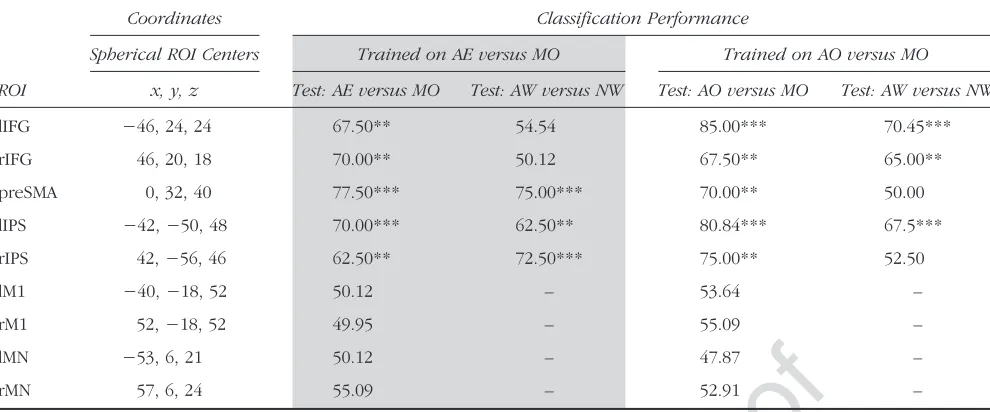
In five of nine ROIs, the classifier trained to distinguish between AE and MO was able to distinguish between a test set of AE and MO stimuli, which were not included in the training session (allps < .001; see Table 1 for exact performance rates andpvalues). This shows that the clas-sifier successfully learned to discriminate between AE and
MO. The signal from these five ROIs was thus reliable for training and testing between action conditions (i.e., train AE vs. MO, test AE vs. MO) and can therefore be used for training and then testing across word conditions (i.e., train AE vs. MO, test AW vs. NW). These ROIs were the bilateral IFG, the bilateral IPS, and the preSMA. The additional four ROIs were not tested further.
[image:6.612.63.558.76.282.2]Without further training, the AE-versus-MO classifier was applied to distinguish between the word categories (AW vs. NW) in the five successful ROIs. The classifier successfully predicted word categories using information from the bilateral IPS and preSMA, but not using infor-mation from IFG (see Table 1, Figure 3).
Table 1. Classifier Performance Rates and Spatial Information for ROIs
ROI
Coordinates Classification Performance
Spherical ROI Centers Trained on AE versus MO Trained on AO versus MO
x, y, z Test: AE versus MO Test: AW versus NW Test: AO versus MO Test: AW versus NW
lIFG −46, 24, 24 67.50** 54.54 85.00*** 70.45***
rIFG 46, 20, 18 70.00** 50.12 67.50** 65.00**
preSMA 0, 32, 40 77.50*** 75.00*** 70.00** 50.00
lIPS −42,−50, 48 70.00*** 62.50** 80.84*** 67.5***
rIPS 42,−56, 46 62.50** 72.50*** 75.00** 52.50
lM1 −40,−18, 52 50.12 – 53.64 –
rM1 52,−18, 52 49.95 – 55.09 –
lMN −53, 6, 21 50.12 – 47.87 –
rMN 57, 6, 24 55.09 – 52.91 –
Information about the center of each spherical ROI (Montreal Neurological Institute coordinates, size = 358 voxels) is provided in the second column. Performance rates for classifiers are provided for each ROI in the final four columns. The columns shaded in gray show the performance rates when the classifier was trained on AE versus MO and then tested on (1) AE versus MO and (2) AW versus NW. The final two columns show the performance rates when the classifier was trained on AO versus MO and then tested on (1) AO versus MO and (2) AW vs. NW. Performance rates are shown for each ROI individually. Asterisks represent significance level.
*p< .05.
**p< .01.
***p< .005.
[image:6.612.320.562.563.693.2]Uncorrected
Proof
AO versus MOThe classifier trained to distinguish between AO and MO showed significant classification accuracy in five of the nine ROIs (all ps < .001; see Table 1). As explained above, this indicates that the pattern extracted from these five ROIs is reliable for training and testing between action conditions (i.e., train AO vs. MO, test AO vs. MO) and is therefore viable for use in training and testing across word conditions (i.e., train AO vs. MO, test AW vs. NW). Therefore, the AO-versus-MO classifier was used in these five ROIs to distinguish between AW and NW. Categorization was successful based on signal from lIPS and lIFG, but not using the signal from the preSMA nor either of the right hemisphere ROIs.
DISCUSSION
In the current study, we used a pattern classification method to investigate the spatial similarity of the signal elicited in motor areas by AE, AO, and the comprehen-sion of AW. Our results show (1) that the pattern of ac-tivation elicited by AE and AW was comparable within the preSMA and bilateral IPS, but not within bilateral ventrolateral premotor cortex (vlPMC). Second, the pat-tern of activation elicited by AO and AW was comparable within lIFG and lIPS. The results of this study make two important contributions: (1) activation in the lateral fronto-parietal motor areas, often reported previously for the comprehension of AW, is shown to be inconsistent with the pattern of activation elicited by the execution of actual motor movements. Second, the pattern of activation observed in lateral frontoparietal motor areas in conjunc-tion with AW is consistent with the pattern of activaconjunc-tion observed during AO. The implications of these findings are discussed further below.
Lateral PMC
The central claim of many embodied theories of language is that modality-specific brain areas are involved in the representation of conceptual information because words initiate a reenactment of actual experience. For example, action verbs such as“grasp”or“kick”activate the respec-tive neural motor areas involved in actually planning and executing grasping or kicking actions (e.g., Pulvermueller, 2005). One popular proposal has been that, during de-velopment, the common co-occurrence of performing a given action and hearing the word denoting the action causes word form and the neural correlates of acting to become connected (Hebbian learning; Pulvermueller, 1999, 2005). Thus, premotor and even primary motor areas are assumed to play a crucial role in represent-ing meanrepresent-ing of action verbs and concepts. The bulk of evi-dence in favor of this perspective shows selective activation of neural substrate close to or within primary motor and premotor areas (e.g., Aziz-Zadeh, Wilson,
Rizzolatti, & Iacoboni, 2006; Tettamanti et al., 2005; Hauk et al., 2004).
The current data show that the signal elicited in the ventral PMC by action verbs is not spatially comparable with that elicited by AE. On the other hand, the spatial parameter of activation within ventral PMC during the comprehension of AW is very similar to what is seen during AO. Intuitively, this finding is reasonable: Language stimuli may evoke an internal form of observation as we follow the verbal description of an unfolding event that is fundamentally different to the processes involved in preparing to act or imagining oneʼs own movements. Although these results indicate that overlapping activation reported previously for AE and word comprehension (e.g., Rueschemeyer et al., 2007; Hauk et al., 2004) probably does not reflect a common neural substrate, shared ac-tivation reported in conjunction with AO and word com-prehension indeed result from common neural resources (e.g., Aziz-Zadeh et al., 2006). Interestingly, a previous study has shown that action word comprehension acti-vates neural resources distinct from those engaged by instructed motor imagery (Willems, Toni, Hagoort, & Casasanto, 2009); thus, the internal observation of actions suggested here contrasts with imagining what it would be like to perform an action oneself and is more comparable with the process of visually perceiving another acting.
It is worth noting that the involvement of the cortical motor areas in processing lexical-semantic meaning has been shown to be influenced by task demands (Tomasino & Rumiati, 2013; Papeo et al., 2012; Van Dam et al., 2012). Specifically, it has been argued that words elicit more reli-able activation with cortical motor areas in language and situational contexts that highlight motor acts (e.g., per-forming mental rotation, thinking about actions vs. forms, etc.). In the current study, participants were arguably motivated to reflect on actions (e.g., they acted out and observed hand actions within each experimental chunk as well as processing word stimuli). Thus, based on pre-vious literature, the current paradigm is one in which the link between AW and cortical motor areas should be strong. Nevertheless, under these optimized conditions, our results show that the pattern of activation across multi-ple voxels in the cortical motor network is different for the processing of AW and the execution of hand actions.
Medial PMC and Parietal Cortex
In this study, AE and action word comprehension do elicit similar patterns of activation in cortical regions out-side lateral PMC. Good correspondence between the pattern of activation elicited by actions and words was observed in medial PMC (preSMA) and bilateral IPS. Both the preSMA and IPS are known to play key roles in the planning and execution of actions (e.g., Fogassi & Luppino, 2005; Picard & Strick, 2001), but both are involved in high-level integrative forms of action planning (e.g., adapt-ing actions to a given context), rather than servicadapt-ing the
Uncorrected
Proof
control of individual muscles. This suggests that the parts of the network that are activated in a comparable man-ner across AE and language comprehension are high-level abstractions of motor movements and not low-high-level residual traces of actual movements.
To summarize the results thus far, ventrolateral PMC is not engaged in the same manner during AE and action word comprehension. On the one hand, this is unsurpris-ing, as participants in the word condition are not engaged in any action, and brain activation should hopefully reflect that nontrivial distinction. On the other hand, this finding stands in contrast to the interpretation offered by the numerous studies, which have reported consistent over-lapping activation in lateral premotor sites for AE and action word comprehension. The results of the current study suggest that the results of previous studies do not reflect a common neural mechanism, but rather either spatially or temporally different processes in nearby neural tissue. In contrast, activation in higher-level integrative motor areas (i.e., preSMA and IPS) is common to action word content and AE.
There are three conclusions that can be drawn from the current experiment. First, brain areas showing comparable activation across action and language processing are high-level multimodal areas (e.g., preSMA, IPS). The areas in question are undoubtedly also crucial components of the neural motor system, but they are not domain specific in the same manner that M1 is. Thus, action and language con-tent share common representation, but the code in which lexical-semantic information is stored cannot be described as motor based. This finding stands in contrast to strongly embodied theories but is in general correspondence with more moderate and weakly embodied perspectives.
Second, the function of high-level multimodal areas is surprisingly consistent across participants. We trained our classifier to distinguish between AE and MO on the basis of signal generated from one participant (or multi-ple participants) but tested its performance on the signal generated in another participant. Therefore, we show not only that patterns of brain activation are common across cognitive tasks but also that there is a high degree of commonality across participants in the functional profile of high-level cognitive areas (preSMA, IPS).
Third, we contribute to the accumulating evidence sug-gesting different functional roles for lIFG/vlPMC engage-ment during AE and AO. Specifically, although evidence for the existence of small populations of neurons sensitive to both AE and AO exists (e.g., Kilner et al., 2009; for a re-view, see Rizzolatti & Craighero, 2004), the vast majority of neurons within PMC has been shown to exhibit differ-ent patterns of activation during execution and observation (e.g., Press, Weiskopf, & Kilner, 2012; Lingnau, Gesierich, & Caramazza, 2009). There are several points that make a distinction between execution and observation plausible. First, although it is likely that the posterior PMC is involved in forming predictions about the consequences of actions during both AE and AO (for a review, see Kilner, 2011),
the predicted consequences of acting and observing are often quite different (see, e.g., Newman-Norlund, van Schie, van Zuijlen, & Bekkering, 2007). In line with this, Oosterhof et al. (2012) demonstrate that the pattern of activation in the posterior PMC elicited by AE and observation is similar if actions are presented from the first-person perspective but that this similarity does not hold if actions are presented from the third-person per-spective. In the current study, we show that the pattern of activation in the lIFG/vPMC is similar for AO and word comprehension, but not for AE and lexical-semantic pro-cessing. We suggest above that words generate internal simulations of actions that are more similar to watching others act than to acting oneself. Thus, we show that action-word content does activate the lIFG/vPMC (i.e., does draw on resources of neural motor areas), but it does so in a manner akin to watching others act rather than to acting oneself.
Conclusion
In the current study, we used multivoxel pattern analysis to investigate whether overlapping cortical activation re-ported previously for AE and action-word comprehension reflects a common neural source or adjacent, but distinct, sources. The results demonstrate that overlapping ac-tivation in high-level multimodal areas (e.g., preSMA, IPS) reflects activation of a common source for AE and word comprehension. In contrast, activation in modality-specific areas (e.g., vlPMC) reflects activation of a common source for AO and word comprehension, but not for AE. The results of this study demonstrate that lexical-semantic meaning is derived from features that make use of neural substrate also involved in executing and observing actions in the real world but that the code in which action fea-tures are stored in the brain cannot be equated with motor content.
APPENDIX 1: DUTCH WORDS IN THE TWO-WORD CONDITIONS AND THEIR ENGLISH TRANSLATION EQUIVALENTS
AW
aaien, aansteken. aftasten, bedekken. betalen, bonken, borstelen, breken, buigen, deppen, dobbelen, duwen, epileren, fladderen, fotograferen, gooien, grabbelen, grijpen, hameren, kerven, knijpen, knutselen, naaien, noteren, openen, ophangen, opnemen, optillen, peuteren, pinnen, plukken, poetsen, prakken, prikken, puzzelen, reiken, salueren, scheren, scheuren, schieten, schilderen, schrapen, schroeven, smeren, smijten, snijden, steken, stompen, stoten, strelen, strijken, strooien, tekenen, uitgummen, verkreukelen, verspreiden, verven, wapperen, werpen, wrijven
Uncorrected
Proof
blot/dab, throw a die, push, tweeze, flutter, take a photo-graph, throw, grabble, grasp, hammer, carve, pinch, fiddle, sew, write down, open, hang up, take/pick up, lift, pick, pin, pluck, clean, mash, prick, do jigsaw puzzles, hand over, salute, shave, tear, shoot, paint, scratch, screw, smear, throw, cut, prick, punch, push, caress, iron, strew, draw, erase, crease, spread, paint, wave, throw, rub
Motion Words
aanspoelen, barsten, bestuiven, bevriezen, blaken, blikkeren, bliksemen, blinken, bloezen, blubberen, bollen, detoneren, dooien, drogen, druppelen, fonkelen, glippen, gloeien, golven, kletteren, lekken, lubberen, mie-zeren, misten, ontkiemen, ontladen, opladen, opzwellen, overspoelen, ploffen, plonzen, rijpen, roesten, roteren, schijnen, sidderen, slieren, sneeuwen, spatten, splijten, splinteren, stijgen, stomen, storten, uitbarsten, uitdrogen, verzachten, vallen, verbrokkelen, verdampen, verdikken, vergaan, vergroten, verkolen, verlichten, verzachten, waaien, wegebben, zinken, zwellen
wash ashore, burst, pollinate, freeze, scorch, flicker, blaze, glitter, droop, blubber, bulge, detonate, melt, dry, drip, sparkle, slide, glow, move in waves, clang, leak, bulge out, rain, fog up, germinate, explode, load, bulge, flood, thud, splash, ripen, get rusty, rotate, shine, tremble, slither, snow, splash, split, splinter (v), sliver, steam, fall, erupt, dry, drain, fall, crumble, evaporate, thicken, perish, enlarge, char, light up, attenuate, blow (wind), fade away, sink, swell up
Reprint requests should be sent to Shirley-Ann Rueschemeyer, Department of Psychology, University of York, York, YO10 5DD, UK, or via e-mail: [email protected].
REFERENCES
Aziz-Zadeh, L., & Damasio, A. (2008). Embodied semantics for actions: Findings from functional brain imaging.
Journal of Physiology-Paris, 102,35–39.
Aziz-Zadeh, L., Wilson, S., Rizzolatti, G., & Iacoboni, M. (2006). Congruent embodied representations for visually presented actions and linguistic phrases describing actions.Current Biology, 16,1818–1823.
Barsalou, L. (2008). Grounded cognition.Annual Review
of Psychology, 59,617–645.
Binder, J. R., Desai, R. H., Graves, W. W., & Conant, L. L. (2009). Where is the semantic system? A critical review and meta-analysis of 120 functional neuroimaging studies.
Cerebral Cortex, 19,2767–2797.
Binkofski, F., & Buccino, G. (2006). The role of ventral premotor cortex in action execution and action
understanding.Journal of Physiology-Paris, 99,396–405. Boulenger, V., Hauk, O., & Pulvermuller, F. (2009). Grasping
ideas with the motor system: Semantic somatotopy in idiom comprehension.Cerebral Cortex, 19,1905–1914. Clithero, J. A., Smith, D. V., Carter, R. M., & Huettel, S. A.
(2011). Within- and cross-participant classifiers reveal different neural coding of information.Neuroimage,
56,699–708.
De Zubicaray, G., Arciuli, J., & McMahon, K. (2013). Putting and end to the motor cortex representations of action words.Journal of Cognitive Neuroscience, 25,1957–1974. Fogassi, L., & Luppino, G. (2005). Motor functions of the
parietal lobe.Current Opinion in Neurobiology, 15, 626–631.
Glenberg, A., & Kaschak, M. (2002). Grounding language in action.Psychonomic Bulletin & Review, 9,558–565. Hanke, M., Halchenko, Y. O., Sederberg, P. B., Hanson, S. J.,
Haxby, J. V., & Pollmann, S. (2009). PyMVPA: A python toolbox for multivariate pattern analysis of fMRI data.
Neuroinformatics, 7,37–53.
Hauk, O., Johnsrude, I., & Pulvermueller, F. (2004). Somatotopic representation of action words in human motor and premotor cortex.Neuron, 41,301–307. Kiefer, M., & Pulvermueller, F. (2012). Conceptual
representations in mind and brain: Theoretical developments, current evidence and future directions.
Cortex, 48,805–825.
Kilner, J. (2011). More than one pathway to action
understanding.Trends in Cognitive Sciences, 15,352–357. Kilner, J., Neal, A., Wiskopf, N., Friston, K. J., & Frith, C. D.
(2009). Evidence of mirror neurons in human inferior frontal gyrus.Journal of Neuroscience, 29,10153–10159. Lingnau, A., Gesierich, B., & Caramazza, A. (2009). Asymmetric
fMRI adaptation reveals no evidence for mirror neurons in humans.Proceedings of the National Academy of
Sciences, U.S.A., 106,9925–9930.
Mahon, B. Z., & Caramazza, A. (2008). A critical look at the embodied cognition hypothesis and a new proposal for grounding conceptual content.Journal of Physiology-Paris,
102,59–70.
Meteyard, L., Cuadrado, S. R., Bahrami, B., & Vigliocco, G. (2012). Coming of age: A review of embodiment and neuroscience of semantics.Cortex, 48,1–17. Mur, M., Bandettini, P. A., & Kriegeskorte, N. (2009).
Revealing representational content with pattern-information fMRI—An introductory guide.Social Cognitive and
Affective Neuroscience, 4,101–109.
Newman-Norlund, R., van Schie, H., van Zuijlen, A., & Bekkering, H. (2007). The mirror neuron system is more active during complementary compared with imitative action.Nature Neuroscience, 10,817–818.
Nichols, T. E., & Holmes, A. P. (2002). Nonparametric permutation tests for functional neuroimaging: A primer with examples.Human Brain Mapping, 15,1–25. Oosterhof, N., Tipper, S., & Downing, P. (2012). Viewpoint
(in)dependence of action representations: An MVPA study.
Journal of Cognitive Neuroscience, 24,975–989.
Papeo, L., Pascual-Leone, A., & Caramazza, A. (2013). Disrupting the brain to validate hypotheses on the neurobiology of language.Frontiers in Human Neuroscience, 7,1–8. Papeo, L., Rumiati, R., Cecchetto, C., & Tomasino, B. (2012).
On-line changing of thinking about words: The effect of cognitive context on neural responses to verb reading.
Journal of Cognitive Neuroscience, 24,2348–2362.
Patterson, K., Nestor, P., & Rogers, T. (2007). Where do you know what you know? The representation of semantic knowledge in the human brain.Nature Reviews
Neuroscience, 8,976–987.
Picard, N., & Strick, P. (2001). Imaging the premotor areas.
Current Opinion in Neurobiology, 11,663–672.
Poser, B., Versluis, M., Hoogduin, J., & Norris, D. (2006). BOLD contrast sensitivity enhancement and artifact reduction with multiecho EPI: Parallel-acquired inhomogeneity-desensitized fMRI.Magnetic Resonance in Medicine, 55,1227–1235. Postle, N., McMahon, K., Ashton, R., Meredith, M., &
de Zubicaray, G. I. (2008). Action word meaning
Uncorrected
Proof
representations in cytoarchitectonically defined primaryand premotor cortices.Neuroimage, 43,634–644. Press, C., Weiskopf, N., & Kilner, J. (2012). Dissociable roles
of human inferior frontal gyrus during action execution and observation.Neuroimage, 60,1671–1677.
Pulvermueller, F. (1999). Words in the brainʼs language.
Behavioral and Brain Sciences, 22,253–336.
Pulvermueller, F. (2005). Brain mechanisms linking language and action.Nature Reviews Neuroscience, 6,576–582. Raposo, A., Moss, H. E., Stamatakis, E. A., & Tyler, L. K. (2009).
Modulation of motor and premotor cortices by actions, action words and action sentences.Neuropsychologia,
47,388–396.
Rizzolatti, G., & Craighero, L. (2004). The mirror-neuron system.Annual Review of Neuroscience, 27,169–192. Rueschemeyer, S.-A., Brass, M., & Friederici, A. D. (2007).
Comprehending prehending: Neural correlates of processing verbs with motor stems.Journal of Cognitive
Neuroscience, 19,855–865.
Rueschemeyer, S.-A., Glenberg, A., Kaschak, M., Mueller, K., & Friederici, A. D. (2010). Listening to sentences describing visual motion activates MT/ V5.Frontiers in Cognition. Rueschemeyer, S.-A., Rooij, D., Lindemann, O., Willems, R.,
& Bekkering, H. (2010). The function of words: Distinct neural correlates for words denoting differently
manipulable objects.Journal of Cognitive Neuroscience, 22,1844–1851.
Saygin, A. P., McCullough, S., Alac, M., & Emmorey, K. (2010). Modulation of BOLD response in motion-sensitive lateral temporal cortex by real and fictive motion sentences.
Journal of Cognitive Neuroscience, 22,2480–2490.
Schuil, K., Smits, M., & Zwaan, R. (2013). Sentential context modulates the involvement of the motor cortex in action language processing: An fMRI study.Frontiers in Human
Neuroscience, 7,1–13.
Tettamanti, M., Buccino, G., Saccuman, M. C., Gallese, V., Danna, M., Scifo, P., et al. (2005). Listening to action-related sentences activates fronto-parietal motor circuits.Journal
of Cognitive Neuroscience, 17,273–281.
Tomasino, B., & Rumiati, R. (2013). At the mercy of strategies: The role of motor representations in language understanding.
Frontiers in Psychology, 4,1–13.
Van Ackeren, M., Casasanto, D., Hagoort, P., Bekkering, H., & Rueschemeyer, S.-A. (2012). Pragmatics in action: Indirect requests engage theory of mind areas and the cortical motor network.Journal of Cognitive Neuroscience, 24, 2237–2247.
Van Dam, W. O., van Dijk, M., Bekkering, H., & Rueschemeyer, S.-A. (2012). Flexibility in embodied lexical-semantic representations.Human Brain Mapping, 33,2322–2333. Vigliocco, G., Vinson, D. P., Lewis, W., & Garrett, M. (2004).
Representing the meanings of object and action words: The featural and unitary semantic space hypothesis.
Cognitive Psychology, 48,422–448.
Willems, R., Toni, I., Hagoort, P., & Casasanto, D. (2009). Neural dissociations between action verb understanding and motor imagery. Journal of Cognitive Neuroscience, 22,2387–2400.
Woolrich, M. W., Behrens, T., Beckmann, C., Jenkinson, M., & Smith, S. (2004). Multi-level linear modelling for fMRI group analysis using Bayesian inference.Neuroimage, 21,1732–1747.
Worsley, K. (2001). Statistical analysis of activation images. In P. Jezzard, P. Matthews, & S. Smith (Eds.),Functional
MRI: An introduction to methods(Chap. 14, pp. 251–270).
Oxford, UK: Oxford University Press.
Zwaan, R., & Fischer, M. (2008). Embodied language: A review of the role of the motor system in language comprehension.Quarterly Journal of Experimental