Complications Faced By Women Executives in New Generation
Private Sector Banks in Puducherry State - India
Dr. Desti Kannaiah,
Senior Lecturer, School of Business, James Cook University, Singapore
Dr. P. Ashok kumar,
Assistant Professor, PG and Research Department of Commerce, AVS College of Arts and Science, Salem – 636 106, Tamil Nadu, India.
Abstract
The phenomenal growth of banks has created massive employment opportunities for the educated unemployed youths of our nation. The women job-seekers find jobs in banks more attractive and more suitable to their nature. Banks also were not only not averse to taking them but even welcomed their entry because women have certain innate traits which fit in with the job requirements. Thus the humongous increase in job opportunities in banks and the abundant availability of qualified women who get selected in job tests paved the way for the large number of women occupying positions in all cadres today in not only public sector and private sector banks but even in new generation banks. Indian women is distinct from their western counter parts in that they do not shed their conventional roles as mothers and house wives inspire of their professional responsibilities. They are skilled at blending professional excellence and traditional love for home harmoniously. In the process of balancing work and home life, they encounter a plethora of problems. The study is purely exploratory in nature and seeks to identify the factors preventing women employees from aspiring for higher post and problems hindering the work performance of women executives in private sector banks in Puducherry state. Further this aims also at finding out the organizational support for women employees to achieve better work performance. The conclusion has been given.
Key Words: Career Advancement, Problems faced by women executives, Role of women, Women in Banking Industry, Working women.
Introduction
India is a country with diverse traditions and customs. In all the religions, women hold a venerable position. Unfortunately, since ages, the role of women has been confined to household chores and limited to domestic issues. In the male-dominated Indian society, women suffered extreme levels of exploitation. Some factors – like death of bread winner, sudden fall in family income or inadequate family income – forced women to seek employment in informal sector (small trader, artisan or field laborer on a family farm), but that did not result in women empowerment. The participation of women as workers and women’s education was negligible.
With changing times, the potential of women was acknowledged and gradually status of women soared up in the society. Although the Government of India made great endeavors to break through such gender discrimination by introducing various initiatives like emphasis on women’s education, abolition of child marriages, women health activities, etc., but the results were not fruitful. The emergence of economic reforms in 1990s changed the entire dynamics of the economy. The economic liberalisation added new dimensions to the role and status of women. Women started stepping out of domestic portals and demonstrated their potential in business world. The growing Indian middle class shed apprehensions about educating the girl child and gave due importance for higher studies. Focus on educating women has changed the role of women. Gradually, women’s education was encouraged and due importance was given to women’s career and professional life.
Problems of Working Women in Banking Sector
A team of Bulgarian experts, headed by Professor Ivanovich, department head at the National Centre of Public Health Protection, conducted a survey on working conditions in the banking sector, aimed at determining risk levels based on employees’ self-evaluation. A case study was carried out in 2004 in a large bank that has branches throughout the country in Bulgaria. Findings of the study indicated that Female employees experience more physical pain and discomfort than their male counterparts. The feeling of fatigue appears earlier and increases more quickly among women (particularly after the fourth hour at work) than their male counterparts.
Constant exposure to computer terminals and the radiation there from has an adverse effect on the pregnant women. Women employees by their inherent fragile health suffer more from high work pace, high psychological pressure, dry air, noise, lighting and sitting position. Sedentary nature of bank jobs make the women employees more vulnerable to severe headache, paints and fingers and wrists, backache and waist problems, pain in neck and shoulders and eye strain.
exams conducted by the respective banks. The thought of attending to new born baby, toddlers, children returning from school, etc., distract the attention of women executives in their thirties. This has an adverse effect on the productivity of female executives. Some executives find it very difficult to manage male subordinates and have a tough time in extracting work from them. The very submissive nature of women executives come in the way of dealing with customers. It is also reported that the higher ups dump the work on submissive female executives which result in overloading the executives. In other words the very feminine nature does not permit them to resist the overload.
Since executives like cashier, teller, accountant, loan officer, portfolio managers, FOREX officer, assistant branch manager, etc., cannot leave the bank without tallying the account, the family members of female executives suffer more and executive concerned experience more mental stress than the male counterparts which have an adverse effect on the psychological health of the women executives. Besides women executives have to bear the verbal abuse of angry and irate customers. This upsets psychological well being of women executives. Some times when male chauvinist happens to be a performance appraiser in the capacity of higher ups, he shows his bias in the appraisal exercise. Similarly male chauvinist happens to be the subordinates; they willfully disobey the instructions of women executives and deliberately prolong the work. In the same vein, women executives do not get any cooperation from the peers in other departments of the bank thanks to male chauvinist attitude.
When it comes to recommending disciplinary action against the errant subordinates on the ground of insubordination or non performance or poor performance, women executives feel nervous to recommend for penal action. Thus the inefficiency syndrome continues to mar the work efficiency of male subordinates. Since most of the public and private sector banks are located in prime locality of the town or city and in the case of reaching branches located in far off places, women executives experience more physical strain in commuting to and fro work spot. This travel leaves an adverse impact on the physical and mental health of women respondents.
In view of hectic work schedule and heavy workload, women executives find it challenging to strike work life harmony. In other words the inability to give up conventional domestic obligations as a home maker cast additional strain on women officers across the bank. Besides women executives across the bank have to be away from the family on account of official meeting, inspection, assignment, etc,. This widens the gap in the relations between the women executives and the family members. All the inconvenience and discomfort suffered by the women executives in their professional journey as cited above have the potential to influence the work efficiency of the subjects thereby striking the quality of work performance.
Review of Literature
Okolo, I. (9th July. 1989). Another obstacle is the lack of role models of executive women due to their scarce presence in top managerial positions. Likewise, this study found out that there is no gender difference in organizational hierarchies when a woman has already gained access to them. The lack of impact in women can occur because executive and managerial women have developed survival features becoming immune to the effects of men’s hierarchies. A hierarchy composed by men solely may have an effect upon the election of a managerial board, and then its further influence is not very strong.
Sederer, L., and R. Seidenberg (1976) addresses genre segregation sustaining that managerial woman tend to concentrate in certain economic sectors only, which reflects the patterns of occupational segregation. In large corporations, if a woman ever gets a top managerial position, it would generally be in non-strategic areas of the organization. Moving towards other more strategic areas within the organization is even more difficult. This organizational barrier is sometimes called “glass ceiling”.
Skinner and Pocock (2008) investigated the relationship between work overload, work schedule control, work hours and their fit with preferences and work-life conflict among full-time employees (N=887). It was found that the strongest association with work-life conflict was demonstrated by work overload, followed by work schedule control, work hours and work hours fit. Time-based work life policies, procedures and interventions were found necessary, but not sufficient, for addressing work-life conflict. They called for effective management of work overload to support a healthy work-life relationship.
Sophia J. Ali (2011) investigated the challenges facing women in career development in Kapsabet Municipality, Kenya. She found that most of the women employees were dissatisfied with career development programmes and women were discriminated against in career development opportunities. The study recommended that organizations should strive to ensure that career development programmes were set to enhance career development amongst women employees. Top management should also be committed to the career development of women, and organizations should also introduce affirmative action to urgently address career development of women.
face problem of role conflict change in attitudes of men and women according to the situation can help to overcome their problem.
Nature and Scope of the Study
The study is purely exploratory in nature and seeks to identify the factors preventing women employees from aspiring for higher post and problems faced by women executives in New Generation Private Sector commercial banks related to work performance, studying the impact of family responsibility on career decisions of women employees in banking industry. The present study intends to survey only women executives who confront challenging situations which demand skills of a higher order for meeting them successfully.
Objectives of the Study
To study the problems faced by women executives working in New Generation Private Sector commercial banks in Puducherry state
To study the factors preventing women executives from aspiring for higher post working in New Generation Private Sector commercial banks in Puducherry state.
Study Area
Union Territory of Pondicherry region is the study area. Pondicherry State is linguistic, multi-ethnic, multi-religious and multi-cultural. This diversity makes it more attractive for this research. Besides, the state, though small in geographical area, has branches of all leading commercial banks.
RESEARCH METHODOLOGY Sample and Questionnaire
Data were collected using the personal contact approach. Questionnaires were distributed to a sample of 44 women employees in executives’ cadre working in New Generation Private Sector Banks (Axis Bank, HDFC Bank, ICICI Bank, Indusind Bank, Kotak Mahindra Bank) located in Puducherry state were surveyed. In the Questionnaire, Likert’s five point scale was employed to determine scores, where respondents were asked to rate each attribute on 5-point scale ranging from highly satisfied to highly dissatisfied, The data so collected was subjected to Factor Analysis. Census survey is to be adopted for collecting data. The statements/items for the questionnaire were formed after consulting relevant literature and some relevant research conducted in the area. Besides attitudes scale, the survey questionnaire also included a section to capture the general profile of respondents. They were asked about their demographic background including age, education level, marital status, job level, year of experience, nature of organization. The present study has used tools Factor analysis and Garret ranking method.
[image:3.595.69.531.458.755.2]ANALYSIS AND INTERPRETATION
Table - 1
Selected Respondents Demographic Profile
Age
Low Age (Below 25) 04(9.1) Middle Age (25-50) 40(90.9) High Age (Above 50) 0
Total 44(100)
Educational Qualification
Graduate 0
Post Graduate 28(63.6)
Doctorate 0
Professionally Qualified 16(36.4)
Total 44(100)
Marital Status
Single 16(36.4)
Married 28(63.6)
Widow 0
Total 44(100)
Salary Range / Month
Less than Rs.20000 8(18.18) Rs.20000 - Rs.30000 32(72.7) Rs.30001 - Rs.40000 4(9.1)
Above Rs.40000 0
Total 44(100)
Designation
Cluster Branch Manager (CGM) 0 Branch Manager (BM) 4(9.1) Branch Operational Manager (BOM) or 12(27.3)
Officers 28(63.6)
Total 44(100)
Experience
Less than 10 years 28(63.6) 10 to 20 years 16(36.4)
21 to 30 years 0
Above 30 years 0
Total 44(100)
Problem Facing Woman Executives in New Generation Private Sector Banks Table – 2
Total Variance Explained
Compo-nent
Initial Eigen values Rotation Sums of Squared Loadings
Total % of
Variance Cumulative % Total
% of
Variance Cumulative %
1 3.787 37.869 37.869 3.434 34.339 34.339
2 2.417 24.170 62.039 2.517 25.170 59.509
3 1.535 15.351 77.390 1.788 17.881 77.390
Extraction Method: Principal Component Analysis.
[image:4.595.74.526.334.678.2]Table 2 furnishes details of the results of factor analysis. A rotated factor matrix was obtained. To decide when to stop functioning so as to get the final rotated matrix, the latent root criteria was applied i.e., only the factors having Eigen values greater than one were considered significant, and all the factors with Eigen values less than one were considered insignificant and discarded. The factor matrix as obtained in the principal component analysis was further subjected to Varimax Rotation. It is seen from the table that three components were discriminated in terms of Eigen values. The first component with Eigen value 3.787 causes problem to woman executives to the extent of 37.869 per cent. The second component with the Eigen value 2.417 is responsible for problems of woman executives to the extent of 24.170 per cent. The last component with the Eigen value 1.535 accounts for 15.351 per cent of problems of women executives.
Table – 3
Rotated Component Matrix S.
No Problems F1 F2 F3
1 The heavy workload makes me completely worn out at the end
of the day. .925 -.088 -.087
2 Physical strain involved in answering our higher officers is
unbearable and it causes mental stress. .822 .102 -.093 3 The thought of my children who would have returned from
schools does not allow me to concentrate on work after office .404 -.377 .767 4 Extracting work from our male subordinates is very tedious. .889 .048 .093
5
Because of submissiveness natural to womenfolk, there is exploitation. I am asked to do work which is beyond my stated job routine.
-.409 -.807 .878
6
Ignorant customers pester me and sometimes quarrel with me causing me tension. I am unable to contain them unlike our male counterparts.
-.338 .165 .353
7 There is workplace harassment and I have to tolerate verbal
abusement. -.668 .485 .475
8
On account of pressing work, supervising the work performance of my subordinates and dealing with different types of customers all at the same time, I feel overburdened in my work. Being a woman it is beyond my physical endurance and I lose my temper quite often.
-.131 .810 .063
9 Sometimes I have a feeling that because of gender
discrimination, I am burdened with more and more work. -.454 .448 .227 10 Difficulty in controlling subordinates who quite often quarrel
with customers. -.008 .764 .003
Percentage of Variance 37.869 24.170 15.351
Cumulative Percentage 77.390
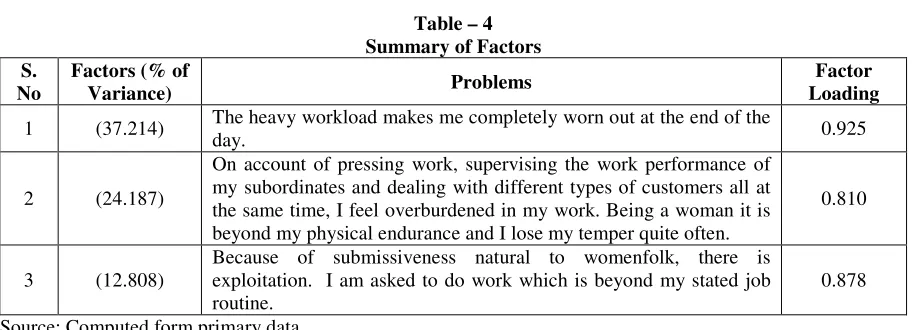
Table – 4 Summary of Factors S.
No
Factors (% of
Variance) Problems
Factor Loading
1 (37.214) The heavy workload makes me completely worn out at the end of the
day. 0.925
2 (24.187)
On account of pressing work, supervising the work performance of my subordinates and dealing with different types of customers all at the same time, I feel overburdened in my work. Being a woman it is beyond my physical endurance and I lose my temper quite often.
0.810
3 (12.808)
Because of submissiveness natural to womenfolk, there is exploitation. I am asked to do work which is beyond my stated job routine.
0.878
Source: Computed form primary data.
The results of rotated component matrix have been furnished in the table 3. The 10 problems were rotated thrice. Each rotation surfaced the most dominant factor in terms of factor loading. Accordingly the first spell rotation unearthed the factor causing heavy workload and the resultant stress is atop with factor loading 0.925. The second phase of rotation uncovered the stress variable dealing with supervising the subordinates and interacting with the customers in terms of factor loading of 0.810. The third rotation disclosed exploitation of women due to submissive nature in terms of factor loading of 0.787. All the three variables collectively account for 77.390 per cent problems experienced by woman executives in New Generation Private Sector Banks. All the three main problems causing are titled as physical stressors.
Factors Preventing Women Employees from Aspiring for Higher Level Posts in Banking Hierarchy The women executives, unlike their male counterparts, find it difficult to take up leadership roles in their path. Though they are on par with the male counterparts in terms of age, education, talent, skill, competence, knowledge, the conventional duties cast on women on domestic front, the natural love and affection towards the family members, inability to bear separation from the family thanks to promotion on transfer, physical debility in undertaking tours, etc. militate against their desire to climb up the career ladder. Number of research studies conducted on the factors preventing woman executives from even aspiring for top slots in the organisation hierarchy have unearthed a number of inhibitive factors. Some of the factors often reported to be barriers have been sieved from the literature survey. The factors such as taking care of the family (Siew Kim, J.L., and Seow Kim, C. 2001), combining domestic work and office work leaves no time for making us fit for higher posts Parveen, S., (1984), physical strain necessitating longer hours of stay in the office (Adams, G.A., King, L.A., and King, D.W. 1996), difficulty of better judgment and quick decision-making required in higher posts (Burke, R.J. and Mattis, M. 2005),strain of frequent tours and/ field visits (Sivakumar 2010)andfear of transfer which disturbs family life and domestic peace (Azhar, R., 1978)are taken into consideration to find out the major factors curbing the desire to aspire for higher end positions in the banking hierarchy.
Table – 5
Factors Preventing Women Employees from Aspiring for Higher Level Posts in Banking Hierarchy: Garret’s Ranking Method
S.
No Factors
Total
Score Total Mean Score Rank
a. Inevitability of conventional domestic obligations as a
home maker leaving little time for career growth. 2536 57.64 II b. Combining domestic work and office work leaves no
time for making us fit for higher posts. 2372 53.90 III c. Physical strain necessitating longer hours of stay in the
office 2712 61.64 I
d. Difficulty of better judgment and quick decision-making
required in higher posts. 1657 37.65 VI
e. Strain of frequent tours and/ field visits. 2113 48.02 IV f. Fear of transfer which disturbs family life and domestic
peace. 1843 41.89 V
The perception of the woman executives on the factors hindering the aspiration for higher post in New Generation Private Sector Banks has been ranked in the Table 5. It is patent from the table that the factor physical strain necessitating longer hours of stay in the office obtains first rank in terms of mean score of 61.64 and the factor inevitable domestic obligations gets the second rank in terms of mean score 57.64. It can be inferred from the top ranked factor that the exploitation of woman executives in higher position and the need to discharge domestic obligations after the office hours discourage the respondents in New Generation Private Sector Banks to aim for higher end jobs. However, the factors like difficulty of better judgment occupying last rank in terms of mean score of 37.65 and the factor fear of transfer on promotion occupying fifth position in term of mean score 41.89 are least hindering the career aspirations of the respondents.
Conclusion
The ten problems were rotated thrice. Each rotation surfaced the most dominant factor in terms of factor loading. Accordingly the first spell rotation unearthed the factor causing heavy workload and the resultant stress is atop with factor loading 0.925. The second phase of rotation uncovered the stress variable dealing with supervising the subordinates and interacting with the customers in terms of factor loading of 0.810. The third rotation disclosed exploitation of woman due to submissive nature in terms of factor loading of 0.787. All the three variables collectively account for 77.390 per cent of problems experienced by woman executives in NGPSBs. All the three major problems discriminated are titled as physical stressors.
The factor physical strain necessitating longer hours of stay in the office obtains first rank in terms of mean score of 61.64 and the factor ‘inevitable domestic obligations’ gets the second rank in terms of mean score 57.64. It is therefore concluded that from the top ranked factor that the exploitation of woman executives in higher position and the need to discharge domestic obligations after the office hours discourage the respondents in NGPSBs to aim for higher end jobs. However, the factors like difficulty of better judgment occupying last rank in terms of mean score of 37.65 and the factor fear of transfer on promotion occupying fifth position in terms of mean score 41.89 are least hindering the career aspirations of the respondents.
Woman executives to fare better in different types of banks, certain problems encountered in the discharge of professional duties like heavy workload, physical strain, the pain of dealing with illiterate customers, difficulties experienced in getting work done from the male subordinates, lack of time to attend to the needs of family members, etc. are found to be obstructing the otherwise smooth professional journey of woman executives. In this context the executives’ performance may be expected to reach the zenith of the performance level, if the suggested measures are implemented in true letter and spirit. Woman employees will, without doubt, come forward to accept challenging roles, and banks of all types can be credited with ushering in revolutionary stage for woman force employed in banking sector.
References:
1. Adams GA., King LA., and King DW. “Relationships of job and family involvement, family social support, and work-family conflict with job and life satisfaction. Journal of Applied Psychology 81(4) (1996): 411– 420.
2. Azhar R. “Attitudes of male towards career women.” M.Sc. Thesis, Department of Rural Sociology, University of Agriculture, Faisalabad, 1978.
3. Burke R.J. and Mattis M. Supporting Women’s Career Advancement. Edward Elgar, Cheltenham. 2005. 4. Okolo, I. (9th July. 1989). Women in the legal profession in Nigeria: Problems and prospects. Daily Times,
P. 5.
5. Parveen S. “An investigation into the problems of working women.” M.Sc. Thesis, Department of Rural Sociology, University of Agriculture, Faisalabad, 1984.
6. Sederer, L., and R. Seidenberg (1976). Heiress to an Empty Throne: Ego Ideal Problems of Contemporary Women. Contemporary Psychoanalisis, 12: 240-251.
7. Siew Kim JL. and Seow Kim C. “Work-family conflict of women entrepreneurs in Singapore.” Women in Management Review 16(5) (2001): 204–221.
8. Sivakumar. “Work commitment between the executives in private and public insurance companies in Vellor district Tamil Nadu.” M.Phil dissertation, Submitted to Madurai Kamarajar University, 2010.
9. Skinner N and Pocock B. “Work-life conflict: Is work time or work overload more important?” Asia Pacific Journal of Human Resources, 46.3 (2008): 303-315.
10. Sophia J. Ali. “Challenges Facing Women Employees In Career Development: A Focus On Kapsabet Municipality, Kenya” International Journal of Current Research 3.8, (2011) 196-203.