Multimedia Internet of Things:
Game Theoretic Approaches for
Distributed Resource Allocation
Nicole M. Sawyer
October 2019
A thesis submitted for the degree of
Doctor of Philosophy of
The Australian National University
and CSIRO Data61
Research School of Engineering
College of Engineering and Computer Science
The Australian National University and CSIRO Data61
c
Declaration
The contents of this thesis are the results of original research and have not been submitted for a higher degree to any other university or institution.
Much of the work in this thesis has been published or has been submitted for publication as journal papers or conference proceedings.
The work in this thesis has been performed while supervised by Dr. David Smith (Data61 CSIRO and The Australian National University), Prof. Xiangyun Zhou (The Australian National University) and Prof. Leif Hanlen (The Australian National University), and also jointly collaborated with Prof. Walid Saad (Virginia Tech) and Dr. Mehdi Naderi Soorki (Isfahan University of Technology). The substantial majority of this work was my own.
Nicole M. Sawyer
Research School of Engineering, The Australian National University, Data61 CSIRO,
Canberra, ACT 2601,
Australia.
Acknowledgements
The work presented in this thesis would not have been possible without the support of a number of individuals and organizations, who are gratefully acknowledged below:
• Firstly, I would like to express my sincere gratitude to my primary supervisor Dr. David Smith. I am grateful for all the continuous support, opportuni-ties, advice, guidance, and motivation throughout my PhD, it has made this journey enjoyable and unforgettable. Thank you for the freedom and flexibil-ity to explore a range of research areas, and being patient during numerous in-depth discussions over Skype.
• I would also like to thank the rest of my supervisory panel: Prof. Xiangyun (Sean) Zhou and Prof. Leif Hanlen. They have provided me great support, advice, and insightful comments, while also asking the hard questions, to help me improve the quality of my thesis.
• I would like to thank Prof. Walid Saad for kindly welcoming me to visit his research group at Virginia Tech for two and a half months. This research visit was an invaluable experience and one of the highlights of my Ph.D. journey, which has lead to many interesting discussions and collaborations. Thank you Prof. Saad for all the comments and feedback during our collaborations. The collaborations with Virginia Tech, have strengthened my research skills. I would also like to thank the rest of the research group at Virginia Tech, for their hospitality during my visit.
• I would like to thank Dr. Mehdi Naderi Soorki for providing supervision and guidance during my research visit at Virginia Tech, as well as the continued supervision and guidance once I returned to ANU. Thank you for your time, support, insight, and patience, during our collaborative research.
vi
• I would also like to thank everyone in the communications, signal process-ing, and acoustics research groups at the Research School of Engineerprocess-ing, ANU. Thank you to everyone, for making this a friendly and supportive en-vironment to study at ANU. Special thanks to Prof. Salman Durrani, for his continued support, advice, guidance, and patience, during my tutoring and course convening. Thank you to my colleagues, both past and present, Dr. Nan Yang, Prof. Parastoo Sadeghi, Prof. Rod Kennedy, Dr. Alice Bates, Dr. Yeif Huang, Dr. Jing Guo, Dr. Prasanga Samarasinghe, Samaneh Movassaghi, Jihui (Aimee) Zhang, Noman Akbar, Samiya Shimly, Khurram Shahzad, Usama Elahi, Yuting Fang, and Katrina Zhou.
• I wish to thank my loving and supportive partner, Josh, for everything you have done for me during my studies. Thank you for all your encouragement and advice. I would also like to thank you for putting a smile on my face everyday, making me laugh, and making sure I took time to relax from my studies. Special thanks to Josh’s parents and sister, for all their support and encouragement.
Abstract
Multimedia Internet of Things (IoT) is an emerging paradigm enabling devices to form an interconnected network of all types of communication. Multimedia IoT is integral to future wireless networks, but there are many challenges that must be addressed, including: network modelling; resource management; massive scale; interference management; clustering; and user quality-of-experience.
This thesis focuses on three key enabling technologies of multimedia IoT: (i) device-to-device (D2D) communications; (ii) machine-to-machine (M2M) commu-nications; and (iii) unmanned aerial vehicles (UAVs) as low flying base stations (BSs). Using game theory, we develop novel solutions for decision making pro-cesses required to address the key challenges and technologies of multimedia IoT, where interactions between users competing for resources are modelled in a fully distributed and autonomous manner.
In the first half of this thesis, we study game theoretic approaches for re-source allocation in underlaid D2D communications. First, we propose a flexible application-driven resource allocation scheme, to enhance and improve D2D user quality-of-experience and reliability. We propose a multiple objective Stackelberg game using a non-scalarised approach to enable flexible resource allocation, by co-ordinating and reducing the effects of intra-cell interference, while ensuring D2D user quality-of-experience. We demonstrate that best social welfare is guaranteed across all D2D users.
Next, to further reduce intra-cell interference in underlaid D2D networks, we jointly optimise D2D mode selection, resource block allocation, and interference management. In existing D2D mode selection techniques, the BS assists D2D pairs in selecting a transmission mode, requiring complete channel state information (CSI), i.e., a network-assisted scenario. We propose both a non-cooperative game and a coalitional game to solve this joint optimisation problem in a network-assisted scenario. Next, we investigate a user-assisted approach as a viable D2D mode
viii
tion solution, where the BS has partial CSI. Hence, we extend the coalitional game to consider the user-assisted approach, while also coordinating intra-cell interfer-ence, scheduling D2D pairs, and allocating resource blocks efficiently. Extensive simulations validate the effectiveness of the proposed coalitional game in a user-assisted scenario.
In the second half of this thesis, we explore two emerging topics in M2M commu-nications: (i) correlation-aware clustering in dense M2M networks; and (ii) UAVs as low flying BSs. We first propose a clustering algorithm to cluster a massive num-ber of machine-type devices based on data correlation, which reduces the numnum-ber of redundant bits being sent to the BS. To solve this, we propose an evolutionary game, and derive a novel utility function that captures the average machine-type device transmission power per cluster, using stochastic geometry. The proposed algorithm converges to a stable cluster formation, which is robust to stochastic changes in the M2M network environment.
List of Publications
The work in this thesis has been published or has been submitted for publication as journal/conference papers. These papers are:
Journal papers:
J1 N. Sawyer, and D. B. Smith, “A Nash Stable Cross-Layer Coalitional Game
for Resource Utilization in Device-to-Device Communications,”IEEE Trans. on Vehicular Technology, vol. 67, no. 9, pp. 8608–8622, Sept. 2018.
J2 N. Sawyer, and D. B. Smith, “Flexible Resource Allocation in
Device-to-Device Communications using Stackelberg Game Theory,” IEEE Trans. on Communications, vol. 67, no. 1, pp. 653–667, Jan. 2019.
J3 N. Sawyer, M. Naderi Soorki, W. Saad, D. B. Smith, and N. Ding,
“Evolution-ary Games for Correlation-Aware Clustering in Massive Machine-to-Machine Networks,” IEEE Trans. on Communications, May 2019.
J4 N. Sawyer, M. Naderi Soorki, W. Saad, N. Ding, D. B. Smith, M. H.
Man-shaei, and M. Mozaffari, “Energy-Aware Scheduling for Ultra-Reliable In-ternet of Things Communications using Unmanned Aerial Vehicles,” (under preparation to be submitted to IEEE Internet of Things Journal).
Conference papers:
C1 N. Sawyer, and D. B. Smith, “Pareto-Efficient Cross-Layer Repeated Game
for Device-to-Device (D2D) Communications,” inProc. IEEE Int. Conf. on Communications (ICC), Kuala Lumpur, Malaysia, pp. 1–6, May 2016.
C2 N. Sawyer, and D. B. Smith, “A Nash Stable Cross-Layer Coalition
Forma-tion Game for Device-to-Device CommunicaForma-tions,” inProc. IEEE Int. Conf. on Communications (ICC), Paris, France, pp. 1-6, May 2017.
x
C3 N. Sawyer, M. Naderi Soorki, W. Saad, and D. B. Smith, “Evolutionary
List of Abbreviations
3GPP 3rd Generation Partnership Project 5G fifth generation
AWGN additive while Gaussian noise BS base station
CTD cellular-type device CSI channel state information D2D device-to-device
dB decibel
dBm decibel-miliwatts
ESS evolutionary stable state GHz Gigahertz
IoT Internet of Things LTE Long-Term Evoluion M2M machine-to-machine MTD machine-type device
OFDMA orthogonal frequency-division multiple access PDR packet delivery ratio
PPP Poisson point process
QAM quadrature amplitude modulation QoE quality-of-experience
QoS quality-of-service
QPSK quadrature phase shift keying
SINR signal to interference plus noise ratio UAV unmanned aerial vehicle
URLLC ultra-reliable low latency communications
List of Notations
The following mathematical notations are consistent throughout the entire thesis:
a scalar variable
a vector variable
A matrix variable
A set variable
||a|| Euclidean norm of vector a
|a| absolute value of scalara
|A| size of set A
logn(·) logarithm of base n
E(·) mathematical expectation operator Γ(·) Gamma function
(·)! factorial
max(·) maximum operator
∅ empty set
\ set exclusion operator
⌊·⌋ floor operator
∪ union operator
Contents
Declaration iii
Acknowledgements v
Abstract vii
List of Publications ix
List of Abbreviations xi
List of Notations xiii
List of Figures xix
List of Tables xxiii
1 Introduction 1
1.1 Motivation . . . 1
1.1.1 Research Challenges in Multimedia IoT . . . 5
1.2 Thesis Objective . . . 11
1.3 Performance Metrics and Analytical Tools . . . 12
1.3.1 Key Performance Metrics . . . 13
1.3.2 Game Theory . . . 14
1.4 Thesis Contributions and Organisation . . . 21
2 Literature Review 29 2.1 Resource Management and End-User Satisfaction in D2D Commu-nications . . . 29
2.1.1 D2D Transmission Mode Selection . . . 30
2.1.2 Interference Management and Resource Allocation . . . 32
xvi Contents
2.1.3 End-User Satisfaction . . . 36
2.1.4 Summary . . . 38
2.2 Data Correlation in M2M Communications . . . 38
2.3 Enabling UAVs as Flying BSs for Mission Critical M2M Communi-cations . . . 41
2.4 Summary . . . 43
3 Flexible D2D Application-Driven Resource Allocation 47 3.1 System Model and Problem Formulation . . . 48
3.2 Flexible Resource Allocation Stackelberg Game . . . 53
3.2.1 Leader Utility Function . . . 54
3.2.2 Follower Utility Function . . . 55
3.2.3 Leader’s Charging Price to the Followers . . . 57
3.2.4 Resource Block Allocation . . . 58
3.3 Analysis of the Proposed Stackelberg Game . . . 59
3.3.1 Follower Analysis . . . 59
3.3.2 Leader Analysis . . . 61
3.4 Proposed Algorithm . . . 63
3.5 Stackelberg Equilibrium Analysis . . . 63
3.6 Simulation Results . . . 66
3.7 Summary of Contributions . . . 72
4 D2D Mode Selection and Resource Allocation in D2D Networks 75 4.1 System Model . . . 76
4.2 Non-cooperative Cross-Layer Repeated Game . . . 80
4.2.1 Non-cooperative Power Control Game . . . 81
4.2.2 Two-Armed Bandit Game . . . 82
4.2.3 Non-Cooperative Cross-Layer Repeated Game Stability Anal-ysis . . . 84
4.3 Cross-Layer Coalitional Game Formulation . . . 85
4.3.1 Cross-Layer Coalitional Game Overview . . . 86
4.3.2 Mode Selection and Resource Allocation Coalitional Game . 89 4.3.3 Sub-Problems in the CLC Game . . . 94
Contents xvii
4.5 Cross-Layer Coalition Game Stability and Computational Cost
Anal-ysis . . . 98
4.5.1 Stability Analysis . . . 98
4.5.2 Computational Cost . . . 101
4.6 Simulation Results . . . 102
4.7 Summary of Contributions . . . 107
5 Correlation-Aware Clustering in M2M Networks 109 5.1 System Model . . . 110
5.1.1 Problem Formulation . . . 112
5.2 Correlation-Aware Evolutionary Game in a Massive M2M network . 118 5.2.1 Evolutionary Game . . . 119
5.2.2 Dynamics of Cluster Formation . . . 121
5.3 Proposed Algorithm . . . 123
5.4 Evolutionary Game Stability Analysis . . . 123
5.5 Simulation Results . . . 124
5.6 Summary of Contributions . . . 135
6 Utilizing UAVs in Mission Critical M2M Communications 137 6.1 System Model . . . 138
6.1.1 Uplink Transmission Model . . . 141
6.1.2 Aggregator Queue Model . . . 142
6.2 Energy-Aware Scheduling for UAVs and CHs . . . 144
6.2.1 A Tunable Minimum-Drift-Plus-Penalty Optimisation . . . . 145
6.3 One-to-Many Matching for Ultra-Reliable Energy-Aware Scheduling 148 6.3.1 Utility Functions and Preference Relations of UAVs and CHs 149 6.3.2 Stable Matching Analysis of Distributed Ultra Reliable and Energy-Aware Scheduling Algorithm . . . 151
6.4 Proposed Algorithm Description . . . 152
6.5 Stability, Convergence, Optimality, and Computational Cost of the Proposed Algorithm . . . 153
6.5.1 Stability, Convergence, and Optimality . . . 154
6.5.2 Computational Cost . . . 154
6.6 Simulation Results . . . 155
xviii Contents
7 Conclusions and Future Research Directions 161
7.1 Future Research . . . 163
A Appendix A 167 A.1 Proof of Proposition 3.1 . . . 167
A.2 Proof of Proposition 3.2 . . . 168
A.3 Proof of Theorem 3.1 . . . 169
B Appendix B 171 B.1 Proof of Proposition 4.2 . . . 171
B.2 Proof of Proposition 4.3 . . . 172
B.3 Proof of Proposition 4.5 . . . 173
B.4 Proof of Theorem 4.1 . . . 174
C Appendix C 175 C.1 Derivation of Equation (5.11): Closed-Form Expression for the Util-ity Function . . . 175
C.2 Proof of Theorem 5.1 . . . 177
D Appendix D 179 D.1 Proof of Lemma 6.1 . . . 179
D.2 Proof of Theorem 6.1 . . . 180
D.3 Proof of Theorem 6.2 . . . 180
List of Figures
1.1 Illustration of traditional cellular communications. . . 2
1.2 Three main 5G use cases for multimedia IoT and examples of appli-cations [1]. . . 4
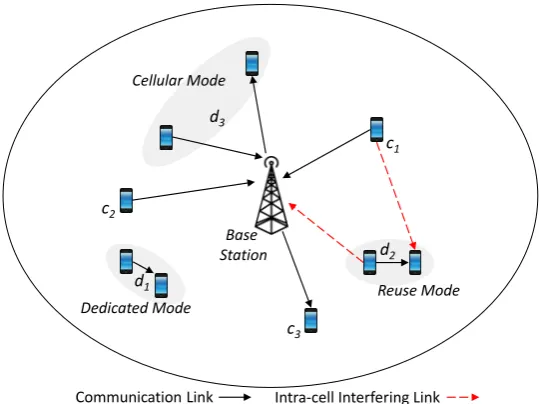
1.3 Illustrative scenario of all transmission modes for D2D communica-tions. In this example, D2D pair d1 is transmitting in dedicated
mode, D2D paird2 is transmitting in reuse mode and causing
intra-cell interference, and D2D paird3 is transmitting in cellular mode. . 7
1.4 Resource block allocation for the example scenario shown in Fig. 1.3. 7
1.5 The thesis outline. . . 22
2.1 M2M network topology, without clustering . . . 39
2.2 M2M network topology, with clustering . . . 39
2.3 Use cases of multimedia IoT communications, including UAVs. This figure is a modification of Fig. 1 in [2]. . . 41
3.1 Illustration of the D2D communication system topology for reuse mode only. The intra-cell interference for cellular userc1 is outlined
in red. Note that, if the colour of the communication link for either a cellular user and/or a D2D pair is the same, this indicates that the BS has allocated the same resource block for transmission. . . . 49
3.2 SINR versus PDR simulation and compressed exponential approx-imation (1.2), for the three modulation types and a packet size of 1500 bytes, as outlined in Table 3.1. . . 51
3.3 Flow chart of the proposed flexible resource allocation Stackelberg game. . . 58
3.4 BS’s satisfaction fee with and without priority, using coded 16-QAM. 68
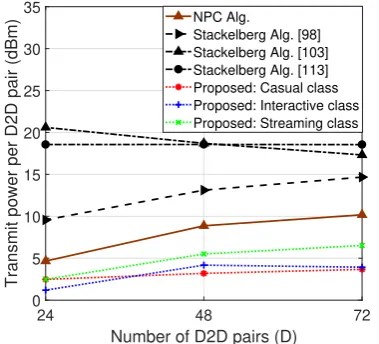
3.5 Transmit power per D2D pair, (no priority), using coded QPSK. . . 68
xx List of Figures
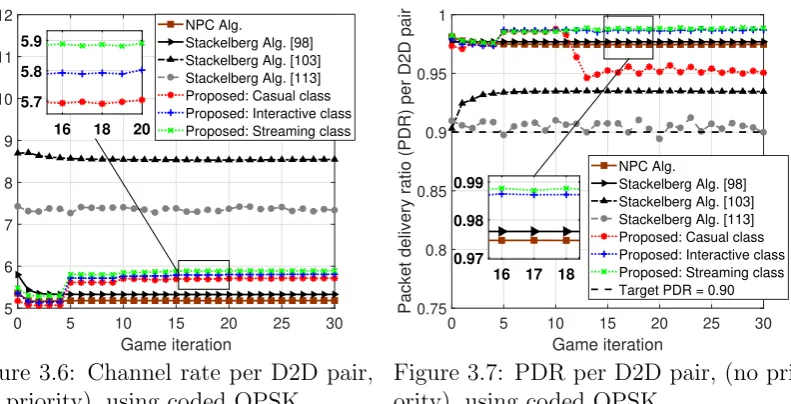
3.6 Channel rate per D2D pair, (no priority), using coded QPSK. . . . 69
3.7 PDR per D2D pair, (no priority), using coded QPSK. . . 69
3.8 PDR per D2D pair, with priority, using coded QPSK. . . 70
3.9 Transmit power per D2D pair under increasing number of cellular users when D=48, (no priority), using coded 16-QAM. . . 70
3.10 Transmit power per D2D pair under increasing number of D2D pairs when C=8, (no priority), using coded 16-QAM. . . 71
3.11 Leader’s charging price assigned to the followers, under increasing number of cellular users and D2D pairs, (no priority), using coded QPSK. . . 71
4.1 D2D communication system topology for all three transmission modes. The intra-cell interference for cellular users c2 and c3 is outlined in red. Note that, this system topology can be used for both network-assisted and user-network-assisted scenarios. . . 78
4.2 Proposed CLC game framework to solve resource utilisation in D2D communications. The red block indicates where the network-assisted or user-assisted schemes are considered. . . 88
4.3 Network sum power across all users in the network. . . 104
4.4 Network sum rate across all users in the network. . . 104
4.5 Network sum rate as a function of cellular users C. . . 105
4.6 Network sum rate as a function of resource blocks R. . . 105
4.7 Number of active D2D pairs in reuse mode as a function of cellular users C. . . 106
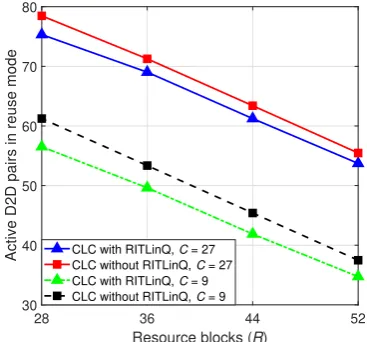
4.8 Number of active D2D pairs in reuse mode as a function of resource blocks R. . . 106
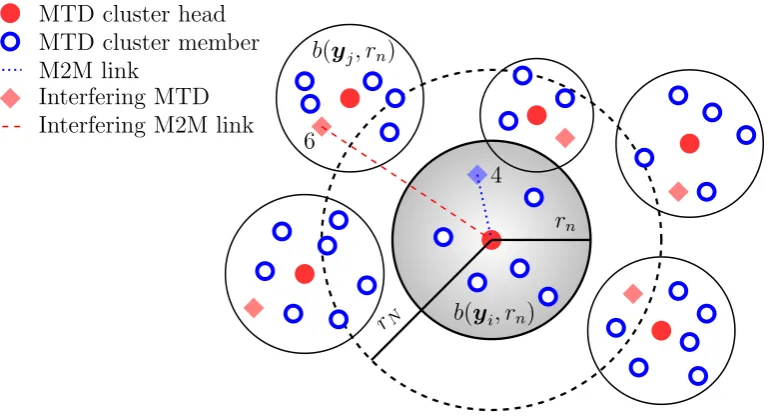
5.1 Illustration example of clustering in an M2M network. . . 112
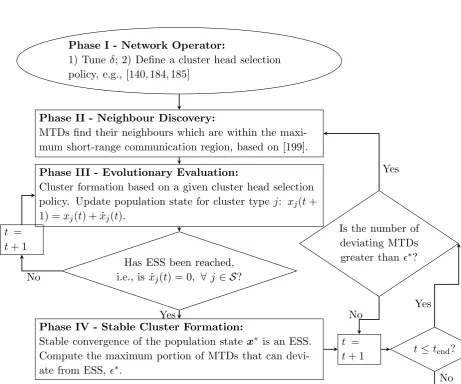
5.2 Flow chart of the proposed algorithm. . . 125
5.3 Simulated and analytical interference as a function of MTD density, λm, where c= 6. . . 127
5.4 Simulated and analytical M2M link transmit power as a function of MTD density, λm, where c= 6. . . 127
List of Figures xxi
5.6 Percentage of MTDs selecting a particular transmission M2M link rate as a function of path loss exponents, ν, where λm = 0.09 and
c= 6. . . 128
5.7 Percentage of MTDs forming a particular cluster as a function of δ, where λm = 0.09, c= 6, and ν = 2.5. . . 129
5.8 Percentage of MTDs forming a particular cluster size as a function of correlation constants,c, and MTD density, λm, where ν= 2.5. . . 130
5.9 Radius of the ball as a function of MTD density, λm, and correlation
constants, c, where ν= 2.5. . . 130
5.10 Dynamics of average transmit power per MTD per cluster, where
λm = 0.09 andν = 2.5. . . 131
5.11 Total M2M link transmit power per MTD per cluster as a function of MTD density, λm, where ν = 2.5. . . 131
5.12 Number of redundant bits per cluster vs. MTD density, λm, where
ν = 2.5. . . 132
5.13 Maximum percentage of deviating MTDs from ESS vs. MTD den-sity, λm, whereν = 2.5. . . 132
5.14 Total transmit power per cluster vs. cluster sizes and MTD density,
λm, where ν = 2.5 and c= 6. . . 133
5.15 Total transmit power per cluster vs. cluster sizes and correlation constant, c, where ν = 2.5 and λm = 0.09. . . 133
6.1 System model of a clustered M2M network, with UAVs as flying BSs. . . 140
6.2 Decision epoch example based on system model example in Fig. 6.1. . . 140
6.3 Maximum queue length, where ρtx = 0.5, K = 2 and [Mth, Bth] =
[20,450]. . . 156
6.4 Maximum queue length variance, where ρtx = 0.5, K = 2 and
[Mth, Bth] = [20,450]. . . 156
6.5 Minimum number of UAVs required to service the setA of aggrega-tors as a function of ρtx and [Mth, Bth]. . . 157
6.6 Average entropic risk for a minimum number of UAVs as a function of ρtx and [Mth, Bth]. . . 157
xxii List of Figures
List of Tables
3.1 Estimated parameters, ac and bc, from (1.2) . . . 51
3.2 Practical application examples of D2D pairs for each class . . . 52 3.3 Simulation Parameters and Values . . . 67
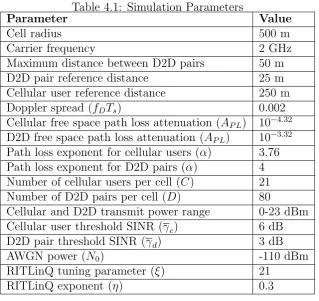
4.1 Simulation Parameters . . . 103
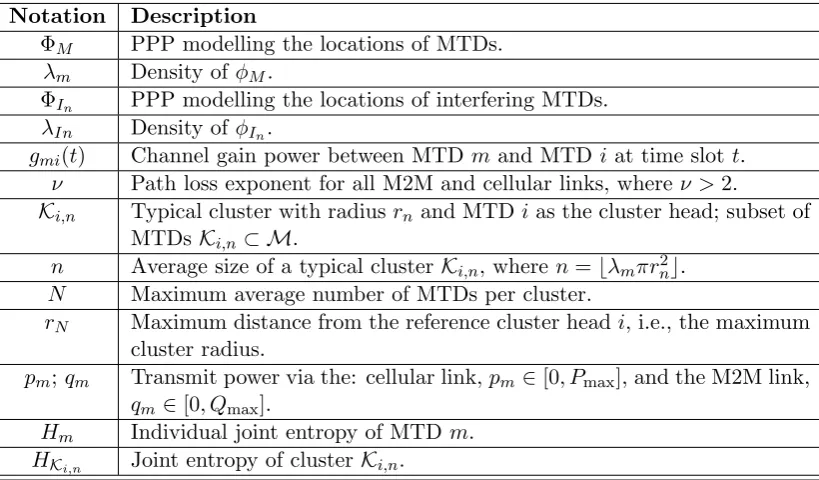
5.1 The maximum average number of MTDs for different densities and radii. . . 114 5.2 Summary of the notations used throughout this work. . . 115 5.3 Average gains for the number of redundant bits per cluster, Fig. 5.12.133
6.1 Simulation Parameters. . . 155
Chapter 1
Introduction
1.1
Motivation
A predominant influence in the evolution of wireless cellular networks is the expo-nential growth in the number of wireless mobile devices, high mobile data traffic, and the need for better quality-of-experience (QoE). In particular, the evolution of wireless cellular networks has been a major driver for the development of mul-timedia Internet of Things (IoT). Mulmul-timedia IoT is an emerging paradigm, that encompasses both cellular-type devices (CTDs) and machine-type devices (MTDs) to form a fully interconnected network, which will provide unlimited access to a range of information and sharing of data [3–6]. In fact, wireless sensor networks are a core part of multimedia IoT paradigm [6].
According to Cisco, there were 18 billion global mobile devices and connections in the year 2017, which is expected to increase to 28.5 billion by 2022, i.e., a compound annual growth rate of 10% [7]. Out of the 28.5 billion global mobile devices and connections in 2022, 14.6 billion will be from MTDs (i.e., sensing, smart metering, actuators, wearable devices, etc.) and the rest will be from CTDS (i.e., smart phones or personal mobile-devices) [7]. In fact, mobile video traffic will account for 82 % of the total mobile data traffic by 2022 [7]. Hence, supporting the massive number of CTDs and MTDs in multimedia IoT is a key design challenge. In traditional cellular networks, a BS is located at the center of the network and provides coverage to all users within the coverage area. Consider a simple scenario, as outlined in Fig. 1.1, where we have cellular user A that wishes to communicate with cellular user B within the coverage area of the same BS. Cel-lular user A will transmit its message to the BS via an uplink, where the BS will then forward (relay) the message to cellular user B via the downlink. Hence, all
2 Introduction
Base Station Cellular
user A
[image:25.595.178.364.98.224.2]Cellular user B
Figure 1.1: Illustration of traditional cellular communications.
cellular users relay their messages via the BS, and thus, the BS has control over all cellular communications within its coverage area. However, due to the number of CTDs exponentially increasing and the addition of the increasing number of MTDs within the cellular network, this will cause an increase in the traffic and demand on the BS and cellular resources [2, 8, 9]. In addition, individual mobile users are now demanding higher data rates for increased social networking appli-cations, gaming, augmented virtual reality, and video streaming [2, 10, 11]. These factors for CTDs, along side the periodic/non-periodic data traffic of MTDs, will continue to increase the data traffic within cellular networks. Hence, this will lead to performance degradation of the network and the BS, which, in turn, will cause increased latency periods and outages, and reduced communication reliability and QoS for all users [2]. Thus, traditional cellular networks have become inadequate to support the massive number of devices, as well as the requirements and demands of these devices. To improve the current cellular networks, new paradigms such as multimedia IoT in next generation wireless networks are needed.
The next generation wireless network, 5G, is expected to provide: (i) en-hanced mobile broadband, (ii) massive machine-type communication, and (iii) Ultra-Reliable Low Latency Communications (URLLC) [10, 11]. In fact, 5G sys-tems will aim to provide increased capacity, higher data rate, increased coverage area, low end-to-end latency, high reliability, and support a massive number of de-vices [7,8,12]. To meet these criteria, it is expected that the future 5G network will provide the following enhancements over the current 4G network [7, 8, 10, 11, 13]:
1.1 Motivation 3
cell-edge devices will receive an increased data rate of at least 100 Mbps.
• Ultra-low end-to-end latency of less than 1 ms, compared to current 4G roundtrip latencies of 15 ms, as well as ultra-high reliability guaranteeing no less than 1−10−5.
• Improving energy efficiency by decreasing the energy per bit and the cost per bit for each data link by 100×.
• Support a massive number of devices (1 million MTDs/km2) densely deployed
within the network.
Multimedia IoT will support a diverse range of devices within the network, i.e., CTDs, MTDs and UAVs, in order to revolutionise and improve our everyday lives [4, 5]. In particular, multimedia IoT will encompass all forms of media, rang-ing from high bandwidth applications for enhanced mobile broadband, to telemetry data sensing for massive machine-type communications, and ultra reliable and low latency for mission critical communications. Hence, in order to achieve these 5G requirements and assist in the evolution of the cellular network, new wireless tech-nologies are being considered [8,14]. The range of new wireless techtech-nologies include: millimeter wave; massive multiple-input multiple-output (MIMO); heterogeneous networks; D2D communications; M2M communications; and UAVs [2, 15]. From these new wireless technologies, in order to investigate a wide range of media type applications, this thesis will focus on three key enabling technologies of multimedia IoT: (i) D2D communications; (ii) M2M communications; and (iii) UAVs as low flying BSs in M2M communications. In particular here, investigations into D2D communications capture the area of enhanced mobile broadband, as it focuses on increased data rate, spectral efficiency, user experience, and energy efficiency. Here, M2M communications are investigated for supporting a massive number of MTDs in the cellular network that are densely deployed, as well as for utilising UAVs as flying BSs to assist in guaranteeing URLLC constraints in order to provide low latency and high reliability for mission critical applications. Fig. 1.2 outlines the three main 5G use cases for multimedia IoT, as well as application examples.
4 Introduction
Figure 1.2: Three main 5G use cases for multimedia IoT and examples of applica-tions [1].
advantages to both users and the network when adopting D2D communications, such as increased spectral efficiency, QoS, reliability, energy efficiency, throughput, system capacity, and scalability, as well as reduced latency [2, 9, 16]. D2D commu-nications can be implemented in either in-band (licensed spectrum) or out-band (unlicensed spectrum). Moreover, enabling direct communication between CTDs in multimedia IoT, will cause an increase in battery lifetime and larger coverage areas.
Like D2D communications, M2M communications is also an integral part in the current and future cellular network, as it enables advanced network applications such as smart home technologies, healthcare, drone systems, and surveillance [17– 22]. In fact, 3GPP conducted a study into further D2D enhancements [23], which proposed a user-to-network relay for IoT and wearables (i.e., MTDs) utilising D2D communications. This study aimed at utilizing the sidelink (i.e., the direct link) to increase energy-efficiency and communication reliability for all users in the net-work, as well as reducing power consumption and guaranteeing QoS for a range of different traffic types [23, 24]. An MTD can be a sensor, actuator, or smart meter whose typical role is to sense or measure an environment, and transmit the col-lected data to BSs. Thus, MTDs generally have little or no mobility and typically transmit small amounts of data [18]. Moreover, MTDs enable real-time monitoring and control of any physical environment, without direct human involvement, thus making processes more efficient and improving human welfare [25, 26].
1.1 Motivation 5
effective solutions for practical scenarios, due to their high mobility, agility, and flexibility [27,28]. In fact, UAVs can be used as aerial BSs, which can deliver reliable communications, as well as increased network capacity and coverage area [29, 30]. UAV BSs can be deployed to several scenarios, ranging from highly densely popu-lated areas to regions without coverage or poor connectivity. Furthermore, UAVs in multimedia IoT will play a key role in assisting M2M communications. For in-stance, an MTD may not have enough energy to transmit their data to the BS, due to limited battery lifetime, power constraints, and large transmission distances. Thus, UAVs can be deployed within close proximity to MTDs, in order to assist in forwarding MTD data to the cellular BS.
Implementing multimedia IoT in future wireless networks, poses significant chal-lenges to D2D communications, M2M communications, and UAVs as low flying BSs, ranging from network modelling to resource management, scalability, inter-ference management, user QoE, energy-efficiency, latency, and clustering. The chal-lenges for these three key enabling technologies of multimedia IoT are discussed in the next subsection.
1.1.1
Research Challenges in Multimedia IoT
1.1.1.1 D2D communications
D2D communications are classified as cellular oriented IoT networks, which focuses on a range of media type applications, including high bandwidth applications. The introduction of D2D communications in the current and future cellular networks, can be implemented in either in-band or out-band. In the case of in-band, D2D users will utilise licensed spectrum, whereas in the case of out-band, D2D users will utilise unlicensed spectrum. In particular, in-band D2D communications (li-censed spectrum) will guarantee higher QoS over out-band D2D communications (unlicensed spectrum), as out-band is susceptible to uncontrolled interference [16]. In this thesis, we focuses on in-band D2D communications. In particular, in-band D2D communications poses three main challenges, which are: D2D mode selection, resource allocation and interference management, and quality-of-experience. In the following we will give an overview of these main challenges.
spec-6 Introduction
trum, to select a transmission mode to operate in, i.e., D2D pairs need to deter-mine whether they should transmit via a direct link or a cellular link [16]. Fig. 1.3 outlines an illustrative example of the three transmission modes for D2D com-munications. Enabling D2D mode selection, allows D2D pairs to operate more efficiently, which leads to improved system capacity and throughput. Hence, the set of possible transmission modes for D2D communications are [16]:
• Cellular Mode: Enables D2D pairs to transmit via traditional cellular com-munications, i.e., relaying messages through a BS (no direct communication link). This mode is typically used if the distance between the D2D pair transmitter and receiver is large, or if the D2D pair is located within close proximity to a BS.
• Dedicated Mode: D2D pairs transmit directly between themselves. The BS al-locates these D2D pairs orthogonal resources, i.e., dedicated spectrum (over-lay). Thus, D2D pairs in dedicated mode will not receive or cause any in-terference within the cellular network, however, they will need to wait till resources become available.
• Reuse Mode: D2D pairs also transmit directly between themselves. The BS allocates these D2D pairs non-orthogonal resources, i.e., D2D pairs share existing cellular resources (underlay). Hence, D2D pairs in reuse mode will cause interference to cellular users and other D2D pairs sharing the same resource/s.
In order for a D2D pair to determine a suitable transmission mode to oper-ate in, the BS typically assists the D2D pairs in making such a decision, which is referred to as network-assisted D2D communications. Network-assisted D2D com-munications assumes that the BS must have global knowledge of the network, such as complete CSI and the location of all users [16, 31–33]. In order for the BS to acquire global knowledge of the network, this will cause signalling overhead and network complexity to significantly increase, especially with the number of users in the network is exponentially increasing. Furthermore, in practical scenarios, network-assisted D2D communications may not be ideal, as complete CSI cannot always be achieved for all users at the time.
1.1 Motivation 7
d1
d
2
Dedicated Mode Cellular Mode
Reuse Mode
d3
c
1
Base Station
Communication Link Intra-cell Interfering Link
c
2
c
3
Figure 1.3: Illustrative scenario of all transmission modes for D2D communications. In this example, D2D pair d1 is transmitting in dedicated mode, D2D pair d2 is
transmitting in reuse mode and causing intra-cell interference, and D2D pair d3 is
transmitting in cellular mode.
c2 uplink c3 downlink d3 uplink d3 downlink
d1 D2D link
Freq
Time
c1 uplink
d2 D2D link
Freq
[image:30.595.191.461.87.289.2]Time
Figure 1.4: Resource block allocation for the example scenario shown in Fig. 1.3.
it is desirable to design a D2D mode selection approach, where the BS has partial CSI of the network, i.e., the BS will have little involvement in the mode selection decision. Moreover, D2D mode selection also relates to the resource allocation and interference management challenge in D2D communications, which focuses on, how resources are allocated to D2D users, as well as how interference can be handled within the network, given a particular mode selection.
Resource Allocation and Interference Management: Resource allocation
8 Introduction
modes in D2D communications, based on the scenario in Fig. 1.3. For reuse mode, D2D pairs can reuse/share the uplink or downlink resource block/s of cellular user/s, which causes severe interference between users in the network. Hence, the interference may significantly degrade cellular user performance and QoS. In the cellular network, interference generated is characterised as intra-cell interference and inter-cell interference. In the case of intra-cell interference, this is generated between devices in a cell using the same time and frequency resources. In contrast, inter-cell interference is generated when users from different cells in the network use the same time and frequency resources.
In uplink resource sharing, D2D pairs will cause intra-cell interference to the cel-lular user’s uplink, as well as all other D2D pairs sharing the same uplink resources. On the other hand, in downlink resource sharing, D2D pairs will cause intra-cell interference to the cellular user’s downlink and the BS will cause interference to the D2D pair receiver. In particular, for uplink resource sharing, the BS can handle the extra interference that is caused by D2D communications, without requiring additional hardware [16, 34, 35]. Whereas, for downlink resource sharing, the D2D pair receiver may require extra hardware to handle the large amount of interfer-ence from the BS [16, 34, 35]. However, in either case, interferinterfer-ence management is needed in order to ensure users operate more efficiently and their performance is guaranteed.
Meanwhile, for dedicated and cellular modes, the BS will allocate orthogonal resources. D2D pairs operating in cellular mode are guaranteed orthogonal re-sources, as they are essentially operating as traditional cellular users. In contrast, coordination is required between D2D pairs and the BS, when allocating orthog-onal resources to D2D pairs in dedicated mode. This is because, the BS needs to assess if there are any free/idle resource blocks available to be allocated to D2D pairs [36].
Therefore, there is a need to adopt distributed resource allocation and inter-ference management schemes, in order to coordinate and reduce the interinter-ference between users in the network, as well as allocate orthogonal resources efficiently.
Quality-of-Experience: There is a wide range of potential applications for D2D
shar-1.1 Motivation 9
ing, advertising, uploading/downloading or streaming content, and emergency ser-vices (local security and safety communications between neighboring police, fire-men, and ambulance officers) [2,37,38]. These different applications in multimedia IoT focus on different forms of media, where each application has different QoE requirements. Thus, depending on the D2D application, particular factors such as, reliability, priority, throughput, or transmit power, can be enhanced in order to increase each D2D users QoE. For example, if low data rate was provided to a D2D user whose application is uploading content, then this would have a negative effect on user satisfaction, when compared to providing high data rate. Hence, guaranteeing D2D user QoE ensures end-user satisfaction, and it is an essential measure of communication quality, alongside QoS, in current and future cellular networks [6, 39–41]. Therefore, the main challenge is, how to ensure that all D2D user’s guarantee QoE, for a range of different applications, in a distributed manner, as well as how to determine the QoE requirements for multimedia IoT applications.
1.1.1.2 M2M communications
M2M communications is an important component of the emerging IoT system, and in typical applications MTDs capture telemetry data from sensing an environment and transmit that data to the BS. These are very different forms of media than those of cellular IoT. Moreover, M2M communications can be categorised into two groups, massive M2M communications and URLLC [42, 43]. Massive M2M communications focuses on increasing battery lifetime, data correlation, scalability, and data rate [44]. On the other hand, URLLC focuses on mission critical M2M communications, which focuses on decreasing end-to-end latency and increasing communication reliability for mission critical M2M applications [42].
10 Introduction
multiple MTDs will send a large number of redundant bits (same information) to the BS.
Recently, the idea of clustering MTDs into smaller groups has emerged as a promising technique to reduce the traffic load on the cellular BS and improve spatial reuse and energy efficiency, while reducing interference in the network [18, 26, 46], and [47]. In M2M communications there are two types of clustering, machine-centric and data-machine-centric. Machine-machine-centric clustering approaches, cluster MTDs in order to maximise MTD data rate and the number of supported MTDs, while minimising energy consumption. Such a machine-centric clustering approach does not take into account the individual data/information of each MTD. On the other hand, data-centric clustering approaches can be used to improve the data qual-ity sent to the BS. Therefore the main challenge is how to design a distributed correlated-aware clustering approach for a massive number of MTDs.
1.1.1.3 UAVs as Low Flying BSs in mission critical M2M
communica-tions
The use of unmanned aerial vehicles (UAVs) as flying BSs have been used to provide reliable, cost-effective, and energy-efficient uplink communications for MTDs de-ployed in areas which experience intermittent or poor covereage, or even no access to cellular infrastructure [20, 28, 48–51]. In particular, the aerial nature of UAVs, such as their dynamic mobility, flexibility, and adaptive altitude, enables UAVs to move towards MTDs to collect their data [27]. In fact, due to the high altitude of UAVs as flying BSs, this enables them to establish a line-of-sight (LoS) communi-cation link between MTDs [30, 52]. Thus, this can lead to reduced shadowing and signal blocking effects, while also establishing a reliable communication link with lower transmission power needed for sending the sensed data. However, despite the many advantages of utilising UAVs as flying BSs, there are a number of challenges that need to be considered that range from optimal three-dimensional deployment of UAVS to path planning (trajectory optimisation), flight time, dwelling time, and resource management.
1.2 Thesis Objective 11
latency [42, 53–59]. Hence, for mission critical applications, relaying on average requirements (such as, average rate or average delay) is no longer adequate [42].
Therefore, the main challenge is, how to ensure UAVs as flying BSs will satisfy the URLLC constraint for mission critical M2M communications, as well as how to determine the required number of UAVs to service all MTDs or the appropriate dwelling time for each UAV, in a distributed and autonomous manner.
1.2
Thesis Objective
The outlined research challenges for multimedia IoT leads to the following hypoth-esis and key research questions that are answered by this thhypoth-esis:
In multimedia IoT — in order to obtain optimal reliability, scalability, energy-efficiency, and quality-of-experience — resource allocation can be performed in a distributed and autonomous manner. The design of such optimal resource alloca-tion schemes is the aim of this research.
In this context, we develop novel solutions for distributed decision making pro-cesses using game theoretic tools. Game theory is a powerful mathematical tool that models the interactions between users competing for resources in a fully dis-tributed and autonomous manner enabling us toanswer the following in this thesis:
Q1. How can user satisfaction be enhanced in future wireless networks using game theory?
Q2. What are the effects of prioritising communications while enhancing user sat-isfaction?
Q3. How can a D2D user determine which transmission mode to operate in, as-suming full channel state information?
Q4. What is the benefits in using cooperative game theory over non-cooperative game theory, to determine D2D mode selection?
12 Introduction
Q6. Can MTDs be clustered based on data correlation? Does this enable improved energy-efficiency?
Q7. What are the effects of considering a massive number of MTDs for fully dis-tributed correlation aware clustering?
Q8. Can UAVs satisfy the ultra reliable low-latency communication constraints as aerial BSs, in an IoT network?
The key contributions of this thesis are outlined in four main technical chapters (Chapters 3 - 6). For the remainder of this chapter, we first provide background information on the key performance metrics and game theoretic approaches. Then, a detailed overview of the thesis contributions and an outline of the thesis layout. Chapter 2 provides a comprehensive literature review of the relevant work on multi-media IoT, which is divided into the three key areas we are investigating, i.e., D2D communications, M2M communications, and UAVs as low flying BSs. In Chapter 3, we propose a flexible resource allocation scheme for D2D communications, to en-hance and improve D2D user QoE and reliability while coordinating and reducing the affects of interference. Then in Chapter 4, we jointly optimise D2D mode se-lection, resource block allocation, and power control, while investigating the effects of non-cooperative and cooperative game theoretic approaches for D2D communi-cations. In particular, we also investigate the effects of D2D mode selection for complete and partial CSI. Moreover, in Chapter 5, we investigate MTD clustering based on data correlation for a massive number of MTDs, where the stable cluster formation is robust to stochastic changes in the M2M environment. In the final technical chapter (Chapter 6), we investigate an energy-aware scheduling scheme that guarantees ultra-reliability for MTDs, where UAVs are utilised as low flying BSs.
1.3
Performance Metrics and Analytical Tools
1.3 Performance Metrics and Analytical Tools 13
1.3.1
Key Performance Metrics
In the cellular network, fundamental performance metrics such as SINR, achievable spectral efficiency (channel rate), packet delivery ratio, and an ultra reliability constraint, are used to evaluate the performance of all users within the cellular network. In the following, we outline the four key performance metrics that are employed in this thesis, to analyse the individual user performance, as well as the network performance.
• Signal-to-Interference-plus-Noise Ratio (SINR): Is defined as a ratio
between the signal power of a user, to noise power plus any interfering signals in the network. Typically SINR is used to measure the quality of a signal. Thus, to ensure interference within the network will not degrade any user’s performance (QoS), we place a threshold on received SINR for all users in the network, γi ≥γth, where γi is useri’s SINR.
• Achievable spectral efficiency (channel rate): Indicates the user’s
expe-rience for a particular application, such as for a voice call or content sharing. In general, the achievable spectral efficiency, r, of a user assumes Gaussian signalling, and is given by:
r= log2(1 +γ). (1.1)
Achievable spectral efficiency and SINR are dependent on one another, where threshold channel rate rth is a function of threshold SINR γth.
• Packet Delivery Ratio (PDR): Measures the communication success in
terms of the number of packets successfully received at the receiver out of the toal number of transmitted packets. In particular, PDR assumes a practical modulation scheme and is defined as a compressed exponential function of inverse SINR [60], as follows:
pdri = exp −
1
γiac
bc!
, (1.2)
whereac andbc are constants that depend on packet size, type of modulation,
14 Introduction
of SINR, as follows:
pdri = exp aγib
, (1.3)
where a=−(1/ac)bc, and b =−bc.
To ensure acceptable PDR is achieved for all users we seek to meet or exceed a target PDR pdrth, such that pdri ≥ pdrth, where target PDR is defined
in terms of threshold SINR γth as, pdrth = exp aγthb
. PDR can also be used to prioritise communications, by assigning particular users with higher target PDR than others, which means that higher target PDR entails higher communication priority and greater reliability.
• Ultra Reliability Constraint: Is a reliability measure for URLLC, where
the notion of risk is leveraged (risk is synonymous with losing urgent mes-sages), i.e., the ultra reliability constraint aims to minimise the risk of losing messages. To do this, we use the entropic risk measure ln(E{eδQt})/δ with a risk sensitivity parameterδ >0 as our reliability metric, whereQtis the
max-imum queue length at time slott (i.e., the worst-case queuing delay) [42]. By imposing a finite threshold κ on the the entropic risk measure, the network will be ultra reliable, if the following requirement is met:
lim sup
t→∞
ln(E{eδQt})
δ ≤κ. (1.4)
Hence, the ultra reliability constraint, ensures that the risk of the maximum queue length is finite and does not approach infinity, which in turn will reduce delay.
1.3.2
Game Theory
1.3 Performance Metrics and Analytical Tools 15
Game theory is a decision making process and models the interactions between users competing for resources in a fully distributed manner. It is a powerful math-ematical tool which is useful for solving the aforementioned research questions, rather than using other classical optimisation techniques. In general, most classi-cal optimisation techniques provide centralized solutions, where often a centralized solution can be NP-hard and complex, due to the combinatorial nature of such problems [62]. By contrast, game theory has a distributed decision making nature, that can enable faster and realistic convergence to feasible solutions. In order to de-termine the efficiency of a game compared to the classical optimization approaches, price of anarchy can be used to measure the selfishness of the users in a game [61].
Within any type of game there are three main elements: a set of players; a set of actions (strategy set); and payoffs (payoffs can also be known as utility functions). The set of players are assumed to be rational, where each player selects an action from the set strategy set. In this thesis, since we have considered games with imperfect and complete information, which means that all players will select an action simultaneously (i.e., at the same time), but will also know the action set and payoffs of all players [63, 64]. Furthermore, since players are rational, this means that they aim to maximise their payoff [61, 63, 65, 66]. In particular, a utility function measures the performance of a player, and is a function of the player’s selected action. Hence, during a game, the players can dynamically update their selected action, in order to achieve a better payoff. Note that, in the static deterministic games, the dynamics of a repeated game are analysed, i.e., the best response, which is different to determining the equilibrium of a dynamic game.
16 Introduction
players will select one action per iteration and play it [63, 66, 68]. However, in the case of mixed strategies, each player will assign a set of probabilities for each strategy in the strategy set [63, 66, 68].
Non-cooperative Power Control Game
A non-cooperative power control game is a popular tool in wireless communica-tions for addressing the interference management problem. The aim of this game is to minimise transmit power for all users in the network, which also reduces interfer-ence, and increases power efficiency and user battery lifetime. A non-cooperative power control game is defined as GNPC = [N,A, ui(·)]. In this game, N is the set
of players, A is the finite set of strategies for all players, and ui(·) is the utility
function for player i that best describes the player’s performance. The set of play-ers in the power control game is the set usplay-ers in the wireless network, and transmit power is the action set which is bounded by a minimum and maximum transmit power. The players have imperfect information, which means that all players select their action simultaneously. The non-cooperative power control game maximises each player’s utility function, with respect to all other players in the game, in order to solve for optimal transmit power.
In a non-cooperative game, there are two important solution concepts which are used to analyse the performance of a game, which are: Nash Equilibrium and Pareto optimality [63]. The Nash equilibrium is a stable point in the game, where no player will have incentive to unilaterally change their strategy without reducing their payoff [61, 66, 68]. In this thesis, we have considered the concept of Nash Equilibrium, as it provides strong assurance for the best response across all players in the game. Moreover, the Nash Equilibrium for GNPC, is defined as:
Definition 1.1 The strategy profile A∗ ={a
1, a2, . . . , aN}, is a Nash Equilibrium
for each stage in the game, if for every player i∈ N, there exists:
ui(a∗i,a
∗
−i)≥ui(ai,a∗−i),∀ai ∈ Ai. (1.5)
Moreover, a strategy profile Ais said to be Pareto optimal, if an outcome of player
i∈ N cannot be made better off, without making any other player’s outcome worse off. Thus, Pareto optimality is defined as:
1.3 Performance Metrics and Analytical Tools 17
and there exists somej ∈ N for whichuj(A)≥uj(A′), whereA′is another strategy
profile and A′ 6=A.
Stackelberg Game
A Stackelberg game consists of a hierarchical structure with a leader and fol-lower. In fact, Stackelberg games can be made up of either multiple individual leader-follower pairs, or a single leader with multiple followers (or vice versa). In a Stackelberg game, the leader moves first, by setting a price that is charged to the follower/s. Next, the follower/s move, and react to the charged price by up-dating their strategy to maximise their individual utility. In the case where there are multiple followers, the followers compete with each other for resources. Thus, depending on how the follower/s react to the charges price, this will, in turn, affect the leader’s strategy. Furthermore, a Stackelberg game considers one utility func-tion assigned to the leader/s, which may or may not be different to the one utility function assigned to the follower/s.
Meanwhile, a Stackelberg game can be classed as a bi-level multi-objective optimisation problem (MOP), which are a subset of multi-level MOPs. Multi-level (and bi-level) MOPs consist of a leader level and multiple follower levels, where several objective (utility) functions are available to followers [69, 70]. To solve a multi-level MOP, typically scalarisation is used, which combines all the separate objective functions at each follower level into one objective (utility) function with multiple objectives. Thus, the problem now considers only one utility function for the leader and one utility function for the followers. Consider the bi-level MOP example from [69, Example 2]. This scalarisation approach can be generalized further by considering multi-level Stackelberg , where each level consists of multiple, different, utility functions, and using the approach in [69] or [70], the multiple, different, utility functions can be reduced to one utility at each follower level.
In Stackelberg game theory, the Stackelberg equilibrium is a popular solution concept, which is a stable point in the game where the leader/s and follower/s have no incentive to increase their payoffs without changing their strategy unilaterally, given all other player’s strategies. The Stackelberg equilibrium is a hierarchal equilibrium, which means that, once the leader achieves a Nash equilibrium, the followers will then achieve a Nash Equilibrium thereafter.
18 Introduction
Evolutionary game theory extends from the traditional non-cooperative game, by considering a population as a set of players which can be either finite or infinite. Hence, evolutionary game theory was developed by biologists, to model and predict the interactions between different specie populations over time and in the presence of conflicting or cooperative objectives [61,71]. An evolutionary game is defined as
GE = [N,A,x, u(·)]. In this game, N is the population of players that is assumed
to be large, A is the finite set of strategies for all players (pure strategy set), x is the population state, and u(·) is the utility function. The population state vector
x ∈ RN, where P
i∈Axi = 1, captures the percentage of the population choosing
strategy typei∈ A. Each elementxi ofxrepresents the average percentage of the
population selecting strategy i. Moreover, in an evolutionary game, the evolution-ary process is characterized by replicator dynamics. Replicator dynamics is used to model the evolution of a population selecting a particular strategy type. Depend-ing on the problem that is beDepend-ing modeled, there are a range of replicator dynamics that can be used to capture the evolution of the population considered, such as imitative dynamics [61]. Over time, the population will update heir reference in x
and will become more certain about what strategy type they would prefer [71]. For instance, in continuous time replicator dynamics, the rate of the population select strategy typeiis proportional to the difference between the fitness of strategy type
i and the average expected fitness of the population [61]. The fitness of a strategy type is defined as the average payoff (utility) of that type, and is a function of the population state x. A popular replicator dynamics to model the evolution of strategy type i, is given by:
dxi(t)
dt = ˙xi(t), (1.6)
˙
xi(t) = xi(t) (ui(x, t)−U(x, t)), (1.7)
where ui(x, t) is the fitness of strategy type i, and U(x, t) is the average expected
fitness of the population. The fitness of strategy type i, is defined as:
ui(x, t) =
X
j∈A
ui,j(t)xj(t), (1.8)
where ui,j(t) = ui(t) if ui ≥ uj, or ui,j(t) = uj(t) if uj > ui; and xj(t) is the
1.3 Performance Metrics and Analytical Tools 19
of the population, is given by:
U(x, t) = X
i∈A
ui(x, t)xi(t). (1.9)
In evolutionary game theory, another important solution concept is an evolu-tionary stable strategy (ESS). The ESS is a stable state in the evoluevolu-tionary game, which is robust to a small portion of the population changing their strategy type (i.e., mutation) [61, 71]. In the context of biology, a mutation would occur if there was an invasion in the population. Moreover, the concept of ESS is stronger than the Nash equilibrium and is more robust.
Coalitional Game
Coalitional game theory, enables players to self-organise into cooperative groups (coalitions), in a fully distributed and autonomous manner [67]. A coalitional game is defined as GC = [N, v,F]. In this game, N is the finite set of players, v is the
coalition value, and F is the set of coalitions (or the coalition structure). The set of coalitions F can be either a disjoint set or overlapping. In this thesis, we will focus on disjoint coalitions, where a coalition Fj ∈ F is defined as a subset of N,
such that SFj∈FFj =N, where∀Fj,Fj′ ∈ F is Fj 6=Fj′ then Fj ∩ Fj′ =∅.
Coalitional games can either have a transferable utility function of non-transferable utility function. For transferable utility games, the coalition value v is a real num-ber, defined by, v : 2N → R, which is divided among all players within the
coali-tion [67]. The division of the coalicoali-tion value depends on the problem that is being solved. For instance, if all players in a coalition contribute equally, then the coali-tion value can be equally shared amongst everyone. Whereas, if some players in the coalition contributed more, then they may receive a higher share of the coalition value compared to the rest of the players in the coalition. For non-transferable util-ity games, the coalition value v is a set of vectors capturing the individual player utilities within the coalition [67]. Thus, each player will have a utility function which is dependant on the actions of all other players in the coalition. The coali-tion value v(Fj) is given by, v(Fj) ={u(Fj)∈R|Fj||ui(Fj),∀i∈ Fj}, where u(Fj)
is a nonempty vector of space R|Fj|, and u
i(Fj) is the utility of user i in coalition
Fj and is an element of u(Fj).
20 Introduction
new coalition, or stay in their current coalition. In order for a player to make such a decision, each player generates a preference-order over all coalitions. A preference-order is an ordered list of coalition preferences that each player prefers being a member of, a concept presented in [67]. A preference-order is a defined as a complete, reflexive and transitive binary relation over the set {Fj ⊆ N : i ∈
Fj} [72]. Preference-order is denoted by ≻i, for any player i ∈ N. Hence, for
player i ∈ N to determine which coalition they prefer being a member of, they must calculate their utility in both coalition, as follows:
Fj ≻i Fj′ ⇔ui(Fj)> ui(Fj′), (1.10)
where Fj,Fj′ ∈ F. Equation (1.10) states that player i, strictly prefers being a
member of coalitionFj overFj′, as playeriobtains a better utility function (payoff)
in coalition Fj.
Nash stability is an important solution concept in coalitional game theory, which is an efficiency measure for coalitional games and is different to that of Nash Equi-librium, which is a best response condition for non-cooperative games. Thus, Nash stability is the strongest notion of stability for coalition partition, which ensures that no player has incentive to change to change their coalition formation [72, 73].
Matching Game
Matching games models the interactions between two disjoint sets of players. It is a powerful mathematical tool that is decentralized [74]. In fact, a matching game can model a one-to-one matching, a one-to-many matching, and a many-to-many matching. In the one-to-one matching game, one player from one set is matching to one player in the other set. On the other hand, in the one-to-many matching game, one player from one set is matched with a subset of players from the other set. In particular, matching games for wireless communications enables interactions between heterogenous devices, i.e., interactions between different devices in the network, such as CTDs and MTDs [75].
A matching game is defined as GM = [N,K,≻n,≻k]. In this game, N and K
1.4 Thesis Contributions and Organisation 21
other types of games, i.e., matching with transfer or matching with externalities. In general, two-sided matching games have relied on the deferred acceptance algorithm. The deferred acceptance algorithm is an iterative process, where players in one set make proposals to the players in the other set. Players in this game, will make their matching decision based on their individual preferences and maximising their utility/payoff. Moreover, the deferred acceptance algorithm is guaranteed to converge to a stable matching [75].
1.4
Thesis Contributions and Organisation
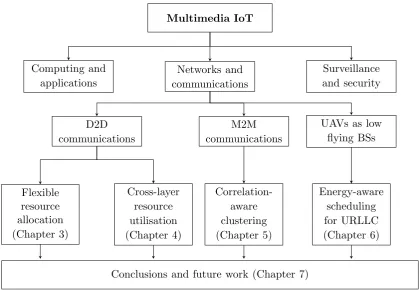
The main focus of this thesis is on distributed resource allocation in multimedia IoT, and using game theory to develop novel solutions for decision making processes required to address the key challenges and area of multimedia IoT. In particular, the three key enabling technologies of multimedia IoT that we will consider are: D2D communications; M2M communications; and enabling UAVs as low flying BSs. The main body of the thesis consists of four technical chapters, as outlined in Fig. 1.5. The first two technical chapters of this thesis investigates interference management, resource allocation, and end-user satisfaction challenges that arise in D2D communications. The last two technical chapters of this thesis investigates the challenges relating to M2M communications, i.e., data correlation for a massive number of MTDs, and enabling UAVs as low flying BSs in mission critical IoT communications.
A detailed summary of the major contributions of this thesis are as follows:
Chapter 3 - Flexible D2D Application-Driven Resource Allocation
In Chapter 3, we address the fundamental problem of flexibility for application-driven distributed resource allocation, to provide significantly improved D2D user QoE in cellular networks for underlaid D2D communications. In particular, we for-mulate this problem as a multiple objective Stackelberg game, in order to optimise throughput, energy consumption, and efficient resource block allocation across all users in the network, while providing greater reliability and user satisfaction guar-antees.
The main contributions of this chapter are:
Stack-22 Introduction
Multimedia IoT
Computing and applications
Surveillance and security Networks and
communications
D2D communications
M2M communications
UAVs as low flying BSs
Flexible resource allocation (Chapter 3)
Cross-layer resource utilisation (Chapter 4)
Correlation-aware clustering (Chapter 5)
Energy-aware scheduling for URLLC (Chapter 6)
[image:45.595.59.479.84.374.2]Conclusions and future work (Chapter 7)
Figure 1.5: The thesis outline.
elberg game is proposed. We consider a single leader and multiple followers, where the BS is the leader and the D2D pairs are the followers. The BS charges the D2D pairs a fee for network (BS) satisfaction/certainty with re-spect to all users (both cellular and D2D) in the network, and a fee for reusing a given cellular user’s resource block, to coordinate and reduce the intra-cell interference. Whereas, the D2D pairs react to the leader’s charging price, and compete to find optimal transmit power and resource block allocation, while guaranteeing QoS and QoE.
1.4 Thesis Contributions and Organisation 23
• We demonstrate beneficial effects of prioritising communications, along with the implicit prioritisation from different utility functions, by setting different PDR targets.
• A distributed algorithm based on a dynamic Stackelberg game with multi-criteria decision making is proposed. The proposed algorithm is shown to converge to a unique Stackelberg equilibrium across all users, which is a sub-game perfect equilibrium for each game stage. Moreover, simulation results show that the proposed approach reduces transmit power effectively and increases throughput, while also guaranteeing best social welfare and satisfaction across all D2D users.
The results in this chapter have been presented in [76], which is listed again for ease of reference:
[76] N. Sawyer, and D. B. Smith, “Flexible Resource Allocation in
Device-to-Device Communications using Stackelberg Game Theory,” IEEE Trans. on Com-munications, vol. 67, no. 1, pp. 653–667, Jan. 2019.
Chapter 4 - D2D Mode Selection and Resource Allocation in D2D
Net-works
In Chapter 4, we jointly optimise mode selection, resource allocation, and inter-ference management for D2D communications, in a distributed manner. We inves-tigate a non-cooperative game and a coalitional game to solve the network-assisted joint optimisation problem. In the non-cooperative game, the BS will assist D2D pairs in selecting a transmission mode (i.e., either cellular mode or reuse mode), while also allocating resources to cellular and D2D users. However, in the coali-tional game, we extend the mode selection to consider all three transmission modes (i.e., either cellular mode, dedicated more, or reuse mode). Network-assisted D2D communications requires global network information, and can cause signalling over-head and network complexity to increase due to the large number of users in the network. Thus, we also investigate user-assisted D2D communications as a viable solution, in which the BS has partial knowledge of the network and partial CSI. Thus, the D2D pairs must determine their transmission mode without the assis-tance of the BS. Hence, we extend the coalitional game to consider the user-assisted approach.
24 Introduction
• We propose a non-cooperative cross-layer repeated game, which combines a non-cooperative power control game and a two-armed bandit game, for network-assisted D2D communications. The non-cooperative power control game aims to minimise transmit power for each user, which leads to a re-duction in the intra-cell interference. Whereas, the two-armed bandit games aims to select the best transmission mode for D2D pairs.
• A distributed algorithm based on the non-cooperative cross-layer repeated game is proposed. The proposed non-cooperative algorithm is shown to con-verge to a unique Nash equilibrium, that is Parteo-optimal.
• On the other hand, we proposed a distributed cross-layer coalitional (CLC) game-theoretic approach, to cluster D2D pairs based on resource block alloca-tion and D2D mode selecalloca-tion, in a fully distributed and autonomous manner. This approach provides insight into practical scenarios when considering all possible D2D transmission modes.
• To further reduce interference in the network, the proposed CLC game-theoretic approach incorporates scheduling D2D pairs reusing cellular user resources along with power control. That is, we aim to find an optimal num-ber of D2D pairs that can reuse a cellular user resource block at a given time while ensuring user performance.
• Furthermore, we investigate the impacts of network-assisted and user assisted D2D communications, when clustering D2D pairs. The network-assisted and user-assisted scenarios are analysed in terms of minimising transmission power, user throughput, and spectral efficiency.
• A fully distributed clustering algorithm based on the CLC game is proposed to find a stable cluster formation of D2D pairs. The proposed clustering al-gorithm converges to a Nash stable coalition partition that is socially efficient and has a non-empty core.
1.4 Thesis Contributions and Organisation 25
The results in this chapter have been presented in [77, 78] and [79], which are listed again for ease of reference:
[77] N. Sawyer, and D. B. Smith, “Pareto-Efficient Cross-Layer Repeated Game
for Device-to-Device (D2D) Communications,” in Proc. IEEE Int. Conf. on Com-munications (ICC), Kuala Lumpur, Malaysia, pp. 1–6, May 2017.
[78] N. Sawyer, and D. B. Smith, “A Nash Stable Cross-Layer Coalition
Forma-tion Game for Device-to-Device CommunicaForma-tions,” in Proc. IEEE Int. Conf. on Communications (ICC), Paris, France, pp. 1-6, May 2017.
[79] N. Sawyer, and D. B. Smith, “A Nash Stable Cross-Layer Coalitional Game
for Resource Utilization in Device-to-Device Communications,” IEEE Trans. on Vehicular Technology, vol. 67, no. 9, pp. 8608–8622, Sept. 2018.
Chapter 5 - Correlation-Aware Clustering in M2M Networks
Chapter 5 focuses on the self-organising, correlation-aware clustering for a dense network of MTDs deployed over a cellular network. In dense M2M networks, MTDs are typically located within close proximity and will gather correlated data, and, thus, clustering MTDs based on data correlation will lead to a decrease in the num-ber of redundant bits transmitted to the base station. We formulate the correlation-aware clustering problem for a massive number of MTDs, as an evolutionary game.
The main contributions of this chapter are:
• We propose a novel distributed correlation-aware clustering scheme for a mas-sive number of MTDs. The proposed correlation-aware clustering scheme is formulated using an evolutionary game, in which MTDs are clustered based on data correlation, in order to decrease MTD transmission power by reduc-ing the number of redundant bits. We investigate the impact on MTD cluster formation, for different MTD densities, MTD data correlation, and the worst case inter-cluster interference.