International Journal of Innovative Technology and Exploring Engineering (IJITEE) ISSN: 2278-3075, Volume-8 Issue-9, July 2019
Performance of Self Compacting Concrete with
Partial Replacement of Coarse Aggregate with
Recycled Coarse Aggregate
L. Rajitha, M. Durga Rao
Abstract-Self Compacted Concrete (SCC) is an advancedapproach for the purpose of placing of concrete.It is a concrete which does not require any external force,vibration or compaction and which is highly flowable, formwork is filled without any compaction and resistance to segregation. Workability tests for SCCin fresh state are Slump-flow, L-Box, J-Box,V-Box are carried out.By using recommended EFNARC guidelines the mix proportion of concrete was prepared for M40 grade concrete is 1:1.75:1.87.Water cement ratio of 0.35 is constant.In this paper Natural Coarse Aggregate(NCA) is partially replaced upto 50% with 10% interval by Recycled Coarse Aggregate(RCA).RCA is prepared by crushing of cubes which are taken from concrete technology lab. Construction and Demolition waste is also used as RCA. RCA is submerged in water for 24 hours before using for the concrete mix,this is because RCA absorbs more waterdue to adhered cement mortar to aggregate. The various tests and their results are shown in this paper.
Key words: Natural Coarse Aggregate (NCA), Recycled Coarse Aggregate (RCA), Self Compacting Concrete (SCC), Workability, Fresh Concrete, Hardened concrete.
I. INTRODUCTION
SCC can also be called as self consolidated concrete. The properties of SCC are passing ability, filling ability, high fluidity, resistance to segregation and self-compatibility without any external compaction or vibration for the placing process and hence it is having noiseless construction.SCC achieved similar engineering properties as normally vibrated concrete. The capacity of SCC mainly depends on the preparation of the fresh mix. In this paper RCA is manufactured by crushing the cubes from the concrete technology lab.Recycling is processing the waste material for the purpose of generating a new useful product.RCA is having lower density than natural coarse aggregate and have greater water absorption value,this is due to adhered mortar to RCA. Depending on the aggregate demolished method properties and quality of RCA can be identified.For this accurate identification proper mix design is carried out.By using these RCA,it is economical and eco friendly.
Revised Manuscript Received on July 05, 2019.
L. Rajitha, Post Graduate student, Department of Civil Engineering, Gudlavalleru Engineering College, India.
M. Durga Rao, Assistant professor, Department Of Civil Engineering, Gudlavalleru Engineering College, India.
II. MATERIALS USED A. Cement
[image:1.595.330.542.252.396.2]53 grade OPC of ultratech brand confirming toIS12269-1987 was used throughout the study.
Table 1: Cement properties S.
No Properties Values
1 Specific Gravity 3.12
2 Normal Consistency 32%
3
Initial Setting Time 45 min
Final Setting Time 480 min
4 Fineness Modulus 5%
B. Fine Aggregate
[image:1.595.320.541.450.565.2]The locally available river sand which is in zone II confirming to IS 383-1987 is used.
Table 2: Fine aggregate tests
S. No Tests Values
obtained
1 Fineness modulus 2.81
2 Specific gravity 2.66
3 Zone II
C. Coarse Aggregate
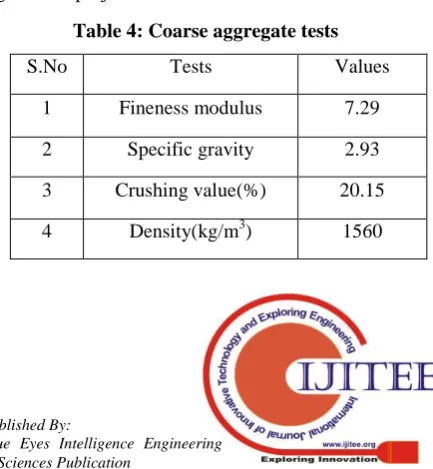
Aggregates of size 10mm to 12.5mm are used for SCC throughout the project.
Table 4: Coarse aggregate tests
S.No Tests Values
1 Fineness modulus 7.29
2 Specific gravity 2.93
3 Crushing value(%) 20.15
[image:1.595.328.545.599.834.2]Coarse Aggregate
D. Recycled coarse aggregate [image:2.595.316.534.75.246.2]It is prepared by crushing the cubes which are taken from the concrete technology lab.RCA can be collected from different sources like construction and demolition waste, tested specimens which are available in the concrete technology labs and dumped waste concrete materials.
Table 4: Recycled coarse aggregates tests
S.No TESTS VALUES
OBTAINED
1 Specific gravity 2.58
2 Fineness modulus 6.89
3 Density(kg/m3) 1353
4 Crushing value(%) 29.12
E. Super Plasticizer
In this study we use master glenium sky B233 as a super plasticizer.The main reason of using super plasticizer in SCC is to give good flowability with high slump which can be used in heavily reinforced structural member.
F. Viscosity Modifying Agent
In this study Aura mix V200 obtained from Fosroc chemicals is used as viscosity modifying agent.In SCC VMA increases the stability,segregation resistance and reduces bleeding from concrete mix
G. Water
Fresh water can be used for curing and mixing for the entire project.
III. FRESH STATE PROPERTIES A. Slump Flow Test
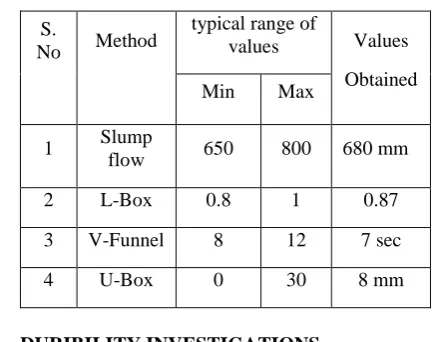
It is tested for the filling ability requirements of SCC. It is able to resist the segregation. The minimum and maximum values of slump as per EFNARC guide lines are 650 mm and 800mm respectively. The higher the value of slump, the greater will be the ability to flow.
B. L-Box Test
This is used to know the passing ability of SCC.The minimum and maximum values of L-Box test as per EFNARC guide lines are 0.8 and 1.0 respectively.
C. V-Funnel
This test is carried out for the filling ability requirements of SCC. It is able to resist the segregation and blocking. The minimum and maximum values of V-funnel test as per EFNARC guide lines are 8 seconds and 12 seconds respectively.
D. U-Box
It is a test for the passing ability requirements of SCC.The typical range of values of U-box are 0 to 30mm.
Table 5: Limitations for different tests for SCC S.
No Method
typical range of
values Values
Obtained
Min Max
1 Slump
flow 650 800 680 mm
2 L-Box 0.8 1 0.87
3 V-Funnel 8 12 7 sec
4 U-Box 0 30 8 mm
IV. DURIBILITY INVESTIGATIONS A. Water absorption
In this process the weight of saturated specimens (W1) is noted.Then the specimens were oven dried at 105oC till constant weight was obtained(W2).
Now the water absorption was calculated as =[(W1-W2)/V]*100
V= Volume of specimen
B. Acid attack
The cubes are immersed in 4% sulphuric acid solution for 90 days.Loss in weight and compressive strength are measured which are shown in table 11.
V. RESULTS AND DISCUSSIONS A. Compressive strength
The cubes of size 150mm*150mm*150mm are used. Compressive strengths for 7days, 28days and 90 days are shown in table 7 and fig 1 with different percentage replacements. The strength is optimum at 40% replacement of RCA.
Table 6: Results for Compressive strength S.
No
RCA
(%)
7 days 28 days 90 days
1 0 31.54 48.29 59.33
2 10 31.61 48.33 59.58
3 20 31.66 48.48 59.67
4 30 31.72 48.63 59.89
5 40 31.92 48.89 59.96
International Journal of Innovative Technology and Exploring Engineering (IJITEE) ISSN: 2278-3075, Volume-8 Issue-9, July 2019
Graph 1: Compressive strength B. Split Tensile Strength
[image:3.595.62.266.47.220.2]The cylinders of size 300mm*150mm are used. Table no 8and fig 2 shows the results of 7days, 28days and 90 days Split tensile strength which is optimum at 40% replacement of RCA.
Table 7: Results Split tensile strength
Sl.No RCA(%) 7 days 28
days
90 days
1 0 3.16 4.81 5.92
2 10 3.17 4.82 5.95
3 20 3.19 4.85 5.96
4 30 3.20 4.87 5.97
5 40 3.21 4.89 5.99
6 50 3.09 4.78 5.85
Graph 2: Split tensile strength C. Flexural Strength
[image:3.595.322.532.62.423.2]The beams of size 500mm*100mm*100mm are used. The strength is optimum at 40% replacement of RCA.The below fig 3 and table 9 shows the Flexural strengths for 7days,28days and 90days with different percentage replacements of RCA.
Table 8: Results for Flexural strength Sl.
No
RCA
(%) 7 days 28 days 90 days
1 0 3.43 5.32 6.59
2 10 3.44 5.33 6.61
3 20 3.46 5.35 6.63
4 30 3.48 5.37 6.65
5 40 3.49 5.38 6.68
6 50 3.34 5.28 6.39
Graph 3: Flexural strength D. Water Absorption
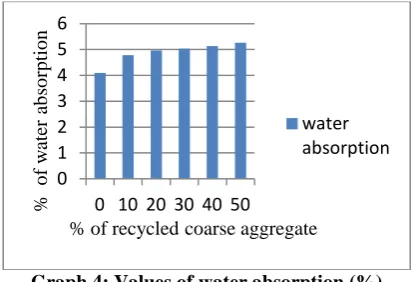
The increase in water absorption values are shown in the below table no 10.
Table 9: Results of water absorption test
Mix Type % Water Absorption
RCA WITH 0% 4.09
RCA WITH10% 4.78
RCA WITH 20% 4.97
RCA WITH 30% 5.03
RCA WITH 35% 5.13
RCA WITH 40% 5.26
0 2 4 6 8
0 10 20 30 40 50
Sp
lit
ten
sile
str
en
g
th
%of recycled coarse aggregate 7 days
28 days
90 days
0 2 4 6 8 10
0 10 20 30 40 50
Flex
u
ral
str
en
g
th
%of recycled coarse aggregate 7 days
28 days
90 days 0
10 20 30 40 50 60 70
0 10 20 30 40 50
C
o
m
p
ress
iv
e
str
en
g
th
% of recycled coarse aggregate 7 days
28 days
[image:3.595.64.275.319.665.2] [image:3.595.345.554.509.666.2]Coarse Aggregate
Graph 4: Values of water absorption (%) E. Acid attack
[image:4.595.65.275.60.201.2]It is identified that the loss in weight and compressive strength are increased with percentage increase in RCA.As RCA is having adhered mortar containing high alkalinity which cannot resist to acids and finally reduces the resistance power of acids.
Table 10: Results of Acid attack
Mix Type
% of Weight
loss
% of loss in compressive
strength
RCA WITH 0% 1.43 2.54
RCA WITH10 % 2.02 2.83
RCA WITH 20% 2.18 2.89
RCA WITH 30% 2.24 3.09
RCA WITH 35% 2.37 3.86
RCA WITH 40% 2.44 4.08
Graph 5: Results of weight loss, compressive strength
VI. CONCLUSION
1) In this study recycled Coarse aggregate are used for replacing natural coarse aggregate upto 50%. Workability of SCC is also achieved using recycled coarse aggregate for M40 grade concrete. The test results on fresh concrete are within the limits of EFNARC guide lines.
2) Use of Recycled coarse aggregate reduces cost which is economical and pollution is controlled as disposed waste is reused.
3) SCC mixes with RCA achieves quick early strength due to presence of partially hydrated cement which is attached to recycled aggregate.
4) As the RCA is having adhered mortar which contains high alkalinity and finally reduces the resistance power of acids. As RCA absorbs more water, it gains higher water absorption values.
5) This paper investigated that there is slight increment in strength properties upto 40% replacement of coarse aggregate by recycled coarse aggregate.
REFERENCES
1. Prashanth O. Modani, VinodM Mohitkar,” Self-compacting with recycled aggregate: A solution for sustainable development”, International Journal of Civil and Structural Engineering, volume 4,Nov- 2014.
2. K C Panda, P KBal, “Properties of Self Compacting Concrete Using Recycled Coarse Aggregate”.
3. AkashRao, Kumar N. Jha, SudhirMisra,” Use of Aggregates from Recycled Construction and Demolition Waste in Concrete”, Resources , Conservation and Recycling ,July 2006.
4. Purva p. Awari, “Use of recycled coarse aggregates in SCC”, Internarnational Journal of Advance Research in Science and Engineering,volume 6,Apr-2017.
5. V.Sai Krishna Mohan Chowdary,” Experimental study on Strength Behavior of Self Compacting Concrete Using Recycled Aggregates”, International Journal of Innovative Research in Advanced Engineering, volume 2,Dec- 2015.
6. Pro.Y.V. Akbari, Dr.K.B.Parikh, TejasH.Raviya, “A Critical Review on Self Compacting Concrete Using Recycled Coarse Aggregate”, IOSR Journal of Mechanical and Civil Engineering, volume 13,Feb-2016.
7. Femy George, Prof.Sarah Anil, “Study on Properties of Self Compacting Concrete made with Recycled Coarse Aggregate”, International Research Journal of Engineering and Technology, volume 5,Apr-2018.
8. C.Sumanth Reddy, K.VRatnaSai, Dr.P.Rathish Kumar, “Mechanical and Durability Properties of Self Compacting Concrete with Recycled Concrete Aggregates”, International Journal of Science and Engineering Research, volume 4, May-2013.
AUTHOR PROFILE 0
1 2 3 4 5 6
0 10 20 30 40 50
%
o
f
w
ater
ab
so
rp
tio
n
% of recycled coarse aggregate water absorption
0 1 2 3 4 5
0 10 20 30 40 50
Val
u
e
s
in
%
% of recycled aggregate
weight loss
Compressiv
International Journal of Innovative Technology and Exploring Engineering (IJITEE) ISSN: 2278-3075, Volume-8 Issue-9, July 2019