LETTER
Batch-processed semiconductor gas
sensor array for the selective detection of NO
x
in automotive exhaust gas
Hani Jang, Minki Kim and Yongjun Kim
*Abstract
This paper reports on a semiconductor gas sensor array to detect nitrogen oxides (NOx) in automotive exhaust gas. The proposed semiconductor gas sensor array consisted of one common electrode and three individual electrodes to minimize the size of the sensor array, and three sensing layers [TiO2+ SnO2 (15 wt%), SnO2, and Ga2O3] were depos‑ ited using screen printing. In addition, sensing materials were sintered under the same conditions in order to take advantage of batch processing. The sensing properties of the proposed sensor array were verified by experimental measurements, and the selectivity improved by using pattern recognition.
Keywords: Nitrogen oxides (NOx), Semiconductor gas sensor array, Common electrode, Batch processing,
Pattern recognition
© 2016 The Author(s). This article is distributed under the terms of the Creative Commons Attribution 4.0 International License (http://creativecommons.org/licenses/by/4.0/), which permits unrestricted use, distribution, and reproduction in any medium, provided you give appropriate credit to the original author(s) and the source, provide a link to the Creative Commons license, and indicate if changes were made.
Background
Semiconductor gas sensors are utilized in the detec-tion of oxidizing and reducing gases by measuring the conductance changes caused by chemical adsorption of gases on metal oxide semiconductor surfaces. However, employing semiconductor gas sensors is inappropriate for automotive diesel engines because most metal-oxide-based gas sensors, such as WO3 and CuO, operate at
low temperatures range between 100 and 300 °C [1, 2]. Although SnO2, TiO2, Ga2O3, and In2O3 are widely used
as high-temperature (500–600 °C) gas sensor materials, the lack of gas selectivity is a major drawback of semi-conductor gas sensors. Because the oxidizing (NO2) and
reducing (CO) gases have similar chemical characteris-tics that tend to react with the electron and ionosorbed oxygen species, respectively. The gas selectivity of metal-oxide-based gas sensors can be improved by adding other metal oxides or dopants (Pt, Pd, Al, Cr, etc.) [3–6]. Fol-lowing previous literatures, adding other metal oxides and dopants plays an important for promoting the spe-cific gas sensing reaction by the spilled over effect [7, 8].
These studies improved the gas selectivity, but the lack of gas selectivity has not been perfectly resolved.
On the other hand, there have been several reports on semiconductor gas sensor arrays. The implementation of a sensor array that consists of various metal-oxide sens-ing layers combined with pattern recognition is one of the methods that compensate this drawback. K. Persaud and G.H. Dodd first presented a report on a sensor array in 1982 [7]. After that, many research teams conducted studies on sensor arrays for the detection of gases in vari-ous fields such as environmental monitoring, food and beverage analysis, and disease diagnosis [8–10]. How-ever, it is difficult to reduce the distance between the sensing layers of a sensor array because the metal oxides have different operating temperatures. In addition, it is difficult to conduct batch processing because processing conditions are different for each sensing material.
Therefore, in this paper, a new design for a gas sensor array that is advantageous to miniaturization and batch processing is proposed. SnO2-doped TiO2, SnO2, and
Ga2O3 were used as the materials of the sensing layers.
The sensing layers were deposited on an Al2O3 wafer
by screen printing. As these three sensing layers oper-ate at the same temperature, so the proposed gas sensor array does not need to be concerned about the thermal
Open Access
*Correspondence: [email protected]
interference by a micro-heater. For this reason, distance between the sensing layers is not a major considera-tion, and the sensor array can use a proposed common electrode in this paper. In addition, the three deposited sensing layers were sintered at the same temperature (1100 °C). The gas-sensing properties of the fabricated gas sensor array were evaluated by detecting NO2, CO,
and NO gases at high temperature (600 °C). The selectiv-ity of the array was improved through a pattern recogni-tion program.
Findings
Design and fabrication
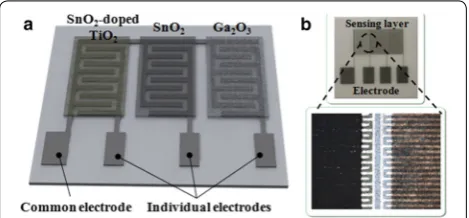
The proposed design that is advantageous to miniaturi-zation of the gas sensor array is shown in Fig. 1. The gas sensor array was fabricated on an Al2O3 substrate. The
interdigitated (IDT) platinum electrode, consisting of a common electrode and three individual electrodes that are interdigitated, was deposited on an alumina sub-strate by using an e-beam evaporator. Then, SnO2 (15
wt%)-doped TiO2, SnO2, and Ga2O3 printable paste was
deposited on the IDT electrode using screen printing. The sensing layer thickness was 1.5–2 μm. The proposed gas sensor array needs only one micro-heater because the three materials of the sensing layers can detect oxidiz-ing and reducoxidiz-ing gases at the same temperature (600 °C). Although gas testing was performed using a tube furnace, a micro-heater will be integrated in the future. The entire substrate size is 1.5 cm2, the sensing layers size is 2.5 mm
(width) × 4.5 mm (length), and the distance between the sensing layers is 100 μm. The sensor array is also advanta-geous to use batch processing because TiO2, SnO2, and
Ga2O3 can be sintered at the same temperature (1100 °C
for 2 h).
Experimental details
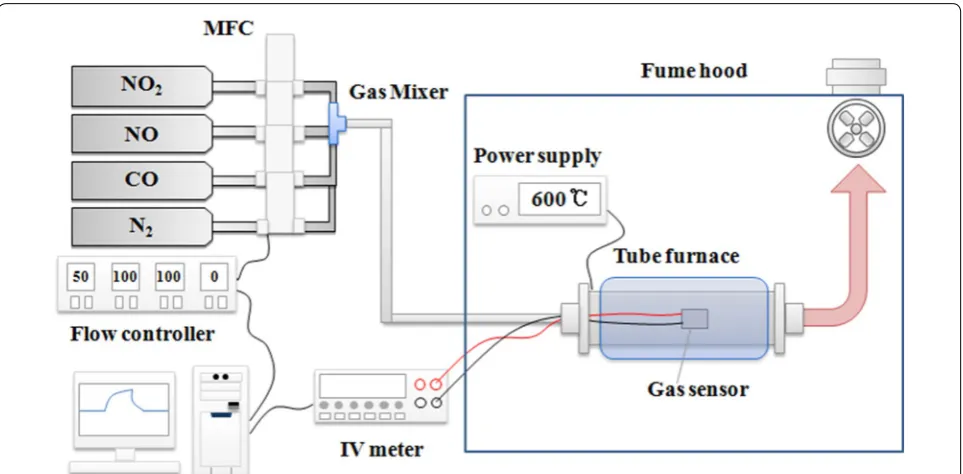
Figure 2 shows a block diagram of the apparatus for gas testing. The experimental setup included a test section, a gas flow system, data acquisition, and a ventilation system. The sensing properties of the sensor array were evaluated inside the quartz pipe. N2 was used as a null
gas, and typical emissions (NO2, CO, and NO) were used
as target gases. The operating temperature was fixed at 600 °C using a tube furnace, and the gas flow rate was also fixed at 1 l/min using a mass flow controller (MFC). The resistances of the sensor array were measured using an I-V source meter. Measurements of the gas sensor array responses were conducted upon its exposure to various concentrations of individual gases or mixtures of gases in order to accumulate the sensor array data for pattern recognition.
Results and discussion
Figure 3 shows the sensitivities of NO2, CO, and NO
(200 ppm) detection at 600 °C. The sensitivity of the gases was defined as (Rnull − Rgas)/Rgas, where Rnull and
Rgas were resistance in null (N2) gas and in the target
gases (NO2, CO, and NO), respectively. All sensing
lay-ers exhibited the highest sensitivity to NO2, as shown
in Fig. 3. However, the highest sensitivity (3.6) to NO2
was obtained for the TiO2-based sensing layer, and the
highest sensitivity (−0.611 and 0.625) to CO and NO
was obtained for the SnO2 and Ga2O3 sensing layers,
respectively.
In order to verify the reliability of the sensor array, the experiments were performed in the presence of various NO2, CO, and NO concentrations at 600 °C. The results
of the gas concentration tests are shown in Fig. 4. The response times (T33–T66) were 10.4–20.5 s. As shown in Fig. 4, the responses of the sensors are proportional to the concentration of gases. Moreover, the Ga2O3 sensing
layer did not respond to CO at low concentrations, i.e., below 100 ppm.
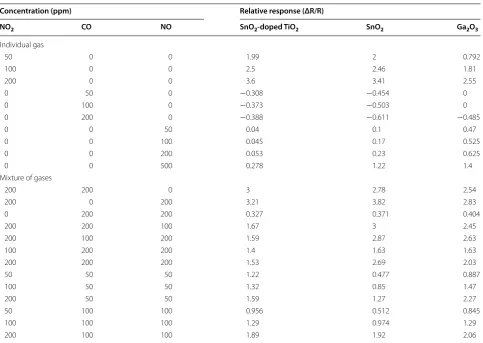
Table 1 shows the relative responses of the sensor array upon exposure to various concentrations of target gases. The relative response was defined as the relative sensitivity to target gases at 200 ppm. All sensing lay-ers exhibited unique response patterns according to the gases.
However, despite the unique response pattern, quan-titatively measuring concentrations of gases is difficult for a mixture of gases. Employing artificial neural net-works (ANNs) is effective in identifying the types and Fig. 1 a Proposed design of semiconductor gas sensor array, and b
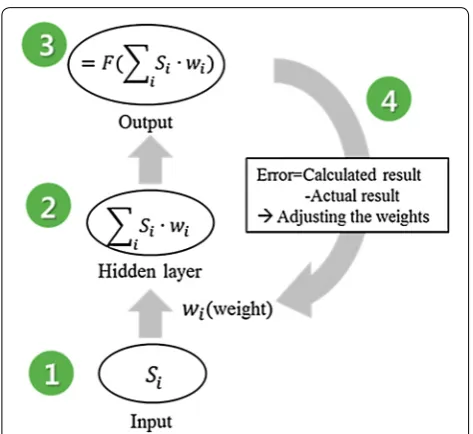
some concentrations of the chemical species. ANNs is a model created by imitating the information process-ing of the brain, and it is achieved by learnprocess-ing data. A back-propagation (BP) algorithm is a common method of learning ANNs. The BP algorithm requires known
output values for each input value to the learning ANNs. BP algorithm consists of an input layer, hidden layer, and output layer, as shown in Fig. 5. The input values are calculated with weight using a linear combi-nation in the hidden layer, and the calculations use an activation function. A sigmoid function is commonly used as the activation function. Weights are optimized at each node until the error between the calculations and the known output values is minimized, and then the training is stopped.
A NeuroXL Predictor was used to train the experi-mental data in Table 1. A sigmoid function was used as an activation function; the initial weight was set to 0.3. After adjusting the weights 15,000 times, training was completed. To predict non-learning data, an additional experiment was performed using the concentrations of NO2, CO, and NO emitted during actual vehicle
driv-ing conditions [11]. Table 2 shows the additional experi-mental conditions and the results of the sensor array. The concentrations of gases were predicted as shown in Fig. 6. The errors of the predicted values were, respec-tively, −12.6, −19.0, and −19.8 % for NO2, CO, and NO,
as shown in Fig. 6. Fig. 2 Schematic diagram of experimental setup for measuring concentrations of gases
Fig. 4 Measured resistance of gas sensor array (SnO2‑doped TiO2, SnO2, and Ga2O3) upon exposure to various concentrations of NO2, CO, and NO
with bias voltage of 2 V
Table 1 Relative response of gas sensor array
Results of gas sensor array upon exposure to various concentrations of individual gas and mixture of gases
Concentration (ppm) Relative response (ΔR/R)
NO2 CO NO SnO2-doped TiO2 SnO2 Ga2O3
Individual gas
50 0 0 1.99 2 0.792
100 0 0 2.5 2.46 1.81
200 0 0 3.6 3.41 2.55
0 50 0 −0.308 −0.454 0
0 100 0 −0.373 −0.503 0
0 200 0 −0.388 −0.611 −0.485
0 0 50 0.04 0.1 0.47
0 0 100 0.045 0.17 0.525
0 0 200 0.053 0.23 0.625
0 0 500 0.278 1.22 1.4
Mixture of gases
200 200 0 3 2.78 2.54
200 0 200 3.21 3.82 2.83
0 200 200 0.327 0.371 0.404
200 200 100 1.67 3 2.45
200 100 200 1.59 2.87 2.63
100 200 200 1.4 1.63 1.63
200 200 200 1.53 2.69 2.03
50 50 50 1.22 0.477 0.887
100 50 50 1.32 0.85 1.47
200 50 50 1.59 1.27 2.27
50 100 100 0.956 0.512 0.845
100 100 100 1.29 0.974 1.29
Conclusions
A proposed gas sensor array was fabricated by using the MEMS technique. The sensor array consists of one com-mon electrode and three individual electrodes. The gas sensor array has three sensing layers; SnO2 (15
wt%)-doped TiO2, SnO2, and Ga2O3. The three sensing layers
were deposited on an IDT platinum electrode and were successfully sintered at 1100 °C for 2 h. Overall the gas sensor array size is 1.5 cm2 and the distance between
the sensing layers is 100 μm. Although the other lit-eratures did not precisely specify the distance between the sensing layers, their sizes were in the range of about 0.5–1 mm [14–16]. Proposed design of gas sensor array will contribute to miniaturizing the sensor array. The fabricated gas sensor array shows a unique response pat-tern according to NO2, CO, and NO at 600 °C. The
Neu-roXL Predictor was used to identify NO2, CO, and NO
among a mixture of gases. By a −12.6 to −19.8 % error,
non-learning gas data could be predicted using an artifi-cial neural networks. Although there were some errors, the feasibility of the proposed gas sensor array to recog-nize a mixture of gases has been demonstrated. If addi-tional gas data is acquired, it is expected that the error will be reduced.
Authors’ contributions
YJK conceived the idea and supervised the project. YJK and HIJ discussed the design and the fabrication process of the gas sensor array. HIJ and MKK performed the experimental measurements and analysis of the results. YJK and HIJ drafted the manuscript. All authors read and approved the final manuscript.
Acknowledgements
This work was supported by the R&D program of MOTIE/KEIT. [10054548, Development of Suspended Heterogeneous Nanostructure‑based Hazardous Gas Microsensor System].
Competing interests
The authors declare that they have no competing interests.
Received: 12 January 2016 Accepted: 19 July 2016
References
1. Zeng J, Hu M, Wang W, Chen H, Qin Y (2012) NO2‑sensing properties of
porous WO3 gas sensor based on anodized sputtered tungsten thin film.
Sens Actuators B Chem 161:447–452
2. Rydosz A (2014) Amorphous and nanocrystalline magnetron sputtered CuO thin films deposited on low temperature cofired ceramics substrates for gas sensor applications. IEEE Sens J 14:1600–1607
3. Jo SE, Kang BG, Heo SM, Song SH, Kim YJ (2009) Gas sensing properties of WO3 doped rutile TiO2 thick film at high operating temperature. Curr
Appl Phys 9:235–238
Fig. 5 Training process of BP algorithm
Table 2 Experimental conditions and results of gas sensor array
NO2 CO NO
Experimental conditions
Concentration (ppm) 40 123 160
Sensing layer SnO2-doped TiO2 SnO2 Ga2O3
Results
Relative response (ΔR/R) 0.951 0.5 0.834
4. Kappler J, Bârsan N, Weimar U, Dièguez A, Alay JL, Romano‑Rodriguez A, Morante JR, Göpel W (1998) Correlation between XPS, Raman and TEM measurements and the gas sensitivity of Pt and Pd doped SnO2 based
gas sensors. Fresenius J Anal Chem 361:110–114
5. Navale SC, Ravi V, Srinivas D, Mulla IS, Gosavi SW, Kulkarni SK (2008) EPR and DRS evidence for NO2 sensing in Al‑doped Zno. Sens Actuators B
Chem 130:668–673
6. Ruiz AM, Sakai G, Cornet A, Shimanoe K, Morante JR, Yamazoe N (2003) Cr‑doped TiO2 gas sensor for exhaust NO2 monitoring. Sens Actuators B
Chem 93:509–518
7. Yamazoe N (1991) New approaches for improving semiconductor gas sensors. Sens Actuators B Chem 5:7–19
8. Fu J, Zhao C, Zhang J, Peng Y, Xie E (2013) Enhanced gas sensing perfor‑ mance of electrospun Pt‑functionalized NiO nanotubes with chemical and electronic sensitization. Appl Mater Interfaces 5:7410–7416 9. Persaud K, Dodd G (1982) Analysis of discrimination mechanisms in the
mammalian olfactory system using a model nose. Nature 299:352–355 10. Martinelli G, Carotta MC, Ferroni M, Sadaoka Y, Traversa E (1999) Screen‑ printed perovskite‑type thick films as gas sensors for environmental monitoring. Sens Actuators B Chem 55:99–110
11. Schweizer‑berberich PM, Vaihinger S, Göpel W (1994) Characterisation of food freshness with sensor arrays. Sens Actuators B Chem 18:282–290 12. Machado RF, Laskowski D, Deffenderfer O, Burch T, Zheng S, Mazzone PJ, Mekhail T, Jennings C, Stoller JK, Pyle J, Duncan J, Dweik RA, Erzurum SC (2005) Detection of lung cancer by sensor array analyses of exhaled breath. Am J Respir Crit Care Med 171:1286–1291
13. Vaaraslahti K, Virtanen A, Ristimäki J, Keskinen J (2004) Nucleation mode formation in heavy‑duty diesel exhaust with and without a particulate filter. Environ Sci Technol 38:4884–4890
14. Mo Y, Okawa Y, Tajima M, Nakai T, Yoshiike N, Natukawa K (2001) Micro‑ machined gas sensor array based on metal film micro‑heater. Sens Actua‑ tors B Chem 79:175–181
15. Kwon CH, Yun DH, Hong HK, Kim SR, Lee KC, Lim HY, Yoon KH (2000) Multi‑layered thick‑film gas sensor array for selective sensing by catalytic filtering technology. Sens Actuators B Chem 65:327–330