International Journal of Innovative Technology and Exploring Engineering (IJITEE) ISSN: 2278-3075, Volume-8 Issue-9, July 2019
Abstract: Local area within a normal natural image can be thought as a stationary process. This can be modelled well using autoregressive models. In this paper, a set of autoregressive models will be learned from a collection of high quality image patches. Out of these models, one will be selected adaptively and will be used to regularize the input image patches. In addition to the autoregressive models, a non-local self-similarity condition was proposed. The autoregressive models will exploit local correlation of individual image, but a natural will have many repetitive structures. These structures, which are basically redundant, are very much useful in image deblurring. The performance of these schemes is verified by applying to image deblurring.
Index Terms: Autoregressive models, deblurring, non-local self-similarity, sparse domain selection.
I. INTRODUCTION
The natural images, generally, can be coded using structural primitives like edges and line fragments [1]. These fragments are similar to simple cell receptive fields [2]. Olshausen et al. proposed to use small number of basis functions which are chosen from an over-complete code set to represent natural image [3]. Recently, such kind of sparse coding schemes are extensively being studied to solve inverse problems. This is in proportion to the progress of l0-norm and l1-norm
minimization schemes [4].
Let
x
n is the signal to be encoded, and
1,
2,...,
n m m
is the assumed dictionary.The sparse coding of x over
is to find a vector
1;
2;...;
m
such thatx
[5]. It is note that many coefficients in α are very close to zero. When the sparsity is measured as an l0-norm of α, which actually countsthe non-zero quantities in α, the problem of sparsity coding becomes . Here T is a number governing the amount of sparsity [6]. On the other hand, the vector α can be
found as
0 2
2
min
arg
ˆ
x
where λ isan arbitrary constant. The l0-norm is non-convex, hence it is
many times replaced with l1-norm or weighted l1-norm, so that
the problem becomes convex [7, 8, 9, 4]. The most important part of sparse representation is the selection of dictionary
.Revised Manuscript Received on July 05, 2019
Y Ravi Sankaraiah, Research Scholar, Dept. of ECE, JNTUK, Kakinada, India.
S. Varadarajan, Professor, Dept. of ECE, Sri Venkateswara University,
Many efforts are made in choosing the training image dataset and learning a dictionary [10-20, 6]. Let the training image
patches are grouped to form the set S,
. The objective of dictionary
learning is to optimize the dictionary
and therepresentation coefficient matrix
1,...,
N
so thati i
s
.
This can be formulated using the following:
2,
min
arg
ˆ
,
ˆ
F
S
Still the above minimization issue is non-convex. Different approaches were proposed to optimize the dictionary and coefficient matrix [11-13, 18-21]. Adaptive sparse domain selection (ASDS) scheme was presented in [22]. The scheme learns a series of compact sub-dictionaries and assigns adaptively each local patch a sub-dictionary as the sparse domain.
By learning a set of compact sub-dictionaries from high quality example image patches, the ASDS will perform the restoration. The example image patches are clustered into many clusters. Since each cluster consists of many patches with similar patterns, a compact sub-dictionary can be learned for each cluster. For an image patch to be coded, the best sub-dictionary that is most relevant to the given patch is selected. Since the given patch can be better represented by the adaptively selected sub-dictionary, the whole image can be more accurately reconstructed than using a universal dictionary, which will be validated by the experiments. With ASDS, a weighted l1-norm sparse representation model
will be proposed for restoration tasks. Suppose that {Φk},
k=1, 2… K, is a set of K orthonormal sub-dictionaries. Let x be an image vector, and xi=Rix, i = 1, 2… N, be the ith patch
(size: root (n) × root (n)) vector of x, where Ri is a matrix
extracting patch xi from x. With ASDS, the image restoration
problem can be modelled as:
1
2
2
min
arg
ˆ
y
DH
o
The design of Φk can be intuitively formulated by the
following objective function:
1
2
,
min
arg
ˆ
,
ˆ
k F k k k k k kk
S
where Λk is the representation coefficient matrix of Sk over
Φk.
Autoregressive Models and Non-Local Self
Similarity in Sparse Representation for Image
Deblurring
II. AUTOREGRESSIVEMODELS
As described in previous section, the training data set was divided into K sub-datasets SK. One autoregressive model can be trained for each SKby utilizing all the patches in it. Assume that the support of the autoregressive model is a square window, and the projected autoregressive model will estimate the middle pixel in the square with the knowledge of its neighbor pixels which are the boundary pixels of the square window. Determination of size window is very difficult. A high order of the window will result in data over-fitting. In this paper, a window size of 3x3 is used. So, the total number of pixels becomes 9, and the number of neighbors of middle pixel is 8, which is the order of the autoregressive model. The vector of autoregressive model arKof one of the sub-dataset SK can be obtained using the solution of the least square problem given below.
K Sq
a
a
i s i T i as
2K
arg
min
r
‘si’ is the middle pixel of the image patch Si and qi is the
vector with all its neighbors. When this training process is applied to all the sub-dataset, a set of autoregressive models {ar1, ar2,..., arK}. This set of autoregressive models will be used for regularization. In the previous section, selection of sub-dictionaries was presented. Similar to that, the selection of autoregressive models will be done. Using the estimate
x
ˆ
,the high pass filtered version
x
ˆ
ih can be calculated. Now,assume
2
ˆ
arg min
hi k c i c k
k
x
, and theautoregressive model arkito be assigned to the image patch xi. The vector holding the holding the neighbors of xi is denoted
by
i. Now, the prediction error of xi using arki and
ishould be minimum. In other words the term 2
2
i
T
i K i
x
ar XY
need to be optimized to be smallest.Incorporating this condition on the sparse representation, the objective function will look like the following.
2
, , 2
1 1
ˆ arg min | |
i i
N N
T i j i j i k i
i j x
y DH x
X ar
Here,
balances the effect of autoregressive regulatingterm.
III. NON-LOCALSIMILARITY
Adaptive regularization based on autoregressive model feats the local features in each and every image patch. In addition to the local features, many repetitive patterns are present on any natural image. These non-local redundancy is very much helpful in further improvement of quality of reconstructed images. For each local patch xi, similar patches in the image need to be identified. A patch
X
li is said to besimilar patch if
2
2
ˆ
ˆ
l l
i i i
e
X
X
t
. Here t is a threshold.Assume xi and
l i
x
to be middle pixels of the patchesX
i andl i
X
respectively.Now use the weighted average of
x
il, 1 L l l i i lb x
can be usedto estimate xi. Here the weight given to
l i
x
is fixed using therelation il
1
exp
li/
i
b
e h
c
. Here h is governing factor ofweight and ci is the normalizing factor given
by
1
exp
/
L l i i lc
e
h
. The estimate error2
1 2
L l l
i i i
i
x
b x
can be rewritten as2
2
T l i i i
x
b
, where biis the column vector containing all the weights
b
il and
i isthe column vector that holds all
x
il. After incorporating thenon-local similarity regularization into sparse representation, we get the following.
2 2
, ,
2 2
1 1
ˆ arg min N N T
i j i j i i i i j
y DH o x b
.IV. RESULTSANDDISCUSSIONS
In this work, to learn dictionaries and thereby sub-dictionaries, two sets of high quality test images were considered. From each set on dictionary and corresponding sub dictionaries are formed. The selection of test images for learning the dictionary is so critical. The test images should have all the possible patterns to represent the features that are there in input images. The effect of the selection of these high quality images is presented in this section. Two kinds of blurs are considered, uniform and Gaussian blurs. Uniform blur is created by convolving the original image with a kernel of specific order. In the experiments two sizes are considered, 3x3 and 9x9. When the dimension of the kernel is more, the effect of the blur will also be more. So, the effect of kernel of 9x9 will be more than that with a kernel of 3x3. Gaussian blur is also applied in two varieties, one with standard deviation of 1 and another with 3. The effect of Gaussian blur with the standard deviation of 3 is predominant than the other. The procedure is an iterative process, and it is iterated for 1000 times. For each 40 iterations, the peak signal to noise ratios is noted. Fig.1.
International Journal of Innovative Technology and Exploring Engineering (IJITEE) ISSN: 2278-3075, Volume-8 Issue-9, July 2019
Input Image
Uniform blur with kernel of 3x3 size PSNR = 30.713 dB
Uniform blur with kernel of 9x9 size PSNR = 23.871 dB
Gaussian blur with standard deviation of 1 PSNR = 30.155 dB
Gaussian blur with standard deviation of 3 PSNR = 24.072 dB
Table 1. Simulation results on Uniform blur with 3x3 kernel
Dictionary – 1 Dictionary – 2
It ASDS ASDS
Autoregressive
ASDS Autoregressive
with non-local similarity
ASDS ASDS
Autoregressive
ASDS Autoregressive
with non-local similarity
0 30.714 30.714 30.714 30.714 30.714 30.714
80 35.375 35.759 36.587 35.381 35.758 36.591
160 35.117 35.690 36.663 35.132 35.697 36.672
240 35.043 35.685 36.679 35.061 35.692 36.681
320 34.999 35.748 36.631 35.021 35.743 36.621
400 34.979 35.801 36.596 34.999 35.790 36.584
480 34.966 35.808 36.595 34.984 35.794 36.584
560 34.956 35.808 36.594 34.970 35.794 36.585
640 34.950 35.797 36.571 34.962 35.789 36.567
720 34.945 35.791 36.563 34.957 35.785 36.561
800 37.089 38.053 38.606 37.096 38.024 38.603
880 37.232 38.106 38.625 37.231 38.076 38.626
960 38.036 38.568 38.787 38.037 38.540 38.778
1000 38.030 38.570 38.790 38.040 38.540 38.780
[image:4.595.79.517.326.697.2]SSIM 0.965 0.967 0.968 0.965 0.967 0.968
Table 2. Simulation results on Uniform blur with kernel of 9x9
Dictionary - 1 Dictionary – 2
It ASDS ASDS
Autoregressive
ASDS Autoregressive
with non-local similarity
ASDS ASDS
Autoregressive
ASDS Autoregressive
with non-local similarity
0 23.871 23.871 23.871 23.871 23.871 23.871
80 28.625 28.611 28.620 28.619 28.604 28.614
160 29.316 29.282 29.157 29.310 29.272 29.151
240 29.839 29.767 29.444 29.835 29.757 29.438
320 30.152 30.068 29.822 30.144 30.056 29.816
400 30.361 30.304 30.330 30.353 30.293 30.317
480 30.505 30.459 30.563 30.501 30.454 30.554
560 30.607 30.562 30.685 30.605 30.565 30.688
640 30.684 30.639 30.846 30.679 30.644 30.857
720 30.739 30.695 30.985 30.733 30.701 30.994
800 31.124 31.019 31.160 31.111 31.019 31.166
880 31.260 31.144 31.241 31.236 31.137 31.247
960 31.242 31.126 31.187 31.204 31.103 31.189
1000 31.270 31.150 31.200 31.230 31.130 31.200
International Journal of Innovative Technology and Exploring Engineering (IJITEE) ISSN: 2278-3075, Volume-8 Issue-9, July 2019
Table 3. Simulation results on Gaussian blur with standard deviation of 1
Dictionary – 1 Dictionary – 2
It ASDS ASDS
Autoregressive
ASDS Autoregressive
with non-local similarity
ASDS ASDS
Autoregressive
ASDS Autoregressive
with non-local similarity
0 30.155 30.155 30.155 30.155 30.155 30.155
80 36.061 35.852 34.167 36.045 35.856 34.186
160 36.049 35.820 32.908 36.030 35.827 32.936
240 36.073 35.831 32.174 36.056 35.833 32.206
320 36.033 35.660 31.680 36.020 35.664 31.712
400 35.968 35.387 31.333 35.967 35.402 31.364
480 35.950 35.320 31.079 35.955 35.339 31.111
560 35.943 35.297 30.888 35.950 35.318 30.922
640 35.935 35.177 30.743 35.943 35.202 30.778
720 35.931 35.088 30.629 35.938 35.119 30.666
800 37.519 36.353 30.511 37.474 36.391 30.562
880 37.593 36.585 30.372 37.534 36.613 30.436
960 37.886 37.368 30.260 37.827 37.347 30.342
1000 37.890 37.390 30.200 37.830 37.370 30.290
SSIM 0.965 0.953 0.721 0.965 0.953 0.726
Table 4. Simulation results on Gaussian blur with standard deviation of 3
Dictionary – 1 Dictionary – 2
It ASDS ASDS
Autoregressive
ASDS Autoregressive
with non-local similarity
ASDS ASDS
Autoregressive
ASDS Autoregressive
with non-local similarity
0 24.072 24.072 24.072 24.072 24.072 24.072
80 26.840 26.824 26.834 26.838 26.821 26.834
160 27.149 27.087 27.122 27.145 27.084 27.123
240 27.351 27.233 27.305 27.341 27.234 27.310
320 27.478 27.369 27.432 27.465 27.370 27.435
400 27.581 27.516 27.529 27.566 27.517 27.532
480 27.652 27.610 27.607 27.639 27.604 27.610
560 27.702 27.676 27.671 27.691 27.667 27.674
640 27.742 27.742 27.723 27.733 27.733 27.725
720 27.773 27.802 27.768 27.766 27.792 27.765
800 27.795 27.873 27.880 27.781 27.853 27.871
880 27.825 27.913 27.930 27.801 27.882 27.917
960 27.835 27.940 27.966 27.800 27.898 27.949
1000 27.840 27.950 27.980 27.810 27.910 27.960
SSIM 0.863 0.868 0.868 0.862 0.867 0.867
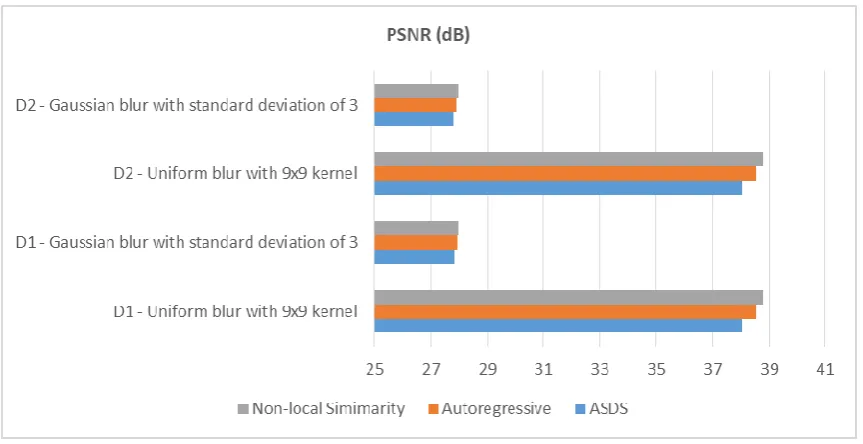
The effect of autoregressive model and extracting non-local similarity is apparent when the blurring is predominant. Hence, the effect can well be observed in
[image:5.595.77.536.419.761.2]Fig. 2 PSNR values obtained with different techniques when blurring is more
V.CONCLUSIONS
In this paper, sparse representation is proposed with few improvement terms and applied on image deblurring. Uniform and Gaussian blurs are simulated and deblurring was done using sparse representation based schemes. Adaptive selection of sub-dictionaries was presented. In addition to the proposal of the said sparse representation, to characterize local image structures, autoregressive models are proposed. These autoregressive models pre-learned from training dataset. Out of the all autoregressive models learned, one or few models will be adaptively chosen to regularize the solution space. Along with the autoregressive models, a non-local self-similarity condition was also proposed. A natural image will have several repetitive image structures. These conditions help in preserving the sharp edges. The simulation results proved the superiority of the two improvements proposed, specifically when the blurring quantity is more.
REFERENCES
1. D. Field, “What is the goal of sensory coding?” Neural Computation,
vol. 6, pp. 559-601, 1994.
2. B. Olshausen and D. Field, “Emergence of simple-cell receptive field properties by learning a sparse code for natural images,” Nature, vol. 381, pp. 607-609, 1996.
3. B. Olshausen and D. Field, “Sparse coding with an overcomplete basis set: a strategy employed by V1?” Vision Research, vol. 37, pp. 3311-3325, 1997.
4. J. A. Tropp and S. J. Wright, “Computational methods for sparse solution of linear inverse problems,” Proceedings of IEEE, Special Issue on Applications of Compressive Sensing & Sparse Representation, vol. 98, no. 6, pp. 948-958, June, 2010.
5. S. Chen, D. Donoho, and M. Saunders, “Atomic decompositions by basis pursuit,” SIAM Review, vol. 43, pp. 129-159, 2001.
6. A. M. Bruckstein, D. L. Donoho, and M. Elad, “From sparse solutions of systems of equations to sparse modeling of signals and images,” SIAM Review, vol. 51, no. 1, pp. 34-81, Feb. 2009.
7. E. Candès and T. Tao, “Near optimal signal recovery from random projections: Universal encoding strategies?” IEEE Trans. on Information Theory, vol. 52, no. 12, pp. 5406 - 5425, December 2006. 8. E. J. Candes, “Compressive sampling,” in Proc. of the International
Congress of Mathematicians, Madrid, Spain, Aug. 2006.
9. E. Candes, M. B. Wakin, and S. P. Boyd, “Enhancing sparsity by reweighted l1 minimization,” Journal of Fourier Analysis and Applications, vol. 14, pp. 877-905, Dec. 2008.
10. M. Elad, M.A.T. Figueiredo, and Y. Ma, “On the Role of Sparse and Redundant Representations in Image Processing,” Proceedings of IEEE, Special Issue on Applications of Compressive Sensing & Sparse Representation, June 2010.
11. J. Mairal, M. Elad, and G. Sapiro, “Sparse Representation for Color Image Restoration,” IEEE Trans. on Image Processing, vol. 17, no. 1, pages 53-69, Jan. 2008.
12. J. Mairal, F. Bach, J. Ponce, G. Sapiro and A. Zisserman, “Non-Local Sparse Models for Image Restoration,” International Conference on Computer Vision, Tokyo, Japan, 2009.
13. M. Aharon, M. Elad, and A. Bruckstein, “K-SVD: an algorithm for designing overcomplete dictionaries for sparse representation,” IEEE Trans. Signal Process., vol. 54, no. 11, pp. 4311-4322, Nov. 2006. 14. J. Mairal, G. Sapiro, and M. Elad, “Learning Multiscale Sparse
Representations for Image and Video Restoration,” SIAM Multiscale Modeling and Simulation, vol. 7, no. 1, pages 214-241, April 2008. 15. R. Rubinstein, M. Zibulevsky, and M. Elad, “Double sparsity: Learning
Sparse Dictionaries for Sparse Signal Approximation,” IEEE Trans. Signal Processing, vol. 58, no. 3, pp. 1553-1564, March 2010. 16. Jaya Krishna Sunkara, Kuruma Purnima, Suresh Muchakala,
Ravisankariah Y, “Super-Resolution Based Image Reconstruction”, International Journal of Computer Science and Technology, vol. 2, Issue 3, pp. 272-281, September 2011.
17. G. Monaci and P. Vanderqheynst, “Learning structured dictionaries for image representation,” in Proc. IEEE Int. conf. Image Process., pp. 2351-2354, Oct. 2004.
18. Jaya Krishna Sunkara, Sundeep Eswarawaka, Kiranmai Darisi, Santhi Dara, Pushpa Kumar Dasari, Prudhviraj Dara, “Intensity Non-uniformity Correction for Image Segmentation”, IOSR Journal of
VLSI and Signal Processing (e-ISSN: 2319-4200, p-ISSN: 2319-4197), Volume 1, Issue 5, PP 49-57, Jan. -Feb 2013.
19. Jaya Krishna Sunkara, Uday Kumar Panta, Nagarjuna Pemmasani, Chandra Sekhar Paricherla, Pramadeesa Pattasani, Venkataiah Pattem, “Region Based Active Contour Model for Intensity Non-uniformity Correction for Image Segmentation”, International Journal of Engineering Research and Technology (RIP) (p-ISSN: 0974-3154) , Volume 6, Number 1, pp. 61-73, 2013.
20. R. Rubinstein, A.M. Bruckstein, and M. Elad, “Dictionaries for sparse representation modeling,” Proceedings of IEEE, Special Issue on Applications of Compressive Sensing & Sparse Representation, vol. 98, no. 6, pp. 1045-1057, June, 2010.
21. K. Engan, S. Aase, and J. Husoy, “Multi-frame compression: theory and design,” Signal Processing, vol. 80, no. 10, pp. 2121-2140, Oct. 2000. 22. Y. Ravi Sankaraiah and S. Varadarajan, “Dictionary Learning Based
International Journal of Innovative Technology and Exploring Engineering (IJITEE) ISSN: 2278-3075, Volume-8 Issue-9, July 2019
AUTHORSPROFILE
Y. Ravi Sankaraiah received B.Tech in Electronics and Communication Engineering from KSRMCE, Kadapa in 1998 and M.Tech in Applied Electronics from Sathyabama University, Chennai in 2007. He worked as Network Engineer in Optonet Technologies Pvt. Ltd., Hyderabad, and HOD, Department of Electronics and Communication Engineering at Priyadarshini College of Engineering, Sullurpet. Currently he is working as HOD, Department of ECE, Bheema Institute of Technology and Science, Adoni and pursuing his Ph.D on Image deblurring at JNTUK, Kakinada.