The portion size effect and overconsumption
–
towards downsizing solutions for children
and adolescents
M. M. Hetherington and P. Blundell-Birtill
School of Psychology, University of Leeds, Leeds, UK
Abstract
Portion sizes of foods offered to consumers have increased at the same time asoverweight and obesity levels have risen. It has been suggested that large portions of high energy density (HED) foods increase total energy intake and that this is not compensated for in the short- to medium-term, potentially promoting weight gain. In the laboratory setting, offering large portions of HED foods increases overall energy intake in both children and adults. This phenomenon is known as the portion size effect (PSE), and it is robust, reliable and enduring. The possible impact of the PSE is that large portions served over time may facilitate overeating and could contribute to overweight and obesity. Explanations for the PSE vary from simple heuristics, such as the tendency to clear the plate, to more complex biobehavioural processes, including individual differences in susceptibility to external food cues through eating traits. Consumers may eat in accordance with available consumption norms or eat opportunistically when large portions are made available. An obvious solution to the PSE is to ‘downsize’ HED meal items and snacks, but whether this strategy is acceptable or feasible is not clear. In adults, the effects of downsizing are mixed and for children and adolescents, as yet unclear. The contention is that for those who are still learning about social norms and appropriate portions, there remains the potential to counter the PSE through downsizing strategies.
Keywords: adolescents, children, energy density, food intake, portion size
Global levels of overweight and obesity among chil-dren have increased by more than 50% since 1990 (United Nations Children’s Fund 2012). Overweight and obesity can increase the risk of diseases such as type 2 diabetes and hypertension in children (Han
et al. 2010), and childhood obesity may lead to
seri-ous illness in adulthood as well as premature death (Bjorge et al. 2008). In 2014, the World Health
Organization (WHO) suggested that limiting portion sizes to reduce overall energy intake would therefore also reduce the risk of unhealthy weight gain (WHO 2014). In particular, large portion sizes of beverages, meals and snacks were identified as a potential deter-minant of overeating. However, before the proposal that large portions are implicated in both overeating
and obesity is accepted, there are at least four forms of evidence needed to support this. The first is that there are associations between large portions and increased bodyweight at the population level; sec-ondly, that providing large portions at a meal prompts Correspondence:Professor Marion M. Hetherington, Professor of
Biopsychology, School of Psychology, University of Leeds, Leeds LS2 9JT, UK.
overconsumption at the individual level; thirdly, that in the longer term, no adjustment for large portions takes place, producing a net energy surfeit; and finally, that systematic exposure to large portions over time promotes weight gain. Given that energy balance is a dynamic process and that excess adiposity is achieved over time, it is important to consider each part of the portion size effect (PSE) from large-scale epidemiologi-cal studies to small-sepidemiologi-cale laboratory experiments. Each form of evidence will be considered in turn.
Associations between portion sizes and
bodyweight
In parallel with rising levels of overweight and obesity, portion sizes of foods served inside and outside the home have increased (Piernas & Popkin 2011). There have been numerous large-scale epidemiological studies demonstrating that portions served to children have increased over time. For example, in a time-series anal-ysis of portion sizes consumed by Australian children aged 2-16 years, recorded between 2007 and 2012, it was found that portions of some high energy density (HED) foods had increased but those of fruit and veg-etables decreased over time and were below recom-mendations (Van der Bend et al. 2017). In tandem, levels of childhood overweight and obesity in Australia increased from 10% in 1985 to 26% in 2012. The obvious conclusion from this study is that consuming large portions of HED foods and small portions of low energy density, nutrient-rich foods are linked to over-weight and obesity. A cross-sectional study of UK ado-lescents (n = 636, aged 11–18 years), using data from the nationally representative National Diet and Nutri-tion Survey (NDNS), found that large portion sizes of some HED foods (cereals, cream and high energy soft drinks) predicted higher body mass index (Albar et al.
2014).
Although it appears parsimonious to link the two, evidence fails to demonstrate a direct causal relationship between portion size and obesity. To infer causality, it must be demonstrated that large portions lead to overconsumption, that this overconsumption is main-tained without compensation elsewhere in the diet and that over time large portions promote weight gain.
Short-term laboratory-based studies of the
portion size effect
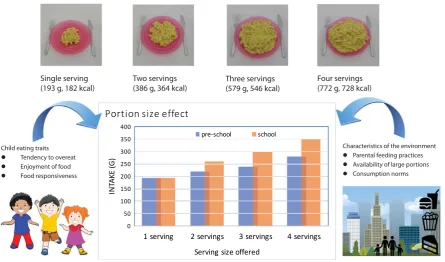
Experiments conducted under laboratory conditions consistently demonstrate that offering large portion
sizes of food to children promotes overconsumption. The PSE is the term applied to the observation that more is eaten when large portions are offered com-pared to small portions (see Fig. 1 for a schematic rep-resentation of the phenomenon). The PSE is found in adults and children, and across a number of different meal and snack types. A series of studies have con-firmed that the PSE is robust and reliable in young children (see Birch et al. 2015 for a review) and in adults (Rolls 2003). In these studies, a main meal or snack is offered in varying amounts, which partici-pants then eat ad libitum. Amount consumed is the primary dependent variable and typically large sizes promote large intakes. Although, in one of the earliest studies of the PSE, Rolls et al. (2000) gave young (aged 3–4 years) and older children (aged 4–6 years) small, medium and large portions of macaroni and cheese. Only the older children showed the PSE and younger children ate the same amount of energy in each condition. At first, it was assumed that very young children are guided more by internal than external cues to eat, such as hunger more than portion size. However, to date, this study has not been repli-cated, and most studies have consistently shown that even very young children respond to large portions by eating more (see Kral & Hetherington 2015 for more detail).
Applying meta-analysis to a range of studies exam-ining the PSE in both adults and children indicated that, on average, when portion sizes are doubled, con-sumption increases by 35% (Zlatevska et al. 2014). If young children are exposed to large portions consis-tently, then this may drive excess energy intakes and, in turn, might result in overweight or obesity. How-ever, as these studies have been conducted within one meal or snack, the question is whether this effect endures beyond the single eating occasion and whether this influences weight gain.
Long-term impact of large portions on
energy intake
intake has been observed. For example, Rolls et al.
(2006) examined the PSE over two days, for three consecutive weeks. Adult participants were provided with breakfast, lunch, dinner and two snacks in the laboratory, on two consecutive days. The portion size given in each week was either a standard size (100%), 150% or 200% of this amount. With an increase of 50% in portion size, intake was increased by 16%, and with an increase of 100% in portion size, intake was increased by 26%. Therefore, the PSE was sustained over two days with no adjustment made on the second day for large portions offered on the first day. In a subsequent study extended over 11 days, all foods and beverages were provided in a laboratory setting in standard or large (150%) por-tions (Rolls et al. 2007a,b). Overall, no adjustment to total energy intake for the larger portion size was made and so a 50% increase in portion size resulted in an additional energy intake of 423 kcal per day
and a cumulative additional energy intake of
4636 kcal over 11 days. For women, the increase in intake was around 25% and for men was 14% of total energy intake. The magnitude of this effect was comparable to that found in the earlier two-day study. Therefore, given that large portions encourage overconsumption over time, then the proposal that
large portions might contribute to overweight and obesity is plausible.
Long-term impact of large portions on
weight gain
To examine the impact of large portions on energy balance and specifically changes in bodyweight, studies must be conducted over many months rather than days. In a workplace study in which participants were given small or large lunches over a period of
2 months, Jeffery et al. (2007) found a modest
increase in bodyweight in the large lunch condition. In a larger workplace study over a 6-month period, adults were assigned to a small (400 kcal), medium (800 kcal) or large (1600 kcal) lunch group (French
et al. 2014). Total energy intake was significantly
higher in the large lunch condition compared to the other conditions. Within the large lunch condition, participants gained about 1 kg of bodyweight, which was significantly different from baseline but not signif-icantly different from the other groups. Indeed, the control group also gained about 1 kg of bodyweight over the period of the study, but participants in the small and medium lunch conditions maintained energy balance. It is hard to interpret these findings except to
Characteristics of the environment Parental feeding practices Availability of large portions Consumption norms Child eating traits
Tendency to overeat Enjoyment of food Food responsiveness
Single serving (193 g, 182 kcal)
Four servings (772 g, 728 kcal) Two servings
(386 g, 364 kcal)
[image:3.595.73.519.61.323.2]Three servings (579 g, 546 kcal)
suggest that smaller lunches given over the 6-month period helped participants to remain weight stable.
Pre-portioned foods have been used to assist in weight loss (Wing & Jeffery 2001). The success of this strategy may be due, in part, to encouraging con-sumers to eat fixed amounts of appropriate sized por-tions rather than eating ad libitum, self-served amounts. Also, it relieves the consumer from having to work out amounts to prepare and serve. In two recent weight loss studies, portion control strategies (including provision of pre-portioned meals) as part of a 12-week (Rock et al. 2016) or a 12-month (Rolls
et al. 2017) weight loss trial facilitated early weight loss. However, in the 12-month trial, portion control strategies did not lead to a greater weight loss than standard advice. Using pre-portioned foods as part of a portion control strategy may be successful during the initial period of weight loss and during the period of food provision (Wing & Jeffery 2001), but portion control did not result in good adherence nor long-term sustained weight loss (Rollset al.2017).
Explanations for the portion size effect
A variety of explanations have been put forward to account for the PSE. Consumers may make a percep-tual error when offered large portions and not realise they have overeaten. This is supported by evidence that the energy content of large portions tends to be underestimated, especially for HED foods
(Almiron-Roig et al. 2013). However, adult participants in PSE
studies will often correctly identify that portion size has been manipulated (so they are aware of the differ-ing sizes offered) and under some circumstances recog-nise that portion size was a factor in determining intake. For example, Vartanian et al. (2017) discov-ered that when participants said that they had con-sumed more than their typical amount, they then identified portion size as an influencing factor. Varta-nian and his colleagues have coined the phrase ‘motivated denial’ to capture the idea that individuals consider the large amount served justification for overindulgence.
For children, at least, a more simple, heuristic explanation for the PSE is the tendency to ‘clean the plate’ as a result of parental influence (Birch et al.
1987). Children might view external cues, such as food served on a plate, as a prime to eat and the amount served as a prompt for how much to eat. Also, the size of the dishware used might set the intake norm. DiSantis et al. (2013) investigated the effect of plate size in first-grade schoolchildren. They
were given adult or child-size plates and asked to serve themselves lunch (pasta on one day and chicken nuggets on another day). Children served themselves 90 kcal more when using the adult compared to the child-size plate, across both foods (DiSantis et al.
2013).
There is strong evidence to show that children eat most of what is served to them by parents (Johnson
et al. 2014). In this study, researchers measured
amounts offered and consumed at a meal by children and parents during three home visits. The amounts served to children explained 73% of the variance in children’s intake and large portions resulted in large intakes. Additionally, the amounts parents served themselves strongly correlated with the amounts served to their child (Johnson et al. 2014). Therefore, parents are guiding their children’s intake of food by establishing portion norms and imparting an expecta-tion that the amount served should be eaten. In low-income households, children may be expected to ‘clean the plate’ to avoid waste, but this strategy shifts reli-ance away from internal cues of hunger and fullness to external cues of portion size. If the amount served on the plate signals the amount to be eaten, then chil-dren may be expected to eat more than they need (or want).
However, if this simple heuristic to clean the plate was the main explanation of the PSE, then there would be a clear dose–response function between por-tion size and energy intake. But investigapor-tions of the PSE combining multiple studies (n = 65) across adults and children reveal that there is a curvilinear function between portion size and intake (Zlatevska et al.
2014). This suggests that rather than a simple plate clearing strategy, consumers will eat a certain amount of what is offered but that how much they eat will be determined, in part, by internal cues of satiation (not merely the external cue of amount served), social norms or unit bias, and individual differences. Results presented from studies of the PSE provide average intakes and mean increases in energy intake, which masks individual differences in the extent to which consumers are influenced by the presentation of large portions.
Who is most susceptible to the PSE?
overeating, whereas the tendency to eat according to internal cues of hunger and satiety limits food intake. Food approach traits, such as external responsiveness, should predict a greater magnitude of the PSE than food avoidance traits, such as food fussiness or satiety responsiveness. These traits in children are generally measured using parental reports, such as the Child Eating Behaviour Questionnaire (CEBQ; Wardle et al.
2001). For instance, children reported to be highly food responsive are more likely to be influenced by portion size than those with high satiety responsive-ness, who depend more on internal cues to determine food intake. In their study of portion size and energy density, Kling et al. (2016) found that children with a high score on the CEBQ for food responsiveness showed a much stronger PSE than those with a low score. Similarly, they found that parents who tended to monitor their child’s food intake due to concerns about overeating also showed a stronger PSE than children whose parents tended not to monitor food intake. Therefore, individual differences in susceptibil-ity to the PSE are worth exploring in more detail, as it could be that portion control strategies either for pro-moting healthy eating in children or helping adults in weight management may need to be tailored to the individual. Whilst eating traits are highly heritable and can be difficult to modify (Llewellyn et al. 2010), learning about appropriate portion sizes for particular foods (such as those high in fat, sugars and salt) espe-cially in children might mitigate against the tendency to overconsume.
Downsizing strategies
So far the evidence suggests that offering large por-tions of food promotes an increase in energy intake with a potential link to both overeating and weight gain. One possible solution to the PSE is to ‘downsize’ portions, particularly for HED foods and beverages. This can be achieved in a number of ways. The most obvious is to provide smaller size meal items, snacks and drinks, assuming that consumers will not adjust for this. This assumption has been supported by a study conducted by Lewis et al. (2015). They pre-sented adults with a standard breakfast, a 20% smal-ler breakfast and a 40% smalsmal-ler breakfast on three separate days. They measured ratings of appetite, gut hormone secretion and subsequent energy intake for the remainder of the day (test meal at lunch,ad libitum
snack intake, food diary for evening intake). They found that energy intake at lunch and for the rest of the day did not differ by breakfast condition, but at
least one of the biomarkers of appetite and the subjec-tive ratings of appetite were sensisubjec-tive to the reduction in portion size. The 40% smaller breakfast produced a net reduction in daily energy intake. However, the authors of the study question the sustainability of con-suming this size breakfast since appetite, incretin hor-mone release and perceived meal size ratings were responsive to the reduction.
Another downsizing strategy might relate to the way food and beverages are presented through pack-aging and dishware. Mantzariet al.(2018) have inves-tigated the feasibility of swapping large volume bottles of sugars-sweetened beverages for smaller size bottles. In this study, 16 households received the usual amount of cola they would consume over a week presented in the form of small (250 ml), medium (500 ml), large (1000 ml) or extra large (1500 ml) sizes, each week for 4 weeks. Overall, the families reported that the small bottles increased drinking occasions citing greater convenience and portability among reasons for greater perceived consumption. Therefore, downsizing in this study failed to produce the desired impact.
Robinson and Matheson (2015) have proposed using small size dishes for meals and tall, thin, low volume glasses for beverages. However, for adults, a small dish size prompted more trips to a buffet bar to obtain more self-served food items (Rollset al.2007a, b); therefore, dishware size alone may not be sufficient to encourage portion control. In two experiments where dishware was designed with in-built portion indicators, it was found that this visual aid reduced the amount of self-served food at a meal in US univer-sity students (Hughes et al. 2017). By encouraging small portions, the small plates reduced overall energy intake; however, the participants also served smaller portions of vegetables than is recommended. Clearly, this is not ideal as most young people fail to eat enough vegetables. Therefore, experiments which downsize HED snacks and meal items are needed to investigate whether children tolerate smaller portions and whether there are unintended consequences of downsizing, such as compensation elsewhere in the diet.
Downsizing for children, adolescents and
families
suggest that learning, nudging or packaging could be used to inform studies to suit the age and stage of the child. Therefore, a series of studies have been devised to investigate this. One study, a randomised control trial, has been designed to test the feasibility and acceptability of reducing snack portions using either a reduction (by 50%) or replacement strategy in which HED snacks were swapped for fruit, vegetables and a breadstick, cracker or rice cake (registered trial, Clini-calTrials.gov NCT03339986).
It will be interesting to discover whether these strategies are acceptable. In previous research, parents struggled with quantifying appropriate portions for children and adjusting portions was considered effort-ful and inconvenient (Curtis et al. 2017). Evidence from a qualitative study by Blake et al. (2015) of 60 low-income families found that portion size control strategies used by parents included using small con-tainers and measuring cups to subdivide large portions and purchasing small pre-packaged snacks. Parents need support in determining appropriate portions especially when purchasing large, family size packages of HED snacks, which offer better per unit value but where it is hard to judge appropriate portions for chil-dren. Food manufacturers might consider offering snacks in smaller, child-size portions or providing scoops and other aids for portion control. However, whether these will be effective is not yet known.
In another trial, energy-dense meal items will be the primary target of downsizing as these typically con-tribute most to total energy intake (Klinget al. 2016). In particular, it is not known whether children might compensate for a smaller meal item by eating more of a low energy density side dish (Cecilet al.2017). This is relevant to the goal to increase intake of nutrient-rich foods, such as fruit and vegetables, whilst reducing intake of energy-dense, nutrient poor foods. However, simply providing large portions of fruit and vegetables in competition with highly liked meal items may not produce the desired effect on overall intake (Kralet al.2010).
For adolescents, a social media framed nudging study has been designed to evaluate this method as a way to model appropriate portion size snacks for this age group (Sharpset al.in preparation). In previous health interventions, platforms such as Facebook (Pedersen & Kurz 2016) have been used both to recruit young peo-ple and to engage in health-oriented interventions. A systematic review of social media interventions found that improvements in some aspect of health behaviour were found in most studies, but the effect size was small (Maher et al. 2014). Therefore, while social media
provides an individually relevant means to reach young people, changing behaviour around diet, including por-tion size control, might be challenging.
Another promising area to explore involves packag-ing, as the unit bias concept predicts that single item packs provide a portion size guide in much the same way as amount served by parents or investigators in PSE studies. In this area of research, packaging solu-tions will be investigated to assist parents in serving appropriately sized portions of food to their children (see https://youtu.be/-_D3cjVCTbg). It is not clear where packaging or provision of single units of food can promote lower intakes of HED foods. Indeed, Kerameaset al. (2015) found that participants ate less when offered the same amount of a snack food served in multiple units than as a single unit (individually wrapped). Simply dividing up and packaging a HED food in smaller units can help consumers limit intake, compared to a single, larger unit. However, as was observed by Mantzari et al. (2018), smaller unit size can also drive intake in the long-term through increased appeal and ease of access.
Conclusions
The PSE, in which more food is consumed when more is offered, is a robust and reliable phenomenon in lab-oratory settings. The evidence is clear that if large por-tions are offered over many days, intake will be increased. However, the evidence is less convincing that this necessarily leads to weight gain. What is apparent is that sustained intake of large portions of high energy-dense, nutrient poor foods is contrary to healthy eating advice, including that from WHO (WHO 2014). Some consumers are more susceptible to the PSE than others and this seems to be related to sensitivity to external cues, such as the availability of highly palatable, energy-dense foods (Fig. 1). There-fore, downsizing strategies may need to be tailored to fit the age, stage and characteristics of the consumer. To date, efforts to provide small portions of foods or beverages to reduce intake have produced mixed results in adults. This may be due to awareness of smaller than usual portions, and so consumers feel hungry or that they have missed out on their typical amount. It could be that small size packaging is attractive, portable and convenient but might inadver-tently increase consumption. However, in children, there is the opportunity to shape expectations about appropriate portions—namely ‘me-size’ amounts (e.g.
for adolescents, who are also establishing dietary habits and food choices, there is the chance to intervene to encourage downsized portions. It is imperative to inves-tigate the impact of downsizing and to provide an evi-dence base for parents to adjust children’s portions of meal items and snacks to suit their needs and appropri-ate to their size.
Acknowledgements
This review sets out the background to the
Biotechnol-ogy and Biological Sciences Research Council
(BBSRC) Diet and Health Research Industry Club (DRINC) Downsizing project (BB/M027384/1).
Conflict of interest
No conflict of interest exists between current sup-port received by the authors and the contents of this paper.
References
Albar SA, Alwan NA, Evans CEet al.(2014) Is there an association between food portion size and BMI among British adolescents? British Journal of Nutrition112: 841–51.
Almiron-Roig E, Solis-Trapala I, Dodd Jet al.(2013) Estimating food portions. Influence of unit number, meal type and energy density.Appetite71: 95–103.
Birch LL, McPhee L, Shoba BCet al.(1987) “Clean up your plate”: effects of child feeding practices on the conditioning of meal size. Learning and Motivation18: 301–17.
Birch LL, Savage JS & Fisher JO (2015) Right sizing prevention. Food portion size effects on children’s eating and weight.Appetite
88: 11–6.
Bjorge T, Engeland A, Tverdal Aet al.(2008) Body mass index in adolescence in relation to cause-specific mortality: a follow-up of 230,000 Norwegian adolescents.American Journal of Epidemiol-ogy168: 30–7.
Blake CE, Fisher JO, Ganter Cet al.(2015) A qualitative study of parents’ perceptions and use of portion size strategies for pre-school children’s snacks.Appetite88: 17–23.
Cecil JE, Carstairs SA, Caton Set al.(2017) ‘Downsizing meal items in pre-schoolers using variety’, poster presented to British Feeding and Drinking Group, Reading, UK, 7th April 2017.
Curtis K, Atkins L & Brown K (2017) Big hearts, small hands: a focus group study exploring parental food portion behaviours. BMC Public Health17: 716.
DiSantis KI, Birch LL, Davey Aet al.(2013) Plate size and children’ appetite: effects of larger dishware on self-served portions and intake.Pediatrics131: e1451–8.
French SA, Mitchell NR, Wolfson Jet al.(2014) Portion size effects on weight gain in a free living setting.Obesity22: 1400–5. Han JC, Lawlor DA & Kimm SY (2010) Childhood obesity.The
Lancet375: 1737–48.
Hughes JW, Goldstein CM, Logan Cet al.(2017) Controlled testing of novel portion control plate produces smaller self-selected por-tion sizes compared to regular dinner plate.BMC Obesity4: 30. Jeffery RW, Rydell S, Dunn CLet al.(2007) Effects of portion size
on chronic energy intake.International Journal of Behavioral Nutrition and Physical Activity27: 27.
Johnson SL, Hughes SO, Cui Xet al.(2014) Portion sizes for chil-dren are predicted by parental characteristics and the amounts parents serve themselves.The American Journal of Clinical Nutrition99: 763–70.
Kerameas K, Vartanian LR, Herman CPet al.(2015) The effect of portion size and unit size on food intake: unit bias or segmenta-tion effect?Health Psychology34: 670–6.
Kling SM, Roe LS, Keller KLet al.(2016) Double trouble: portion size and energy density combine to increase preschool children’s lunch intake.Physiology and Behavior162: 18–26.
Kral TV & Hetherington MM (2015) Variability in children’s eating response to portion size. A biobehavioral perspective.Appetite88: 5–10.
Kral TV, Kabay AC, Roe LSet al.(2010) Effects of doubling the portion size of fruit and vegetable side dishes on children’s intake at a meal.Obesity18: 521–7.
Lewis HB, Ahern AL, Solis-Trapala Iet al.(2015) Effect of reducing portion size at a compulsory meal on later energy intake, gut hormones, and appetite in overweight adults. Obesity23: 1362–70.
Llewellyn CH, van Jaarsveld CH, Johnson Let al.(2010) Nature and nurture in infant appetite: analysis of the Gemini twin birth cohort.The American Journal of Clinical Nutrition91: 1172–9. Maher CA, Lewis LK, Ferrar Ket al.(2014) Are health behavior
change interventions that use online social networks effective? A systematic review.Journal of Medical Internet Research16: e40. Mantzari E, Hollans GJ, Pechey Ret al.(2018) Perceived impact of
smaller compared with larger-sized bottles of sugar-sweetened beverages on consumption: a qualitative analysis.Appetite120: 171–80.
Pedersen ER & Kurz J (2016) Using Facebook for health-related research study recruitment and program delivery.Current Opinion in Psychology9: 38–43.
Piernas C & Popkin BM (2011) Food portion patterns and trends among U.S. children and the relationship to total eating occasion size, 1977–2006.Journal of Nutrition141: 1159–64.
Robinson TN & Matheson DM (2015) Environmental strategies for portion control in children.Appetite88: 33–8.
Rock CL, Flatt SW, Pakiz Bet al.(2016) Randomized clinical trial of portion-controlled prepackaged foods to promote weight loss. Obesity24: 1230–7.
Rolls BJ (2003) The supersizing of America: portion size and the obesity epidemic.Nutrition Today38: 42–53.
Rolls BJ, Engell D & Birch LL (2000) Serving portion size influences 5-year-old but not 3-year-old children’s food intakes.Journal of the American Dietetic Association100: 232–4.
Rolls BJ, Roe LS & Meengs JS (2006) Larger portion sizes lead to a sustained increase in energy intake over 2 days.Journal of the American Dietetic Association106: 543–9.
Rolls BJ, Roe LS, Halverson KHet al. (2007b) Using a smaller plate did not reduce energy intake at meals using a smaller plate did not reduce energy intake at meals.Appetite49: 652– 60.
Rolls BJ, Roe LS, James BLet al.(2017) Does the incorporation of portion-control strategies in a behavioral program improve weight loss in a 1-year randomized controlled trial?International Journal of Obesity41: 434–42.
Sharps M, Evans C & Hetherington M. (2017) Downsizing portions of high energy-dense food and sugar-sweetened beverages in ado-lescents. The Smart Snacking study. Poster presented to British Feeding and Drinking Group, Reading, UK, 7th April 2017. United Nations Children’s Fund (2012) World Health Organization,
The World Bank. UNICEF-WHO-World Bank Joint Child Nutri-tion Estimates (UNICEF, New York; WHO, Geneva; The World Bank, Washington DC; 2012).
Van der Bend D, Bucher T, Schumacher TLet al.(2017) Trends in food and beverage portion sizes in Australian children; a
time-series analysis comparing 2007 and 2011–2012 national data. Children4: 69.
Vartanian LR, Spanos S, Herman CPet al.(2017) Conflicting inter-nal and exterinter-nal eating cues: impact on food intake and attribu-tions.Health Psychology36: 365–9.
Wardle J, Guthrie CA, Sanderson Set al.(2001) Development of the children’s eating behaviour questionnaire.Journal of Child Psychology and Psychiatry42: 963–70.
Wing RR & Jeffery RW (2001) Food provision as a strategy to pro-mote weight loss.Obesity Research9: 271S–5S.
WHO (World Health Organization) (2014) Limiting portion sizes to reduce the risk of childhood overweight and obesity: Biological, behavioural and contextual rationale. Available at: http://www. who.int/elena/bbc/portion_childhood_obesity/en/ (accessed 1 November 2017).