Progress
and strategy paper
Environment
to
the
year
2000
t
*
*
*
,, $
V|tr\fl
33?,?8,1,o,
bzE.0ol,{
bZ?,
L/t//,L
3?F,/24
G)
Progress and strategy paper
Environment to
the
year
2000
1'
Lead
author
Julian
Wilson
With
contributions
from
Eric
BJLume,
Ben
Griepink,
Richard
Moxon
Editors
Vittoria Alliata,
Jonathan
Hatwell
-l
Foreword
This
paper
is
part
of
a series
which
covers each
of
the
main
areasof
Phare
activity. It
describes
the
nature
of
the problems faced
in
Phare's
partner countries
during their
transition
from
planned to
market
economies.
It
goes on
to
examine actions undertaken
to
date, and
to
assesstheir impact
on
the
fransformation
process.
There is
clearly
aneed
to
ensure that the approach
being taken
in
any
given
sector
is
relevant
to
the
longer-term goals
of
economic
transformation. For
this reason, these papers contain the
thinking
of
those
responsible
for
operating Phare
on
actions
for
the
future
and
how
Phare should
contribute to
the next phase
of
the
transition.
The
papers
do not
reflect any
official
position
of
the
European
Commission.
They
have
been
written
by
the
Phare
Operational
Units
and are
intended
as
a
stimulus
to
discussion
for all
those
involved in
the debate on economic
transformation
in
central and eastern Europe.
Alan Mayhew
Table
of
contents
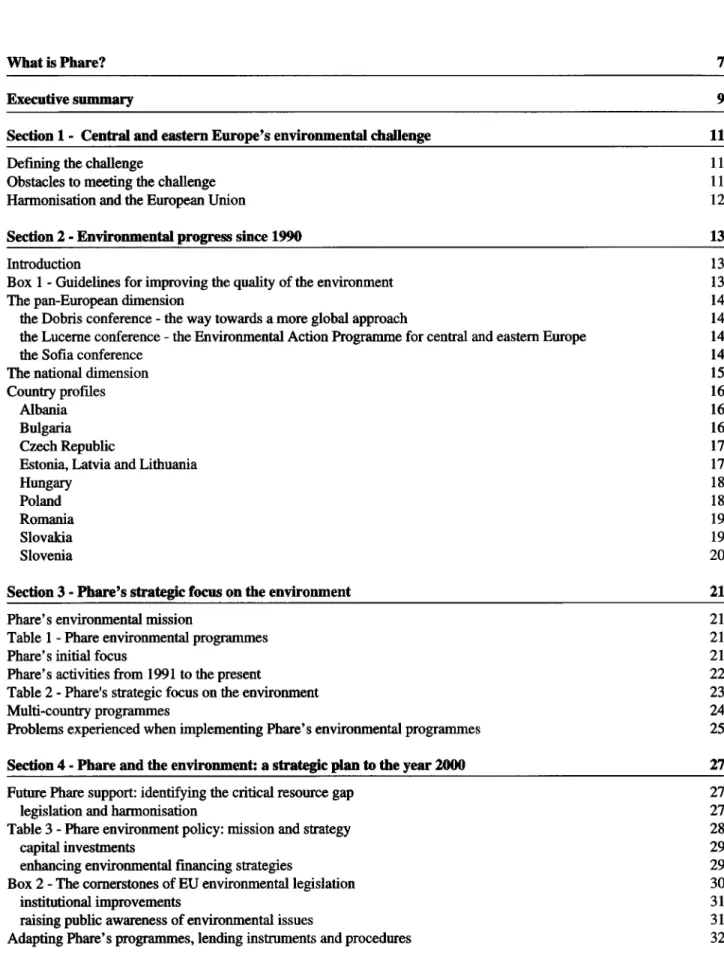
What
is Phare?Executive
srunnary
Section
I -
Central
and eastern Europe's environmental challengel1
Defining the challengeObstacles to meeting the challenge
Harmonisation and the European Union
Section 2 -
Environmental
progress since 199011 11
12
Intoduction
Box
I
- Guidelines for improving the quality of the environmentThe pan-European dimension
the Dobris conference - the way towards a more global approach
the Lucerne conference - the Environmental Action Programme for cenfial and eastem Europe
the Sofia conference The national dimension Country profiles
Albania Bulgaria
Czech Republic
Estonia, Latvia and Lithuania Hungary
Poland Romania Slovakia Slovenia
Section 3 - Phane's strategic focus on the environment
13
l3
t4
t4
t4
t4
r5r6
t6
t6
t7
t7
18t8
t9
t9
202t
Phare' s environmental mission
Table
I
- Phare environmental prograrnmes Phare's initial focusPhare's activities from 1991 to the present
Table 2 - Phare's stategic focus on the environment
Multi-county
programmesProblems experienced when implementing Phare's environmental programmes
Section 4 - Phare and the environment: a strategic plan to the year
20fi)
21
2t
2t
22 23 24 25n
Future Phare support: identifying the critical resource gap
legislation and hannonisation
Table 3 - Phare environment
potcy:
mission and stategy capital investnrentsenhancing environmental financing sfiategies
Box 2 - The cornerstones of EU environmental legislation institutional improvements
raising public awareness of environmental issues
Adapting Phare's prograrnmes, lending instruments and procedures
Annex
I
-Ihe
legal agreements and treaties steering Phare's operations AnnexII
- Past Pharc environment programmes bycountry
What
is
Phare
?
The
Phare Programmeis
a
EuropeanUnion
initiative which supports the developmentof
a larger democratic family of nations within a prosperous and stable Europe.Its aim is to
help the countriesof
central and eastemEurope rejoin the mainstream
of
European development andbuild
closerpolitical
and economicties with
the European Union.Phare does this by providing grant finance to support the
process
of
economic transformation andto
stengthen newly created democratic societies. Phare also provides grant finance to help countrieswith
Europe Agreements integrate with the European Union.h
its firct five years of operationto
1994, Phare has made availablercU
4,284million
to
11
parfirer counties,making Phare
the
largest
assistance pnogrammeof
its kind.
Phare works
in
close
cooperationwith its
parher countriesto
decide how funds are to be spent,within
aframework
agreedwith
the
EuropeanUnion.
Thisensures
that
Phare
funding
is
relevant
to
eachgovernment's own reform policies and
priorities.
Eachcounty
takesthe
responsibilityfor
running
its
ownprograrnmes.
Phare provides know-how
from a wide
rangeof
non-commercial,public
and private
organisationsto
its partner countries.It
acts as a multiplierby
stimulating investrnent and respondingto
needs that cannot be metby others.
Phare acts
as
a
powerful catalyst
byunlocking funds
for
impo(ant projects
from
otherdonors
through
studies,
capital
grants,
guaranteeschemes and
credit
lines.
It
also investsdirecfly in
infrastructure, which
will
accountfor
more Phare fundsas the restructuring process progresses.
The main priorities for Phare funding are common to all countries, although every one
is
at a different stageof
tansformation.
Thekey
areas include restructuringof
state en0erprises
including
agriculture,private
sectordevelopment,
reform
of
institutions
and
public adminisfiation, reformof
social services, employment, education and health, developmentof
energy, transportand telecommunications infrastructure, and environment
and
nuclearsafety.
Under the
Europe Agreements,Phare funding
is
being usedto
make laws compatibleExecutive
suflrmary
The environmental challenge facing central and eastern European countries is immense. Not only does the area contain some
of
Europe's most polluted areas but high levels of emissions continue to erode its rich and diverse eco-system and to adversely affectliving
standards.It
is estimated that some ECU 300billion
is needed over the next 15 years to substantially raise the qualityofthe
environment
in
central and easternEurope.
Given that the area is currently experiencing a recession as a resultof
restructuring, resources onthis
scale are simply notavailable.
Instead, governments are developing graduallong-term
approaches
to
meet
their
respectiveenvironmental challenges. These me
.
cleaningup
contaminationffierited
from
the former communist pg[rod.
intoducing
cleaner and environmentally sustainablepractices
in
the
sectorsof
energy, municipal waste,industy
and agriculture which cause particularly high levels of pollutiono
ftsrrt6fising
environmental
policies
and
specificlegislation
with
European
Union
(EU)
andinternational conventions.
Given the
scaleof
the
problem facedby
cenEal and east€,m European countries,the
Phare Programme canonly play a catalytic and facilitating
role.
Governments in the area and the pnvate sector must provide the bulkof
the resources required. However, as Phare's funds are provided as grants, this funding can be a powerfirl and
influential tool.
Between 1990 and 1994, Phare financed several hundred environmental projects
totalling
E.CU337
million
in
Albania Bulgaria, Czech and Slovak Republics, Estonia,
Hungary,
Latvia,
Lithuania, Poland, Romania.
and Slovenia. This amounts to some 10 per cent of the total Phare budget for this period.The environment, which has been identified as one
of
the
focal points
for
future
investment,will
receivefirther
substantial fundsfrom
Pharein
the comingfive
years.
Phare's
environmental programmes, whilst tailored to the individual circumstances of eachcounty,
have
followed
a
similar
sfrategicpath since
1990, namely the progressive strengtheningof
environmentalpolicies, legislation
and institutions through
to
thefacilitation
and initiation
of
priority
environmental capital invesfrnents.development
of
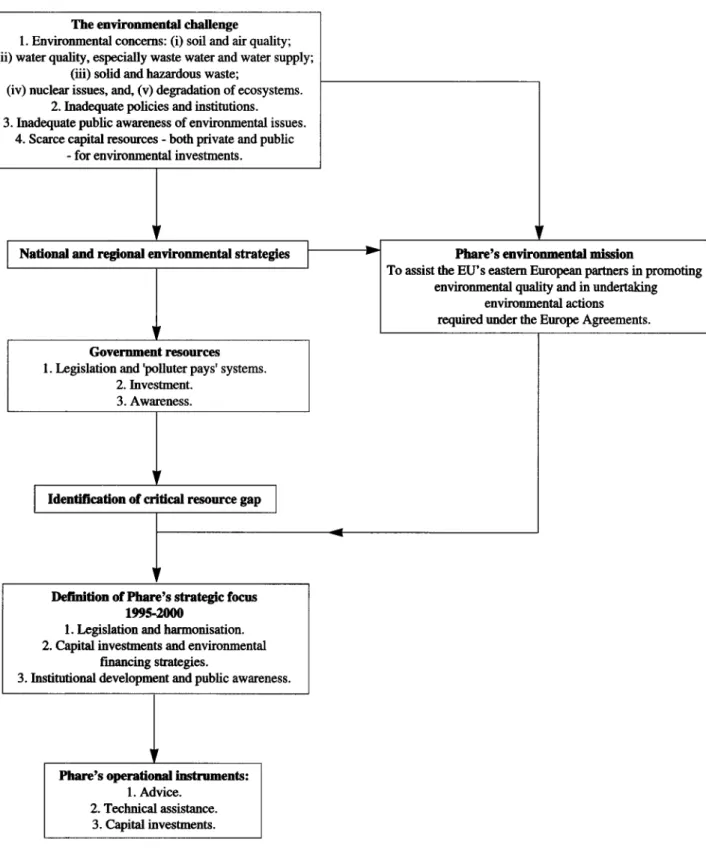
Phare's 1995-20[10 environmentalhas involved four tasks:
an analysis
of
the progress madein
the environment by eachof
the central and eastern European countries since 1990an evaluation
of
the support that Phare has provided for environmental issues since 1990the
identificationof
the critical
resource gap wherePhare's future support
will
be
concentrated most effectivelythe
compositionof
the
operationalinstuments
andtools which Phare must adopt to ensure that its future
support is effective and efficient.
ith policy and institutional foundations now largely
in
for
tackling
environmental problems,the
EU'sand
eastern European paxtnersare
seeking's
supportin
taking the next major stepsin
raising quality, which arepolicy refinement, including the horizontal integration
of
environmental issueswith
other
sectors and the harmonisation of environmental laws and standardspriority
capital investments which are now essentialif
there
is to
be
a
substantial improvement in
environmental quality in the area before the turn of the
century
institutional
developmentand the raising
of
public awareness.strategy paper outlines the initiatives which
will
beout
in
thesethree broad
areas,as
well
asing the
changeswhich
will
be
madeto
Phare's procedures and instruments to ensure that its futureare implemented quicHy and effectively.
paper has three annexes. The first outlines the legal guiding Phare's actions
in
the
sector. Thedescribes
Phare's
past
environmentalin
each of the Phare partner countries. Theprovides
an
executive
summary
of
theAction
Programmefor
cental
and Europe,a
key
strategic documentwhich
wasup
by
the
govemmentsin
the
area,
theof
the
EuropeanUnion
and internationalSection
1
- Central
and
eas
Europe's environmental
challenge
Defining
the challenge
les
to meeting the challenge
Solving
the
environmental problemsof
central
and eastern European countriesis
oneof
the mostdfficult
tasks
facing
Europe sinceits
reconstructionin
1945.Countries must clean up past contamination
while
also rapidly reducing the high levelsof pollution
which arestill
being
emit0edby
the
region'sinefficient
energy,industrial, municipal waste and agricultural enterprises. ln1993, the environment ministers of
cental
and easternEurope defined
their
most important
environmentalchallenges as
followsl'
.
reducing lead and other heavy metalsin air
and soil from metal refining, transport and energy production.
managing toxic waste from heavy industry and energyproduction
.
eliminating
airbomedust from
household furnaces,small
businesses,
power
and
heating
plants,metallurgical and other industrial plants
.
eliminating contaminants and pathogensin
food
and waterfrom
industial
and energy sources (especially dangerouswhere heavy
metalsor
toxic
chemicals threaten drinking water supplies) and from inadequate and at times inoperative waste water and water supplyteatuent
facilities.
reducing sulphur
dioxide and other
gasesin
theatnosphere from various
industial
and energy sources(especially
dangerouswhen
combined
with
dust particles).
reducing
nutrients2in
water
from
inefficient
andwasteful agricultural
enterprises,the
inappropriate applicationof
fertilisers and untreated sewagein
ruralareas
.
reversing productivity losses from damage oroutight
destruction ofphysical capital and natural resources
.
halting
damageto
bio-diversity
from
agriculture,industry and urban development, which
is
especially seriousin
the
enclosed seaswithin the
area andin
some forests.
obstacles
which must
be
overcomeinclude
theHuman
resource
and
institutional
weaknesses.Technical skills,
technical equipmentand
planning capacitiesin
the
ministriesof
environmentand in
other
key
agenciesneed
to
be
developed
andimproved.
Insufficient
awanen€ssof
environmental
issues.Governments
often lack the political
will
to
tackle environmental issues becausethere
is
very
little
awareness
of
the
existing
problems
and
little
awareness
of
the cost
of
ignoring
these problems.Facilitating
communicationand raising
awareness amongstthe
general population,in
enterprises andwithin
governmentitself,
especiallyin
the Minisfriesof
Finance and
the
principal
'polluter'
ministries (e.g. industry, energy and agdculture), remains a key priority for the area.Inadequate
policy
and
regulatory
frameworks.
While the basic frameworks are now
in
placein
most central and eastem European countries, changes arestill
necessaryin
the
areas
of
regulation
and enforcement.Scarce
financial
nqilrunces.
Given
the
scarceresources
available'to the public
sector, alternative systemsfor
tappingprivate
sector financemust
bedeveloped
and
adapted
to
local
conditions (e.g. tadeable permits systems) and institutional andtechnical
capacitiesmust
be
developedfurther
toensure that funds are directed
only to
those projects offering the most benefits for the least cost.Poor monitoring
systems.The
absenceof
accurate pollution monitoring data and of clear arnbienUqualitytargets
severely
restricts
governmenJs
when developing appropriate environmental strategies and when enforcing the law.2
of
this paper summarises these environmentaland
obstaclesin
each
counfiry,and
also ines the progress that each government has made soin raising environmental standards.
I
These priorities were identified by eastem European governmentsir
at a conference in Lucerne, Switzerland. The conference produced the Environmental Action hogramme for central and eastern Europe, a2
nifratesandphosphates.12
Section I - Central and eastern Europe's environmental challengeHarmonisation
and the
European
.
pollutionmonitoringUniOn
.
multi-country and cross-border pollution issuesA
further underlying incentive behind the need toraise
o energY efficiencyenvironmental
quality
in
the
area
is
the
desire
for
.
handling, storage and disposalof
hazardous products eventual integration into the European Union(EU).
and wasteThe most concret€ demonstration
of
this is foundin
the
.
water quality, especially where bodies
of
water Europe Agreements which have been signed byPoland,
staddle borders orflow
into the open seaHungary, the Czech and Slovak Republics, Romania and
Bulgariar.
These are frameworks*itlrio
*hi"i;;;;
'aeFiculturalpracticesandlandmanagementcountries can prepare
for
eventual accession to theEU,
.
developmentof
appropriate economic and financial andwhich
include clauses ouflining theenvironmental
instruments.actions that must be
initiated'
Europe Agreement committees
meet
regularly
toMost
of
theseinitiatives
will
be carried out
by
the
discuss progressin
these issuesof
approximation andcountries themselves. However the Europe
Agreements
harmonisation. However, at present, thereis only
onecite the
Phare Programmeas
a
major
instmmentin
sub-committeeacting
for
the
environmentwithin
thehelping
achievethe
environmental pre-conditionsfor
frameworkof theEU-RomaniaEuropeAgreement. membership. For example, Poland's Europe Agreementstates that the polish govemment and the EU,
;;.uti"*
*:r
*olti-country
agreements which steer central andthroughphare,willcooperar€inrhefollowing;;;;*-'
l:f-|-E*tp"'s
environmentalpolicies include
theenvironmental action plan for
cental
and eastern Europe.
harmonisation
of
environmental
legislation
and
and
the
various
EuropeanRiver Basin
Agreements.standards
with
those applicablein
theEU,
in
close
These are described in AnnexI
and Annexltr.
cooperation
with the
European
Commission'sDirectorate General
for
Environment, Nuclear Safety andCivil hotection
(DGXI)
Section
2
Environmental
Introduction
Since
1990the
governmentsof
cental
and
eastern Europe have takenmajor
steps towardstackling
their environmentalproblems. They
have established new environmental institutions and have developed generalenvironmental policies and extensive specific legislation
for
the sector.
[n
addition,major
investmentsin
the controlof
air, water and soil pollution have continued, despite the major economic recession.However,
too much optimism over
progressto
date would be inappropriate.Fa[ing
pollution levels during1992-1994
are largely the resultof
falling
economic output rather than improved environmental management.Also,
a
deeper analysisof
the
situation indicates that many of the basic problems which caused the decline in the area's environmental quality are still present:.
industrial
manufacturing,much
of
it
causing high levelsof
pollution,
still
dominates the economiesof
the area
.
awarenessof
environmental issuesis
still very
lowamongst
cental
and local
government
officials, business leaders and the general population.
the
environment
has
been
supersededby
morepressing and
politically
delicate economic problemsin
the principal political agenda
l3
gress
since
1990
capital and
personnel
resourcesare
increasinglyrestricted,
owing
to
falling cental
governmentrevenues
suppliers and
producersof
energy
and
domesticheating
still
exploit the cheapest available fuels whichare often the most
likely
to
causepollution
(e.g.brown coal)
systems
whereby
consumers
are
charged for
environmental services (e.g. waste water teatment and
water supplies) remain underdeveloped
environmental standards
are often
ineffectively enforcedowing to
inadequate monitoring equipmentand
inadequatestaffing
levels
and due
to
the reluctance of enterprises to comply with legislation environmentalpolicies are often too
ambitious and insufficiently coordinated with other ministries. his section looks more closely at the progress alreadyade
by
cental
and
eastern European countriesin
rproving environmental standards and outlines some
of
e
remainingcritical problems.
Obviously, national )vemmentswill
carry out mostof
the remaining work emselves,with the
Phare
Programmeplaying
a rtalysing and facilitating role.Box
1
- Guidelines
for improving
the
Improvements
in
environmental quatity canonly
be realissystem which
is
ableto
forrnulate appropriatepolicy, tar
effectively enforce those regulations.
However,
the
advances madeby
sucha
system cannot protection of the environment. For this reason, raising pubequally critical
in
the pursuit
of
improved environmenlencouraged on two levels,
firsfly
at the level of the generalministries. This reflects the fact that environment is not a sr
on every economic and social activity.
In addition to policy, management, enforcement and awarel
finance.
Environmental problems are expensiveto rectifi
management fails to place monetary values on environment ensure that finance
for tackling
environmental problems offering the maximum benefit for the least cost.Strategies which p,rovide
only
oneor t'flo of
these elemen successful strategy is one that provides a mix of policy, enfcpality
of
the environment
d through an environmental
policy
and management llate thatpolicy into
laws and regulations, and thene
sustained unless thereis
popular supportfor
the c awareness and encouraging public participation are1
standards.
Participationand
awarenessmust
be,ublic and business groups, and secondly among other
:tor
in
itseH but a 'horizontal' issue which encroachesss, the last element in raising environmental quality is
especially when traditional economics and business
I assets. For this reason great efforts must be made to
i
maximised and that funds are directedto
projects16
Section 2 - Environmental progress since 1990Country
profiles
The following country profiles are based on a survey
of
150 senior figures
from
central and eastem Europeangovernments, non-governmental organisations (NGOs),
educational institutions and the business fraternity, which was carried out
by
the Regional Environmental Centre,based in Hungary and was released in May 1994.
Albania
Politics, economics, society and the environment
As
isoften found
in
central
and
eastern
Europe,
theenvironment was an important and prominent issue in the
early post-communist period but has since lost ground as
economic
growth
and
security
have
become
all-consuming politicalconcems.
Although the Committeefor
Environmental Preservation and Protection (CEPP)was founded
in
theMinisty of
Health two years ago,it
has limited political force and is seriously understaffed.
On
balance,
the
economic
tansformation
of
theeconomy has had a positive impact on the environment
through the closure
of
heavy industies and
energyplants.
Awarenessof
environmental issuesis
generallylow
andis
now largely sublimatedin
the mindsof
thegeneral
public and
politicians
by
more
pressingeconomic concerns.
Environmental
assetsand
damage:Fortunately,
the environmental situationin
Albania
is
quite good, in
relation
to
the restof
cenfial and eastemEurope.
Thequality
of
air,
water
and
soil
improved during
the transition period and the country'srich
bio-diversity isrelatively untouched.
However, there are particularly pressing environmental issues (e.g. unmanaged forestryand
the
hunting
of
rare
birds),
overloaded urban infrastructures(e.9. Tirana) and specific
areas wherepollution
is
particularly
severe(e.g.
Lac
and
Vlore where populations have actually been evacuated owing to environmental problems).Priority
environmentalproblems:
The
most
urgent environmentalproblems facing
the
govemment are deforestation,soil
erosion, waterpollution
and waste management.Critical environmental actions: Urgent capital investnents
are required to tackle some of the urgent priority problems
above. In addition, the CEP urgently needs sffengthening,
regional
efforts must
be
increasedand
monitoring expanded. The CEP's regulatory enforcement role alsoneeds overhauling
and
stengthening,
although
10additional regional enforcement inspectors have recently
been
recruited.
Bothpolicy
and legislation have been substantially improved emlier this year.Bulgaria
Politics,
economics,society
and
the
environment-substantial legislation was passed
in
1991 and a major national environmental strat€gy was developedn
1992. Environmental issues have been droppedto
a
certainextent
from the
political
agendain
recent
times.However, activity
in
non-govemmental organisations(NGOs)
and
the
raising
of
public
awareness is progressingsuccessfully.
For
example,plans
for
aproposed metal
works
were droppedfollowing
public protests. The Ministry of Environment has even opened an office for NGO relations.The closure
of
certain
enterprisesand
a
decline in
economic production has reduced
pollution
levels butthe
economic transformationhas also
cut
the
funds availablefor
environmentalimprovements. Also,
the failure to privatise state enterprises has meant that majorpolluters continue
to
avoid enforcing
environmental regulations.Environmental assets and damags; Unique reserves
of
bio-diversity and a commifinent
to
nature conseryation aremajor assets.
However, thereare
some areasin
Bulgaria where there are very
high
levelsof
pollution the chemical factory at Varna-Devnya and the Danube and Maritsarivers). In
some cases, water is not evenfit
for irrigation.Priority
environmentalproblems:
The
most
urgent environmental problems facing the government are theprotection
of
water resources (especiallywith
regard toindusrial
dischargesand
domestic wastewater),
airquality
(especiallywith
regardto
the burningof
poor quality coal) and waste management.Critical
environmental actions:The focal points for
future support, together
with critical
capital projectsin
the
water
and
air
sectorsare, modern
monitoring systems,some selective institutional
improvements, supportfor
enforcement agenciesto
raise compliance rates, the regionalisationof
environmentalcontol
andCountryprofiles 17
Czeci RepubHc
Politics, economics, society and the environment: Since 1990, when
it
was part of the Czechoslovak Federation,the
Cze,chRepublic
has
placed
the
environment relatively high on its political agenda. Not only have the public viewed the environment as among its top political priorities,but
many seniorofficials
have considerableknowledge
of
environmental issues
and enjoy
a relatively high degreeof
environmental awareness. The splitin
the Federation has not substantially harmed thisgeneral environmental awareness. However, some of the
targets set under current legislation are
too
ambitiousand contain major inconsistencies. As a result, much
of
this legislation is now being revised. Also, a 20 per cent decline
in
gross national product (GI.{P)in
recent yearshas obviously pushed the environment's ranking down
the political agenda.
Environmental
assets
and
damage:
The
first
conservation
law
was passedin
1754 and the country's first national park was openedin
1858. This traditionof
nature conservation
is
reflectedby
thefact
that about40
per centof
the nation's land enjoys somefonn of
protected status. However, environmental damage was considerable during the communist period, especially
in
the
mining
disticts
of
northern Bohemia
and
theindustial
arcas of northern Moravia.hiority
environmental problems:The building
of
anuclear
plant
in
Temelin andair pollution
in
severelypolluted
industial
and urban
areasare
the
CzechRepublic's
most
frequently
cited
environmentalproblems.
The problem
of
air
pollution
is
closely interwoven with the Czech Republic's energy policy. Republic and environmental coordination is essentialin
this area, especially
if
the proposed building of a nuclearplant
will
resultin
reducedcoal buming
in
NorthemBohemia.
Theteafinent of
waste water and the water supply are also problems that needs to be addressed.Critical
environmental initiatives: Environmental policyis
well
developedin
the
CzechRepublic.
A
major environmentalpolicy
was
passedin
1993
which,perhaps,
is
central and eastern Europe's most advanced and comprehensive environmental strategy and actionplan.
However, problems
may
occur
due
to
the umealistic targets which have beenset.
Coordination, regionalisation, refinementof
1990's legislation, supportto
enforcement agencies,continuing
educational andinstitutional
improvements,the
developmentof
vital clean technologies andpnority
capital investnentsfor
water and air quality are the
likely
focal points for future environmental action.Estonla, Latvia and Lithuania
Politics, economics, society
and
the
environment: Environmental issues werecritical in
the independencemovements
of all
threecounries
and asa
result theenvironment enjoyed a high political profile
in
the earlyyears
of
independence.However,
falling
economic outputduring
periodsof
transition andlow
levelsof
environmental awareness amongst governments and the public alike, have pushed environmental issues down the political agenda in recent years.'Economic recession has eased
pollution levels
but
has also
led
to
falling
govemment revenues
and
smaller
environmentalbudgets.
Environmental assets and damage: Estonia,
Latvia
and Lithuania contain someof
Europe's major reservesof
natural marine, lake and forest bio-diversity. While each independent
country
suffersfrom
its
own
particular environmental problems, certain themes are shared. Forexample, Soviet-style economic development
hasresulted
in
some particularly
severeindustial
and energy'hot
spots', the production and consumptionof
energy causes high pollution levels (except
in
Lithuania where energy problems are largely nuclear-related), the infrastructurefor
waste
water treatment and
water supplyis
antiquated,solid
waste problems are poorly addressed and precious reservesof
natural eco-systems are being eroded by nationally sourced pollution and by pollution carried by rivers from Poland and other cenfialand eastern European countries.
Priority environmental problems: Although independent
for
only three years, Estonia, Latvia and Lithuania havemade
considerableenvironmental
advances.
Eachcountry
has
maintained
as
much
investment
and maintenance expenditure as possible.At
the same timeeach country
is
now
revising earlier
environmentalsftategies, developing detailed and viable investment and
action plans, instituting and refining
environmentallegislation
and
developing
more
sophisticated enforcementand
Environmental
Fund
stategies
to tackle environmental issues.Critical
enyironmentalactions:
Policy
development,legislation
refinement,
the
decentralisation
of
environmental actions,
the
stengtheningof all
cental
and regional environmental agencies,
the
developmentof
new institutions (e.g. funds) and
priority
capitalinvestrrents, especially
in
nature
conservation, the storageof
waste water and solid and hazardous waste,18
Section 2 - Environmental progress since 1990Hungary
Politics, economics, society and the enyironment: As
in
other
cenfral
and
eastern Europeancountries,
theenvironment does not now receive the same attention
in
Hungary as
it
did
in
the early yearsof
independence.However, Hungary has one
of
the
most
advancedsystems
of
environmental management
and
its environmental problems,while difficult,
are not on thesame scale as those
of
some other cenfral and eastern European countries.Economic ftansition has not only reduced the
profile of
the environment but has led to the rapid growth
of
smalland medium-sized enterprises which do not abide by any
environmental contols.
Environmental assets and damage: Nature reserves and national parks account
for
some15 per cent
of
thecountry's land
mass.
Hungary suffersfrom
general environmental degeneration (especiallywith
regard to poor water quality which affects the country as a whole)rather than particular and local environmental problems.
Priority
environmentalproblems:
The
most
critical environmental problems facing Hungary relateto
waterquality.
Unconffolled'run-off
has ledto
surface andsub-surface
water
contamination
which
is
being exacerbatedby
the lack
of
waste water
teatmentfacilities.
However, there are also increasing problemswith air quality, from high
sulphur power production, industry, households and transport, andof
waste water,and the management
of
solid and hazardous waste (e.g.Hungary has 2,000 illegal dumping sites).
Critical
environmental actions:The
consolidation andrefinement
of
a
national
environmentalsfrategy
is needed to augment Hungary's progress in environmental mattersover the coming
five years.
In
addition, anincreasing
priority
is
the
integrationof
environmental concernswith
other areasof
government. kgislative
advances, such as the introduction of impact assessments
and
the
new
environmentallaw
of
1994, must
bereinforced
by
further and more
extensive reforms.Nonetheless,
Hungary's
relatively
well-developed environmental awareness should be recognised (e.9. theprivatisation of Hungarian nature conservation areas has
ceased). Major initiatives are therefore
likely
to involvecapital
investnents,
the
raising
of
awareness,institutional improvements and eco-system management.
Poland
Politics, economics, society
and
the
environment: Democratisation has resultedin
a mmked improvementin
issuesrelating
to
the
environmentwith
awarenessincreasing
in
all
spheres
of
Polish
society
and government.However,
the
economic
recession has pushed environmental issuesdown
the
government'sand
the
public's
list
of
immediatepriorities.
Thecountry's
environmental sfrategies
must
now
beredefined to take this different, albeit temporary,
priority
into account.
They mustidentify
waysin
which theycan tacHe what are some of central and eastern Europe's
most
intractableand
severe environmental problemswith,
for
the
moment,
less
support
from
centralgovernment.
Although there has been
a
reductionin
manufacturing output and a corresponding reductionin
environmental emissions,the
effects
of
economic
recession andtransition have, on balance, had a negative impact on the
environment.
Environmental assets and damage: Poland has some
of
Europe's
most
precious reservesof
bio-diversity, the 'green lungs' forests in the northern partofthe
country). Emerging non-governmental organisations and,in
someareas, strong community environmental lobbies must
also be regarded as positive elements in Poland's fight to
reverse
environmental
degradation.
However,considerable environmental damage has been done in the past and is still currently ongoing, e.g. the contamination
of
soil and water, the deteriorationof
air quality and the inadequate storage and disposalof waste. In
short, the costof
alleviating Poland's environmental problems has been estimated at ECU 70-90billion
which is twice the levelof
similar estimatesin
any other individual centraland eastern European country.
Priority
environmentalproblems: Particularly
heavy communist-style indusfiial and energy development hasleft
the
county with
severe problemswhich
threateneconomic
development,health
and
general living
standards (e.g.
the two
severely affected areasin
thesouth west
of
thecounty,
Upper Silesia and the Black Triangle). While poor air and water quality are the most frequently cited problems, solid waste and waste water,ffansport pollution and
energy-related environmental degenerationalso
representmajor
challengesto
theCountryprofiles 19
Critical enyironmental actions: Legislation is recognised as being well developed in Poland, as are environmental
skills
among
its
technicians, policy-makers
andacademics. Therefore, the critical focal points for future environmental inidiatives are major capital investments
in
water
teafnents and
in
the
improvementof
airquality,
in
institutional
srengtheninB,the raising of
awareness,
in
training
and cleantechnologies.
Also, major supportwill
be provided for enforcement agencies and for new agencies such as the National Fund.Romania
Politics, economics, society
and
the
environment: Political change has allowed the public to address issuesrelating to environmental degeneration and several non-governmental organisations (NGOs) have been formed. However,
the
transformation process,on
balance, has hada
negative impacton
the environment, as several changesin
adminisfiations have resultedin
weaknessesin
legislation, unconfrolledindustial,
agricultural and building development, inadequatelaw
enforcement andsmall environmental budgets.
Environmental assets and damage:
Much
of
Romaniahas remained free from environmental damage and there
are many areas
of
great natural value (e.g. forests and wetlands)in
the
country.
Howeveracid rain,
waterpollution
and energy andindustial
plants have causedmajor
environmentaldamage.
There
are
particular problems in the urban areas of Baia, Mare, Copsa,Mica
where indusnial
activity
has
resulted
in
major environmental degeneration.Priority environmental problems: The quality
of
surface and ground-water and thequality
of
nature protectionand
rehabilitation
are the
most
frequently
cited environmental problemsin
Romania.
However,
airquality and the
managementof
solid and
hazardouswaste also represent major challenges
to
the Romaniangovernment.
Critical environmental actions: Improved environmental
management
and
institutional
improvements,
the augmentation of enforcement systems, education and theraising
of
awareness,
priority water
teatment investments,bio-diversity
protection and management and clean technologies are possible focal pints for future initiatives.Slovakia
Politics, economics, society and the environment The
environment
has
moved
further down
the
list
of
government priorities
in
the Slovak Republic after the breakupof
the
Federationdue
to
pressing economicproblems.
However, legislation
(adoptedfrom
theFederation)
is
in
place anda new
overallpolicy
andspecific
legislation
(fully
coordinated
with
the enyironmentalaction
plan
for
cenfral
and
easternEuropean countries) has been
adopted. On
balance,economic
tansition
has had a largely negative impact on the environment reducingits political
importance andcutting its budgets.
Environmental assets and damage: The Slovak Republic
is
particularly
rich
in
natural
resourceswith
largenational parks
and
conservationareas.
Howeverextensive
damagehas been
causedby
unmanagedforestry, intensive tourism, waste and air emissions from the energy sector (including the nuclear energy sector)
and
industial
areaswhere pollution
from
chemical, pefiochemical, metallurgical, steel, cement, paper andaluminium enterprises is particularly severe.
Priority
enyironmental problems:Air
pollution
is
themost
serious environmentalproblem
in
the
SlovakRepublic,
especiallywith
regard
to
sulphur
dioxide (SO2),toxic
and heavy metal substances, particulates and cmbondioxide
(CO2).
However thereare
also major problemswith
water quality, waste management and agriculturaUforestry practices.Critical
environmentalactions:
The
most
vital
key initiatives are, the augmentation of enforcement systems, institutional improvements,taining
and the raisingof
20
Section 2 - Environmental progress since 1990Slovenla
Politics, economics, society
and
the
envfuonment:Environmental issues continue to enjoy a high profile in Slovenian
politics.
There is a relatively powerfrrl GreenParty
in
Sloveniq which
is
most
unusual amongstcenhal and
eastern Europeancountries.
Also,
non-govemmental organisations
(NGOs)
and
public awarenessare both
well
developedand
Slovenia's rejectionof
energy sources which cause high levelsof
pollution is a measure of the country's progress in issues
relating to the environment.
Environmental assets and damage: Slovenia
is rich in
natural resources and while damage has been done to the
environment,
it
mustnot be
exaggerated and must be seen in the context of far more serious problems in otherareas of central and eastern Europe and in the context
of
similar
problemsin
the
EuropeanUnion
@U).
Acidrain,
cross-borderair pollution from Italy,
and surfaceand ground-water pollution are the main environmental problems which have been experienced.
Priority
environmental problems:
Afu
quality,
the managmentof
hazardouswaste (including
nuclear waste)and the
managementof
municipal
waste, theteatment
of
wastewater and tansport pollution
are commonlycited problems. The
energy sectoris
the principal source of air pollution in the country.Critical
environmentalpolicies:
Key priority
capitalinvestment,
more
comprehensive
and
viable environmentalpolicies
and legislation,more
effectivelaw
enforcement, institutional improvements and clean2l
Section
3
-
Phare's
strategic focus
on the
environment
Phare's
environmental mission
Table
2
overleaf identifies the core areasof
the PhareProgramme's support for the environment:
.
technical supportto
promote effective enyironmentalpolicies,
to
raise public
awareness
aboutenvironmental issues and to stengthen the institutions involved in enyironmental issues
.
pilot
prograrnmes and capitalinvestnent
in
priority environmentalprojects,
primarily
in
ground-water protection,toxic
wastecontol, the
reductionof
air emissions and nature protection.Phare's environmental support initiatives, while tailored to the particular circumstances of each country,
follow
acommon
strategyin all
its
partner countries:firstly
improving
institutions, secondly establishingthe
lawsand
policies
necessaryfor
tackling
environmental problems andthirdly
establishing and executingpriority
capital investuents.
Phare's
initial
focus
As
no
comprehensive environmentalstategy
had yetbeen
developedby
the
newly
elected governments,Phare's
first
environmental progrilrnmes
in
l99Oaddressed
immediate
problems.
Emergency environmentalsupport projects
were identified
anddeveloped
during visits
to
the
areaby
the
C:roap 24countries,
with
technical supportby
Phare andDG XI.
The projects proposed
by the
governmentsof
Poland,Hungary and the fomrer Czechoslovakia concentrated on
.
equipmentfor
monitoringpollution, for
waste watertreatnent plants,
for
energy
conversionin
powerplants
and
for
conversion
to
forrns
of
powergeneration that cause less pollution
.
technicalfeasibility
studies andpilot
programmes to tackle particularly urgent projects.
institutional improvements, strategy development and other forms of advice.Thble
1
-
Phare
environmental programmes
1990-194in
Mecu YearCountry
1990
191
1992
1993
199t
TotalAlbania
3.3
3.34.9 0.65
Lithuania 0.1 1.0 1.0 2.1
7.2
1.0
0.7
t.9 1.9
22
Section 3 - Phare's strategic focus on the environmentPhare's activities
from
1991
to
the present
Basic environmental strategies and actions plans were
taking
shapein
most central and
eastern European countriesby
1991,allowing the
Phare Programme toimplement
its
first
comprehensive programmesof
capital investnents and technical support to address air,
water and
soil
pollution
issues. These programmes stressed the importanceof
regional decentralisation andspecific
issues
relating
to
the
environmental infrastructure.This
approachis
seenmost clearly
in
Poland
andHungary.
In
Poland,
for
example,a
decentralised regional prograrnme was developedin
Upper Silesia totackle
municipal waste,low-level
air
pollution,
water supply and waste water problems and the contaminationof
agricultural
land. In
addition,
a
specific environmental infrastructure prograrnme was developedto tackle toxic waste problems in the
county
as a wholeand
to
provide
a
way
of
dealing
with
seriousenvironmental accidents, such as
the
spillageof
toxicwaste.
These regional and sectoral programmes werebacked up
by
institutional supportfor
theMinistry
of
Environment,
technical
support
for
the
nationalEnvironmental
StandardsEnforcement Agency
andadvice
and
support
for
the
development of
environmental
legislation and
its
harmonisation with European Union @U) and international standards.la
1992, this focus on investnent was complemented bythe
developmentof
national
environmentalfunds in
Poland and Hungary. These countries have decided that funds are the best way
of
raising the effectiveness andscale
of
environmental interventions
because they specialisein
direct
environmental investrnents and inpromoting and
subsidising environmental investnentsby
other
organisations
(see
'Adapting
Phare's prograrnmes,lending instruments
and
procedures'). This fund initiative is now being replicatedin
the Czech Republic andis
being
exploredin
other central
and eastern European counries.Therefore, Phare's 1991, 1992
and
1993 environment pro$ammes stessed.
environmental
policy and
management includingtaining,
institutional
strengthening, environmentalstategy
and actionplan
design, the developmentof
enforcement systems,
legislation and
harmonisation wittr EU and international standards.
sectoraland feasibility
studies addressing specificenvironmental
issues
(e.g.
the
managementof
hazardous waste, the teafinent of waste water etc.)
.
equipmentsupply, action plans and
pilot
projectsbased on sectoral and feasibility studies
.
ongoingpollution
monitoring projectsproviding
thedata which
is critical for
effectivepolicy
formulation and for enforcing compliance with permit systems.The Phare Programme implementation procedures were decenfralised
in
1991-1992from
Brusselsto
partner countriesand, where
appropriate,to
regions within
paxtner countries
themselves.
This
decentralisedapproach, coupled
with
Phare's practice
of
first
developing master plans and then
following
them upwith pilot
studies and capital investrnent, has ensuredthat
Phare's environmental support
has
provided maximum benefit to the clientcounty.
Phare's activities during
this
period complemented thetraining and
policy
advice activities carried
out
byDG
)C,
the
European Commission's environmentalTable 2 - Phare's strategic focus on the environment 23
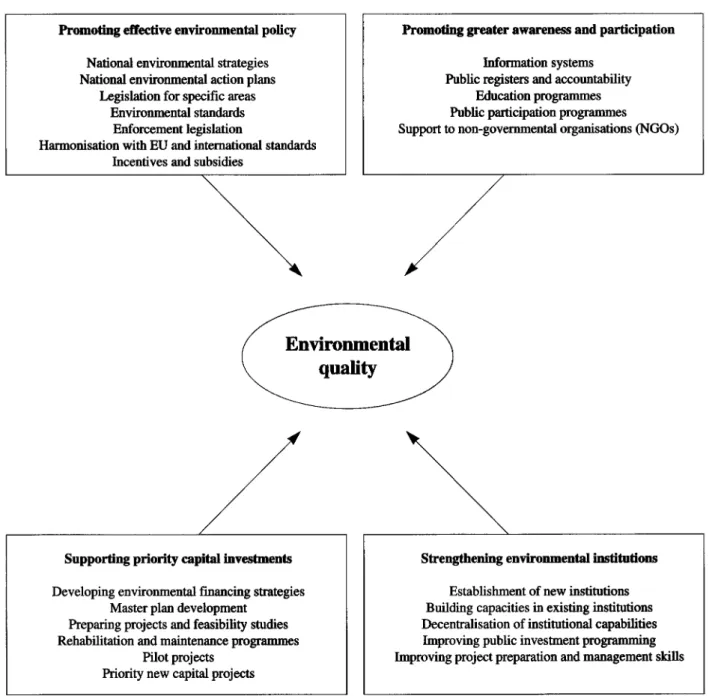
Table 2 -
Phare's
strategic focus
on
the environment
homoting effective environmental pollcy
National envircnmental sfr ategies
National environmental action plans
Irgislation for specific areas
Environmental standards
Enforcement legislation
Harmonisation with EU and intemational standards
Incentives and subsidies
Promoting greater awaren€ssr and participation
Information systems
Public registers and accountability Education programmes Public participation programmes
Support to non-governmental organisations (NGOs)
Supporting priority capital invcshents
Developing environmental financing strategies
Master plan development heparing projects and feasibility studies
Rehabilitation and maintenance prograrnmes
Pilot projects Priority new capital projects
Strengthening environmental insdfirtions
Establishment of new institutions Building capacities in existing institutions Decentralisation of institutional capabilities
24
Section 3 - Pharc's strategic focus on the environmentMulti
-country
prograrnme
s
The principal multi-counfiry environmental progralnmes operated by Phare since 1991 are
.
1991 regional
environment prograrnme
-
this focused ontwo
major pan-European problemsin
theDanube
river
basin andthe 'Black Triangle'
and onlinking
central and eastem European countrieswith
the European Environmental
Agency.
Projects haveinvolved pollution
monitoring, support
to
newregional environmental stategies
and
equipment supply..
1992
regional
environment
programme
-
in
addition, projects in the Black Sea and Baltic Sea were
carried
out
which
involved pollution
monitoring, equipment supply and technical support projects to tacklethe
most severely affected areas around eachsea (e.g. waste water treafinent
in
port
cities
in Lithuania)..1992
project
preparation
facility
-
this
facility
supports
the
identification and preparationof
major capital investment projects involving the environment,as recommended
in
the environmental action planfor
cental
and eastem Europe. Projecs under thisfacility
are being carried
out
in
various countries including Estonia, Hungary, Slovenia, Poland and Lithuania.Phare's multi-countiy programmes generally concenhate on
.
funding
the cental
managementand
coordinationbody which is addressing a multi-country problem
@anube programme Coordination Unit)
.
the development of critical sfrategies and master plans.
support
for
the
establishmentand
operation
of
pollution monitoring systems
.
limited
capital investmentswhich
demanda
multi-country approach and which cannot be carried out on a
national basis.
Phare's
multi-country
programmeshave
only
limited fundswith
whichto
address massive capital invesfinent needsand most multi-country
programmes highlight problemswhich
are then tacHedon a
national level, frequently through cooperation with the World Bank and the European Bank for Reconstruction and Development (EBRD).The
implementation
of
multi-country
prograrlrmesrequires extensive consultation, management
andcoordination between several national
governments.Therefore, they are only carried out where there is a real benefit
in
taking a multi-country rather than a national approach. Examples include.
multi-country
pollution
monitoring
projects integratedair
and water monitoring systems must be carriedout on a
multi-country basisto
give a
true pictureof
pollution
levels and sources.This
multi-country approach also allows pressure to be brought to bear
on
the more reluctantparher countries within
the
area.
Furthermore,this
approachcan
helpcountries
feel
that they can
combat
a
pollution problem which they feel unable to solve on a national level (e.g. the Danube river basin programme)..
cross-border
pollution
problems
-
pollution produced in one country mayflow
into a neighbouringcountry.
In
this
situationthe
soufce countryis
notgenerally
enthusiasticabout cleaning
up
pollution becausethe effect on
its
own territory
is
minimal,although
the
neighbour
country
is
powerless to preventthe
problem.
A
multi-counfiry approach isessential in these circumstances.
.
hamonisation
with
European
Union
(EU)
andinternational
standards-
many harmonisation issues canbe
tacHed mosteffectively on
a
multi-counry
basis. The Corine monitoring and
taining
prograrnmeis a
good example.
The
European Environment Agency usesthe
Phare-funded Corine multi-country programmeto
addresscental
and eastern Europe'soverall
problems
with
pollution
monitoring
andtraining.
Also,
Trans-European
Mobility
Programmes for
University Studies (TEMPUS)
and
the
EuropeanTraining
Foundationare
additional areas where such multi-country approaches are beingtaken.
They resultin
considerable savings through economiesof
scale andwill
allow monitoring and assessmentof
the state of theProblems experienced when implementing Phare's environmental programmes 25
Problems experienced
when implementing
Phare's
environmental programmes
Phare's environment progmrnmes have generally taken
from
tlree to five
yearsto
implement,which is
much longer than wasoriginally
anticipated. This profacted implementation period is due to.
the
need
to
develop
policy and
institutionalcapabilities and then carry
out
masterplans
andfeasibility
studies
before
progressing
to
capital investuents and pilot projects.
the
needfor
extensive consultationand
consensuswithin
national
govemmentsand,
in
multi-country prograrttmes, between several national govemments.
the
needto
decenfalise implementation procedureswhich
requires
local
Project
Management Units@MUs)
to
be
established
and
staffed
before implementation can begin. The lack of suitablytained
staff has been a major impediment to implementation.
.
the fragnentation of each programme into many small projects,reflecting the
natureof
the
environmental problemsthey are
attemptingto solve
(e.g.
the establishmentof
regional
environmental educationcentes tlroughout Poland).
Cumbersome procedures
within
partner countries andwithin
Phareitself
have also delayed implementationprocedures.
However,
this
problem
has
beenconsiderably reduced owing
to
a new standardised andfully
decentralised systemfor
the managementof
Phare projects,which
was instigatedtn
1994, andowing
to increasing efficiencywithin
Environment mini56iss and funds in the area.Not only
are
the
programmes accelerating throughimproved
project
management
effrciencies, implementationof
the capital projectswhich
Phare isnow
increasinglyfunding
tendsto
be
far
faster thanlechnical support.