Cognitive Work Analysis of a Sensor to
Effecter System: Implications for
Network Structures
Daniel P. Jenkins*, Neville A. Stanton, Guy H. Walker, Paul M. Salmon, Mark S. Young
School of Engineering & Design, Brunel University, Uxbridge, Middlesex, UB8 3PH, UK
*Contact author:[email protected]: 01895 267108
Fax: 01895 265546
1 Abstract
This paper presents a Cognitive Work Analysis of a command and control experimental
environment. The network facilitates the exchange of information between agents in
the field and a series of centrally located commanders. The environment developed
allows the manipulation of dependent variables to establish the most efficient network
structure for a variety of different scenarios. Cognitive Work Analysis has been used to
analyse and model the experimental system and hypothesise the implications of
changes to the network structure and the resulting influence this will have on the
system and the agents contained within. The analysis uses aWork Domain Analysisto
capture the purpose of the system. A Control Task Analysisoutlines the task required
to fulfil the purpose of the system. This task is broken down in a Strategies Analysis,
which explains the possible ways that the system can be configured to enable the
same end state. A Social Organisation and Cooperation Analysiselucidates which of
Competencies Analysis describes the resulting behavioural characteristics the actors
will exert depending on the level of tasks they are assigned.
Keywords: Cognitive Work Analysis; command and control; networks
2 The Domain
The system consists of two distributed teams located in an urban environment of
approximately 20 hectares. The first team is made up of a number of reconnaissance
units known as ‘sensors’. Sensors have the ability to sweep a geographic area and
identify targets that need to be neutralised. The second team is made up of effecters
who are responsible for neutralising identified targets. In this simple experimental
model sensors are the only actors that can detect targets and effecters are the only
actors who can neutralise previously identified targets.
There are a number of ways that information can be transmitted between the sensors
and effectors based on the way the system is configured. The system can be set up to
enable information to be sent via the commanders with information travelling up the
hierarchy and then back down to the units in the field, alternatively information can be
sent peer to peer.
When sending peer to peer the network can be configured so that a sensor can be
linked to an effecter. Alternatively the system can be configured so that the sensor has
the ability to select the recipient of the information. The system is reconfigurable; the
configuration choice will be influenced by a number of variables. These include:
• Number of units – how may sensors
• Ratio of targets to sensors – how many targets per sensor
• Complexity of task – are there a number of conflicting requirements
• Complexity of the target – is interpretation of the target required
• Ambiguity of information – is it clear what the information represents
• Type of information transmitted
3 Cognitive Work Analysis
Cognitive Work Analysis (CWA) is a structured framework for considering the
development and analysis of complex socio-technical systems. The framework leads
the analyst to consider the environment the task takes place within and the effect of the
imposed constraints on the systems ability to perform its purpose. The framework
guides the analyst through the process of answering the question of why the system
exists; what activities are conducted within the domain as well as how this activity is
achieved andwhois performing it.
According to Sanderson (2003) CWA does not focus on how human-system interaction
should proceed (normative modelling) or how human-system interaction currently
works (descriptive modelling). Instead, it focuses on identifying properties of the work
environment and of the workers themselves that define possible boundaries on the
ways that human-system interaction might reasonably proceed, without explicitly
identifying specific sequences of actions (formative modelling).
CWA was originally developed at the Risø National Laboratory in Denmark
(Rasmussen et al, 1994). The framework has been developed and applied for a
number of purposes including: system modelling (e.g. Hajdukiewicz, 1998); system
design (e.g. Bisantz et al, 2003); training needs analysis (e.g. Naikar & Sanderson,
interface design and evaluation (Vicente, 1999); information requirements specification
(e.g. Ahlstrom, 2005); tender evaluation (Naikar & Sanderson, 2001); team design
(Naikar et al, 2003); and error management strategy design (Naikar & Saunders,
2003).
The framework has been applied in a variety of domains including: aviation (e.g.,
Naikar & Sanderson, 2001); process control (e.g., Vicente, 1999); nuclear power (e.g.,
Olsson & Lee, 1994); Naval (e.g., Bisantz et al, 2003); military command and control
(e.g., Salmon et al, 2004); road transport (e.g., Stoner et al, 2003); health care (e.g.,
Miller, 2004); air traffic control (e.g., Ahlstrom, 2005); and manufacturing (e.g., Higgins,
1998).
According to Vicente (1999) CWA can be broken down into 5 defined phases.
Phase Tool
Work Domain Analysis Abstraction Decomposition Space
Control Task Analysis Decision Ladder
Strategies Analysis Information flow map
Social Organisation & Cooperation Analysis All of the Above
Worker Competencies Analysis Skills Rules Knowledge
3.1 Work Domain Analysis
The first phase work domain analysis (WDA) is used to describe the domain in which
the activity takes place independent of any goals or activities. The first stage of this
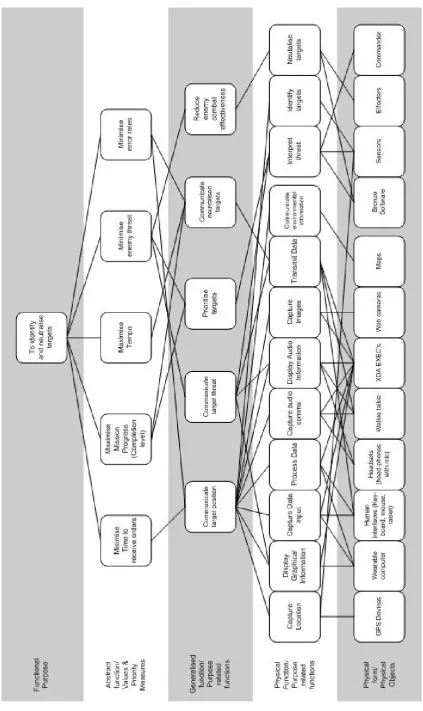
process is to build up an abstraction hierarchy (AH) of the domain.
The AH represents the system domain at a number of levels; at the highest level the
objects within the system. In this simple sensor-effecter paradigm the sole reason that
the system exists is to detect and neutralise targets within a predefined area. The
system is evaluated against its ability to enact its purpose. This can be measured by a
number of criteria, including; the time it takes the effecter to receive a target; how
quickly all of the targets can be neutralised (this could be achieved by neutralising them
based on the targets geographical position); the speed at which threat is reduced (this
could be achieved by neutralising the most dangerous targets first); and the number of
errors made.
In many circumstances these criteria may be conflicting. An example of this conflict
would be units approaching targets in threat priority order; the same effecter prioritising
the targets by their geographical position, would approach the targets in a different
order; this route is shorter and therefore faster to complete, however the target with the
greatest threat may not be neutralised until last. It could also be argued that the speed
to complete and error rates are conflicting constraints. The assumption being that;
more careful time consuming planning reduces errors.
The bottom level of the AH shows each of the physical objects within the domain, in
this case the nodes comprise all of the equipment and all of the actors within the
domain. The level above this describes the functions that each of the objects can
afford; in many cases an object may perform a number of functions, in the same way a
particular function may be afforded by a number of objects.
The generalised functions in the middle of the AH are the functions required to perform
the purposes of the system. Each of these levels can be linked by means-ends
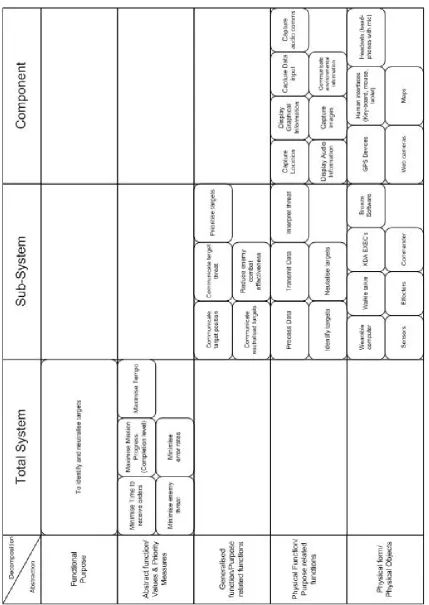
relationships using the why-what-how relationship. This analysis results in the AH
The AH can then be decomposed into a number of categories’ in this case three
categories; system, subsystem and individual components. Once decomposed, the
3.2 Control Task Analysis
The second stage of the analysis focuses on what has to be achieved independent of
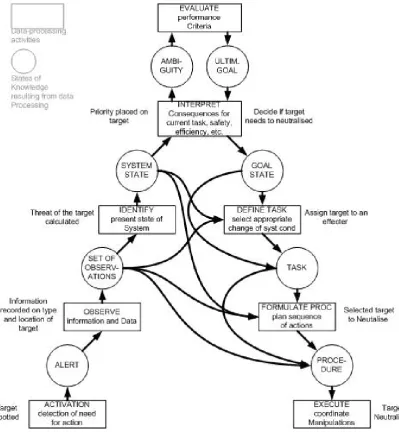
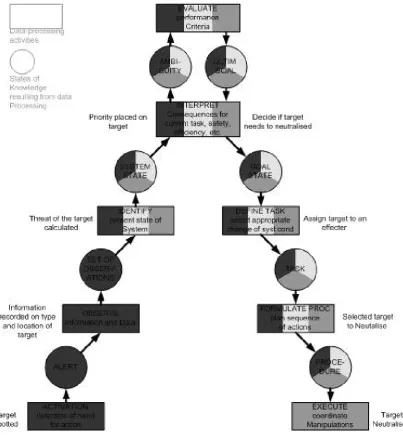
how the task is conducted or who will be doing it. The task of identifying a target and
neutralising it is shown by following the path up the left hand side and down the right
hand side in the decision ladder in Figure 3.
The spotting of a target is the activation for the system to start. Once a target is
spotted information is recorded on the targets location and type (no inference or
calculation is made). Assessment is then made to calculate the threat of the target.
Once a threat has been assigned, the target is then considered relative to the task and
the environment and a priority is placed. This prioritisation allows the target to be
assigned to an effecter. A target is then identified and finally neutralised
In order to speed up this process it is possible to bypass some of the steps, removing
some of the decision making processes allows the transition from spotting the target to
neutralisation to be expedited. Figure 3 shows each of the possible leaps (circle to
circle) and shunts (circle to square). Figure 3 illustrates that the shortest path for this
paradigm is that the target is spotted, information recorded and this information is used
Figure 3 – Decision ladder for Sensor-Effecter activity shortened
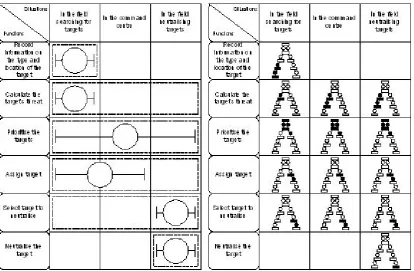
Naikar et al (2005) introduce the contextual activity template for use in this phase of the
CWA (see Figure 4). This template is one way of representing activity in work systems
that are characterised by both work situations and work functions. Work situations are
situations that can be decomposed based on recurring schedules or specific locations.
Rasmussen (1994) describes work functions as, activity characterised by its content
According to Naikar et al (2005) the work situations are shown along the horizontal axis
and the work functions are shown along the vertical axis of the contextual activity
template. The circles indicate the work functions and the boxes around each circle
indicate all of the work situations in which a work function can occur (as opposed to
must occur). The bars within each box indicate those work situations in which a work
function will typically occur. This template therefore shows the context, defined by work
situations, in which particular work functions can occur.
The work functions are similar to the generalised functions in the WDA (see Figure 1).
Three distinctly different situations have been selected; in the field searching for
targets; in the command centre; in the field neutralising targets. These situations can
be considered different due to their geographical variation and their different
constraints. Figure 4 shows that the constraints imposed on the system mean that two
of the functions are bound by the situations (records information on the type and
location; and neutralise the target). The functions of prioritising the targets and of
assigning the threat can take place in any situation. Figure 4 illustrates that the
function of calculating the threat of the targets is more likely to take place in the field
Figure 4 – Contextual activity template
The decision ladder introduced in Figure 3 can be used to communicate which stage of
the task is being completed at any particular mix of work situation or function. The
diagram on the right shows the contextual activity template overlaid with this
information.
3.3 Strategies Analysis
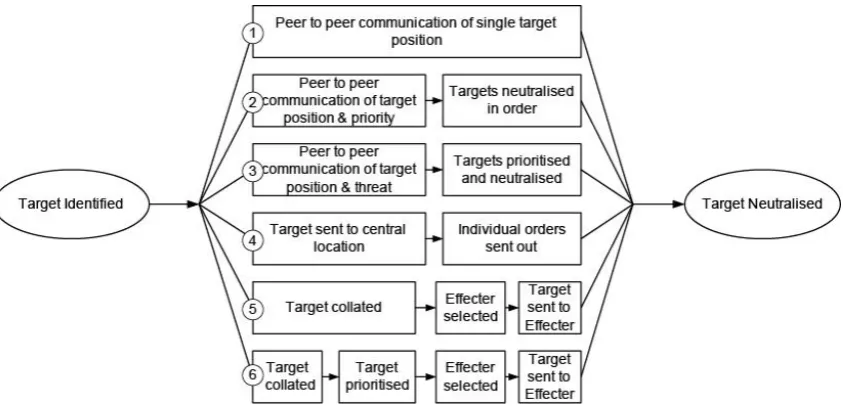
There are a number of ways of achieving the same ends with the system described in
the Abstraction Hierarchy. Each of these strategies uses different resources and
Figure 5 – Strategies analysis for Sensor-Effecter activity
In this case the start state is that a target is identified and the end state that the target
is neutralised. Use of the decision ladder representation in Figure 6 illustrates that the
strategy chosen affects the way in which the task is completed. The first strategy
shows that the task is completed at a simplistic level with out threat calculation or
prioritisation. This situation requires the targets to be neutralised as they are detected.
An example of a more complex situation is situation 6, here the target is processed
centrally and considered with all other targets, a priority is assigned and the
appropriate effecter selected.
[image:13.595.84.509.575.663.2]3.4 Social Organisation & Cooperation Analysis
It is possible to map each of the actor types on to the existing tools in order to show
who has the capability of doing what. Using arbitrary colours it is possible to show
[image:14.595.83.513.209.258.2]where each on the actor groups can conduct tasks.
Figure 7 – Key of actor type and colour
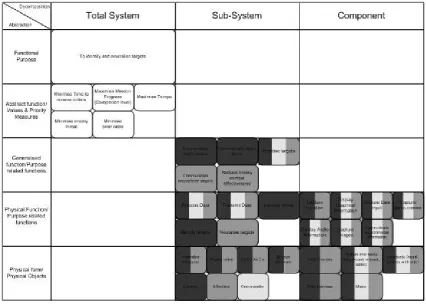
Figure 8 shows the abstraction-decomposition space (ADS) coloured to show the
nodes that can be used by the key actor groups. The total system requirements have
[image:14.595.81.508.418.724.2]been left blank as these are generic and apply to all actors.
Figure 9 shows the decision ladder introduced in Figure 3 coloured to show where
each of the actor types can conduct tasks. Due to the limitations of the system sensors
are the only actors that can detect targets and effecters are the only actors who can
neutralise previously identified targets (highlighted in Figure 4). This leads to the ‘feet’
of the ladder being coloured dark for the sensors and ‘medium grey’ for the effecters.
In these cases they are the only actors physically capable of conducting these tasks.
The remaining part of the decision ladder involves taking the basic information from the
sensor, interpreting it and making a decision about which targets to neutralise. In this
case this activity can be conducted by the sensor, the commander or the effecter. For
Figure 9 – Decision ladder showing tasks that can be conducted by actor types
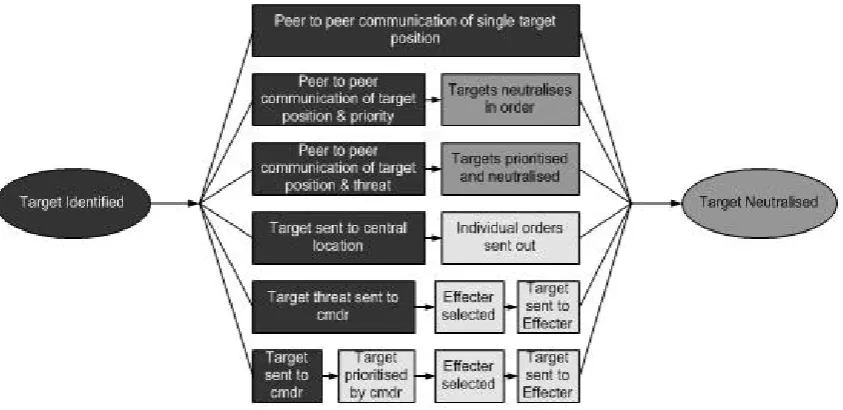
Figure 10 shows that the strategies analysis diagram introduced in Figure 5 can also
be coloured to show the actors engaging in the task. Here the initial state must start
with the sensor and end with the effecter, however the strategy used in the middle can
Figure 10 – Strategies analysis showing tasks that can be conducted by actor types
Experimentation is required to decide how the workload should be distributed. The
dependant variables listed at the start of this document and the network configuration
will affect this decision.
3.5 Worker Competencies Analysis
According to Vicente (1999) Skill based behaviour (SBB) is performed without
conscious attention. SBB typically consists of anticipated actions and involves direct
coupling with the environment. Rule Based Behaviour (RBB) is based on a set of
stored rules that can be learned from experience or from protocol. Individual goals are
not considered, the user is merely reacting to an anticipated event using familiar
perceptual cues. Unlike SBB, users can verbalise their thoughts as the process is
cognitive. When decisions are made that explicitly consider the purpose or goal of the
system the behaviour can be considered to be Knowledge Based Behaviour (KBB).
The network structure will also be dependant on the behaviour level expected from the
actors. The actors can work at three different behaviour levels dependant on the level
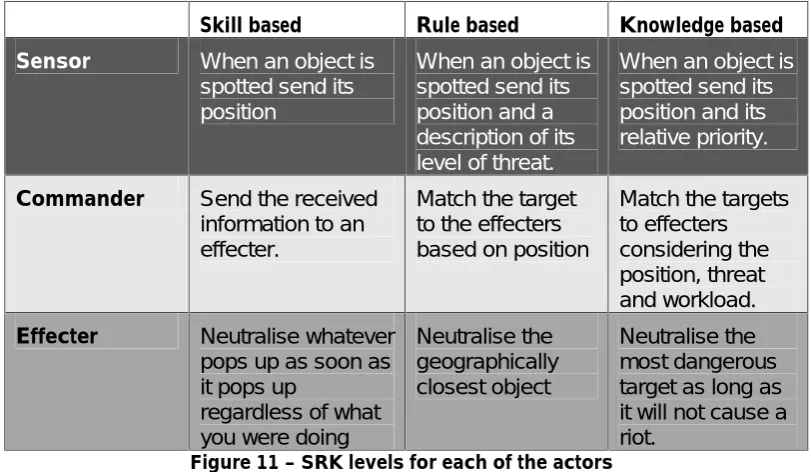
of processing required to complete the desired activity. Figure 11 shows example
responsibilities for each of the actors at the three behavioural levels.
Skill based Rule based Knowledge based Sensor When an object is
spotted send its position
When an object is spotted send its position and a description of its level of threat.
When an object is spotted send its position and its relative priority.
Commander Send the received information to an effecter.
Match the target to the effecters based on position
Match the targets to effecters considering the position, threat and workload. Effecter Neutralise whatever
pops up as soon as it pops up
regardless of what you were doing
Neutralise the geographically closest object
Neutralise the most dangerous target as long as it will not cause a riot.
Figure 11 – SRK levels for each of the actors
4 Conclusions
This paper has described the sensor to effecter system at each of the five CWA levels.
The analysis has described the domain and answered questions on why the system
exists, what it should do, how it should do it and who should be enacting the various
stages of the task.
The CWA demonstrate the flexibility of the network. Due to the physical nature of the
sensors, they are essential to the system as they are the only method for capturing
target positions. The effectors are also essential to the system as they are the only
means of neutralising targets. The commander/command team have no unique role
[image:18.595.94.500.198.434.2]sensing and neutralising are fixed, however the more complicated tasks of interpreting,
evaluating and defining the task can be assigned to anyone within the system.
By changing the roles and responsibilities of the groups of actors, it is possible to
rapidly reconfigure the network to compensate for environmental changes. By focusing
on the constraints the analysis captures every physically possible network
configuration.
5 Acknowledgements
This research from the Human Factors Integration Defence Technology Centre was
part-funded by the Human Sciences Domain of the UK Ministry of Defence Scientific
Research Programme.
Any views expressed are those of the author(s) and do not necessarily represent those
of MOD or any other UK government department.
6 References
Ahlstrom, U. (2005) Work domain analysis for air traffic controller weather displays.
Journal of Safety Research, 36, 159-169.
Bisantz, A. M., Roth, E., Brickman, B., Gosbee, L. L., Hettinger, L., & McKinney, J.
(2003). Integrating cognitive analyses in a large-scale system design process.
International Journal of Human-Computer Studies, 58, 177-206.
Chin, M., Sanderson, P., & WATSON, M. (1999). Cognitive Work Analysis of the
Research and Technology Symposium, United States Naval War College, Newport, RI,
June 29-July 1. 8pp
Hajdukiewicz J. R. (1998). Development of a structured approach for patient monitoring
in the operating room. Masters Thesis. University of Toronto
Higgins, P. G. (1998). Extending cognitive work analysis to manufacturing scheduling.
In Proceedings of OzCHI’98, November 30-December 4, 236-243.
Miller, A. (2004). A work domain analysis framework for modelling intensive care unit
patients. Cognition, Technology and Work. Vol. 6, No. 4. (November 2004), pp.
207-222.
Naikar N, Hopcroft R, & Moylan A (2005) Work Domain Analysis: Theoretical Concepts
and Methodology. DSTO-TR-1665 System Sciences Laboratory: Edinburgh, Australia.
Naikar, N., Pearce, B., Drumm, D. & Sanderson, P. M. (2003). Technique for designing
teams for first-of-a-kind complex systems with cognitive work analysis: Case study.
Human Factors, 45(2), 202-217.
Naikar, N. & Sanderson, P.M. (1999). Work domain analysis for training-system
definition. International Journal of Aviation Psychology, 9, 271-290.
Naikar, N. & Sanderson, P.M. (2001). Evaluating design proposals for complex
Naikar, N. & Saunders, A. (2003). Crossing the boundaries of safe operation: A
technical training approach to error management. Cognition Technology and Work, 5,
171-180.
Olsson, G. & Lee, P. L. (1994). Effective interfaces for process operators. The Journal
of Process Control, 4, 99–107.
Rasmussen, J., Pejtersen, A., & Goodstein, L. P. (1994). Cognitive systems
engineering. New York: Wiley.
Rasmussen, J., (1999). Forword to Cognitive work analysis: Toward safe, productive,
and healthy computer-based work. (pp xi) Mahwah, NJ’ Erlbaum.
Rasmussen, J., (1990). Mental models and the control of action in complex
environments. In D. Ackermann & M. J. Tauber (Eds.), mental models and human
computer interaction 1 (pp. 41-69). Amsterdam: North-Holland.
Rasmussen, J., Pejtersen, A., & Goodstein, L. (1994). Cognitive Systems Engineering.
New York: Wiley.
Salmon, P., Stanton, N., Walker, G., & Green, D. (2004). Future battlefield
visualisation: Investigating data representation in a novel C4i system. In V. Puri, D.
Filippidis, P. Retter & J. Kelly (Eds.) Weapons, Webs and Warfighters. Proceedings of
the Land Warfare Conference, DSTO, Melbourne, 2004.
Sanderson, P. M. (2003). Cognitive Work Analysis across the system life-cycle:
Achievements, challenges, and prospects in aviation. In P. Pfister & G. Edkins (Eds.).
Sharp TD, Helmicki AJ (1998). The application of the ecological interface design
approach to neonatal intensive care medicine. In Proceedings of the Human Factors
and Ergonomics Society 42nd Annual Meeting (pp. 350- 354). Santa Monica, CA:
HFES.
Stoner, H. A., Wiese, E. E., & Lee, J. D. (2003). Applying ecological interface design to
the driving domain: the results of an abstraction hierarchy analysis. In Proceedings of
the Human Factors and Ergonomics Society 47th Annual Meeting, Santa Monica, CA,
444-448.
Vicente, K. J. (1999). Cognitive work analysis: Toward safe, productive, and healthy