Mobile business: An exploratory study to define a framework for the
transformation process
Tsai, Heng-Sheng (Aaron Bond) and Gururajan, Raj Department of Information Systems
University of Southern Queensland Toowoomba, QLD 4350
Tel: + 61 7 4631 1834 Fax: + 61 7 4631 5594
Correspondence email: [email protected]
Mobile business: An exploratory study to define a framework for the
transformation process
Abstract
The advent of frontier technologies such as wireless technology has given the necessary impetus for businesses to transform from traditional ways into digital ways. While the Internet
transformed traditional businesses to e-businesses, wireless technology enabled to move further to mobile business or m-business. Despite the development in the technical domain, businesses still struggle to comprehend the processes involved in the transformation and a proper
framework is yet to evolve. This work-in-progress paper provides a background to such transformation with a method to achieve this transformation.
Introduction
businesses to move into m-businesses.
It appears that most current studies mainly focus on the issues of wireless technology due to infancy of mobile technology in the business domains. Although mobile technologies can be helpful on internal business processes, there is little information available on the guidelines of mobile business transformation (Carlsson, 2002; Holliday et al, 2002). This has given the basis for this research.
Literature review
Literature review in the area of mobile commerce or m-business can be divided into six parts: (1) definitions of m-commerce and m-business, (2) limitations and characteristics, (3) business models and value chain, (4) reasons of transforming into m-business, (5) transformation framework and guidelines, (6) challenges for m-business development. This study provides details of some aspects of these six parts.
Definitions of m-commerce and m-business
There are many definitions available for m-business and m-commerce. For instance, mobile e-commerce transaction is defined by Tsalgatidou and Pitoura (2001) as ‘any type of transaction of an economic value that is conducted through a mobile terminal that uses a wireless telecommunications network for communication with the c-commerce infrastructure’. Liao et al. (1999) define mobile commerce as ‘… involves the delivery of products and services via wireless technologies to enable e-commerce activities without restrictions of time and space’. Clarke (2001) states ‘mobile e-commerce, commonly referred to as m-commerce, is the ability to purchase goods anywhere through a wireless Internet-enabled device’. Terziyan (2002) defined mobile e-commerce as ‘a business transaction of an economic value that is conducted using a mobile terminal that communicates over a wireless telecommunications or personal area network with the e-commerce infrastructure’. Kalakota and Robinson (2002) claimed that m-business should combine Internet, wireless technologies, and e-business indicating that m-business includes aspects of information, services, and products with mobile devices on wireless network infrastructures.
Potential and advantages of mobile commerce
provided from wireless devices. This also allows m-businesses to differentiate its abilities from e-businesses. Localization of m-businesses is in terms of knowing the location of the user to create a significant advantage so as to leverage location-specific information by supplying information relevant to the current geographic position of the user. Personalization is achieved by making mobile devices ideal for individual-based target marketing. It offers the opportunity to personalize messages to various segments, based upon time and location, by altering both sight and sound. When these four elements are combined, the potential to improve the activities of a business becomes enormous.
The reasons for transforming into m-businesses
The main question that this study aims to answer is ‘Why should businesses pay attention to mobile commerce now?’. There is skepticism that the wireless technology as applied to business is still in infant stages. Further, businesses still encounter problems with e-business models and a number of issues such as e-signatures are yet to be comprehensively addressed. The greatest advantages businesses can derive from wireless technology include operational efficiency and customer interaction. Even in its current nascent stage, m-business can enhance business efficiency by distributing information to the workforce remotely, and offering new channels on which to interact with customers (Kumar and Zahn, 2003). Clarke (2001) provides supporting evidence by stating that: ‘Industries that are time sensitive, such as financial services and travel, are likely to benefit from businesses exploiting this value-added feature of mobile commerce. For example, alert notifications services, such as for auctions, betting, and stock price changes, which are specified by the user as an important part of relevant personal content’. He further states that ‘The convenience of m-commerce offers tremendous opportunities to expand a client-base by eliminating some of the customers’ labor of life's activities’. By making services more convenient the customer may actually become more loyal’.
Mobile technology can enhance the business value by making the activities more convenient and efficient in four related value-adding continuum that are being revolutionized by the Internet. They are Internet—search, evaluation, problem-solving, and transaction (Lumpkin and Dess, 2004). However, to accomplish these four, businesses need to transform to m-business from their current position properly and smoothly (Phan, 2003). A compelling reason to do so includes the potential and growing market creating by mobile users and the huge benefit offered by these mobile customers.
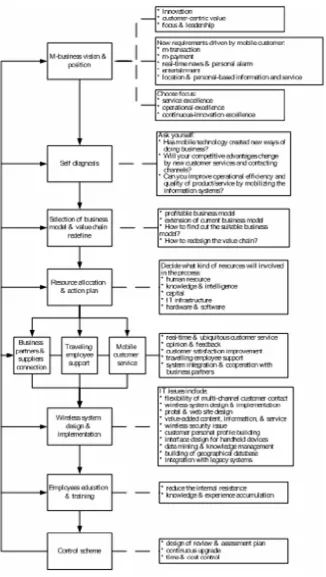
The mobile business transformation framework
models are discussed below.
Models suitable for m-business transformation
This study examined the model provided by Thomas M. Siebel (2001), the CEO of Siebel System, for introducing m-business strategy. This model is developed from hundreds of cases which use Siebel’s e-business system, and gained obvious success in their companies. These steps are:
1. Analyze current situation, create the e-business vision. 2. Design multi-channel strategy for the vision.
3. Action plans development.
4. Introduce and launch e-business system.
5. Evaluate, monitor and trace the e-business strategy.
Further more, there are 8 reference principles to follow in introducing processes associated with the five steps stated above:
z Understand the customers
z Provide multi-channel contact experience
z Give customer personal experience
z Make the best use of each customer’s value
z Focus on the best customer satisfaction
z Develop and maintain a global, customer-centric e-business architecture
z Utilize and expand e-business ecosystem
z Cultivate excellent and innovative business culture
On the other hand, the model proposed by Kalakota and Robinson (2001) contained following 4 steps.
Step1: Self-diagnosis
Before embarking on your journey to create an e-business design, you must first assess the impact of recent customer, business, and technological on your company by asking the following questions.
z Has the recent wave of technological innovation created new ways of doing business and reorganizing priorities within your firm?
z Is your company willing to question and to change countless industry assumptions to take advantage of new opportunities while also preserving existing investments in people, applications, and data?
z Is your company successful at lowering operating costs while making complex business applications adaptive and flexible to change under the relentless pressure of time to market? According to the answers, companies can be classified as market leader, early adopter/visionary, or silent majority. These questions can help managers understand the position of their company. Step 2: Reverse the value chain
[image:6.595.65.505.307.529.2]Businesses must redefine themselves in times of flux, a danger for companies married to a business definition that is fixed to specific products. By defining new product and service offerings, based on a continuous sensitivity to customer needs (see Figure 5).
Figure 1 Reversing the value chain (Kalakota and Robinson, 2001)
Step 3: Choose a focus
In order to narrow its circle of competence, a successful firm chooses one of the following types of focused excellence.
z Service excellence: Delivering what customers want with hassle-free service and superior value.
z Operational excellence: Delivering high-quality products quickly, error free, and for a reasonable price.
boundaries and delight customers.
To succeed, a company’s e-business design must be focused. Step 4: execute flawlessly.
Once the tough decisions are made, the next step is how to move from the current position to the goal, and how to integrate the legacy infrastructure to meet new e-business requirements? Some companies, such as American Express, Dell, and Cisco, have been the successful examples. The design job of m-business transformation framework should also absorb the previous knowledge obtained from e-business adoption, and then take the advantages and characteristics of m-business into account. Certainly, the job is not as easy as just putting ‘mobile’ in front of each term. Integration of the Internet with mobility will require a re-engineering of billing platforms (Kalakota & Robinson, 2001). Kalakota and Robinson (2002) warn that mobile Internet is in its infancy and there are no real framework available that can provide a systematic way to think about opportunities or problems t facilitate transformation.
After two years of continuous evolving, the landscape of m-business is clearer than before. Therefore, it is possible to construct a framework and action guidelines for companies that want to transform to m-business. There are three key issues that need to be considered while transforming to m-business (Clarke, 2001):
z Innovation and customer value.
z Profitable business models.
z Focus and leadership.
Clarke also believes that prudent managers may select to ask the following questions prior to offering an m-business application.
1. What is the value proposition provided from this wireless technology? 2. What market segments are best able to monetize this value proposition? 3. Does this application have potential to become a ‘killer app’?
4. Is this value proposition congruent with other wireless applications currently provided?
Success will depend on the ability to integrate e-competencies of current business models with the unique features of m-commerce. Long term m-commerce business success is likely to come from consumer-oriented, rather than technology-based strategies (Clarke, 2001).
The future challenges
z Michael Porter (2001) has emphasized that Internet technology becomes strategically significant only when its practical application creates new value.
z Kalakota and Robinson (2002) think customer value creation will most likely occur in five solution phases based on continuous improvements in mobile technology. These phases are messaging, info-connectivity, transactions, transformation, infusion.
Mobile companies today are in Phase 1. How quickly and completely the mobile Internet is adopted and used will be determined by how well the software applications it provides meet real customer needs.
z If the phones are too expensive, if the telecom companies charge too much per minute, if the vendors’ price their goods and services too high for impulse and convenience buying, then the cell phone may not turn into a product development success story (Kumar and Zahn, 2003).
z Decision makers have a difficult task in assessing the range of proposed business models in order to determine those that are most suitable (Hayes and Finnegan, 2005).
z For those have transformed into e-business, the implications for managers failing to develop effective consumer-oriented m-commerce strategies may include: wasting company resources chasing the ever changing technological environment, consumer alienation, and erosion of e-commerce market share (Hayes and Finnegan, 2005).
Based on the literature reviewed, the following research objectives have been developed as the basis to study the transformation of business to m-business.
Research questions
z What are the suitable ingredients to develop a model for m-business?
z What are the challenges facing businesses while transforming to m-business from their current stage?
z What factors impact the development of an effective framework in the transformation process?
z What are the efficient strategies in realizing an m-business transformation?
Initial research model
Figure 2 Initial research model
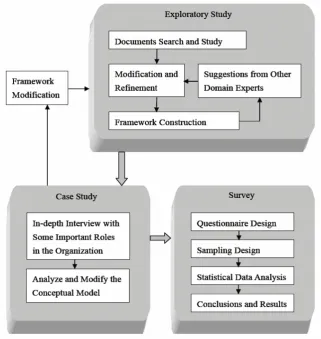
Research Framework of this study
m-commerce wave. The conceptual framework will build on the base combining knowledge and experience of previous studies, case investigations, and industrial forerunners. Once this is accomplished, a case study approach will be followed to gain business perspective to refine the initial transformation framework. The third step in the process is administering a survey. Once the survey is completed, an efficient and effective framework and guidelines for m-business transformation can be built for businesses, and making the transformation process successful. The research steps are listed in Figure 2.
Figure 3 Research framework of this study
Research Methodology
This study combines conceptual and empirical research methods. Conceptual research mainly focuses on the development of framework (step 1). On the other hand, empirical research emphasizes the findings of practical knowledge and successful experience relating to the m-business transformation process (step 2 & 3). In this part, case study and survey will be used.
References
Clarke, Irvine Iii (2001), Emerging Value Propositions for M-Commerce, Journal of Business Strategies, Vol. 18, Iss. 2, 133-148.
Durlacher Research Ltd (2000), Mobile Commerce Report. [http://www.durlacher.com]
Hayes, Jeremy, & Pat Finnegan (2005), Assessing the Potential of E-Business Models: Towards a Framework for Assisting Decision-Makers, European Journal of Operational Research 160, 365–379.
Holliday, Joanne, Divyakant Agrawal, & Amr El Abbadi (2002), Disconnection Modes for Mobile Databases, Wireless Networks, 8, 391-402.
Kalakota, Ravi, & Marcia Robinson (2001), E-Business 2.0: Roadmap for Success, Addison Wesley. Kalakota, Ravi, & Marcia Robinson (2002), M-Business: The Race to Mobility, McGraw-Hill.
Kumar, S., & C. Zahn (2003), Mobile Communications: Evolution and Impact on Business Operations, Technovation 23, 515–520.
Liao, S., Y.P. Shao, H. Wang, & A. Chen (1999), The Adoption of Virtual Banking: An Empirical Study, International Journal of Information Management, 19, 1, 63–74.
Lumpkin, G.T., & Gregory G. Dess (2004), E-Business Strategies and Internet Business Models: How the Internet Adds Value, Organizational Dynamics, Vol. 33, No. 2, 161–173.
Phan, Dien D. (2003), E-Business Development for Competitive Advantages: A Case Study, Information & Management 40, 581–590.
Porter, Michael E. (2001), Strategy and the Internet, Harvard Business Review, Boston, Mar, Vol. 79, Iss. 3, 63-77. Siebel, Thomas M. (2001), Taking Care of E-Business: How Today’s Market Leaders Are Increasing Revenues,
Productivity, and Customer Satisfaction, Doubleday.
Terziyan, Vagan (2002), Ontological Modeling of E-Services to Ensure Appropriate Mobile Transactions, International Journal of Intelligent Systems in Accounting, Jul-Sep, 11, 3, 159-172.