Dynamic resilience and stability of
Ecklonia radiata
:
the importance of density-dependent ecosystem
engineering feedbacks
By:
Masayuki Tatsumi
BASc (Hons)
A thesis submitted in fulfilment of the requirements for the degree of Doctor of Philosophy (Fisheries Studies)
Institute for Marine and Antarctic Studies University of Tasmania
This thesis is dedicated to all the volunteers who assisted me in the field and in the lab. Without their contribution, it would not have been possible to complete this research.
Áine Nicholson Anna Cresswell Claire Butler Christopher Mabin
Damon Britton Danielle Zanetto
Emma Flukes Harry Watson Jo Randall Kathy Willis
Jordi Boada Marty Filleul Matthew Doggett
Megan Dykman Natasha Gafar Nazarene Tan
Rob Perry Sarah Powell
University or any other institution, except by way of background information and duly acknowledged in the thesis, and to the best of my knowledge and belief no material previously published or written by another person except where due acknowledgement is made in the text of the thesis, nor does the thesis contain any material that infringes copyright.
Signed: (Masayuki Tatsumi)
Date: 29th September 2018
Statement of Authority of Access
This thesis may be made available for loan and limited copying and communication in accordance with the Copyright Act 1968.
Signed: (Masayuki Tatsumi)
journals. The conducts of the research (experiment designs, method developments, analysis, interpretation of results, manuscript preparation) were responsibility of the candidate, but were consulted with supervisors and other co-authors. These contributions are outlined below.
Chapter 2
Jeffrey Wright and Craig Johnson contributed to the conception and design of the experiment, and analysis and interpretation of the results. Cayne Layton and Matthew
Cameron contributed to development of methodologies and conduct of filed work along with Victor Shelamoff. All co-authors provided comments on the manuscript.
Chapter 3
Jeffrey Wright and Craig Johnson contributed to the conception and design of the
experiment, and analysis and interpretation of the results. Cayne Layton, Matthew Cameron and Victor Shelamoff contributed to development of methodologies and conduct of filed work. All co-authors provided comments on the manuscript.
Chapter 4
Mr. Masayuki Tatsumi (candidate) – IMAS, University of Tasmania --- Candidate
Dr. Jeffrey Wright (primary supervisor) – IMAS, University of Tasmania --- Author 1
Prof. Craig Johnson (co-supervisor) – IMAS, University of Tasmania --- Author 2
Mr. Cayne Layton (co-author) – IMAS, University of Tasmania --- Author 3
Dr. Matthew Cameron (co-author) – IMAS, University of Tasmania --- Author 4
Mr. Victor Shelamoff (co-author) – IMAS, University of Tasmania --- Author 5
Dr. Christopher Mabin (co-author) – IMAS, University of Tasmania --- Author 6
We the undersigned agree with the above stated “proportion of work undertaken” for each of the above to-be-submitted as peer-reviewed manuscripts contributing to this thesis:
Signed: Candidate (Masayuki Tatsumi):
Author 1 (Dr. Jeffrey Wright):
Author 2 (Prof. Craig Johnson):
Author 3 (Mr. Cayne Layton):
Author 4 (Dr. Matthew Cameron):
Author 5 (Mr. Victor Shelamoff):
Author 6 (Dr. Christopher Mabin):
The preparation and submission of this thesis was made possible with the support from my research organisation, Institute for Marine and Antarctic Studies, University of Tasmania. I would like to thank their great assistants and all people who inspired and motivated me throughout my candidature. The following people, especially, deserves special thanks:
I would like to thank my supervisors, Jeff Wright and Craig Johnson, who opened up an opportunity for me to conduct this research. Without your supports in academic and personal life, it was not possible to complete the research and I am grateful that I conducted my research under your supervision.
To my fantastic research team at work and great friends off-work, Cayne Layton, Victor Shelamoff and Matthew Cameron. We spent such long hours together in the field, sometime in a very bad weather and lot of challenges, but we always kept our smiles and laughter. I believe we could not achieve what we have achieved if it were not us four conducted the research together.
To all volunteers who helped me in the field and lab. The amount of work you contributed to the research was enormous. I would like to thank you all for spending your valuable time to make this research possible.
Declaration of Originality ii
Statement of co-author contributions iii
Acknowledgement v
Contents vi
List of Figures viii
List of Tables x
Abstract xi
Chapter 1. Introduction 1
References 8
Chapter 2. Density-dependent effects of Ecklonia radiata on sub-canopy abiotic
conditions, understory algae and recruitment 16
Abstract 16
Introduction 17
Materials and methods 20
Results 30
Discussion 45
References 54
on self-recruitment in kelp 67
Abstract 67
Introduction 68
Materials and methods 71
Results 77
Discussion 81
References 89
Chapter 4. Density-dependent and seasonal variation in reproductive output,
sporophyte production and performance in the kelp, Ecklonia radiata 97
Abstract 97
Introduction 98
Materials and methods 101
Results 105
Discussion 112
References 119
Chapter 5. General discussion 130
Figure 2.1: The effects of Ecklonia radiata density on sub-canopy sediment deposition rates,
relative sediment deposition, sediment accumulation in the turf/sediment matrix,
scour, water flow and relative water flow. 32
Figure 2.2: The effects of Ecklonia radiata thallus density on sub-canopy photosynthetic
active radiation (PAR). 35
Figure 2.3: The effects of Ecklonia radiata thallus density on understory algal species
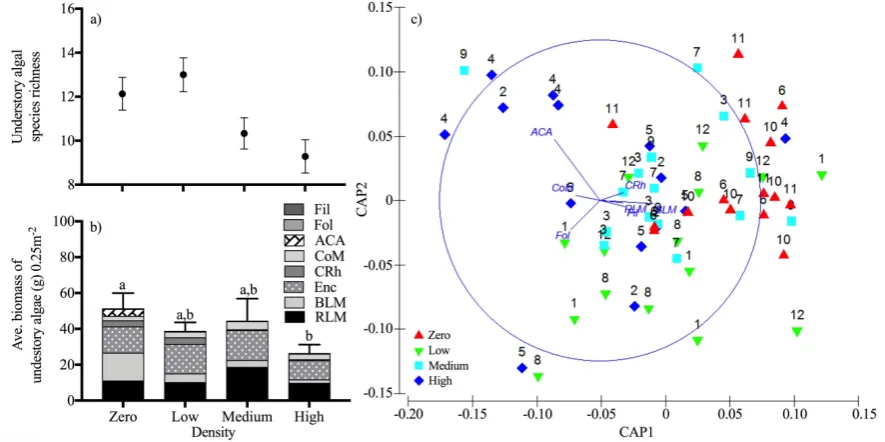
richness, biomass, and community structure. 38
Figure 2.4: Number of outplanted microscopic Ecklonia radiata sporophytes after 42 days in
four different adult Ecklonia radiata thallus densities. 41
Figure 2.5: Survivorship, lamina length, growth rates, and erosion rates of juvenile Ecklonia
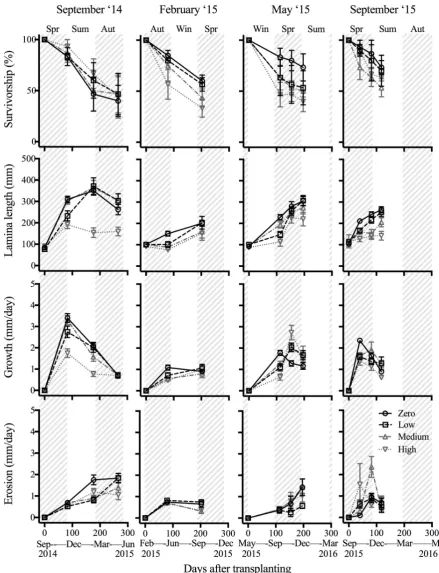
radiata transplanted into plots with different adult E. radiata thallus densities. 44
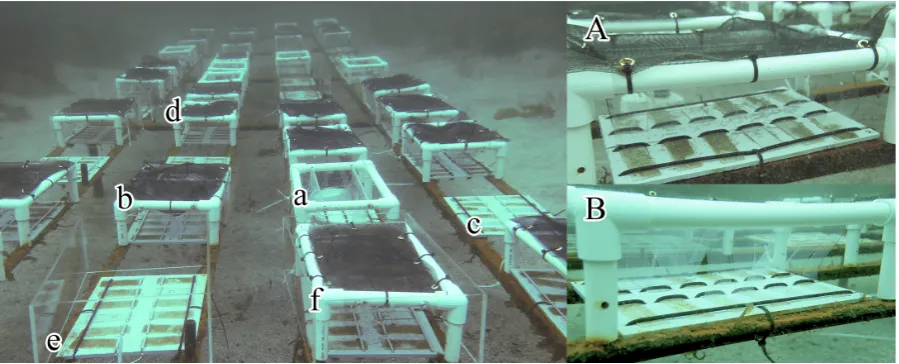
Figure 3.1: Racks for outplanting of microscopic sporophytes showing replicate slide holders
and frames. 73
Figure 3.2: Effects of scour, water flow and light on survivorship of outplanted juvenile
Ecklonia radiata sporophytes. 79
Figure 3.3: Effects of scour, water flow and light on size of outplanted juvenile Ecklonia
radiata sporophytes. 81
Figure 4.1: Seasonal pattern of zoospore release in Ecklonia radiata. 106
Figure 4.2: Effect of density of adult Ecklonia radiata sporophytes and season on zoospore
release. 108
Figure 4.3: Linear regressions between sea surface temperature and mean Ecklonia radiata
gametophytes, sporophytes, and the percentage transition between female
gametophytes and sporophytes in spring and winter. 110
Figure 4.5: Linear regressions between mean Ecklonia radiata micro-sporophyte density and
Table 2.1: Two-way analyses of variance examining the effects of adult Ecklonia radiata
density and time on sub-canopy photosynthetic active radiation (PAR) and
relative sub-canopy PAR. 36
Table 2.2: One-away analyses of variance examining the effects of adult Ecklonia radiata
density on the biomass of understory algae. 39
Table 2.3: Analyses of deviance examining the effect of adult Ecklonia radiata density on
the survivorship of outplanted microscopic sporophytes. 40
Table 2.4: Analyses of variance examining the effects of adult Ecklonia radiata sporophyte
density on the survivorship, lamina length, growth rates and erosion rates of
transplanted juvenile Ecklonia radiata. 43
Kelps are the dominant marine ecosystem engineers of temperate subtidal rocky reefs around the globe. Kelp forests create a complex habitat structure, modify abiotic factors and support diverse and highly productive systems. However, kelps face several threats and degradation of kelp forests has been reported in a number of places including south-eastern Australia. To date, most studies of threats to kelps focus on how external factors contribute to the
degradation but there are also important internal drivers that will also influence kelp stability and resilience. Because ecosystem engineers modify the abiotic and biotic environment, the changes they make may positively feedback to affect their own demography. Consequently, a decline in adult density may lead to a decline in engineering capacity, a change in the
modified conditions and reduction in, or loss, of positive effects.
Ecklonia radiata is the most widespread habitat-forming kelp in Australia, however, range of stressors, such as ocean warming, more severe and frequent storms, overgrazing and
pollution have been impacting its populations causing localised declines in population density. Although studies have been conducted to understand the implications of these changes, how a decline in adult density will affect the demography (reproduction,
recruitment, post-recruitment growth and survivorship) of E. radiata are poorly understood. The central aims of this thesis were to determine; (i) how a decline in the density of Ecklonia affects engineering of critical abiotic factors and the link between those abiotic changes and both the understory community and Ecklonia reproduction,recruitment and post-recruitment growth and survivorship, (ii) whether abiotic factors modified by E. radiata were important mechanisms affecting the early post-recruitment survivorship and growth of E. radiata sporophytes, and; (iii) how density-dependent effects on reproductive output affected recruitment of both gametophytes and sporophytes.
radiata recruits did not always reflect these changes due to large variation in these metrics within the density treatments which highlighted the variable nature of these processes acting on small-spatial scales on natural reefs.
In chapter 3, I manipulated three modified abiotic factors (light, scour and water flow) in the field to identity their role as mechanisms affecting the survivorship and growth of early sporophyte recruits. Overall, this experiment revealed low light / low scour (ambient flow) as important for very small / early sporophytes, but the response of slightly larger sporophytes was more complex. By week 6 in the absence of scour, light and water flow interacted and the highest survivorship occurred with ambient flow/low light and low flow/ambient light. Importantly, these larger sporophytes respond positively and grow much faster under higher light.
Chapter 4 tested density-dependent issues related to reproduction. Specifically, how reproductive capacity of E. radiata in the field (the amount of zoospores released per individual) was affected by adult E. radiata density and how recruitment of microscopic stages (gametophytes and sporophytes) was influenced by zoospore density in two different seasons. Zoospore released per individual did not vary greatly in relation to adult density indicating that the total amount of zoospores produced in a E. radiata forest is likely to increase as the number of reproductive adults increases. Gametophyte and sporophyte recruitment were dependent on the density zoospores, with clear optimal ranges (90-355 mm -2 in spring and 21-261 mm-2 in winter) and threshold densities (< 6.5 mm-2 in spring < 0.5
mm-2 in winter) of zoospores for successful recruitment.
Overall, this study indicates that some abiotic factors (light, scour and sediment
accumulation) change in response to a declining density of Ecklonia and that low scour and combinations of light and water flow are important to post-recruitment survivorship and growth. However, the evidence for the break-down of a positive demographic feedback with a decline in E. radiata density was not strong. Nonetheless this study did indicate that a high density of reproductive E. radiata sporophytes is likely to result in a high density of
Chapter 1.
Introduction
Marine ecosystems around the globe are being exposed to increasing levels of anthropogenic
stressors including urban development, climate change, excess nutrients, declining water
quality and overfishing (Jackson et al. 2001, Scheffer et al. 2001, Airoldi 2003, Ling 2008,
Gribben et al. 2013, Wernberg et al. 2016). Climate change is often considered the most
significant threat to marine species, including habitat-forming ecosystem engineers, and
cumulative evidence of changes to populations of ecosystem engineers and the species that
rely on them for habitat have been reported (Ridgway 2007, Johnson et al. 2011, Kroeker et
al. 2013, Wernberg et al. 2016, Provost et al. 2017). The increased frequency and intensity of
stressors can degrade key coastal habitat created by ecosystem engineers such as kelp, coral,
seagrass and mangroves (Poloczanska et al. 2007, Wernberg et al. 2010, de Fouw et al. 2016,
Goatley et al. 2016). As these species are fundamental for the health of these coastal
ecosystems, loss of these ecosystem engineers can lead to declines in diversity, simplified
and low productive systems and in extreme cases, catastrophic phase shifts (Scheffer et al.
2001, Folke et al. 2004, Krumhansl et al. 2016, Wernberg et al. 2016, Chefaoui et al. 2018).
Ecosystem engineers are species which modify the environment in ways that often enhance
productivity and species diversity (Jones et al. 1994, Coleman and Williams 2002, Hastings
et al. 2007). Engineer species are categorised as either autogenic or allogenic engineers
(Jones et al. 1994). Autogenic engineers modify the environment by simply being present in a
system (e.g. kelps providing shades and seagrass reducing sediment transfer rate; Kennelly
1989, van der Heide et al. 2012) while allogenic engineers actively modify the environment
through their behaviour (e.g. beavers changing flows of water by creating a dam and pika
2008). Modifications to the environment by ecosystem engineers can occur in three ways:
structural, abiotic and biotic engineering (Jones et al. 2010). For autogenic ecosystem
engineers, structural engineering involves the insertion of the physical structure of the
engineer (for example, a tree or a bivalve shell) into the environment. The structure leads to
abiotic change (abiotic engineering: for example, a decrease in light or boundary flow) and
both structural and abiotic engineering lead to biological change (biotic engineering) such as
changes to community structure (Jones et al. 2010).
Here I present a conceptual framework highlighting how structural, abiotic and biotic
engineering in a marine ecosystem engineer such as kelp, can result in a feedback to the
engineer itself (also see Jones et al. 2010). The presence of kelp causes structural engineering
of the environment, which in kelp forests results in the modification of abiotic factors such as
light, sedimentation, scour and water flow (Eckman et al. 1989, Kennelly 1989, Madsen et al.
2001, Toohey et al. 2004, Tatsumi and Wright 2016). Associated biotic communities, such as
understory algae and invertebrates, are then determined by the presence of kelp structure and
abiotic factors (Connell 2003b, Toohey 2007, Flukes et al. 2014). Kelp recruits are also
influenced by the presence of the kelp structure (Anderson et al. 1997, Taylor and Schiel
2005) modifying abiotic factors such as light and sedimentation (Novaczek 1984, Bearham et
al. 2013, Geange et al. 2014) and biotic factors such as competition and grazing (Anderson et
al. 1997, Tatsumi and Wright 2016). Consequently, changes to the structural, abiotic and
biotic environments beneath the kelp canopy can positively affect the demographic rates of
kelp including reproduction, recruitment and post-recruitment survivorship. This positive
feedback to the demography of an engineer has been termed an environment-engineer
feedback (Jones et al. 2010) and may be crucial to the stability and resilience of ecosystem
positive for populations of the engineer species to remain stable. Additionally, the degree of
feedback effects are expected to be density dependent (Hastings et al. 2007, Jones et al. 2010,
Wernberg et al. 2016), therefore population degradation which results in a decline in density
may affect the engineering capacity and thus the feedback. If there is a threshold density
where positive feedbacks are lost, then identifying this threshold may be important in the
management of these crucial habitats.
Kelps are important ecosystem engineers of temperate sub-tidal rocky reefs (Steneck et al.
2002, Steneck and Johnson 2014, Krumhansl et al. 2016). The abiotic factors they modify
can change in density-dependent ways (Gerard 1984, Wernberg et al. 2005) and influence
associated sub-canopy benthic communities (Gerard 1984, Dayton et al. 1992, Clark et al.
2004, Tatsumi and Wright 2016). Light in particular is significantly reduced under intact kelp
canopies by as much as 90% (Wernberg et al. 2005), reducing the biomass of turfing,
filamentous and foliose understory algae with understory communities beneath a full canopy
typically dominated by encrusting algae and sessile invertebrates (Connell 2003a, Tatsumi
and Wright 2016). Turfing, filamentous and foliose algae are generally more common in
canopy gaps where there is more light available (Connell 2003a, Wernberg et al. 2005,
Toohey and Kendrick 2008). Similarly, a 66% decline in the kelp canopy causes changes to
the understory community, with more foliose algae with fewer sponges, bryozoans and
encrusting algae compared to a full canopy (Flukes et al. 2014). As understory algae are
direct competitors of kelp recruits (Kennelly 1987, Toohey and Kendrick 2007, Tatsumi and
Wright 2016), an increase in foliose understory algae associated with a decline in kelp
density may result in conditions that decrease kelp recruitment. To our knowledge, the
change and how these affect the demography of engineers such as kelp has not previously
been tested.
Ecklonia radiata (herein referred as Ecklonia) (C. Agardh) J. Agardh (order Laminariales) is
the most wide-spread marine ecosystem engineering alga of Australasia and it dominates
much of the temperate sub-tidal coastlines of southern Australia (Womersley 1967, Bennett
et al. 2016). Ecklonia forests support productive and diverse communities including a number
of economically important species (Johnson et al. 2005, Bennett et al. 2016). Ecklonia has a
typical kelp life-cycle consisting of microscopic male and female gametophytes and a
macroscopic sporophyte stage (Womersley 1967, Schiel and Foster 2006). Its maximum
height is two meters and consists of a holdfast and a single stipe from which arises a central
lamina with paired lateral developments, although large morphological variation has been
reported (Womersley 1967, Jennings and Steinberg 1997, Fowler-Walker et al. 2006,
Wernberg et al. 2010, Mabin et al. 2013). The reproduction season also varies depending on
location with peaks in summer on the west coast but in cooler months on the east coast
(Mabin et al. 2013, Mohring et al. 2014). Populations of Ecklonia on both the east and west
coasts of Australia are increasingly being impacted by the southwards movement of warm
water associated with boundary currents which negatively affects Ecklonia directly and
indirectly via associated movement of grazers, causing population degradation (Ling and
Johnson 2012, Mabin et al. 2013, Wernberg et al. 2016). As positive feedback effects by
Ecklonia may be density dependent, a reduction in density may have implication for the
When considering factors affecting the population degradation of habitat-forming kelps, most
previous research has focussed on external drivers, such as increased ocean temperature,
severe storms and over grazing (Seymour et al. 1989, Ling and Johnson 2012, Wernberg et
al. 2013, Filbee-Dexter et al. 2016, Vergés et al. 2016) with less attention on internal drivers
such as a decline in a positive environment-engineer feedback from adult sporophytes.
Although Ecklonia is known to modify abiotic and biotic factors (Kennelly 1989, Connell
2003a, Connell 2003b, Wernberg et al. 2005, Flukes et al. 2014), little is known about
whether these modifications change in a density-dependent manner, and how this feeds back
to influence its recruitment and post-recruitment performance. Survivorship of early
life-history stages of kelp is typically low and highly variable (Schiel and Foster 2006, Tatsumi
and Wright 2016) Kelp recruits are often observed beneath the adult canopy (Anderson et al.
1997, Wernberg et al. 2010) where they are likely to be influenced by modified sub-canopy
environment. Performance of juvenile sporophytes is likely to be influenced by a range of
external factors (Ling & Johnson 2012, Wernberg et al. 2016), but engineering modifications
by adult sporophytes may reduce stressors, improving recruitment success. However,
mechanisms determining the recruitment and post-recruitment growth and survivorship of
sporophytes is not well known. In addition, we know little about factors influencing
population replenishment in Ecklonia, particularly possible density-dependent effects on
reproductive output (amount of zoospore released) and how zoospore density influences
gametophyte and subsequent sporophyte survivorship and growth. Predicted ocean warming,
more frequent and severe storms, grazing and other anthropogenic disturbances are likely to
cause further degradation of kelp forests (Ling and Johnson 2012, Filbee-Dexter et al. 2016,
Vergés et al. 2016, Wernberg et al. 2016) hence, understanding ecosystem-engineering
Thesis structure
Much of current research on Ecklonia has focused on how external drivers influence its
stability and resilience, but internal drivers affecting its demography, environment-engineer
feedback in particular, may also be important but are not well ununderstood. To reveal the
dynamic nature of density-dependent engineering feedback, helping to define any tipping
points where positive engineering effects may be lost, I set the central aims of this thesis to
determine: (i) how a decline in the density of Ecklonia affected engineering of critical abiotic
factors and the link between those abiotic changes and both the understory community and
Ecklonia reproduction,recruitment and post-recruitment growth and survivorship, (ii)
whether abiotic factors modified by Ecklonia were important mechanisms affecting the early
post-recruitment survivorship and growth of Ecklonia sporophytes, and; (iii) how
density-dependent effects on reproductive output affected recruitment of both gametophytes and
sporophytes. Aims (i) and (ii) were addressed using field experiments and aim (iii) by a
laboratory experiment.
Chapter 2:Density-dependent effects of Ecklonia radiata on sub-canopy abiotic conditions, understory algae and recruitment.
The density of adult Ecklonia radiata was manipulated to four different levels for 24 months
to test for density-dependent engineering of abiotic factors, associated biotic communities
and effects on Ecklonia demographic rates. The demography of both microscopic (by
outplanting cultured sporophytes) and macroscopic (by transplanting) juveniles were
Chapter 3:Interactive effects of canopy-driven changes in light, scour and water flow on self-recruitment in kelp.
A field experiment was conducted to determine interactive effects of three key abiotic factors
engineered by Ecklonia:light, scour and water flow, on the survivorship and growth of
microscopic sporophytes. Each abiotic factor had two treatment levels (light: ambient/low,
scour: present/absent, water flow: ambient/low) crossed with a second abiotic factor and the
effects of these treatments on the survivorship and growth of outplanted cultured sporophytes
was determined at two times.
Chapter 4:Density-dependent and seasonal variation in reproductive output, sporophyte production and performance in the kelp, Ecklonia radiata.
This chapter combined long-term data on seasonal and density-dependent reproductive output
(measured as zoospore release) with a laboratory experiment that determined the effects of
variable zoospore density on subsequent recruitment. Density-dependent zoospore release
was monitored in the field for 24 months while the effects of zoospore density was examined
in the lab using a dilution series experiment.
Chapter 5:General discussion
In the final chapter, I synthesise the overall findings of the research and drawing on
ecosystem engineering theory, discuss the implications of my research for the stability and
resilience of kelp. I also discuss how my findings can contribute to the management and
restoration of Ecklonia and highlight possible further avenues of research. My research
highlighted some engineering effects of a healthy Ecklonia forest in providing a suitable
sub-canopy environment for microscopic sporophyte recruitment (low light and low scour) but
References
Airoldi, L. 2003. The effects of sedimentation on rocky coast assemblages. Oceanography
and Marine Biology: an annual review 41:161-236.
Anderson, R., P. Carrick, G. Levitt, and A. Share. 1997. Holdfasts of adult kelp Ecklonia
maxima provide refuges from grazing for recruitment of juvenile kelps. Marine
Ecology Progress Series 159:265-273.
Bearham, D., M. A. Vanderklift, and J. R. Gunson. 2013. Temperature and light explain
spatial variation in growth and productivity of the kelp Ecklonia radiata. Marine
Ecology Progress Series 476:59-70.
Bennett, S., T. Wernberg, S. D. Connell, A. J. Hobday, C. R. Johnson, and E. S. Poloczanska.
2016. The ‘Great Southern Reef’: social, ecological and economic value of
Australia’s neglected kelp forests. Marine and Freshwater Research 67:47-56.
Chefaoui, R. M., C. M. Duarte, and E. A. Serrão. 2018. Dramatic loss of seagrass habitat
under projected climate change in the Mediterranean Sea. Global Change Biology.
Clark, R., M. Edwards, and M. Foster. 2004. Effects of shade from multiple kelp canopies on
an understory algal assemblage. Marine Ecology Progress Series 267:107-119.
Coleman, F. C., and S. L. Williams. 2002. Overexploiting marine ecosystem engineers:
potential consequences for biodiversity. Trends in Ecology & Evolution 17:40-44.
Connell, S. 2003a. The monopolization of understorey habitat by subtidal encrusting
coralline algae: a test of the combined effects of canopy-mediated light and
sedimentation. Marine Biology 142:1065-1071.
Connell, S. D. 2003b. Negative effects overpower the positive of kelp to exclude
Dayton, P. K., M. J. Tegner, P. E. Parnell, and P. B. Edwards. 1992. Temporal and spatial
patterns of disturbance and recovery in a kelp forest community. Ecological
Monographs 62:421-445.
de Fouw, J., L. L. Govers, J. van de Koppel, J. van Belzen, W. Dorigo, M. A. S. Cheikh, M.
J. Christianen, K. J. van der Reijden, M. van der Geest, and T. Piersma. 2016.
Drought, mutualism breakdown, and landscape-scale degradation of seagrass beds.
Current Biology 26:1051-1056.
Eckman, J. E., D. O. Duggins, and A. T. Sewell. 1989. Ecology of under story kelp
environments. I. Effects of kelps on flow and particle transport near the bottom.
Journal of Experimental Marine Biology and Ecology 129:173-187.
Filbee-Dexter, K., C. J. Feehan, and R. E. Scheibling. 2016. Large-scale degradation of a
kelp ecosystem in an ocean warming hotspot. Marine Ecology Progress Series
543:141-152.
Flukes, E. B., C. R. Johnson, and J. T. Wright. 2014. Thinning of kelp canopy modifies
understory assemblages: the importance of canopy density. Marine Ecology Progress
Series 514:57-70.
Folke, C., S. Carpenter, B. Walker, M. Scheffer, T. Elmqvist, L. Gunderson, and C. S.
Holling. 2004. Regime shifts, resilience, and biodiversity in ecosystem management.
Annual Review of Ecology, Evolution, and Systematics 35:557-581.
Fowler-Walker, M. J., T. Wernberg, and S. D. Connell. 2006. Differences in kelp
morphology between wave sheltered and exposed localities: morphologically plastic
or fixed traits? Marine Biology 148:755-767.
Geange, S. W., A. Powell, K. Clemens-Seely, and C. A. Cárdenas. 2014. Sediment load and
timing of sedimentation affect spore establishment in Macrocystis pyrifera and
Gerard, V. 1984. The light environment in a giant kelp forest: influence of Macrocystis
pyrifera on spatial and temporal variability. Marine Biology 84:189-195.
Goatley, C. H., R. M. Bonaldo, R. J. Fox, and D. R. Bellwood. 2016. Sediments and
herbivory as sensitive indicators of coral reef degradation. Ecology and Society 21:29.
Godet, L., N. Toupoint, F. Olivier, J. Fournier, and C. Retière. 2008. Considering the
functional value of common marine species as a conservation stake: the case of
sandmason worm Lanice conchilega (Pallas 1766)(Annelida, Polychaeta) beds.
Ambio 18:665-674.
Gribben, P. E., J. E. Byers, J. T. Wright, and T. M. Glasby. 2013. Positive versus negative
effects of an invasive ecosystem engineer on different components of a marine
ecosystem. Oikos 122:816-824.
Hastings, A., J. E. Byers, J. A. Crooks, K. Cuddington, C. G. Jones, J. G. Lambrinos, T. S.
Talley, and W. G. Wilson. 2007. Ecosystem engineering in space and time. Ecology
letters 10:153-164.
Jackson, J. B., M. X. Kirby, W. H. Berger, K. A. Bjorndal, L. W. Botsford, B. J. Bourque, R.
H. Bradbury, R. Cooke, J. Erlandson, and J. A. Estes. 2001. Historical overfishing and
the recent collapse of coastal ecosystems. Science 293:629-637.
Jennings, J., and P. Steinberg. 1997. Phlorotannins versus other factors affecting epiphyte
abundance on the kelp Ecklonia radiata. Oecologia 109:461-473.
Johnson, C. R., S. C. Banks, N. S. Barrett, F. Cazassus, P. K. Dunstan, G. J. Edgar, S. D.
Frusher, C. Gardner, M. Haddon, and F. Helidoniotis. 2011. Climate change cascades:
Shifts in oceanography, species' ranges and subtidal marine community dynamics in
Johnson, C. R., S. Ling, D. Ross, S. Shepherd, and K. Miller. 2005. Establishment of the
long-spined sea urchin (Centrostephanus rodgersii) in Tasmania: first assessment of
potential threats to fisheries.
Jones, C. G., J. L. Gutiérrez, J. E. Byers, J. A. Crooks, J. G. Lambrinos, and T. S. Talley.
2010. A framework for understanding physical ecosystem engineering by organisms.
Oikos 119:1862-1869.
Jones, C. G., J. H. Lawton, and M. Shachak. 1994. Organisms as ecosystem engineers. Pages
130-147 Ecosystem management. Springer.
Jones, C. G., J. H. Lawton, and M. Shachak. 1997. Positive and negative effects of organisms
as physical ecosystem engineers. Ecology 78:1946-1957.
Kennelly, S. J. 1987. Inhibition of kelp recruitment by turfing algae and consequences for an
Australian kelp community. Journal of Experimental Marine Biology and Ecology
112:49-60.
Kennelly, S. J. 1989. Effects of kelp canopies on understorey species due to shade and scour.
Marine Ecology Progress Series 50:215-224.
Kroeker, K. J., F. Micheli, and M. C. Gambi. 2013. Ocean acidification causes ecosystem
shifts via altered competitive interactions. Nature Climate Change 3:156-159.
Krumhansl, K. A., D. K. Okamoto, A. Rassweiler, M. Novak, J. J. Bolton, K. C. Cavanaugh,
S. D. Connell, C. R. Johnson, B. Konar, and S. D. Ling. 2016. Global patterns of kelp
forest change over the past half-century. Proceedings of the National Academy of
Sciences 113:13785-13790.
Ling, S. 2008. Range expansion of a habitat-modifying species leads to loss of taxonomic
Ling, S., and C. Johnson. 2012. Marine reserves reduce risk of climate driven phase shift by
reinstating size and habitat specific trophic interactions. Ecological Applications
22:1232-1245.
Mabin, C. J. T., P. E. Gribben, A. Fischer, and J. T. Wright. 2013. Variation in the
morphology, reproduction and development of the habitat-forming kelp Ecklonia
radiata with changing temperature and nutrients. Marine Ecology Progress Series
483:117-131.
Madsen, J. D., P. A. Chambers, W. F. James, E. W. Koch, and D. F. Westlake. 2001. The
interaction between water movement, sediment dynamics and submersed
macrophytes. Hydrobiologia 444:71-84.
Mohring, M. B., T. Wernberg, J. T. Wright, S. D. Connell, and B. D. Russell. 2014.
Biogeographic variation in temperature drives performance of kelp gametophytes
during warming. Marine Ecology Progress Series 513:85-96.
Novaczek, I. 1984. Response of Ecklonia radiata (Laminariales) to light at 15 ˚C with
reference to the field light budget at Goat Island Bay, New Zealand. Marine Biology
80:263-272.
Poloczanska, E. S., R. Babcock, A. Butler, A. Hobday, O. Hoegh-Guldberg, T. Kunz, R.
Matear, D. Milton, T. Okey, and A. Richardson. 2007. Climate change and Australian
marine life. Oceanography and Marine Biology 45:407-478.
Provost, E. J., B. P. Kelaher, S. A. Dworjanyn, B. D. Russell, S. D. Connell, G. Ghedini, B.
M. Gillanders, W. Figueira, and M. A. Coleman. 2017. Climate driven disparities
among ecological interactions threaten kelp forest persistence. Global Change
Biology 23:353-361.
Scheffer, M., S. Carpenter, J. A. Foley, C. Folke, and B. Walker. 2001. Catastrophic shifts in
ecosystems. Nature 413:591-596.
Schiel, D. R., and M. S. Foster. 2006. The population biology of large brown seaweeds:
ecological consequences of multiphase life histories in dynamic coastal environments.
Annu. Rev. Ecol. Evol. Syst. 37:343-372.
Seymour, R., M. Tegner, P. Dayton, and P. Parnell. 1989. Storm wave induced mortality of
giant kelp, Macrocystis pyrifera, in southern California. Estuarine, Coastal and Shelf
Science 28:277-292.
Steneck, R. S., M. H. Graham, B. J. Bourque, D. Corbett, J. M. Erlandson, J. A. Estes, and M.
J. Tegner. 2002. Kelp forest ecosystems: biodiversity, stability, resilience and future.
Environmental Conservation 29:436-459.
Steneck, R. S., and C. R. Johnson. 2014. Kelp forests: dynamic patterns, processes, and
feedbacks. Pages 315-336 in M. D. Bertness, J. F. Bruno, B. R. Silliman, and J. J.
Stachowicz, editors. Marine Community Ecology and Conservation. Sinauer
Associates, Inc., Massachusetts, USA.
Tatsumi, M., and J. T. Wright. 2016. Understory algae and low light reduce recruitment of
the habitat-forming kelp Ecklonia radiata. Marine Ecology Progress Series 552
:131-143.
Taylor, D. I., and D. R. Schiel. 2005. Self-replacement and community modification by the
southern bull kelp Durvillaea antarctica. Marine Ecology Progress Series 288
:87-102.
Toohey, B., G. A. Kendrick, T. Wernberg, J. C. Phillips, S. Malkin, and J. Prince. 2004. The
effects of light and thallus scour from Ecklonia radiata canopy on an associated
foliose algal assemblage: the importance of photoacclimation. Marine Biology
Toohey, B. D. 2007. The relationship between physical variables on topographically simple
and complex reefs and algal assemblage structure beneath an Ecklonia radiata
canopy. Estuarine, Coastal and Shelf Science 71:232-240.
Toohey, B. D., and G. A. Kendrick. 2007. Survival of juvenile Ecklonia radiata sporophytes
after canopy loss. Journal of Experimental Marine Biology and Ecology 349:170-182.
Toohey, B. D., and G. A. Kendrick. 2008. Canopy–understorey relationships are mediated by
reef topography in Ecklonia radiata kelp beds. European Journal of Phycology
43:133-142.
van der Heide, T., J. S. Eklöf, E. H. van Nes, E. M. van der Zee, S. Donadi, E. J. Weerman,
H. Olff, and B. K. Eriksson. 2012. Ecosystem engineering by seagrasses interacts
with grazing to shape an intertidal landscape. PLoS One 7:e42060.
Vergés, A., C. Doropoulos, H. A. Malcolm, M. Skye, M. Garcia-Pizá, E. M. Marzinelli, A.
H. Campbell, E. Ballesteros, A. S. Hoey, and A. Vila-Concejo. 2016. Long-term
empirical evidence of ocean warming leading to tropicalization of fish communities,
increased herbivory, and loss of kelp. Proceedings of the National Academy of
Sciences 113:13791-13796.
Wernberg, T., S. Bennett, R. C. Babcock, T. de Bettignies, K. Cure, M. Depczynski, F.
Dufois, J. Fromont, C. J. Fulton, and R. K. Hovey. 2016. Climate-driven regime shift
of a temperate marine ecosystem. Science 353:169-172.
Wernberg, T., G. A. Kendrick, and B. D. Toohey. 2005. Modification of the physical
environment by an Ecklonia radiata (Laminariales) canopy and implications for
associated foliose algae. Aquatic Ecology 39:419-430.
Wernberg, T., D. A. Smale, F. Tuya, M. S. Thomsen, T. J. Langlois, T. De Bettignies, S.
Bennett, and C. S. Rousseaux. 2013. An extreme climatic event alters marine
Wernberg, T., M. S. Thomsen, F. Tuya, G. A. Kendrick, P. A. Staehr, and B. D. Toohey.
2010. Decreasing resilience of kelp beds along a latitudinal temperature gradient:
potential implications for a warmer future. Ecology letters 13:685-694.
Womersley, H. 1967. A critical survey of the marine algae of southern Australia. II.
Chapter 2.
Density-dependent effects of
Ecklonia
radiata
on sub-canopy abiotic conditions, understory algae
and recruitment
Masayuki Tatsumi, Cayne Layton, Matthew J. Cameron, Victor Shelamoff, Craig R. Johnson and Jeffrey T. Wright
Abstract
Ecosystem engineers, such as kelp, play critical roles in temperate coastal marine systems, modifying biotic and abiotic resources and supporting diverse communities. However, degradation of kelp populations, including a decline in local density, has been observed in a number of places. A decline in kelp density may change the modification of abiotic factors and influence the associated biotic community as well as negatively affect the kelp's own recruitment and post-recruitment growth and survivorship beneath the canopy (i. e. a positive demographic feedback). We manipulated the common kelp, Ecklonia radiata, to four
Introduction
Ecosystem engineer species play critical roles in many systems, modifying biotic and abiotic
resources and supporting diverse communities (Jones et al. 1994, Coleman and Williams
2002, Hastings et al. 2007, Jones et al. 2010). Marine autogenic ecosystem engineers include
invertebrates (e. g. corals, bivalves, tubeworms) and macrophytes (e. g. mangroves,
seagrasses, seaweeds). These species create three-dimensional habitat and structural
complexity that causes local environmental change via modification of abiotic factors with
large flow-on effects for associated species (Bertness et al. 1999, Bruno et al. 2003, Altieri et
al. 2010, van der Heide et al. 2012, Kimbro et al. 2014, Wright and Gribben 2017) as well as
for the engineer itself. The complex food webs supported by marine ecosystem engineers are
often resilient to external stress (Elmqvist et al. 2003), however, multiple stressors, such as
ocean warming, the introduction and migration of species, over fishing, nitrification and other
pollution, and increased sedimentation can threaten marine ecosystem engineers (Jackson et
al. 2001, Airoldi 2003, Ling 2008, Gribben et al. 2013, Wernberg et al. 2016). These stressors
can result in reduced densities of ecosystem engineers (Wernberg et al. 2011, Waser et al.
2015) and thus their capacity to modify key biotic and abiotic parameters.
Abiotic factors which may be modified by marine ecosystem engineers including light,
temperature, water flow, water chemistry, sedimentation, substratum stability, and benthic
scouring (Kennelly 1989, Wernberg et al. 2005, Altieri et al. 2010, Gribben et al. 2013). The
modification of these factors is often density dependent, and a decline in the density of
marine macrophytes can result in changes in these factors that can potentially impact
associated species that use the engineer as habitat. For example, lower macrophyte densities
result in higher light, benthic sediment cover (Wernberg et al. 2005, Toohey 2007), water
2013, Gribben and Wright 2014) beneath the canopy. Higher light typically results in more
understory algae and a different understory community (Airoldi 2003, Clark et al. 2004,
Toohey and Kendrick 2008, Wernberg and Goldberg 2008, Flukes et al. 2014, Strain et al.
2015), while increased sediment can smother small organisms or early stages of the life-cycle
(Geange et al. 2014), and changes in water chemistry can influence the behaviour, growth
and survivorship of associated species (Gribben et al. 2013, Gribben and Wright 2014).
These abiotic and/or biotic changes can in turn affect the recruitment and performance of the
engineer itself. Examples of self-facilitation or positive environment-engineer feedback
(sensu Jones et al. 2010) include increased survivorship of barnacle recruits at a high density
due to reduced temperature (Bertness et al. 1999), greater recruitment of cockles as adult
cockle density increases due to increased sediment accumulation (Donadi et al. 2014), and
reduced grazing of seagrass as density increases and more sediment accumulates (van der
Heide et al. 2012). Despite the potential far-reaching consequences, relatively few studies
have experimentally determined density-dependent effects of ecosystem engineers on abiotic
factors, associated species and self-facilitation (D'Andrea and DeWitt 2009, Jones et al.
2010).
Kelps are the dominant ecosystem engineers of temperate reefs world-wide and the habitat
they create support diverse assemblages of fish and invertebrates (Steneck et al. 2002,
Steneck and Johnson 2014, Krumhansl et al. 2016). Kelps engineer abiotic resources through
their structure. Their canopies create shade causing a significant reduction of light and, in
some cases, increase physical abrasion of the benthos (Wernberg et al. 2005, Toohey and
Kendrick 2007). Canopy development can also reduce local water velocity which can affect
sub-canopy sediment deposition rate (Eckman et al. 1989, Layton et al. in review). Under a
encrusting algae and sessile invertebrates such as sponges and bryozoan (Kennelly 1989).
The increase in light and sediment cover with declining kelp canopy (Wernberg et al. 2005)
is usually correlated with a shift from an encrusting algal and invertebrate-dominated
understory community to a foliose algal-dominated community (Kennelly 1989, Clark et al.
2004, Toohey et al. 2004, Flukes et al. 2014). This dense understory algal canopy has
implications for the resilience of kelp forests as they compete with kelp recruits (Kennelly
1987, Geange 2014, Tatsumi and Wright 2016).
Although density-dependent ecosystem engineering may be expected in autogenic engineers
such as kelp, studies often focus on presence/absence of the engineer species with limited
information on density-dependent modifications of biotic and abiotic factors. Wernberg et al.
(2005) demonstrated density-dependent engineering by Ecklonia radiata (hereafter referred
to as Ecklonia) on light and sedimentation but not water flow in a naturally occurring kelp
forest, with light and sediment cover decreasing with increasing Ecklonia density. In this
study, we examine density-dependent engineering of the abiotic environment by Ecklonia
and the consequences for the associated understory community and its own recruits by
manipulating adult Ecklonia sporophyte density for 24 months at four different levels: high
(natural), medium, low and zero. We determined 1) how density affected five important
abiotic parameters engineered by kelp: sediment deposition and accumulation, water flow,
light, and benthic scouring, 2) the response of understory algal communities to examine the
link between long-term reductions in density, abiotic and biotic change, and 3) how density
of adult sporophytes affected the recruitment and the post-recruitment performance of
Materials and methods
Study species
Ecklonia radiata is the most abundant habitat forming ecosystem engineer of the Great
Southern Reef of Australia (Bennett et al. 2016). The habitat provided by Ecklonia supports
diverse and productive food webs including commercially important species. The economic
value generated by these reefs is at least AU$10 billion a year from fishing and tourism
(Wernberg et al. 2011, Ling and Johnson 2012, Bennett et al. 2016). Ecklonia occurs from
depths of a few meters down to 50 m (Marzinelli et al. 2015), but dense forests are typically
found between ~ 8 to 20 meters deep. Adult sporophytes grow up to two meters tall with
large latitudinal and localised morphological variations and forming a thick canopy
(Womersley 1967, Mabin et al. 2013).
Study site
The experiment was conducted in Fortescue Bay, on the south-east coast of Tasmania (43°
08’ S, 147° 58’ E). In the bay, Ecklonia forms a monospecific canopy between 8 – 15 m
depth at an average density of 9 -12 adult thalli m-2 (Flukes et al. 2014). In Feb 2014, we
established twelve 5 x 5 m plots at a depth of 11 ± 2 m along approximately 150 m stretch of
a reef on the northern side of the bay. Treatments were allocated randomly to the plots as one
of four densities of adult Ecklonia (high: un-manipulated = 9.3 ± 1.5, medium: 4-5, low: 1-2,
and zero: 0 adult Ecklonia thalli m-2). Densities were manipulated by removing adult
Ecklonia (including holdfasts) by hand until the desired density was reached. Although we
manipulated Ecklonia density in the entire 5 x 5 m plots, we took all our measurements in the
central 3 x 3 area of each plot to minimise edge effects from the surrounding continuous
forest. Plots were delineated by a rope border (3 m x 3 m) on the benthos which was tied at
throughout the experiment, we removed adult Ecklonia as required approximately every 3
months for the duration of experiment (24 months) to maintain the treatments.
Sedimentation deposition
In each plot, we measured sediment deposition into sediment traps five times during the first
year of the experiment. Sediment traps were constructed from PVC cylinders 300 mm in
height and 50 mm in diameter with baffles installed at the entrance to the traps. This
height-to-diameter ratio and the baffles minimised resuspension of captured sediment from the traps
(Jürg 1996). A frame of galvanised steel was fixed to approximately the centre of each plot to
which four traps were attached (two above the Ecklonia canopy and two below the canopy).
The traps were installed in March, April, June, July and November 2014 and left for
approximately 40 days, with the exception of the November deployment which remained in
the water for 120 days due to logistical challenges. The collected traps were capped and taken
back to the lab and the sediment left for 1-2 days to settle. Excess water was removed, and
sediments were flushed into pre-weighed foil trays and dried at 70˚C oven for 48 hours. Any
obvious organisms, such as gastropods, in the samples were removed prior to drying. The
dried samples were weighed and converted to g sediment m-1 day-1. We calculated the
percentage increase or decrease in sediment deposition beneath the canopy. If a sediment trap
was missing or not suitable to take a measurement (i.e. the top was blocked or the trap was
hanging at an angle), only one sediment trap was used. This happened to only three sediment
traps during the experiment.
Sediment accumulation
We measured sediment accumulation within the turf sediment matrix seven times over the
ruler vertically to measure the depth of the turf-sediment matrix (to 1 mm accuracy).
Measurements were taken in March, April, June, September, November 2014 and May,
December 2015.
Scouring of the benthos by kelp laminae
We measured relative scour by using a wire sensor method similar to that outlined by
Beermann et al. (2013). We inserted 49 thin copper wires as a 7 x 7 equidistant grid into a 7 x
4.5 cm kitchen sponge. The sponge had been pre-soaked in casting plaster to make it rigid but
still allow the copper wires to be inserted. The sensors were left to dry at room temperature
for 24 hours and then dried at 50˚C for a further 24 hours. They were then attached to a 9 x
4.5 cm PVC panel which had heavy duty Velcro attached to the other side. Prior to
deployment of the sensors, five pieces of the other side of the Velcro were randomly attached
in each of the 12 plots using underwater epoxy (A-788 Splash Zone Compound). Five sensors
were then attached in each plot making sure that all wires were at the 90˚ position (vertical) at
the start of the experiment so any canopy abrasion on the sensors will deform the copper
wires and provide a measure of relative canopy scour. We also deployed five control sensors
which were surrounded by a mesh cage to prevent contact with kelp laminae. Understory
algae around all panels were removed to isolate the scouring effect of the Ecklonia canopy.
The sensors were left in place for four days after which the angle that each wire had departed
from 90˚ was measured. This experiment was conducted in late February 2016 (at the end of
the experiment), during low wave exposure in the bay (Mundy & Keane, unpubl.).
Water flow
Relative water flow among treatments was measured using plaster blocks (i.e. clod-cards).
by the manufacturer (20 :13 plaster : water ratio). The casting plaster was poured into a 500
ml mould containing a 50 mm steel bolt, to enable later attachment in the field. The
clod-cards were left for 24 hours and then dried at 50˚C for further 24 hours, labelled, weighed and
attached to a PVC base-panel (equipped with a mesh cage to stop scour of the plaster by
Ecklonia laminae) for installation. In the field, one panel each with one clod-card was
attached to the base of the frame supporting the sediment traps (below the canopy) and
another one on the top of the frame (above the canopy) as a ‘control’ to measure ambient
flow. One pair of the clod-cards was installed in each of the 12 plots in October and
November 2014. Clod-cards were left in the field for 4 to 5 days, retrieved and taken back to
the lab. They were removed from the PVC base-panel, dried at 50˚C for 24 hours and
weighed. Pre- and post-deployment weights were used to calculated mass loss per day and
the percentage difference between clod-cards above and below the canopy was calculated for
each pair to determine the effects of different canopy density on water flow beneath the
canopy.
Irradiance
Photosynthetic Active Radiation (PAR) was measure in two ways. In November 2014, we set
up sites at the same depth but outside the main experimental plots in which we applied the
same four adult density treatments in which we measured in-situ density-dependent PAR
using fixed Odyssey PAR loggers. These plots were approximately 1.5 m2 in size and we
ensured that the canopy outside the plots did not interfere with the measurements. PAR was
measured continuously in these plots from Nov 2014 to Aug 2015 with average accumulated
PAR recorded every 15 min. Although these measurements provide information on temporal
changes in PAR over time, because the Odyssey PAR loggers only measure irradiance from ~
canopy. Consequently, we also used a handheld LI-COR LI-1500 Light Sensor Logger with a
LI-193 Spherical Underwater Sensor. Unlike traditional flat sensors, this sensor can detect
PAR from ~ 330˚, which allows the measurement of incidental PAR that enters the kelp
patches horizontally and thus is a more accurate reflection of irradiance beneath the canopy.
The sensor was attached to the end of a 1.8 m pole to avoid shading from divers and
measurements taken above and below the canopy for 60 seconds at the centre of each of the
twelve 5 x 5 m plots to calculate the percentage of light reduced by the different canopy
treatments. PAR was logged automatically every 15 second as mean µmol photon m-2 s-1 (n =
4). The average of ambient (above canopy) PAR in each plot was used to calculate
sub-canopy PAR reduction. The measurements were taken on sunny days between 11:00 to 14:00
in June and Nov 2015.
Species richness, biomass and community structure of understory algae
At the end of experiment (March 2016), we conducted a survey to determine whether
different Ecklonia densities over 2 years caused changes in understory algal species richness,
biomass and community structure. We placed five 0.5 m x 0.5 m quadrats randomly (but
avoiding positions used for measuring scour) in each plot and all understory algae within
quadrats were removed by hand and/or a dive knife and placed into mesh bags (mesh size
approximately 500 µm). We did not sample encrusting coralline algae. The samples were
taken back to the lab and washed in fresh water to remove sediments and other organic
materials, such as gastropods. The algae were identified then dried at 70˚C for 48 hours
(Wright and Davis 2006). Dry weights were taken according to the functional groups
(Steneck and Dethier 1994). We weighed Caulerpa rhizomes and Sonderopelta
coriacea/Peyssonnela novaehollandie separately as the function of these species may be
Survivorship of microscopic Ecklonia sporophytes
Culturing
Microscopic sporophytes were out-planted in June and November 2014. For these
experiments, sori were collected from 12 adult thalli at Fortescue Bay at approximately 10 m
depth. They were kept in a cool dark container filled with seawater and transported back to
the laboratory where they were kept overnight with aeration. Each sorus was cut to
approximately 50 x100 mm in size, cleaned in sterilised 0.2 µm filtered seawater with 1% of
Betadine® solution and rinsed with fresh filtered seawater. The sori were then placed between
pieces of absorbent paper and left in a dark cool (12 ˚C in June/17 ˚C in November) room
overnight. The next morning, sori were placed into pre-sterilised f/2 seawater media (herein
SWM, Andersen 2005) under a constant light intensity of approximately 133 µmol s-1 m-2 for
one hour to release zoospores. Sori were discarded after an hour and zoospore density
measured by using a hemocytometer. A stock solution of approximately 7,000 zoospore ml-1
was created (by adding filtered seawater) to maximise germination success (Tatsumi and
Wright 2016). 50 ml of sterilised f/2 SWM was added to prepared culture jars that had a
frosted microscope slide (25 x 75 mm) on the bottom. A few jars also had a 10 mm2 coverslip
which could be removed and examined to monitor development during the culturing. Jars
were placed under a light intensity of ~133 µmol photon m-2 sec-1 on a 12 : 12 light : dark
cycle. The temperature was set to ambient seawater temperature at the time of the experiment
(12 ˚C for June and 17 ˚C for November). Both trials were maintained in the laboratory for 6
weeks before out-planting of microscope slides supporting sporophytes. Examination of test
Transportation and out-planting
The day before out-planting, we removed microscope slides from the culture jars and secured
them onto PVC panels (380 x 115 x 5 mm) with elastic bands ready for out-planting. Five
microscope slides were attached to each panel along with three ‘control’ slides which had
been kept in the f/2 SWM for the duration of culturing, but with no zoospores added. The
prepared panels were kept in filtered seawater in large transport containers overnight and
transported to Fortescue Bay the next day. In the field, the panels were removed from the
containers and taken underwater immediately. Three panels each containing the eight slides
were installed in each plot onto pre-installed mesh racks. The racks were weighed down with
heavy chain and positioned haphazardly in the plots. The panels were installed 30 cm above
the substratum to avoid grazing by the sea urchin, Centrostephanus rodgersii. We observed a
number of gastropods (mostly Clanculus limbatus but also Bellastraea aurea and
Phasianotrochus spp.)on the panels during the out-planting, but we did not attempt to
exclude them. The microscope slides were left on the rack for 42 days, collected and
transported back to the laboratory in the same transport containers filled with seawater. In the
laboratory, the number of sporophytes on each microscope slide were counted with the naked
eye or under a dissecting microscope when necessary. No Ecklonia recruits were observed on
any control slide in either trial.
Natural macroscopic recruitment of Ecklonia
All macroscopic Ecklonia recruits (stages 1 and early 2) were counted in 0.25 m2 quadrats
placed randomly in each plot on 6 occasions over the two years of the experiment. These
counts were made in June, September, November 2014, and in May, September and
Survivorship, height, growth and erosion of macroscopic Ecklonia recruits
Four times during the experiment (266 days from September 2014, 203 days from February
2015, 196 days from May 2015 and 118 days from September 2015), 10 stage 1 recruits (as
defined by Kirkman 1981, < 150 mm in length) were transplanted into each plot. On each
occasion approximately 150 recruits were collected near the experimental plots and at the
same depth. The blade length (bottom of the central lamina to tip) of each juvenile was
measured and a 3 mm diameter hole was punched into the central lamina 5 mm above the top
of the stipe. The method was modified from Larkum (1986) to best suit the juveniles, and
allowed growth to be measured without damaging the small thalli. These juveniles were then
attached to a 1.5 m long, 6 mm diameter 3-strand polyethylene rope by untwisting strands
and placing the holdfast between them before tightening it again. Ten juveniles, 100 mm
apart, were attached to each rope. These were kept overnight in a dark cool container filled
with seawater. One rope was then installed in each plot secured on a fixed anchor point at one
end and with a dive weight at the other end. Tensioning the rope held the juveniles in place
and also ensured they remained on the substratum. The survivorship, lamina length (mm),
growth rate (mm day-1) and rate of erosion (mm day-1) of these juveniles were measured at
each visit (2-3 measurements for each trial) to the site, but only the final measurement of
survivorship, lamina length, overall growth, and erosion rate were used in the analyses.
Growth rate was measured as the distance from the hole to the bottom of the central lamina
minus 5 mm (as the holes were punched 5 mm above the bottom of the central lamina) and
calculated as growth (mm/day) for each time period based on the number of days since the
previous visit. When the hole was no longer able to be seen (due to erosion of the thallus), we
used the thallus height to calculate growth rate (therefore, potentially underestimating
growth). Erosion was calculated by
!"#$ &' $(&)*&+ =(./01234561789234:;./01234:)
where t0 is the measurement from previous visit and t1 is the new measurement. When the
hole was eroded, we used height from the previous measurement minus 5 mm to calculate
erosion rate.
Analysis
Differences in sediment deposition and water flow were determined using a two-factor
ANOVA (Density [fixed] x Month [random]) while differences in sediment accumulation
and irradiance (from the LI-COR measurements) were determined using a two-factor nested
ANOVA (Density [fixed] x Month [random] with plots [random] nested within the Density x
Month interaction). Sub-canopy light reduction data was arsine transformed. ANOVA
assumptions were tested using diagnostic plots, model residuals, and data were transformed
as required based on the maximum log-likelihood λ value from Box-Cox plots. Where
significant overall effects were evident, differences between means were tested with Tukey’s
post-hoc test. As Tukey’s test is a conservative approach, a less conservative test (least
significant difference; LSD) was used when Tukey’s could not identify differences between
means. We attempted transforming data for scouring, but they were highly skewed and did
not meet ANOVA assumptions. Thus, we tested these data with the non-parametric
Kruskal-Wallis test followed by Mann-Whitney U tests to compare treatment means (Quinn and
Keough 2002, Dytham 2011, Beermann et al. 2013). In the non-parametric tests, we did not
include each sensor card as a nested factor as this analysis cannot accommodate nested
designs.
Species-area curves showed that an 0.25 m2 area was not a good representation to capture
understory algal species richness associated with each density treatment, therefore, total
across densities. Biomass data were analysed by one-factor nested ANOVA (plot [random]
nested within the density treatments [fixed]) on total biomass and on the separate biomass of
five functional groups (see Steneck and Dethier 1994, Appendix A) per quadrat. The five
functional groups were articulated calcareous algae, corticated macrophytes, brown leathery
macrophytes and red leathery macrophytesand Sonderopelta coriacea/ Peyssonnelia
novaehollandiae. S. coriacea and P.novaehollandiae had their own category as their
functional morphology is different from other macrophytes. Understory community
assemblage (biomass by functional groups) after 24 months of density manipulation was
determining using multivariate analyses. Canonical analysis of principal coordinates (CAP)
was used to distinguish differences in multivariate community assemblage using Bray-Curtis
similarity with no data transformation. A nested permutational analysis of variance
(PERMANOVA) was also run on these data, with plot nested within the density treatments.
There was generally low survivorship of microscopic sporophytes to 40 days, and there were
many zeros for replicate slides (72% in winter and 65% in summer). Therefore, we used
generalised linear models (GLM) to test differences in survivorship of microscopic recruits
among density treatments. The winter sample was tested using a Poisson and summer sample
tested with quasi-Poisson depending on the degree of data dispersion (Zuur et al. 2009) with
a log-link. The density of natural recruits was analysed with two-way nested ANOVA (plot
[random] nested within density [fixed] x month [random]).
Because stage 1 Ecklonia juveniles were transplanted for different amounts of time,
differences in juvenile performances (survivorship, lamina length, growth rate, and erosion
rate) were determined at the end of transplantation period separately for each cohort. A single
differences in survivorship among plots, while nested ANOVAs (plot [random] nested within
density treatment [fixed]) were undertaken to determine differences in height, growth rate,
and erosion rate. Because growth and erosion were calculated as rates per day for the
duration of transplanting, we also tested for differences among cohorts using a two-factor
ANOVA (density [fixed] x cohort [random]). ANOVA assumptions were tested by
diagnostic plots, model residuals, data were transformed as required based on the maximum
log-likelihood λ value from Box-Cox plots. Because transplanted juvenile Ecklonia ranged in
size between 50 - 150 mm, we conducted a preliminary analysis which revealed that growth
rate had no significant relationship with initial size (lamina length) of the transplanted
recruits, except for the September 2014 cohort. However, the initial lamina length of
transplanted sporophytes in September 2014 cohort was not significantly different among
plots. Tukey’s post-hoc tests were performed when significant overall effects were detected.
All ANOVA analysis was conducted using R studio (ver. 1.0.136) and R (ver. 1.68) with the
MASS package and the Canonical analysis of principal coordinates (CAP) and Permutational
multivariate analysis of variance (PERMANOVA) routines were performed using PRIMER 6
(ver. 6.1.18) & PERMANOVA+ (ver. 1.0.8).
Results
Sediment deposition
There were significant differences among density treatments (F3,39 = 3.176, P = 0.034) and
time of the year (F3,39 = 55.001, P < 0.001) for sub-canopy sediment deposition but no
significant interaction between kelp density and time (F12,39 = 0.780, P = 0.667). Tukey’s
post-hoc test could not identify which density treatments differed, but LSD post-hoc test
indicated that the plot with medium kelp density had significantly lower sediment deposition
compared to all other density treatments (Fig. 2.1a). Sediment deposition during April, June
(approximately 5 times, Fig. 2.1a). Traps accumulated more sediment below the canopy than
above (50 to 100 percent higher depending on the month, Fig. 2.1b). There was no effect of
kelp sporophyte density (F3,37 = 2.307, P = 0.092) but there was a significant effect of time
(F4,37 = 4.548, P = 0.004) for the percentage difference in sediment deposition below the
canopy relative to above the canopy, with June significantly higher than March, July and
November (Fig. 2.1b). April was not different from any other months. There was no density x
time interaction (F12,37 = 0.893, P = 0.562) in the percentage difference in below- versus
above-canopy sediment deposition.
Sediment accumulation
Both sporophyte density and time of the year had significant effects on the depth of
accumulated sediment in the turf-sediment matrix (density: F3,52 = 8.965, P < 0.001, month:
F6,52 = 6.366, P < 0.001) but there was no significant interaction between density and time
(F18,52 = 0.735, P = 0.791). Plots with no kelp had significantly higher sediment accumulation
than all other treatments (Fig. 2.1c). The mean depth of accumulated sediment in the low
density treatment was over 1.5 mm less than the zero density treatment (Fig.2.1c). Although
no significant difference was found between the low, medium and high kelp density
treatments (Tukey’s comparisons > 0.05), the depth of the turf-sediment matrix decreased
with increased adult Ecklonia density. The mean depth of the matrix with the low density of
kelp was approximately 0.8 mm deeper than in the high density kelp treatment (P = 0.063,
Fig. 2.1c). There was also significant variation among plots within each treatment (F52,600 =