UNIVERSITI TEKNIKAL MALAYSIA MELAKA
DEVELOPMENT OF A GUI FOR AUTOMATIC EYE
TRACKING FOR POST DATA ANALYSIS
This report is submitted in accordance with the requirement of the Universiti Teknikal Malaysia Melaka (UTeM) for the Bachelor’s Degree in Computer
Engineering Technology (Computer Systems) with Honours
by
TUNG CHIA SENG B071410258 940703-02-5977
i
DECLARATION
I hereby, declared this report entitled “Development of a GUI for Automatic Eye Tracking for Post Data Analysis” is the results of my own research except as cited
in references.
Signature : ………
Author’s Name : ……….
ii
APPOROVAL
This report is submitted to the Faculty of Engineering Technology (FTK) of Universiti Teknikal Malaysia Melaka (UTeM) as a partial fulfilment of the requirements for the Bachelor Degree of Engineering Technology Computer Engineering Technology (Computer System) with Honours. The member of the supervisory is as follow:
………
iii
ABSTRACT
In this modern era of technology, eye tracking technique are now been widely used in several fields including engineering, health and medical, computing education, psychology, marketing and even product designing with the aids of various advanced type of eye tracking devices. However, most of the eye trackers that been used commercially today produced eye movement data with many complexity inside it. In other words, recorded raw data produced by eye tracking devices are having many constrains inside the system. This caused difficulties in differentiating and analysing useful data for further used in eye movement study. Thus it comes to an idea of developing a Graphical User Interface (GUI) using MATLAB software to serve as a platform that able analyse and process raw data collected from eye tracker in a clearer graphical view. The GUI created are able to arrange the particular eye
movement data needed by the user, such as fixations and saccades neatly and present it in clearer form. This project reduce the time consumed by the users in
differentiating and separating unwanted data from raw data collected. The
optometrist are also able to identify dyslexia patients by analysing the graphical data displayed by the GUI
Keywords: Eye Tracking, Tobii TX300, Fixations and Saccades, GUI, MATLAB,
iv
ABSTRAK
Di zaman moden ini, teknik pengesanan mata kini telah digunakan secara meluas dalam pelbagai bidang termasuk kejuruteraan, kesihatan dan perubatan,
pengkomputeran pendidikan, psikologi, pemasaran dan juga reka bentuk dengan bantuan daripada pelbagai jenis maju peranti pengesanan mata. Walau
bagaimanapun, sebahagian besar daripada pengesan mata yang sedia guna secara komersial hari ini menghasilkan data pergerakan mata dengan banyak kerumitan terkandung di dalamnya. Dalam erti kata lain, rekod data mentah yang dihasilkan oleh peranti pengesanan mata menghadapi banyak kekangan dalam sistem. Ini menyebabkan kesukaran dalam membezakan dan menganalisis data yang berguna untuk terus digunakan dalam kajian pergerakan mata. Oleh sebab itu, sebuah idea untuk membangunkan paparan grafik antara muka (GUI) menggunakan perisian MATLAB bertujuan berkhidmat sebagai satu platform yang dapat menganalisis dan mengemaskini rekod data mentah yang dikumpul daripada alat pengesan mata dengan mempaparkan sebuah grafik yang lebih jelas. GUI yang dicipta ini mampu menyusun data pergerakan mata tertentu yang diperlukan oleh pengguna, seperti fixations dan saccades dengan kemas dan mengemukakannya dalam bentuk yang lebih senang untuk diperhatikan. Projek ini mengurangkan masa yang digunakan oleh pengguna dalam membezakan dan memisahkan data yang tidak diingini daripada data mentah yang dikumpul. Para optometris juga boleh mengenal pasti pesakit disleksia dengan menganalisis data grafik dipaparkan oleh GUI.
Kata Kunci: Penjejakan mata, Tobii Tx300, Fiksasi dn Sakad, GUI, MATLAB,
v
DEDICATION
vi
ACKNOLEDGEMENT
I would like to thanks all the people who has helped me along the whole process of this project because I wouldn’t have come this far without their support.
I am hereby to thanks to my supervisor, Mr. Ahmad Sayuthi bin Mohamad Shokri for his advice for my project.
I am very thankful to my family especially my mother and father for
vii
TABLE OF CONTENTS
DECLARATION i
APPOROVAL ii
ABSTRACT iii
ABSTRAK iv
DEDICATION v
ACKNOWLEDGEMENT vi
TABLE OF CONTENT vii
LIST OF TABLES x
LIST OF FIGURES xi
LIST OF ABBREVIATIONS, SYMBOLS AND NOMENCLATURES xiii
CHAPTER 1: INTRODUCTION 1
1.1 Research Background 1
1.2 Problem Statement 3
1.3 Objective 4
1.4 Scope of Study 5
1.5 Thesis Organization 5
CHAPTER 2: LITERATURE REVIEW 7
2.1 Introduction 7
2.2 Related Project 7
2.2.1 Eye-tracker Data Analysis in Cephalometric Landmarking 8 2.2.2 Eye Tracking in Computing Education 9 2.2.3 Eye-Tracking Analysis of User Behaviours in WWW Search 10 2.2.4 Comparison of related journals with current project 11 2.3 Human Eye Structure and Eye Movement 13
viii
2.3.2 Eye Movement 14
2.3.3 Fixation 16
2.3.4 Saccades 18
2.4 Eye Movement in Reading 21
2.4.1 Good Reader 21
2.4.2 Poor Reader/Dyslexia Reader 22 2.5 Eye Tracking Techniques and Eye Tracking Device 24 2.5.1 Introduction to Tobii TX300 Eye Tracker 28
2.6 Conclusion 30
CHAPTER 3: METHODOLOGY 31
3.1 Introduction 31
3.2 Project Planning 31
3.3 Tobii TX300 Tracker 34
3.4 Text on Screen 36
3.5 TSV ( Tab Separated Value) File 37
3.6 Microsoft Excel 38
3.7 MATLAB Software 40
CHAPTER 4: RESULT AND DISCUSSION 44
4.1 Introduction 44
4.2 Eye Movement Data Parameter (Fixation & Saccade) Analysis 45 4.2.1 Respondent Data Analysis (Normal Text) 46 4.2.2 Respondent Data Analysis (Spaced Text) 48 4.2.3 Respondent Data Analysis 50
4.3 Graphical User Interface (GUI) 51
4.3.1 GUI in layout editor 52
4.3.2 GUI Coding 55
4.3.3 Fixation & Saccade Graph Result 58
4.4 Conclusion 62
CHAPTER 5 CONCLUSION AND RECOMMENDATION 63
ix
5.2 Conclusion 63
5.3 Recommendation 64
REFERENCES 65
x
LIST OF TABLES
2.1 Comparison of Related Journal with Current Project 11 4.1 Average fixation & saccade amplitude (ms) of normal respondents
(Normal Text)
46
4.2 Average fixation & saccade amplitude (ms) of dyslexia respondents (Normal Text)
47
4.3 Average fixation & saccade amplitude (ms) of normal respondents (Spaced Text)
48
4.4 Average fixation & saccade amplitude (ms) of dyslexia respondents (Spaced Text)
49
xi
LIST OF FIGURES
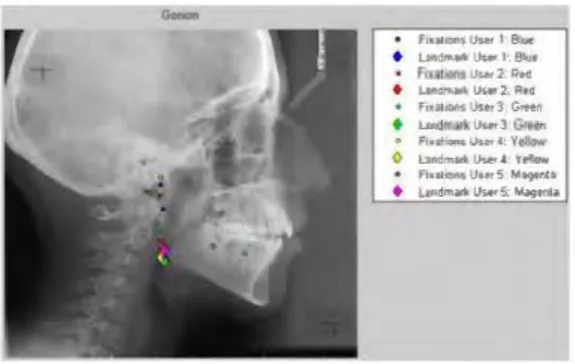
2.1 Fixations point for the five subjects to locate Gonion 9 2.2 Source code example used with respondent eyes movement 10
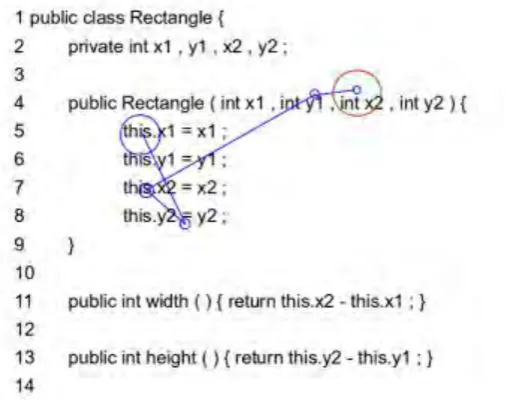
2.3 The Human Eye Structure 13
2.4 Thoughts by human according to their eye movements 15 2.5 Eye movements during fixation of a stationary point target 16 2.6 A gazing plot showing trace of saccades and micro saccades of
human eyes to find interesting parts on the faces of Carl and Ellie
19
2.7 Comparison of usability of brain area between a dyslexic reader and an efficient reader
23
2.8 A wearable Eye Tracker 27
2.9 Tobii TX300 Eye Tracker 28
3.1 Project methodology flowchart 32
3.2 The Tobii TX300 Tracker 34
3.3 Eye calibration process on screen 35
3.4 Example texts generated randomly 36
3.5 Example texts generated randomly with spacing between each alphabets
37
3.6 Example of .tsv type file with complex data display 38 3.7 Last step to be configure when importing a .tsv type file in Excel 39 3.8 Example of .xlsx type file opened in Microsoft Excel with
significantly easier to read tabular form.
40
3.9 MATLAB R2016a interface 41
3.10 GUIDE setting 42
3.11 GUIDE layout editor 42
xii 4.2 Align objects window to align the components 53 4.3 Inspector properties to change different types of variables 54
4.4 GUI interface after build and run 55
4.5 Coding to modify colour in GUI 55
xiii
LIST OF ABBREVIATIONS, SYMBOLS AND
NOMENCLATURES
GUI - Graphical User Interface
ICCIS - Conference on Computer & Information Science
PC - Personal Computer
TFT - Thin Film Transistor
OGAMA - Open Gaze and Mouse Analyser
WWW - World Wide Web
CCD - Charge Coupled Device
PCCR - Pupil Centre Corneal Reflection
SEAL - Sea, Air and Land
1
CHAPTER 1
INTRODUCTION
1.1 Research Background
Eyes are the window to the soul. The agile movement of human eyes provides several useful details if undergoing analysis. Eye tracking is the technique that determine the position and measuring the point of gazing of human eye by controlling the period and the sequence of moving the eyes. Eye tracking helps in getting and analysing human visuals information for some diagnostic and interactive applications. This method can assist the attention measure of human visual, which contributes a huge section in variety of fields. For example, in
psychology, engineering, education, as well as in human computer interaction by navigating using eyes. Using eye tracking techniques, scientists are able to
investigate the language skills along with the reading behaviour of human activity. Nowadays, the eye tracking methods is most greatly used in the field of optometry, where all the eye movements are being recorded by using computer technology to be analyse (Chartier & Renaud, 2008).
The history of eye tracking techniques are generally improving from time to time. In the early introduction about eye tracking methods, the research about eye movements are done by using direct observations. It is found that the eye movement on behalf the reading behaviour of a particular individuals are not smoothly done, but with a series of short pause, called fixations and rapid small eye movements called quick saccades. In 19th century, the research and studies about visual movements are
2 tracking device were made. For example something similar to a contact lens that connected to an aluminium pointer which is moving according to the respondent’s visual movement, in which in this study regression are showed (Edmund Huey, 2009).
In the research paper done by (Poole & Ball, 2006), it concluded that eye movements are to be captured and being used as a controlling signal that allow an disabled individual to send command and interact directly with technology interface by only through their eyes without having to use a mouse or a keyboard. Next, some recent area of research about eye movements are done which focusing on the web development. The researchers observe on the period of users react to the website menus or where do they focusing their visual attention on the webpage. This helps the website admin to put the advertisements on the popular spots or the area being most focussed by the users.
Basically, the eye movements testing are done by doing the reading test. The respondents are giving papers with some words and sentences and are asked to read it while their eye movements while reading is recorded. This research can prove that individual that suffers from dyslexic symptoms are weaker in reading by not able to fixate well when reading the words. Thus, it can be concluded that the dyslexic respondents have problems in extracting information, although their brains function are nevertheless similar to the normal readers.
3 The example of eye tracking device used in this research is the Tobii TX300 Eye Tracker. The Tobii TX300 is a new and standardized remote eye trackers. It is used to study the eye movements such as fixation and saccades in this study. It is comfort for the user as it collect gaze data at 300 Hz and does not needed a chin-rest (Tobii Technology, 2014). Users or respondents can move rather freely as the tracker itself are still able to detect the eyes movement as long as the users are focusing on the screen.
Most of the eye trackers on the market produce results in the form of graphical illustration, including the Tobii TX300 model. The output data after the eye movements being observed cannot be further analysed due to the constraints of current eye tracking system. This results in difficulties facing by ophthalmologists when they have to read and analyse the data manually. Time has been wasted in order to produce the eye syndromes results. Hence, in this project, the eye tracker Tobii TX300 is used to produce raw data of eye movements and a clearer results are being examine and generate by using a new developed graphical user interface (GUI) created by MATLAB software. This automated software system designed to analyse and separate the raw data of visual movements collected, which provides greater helps in graphical data analysing and processing , while lessen the gaps of conducting a research using the eye detection device.
1.2 Problem Statement
4 These eye tracker devices or systems produce eye movement data to be stored in the computer for further analysing which results in the form of graphical
illustration. However, there is much complexity in the data collected. In other words, the data collected is full of unwanted data, resulting in difficulty in processing useful data to be read. It made the data analysis to be troublesome and time wasting.
A development of an automated graphical user interface (GUI) system that serve to improve the raw data analysis will be created to overcome such issue. The GUI will helps in expedite the processing of eye movements data and generate a clearer view of results. It act as a computing tool that can be used by optometrists to analyse data generated by the system Tobii TX300. The GUI will display the data according to what user requested, such as saccade and fixation.
1.3 Objective
The objectives of this project are:
1. To develop a GUI that serve as a platform for eye movement data analysis.
2. To identify and extract eye movement data such as saccade and fixation from the raw data collected.
5 1.4 Scope of Study
The work scope of the project is to develop a Graphical User Interface (GUI) that are able to identify and simplify eye movement data such as saccade and fixation from the raw data collected using Tobii TX300 eye tracking device. Eye movement data such as fixation and saccades are taken from 6 respondents for analysis. The respondents will be given texts to be read in front the Tobii TX300 for eye
movement data collection. The raw data is then transferred into Microsoft Excel to be stored. The Graphical User Interface will be create using MATLAB software, and data collected will be transferred into the GUI to be analyse.
1.5 Thesis Organization
The project thesis has been completed by combining 5 important parts, which are Introduction, Literature Review, Methodology, Result and Discussion, and Conclusion and Recommendation of project.
Chapter 1 explained the introduction of the whole research, including
background, problem statement, objectives and work scope. This chapter describe in detail the idea of the project along with steps taken to finish the project.
In Chapter 2, literature review of the project is stated. This included the detailed explanation about related elements in the project, such as eye movements, studies about good and poor reader and information of eye tracking devices.
Research that has been done by previous researcher about current project is taken as reference. The purpose of this chapter is to provide a full knowledge and idea about the project research ongoing.
6 detailed explanation the procedure in obtained raw data through Tobii TX300 eye tracker, the steps to transfer data to the GUI created along with a flowchart.
Chapter 4 displayed the result and outcome obtained from the project research that performed by the researcher. The result is discussed and analysed comprehensively in this chapter.
Chapter 5 is about the final conclusion about the project research. In this chapter, the strength and weakness of the GUI developed is being discussed. Several recommendations for future works based on this project are also stated in this
7
CHAPTER 2
LITERATURE REVIEW
2.1 Introduction
This chapter served to discuss about the literature review of all previous research that has been completed by others researchers which related to this project. Some of the reviews that being discussed in this chapter are regarding the human eye structure and type of eye movement, such as fixation and saccade. The eye
movements in reading and the characteristic of good reader and poor reader were also discussed. Besides, the introduction to eye tracking techniques and eye tracking devices were also stated and elaborated. All reviews stated are described in detail with correspond information and explanation in this chapter.
2.2 Related Project
8
2.2.1 Eye-tracker Data Analysis in Cephalometric Landmarking ( Maiorana, 2012)
This journal is prepared by Francesco Maioranal, Rosalia Leonardi and Daniela Giordanol from International Conference on Computer & Information Science (ICCIS) in year 2012.
9 Figure 2.1 Fixations point for the five subjects to locate Gonion
Source: <http://www.osas2003.com/AtoZ11.html>
2.2.2 Eye Tracking in Computing Education (Busjahn, 2014)
This journal is done by Teresa Busjahn, Carsten Schulte, Bonita Sharif, Simon, Andrew Begel, Michael Hansen, Roman Bednarik, Paul Orlov, Petri Ihantola Aalto, Galina Shchekotova, and Maria Antropova in tenth annual conference on International computing education research in year 2014.
This paper describe eye tracking as an equipment for computer science education research. There were several contributions of this paper, which mainly act as an approach that helps in elucidate novices to learn in reading and understanding programs coding and to enhance improvements of teaching and tools. Besides, this workshop brought both the educators and practitioners together in order to analyse how eye tracking and the rich data it affords could provide benefit in programming education. It studies the
10 developers and they were asked to read and understand simple java program. The types of the tracker used is SMI REDm 120Hz eye tracker, along with the installed OGAMA tracking software in the operating system. The coding were displayed on screen and respondents were needed to read these coding while the gaze locations is observed.
Figure 2.2 Source code example used with respondent eyes movement (Busjahn, 2014)
2.2.3 Eye-Tracking Analysis of User Behaviours in WWW Search (Granka, 2013)
This journal is researched by Laura A. Granka, Thorsten Joachims and Geri Gay from Human-Computer Interaction Group of Cornell University in year 2013.
The main purpose of this research is to study and determine how a webpage user interact with the page in WWW search engine using eye