EUROPEAN PARLIAMENT
***
*
*
*
*
*
***
*
DIRECTORATE GENERAL FOR RESEARCH
WORKING DOCUMENT
TRADING
BY
THE NEW GERMAN UNDER WITH
THE FORMER COMECON COUNTRIES IN EUROPE
DEVELOPMENT, PROBLEMS AND PROSPECTS
EXTERNAL ECONOMIC RELATIONS SERIES
W2
EUROPEAN PARLIAMENT
***
* . *
*
. *
.· *
*
*•*
DIRECTORATE GENERAL FOR RESEARCH
WORKING DOCUMENT
TRADING BY THE NEW GERMAN LANDER WITH
THE FoRMER CoMECON CouNTRIES IN EuROPE
DEVELOPMENT, PROBLEMS AND PROSPECTS
PRODUCED ON BEHALF OF THE El1ROPEAN PARLIAMENT
BY TilE
HALLE EC:ONOMIC RESEARCH INSTITUTE
EXTERNAL EcoNOMIC RELATIONS SERIES
W2
was commissioned by the Directorate-General for Research of the Secretariat of the European Parliament. Responsibility for the views expressed herein, which in no way represent the opinion of the European Parliament, lies with the authors.
This study is also being published in German and French.
To date, the following have been published in the External Economic Relations Series:
No. 1
No. 2
No. W
(10/1989): European Free Trade Association (EFTA) and the Community's internal market
(10/1990): Third World debt- analyses
(1/1992): Structural adjustment in the ACP countries and European Community intervention -situation and prospects
Published by:
EUROPEAN PARLIAMENT
Directorate-General for Research Directorate A
FOREWORD
In May 1992, in Dresden, the European Parliament is organizing a conference to discuss the impact of the economic and social situation in the five new German Lander on the Community's policies.
That prompted the European Parliament's Directorate-General for Research, in line with the wishes of the Committee on External Economic Relations, to commission this study on the external trade aspects of the conference from the Halle Economic Research Institute.
The study aims to provide an analysis of trading by the new German Lander, following German unification, with the former COMECON countries in Europe. It aims to portray the key problems and discuss the consequences thereof, in particular any impact of the Community's commercial policy and corresponding effect of investment from other EC countries on that trade, together with an examination of any competitive advantages for the new Lander because of their earlier trading relations with the former COMECON countries.
The study also aims to describe the prospects for that trade, the examination focusing on the scope for development and on recommended action to be taken as part of EC trade policy towards the group of countries referred to.
Luxembourg, March 1992
Overview
1.
2.
2.1.
2.2.
2.3.
2.4.
2.5.
2.6.
3.
Introduction
Quantitative and structural change in trading by the new
German Lander with the countries of Central and Eastern Europe since 1989 . . . .
A new environment and overall trends
.
Movement in imports
Movement in exports
High trade surpluses
Changes in trade structure by group of countries
Changes in trade structure by category of goods
Economic policy as a factor in trade with the East by the new German Lander . . . .
7
7
8
8
10
11
12
13
14
17
3.1. Application of the European Community's common commercial policy 17
3.2. Federation and Lander assistance for trade with the East 19
3.3. Privatization in the new Lander and implications for trade with Central and Eastern Europe . . . 20
4. Trade with the East by the new German Lander: prospects and scope for growth
4.1. Economic upswing in East Germany and the competitive advantages
22
of the new Lander . . . . 22
4.2. Economic development and the reform process in Eastern Europe 24
4.3. Trade with the East by the new German Lander:
forecast for 1992 25
5. Conclusions 27
5.1. Are there lessons to be learnt with regard to the development
of the other former COMECON countries' external trade? 27
5.2. Key aspects of a common European Community economic policy
towards the former COMECON countries 28
7
Overview
Within two years, trading by the new German Lander with the states of Central and Eastern Europe has fallen to one third of its original level. The decisive factor in this has been the fundamental change that has taken place in East Germany's regulatory environment as a result of monetary union and German reunification. Political and economic transformation in Eastern Europe, together with the disbanding of COMECON, has speeded up this process.
Contrary to expectations, East Germany has not become the hub of intensifying trade relations between East and West. Very few traditional economic links have been maintained, with the result that a completely fresh start is having to be made in most areas. The headlong decline in trade has not been checked by the transitional arrangements adopted, for the adjustment period, by the European Community and the Federal Government; were it not for those arrangements, however, matters would have been worse.
To judge from the prospects for trading by the new Lander with the East in the short and medium terms, no more than a gradual recovery at a modest level -is likely. More effective forms of European Community support for the revitalization of trade with the East would appear imperative.
1. Introduction
When German reunification took effect on 3 October 1990, East Germany (the former GDR) was formally incorporated into the European Community. German economic and monetary union - three months previously - had been the vital step in that direction. For the European Community, the incorporation of East Germany was an historically unique event made possible only because East Germany had taken over virtually the entire regulatory environment, as it stood, from the old Federal Republic's market economy and political system.
A sweeping and complex process of structural change began for the East German economy, throwing up inconsistencies as it proceeded. It extended to external trade, too; in the former GDR, this was characterized by its bias towards the COMECON states - its role in the international division of labour being modest overall - and by a product structure that was inappropriate for highly industrialized countries. Initially, it appeared desirable to maintain many of the external trade links of the new German Lander with their Central and Eastern European partners, since, in spite of the distortions and structural weaknesses caused by the system, considerable business was done with Eastern Europe in terms of both quality and quantity. In 1989 the GDR's exports to the European COMECON area were the equivalent of a little more than half the exports of all EC countries combined to Eastern Europe. The equivalent figure for imports was about 47%. After the new German Lander had been incorporated, therefore, the potential opportunities afforded by intensifying economic cooperation between the Community and the former COMECON had grown. The Community's declared political objective was to capitalize on them in spite of the warranted assumption that, for market reasons, trade flows between the new Lander and Eastern Europe would initially decline considerably. The transitional arrangements adopted were therefore geared to bringing traditional trading structures into line with the fact of East Germany's incorporation - in legal, political and economic terms - into the Community. Expectations were even voiced that the external trade obligations of
1the new Lander might become a catalyst for pan-European economic cooperation .
This study provides an analysis of how trade involving Eastern Europe has actually developed since German unification, describes the key factors and problems in this connection, and examines the medium-term prospects for the new trade relations, which are based on the market economy.
2. Quantitative and structural change in trading by the new German Lander with the countries of Central and Eastern Europe since 1989
2.1. A new environment and overall trends
Over the last two years there has been considerable change, in both quantitative and qualitative terms, in trade with the East by the new German Lander. This is the result of the entirely new conditions - in the domestic economy and in external trade - which have emerged for East German enterprises. Although certain processes of radical change had already been set in train, the institution of economic and monetary union on 1 July 1990 was the vital turning point. That was the beginning of what was a rigorous and irreversible transition for the East German economy from centralized planned economy to social market economy. That was also the point when the economy began to be cut free from the Eastern European economic ass'ociation and integrated into the all-German and hence Western European economic area. That led to shock - because of the structural change and transformation - the scale of which was initially underestimated; that shock has not yet been overcome; because of it, a completely fresh start has been necessary in most areas of economic activity. The immediate opening up of the economy to world markets, accompanied by substantial revaluation of the currency, was the most significant change in external trade conditions.
At the same time as the economy was being reformed in East Germany, major political and economic changes were taking place in all Central and Eastern European states which largely removed the basis for trade among the former COMECON countries. As a result, COMECON was disbanded and its pricing, financial and clearing system done away with, which had a considerable impact on trade relations with East Germany.
It is now certain that initial expectations as to the ability of the East German Lander to hold their own as the hub for Germany's trade with the East (or even Western Europe's as a whole), or to become such a hub, have turned out to be unrealistic. What is more likely, rather, is that, in future, the Central and Eastern European countries' relations with united Germany will act as the catalyst to which reference has been made.
I The potential significance of trade with the East for the viability of many East German firms, and -Jor the likely economic upswing in the new Lander, must be reassessed, however . An analysis of trade relations in quantitative terms bears out this view.
East German firms' relations with the European COMECON countries in terms of imports and exports stagnated, at a very high level, from 1985 to 1989; by November 1991, they had dwindled to about one third of the 1989 level. Imports were particularly affected, declining by three quarters, while export figures were still about 41% of the 1989 level.
2 Until 1989, trade with the European member countries of COMECON was a
9
Table 1:
External trad~g by the GDR
I
new Lander with the states of Central and Eastern Europe since 1985: volume and movementAverage January-November
1985 1989 1990 1991
to
1988 %change %change %change
over over over
DM bn DM bn prev. DM bn prev. DM bn prev.
year year year
Exports 28.80 28.89 99. 1 29.72 102.9 10.69 40. 1 Imports 28. 15 26.79 96.6 14.81 55.3 6.24 44.5
Source: Federal Statistical Office, IAW calculations
This implosion-like collapse in trade with the East both stems from and has caused the thoroughgoing shock of economic adjustment in the new Lander and can be properly evaluated only in that context. Within two years, gross domestic product fell to about 60% and manufacturing sector output to as low as about 42% {of the 1989 level). This process has not been uniform: while some production areas have been completely wound up, other branches of industry have been less affected by downturns in production.
Table 2:
Major indicators-of trends in the East German economy for 1989, 1990 and the first half of 1991
1989 1990 1st half of 1991
Percentage Percentage
change over change over DM bn DM bn previous yr DM bn previous yr
Gross domestic
product 284.4 230.0 80.9 85.7 64.4
Gross value added - Agriculture
and forestry 9.3 8.0 85.1 2.7 69.2
- Manufacturing 130.1 97.6 75.0 27.1 44.6
- Trade and
transport 46.2 39.9 86.4 16.7 74.2
- Services and
public sector 98.8 85.4 86.5 39.4 86.4
Capital
investment 62.0 50.8 81.9 26.0 96.3
Total external
trade 82.2 61.6 74.3 14.3 40.2
Source: Federal Statistical Office
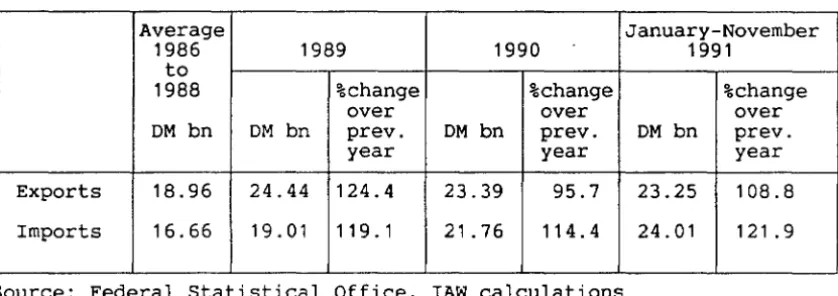
However, an analysis of trade relations between the old Lander and the states of Central and Eastern Europe in recent years confirms that there was by no means a general collapse in German trade with the East. On the contrary, in
3 The countries included here, and in the following tables, are the USSR,
[image:8.558.53.472.130.276.2] [image:8.558.52.467.417.664.2]some instances Eastern European states achieved significant growth rates in exports to West Germany, principally because market economy criteria had long been the basis for those exports, but also because government policy in Eastern Europe gave them particular encouragement and, to some extent, trade relations with successful West German firms were stepped up at the expense of East German enterprises.
Table 3:
Trading by the old Lander with the states of Central and Eastern Europe since 1985: volume and movement
Average January-November
1986 1989 1990 1991
to
1988 %change %change %change
over over over
DM bn DM bn prev. DM bn prev. DM bn prev.
year year year
Exports 18.96 24.44 124.4 23.39 95.7 23.25 108.8
Imports 16.66 19.01 119. 1 21.76 114.4 24.01 121 . 9
Source: Federal Statistical Office, IAW calculations
Much the same can be said of the trade relations of the EC Member States as a whole with Eastern Europe until mid-1991 (cf. Table 5 in Appendix).
Because the positions of the old and new Lander in trade relations with the East have reversed, the significance of the East German economy for trade with Eastern Europe, which used to be considerable, has, in an all-German context, now become much smaller (cf. Table 2 in Appendix). While, in 1989, East Germany still accounted for about 55% of German trade with the East - Germany taken as a whole - that figure had fallen to about one quarter by the end of 1991 .
In terms of volume, trade with the East by the new Lander has dwindled to become an insignificant factor for the economy of Germany as a whole. From January to November 1991, it accounted for 1.7% and 1.1% of united Germany's exports and imports respectively. In qualitative terms, however, it must be regarded as much more significant for the economic situation and necessary upturn in the new Lander.
The swift' decline in trade with the East did not affect imports and exports simultaneously; decline occurred after fundamental changes had taken place in the relevant regulatory environment.
2. 2. Movement in imports
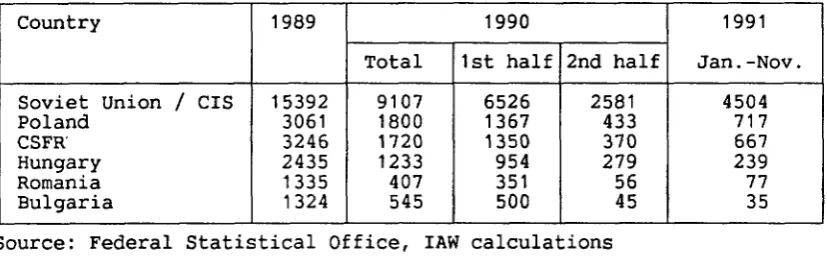
Statistics show that the break in relations between the new Lander and Eastern Europe with regard to imports came with the introduction of monetary union in mid-1990, which created an entirely new business situation for East German
enterprises. ·
[image:9.563.57.476.199.347.2]11
Table 4:
Imports into the new Lander from Eastern Europe (DM m)
Country 1989 1990
Total 1st half
Soviet Union
I
CIS 15392 9107 6526Poland 3061 1800 1367
CSFR' 3246 1720 1350
Hungary 2435 1233 954
Romania 1335 407 351
Bulgaria 1324 545 500
2nd half
2581 433 370 279 56 45
Source: Federal Statistical Office, IAW calculations
The key factors in this development have been as follows:
1991 Jan. -Nov. 4504 717 667 239 77 35
(a) East German firms made use of their new opportunities to gain access to better Western products, preferably from the old Lander and other EC Member States. In the main, Eastern European goods and services proved to be insufficiently competitive with regard to technical standard, production quality, allegiance to customers and performance.
(b) Particularly in the second half of 1990, imports became considerably more expensive, in relative terms, because of the conversion rate between the transferable rouble and the Deutsche Mark (1 to 2.34) which had been laid down for supply contracts that had already been concluded, though that was no longer relevant from 1991 onwards.
(c) The fact that East German industry, which was the principal customer for primary products and capital goods from Eastern Europe, cut production considerably, and its own fixed asset investment declined at the same time, had a major impact on requirements of imports from Eastern Europe.
(d) For a long time, there was uncertainty in most cases as to whether East German firms could be salvaged and what scope there was for their privatization. The rapid break-up of the integrated production units (the Kombinate) created a new economic system with uncertain prospects. A number of Eastern European partners therefore geared their economic links to powerful West German firms.
During the last few months of 1991, imports from the CSFR, Hungary and Poland picked up again a little. To what extent that conceals a stable trend remains to be seen.
2. 3. Movement in exports
The rate of change with regard to exports has been different. Initially, in the second half of 1990, East German firms succeeded in increasing their exports to Eastern Europe (except for the CSFR and Bulgaria). That was the result, however, of what was a unique transitional situation and, as such, could in no way be a model for the future. The following were significant factors in that short-lived upturn:
~ Invoices in connection with supply contracts were still being made out in transferable roubles.
- The exchange rate for the transferable rouble, which was overvalued, provided a powerful export incentive.
[image:10.559.52.466.130.258.2]Eastern European countries more interested in additional imports. Because of unused capacity in the East German economy, a prompt response was possible.
To safeguard confidence in existing contracts and secure East German exporters' cash position, the Federal Republic temporarily granted sizeable subsidies.
At the start of 1991, exports began to decline with much the same ferocity as imports had six months previously. This hit exports to all Eastern European countries, the least decline, in relative terms, being in exports to the Soviet Union and Poland.
Table 5:
Exports from the new Lander to Eastern Europe
(DM m)
Country 1989 1990
Total 1st 2nd half half
Soviet Union/CIS 16576 17761 8052 9709
Poland 3116 2944 1069 1875
CSFR 3814 3405 2056 1349
Hungary 2597 2696 1263 1433
Romania 1429 1505 749 756
Bulgaria 1361 1412 819 593
1991 January
-November 8440 952 607' 353
212 123
Source: Federal Statistical Office, IAW calculations
% change over previous year 53.3 37.7 19.2 14.5 15.5 9.4
The crucial factors in this, which are interrelated, are as follows:
(a) When the switch to trade based on convertible currencies took place, world market conditions won through in the Eastern European economic area too. It has become plain for all to see that many East German firms are not up to international competition; there is a lack of competitive products and viable marketing strategies; in addition, distribution systems are inadequate.
(b) The structural adjustment crisis in all Central and Eastern European countries - involving a swift decline in the productive capacity of the economy as a whole, high budget deficits, increasing financial difficulties for firms, an end to industrial cooperation arrangements which in the main emerged within a planned economy environment, and an across-the-board drop in real incomes - has appreciably worsened. This is continuing to have an adverse effect on the degree of intensity and structure of external trade, in particular with the East German market.
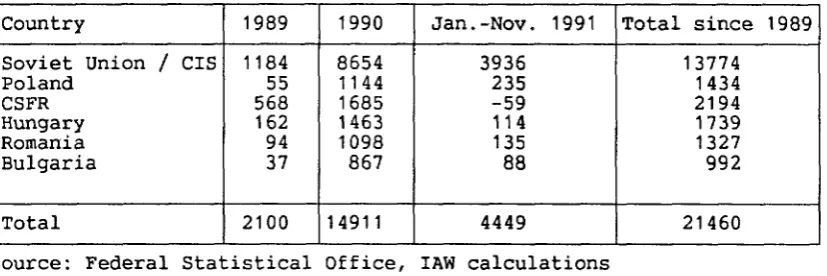
2.4. High trade surpluses
[image:11.559.63.482.260.419.2]13
Table 6:
Trade surpluses achieved by the new Lander vis-a-vis Eastern Europe (DM m)
Country 1989 1990 Jan.-Nov. 1991 Total since 1989
Soviet Union
I
CIS 1184 8654 3936 13774Poland 55 1144 235 1434
CSFR 568 1685 -59 2194
Hungary 162 1463 11 4 1739
Romania 94 1098 135 1327
Bulgaria 37 867 88 992
Total 2100 14911 4449 21460
Source: Federal Statistical Office, IAW calculations
It should be borne in mind that export surpluses were denominated in transferable roubles until the end of 1990. Their DM value was calculated on the basis of the official conversion factor. No agreements have as yet been reached as to settlement in this regard by the Central and Eastern European countries concerned. Effectively, they constitute interest-free loans to those states.
Surpluses since January 1991 show that, even at the current very low level of trade, very few sales outlets have been opened up in the new Lander by Eastern European firms. Through successful marketing in the old Lander, however, the CSFR, Hungary and Romania have recorded export surpluses (with reference to Germany as a whole).
2.5. Changes in trade structure by group of countries
Two significant conclusions can be drawn from an examination of the regional structure of the external trading activity of the new Lander from 1989 to 1991 :
(a) Relations with the countries of Central and Eastern Europe continue to dominate external trading as a whole by the new Lander. The significance of the EC countries, while it has increased, remains relatively modest, however.
In 1989, the former COMECON countries in Europe accounted for some 70% of GDR trade (not including German-German trade), whereas the EC countries (not including the FRG) accounted for less than 10% of the total. That stemmed from East German producers' inadequate, and worsening, competitiveness. The situation changed following monetary union inasmuch as, initially, Central and Eastern European countries' share of exports rose as high as 78% plus, falling in 1991 (following the introduction of convertible currencies in trade with Eastern Europe too) to a good 60%. The EC countries' share of imports rose somewhat more quickly, though either stagnated or fell in absolute terms, admittedly more slowly than imports overall.
Table 7:
Percentage breakdown of the external trade of the new Lander, mid-1991
EC EFTA Developing Central and
countries countries countries East. Europe
Imports 18.2 8.1 6.1 62.9
Exports 16.8 6. 1 7.9 65. 1
[image:12.559.57.471.130.268.2] [image:12.559.54.468.679.752.2](b) In connection with trade with the East by the new Lander, the significance, in terms of both exports and imports, of the USSR/CIS, which was already dominant while the GDR still existed, has grown substantially. The crucial factor in this is the fact that, in its raw materials and fuel, the Soviet Union possesses export products which are saleable on the world market and that its imports of East German manufactures benefited from the special terms for Hermes credit guarantees until the end of 1991 at least.
Table 8:
Percentage breakdown of trade with the East by the new Lander
Country Exports Imports
1989 1990 Nov. 1991 1989 1990 Nov. 1991
USSR 57.4 59.8 79.0 57.4 61.5 72.2
Poland 10.8 9.9 8.9 11.4 12.2 11.5
CSFR 13.2 11.5 5.7 12. 1 -11 . 6 10.7
Hungary 9.0 9. 1 3.3 9. 1 8.3 3.8
Romania 4.9 5. 1 2.0 5.0 2.7 1.2
Bulgaria 4.7 4.8 1.2 4.9 3.7 0.6
Source: Federal Statistical Office, IAW calculations
The other Central and Eastern European countries, in some instances, have become much less significant, however. Only relations with Poland and the CSFR remain of significance. Further shifts are likely in the near future, however. The dominant role of the CIS will diminish, while the significance of trade with th_e smaller Central and Eastern European countries could gradually rise. The fact that the present situation is very different from the breakdown, by country, of trade with the East by the old Lander is striking. The significance of the USSR in terms of exports and imports has decre~sed (to 33.6% and 37.6% respectively), while, in certain respects, that of the so-called reforming countries - Poland, Hungary and the CSFR - has risen considerably. The specific reasons for these differences remain to be investigated.
2. 6. Changes in trade structure by category of goods4
There have been radical changes in the breakdown of imports and exports not only by country, but also by category of goods. They reflect the growing influence of world economic factors over Eastern Europe's economies, together with changes in supply and demand within those economies.
What is striking, with regard to exports, is that a much greater proportion of foodstuffs (including meat and dairy products) has been sold and that there has been a substantial decline in chemicals and machinery. Nevertheless, machinery and vehicles account for by far the largest share of exports from the new Lander to all Central and Eastern European countries (in the·first half of 1991: over 40% in respect of Poland, the CSFR and Hungary; 57% in respect of the USSR; and as much as 73% in respect of Bulgaria).
[image:13.562.56.476.233.359.2]1 5
Table 9:
Percentage breakdown of exports, by category of goods, from the new Lander to Central and Eastern Europe
Category of goods, SITC Rev. 3 1989 1st half of 1991
0 Food and live animals 1.4 13.9
1 Beverages and tobacco 0. 1 0.8
2 Crude materials (not including
0 and 3) 0.9 1.4
3 Mineral fuels 2.4 2.9
4 Animal and vegetable oils 0 0. 1
5 Chemicals and related products 9.4 6. 1
6 Manufactured goods 10.4 7.5
7 Machinery and transport
equipment 60.4 53.4
8 Miscellaneous manufactured
articles 13.9 12.2
9 Other commodities and
transactions 1.1 1.7
Source: Federal Statistical Office, IAW calculations
The problem for the East German economy is that the decline in exports has particularly hit those branches of industry which used to underpin the export business in the past. In the chemicals category, only medical products and pharmaceuticals in the first half of 1991, together with organic chemical products, achieved impressive export volumes. With regard to machinery and transport equipment, only exports of rolling stock and vessels, worth a little more than DM 1 bn, 96% of which was sold to the USSR, were significant. A detailed country-by-country breakdown reveals that, for most categories of goods, the USSR/CIS is the dominant importer. In addition to rolling stock and vessels, which have already been referred to, that holds true for machinery and equipment for agriculture, the construction industry, the textiles, leather goods and stationery industries, the food and animal feed industry, and the printing and bookbinding industry. In addition, office equipment and computers also have a part to play, albeit one of diminishing importance. The share accounted for by food and consumer manufactures has increased, but there has been a prompt fall in supplies of products from the electrical and electronics industry, from the precision engineering and optical industry and from the machine tools industry.
The most important exports to Poland in the first half of 1991 were machinery and transport equipment, in particular road vehicles. In addition, supplies of oil and oil products and foodstuffs, in particular meat and meat products, increased substantially.
The dominant exports to the CSFR were
5electrical machinery, appliances and equipment, special-purpose machinery , metalworking machinery and road vehicles. Chemical products accounted for a comparatively modest proportion of exports - 20% - anorganic and organic chemical products and fertilizers being more significant than in the past. Exports of non-ferrous metals remained virtually constant. The CSFR was far and away the largest Eastern European market for inorganic chemical products and fertilizers and non-ferrous metals. Exports of office equipment and computers, on the other hand, fell off substantially.
Supplies to Hungary of road vehicles and special-purpose machinery, but also of mineral fuels (coal, coke and briquettes) and organic chemical products, were more significant than in the past.
5 Special-purpose machinery comprises the following: agricultural machinery,
[image:14.558.51.465.132.317.2]The principal feature of the structural changes in imports from Central and Eastern Europe into the new Lander is that mineral fuels and primary processing commodities suffered the least decline in volume terms, their share increasing considerably as a result.
Table 10:
Percentage breakdown of exports, by category of goods, from the new Lander to Central and Eastern Europe
Category of goods, SITC Rev. 3 1989 1st half of 1991
0 Food and live animals 1.4 0.9
1 Beverages and tobacco 1.5 0.2
2 Crude materials (not including
0 and 3) 4.0 2.3
3 Mineral fuels 29.6 59.3
4 Animal and vegetable oils 0 0
5 Chemicals and related products 4.4 3.9
6 Manufactured goods 14.5 9.7
7 Machinery and transport
equipment 35.8 20.8
8 Miscellaneous manufactured
articles 4.2 1 . 7
9 Other commodities and
transactions 4.6 1.2
Source: Federal Statistical Office, IAW calculations
Oll and oil products alone accounted for 45.4% of total imports from Eastern Europe in the first half of 1991. Iron and steel and non-ferrous metals accounted for a further 7.4%, the USSR being the main supplier of all these products. Imports of machinery and transport equipment in the first half of 1991 were worth only DM 765 m. Apart from imports from the Soviet Union, only imports from the CSFR (a little over DM 500 m) were of any significance. The decline in the share accounted for by the machinery and transport equipment category stems from the collapse of a good number of collaborative arrangements in this area. In 1989, for instance, machinery and transport equipment accounted for 44.7% of imports from Poland into the new Lander, while the share for the first half of 1991 was 23.2%.
Further features unique to certain countries are to be found in few areas. There was such a substantial increase in the first half of 1991 in purchases of ferrous metals from Poland that Poland became the main supplier of non-ferrous metals, after the Soviet Union, and that category of goods accounted for 13% of imports from Poland.
Road vehicles, organic chemical products and rolling stock accounted for the largest proportion of imports.from the CSFR (22%). Purchases of special-purpose machinery fell off substantially, however. Mineral fuels (in
particular coal, coke and briquettes) have also become negligible in terms of imports.
[image:15.559.56.476.186.364.2]17
3. Economic policy as a factor in trade with the East by the new German Lander
In view of the frictional effects - in both quantitative and structural terms - on trade with the East by the new Lander which were expected following German reunification, measures were laid down for a transitional period which were designed to ease the necessary adjustment process for the East German economy. This concerned both European Community derogations and German Federal Government decisions.
3.1. Application of the European Community's common commercial policy
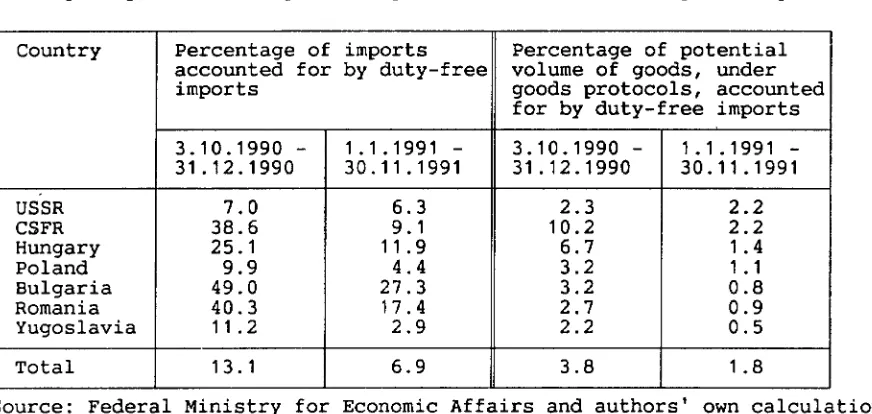
In principle, the new Lander were incorporated into the common commercial policy on the day of unification, a form of advance customs union having been in existence since German economic and monetary union came into effect. Adjustment measures concentrated on import arrangements, since exports were not regarded as particularly problematic for the European Community. In this connection, the greatest importance attaches to the tariff measures benefiting the former member countries of COMECON. This relates to the special arrangements to suspend- from 3 October 1990 to 31 December 1992 - the common customs tariff, including anti-dumping duties, applied to certain imports of goods originating in Bulgaria, the CSFR, Hungary, Poland, Romania, the USSR and Yugoslavia on the basis of yearly maximum quantities or values derived from the former GDR's trading agreements with those countries for 1990 and with Poland for 1989. To date, however, the practical impact of suspending tariffs can only be termed modest. By 30 November 1991, under these arrangements, goods to the value of OM 674.3 m had been imported duty-free into the new Lander: OM 245.5 min the fourth quarter of 1990, OM 128.5 min the first half of 1991, and OM 300.3 m from July to November 1991. As a proportion of the potential volume of duty-free imports, this amounts on average to 3.8% for the last quarter of 1990 and to 1.8% from January to November 1991.
Take-up by Yugoslavia, Poland and the USSR of duty-free imports has been below average, whereas it has been above average in trade with Bulgaria and Romania. Duty-free admissions from the CSFR and Hungary, too, were above average in
1991 .
When evaluating the volume of duty-free imports, it should be borne in mind that some of the goods eligible for duty-free admission and some covered by the 'overall imports' heading are zero-rated anyway i% the Common Customs Tariff (CCT). This is particularly true of raw materials . It is not possible to separate precisely the goods which are zero-rated in the CCT from the rest. The same applies to imports under the Generalized System of Preferences (GSP) and the Cooperation Agreement with Yugoslavia.
A comparison of duty-free imports between the fourth quarter of 1990 and the period January-November 1991 demonstrates that all Central and Eastern European countries' shares have declined.
Table 11:
Take-up of potential duty-free exports in 1990 and 1991 by country
Country Percentage of imports Percentage of potential accounted for by duty-free volume of goods, under
imports goods protocols, accounted
for by duty-free imports 3 0 10 0 1990 - 1.1.1991
-
3.10.1990 - 1.1.1991 -31.12.1990 30 0 11 0 1991 31 0 12 0 1990 30.11.1991USSR 7.0 6.3 2.3 2.2
CSFR 38.6 9 01 10.2 2.2
Hungary 25 01 11.9 6.7 1.4
Poland 9.9 4.4 3.2 1.1
Bulgaria 49.0 27.3 3.2 0.8
Romania 40.3 17.4 2.7 0.9
Yugoslavia 11 0 2 2.9 2.2 0.5
Total 1 3 0 1 6.9 3.8 1 0 8
Source: Federal Ministry for Economic Affairs and authors' own calculations
The underlying reasons for this movement are explained in detail in Chapter 2 of the study.
In addition, the above figures on the take-up of the preferential import facility show that the transitional measures have had a very limited impact. Distortions of competition have not occurred. The Community's accompanying trade policy measures have not been able to counteract the adverse impact on traditional trade relations which has been caused by comprehensive structural change in East Germany and in.the countries qualifying for this facility.
The low take-up does not allow us to conclude that exemption from customs duties is of no economic importance to many East German firms. Many firms in the new Lander are overhauling their business operations. Market openings, compettti veness and purchasing opportunities have to be analysed afresh. Rethinking a sales strategy takes time, and the Community measures are helping to maintain some traditional business relations. In the fourth quarter of 1990 and from January to November 1991, for example, some 1200 firms in the new Lander made use of the customs duty exemption arrangements.
The continuation of the transitional tariff measures until 31 December 1992 will provide useful transitional aid for the economic stabilization of a number of firms in
7 the new Lander which are undergoing a difficult restructuring process .
The renegotiation of continuing obligations has been affected by further transitional arrangements. The vast majority of the agreements concluded by the former GDR with other states have become irrelevant as a result of German unification and the incorporation of the territory of the GDR into the European Community and indeed, in many instances, as a result of the political and economic upheavals in Eastern, South-Eastern and Central Europe. In a number of cases, it has proven expedient to keep earlier agreements in force. That holds true for joint investment projects. In order to bring terms and conditions into line with the changed circumstances, the authorities of the FRG are holding consultations with the parties with which the former GDR concluded agreements; representatives of the Commission of the European Communities, too, have been involved in those consultations since July 1991.
7 cf. the Commission report to the European Parliament and the Council on the
[image:17.558.53.489.110.317.2]19
The decision to allow a two-year derogation from European Community standards and quality requirements - in connection with production in, and imports into, the new Lander - was also designed to make it easier to adjust. There are no research findings on the actual effect of this, but it may be assumed that the decision is likely to have had a negligible impact in practice.
3.2. Federation and Lander assistance for trade with the East
To safeguard confidence in existing contractual obligations towards members of COMECON, as laid down in the Treaty on Unification (Article 29), exports by ent'erprises.in the former GDR were subsidized in the second half of 1990, upon request, to the value of DM 2 bn in total. At the same time, the Government-fixed exchange rate for the transferable rouble and the Deutsche Mark (1 to 2.34) created a powerful export incentive. In spite of what was an incipient structural adjustment crisis, exports to the COMECON countries in the second half of 1990 rose 8% over the same period the previous year.
No assistance was given for imports from those countries, by contrast, which fell 73% during the same period.
The special terms of the Hermes credit guarantees for exports to the Soviet Union and its successor states (advance payments waived; three-year period of grace for repayment of principal) constituted the Federal Government's key instrument in 1991 to encourage trade with the East. This considerably slowed down the decline in exports from the new Lander to the Soviet Union by comparison with exports to the other former COMECON countries. Take-up of the Hermes credit guarantee arrangements for exports to those countries (no special terms; Bulgaria temporarily excluded) has been no more than modest.
Trade with the East is fostered by the various forms of cooperation between these countries and Federal Government ministries and the Lander. At Federal Economic Affairs Ministry level, this takes place first and foremost within the Joint Commissions and their specialist working parties. Following the disintegration of the Soviet Union, moves involving individual ex-Soviet republics got under way to set up standing advisory bodies (Cooperation Councils) to provide support for the reform processes and to promote bilateral economic relations. The German-Russian Cooperation Council was set up on 18 February 1992.
At the same time, German industry has set up consulting agencies (cofinanced by the Federal Ministry for Economic Affairs) in a number of Eastern European countries which subsequently could be turned into b~lateral chambers of foreign trade. The Federation has given assistance for, in particular, business management and industry-specific Consultancy services in the countries of Central and Eastern Europe (DM 10m in 1991; DM 16.6 min 1992). In addition, the Federation is supporting a variety of management and vocational training measures. DM 14m was available for this in 1991; some DM 18m has been earmarked for 1992. Not only have measures been continued in the CIS in 1992, but add~ tional operations have been put in hand i'n the CSFR, Bulgaria, Romania and the Baltic states too.
In 1991, the Federal Ministry for Economic Cooperation made use of its well established methods to carry out activities in Bulgaria, the CSFR, Poland, Romania and Hungary. This year, they have been extended to the Baltic region and the republics of the former USSR with a view to promoting the development of a market economy. The aim is to provide a flexible response to needs in terms of advisory services by providing funding for studies and specialists.
measures taken by all the new Lander in connection with the initial and in-service training of skilled workers and managerial staff in the countries of Central and Eastern Europe.
3. 3. Privatization in the new Lander and implications for trade with Central and Eastern Europe
Taking economic activity out of the public sector, with priority going to the privatization of the means of production, has been the starting point for the most important structural adjustment processes, which have a corresponding impact on external trade.
Privatization has focused on selling 100% stakes in firms to business investors, since this is the best way of providing the requisite capital and know-how. An important motive for buying is the scope that exists for placing a firm on a healthy footing, which is evaluated on the basis of business criteria, including selling conditions. Maintenance and expansion of links with the Eastern European market is a major factor in this connection.
It has proved to be the case, nevertheless, that progress in privatization is not synonymous with growth in trade with Eastern Europe. On the contrary: there are often setbacks initially, as a result of altered business strategies, even if long-term prospects for trade with the East improve. This is fundamentally true for the involvement of foreign buyers in the privatization process, the scale of which c~n only be termed too low.
Of the total of 5210 firms which the Trust Agency had sold outright or in part by the end of 1991, 248 sales (4.8%) involved foreign investors.
Of the EC countries, there were 44 partners from France, 26 from the United Kingdom, 24 from the Netherlands, 11 from Denmark, 10 from Italy and nine from Belgium. Sales to buyers from Switzerland (42), the US (19), Sweden (18) and Austria (17) were also significant. Foreign involvement has safeguarded some 92,000 jobs (9.2% of the total number of jobs safeguarded through privatization), and some DM f0.5 bn in investment has been pledged (9.2% of the total investment pledged as a result of privatization). The impact of these privatization measures in terms of employment and investment is therefore greater than their share of privatization overall. There is no information as to the scale of foreign investment that has already been made. Realistically, the impact of this to date on trade with the East should be rated as modest. However, a survey of firms in 1991 found that, out of a list of 13 motives for acquiring an East German firm, foreign buyers put 'to tap the Central and Eastern European market' in third place (after 'to acquire the land belonging to the East German firm' and 'to tap the East German market').
21
Table 12:
Breakdown by industry of outright or partial sales of enterprises to buyers from EC states
Industry Percentage of total number of
sales of firms to buyers in EC states
Primary, producer goods 25
Food, beverages and tobacco 17
Construction 1 3
Commerce 12
Capital goods 11
Services 10
Other 12
[image:20.562.49.465.128.254.2]4. Trade with the East by the new German Lander: prospects and scope for growth
An analysis of the present situation allows us to conclude that, for the most part, trade relations between East Germany and Eastern Europe, which were established on the basis of planned economies, already belong to the past.
Those aspects of export and import relations which have remained viable have done so:
- because it has been possible, as a result of relatively high standards, to adapt to market economy requirements;
because various forms of government support have kept them going for the time being, leaving firms more time to get themselves on their feet again;
- because certain firms are geared to specific needs of Eastern European clients, e.g. spare parts for goods previously supplied, and have been able to continue to satisfy a demand.
The prospects for, and future growth in, trade with the East by the new Lander depend on the following four factors in particular:
- progress in rehabilitating the East German economy as a whole;
- the outcome of the process of structural change towards a market economy and economic stabilization in the states of Central and Eastern Europe, and the related process of revitalizing Eastern Europe's markets;
- the scale and effectiveness of Federation and Lander support for trade w~th
the East.
4.1. Economic upswing in East Germany and the competitive advantages of the new Lander
Swift economic recovery in the new Lander and the prompt privatization and rehabilitation of East German firms are the key prerequisites for a further increase in trade with Eastern Europe. The
8fact is at present, however, that the economic situation remains complicated .
Contradictory trends are predominant. While some areas of the economy have not yet bottomed out, there are encouraging signs in the construction industry and in certain areas of manufacturing. According to the Institut fur Angewandte Wirtschaftsforschung (Applied Economic Research Institute), real gross domestic product, which declined by just under 24% in 1991, is likely to grow by close to 5% in 1992.
Within manufacturing above all, which is of particular importance for trade, stagnation and gradual stabilization will extend well into the first half of 1992, while recovery in appreciable terms will not commence until the second half of 1992. The data available show that production began to consolidate -at a very low level and with an uneven trend - -at the earliest from September 1991 onwards.
23
Table 13:
Movement in net output in manufacturing (%)
Change over previous month August 1991 - September October November
August 1990 1991 1991 1991
Manufacturing
overall - 38.6 8.9 4.4 1.5
Of which:
Primary products and
producer goods - 21 .8 8.2 11.1 - 1.3
Capital goods - 51.2 11.3 - 2.0 6.6
Consumer goods - 35.0 13. 1 9.9 - 2.4
Food,
beverages and
tobacco
-
11.8 2.6 8.1 - 3.8Source: Federal Statistical Office, Deutsche Bank, IAW calculations
Industry provides clear evidence of the diminished role of trade with the East - though the scale varies - in overall economic activity. As a result, enterprises' efforts to overcome business bias towards the East German domestic market and the markets in the East have stepped up appreciably, principally on the part of enterprises which are now part of West German firms or have been otherwise privatized.
Nonetheless, there is continuing demand from Central and Eastern European countries, principally (in 1991) from the Soviet Union/CIS. Analyses in the engineering, shipbuilding and rolling stock industries, in the pharmaceuticals industry and in parts of the chemical industry confirm that the CIS remains East German industry's most significant export market. In the short and medium terms, further traditional supply business is likely to collapse. The present modest scope for exports to the other countries of Central and Eastern Europe will persist for some time, though there are signs of increased cooperation to some extent among individual firms for 1992.
The use that is made of forms of cooperation which involve more than trade links alone will also be a factor influencing the future of trade with the East, e.g. the stepping up of scientific and technical collaboration - an area in which there is a particularly great risk that established contacts will be lost.
[image:22.561.52.467.120.355.2]East German firms do continue to enjoy certain competitive advantages on Central and Eastern Europe's markets, though, in particular sound knowledge of countries and markets, an array of personal contacts with those countries' economists and greater appreciation of the transformation along free market lines that is now taking place. These advantages can be exploited, however, only if East German firms keep on their marketing staff and provided that links with clients there are not severed altogether as a result of hasty decisions. On the other hand, the general drawbacks of East German firms -characterized by a lower level of management, lower-productivity technologies, inadequate financial resources and a poor reputation by comparison with western firms - also operate. on markets in the East. Since the competitive advantages are rapidly being whittled away, the focus is already on those drawbacks which are closely bound up with the overall economic situation in
the new Lander.
4.2. Economic development and the process of reform in Eastern Europe
How the economic situation in the countries of Eastern Europe develops over the next few years, and how successful the essential process of structural adjustment along market economy lines is, will be very significant for future trade with the East by the new Lander.
The process of transforming the economic systems is proving to be a long-term and complex undertaking which is still in its infancy in all Central and Eastern European countries (regardless of specific differences). Many economic reforms must be carried out simultaneously to a large extent. Above all, commodity markets must emerge on which there is competition. The appropriate monetary framework and requisite currency stability must be established; at the same time, a taxation system and a new framework for public finances are also essential. It is very important that Eastern Europe's economies should open up to the world market. Not only must the appropriate institutional and regulatory environment be created; a large number of economists must also be trained, too, with a view to successfully exploiting that environment.
Transformation is being complicated by the fact that, in the process of creating market economies, the countries of Central and Eastern Europe are presently going through painful adjustment crises in the form of production slumps, balance of payments deficits and runaway inflation.
The disbanding of COMECON has had a major impact on the trading activity of all its former members. In general, there has been a swift contraction in trade within what used to be COMECON. At the same time, the smaller Eastern European countries are endeavouring to reduce their ties with the economy of the CIS, which used to be one-sided and excessive. The impact on industrial production and employment has been particularly marked in those countries for which trade within COMECON was particularly significant.
The high level of external indebtedness, of all the countries concerned, in convertible currencies and growing debt-servicing difficulties are narrowing the economic policy-making latitude available to the governments concerned and constitute a major burden on what is an economic new deal.
Central and Eastern Europe's economies are not likely to pick up quickly. Clearly, the situation is not everywhere the same. Hungary and the CSFR are the most likely candidates to be past the worst shortly. Romania and Bulgaria probably have the least internal momentum. The position in the republics of the CIS remains very confused. A dramatic worsening in that position cannot be ruled out. Everything depends on whether free-market reforms can be single-mindedly put in hand, whether the further collapse of the economy into chaos can be lessened and whether better use can be made of the scope for economic cooperation within the CIS.
25
change, towards a market economy, and foreign assistance must therefore be primarily geared to bringing about gradual change in this regard. However, this requires time and a high level of concentration of economic forces. The current marketing potential for a number of categories of goods is not high enough for efficient incorporation into the international division of labour. We cannot yet tell how, and how quickly, the structural changes which are necessary will prove successful.
Formulation of economic policy should therefore be based on the assumption that revitalization of Eastern Europe's markets will not be an automatic process. The countries concerned must evolve before they can become trading partners. It would be correct to provide active assistance with regard to the privatization of industry and to administration. Investment in this will pay off in the long term if prospective trading partners can be acquired in the process.
4.3. Trade with the East by the new German Lander: forecast for 1992
To forecast how, in quantitative terms, trade with the East by the new Lander will develop in 1992 - on the basis of a summary analysis of the circumstances set out above - is a problematic undertaking surrounded by a whole host of uncertainties.
We may nevertheless assume with some degree of certainty that East German firms' exports to Easter Europe will decline in 1992 by a further one sixth over the previous year (to approx. DM 10.5 bn), while imports are likely to grow slightly by between 5% and 8% to about OM 9 bn.
However, this assessment presupposes 'normal' developments, so to speak, i.e. no major political or nationwide upheavals or disasters in Eastern Europe.
Detailed examination of marketing and supply conditions in the countries of Eastern Europe bears out the overall assessment.
Because of increasing efforts in the Commonwealth of Independent States (CIS) to achieve political and economic sovereignty, and because of the break-up of traditional administrative structures, foreign trade relations, too, have become highly unpredictable. The general economic crisis is worsening and is bound up with a drastic contraction in exports. A growing foreign currency shortage for firms and a further increase in the republics' total indebtedness are likely in 1992, too. To a large extent, therefore, exports to the CIS are tied to special financing solutions. While Russia and other CIS members continue to be the most important partners for the new Lander in their trade with the East, the situation is not likely to bottom out until the second half of the year, however.
The economic situation in Poland is not likely to improve significantly in 1992. In spite of considerable progress in reshaping the regulatory environment along market economy lines, the most important structural adjustments have yet to be made. Structural change has been slight; nevertheless, trade with East Germany has contracted by two thirds within a year. The fact that Polish firms geared themselves to the old Lander early on is harming :~;:ast German firms' positions, which were adverse as it was; consequently, a swift trade revival is not on the cards.
The Czechoslovak economy, too, is experiencing a severe adjustment crisis. Given the potential that exists, and provided that the country moves closer to the EC, a reversal of what have been negative trends to date seems more likely than in other Eastern European countries. If there is strong growth in trade between the CSFR and West German firms, sales opportunities for the new Lander will remain modest in the short term. Such opportunities are most likely to be found in areas which are receiving assistance under government structural programmes (environmental protection, energy and infrastructure).
economy lines. The main feature of its trade with Germany is that, as trade with the old Lander expands, its prospects for trade with East German firms are tending to worsen. The scope for cooperation in the area of agricultural machinery is an exception to this.
27
5. Conclusions
5.1. Are there lessons to be learnt with regard to the development of the other former COMECON countries' external trade?
Because the process of transforming the system in the former GDR is inextricably bound up with German reunification, we may infer that the East German process exhibits unusual, indeed unique, features. The changeover from one system to another took place suddenly; and the structural adjustment crisis - of which the collapse, to a large extent, of traditional trade links was a feature or, as the case may be, a consequence - is particularly acute. Nevertheless, because of the assistance being provided by the old Lander the resulting problems can be dealt with far more easily than would otherwise have been the case.
The other Central and Eastern European countries are unable to realize the shared objective of establishing a market economy in this form. The same is true of external trade too. We would highlight two lessons to be learnt.
Firstly, it has become clear that trade relations which have been established
in a different political and economic environment will inevitably founder, logically enough, if there is an immediate switch to trading under world market conditions, at world market prices and with convertible currencies. That is true of former intra-COMECON trade in its entirety, though no-one disputes its benefits in a host of areas. In order to limit the damage that has already been inflicted, therefore, special solutions should be sought to maintain or, as the case may be, revive trade between the countries of Central and Eastern Europe, including making use of clearing or barter arrangements. Secondly, there are lessons to be learnt as to where the main emphasis should lie in the process of liberalizing external trade arrangements, in the countries of Central and Eastern Europe, and how quickly that process should proceed. It was imperative to put an end to the State monopoly on foreign trade in those countries. Private business has been granted greater rights and latitude to organize its external trading relations; its development is closely bound up with this. Government regulatory action is called for during a transitional period, in particular:
- to safeguard higher national economic interests (e.g. by granting export licences),
- to encourage exports (e.g. through an appropriate exchange rate policy, through targeted support for exporters and, in special cases, through subsidies),
- to create the basis for essential imports, in particular food, pharmaceuticals, etc. (e.g. through setting up centralized foreign exchange funds),
- to ensure that previously contracted foreign loans or loans guaranteed by State institutions are serviced (e.g. by placing restrictions on a proportion of foreign exchange earnings).
5.2. Key aspects of a common European Community economic policy towards the former COMECON countries
From the way in which trade by the new Lander with their Central and Eastern European partners has developed, it can now be seen that the EC Commission's original assumptions regarding economic realities in the former COMECON area and the necessary measures to support the process of transforming the system were not sufficiently realistic, meaning that the Community must take renewed action to support both the new Lander and the economies of Central and Eastern Europe. This derives from an appreciation of the fact that the new Lander form the Community's most easterly .region and that, as a result of Eastern European countries becoming associated states, their importance is increasing in terms of forging political links and economic integration. They ought to be made stable, out of common interest, to enable them to absorb at least some of the potential pressures emanating from Central and Eastern Europe towards Western Europe. This relates in particular to worker migration and to changes in the division of labour within Europe. It is also obvious that the Community bears increasing responsibility for making a success of the reform process in the former COMECON countries and - by giving them effective help to help themselves for supporting the restructuring and rebuilding of those countries' economies.
In addition, the process of shaping a Europe-wide economic area calls for expansion, in both quantitative and qualitative terms, of the continental infrastructure. East German border crossings are already turning out to be bottlenecks which are hampering efforts to step up trade.
On the basis of studies to date, key aspects of Community policy towards the new Lander and the former COMECON countries can be summarized as follows:
(a) The Community's strategy to assist the Lander (use of the Structural Funds) where its key objectives lie, how effectively funding has been employed - should be subjected to critical examination; substantial sums have already been spent on the basis of that strategy. In view of what are extremely serious problems, checks should be carried out as to whether the scale on which EC assistance is being implemented in the new Lander, the timescales involved and the way in which that assistance is broken down are commensurate with the task of integrating this region promptly.
(b) In connection with support for Central and Eastern Europe, the key problem the countries concerned have in creating effective ways and means - largely by their own efforts - of integrating themselves into the international division of labour is the fact that their 'export products have been granted generous and virtually unrestricted access to the Western European market. Given the productivity gap in Eastern Europe, the risks this poses for Western Europe's economy are significantly less serious than was originally assumed. That also holds true for the so-called sensitive areas, including agriculture. The inclusion of the smaller Central and Eastern European countries in the food aid programmes for the CIS is to be welcomed. This must proceed in such a way as to prevent agricultural production structures which are not up to the requirements of the Western European market from being preserved.
(c) Further prompt elimination of all trade barriers under COCOM rules - with a view to enabling Central and Eastern Europe's economies to gain unrestricted access to all advanced technologies - would also be conducive to economic stabilization and trade with the East.
(e)
(f)
(g)
29
precisely what would enable them to become involved in existing collaborative arrangements in science and technology. That also holds true for training-related assistance and for know-how transfers.
Consideration should be given to extending the transitional arrangements for imports into the new Lander from the former COMECON area .. As regards imports from those countries, they will become less significant because of the entry into force of the interim agreements concerning the European Community's association agreements with Poland, Hungary and the CSFR. There would be benefits to some extent, however, if the opportunities that remained were exploited.
It is also important that a regional policy strategy be formulated for the border regions of the new associated countries and their h~nterland, which could be implemented to support trade with East Germany in particular.
An investigation should be·carried out into the extent to which trade with Eastern Europe, in particular by the European Community's structurally vulnerable regions, might be promoted by a system of export credit guarantees along similar lines to the Hermes guarantees in the FRG.
In general, Western Europe must prov,ide much more direct investment much more quickly than in the past and support the growth process with loans, though lending should be tied to progress in carrying through macroeconomic reforms
(currency, taxation system, budgetary policy, etc.).