Multi-Agent Data Mining with Negotiation: A Study in
Multi-Agent Based Clustering
Thesis submitted in accordance with the requirements of the University of Liverpool for the degree of Doctor in Philosophy
by
Santhana Chaimontree
Abstract
Contents
Abstract i
Contents iv
List of Figures vi
List of Tables ix
Acknowledgement x
1 Introduction 1
1.1 Motivation . . . 2
1.2 Research Issues . . . 4
1.3 Methodology . . . 5
1.4 Contributions . . . 5
1.5 Structure of Thesis . . . 6
1.6 Summary . . . 6
2 Literature Review 7 2.1 Agents and Multi-Agent Systems . . . 7
2.1.1 Agents . . . 8
2.1.2 Multi-Agent Systems (MASs) . . . 8
2.1.3 Intra Agent Communication . . . 10
2.1.4 JADE (Java Agent DEvelopment framework) . . . 15
2.2 Data Mining . . . 19
2.2.1 Clustering . . . 20
2.2.2 Clustering Metrics . . . 22
2.3 Multi-Agent Data Mining (MADM) . . . 27
2.4 Summary . . . 33
3 A Multi-Agent Data Mining Framework 34 3.1 The Proposed Multi-Agent Data Mining Framework . . . 35
3.2 Multi-Agent Based Clustering Demonstration . . . 39
3.3 Evaluation . . . 42
3.3.1 Performance Comparison of the MADM Framework When Used For MABC . . . 42
3.3.2 Comparison of The WGAD and BGAD Metrics . . . 44
3.4 Critique and Conclusion . . . 49
4 Agent Negotiation for Multi-Agent Based Clustering 51 4.1 The MABC framework . . . 52
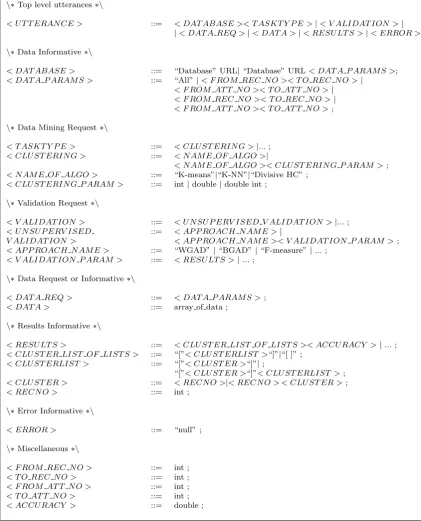
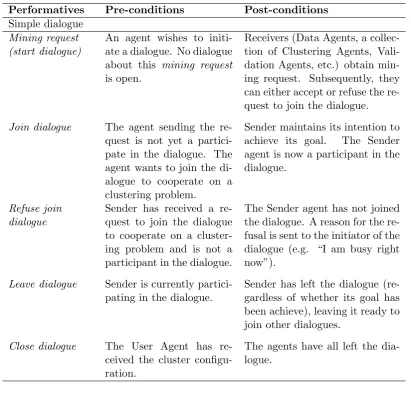
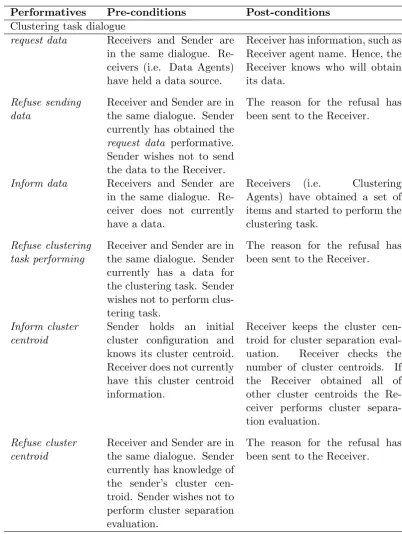
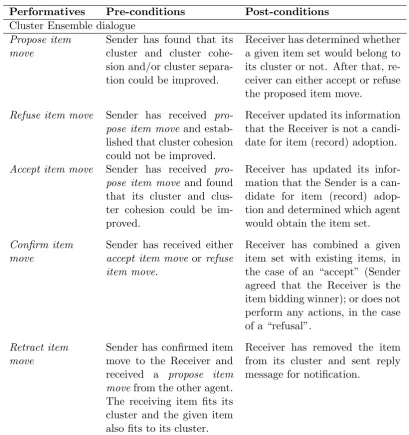
4.2 Agent Communication within the Framework . . . 56
4.3 Operation . . . 67
4.3.1 Initial Cluster Configuration founded on the K-means Paradigm 67 4.3.2 Initial Cluster Configuration founded on the K-NN Paradigm . . 67
4.3.3 Initial Cluster Configuration founded on the divisive hierarchical clustering Paradigm . . . 69
4.3.4 Negotiation (Refinement) Phase . . . 70
4.4 Multi-Agent Clustering Example . . . 74
4.4.1 Multi-Agent Clustering Example usingK-means . . . 74
4.4.2 Multi-Agent Clustering Example usingK-NN . . . 74
4.4.3 Multi-Agent Clustering Example using divisive hierarchical clus-tering . . . 77
4.4.4 Multi-Agent Clustering Example: Negotiation Phase . . . 77
4.5 Conclusions . . . 79
5 Evaluation and Analysis 82 5.1 MABC Accuracy and Runtime Comparison . . . 83
5.2 Accuracy Comparison Using Different Parameter Values . . . 89
5.3 Summary . . . 102
6 Experiments to Automatically Identify Clustering Parameters 103 6.1 Generate and Test Identification of Parameters . . . 104
6.2 Alternative Approach to Identifying Best Parameters . . . 105
6.3 Evaluation of the generate and test approach . . . 106
6.4 Evaluation of Alternative Approach . . . 110
6.5 Conclusion . . . 113
7 Conclusion and Future Work 115 7.1 Summary . . . 115
7.2 Main Findings . . . 116
7.3 Contributions . . . 119
A DBSCAN Algorithm 121
List of Figures
2.1 Relationship between the main elements in the JADE architecture [12]. 16
2.2 (a) Prototype-based Cohesion (b) Prototype-based Separation . . . 23
2.3 Derivation of the Silhouette Coefficient (Sil. Coef.) . . . 25
2.4 Derivation of the Davies-Bouldin (DB) index . . . 26
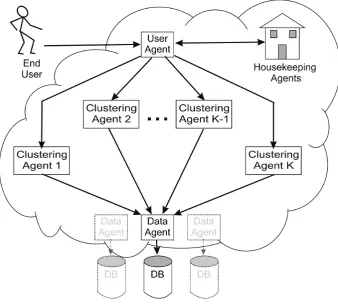
3.1 Architecture of the proposed MADM system . . . 37
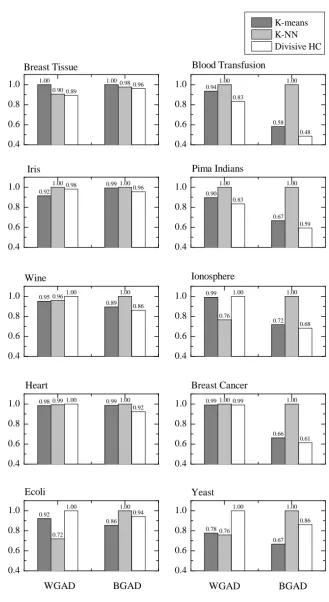
3.2 Histograms of WGAD and BGAD produced usingK-means,K-NN and divisive hierarchical clustering algorithms. . . 47
4.1 Schematic of initial cluster configuration usingK-means. . . 54
4.2 Schematic of initial cluster configuration using either K-NN or divisive hierarchical clustering. . . 55
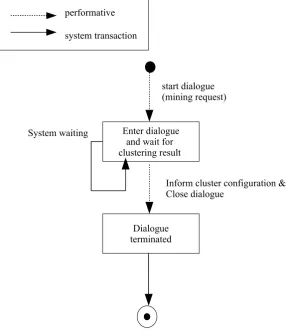
4.3 State transition diagram for User Agent. . . 62
4.4 State transition diagram for Data Agent. . . 63
4.5 State transition diagram for Validation Agent. . . 64
4.6 State transition diagram for Clustering Agent. . . 65
4.7 A simple alternating offer protocol for negotiation within MABC. . . 66
4.8 Example of initial cluster configuration generation using K-means. . . . 75
4.9 Example of initial cluster configuration generation using K-NN. . . 76
4.10 Example of initial cluster configuration generation using divisive hierar-chical clustering. . . 78
4.11 The refinement process using the initial clusters configuration generated using theK-means paradigm. . . 80
5.1 MABC using K-means with the different number of clusters, K (Iris data set). . . 90
5.2 MABC using K-means with the different number of clusters,K (W ine data set). . . 90
5.3 MABC usingK-means with the different number of clusters, K (Heart data set). . . 91
5.5 MABC using K-means with the different number of clusters, K (Ecoli
data set). . . 92 5.6 MABC using K-NN with different threshold values on Irisdata set. . . 93 5.7 MABC using K-NN with different threshold values on W inedata set. . 94 5.8 MABC using K-NN with different threshold values on Heart data set. . 94 5.9 MABC using K-NN with different threshold values on Breast T issue
data set. . . 95 5.10 MABC using K-NN with different threshold values on Ecoli data set. . 96 6.1 K-means clustering K parameter plotted against a range of K values
using theIrisdata set (Silhouette Coefficient and DB index). . . 107 6.2 K-NN clustering τ parameter plotted against a range of τ values using
theIrisdata set (Silhouette Coefficient and DB index). . . 108 6.3 Divisive hierarchical clustering K parameter plotted against a range of
K values using the Irisdata set (Silhouette Coefficient and DB index). 108 6.4 K-means clustering K parameter plotted against a range of K values
using theIrisdata set (WGAD-BGAD). . . 109 6.5 K-NN clustering τ parameter plotted against a range of τ values using
theIrisdata set (WGAD-BGAD) . . . 109 6.6 Divisive hierarchical clustering K parameter plotted against a range of
List of Tables
2.1 An example of the tellperformative in a KQML message where agent i
“tells” agentj that the pizza price is £5. [53] . . . 11
2.2 KQML semantics fortell[53]. . . 11
2.3 An example of the inf orm performative in a FIPA ACL message that agenti“informs” agentj that the pizza price is £5 [66]. . . 12
3.1 The OntoDM. . . 40
3.2 Clustering Process in Terms of the Agent Communications using OntoDM. 41 3.3 Statistical information for the data sets used in the evaluation. . . 43
3.4 The clustering results as produced by the MABC framework. . . 43
3.5 The “best” cluster result identified using the MADM framework. . . 44
3.6 WGAD and BGAD values usingK-means. . . 45
3.7 WGAD and BGAD values usingK-NN. . . 46
3.8 WGAD and BGAD values using Divisive hierarchical clustering. . . 46
3.9 Summary of the best WGAD and BGAD values obtained with respect to Tables 3.6 to 3.8 and the best F-measure values obtain with respect to Table 3.4. . . 46
3.10 Best accuracy values produced using K-means, K-NN, and Divisive hi-erarchical clustering algorithms from Tables 3.6 to 3.8. . . 48
4.1 Performatives to support Multi-Agent Clustering System (I). . . 57
4.2 Performatives to support Multi-Agent Clustering System (II). . . 58
4.3 Performatives to support Multi-Agent Clustering System (III). . . 60
4.4 Performatives to support Multi-Agent Clustering System (IV). . . 61
4.5 Initial cluster configuration phase using theK-means paradigm. . . 68
4.6 Initial cluster configuration phase using theK-NN Clustering Paradigm 69 4.7 Initial cluster configuration phase using the divisive hierarchical cluster-ing paradigm. . . 71
4.8 Algorithm for negotiation phase: moving, splitting, and merging . . . . 73
5.2 Accuracies obtained using theK-NN paradigm with and without appli-cation of the negotiation phase (UCI data). . . 85 5.3 Accuracies obtained using the divisive hierarchical clustering paradigm
with and without application of the negotiation phase (UCI data). . . . 86 5.4 Accuracies obtained using the Housing Benefits data set with and
with-out application of the negotiation phase. . . 87 5.5 Comparison of processing time required by K-means using both a
cen-tralised and a MABC approach. . . 88 5.6 Comparison of processing time required by K-NN using both a
cen-tralised and a MABC approach. . . 88 5.7 Comparison of processing time required by divisive hierarchical
cluster-ing uscluster-ing both a centralised and a MABC approach. . . 88 5.8 Processing times recorded using benefits data set with and without the
application of the negotiation phase. . . 89 5.9 Individual cluster cohesion values for a range of K values from 2 to 5
(Irisdata set). . . 96 5.10 The number of records in each cluster using Irisdata set. . . 97 5.11 Individual cluster cohesion values for a range of K values from 2 to 5
(W ine data set). . . 97 5.12 The number of records in each cluster using W inedata set. . . 98 5.13 Individual cluster cohesion values for a range of K values from 2 to 5
(Heart data set). . . 98 5.14 The number of records in each cluster using Heartdata set. . . 99 5.15 Individual cluster cohesion values for a range of K values from 5 to 8
(Breast T issue data set). . . 100 5.16 The number of records in each cluster using Breast T issue data set. . . 100 5.17 Individual cluster cohesion values for a range of K values from 7 to 10
(Ecoli data set). . . 101 5.18 The number of records in each cluster using Ecolidata set. . . 101 6.1 Algorithm to identify the most appropriate parameter for generating the
best cluster configuration using aheuristic generate and test method. . 104 6.2 Algorithm to identify the most appropriateKgenerating the best cluster
configuration using K-means. . . 106 6.3 Algorithm to identify the most appropriateK andτ, generating the best
6.7 Results using WGAD-BGAD withK-NN to identify the bestτ parameter
value. . . 112
6.8 Results using divisive hierarchical clustering to identify the best K pa-rameter value. . . 112
6.9 A comparison of identified value ofK with the known value forK using K-means,K-NN and divisive hierarchical clustering. . . 113
A.1 DBSCAN Algorithm [34] . . . 121
A.2 The clustering results as produced by the MADM framework . . . 122
A.3 The “best” cluster result provided by the MADM framework . . . 123
A.4 Muti-Agent Based Clustering Results using the K-means algorithm. . . 123
A.5 Muti-Agent Based Clustering Results using the K-NN algorithm. . . 123
A.6 Muti-Agent Based Clustering Results using the DBSCAN algorithm. . . 124
A.7 A comparison of WGAD and BGD measures. . . 124
Acknowledgement
It is with immense gratitude that I acknowledge the support and guidance of my main supervisor, Dr. Frans Coenen. His enthusiasm, constructive criticism, research ideas and always making time for discussion have made the completion of my PhD possible and highly enjoyable. I would also like to express my gratitude to my second supervisor, Dr. Katie Atkinson, for her assistance, suggestions and constructive feedback.
In addition, I would also like to convey thanks to all who have provided me with financial assistance. My PhD research has been funded by the Ministry of Science and Technology of the Royal Thai Government and I am most grateful for this support. Ad-ditionally, the Department of Computer Science at the University of Liverpool within the Faculty of Science and Engineering has provided me with financial assistance to en-able me to attend a number of conferences/workshops and present my work throughout my years of studying. I am grateful to all parties for this assistance.
Special thanks also to all my colleagues, especially group members; Stephanie Chua, Kamal Ali Albashiri, Maya Wardeh, Puteri Nor Ellyza Nohuddin, Mohd Hanafi bin Ahmad Hijazi, Chuntao (Geof) Jiang, Matias Garcia Constantino and Ayesh Alshukri for sharing the literature and invaluable assistance.
Chapter 1
Introduction
An agent is a software entity located in some environment where it is able to operate in an autonomous manner to achieve some specific end goal [89]. By combining a number of such agents to interact with each other, the problem-solving power of agents can be significantly enhanced. Such a system is referred to as a Multi-Agent System (MAS). An important aspect of MASs is the necessary communication between agents so that they can cooperate and negotiate in order to carry out collectively some allotted task. MASs are seen to offer a number of advantages over more conventional distributed and parallel systems. These include:
• Decentralise control
• Autonomy
• Expertise sharing
• Resource sharing
• Scalability
• Enhance performance
pre-labelled data imposes limitations on the use of supervised techniques. Unsuper-vised learning, in turn, does not require the provision of pre-labelled data to support the data mining process. One common example of unsupervised learning is data clus-teringwhere the data is grouped into a number of clusters according to some similarity metrics, similar data objects are placed in the same cluster while the dissimilar objects are placed in different clusters. It is interesting to note that given a definition of a set of clusters (for example in terms of a set of prototypes), this definition can be used for classification purposes.
Over the last twenty years data mining has become a well established field of study which has found application in many domains [44]. However research challenges still remain. Current issues include [91]: (i) the ability to deal with high dimensional data, high speed data streams, complex data, sequence data, time series data and distributed data; (ii) the maintenance of the security/privacy of data; (iii) data integration and (iv) scalability.
It is conjectured that data mining and MAS technology have much to offer one another [23, 22, 24]. There are two main paradigms for this integration:
• Data mining-driven agents: The use of data mining to support the abilities of agents with respect to (say) adaptation, coordination, learning and/or reasoning.
• Agent-driven data mining (also known as Multi-Agent Data Mining (MADM) or Agent Assisted Data Mining (AADM)1): The use of collections of agents to perform collaborative data mining tasks.
This thesis is concerned with MADM, that is the use of MAS technology to support data mining. More specifically, to act as focus for the work, the research described in this thesis is directed at Multi-Agent Based Clustering (MABC).
The rest of this chapter is organised as follows. Section 1.1 provides an overview of the motivation for the research. The research question and associated issues to be addressed are then described in Section 1.2. The adopted research methodology is then presented in Section 1.3, followed by an overview of the contribution of the work described in Section 1.4. The structure of the remainder of the thesis is then described in Section 1.5. A brief summary is given in Section 1.6.
1.1
Motivation
This section presents the motivation for the described work. In particular this section seeks to establish the advantages that MASs can offer data mining. In essence MADM seeks to harness the general advantages offered by MASs with respect to the domain of
1
data mining. In the context of this thesis these advantages are considered with respect to Multi-Agent Based Clustering (MABC).
Recall the generally accepted advantages offered by MASs with respect to dis-tributed cooperative computing and resource sharing listed previously. From a high level viewpoint these advantages all have something to offer data mining of which the decentralisation property of MAS can be argued to offer the most significant advan-tages with respect to data mining processes where it is often necessary to process very large amounts of geographically distributed data. Of course, for many applications it may be appropriate to move the data to a centralised storage structure (such as a data warehouse) and perform data mining in a centralised manner. However, in many cases this can be inefficient and/or result in data security and privacy preserving is-sues. MADM provides a potential solution. An example of a MABC application that preserves data privacy and minimise communication between sites can be found in [51]; where an agent based distributed data clustering mechanism is described founded on a distributed density based clustering algorithm whereby density estimation samples are transmitted, instead of actual data values.
Autonomy is an important advantage offered by MAS that allows agents to operate in a self directed manner. This advantage is equally applicable to MADM. There are three main capabilities that support autonomy; reactive, proactive and social capability [89]. Reactive capabilities allows agents to perform tasks (such as data mining tasks) and produce results when requested to do so. Proactive capabilities allow agents to predict likely requests. Social capabilities allow agents to communicate and negotiate with one another, exchange information and share expertise (for example expertise in the context of clustering algorithms) and resources (for example clustering results). Central to the work described in this thesis is the ability of agents to be able to negotiate with one another.
Finally, MASs have the ability to enhance performance in terms of: (i) computa-tional efficiencybecause of the concurrency of computation; (ii)reliabilityin that MASs can auto-recover, in the event of “crashed” agents, by dynamically finding redundant agents or appropriate alternative agents; (iii)extensibility, by allowing new agents to be added to the systems; (iv)maintainability because of the modularity of MASs; and (v) flexibility, because agents with different abilities can contribute to disparate tasks. There is no a generic clustering algorithm that suited to every data set, hence dif-ferent clustering algorithms perform difdif-ferently and produce difdif-ferent clustering results depending on the characteristic of a given data set. The clustering results often are suboptimal. Thus the proposed intra-negotiation mechanism offers the additional ad-vantage that it can be used to refine an initial clustering result in order to improve the cluster configuration in terms of cluster cohesion and separation. This intra-agent negotiation, when incorporated into an MABC framework, such as that proposed in this thesis, serves to harness the true potential of MASs rather than simply using the concept of MASs to achieve a form of distributed clustering.
1.2
Research Issues
The aim of the research described in this thesis is to investigate the use of MAS tech-nology with respect to data mining, and more specifically clustering, so as to establish the advantages that MAS can offer data mining. The research question to be addressed is:
“How do we obtain a best cluster configuration using the full power of MAS to support unsupervised learning and specifically clustering?”
The provision of an answer to this research question, in turn, entails the resolution of a number of research issues:
1. How can a MAS identify the most appropriate number of clusters with respect to a given data set?
2. What is the nature of a MAS framework to support data mining and clustering in particular?
3. How do a group of agents know when they have generated a “best” cluster con-figuration?
4. What are the specific MAS mechanisms that can usefully be adopted to support MADM?
1.3
Methodology
The broad research methodology that has been adopted was to first investigate and build a multi-agent platform to support the investigation of MABC. Once this plat-form was established, the incorporation of a sequence of clustering paradigms was considered: K-means [57], K-NN [27] and divisive hierarchical clustering [50]. These paradigms were selected because they are well established, feature extensively in the lit-erature, and have been used as the foundation for many enhancements and variations. Two communication mechanisms were considered. The first was an ontology based communication mechanisms used with respect to simple scenarios to identify a best cluster configuration. The second was founded on the concept of dialogues as found in, for example, work on argumentation. It was found that the second mechanism much more readily supported intra-agent communication and especially negotiation. The basic idea behind the negotiation was that when a group of agents had established an initial cluster configuration they could negotiate to improve this cluster configuration by exchanging records between them. A negotiation protocol was therefore defined and implemented to support the desired intra-agent communication.
Evaluation of the initial framework, the inclusion of the different paradigms and the negotiation mechanism, was conducted using benchmark data sets and a welfare benefit data set that was used as the exemplar application. The evaluation was conducted in terms of the cluster configuration accuracy with respect to known “ground-truth” configurations.
1.4
Contributions
The main contributions of the research work considered in this thesis can be summarised as follows:
• A generic approach to multi-agent based clustering to identify a best set of clusters using a collection of “clustering agents”.
• The design of a MABC framework, a generic MADM environment that uses a “bespoke” data mining ontology.
• The use of clustering metrics to evaluate the quality of cluster configurations generated by a MABC and hence identifying the best one.
• Mechanisms to determine the most appropriate parameters for a given clustering algorithm using clustering metrics.
• A versatile multi-agent based clustering framework.
• A set of communication performatives specifically to support negotiation within multi-agent based clustering.
• A negotiation protocol whereby agents can interact with one another with the express aim of exchanging records to improve an initial cluster configuration. The most significant contributions of the work is the negotiation capability, to support MABC, that has been built into the proposed MADM framework.
1.5
Structure of Thesis
The remainder of this thesis is structured into seven chapters as follows. Chapter 2 presents a literature survey of existing research relevant to the contributions presented in this thesis. Chapter 3 introduces a generic Multi-Agent Data Mining (MADM) framework, that can be used for MABC, that allows a collection of agents to collabo-rate to produce a “best” cluster configuration. Chapter 4 proposes an extension of the proposed initial MADM framework introduced in Chapter 3 whereby a “best” cluster configuration could be found using cooperation and negotiation among agents. This chapter also gives a detailed description of a set of communication performatives which is proposed as part of a negotiation protocol to facilitate intra-agent negotiation. The operation of the proposed extended framework is described in terms of both the com-munication performatives used and from an algorithmic perspective. Some examples of the operation of the proposed extended framework are also presented in this chapter. Chapter 5 presents the evaluation of the extended MADM framework, and especially the negotiation mechanism that is incorporated into the extended framework. Chapter 6 presents a number of conducted experiments to automatically identifying clustering parameters. A summary of the main findings and a discussion of possible avenues for future research work are then presented in Chapter 7.
1.6
Summary
Chapter 2
Literature Review
This chapter presents a discussion and a critical review of the current research relating to Multi-Agent Data Mining (MADM). The organisation of this chapter is as follows. Section 2.1 presents a general description of agents and MADM systems including a review of intra-agent communication and the JADE (Java Agent DEvelopment) plat-form used to implement the two proposed frameworks, MADM, so as to both illustrate and evaluate the ideas suggested in this thesis. Section 2.2 then gives an overview of data mining and Distributed Data Mining (DDM). The section also reviews three specific clustering paradigms: K-means,K-Nearest Neighbour (K-NN) and hierarchical clustering; which are all used for demonstration purposes later in this thesis. The pvious work concerning MAS for data mining is reviewed in Section 2.3, where recent re-search in this field is summarised and some established approaches are presented. More specifically, the section considers the use of MADM for data clustering and presents a discussion of the use of negotiation in MADM to improve data mining results. This chapter is concluded, in Section 2.4, with a brief summary.
2.1
Agents and Multi-Agent Systems
design objectives. The agents in MASs can interact with one another by exchanging messages using network protocols. The agents in a MAS typically have different goals and motivations thus there is a chance of conflict with regard to the aims of individual agents. Hence the operational requirement that to successfully interact and resolve such conflicts agents must have the ability to cooperate, coordinate and negotiate with each other.
The rest of this section is organised into four subsections. Subsection 2.1.1 gives a brief overview of agents and their capabilities with respect to data mining activities. Subsection 2.1.2 presents a general overview of MAS. Subsection 2.1.3 describes intra-agent communication and includes a discussion about Agent Communication Languages (ACLs). Finally, JADE (Java Agent DEvelopement platform), the platform used to implement the MADM frameworks that features the ideas proposed in this thesis, is presented in Subsection 2.1.4.
2.1.1 Agents
Agents are usually defined as computer entities that are suited to some environment, and that are able to carry out their tasks in an autonomous manner. The environments in which agents operate may be dynamic, unpredictable, and uncertain; thus it is desirable for agents to exhibit some form of computer intelligence in order to interact with their environment. There are a number of capabilities that intelligent agents are expected to display [89]:
• Reactivity. Intelligent agents should be able to anticipate tasks, according to their environment, so that they can respond in a timely fashion.
• Proactiveness. Intelligent agents should be able to explore alternatives to achieve their design objectives.
• Social ability. Intelligent agents should be capable of interacting with other agents (and possible humans) in order to satisfy their design objectives.
It is self-evident that the above capabilities can increase the degree of autonomy with which agents can perform tasks.
2.1.2 Multi-Agent Systems (MASs)
• In a MAS computational resources and capabilities are distributed across a net-work of interconnected agents to solve problems that are too large for an in-dividual agent. A centralised system may be plagued by resource limitations, performance bottlenecks, or critical failures.
• A MAS allows for the interconnection and interaction of multiple existing legacy systems; by building an agent wrapper around such systems, so that they can be incorporated into an agent society.
• In a MAS problems are modelled in terms of autonomous interacting component-agents that allows these component-agents to operate in self directed manner.
• In a MAS information from sources that are spatially distributed is efficiently retrieved, filtered, and globally coordinated.
• Use of a MAS provides solutions in situations where expertise is spatially and temporally distributed. With respect to the social ability of agents, expertise and resources can be shared.
• Use of MAS enhances overall system performance, especially along the dimensions of: computational efficiency, reliability, extensibility, robustness, maintainability, responsiveness, flexibility and reuse due to its distributed nature.
2.1.3 Intra Agent Communication
An obvious aspect of the interaction within a MAS is the ability for the agents to be able to communicate effectively. The development of agent communication mechanisms has been influenced by work from philosophy on speech act theory, most notably Austin’s work [5] and Searle’ work [78]. Speech act theory conceptualises agent communication in terms of “performatives” which are derived from the actions which an agent may wish to “perform” in order to achieve a desired task [5]. Thus performatives were defined as a class of natural language utterances which have the characteristics of actions. A number of performative verbs were identified to correspond to different types of speech act (for example request,inf orm and promise).
Agent Communication Languages (ACLs) were devised to allow agents to commu-nicate by exchanging information and knowledge, especially in the form of complex objects, such as shared plans and goals or even shared experience and long-term strate-gies. Other means of exchanging information and knowledge among applications are Remote Procedure Call and Remote Method Invocation (RPC and RMI), and CO-BRA. Using these methods software modules (objects) are able to communicate with one another regardless of where they are located in a network. ACLs provide additional functionality over the above for two reasons: (i) ACLs handle propositions, roles and actions (which have semantic associations), whereas RPC and RMI or COBRA have no such semantic association, and (ii) an ACL message describes a desired state in a declarative rather than a procedural form [55].
There is no definitive agent communication language appropriate to all applications. There are some notable examples of popular languages that have been developed for use in multi-agent systems, with two of the most prominent proposals being: (i) the Knowledge Query and Manipulation Language (KQML) and the associated Knowledge Interchange Format (KIF) [69] and (ii) the FIPA (Foundation for Intelligent Physical Agents1) ACL [37].
Firstly, regarding KQML and KIF, KQML is defined as a message-based “outer” language for communication; classifying messages into particular groups, called perfor-matives, to establish a common format for the exchanges. KIF, in turn, is concerned with providing a representation for “inner” content of the communication, thus the knowledge applicable in a particular domain. Table 2.1 illustrates an example KQML message using thetellperformative. In the example agent itells to agentjthat agent
ibelieves the price of pizza is£5. Table 2.2 indicates the semantics of the tell perfor-mative for sender i and receiver j. The semantics of KQML were described in terms of preconditions, postconditions and completion conditions for each performative [54]. Preconditions indicate the necessary states for a sender to send the performative and for a receiver to accept and successfully process the performative. If the preconditions
do not hold, anerrororsorryperformative will be generated to report the unsuccessful message processing. A completion condition describes the final state that corresponds to the fulfilment of the intention that starts the conversation. Preconditions, postcon-ditions and completion conpostcon-ditions describe mental states of agents (belief,knowledge,
desire and intention) and the action description used for sending and processing a messages.
Table 2.1: An example of the tell performative in a KQML message where agent i
“tells” agentj that the pizza price is £5. [53] (tell
:sender agent-i :receiver agent-j :content
(price pizza 5) :language kif :ontology x-auction )
Table 2.2: KQML semantics for tell[53]. tell(i,j,X) i states to j that i believes the content to be true.
-BEL(i,X)
-Pre(i): BEL(i, X) ∧KNOW(i, WANT(j, KNOW(j,S)))
Pre(j): INT(j, KNOW(j,S))
where S may be any of BEL(j,X), or¬(BEL(j,X)). -Post(i): KNOW(i, KNOW(j, BEL(i,X))
Post(j): KNOW(j, KNOW(i,X)) -Completion: KNOW(j, BEL(i,X))
the sequences of performatives and the constraints. The conversation policies depend on values of the reserved parameters of the performatives involved in the conversa-tions. Each KQML message was defined as a terminal in the DCG. A terminal is a list of the following values: performative name, sender, receiver, in-reply-to, reply-with, language, ontology, IO, content. The IOis used for setting the type of the message; I
is an incoming message and O is an outgoing message. Thecontentis the performative itself, thus the content is also a list. The list is closed with “[”and “]”. An example of a terminal is [[ask−if, A, B, id1, id2, prolog, onto, price(X)]]. A benefit of the use of conversation policies is that they can be used to devise a software component that monitors an agent’s incoming and outgoing messages and ensures that it only engages in valid KQML conversations. Additionally, an agent’s multiple interaction (conversa-tion) with other agents can be kept track of when it goes wrong, and can be recovered from unforeseen situations. However, with respect to the work presented in this thesis a set of performatives was defined to be used as part of the protocol (a set of rules) that govern the exchange information between agents and to support negotiation within multi-agent based clustering. Transition diagrams are used to illustrate the state of agents when receiving a performative.
Although KQML has been influential among agent developers and has formed the basis of a number of implementations, numerous criticisms have been directed at it on a number of grounds including [21, 53]: (i) its interoperability, (ii) insufficient seman-tics support, and (iii) the omission of certain classes of message to handle particular expressions.
Table 2.3: An example of theinf orm performative in a FIPA ACL message that agent
i“informs” agentj that the pizza price is £5 [66]. (inform
:sender agent-i :receiver agent-j :content
(price pizza 5) :language sl
:ontology x-auction :protocol contract-net )
language. For the outer language, FIPA ACL provides twenty two performatives to distinguish between the different kinds of messages that can be passed between agents. Examples of FIPA ACL performatives are: (i)inform, and (ii)request. The first is used to pass information from one agent to another; the second to ask for a particular action to be performed. The full specification of FIPA ACL performatives can be found in [37]. In order to avoid some of the criticisms that were directed against KQML, the de-velopers of FIPA ACL provided a comprehensive formal semantics for their language. These semantics made use of the work on speech act theory, as mentioned earlier, through the definition of a formal language called Semantic Language (SL). SL enables the representation of agents’ beliefs, uncertain beliefs, desires, intentions and actions available for performance. To ensure that agents using the language are conforming to it, SL contains constraints (pre-conditions), in terms of formulae mapped to each ACL message, that must be satisfied in order for compliance to hold. For example agents must be sincere, and they must themselves believe the information they pass on to others. Additionally, SL enables the rational effects of actions (post-conditions) to be modelled, which state the intended effect of sending the message. For example, that one agent wishes another to believe some information passed from the first to the second.
Although, the FIPA ACL gives a precise and standardised language for inter-agent communication, as discussed in [61], the FIPA ACL is rather broad and not universally applicable to all types of dialogue interaction that may take place within different do-mains. There are some performatives, such as proposal, Calling For Proposals (CFP) and so on, for general agent negotiation processes, but they are not sufficient for nego-tiation specific to the data mining domain such as that considered in this thesis. Thus, instead of using the generic FIPA ACL performatives, a set of “bespoke” communi-cation performatives designed specifically to support negotiation within multi-agent based clustering will be proposed later in this thesis (Chapter 4).
Negotiation is a key form of interaction in MAS whereby agents are able to exchange offers. The agents may accept these offers or respond in some other way to the offers made to them. With respect to MAS negotiation, a negotiation framework should specify a negotiation protocol in order to govern the interaction among participants (agents) [47]. The protocol specifies which an agent is allowed to say what and actions that an agent can make. It also includes possible communication scenarios among individual agents. For example, one agent makes a proposal, the other agent may be able to accept it, reject it or criticise it, but the agent might not be allowed to ignore it by making a counterproposal. The operation of the protocol rules might be dependent on the last utterance (or the last message) that has been made or the message series exchanged between participants.
pro-tocols which have been proposed, for example Persuasive Negotiation (PN) [72] and the work described in [79, 4, 60, 77]. The specification of negotiation protocols in [79] was carried out using finite state machines while the work proposed in [4, 60, 77] was carried out usingdialogue games2.
The work in [72] focused on a reasoning mechanism and a protocol for agents to engage in persuasive negotiation in situations where the agents need to negotiate with one another repeatedly. The mechanisms allow agents to influence the outcomes of future negotiations through promises of rewards, rather than exchanging offers and counter offers that only impact on the outcome of the current a negotiation. Agents try to give rewards or ask for rewards in order to get their opponent(s) to accept a particular offer. Rewards are about giving a higher current utility outcome to an opponent or a higher utility to the agent in the future. The Persuasive Negotiation (PN) protocol structures the interactions between agents as it allows them to understand messages exchanged and the commitments that agents make to each other when engaging in persuasive negotiations using rewards. The protocol was specified using dynamic logic and provided detail about how commitments arise or get retracted as a result of agents promising rewards or making offers. The protocol consists a set of illocutionary actions that agents interchange. A set of axioms was defined to express the constraints and applied to the protocol.
In [79] an argument-based negotiation was presented for a scenario in business pro-cess management. The communication language contains locutions in the form of locu-tion(sender, receiver, content, time). In addition, the locutions express offers, requests, acceptances, rejections and withdrawals. The communication language expresses three types of locutions: (i)threats, (ii)rewards, and (iii)appeals. The negotiation protocol was specified as a finite state machine which terminate when an agent utters anaccept
orwithdraw locution.
The work proposed in [3] was based on MacKenzie’s system DC [56], a game for two players applying the same rules. DC allowed the participants to argue about the truth of a proposition. A subset of the moves from DC which was useful in agent dialogues, was taken and augmented with some new moves. Each move was defined in terms of arguments that agents can build, and defined the moves that an agent is allowed to make at a given point in time (determining from the set of acceptable arguments). A system enabling persuasion, inquiry and information-seeking dialogues was proposed. The agent interaction protocol of [3] was based on four locutions allowed by DC:assert, accept, questionandchallenge. Three additional locutions: request, promiseand refuse
for negotiation were proposed in [4].
In [77], the work focused on one-to-one agent negotiation for achieving goals in a
2Dialogue games are interactions between two or more players, where each player “moves” by making
system with limited resources, thus the negotiation was used for exchanging resources. Agents were equipped with a planner including a given goal. The agents were able to generate a sequence of actions and an associated set of needed resources required to carry out a plan. A single dialogue was used to obtain a resource. An agent dialogue cycle was used to trigger a new dialogue after one dialogue was terminated in order to collect all the needed resources to achieve some goal. A similar protocol to that giving in [4] was proposed but with fewer locutions. The proposed locutions for negotiation are: request, accept, refuse, challenge, justify and promise. The content of request
and promise are resources, while the content for the other locutions were any of the defined six locutions. Thejustify locution allows for the utterance of some support by means of a reason for a previous locution. Because the proposed framework is based on declarative logic programming, the protocol was presented in the form of if-then rules, called a set of dialogue constraints. Each protocol rule was represented in the form
p(T)VC ⇒ p0(T + 1); which meant that if the agent received the performative p at
a certain time t, and condition C was satisfied at that time then the agent (receiver) must use the performativep0 on the next occasions.
The work in [60] presented an overview of agent interaction protocols based on formal dialogue games. A dialogue game is an interaction among two or more par-ticipants who make “moves” by uttering locutions according to some predefined rules. Dialogue game rules are specified in terms of a dialogue game protocol. The protocol consists of a number of different type of rule: commencements, locutions, combina-tions, commitments and terminations. Commencement and termination rules spec-ified when a dialogue commenced and ended. Locutions indicated what utterances were permitted in the construction of dialogue moves. Commitment rules specify how agents’commitments should be managed. Finally, combination rules defined the per-mitted sequences of the dialogue moves.
The negotiation protocol presented in this thesis, Chapter 4, is defined in terms of a set of performatives. This set of performatives includes the name of the performatives, pre-conditions and post-conditions. The pre-conditions describe the necessary state for an agent to send a given performative. The post-conditions indicate the state of the sender after successful utterance of a performative and the state of the receiver after obtaining and processing a performative. Transition diagrams are used to represent the dialogue moves (performatives that can be uttered) by the agents and the subsequent choice of moves which are then available in the new state.
2.1.4 JADE (Java Agent DEvelopment framework)
appli-cations in compliance with the FIPA specifiappli-cations for interoperable intelligent multi-agent systems. The JADE framework is based on middleware that provides a set of generic services for the development of multi-agent systems based on the Peer-to-Peer (P2P) communication architecture. In P2P systems, the system is required to provide suitable services that allow “peers” to enter, join, or leave the network at any time, and search for or discover other peers. These services are implemented in the form of a set of virtual “yellow pages” that allow for the publishing and discovering of services provided by peers. In JADE, a peer is an agent. The services provided by agents can be registered and modified through the yellow page service. JADE allows agents to communicate by exchanging synchronous messages using the FIPA ACL.
JADE includes software packages and tools to allow Java developers to construct and deploy FIPA agent systems. JADE also includes a run-time environment that provides the services that are required to support the operation of MASs. Figure 2.1 illustrates the relationship between the main architecture elements in a JADE platform. Each instance of JADE runtime is called a container and a set of containers is called a platform. A JADE platform includes a main container. The main container is the “bootstrap” container and all containers in the system must register with the main container. The main container holds a number of agents providing basic services. These include: (i) the AMS (Agent Management System) agent responsible for managing and controlling the life cycle of other agents in the platform, (ii) the DF (Directory Facilitator) agent that provides the “yellow pages” service to allow agents to register their capabilities, and (iii) the RMA (Remote Management Agent) which provides the general (GUI) management console for the JADE agent platform. Functions provided by the RMA include: new agent creation, agent removing and container terminating. The RMA obtains the information about the platform by interacting with the AMS.
Figure 2.1: Relationship between the main elements in the JADE architecture [12].
Direc-tory Facilitator (DF) service and (iii) a Message Transport Service (MTS). As noted above, in JADE, the agent management service and the directory facilitator service are provided by the AMS agent and the DF agent respectively. The MTS is intended to manage all messages exchanged within and between platforms. In the case of JADE, to support interoperability between platforms (including, none-JADE platforms), JADE implements all the standard Message Transport Protocols (MTPs) defined by FIPA. Each MTP includes the definition of a particular transport protocol and a standard encoding of the message envelope. HTTP (HyperText Transfer Protocol) is the default MTP. JADE always starts a HTTP-based MTP when the main container is initialised, as a result a server socket is created on the main container host. The HTTP-based MTP listens for incoming HTTP connections at the URL specified. When an incoming connection is established and a valid message received over the connection, the MTP routes the messages to its destination agent. A “single-hop routing” table, which pro-vides direct IP visibility among the containers, is used when JADE performs message routing for both incoming and outgoing messages.
Agents apply an asynchronous message passing mechanism, ACL message, to ex-change messages through the computer infrastructure. Through the content language a particular expression is communicated from a sender to a recipient. The content expression might be encoded in several ways; JADE provides three types of content language encoding as follows [12]:
1. SL. The SL (Semantic Language) is a human-readable string encoded content language, suitable for open-based applications where agents provided by different developers, and running on different platforms, are required to communicate. 2. LEAP. The LEAP (Lightweight Extensible Agent Platform) is a non-human
read-able byte-code content language. Therefore, LEAP is “lighter” than SL and typ-ically adopted for agent-based applications that have a memory constraint. 3. User Defined. Any user-defined content language that is consistent with the
languages handled by the resources, for example SQL, XML, RDF, etc.
FIPA does not define a specific content language but recommends using the SL lan-guage when communicating with the AMS and DF agents. JADE creates and manages a queue of incoming ACL messages which is private to each agent. This provides a com-munication architecture which is flexible and efficient. Agents can access their queues via a combination of several modes: blocking, polling, timeout and pattern matching. The full FIPA communication model has been fully incorporated into JADE. JADE also provides features to facilitate the automatic conversion of message content into a suitable exchange content format such as XML, RDF or Java objects.
an evaluation medium to support the analysis of the ideas concerning MADM proposed in this thesis. The reasons for choosing JADE were as follows [13]:
• Standard compliance. JADE complies with the FIPA specifications that enable end-to-end interoperability between agents in different platforms.
• Well known and widely used. JADE is the best-known and widely used toolkit for developing MAS applications. JADE is used by a various communities of users both with respect to research activity and commercial applications. There is evidence for the use of JADE in many research papers, such as in [2, 25, 71].
• Mature software framework. The JADE framework was released in 2003 and has been in use (although sometimes updated and maintained) ever since. There has been a continual improvement in JADE; while other development tools were created as part of short-time research activity, their further development and maintenance has thus typically ended after two or three years.
• Extensibility. The JADE framework is distributed under an Open Source License, therefore JADE code can be extended to enhance the platform with respect to some specific application or requirement. For example, the jade.mtp API allows the users to add new message transport protocols.
• User support and documentation. JADE code is distributed together with a pro-gramming guide and an administrator guide, a number examples and tutorials, and thejavadocsfor all the APIs.
• Versatility. JADE provides APIs which are independent from underlying net-works. With respect to JAVA technology, JADE also provides multi-platform support; the agent platform can be distributed across machines regardless of the operating system used.
• Information hidding. Each JADE API is independent and provides some specific purpose-functionality, therefore developers need to understand only the required functionalities used with respect to some specific implementation.
• Transparent communication. The communication in the JADE framework is han-dled by the JADE run-time environment, thus programmers need not be con-cerned with the mechanism used to actually deliver messages. A number of GUI based tools are also provided in order to allow users to monitor and control run-time system activity.
domains. User defined performatives can makes the syntax of the communication used by the agents more specific and descriptive of the particular task that the agents are communicating about (as will be demonstrated in Chapter 4).
2.2
Data Mining
Data mining refers to the process of discovering hidden but interesting patterns and knowledge from large amounts of data. The data sources are typically held in databases or data warehouses, however the Web and other information repositories can be used, or data that is streamed into the system dynamically or distributed across many sites. Data mining methods may be classified into three categories:
1. Association Rule Mining (ARM) or frequent pattern mining is concerned
with the discovery of interesting associations and correlations between itemsets in transactional and relational databases. A popular frequent pattern mining application is market basket analysis, which is the process of analysing the buying habits of customers by finding associations between items that are frequently purchased together.
2. Classificationis the process of finding a model (a classifier) that can be used to
predict (classify) objects according to some set of predefined labels. The classifi-cation process comprises two major steps: (i) the learning step (or training phase) where the training data is used to generate a classifier using some classification algorithm, and (ii) the classification step where the classifier is applied to unseen data. Usually, to obtain some measure of the effectiveness of a generated classifier, it is first tested prior to the classification step using test data. If the accuracy is acceptable, the classifier is used to classify new data. Classifiers may be format-ted in different ways, popular formats include: classification rules, decision trees, mathematical models and neural networks. Because a pre-labelled training set is required, classification is sometimes referred to as a type of supervised learning.
3. Clusteringis the process of partitioning a set of data into categories (“clusters”)
according to characteristics found in the data. Objects (records) in a cluster are similar to one another, while dissimilar objects are located in alternative clusters. Clustering has a long and rich history in a variety of scientific fields. No prior knowledge concerning which records should belong to which cluster is required, thus clustering is sometimes referred to as a type ofunsupervised learning.
system. Even though the centralised processing approach tends to be the most straight forward approach, it might be infeasible in cases where the size of the data is too large to store at a single location or where the data is naturally distributed and for reasons of confidentiality cannot be combined (such as in the case of cross border policing appli-cations). A hybrid form of processing can also be identified where data can be locally analysed and the results combined at some central site to generate the final result. Sur-veys of Distributed Data Mining (DDM) techniques can be found in [8, 31, 46, 67]. The decentralised processing paradigm is clearly of interest with respect to MADM. However a recognised problem with this approach is the “message passing” overhead. To ad-dress this weakness, many researchers attempt to achieve the integration of knowledge discovered from different sites with a minimum amount of network communication and a maximum amount of local computation. Agent based architectures are well suited to supporting DDM because of the “added value” that they provide in terms of mech-anisms to support the interchanging of information and coordinating activities. There is also evidence to suggest that the use of agent architectures can speed up the data mining task (see for example [75]).
The remainder of this section is organised into two subsections. Subsection 2.2.1 gives some background concerning a number of clustering techniques used to investigate the use of MADM/MABC as reported in this thesis, and to evaluate the proposed solutions to the research issues identified in Chapter 1. Subsection 2.2.2 then consider a number of cluster evaluation metrics that may be used for assessing the quality of cluster configurations.
2.2.1 Clustering
Clustering is one of the most prevalent of data mining activities; as already noted the aim is to group data into a set of categories (clusters). The grouping is accomplished by finding similarities between data according to characteristics found in the actual data without any prior knowledge concerning the nature of the clusters. Thus, data objects in the same cluster should be similar to each other, while data objects in different clusters should be dissimilar from one another. Four basic steps can be identified within the overall clustering process [45]:
• Feature selection. Feature selection is the sub-process of finding a subset of
clustering result, choosing appropriate and meaningful features can greatly reduce the burden of subsequent design and result evaluation.
• Clustering algorithm application. This step includes the specification of the
necessary parameters and cluster criterion functions and, of course, the selection of an appropriate clustering algorithm. Recall that many different clustering algorithms have been developed and there is no single best clustering algorithm suited to all possible applications.
• Cluster validation. In this third step, various metrics are used to evaluate the
quality of the generated cluster configuration. A review of established metrics used to evaluate clustering results is given in Subsection 2.2.2 below.
• Result interpretation. In many cases, end users (typically experts in the
rele-vant field) must integrate the clustering result with experimental evidence so as to analyse the outcomes.
Clustering algorithms may be broadly categorised into two types: (i) partitional
and (ii) hierarchical. Partitional clustering algorithms generate clusters by allocating them to a “flat” set of clusters, while hierarchical clustering algorithms iteratively subdivide/combine a given data set into a set of clusters.
Two well-known partitional clustering algorithms areK-means [57] and K-Nearest Neighbour (K-NN) [27]. The K-means algorithm partitions a given data set into a user-specified set of K clusters. The algorithm operates as follows: (i) select the K
first records to defineK distinct clusters (a cluster is defined according to itscentroid, which in turn is defined by the mean values of the records contained within it, if there is only one record then that record represents the centroid); (ii) assign each remaining record to its “closest” cluster centroids (some Euclidean distance measure is usually used); (iii) when all records have been assigned, recalculate the cluster centroids and reassign the records; (iv) continue in this manner until the cluster centroids become “fixed”. The performance of K-means is strongly influenced by the value of K used and the nature of the firstK records used to define the initial centroids.
The K-NN algorithm does not require specification of a predefined number of clus-ters; instead a user supplied threshold,τ, is used to determine nearest neighbours. The algorithm starts with one cluster whose centroid is represented by the first record. Fur-ther records are then added. If the “distance” between a new record and an existing cluster centroid is less than τ the new record is placed into the appropriate existing cluster, otherwise a new cluster is created. The chosen value ofτ thus greatly influences the number of clusters.
manner [90]. Top-down hierarchical clustering commences with a single cluster repre-senting the entire data set which is then divided (split) into two sub-clusters. The cluster with the largest diameter, defined as the largest distance between any pair of records, is selected for further division. The algorithm continues until an appropriate cluster configuration is reached (according to some given metrics) or each cluster con-tains only one record. The bottom-up hierarchical clustering works in the reverse order. The process starts with a number of clusters equivalent to the number of records. The two clusters with the largest “similarity” are then combined to form a merged cluster. The process again continues until an appropriate cluster configuration is arrived at or all nodes are merged into a single cluster. Hierarchical clustering may involve exces-sive computational time and storage, because the algorithms used must make many iterations for each level in the hierarchy.
Three of the above clustering algorithms;K-means,K-NN and divisive hierarchical clustering, were selected for the proposed of evaluating the work described later in this thesis. Agglomerative hierarchical clustering was not selected because of its similarity to divisive hierarchical clustering.
2.2.2 Clustering Metrics
Given a data set, any clustering algorithm can always generate a set of clusters, al-though the quality may not be as desired. Moreover, different clustering algorithms will produce different clustering results depending on: (i) the characteristics of the input data sets, (ii) the presentation and ordering of records in the input data and (iii) the input parameters used to define the nature of the desired clusters (this in turn will be dependent on the nature of the adopted clustering algorithm). Thus, given the above, effective evaluation standards or criteria are important to provide users with a degree of confidence in the clustering results derived from using a particular clustering algorithms.
decide which of them is better. Surveys of well established metrics, with respect to the foregoing characterisation, can be found in [42, 43].
Internal criteria metrics are typically founded on the the concepts of cluster cohe-sion and separation [83]. Cohesion is used to measure the compactness (“tightness”) of clusters, whilst separation is a measure of the distinctiveness of a cluster with re-spect to other clusters. There are a number of different methods whereby cohesion and separation can be calculated, these include: (i)density-based, (ii)graph-based and (iii)
prototype-based approaches. The density based approach evaluates the density distri-bution within and between clusters. Using the graph-based approach the cohesion of clusters is defined as the sum of the weights of the links among points in the cluster. Separation is then measured by computing the sum of the weights of the links from all points in one cluster to all points in another cluster. Using the prototype-based approach the cohesion of a cluster is measured in terms of the sum of the weights of the links from the prototype to points in the cluster. The separation between two clusters may then be measured in terms of the sum of the weights of the links among the proto-types of two clusters. This is illustrated in Figure 2.2 where an asterisk (∗) represents a centroid of a cluster. In the context of the work described later in this thesis the prototype (centroid or medoid) based approach has been adopted with respect to the internal criteria metrics because it has a lower computational overhead associated with it compared to the other two approaches.
Figure 2.2: (a) Prototype-based Cohesion (b) Prototype-based Separation
Coefficient (Sil. Coef.) [76], (ii) the Davies-Bouldin (DB) index [28], and (iii) the combination of WGAD and BGAD (WGAD-BGAD). Details concerning each of these metrics are presented in the remainder of this subsection.
The F-measure (F1 measure) is an external criteria metric and is popularly used in the domain of Information Retrieval [85]. The metric measures how well cluster labels match externally supplied class labels. The F-measure combines the probability that a member of a cluster belongs to a specific partition (precision) and the extent to which a cluster contains all objects of a specific partition (recall) [83]. LetC={C1, C2, ..., Ck}
be a clustering result,P ={P1, P2, ..., P k}be the ground-truth partition of the input data set. The precision of clusteriwith respect to partitionjisprecision(i, j) =|Ci∩
P j|/|Ci|. The recall for clusteriwith respect to partitionj is defined asrecall(i, j) =
|Ci∩P j|/|P j|. The F-measure for clusteriwith respect to partition j is then defined as:
Fij =
2×precision(i, j)×recall(i, j)
precision(i, j) +recall(i, j) . (2.1) and the overall F-measure of the cluster is calculated using:
F =
m X i=1
|Pi|
|P| ×max(Fij) . (2.2)
wherem is the number of partitions.
Out of the two internal criteria metrics used for evaluation purposes (and used with respect to this thesis), WGAD is used to determine cohesion [73] while BGAD to determine separation [83]. WGAD is the sum of the average distance of a cluster centroid,ci, to each data point (x) in the cluster. The lower the WGAD the greater the
compactness (cohesiveness) of the cluster. The WGAD of a given cluster configuration is defined as:
W GAD=
i=K X i=1
Pj=Xi
j=1 dist(xj, ci) |Xi|
. (2.3)
whereK is the number of clusters and|Xi|is the number of data points in clusteri.
BGAD, in turn, is the average distance of each cluster centroid, ci, to the overall
centroid,c. The higher the BGAD of a cluster configuration the greater the separation of the clusters from one another. The BGAD of a given cluster configuration is defined as:
BGAD=
Pi=K
i=1 dist(ci, c)
|K| . (2.4)
The combination of WGAD and BGAD (WGAD-BGAD) is the difference between a pair of WGAD and BGAD values to express the overall validity of a given cluster configuration. This metric was derived by the author and used, later in this thesis, to measure the “goodness” of an obtained cluster configuration.
x x1
x C1
x x C2
x x
C3
10 12
8 6
5 3
Figure 2.3: Derivation of the Silhouette Coefficient (Sil. Coef.)
The Silhouette Coefficient (Sil. Coef.) of a cluster configuration is a measure of both the cohesiveness and separation of a configuration. It is determined by first calculating thesilhouette (Sil) of each individual point xj within the configuration as follows:
Sil(xj) =
b(xj)−a(xj)
max(a(xj), b(xj))
. (2.5)
where a(xj) is the average intra-cluster distance of the point xj to all other points
within its cluster, and b(xj) is the minimum of the average inter-cluster distances of
xj to all points in each other cluster (see Figure 2.3 for further clarification). The
Sil. Coef.value is then calculated as follows:
Sil. Coef.=
Pi=K
i=1
Pj=|Ci|
j=1 sil(xj)
|Ci|
K . (2.6)
Figure 2.4: Derivation of the Davies-Bouldin (DB) index
measure the goodness of a cluster configuration. The larger the coefficient the better the cluster configuration.
The Davies-Bouldin (DB) index is the sum of the maximum ratios of the intra-cluster distances to the inter-intra-cluster distances for each intra-clusteri:
DB = 1
K
i=K X i=1
Ri . (2.7)
whereRi is the maximum of the ratios between clusteriand each other clusterj(where
1≤j≤K and j6=i). The lower the DB index value the better the associated cluster configuration. The individual ratio of the intra-cluster distances to the inter-cluster distances for clusteriwith respect to clusterj is given by:
Rij =
Si−Sj
dij
. (2.8)
wheredij is a distance between the centroid of cluster iand the centroid of cluster j,
and Si (Sj) is the average distance between the points within clusteri(j):
Si=
1
|Ci| n=|Ci|
X n=1
d(xn, ci) . (2.9)
where ci is the centroid of cluster i, and x is a point (object) within cluster i. The
derivation of DB index is illustrated in Figure 2.4.
2.3
Multi-Agent Data Mining (MADM)
This section presents a review of some work related to that described in this thesis. The section commences by first considering data mining driven agents and then continues with agent driven data mining or Multi-Agent Data Mining (MADM). The discussion includes consideration of MADM directed at Association Rule Mining (ARM), classi-fication and clustering; and highlights the distinctions between this previous work and that proposed in this thesis.
As already noted, MASs provide a powerful technology for distributed, autonomous problem solving. Given the popularity of MAS the idea of adopting MAS technology for data mining is an attractive one. Reviews of agent mining interaction and integration can be found in [17, 18, 19, 20]. As already noted there are two main paradigms with respect to integration of MAS and data mining:
• Data mining-driven agents. The use within MASs of knowledge models, derived through data mining, to enhance agent intelligence including learning/reasoning, coordination, adaptation, planning and behaviour analysis.
• Agent-driven data mining. The utilisation of collections of agents, within some MAS, to perform collaborative data mining tasks (referred to in this thesis using the acronym MADM).
to students using CanadarmTutor, a system used to teach astronauts how to operate a robot manipulator aboard the International Space Station.
MADM is concerned with using MAS technology to enhance data mining processes. Typically a collection of agents is used to perform a data mining task in an autonomous manner. As noted earlier in this chapter, MADM allows for distributed data to be mined effectively without the need to first move the data into a data warehouse. This offers advantages where it is not easy or not possible for data to be first collated; for example because of security and privacy reserving issues or because of technical issues. MADM also supports the creation of frameworks that can be allowed to grow in an anarchic manner such that additional agents can be easily incorporated as long as they comply with whatever protocols have been specified [2]. However, the true power of agents is their ability to behave in an autonomous manner and interact (negotiate) in order to provide a solution to a problem. The proposed MADM approach described in this thesis seeks to harness this power in the context of clustering problems. In this thesis the acronym MABC (Multi-Agent Based Clustering) is used to refer to the application of MADM to clustering.
From the literature there have been a number of MADM systems reported. Many of these can be considered to be simply distributed systems founded on agent architecture (they do not make full use of the capabilities offered by MASs). To use MAS for Distributed Data Mining (DDM), where data sources are located at different sites, it is necessary to develop mechanisms to achieve acceptable time and space performance. DDM offers a way of dealing with data sets regardless of their physical locations. The “standard” approach is to process the data at each site to produce local results which are then combined to generate a global result. MAS technology “dovetails” nicely with DDM because MAS is well suited to distributed problem solving. Surveys of agent-based DDM can be found in [26, 39, 52, 63, 74]. In many of these reported cases, unlike the approach reported in this thesis, the reported MADM systems do not use MASs to their full potential, control tends to be centralised and very little “negotiation” (agent interaction) takes place between agents.
An early MADM is described in [29, 30] in which a collection of agents was used to enhanced the Knowledge Discovery in Databases (KDD) process. The system epit-omised the high level concept of MADM whereby communities of data mining agents perform data mining tasks. In this early system, Inductive Logic Programming (ILP) was adopted in order to find first-order relations in data. The MADM in this case comprised a coordinator agent designed to support coordination between agents and provide an end user interface to allow users to interact with the system and assigning data sources to mining agents. At the final stage, individual knowledge was generated and integrated into a “globally coherent theory”.