Multi-Agency Working
Graham Connelly
Setting out the Scottish Government‟s ambitions for children in the autumn of 2011, the then Minister for Children and Early Years, Angela Constance, said: „[children‟s] services need to be personalised and focused on what the child and family need - and agencies must find better ways to work together to meet these needs‟ (www.scotland.gov.uk/Topics/People/Young-People/legislation/minister/keynote-address). The theme of this chapter, like that of the Minister‟s speech, is what is often referred to as „joined-up‟ working, the concept of
professionals collaborating to provide effective services for the most vulnerable children and their families. It considers the professional imperatives for collaboration between agencies and the barriers which present significant challenges to action. The chapter begins with an outline of the policy context. This is followed by a discussion of multi-agency working in the school context and the implications for practice in the more specific context of children and young people who are „looked after‟ by local authorities. [potential link to Ian Milligan‟s chapter here]
THE POLICY CONTEXT
The broader political context lies in the statutory requirements following from the Local Government in Scotland Act 2003 giving local authorities the „power to do things which they consider will advance well-being‟. The relevant sections of the Act, in relation to the
such as police authorities and health boards, statutory duties to participate in community planning. Local authorities can also invite other bodies like further education colleges, universities, business and voluntary organisations and community groups to take part in community planning. Following the election of the SNP minority administration in 2007, the new Scottish Government agreed a „Concordat‟ with local government collectively, the effect of which was to make a requirement for a so-called „single outcome agreement‟ between each local authority and the Holyrood government. The principle behind single outcome
agreements (SOAs), maintained when the SNP formed a majority administration after the 2011 election, is that funding transferred to local authorities in the annual budget settlement should not be subject to „ring-fencing‟ for specific projects; the SOAs set out the locally-agreed priorities, with reference to national outcomes and indicators. From the 2009-10 budget year the agreements were effectively contracts between the Scottish Government and local community planning partnerships, representing key public services. In devising the SOAs, community partnerships typically consulted stakeholders, such as local businesses, representative bodies and service users.
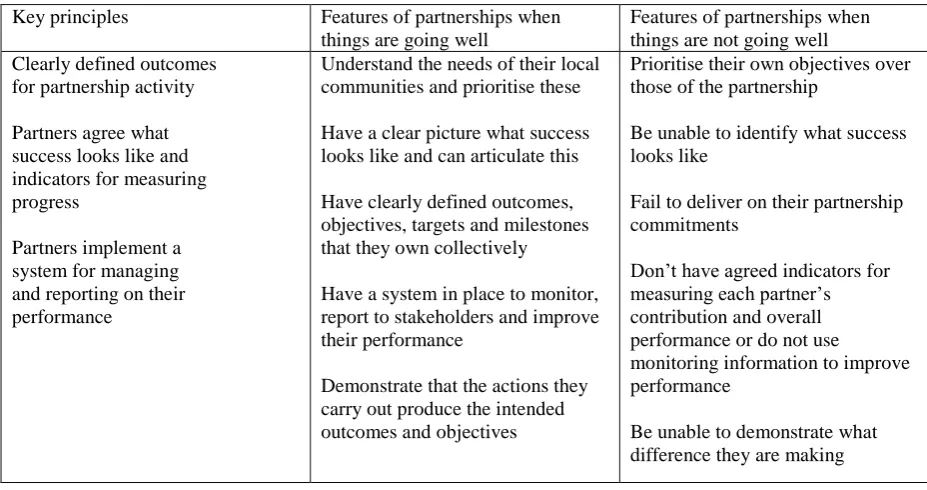
partnership working intended for use in auditing the performance of community planning partnerships. Table 1 shows, for illustration, principles for performance measurement and management, one of four aspects outlined in the report (the others being behaviours, processes and use of resources).
[Table 1 about here]
The area of government policy in relation to services for children which is most dependent upon these principles is what has become known as the Getting it right for every child (GIRFEC) approach. This has several aims but one of these is particularly dependent on effective multi-agency working - the recognition of the importance of drawing help towards the child rather than passing the child from one service to another.
(www.scotland.gov.uk/Publications/2010/07/19145422/0).
Achieving this aim, according to policy guidance, is facilitated by giving significant responsibilities for the overall wellbeing of children to the so-called „universal services‟ of health and education. In essence, the GIRFEC approach intends to encourage professionals to view the child as part of a wider system comprising family and community, to be vigilant towards the child‟s broader developmental needs and to avoid a child at risk of neglect or abuse disappearing from the professional „radar‟. The GIRFEC system aims to do this, among other approaches, by appointing a „named person‟, usually a health visitor for pre-school children and the head teacher or other senior manager in a school setting. The role of the named person includes ensuring that „core‟ information, such as where the child lives and the details of the principal carers is accurate and acting as a conduit or advocate to access
universal services and consequently to need targeted help for shorter periods, and to be critical in supporting the transition from single to multi-agency support (Stradling, MacNeil & Berry, 2009). A second key role envisaged by GIRFEC is the „lead professional‟, where more than one service is involved with the child. Both roles may be performed by the same professional, though government guidance suggests it may be appropriate to transfer the lead role to a specialist service, typically a social work agency. The rationale for not automatically transferring the role when specialist services become involved includes countering the
assumption that responsibility for a child‟s welfare should always be passed to social workers when difficulties arise.
Similar approaches are in operation in other countries; what appears to be unusual, if not unique, about the Scottish approach is the provision for all children to have a named person. At the time of writing, GIRFEC had not been implemented in all local authorities, but the assumption that universal provision is a good thing has been challenged. The journalist, Kenneth Roy, writing in a critique which spanned two issues of the online journal Scottish Review in 2010, argued that the purported virtues of GIRFEC „have been swallowed whole without proper scrutiny of the claims or, more generally, of the underlying agenda‟ (see archive at www.scottishreview.net). Roy‟s main concerns relate to the „intrusion into privacy‟ and the „establishment of a vast database of personal information about our children‟ which he contends raise both practical and ethical concerns.
collaborate in the best interests of children and their families. Experience from the Learning in and for Interagency Working Study (LIW) suggests that two changes are demanded of
professionals in doing interagency work.
First, practitioners learnt that they needed to look beyond the boundaries of their organisations at what else was going on in children‟s lives and, at the very least, to develop some understanding of how other professionals interpreted specific children, their needs and strengths. Second, this outward-looking stance was accompanied by a revived focus on individual children with complex lives who were interconnected with their families and communities. The complexity of children‟s worlds was no longer
hidden from practitioners by their looking at them using the narrow lenses of a tightly focused profession (Edwards, Daniels, Gallagher et al., 2009, pp p-10).
The implications of inter-agency working for schools are discussed in the following section.
MULTIPLE AGENCIES AND THE SCHOOL CONTEXT
There is a long history in Scotland of recognition of the importance of joint working between education, social work, health and other agencies. The Kilbrandon Report of 1964, famous for proposing what subsequently became the system of Children‟s Hearings
French (2007) says that multi-agency working involves partnership and integration.
Partnerships, she says, are: „working relationships in which different groups of people work together to support the child and family‟ (pp. 47-48). This vision of joint working underlined
the previous Labour-Liberal Democratic administration‟s plan to have all publicly funded schools designated as Integrated Community Schools (ICS), based on the experience of the NCS initiative. The official evaluation of the pilot programme was not encouraging, however, in relation to the initial success of NCS in promoting multi-agency working. Unsurprisingly, the researchers found that commitment by staff, managers and partners was an important success factor, but they also uncovered considerable barriers, including differences in working hours and holiday arrangements between professional groups, differences in understandings about professional matters such as confidentiality, and difficulties in finding time to meet to discuss different perceptions of practice and to plan joint strategies. Effective multi-agency staff development was regarded as contributing to improved collaborative working, but the evaluation pessimistically concluded that: „…the overall extent to which NCS projects had contributed to multi-agency training for the specific needs of vulnerable children was reported as fairly limited‟ (Sammons, Power, Elliot et al., 2003). Baron (2001) has been critical of a tendency towards „increasing professionalisation of the issues of deprivation‟ (p.100). In contrast to an approach which Baron characterises as State centralisation of power, a more democratic account of the potential of multi-agency working in a community school context is outlined by Illsley and Redford (2005). The project they described, based in a NCS in Perth in central Scotland, was explicitly aimed at empowering families through building and
equality of power in the „growing number of occasions when parents have approached staff and included them in their social occasions‟ (p.165).
In a review of inter-agency working conducted for the Irish government, Statham (2011) concludes that this practice is becoming increasingly common in children‟s services
internationally and is widely regarded as improving the quality of services and support offered to children and their families. She cautions that there is so far limited evidence of improved outcomes for children and families resulting from this way of working, but that there is promising evidence from many countries on the benefits of a more joined-up approach in improving professional practice and providing better support at an earlier stage for children and families who need it.
As the NCS initiative in Scotland found, there are significant barriers to multi-agency working but what are the factors that facilitate it? Two sources are helpful in this regard: Statham (ibid.) identified 11 „enablers‟ of joint working in her review of the research
literature; meanwhile Cassidy, in a study in four Scottish local authorities, constructed a set of seven pairs of factors capable of „driving and shaping the scope, pace and progress of
embedding integrated working in children‟s services‟ (2008, p.9). Unsurprisingly, the two studies identified broadly similar characteristics. When the two lists are amalgamated, 12 conditions for effective multi-agency working emerge, as listed below.
Being clear about the purpose of multi-agency work
Vision and leadership, with identified „champions‟ and dedicated posts for developing
capacity in collaborative working
Experiencing a culture of collaboration and willingness to develop new professional
identities
Making efforts to develop strong personal relationships and trust between partners Achieving clarity about roles and responsibilities
Putting efforts into maintaining good communication Providing opportunities for joint/multi-professional training
Having good experiences of inter-professional working and opportunities to develop
and practise the skills needed for this type of work
Willingness to restructure and develop services in ways required to meet children‟s
needs
Having clear procedures for information sharing, including databases
Providing opportunities for secondments between services, or having services
co-located in one building.
These 12 conditions in general reflect the perspectives of practitioners and it is important to recognise that the perspectives of service users are paramount, and may be rather different. Some of these characteristics are discussed further in the next section in which multi-agency working is examined within the specific context of a group of children whose generally poor outcomes have become a major concern among politicians, policy makers and practitioners.
MULTI-AGENCY WORKING AND LOOKED AFTER CHILDREN
looked after under voluntary agreements. Compulsory measures are actions taken for the „protection, guidance, treatment or control‟ of children under a set of conditions (e.g. lack of parental care, failure to attend school regularly, committing an offence) specified in Section 52 (2) of the Act. In Scotland in 2011, more than 16,000 children were looked after. This figure accounted for 1.5% of all children up to age 18 across the country, although the proportions of children looked after are higher in the larger cities (for example, 2.8% in Glasgow). The process of becoming looked after involves a children‟s hearing, at which a panel of three volunteer members of the community considers background reports and listens to the views of the child, family members and professionals. If the panel concludes that compulsory measures of care are necessary it will specify whether these should be provided „at home‟, i.e. with the child remaining in the usual family home (about 40% of all looked after children) or „away from home‟. Half of all children looked after away from home live in family-type settings, either with foster carers or potential adoptive parents, or in so-called „kinship‟ settings where a member of the close or extended family is officially recognised as
the main carer. A minority (about 10%) lives in group settings, including residential homes in the community (also called „units‟, young people‟s centres or children‟s houses), residential schools and secure care settings. This figure is an average, however, and when age is taken into account foster care is more common as a placement for younger children and residential care for older children. For example, 20% of 12-15 year old looked after children live in residential settings, compared with less than 3% of 5-11 year olds and a negligible proportion of under-fives. The overall proportion of looked after children cared for in group settings has been falling over a period of many years in comparison with increasing proportions of children living in foster and kinship placements. For example, in 1976, while 36% of looked after children lived in residential settings, 22% were in foster care. (See:
Looked after children are at risk of poor physical and mental health, low educational
attainment and unemployment. One indicator of poor outcomes in the educational context is school attendance. Table 2 shows the percentage attendance of children who were looked after continuously for 12 months during 2010-11. What is evident is that children in foster care typically attend well (better than the average for all children) but that children in local authority children‟s homes have below average school attendance and those remaining with their families while on home supervision orders have considerably below average attendance. The attendance of looked after children has improved in recent years, as has their attainment, though the gap in attainment between looked after children and all children has not decreased. Concerns about the generally poor educational outcomes of looked after children prompted the Education and Culture Committee of the Scottish Parliament to conduct an inquiry. (Interested readers can access the evidence presented to the Committee, among which the official SPICe Briefing by Camilla Kidner (26 October 2011) is particularly recommended, and the Inquiry report, at the Parliament website: www.scottish.parliament.uk.)
[Table 2 about here]
Among five implications for practice identified by the Committee was the need for greater joined-up working between agencies. Its members noted that while the necessary legislation and policies were in place, these needed to be better implemented. The key policies are
towards and on behalf of looked after children. The expectations of corporate parents in different agencies are specified in the 2008 practice guide, These are our Bairns,
(www.scotland.gov.uk/Publications/2008/08/29115839/0). A number of factors appear to be critical in determining the effectiveness of corporate parenting, and, in consequence,
successful multi-agency working. Three factors, drawn from the list of 12 outlined earlier in this chapter, are discussed here: good communication; clarity of roles; and procedures for information sharing.
Good communication
There is considerable evidence to suggest that schools are inhibited from fulfilling their duties as good corporate parents because they are not always clear which children are looked after. There are several possible reasons for problems in identifying children with accuracy. One has to do with confusion in schools about the different categories of looked after children, particularly those in kinship care and those looked after at home. The difficulty in identifying children, for whom a school shares responsibilities, is highlighted in the field note quoted below, from pilot research conducted in 2008. (The research report, Supporting Looked After Children and Young People at School, is available at http://strathprints.strath.ac.uk/6175/)
In another study, conducted between 2006 and 2008, University of Strathclyde researchers asked 18 local authorities with pilot projects aimed at improving the educational outcomes of looked after children to provide details of the attainment of young people targeted for special intervention (see www.scotland.gov.uk/Publications/2008/09/12095701/0). More than half of the authorities experienced difficulties in supplying basic information which parents of all children would expect to be readily available, and one authority had still not supplied the information three months after the deadline. Difficulties in information transfer between local authorities and government, between departments within authorities, and between agencies, often have organisational causes, including the use of different databases, though considerable efforts have been put into improving information transfer in recent years. Scottish
Government guidance, based on the research referred to above, highlighted the importance of personal contact and of not relying solely on formal - typically electronic - channels.
It is good practice for a liaison professional (often this will be a social worker) to inform the school‟s designated senior manager for looked after children and young people in person. In one pilot the social work database was amended to include a field to note the details of the school attended. This allowed the information to be sorted by school and for details to be provided monthly to relevant schools
(www.scotland.gov.uk/Publications/2009/03/25142835/0).
get to know and respect each other, and good working relations often flow from such personal contacts. Sometimes simple practical measures can produce significant benefits. For example, school managers complain about difficulties in making contact with social workers, though electronic media are helping to improve communication. The lack of a common language for planning and monitoring services has caused difficulties between agencies in the past, a difficulty that the GIRFEC principles are intended to counteract.
Clarity of roles
The most basic rule in effective multi-agency working is to be clear about who does what. An important role in relation to supporting looked after children in school, is that of the
designated manager (DM). The role is elaborated in the guide, Cores Tasks for Designated Managers in Educational and Residential Establishments in Scotland, and is envisaged as having important functions in communicating with families and among professionals, making arrangements to meet the learning needs of individual children, acting as an advocate if necessary, and organising relevant training for staff
(www.scotland.gov.uk/Publications/2008/09/09143710/0).
The role of DM is typically undertaken by a head teacher or depute head and this will be only one of many roles performed by a school‟s senior manager. One experienced DSM described her role to a University of Strathclyde researcher:
as well if I felt that they needed a bit of extra support (see http://strathprints.strath.ac.uk/6175/1/strathprints006175.pdf).
Achieving clarity of understanding of the role involves both a willingness to accept
responsibility and also confidence in interacting with fellow-professionals inside and outside of one‟s agency. In a report of a seminar on the Experience of Learning and Educational Outcomes for Looked After Children and Young People published by the Pupil Inclusion Network Scotland (PINS) in November 2004 (see www.pinsscotland.org), it was noted that delegates ‘emphasised the importance of each and every individual taking both professional
and personal responsibility for each and every looked after child/young person‟. One delegate commented that:
Resources are important, as is funding, but it‟s about creating a culture of understanding and care so that those involved in supporting looked after children and young people offer support and challenge to one another but also take personal responsibility for their part in the support package.
Procedures for information sharing
story told to me by a student about interviewing a DM who explained that information was shared only on a „need to know‟ basis; the student later found details of looked after children in a handbook for teachers which was given to students and visiting tutors.
Confusion about what data can be shared between agencies and among professionals within the same agency is a common problem. There are real worries about ethical and legal considerations. Local authorities need to provide clear guidance to professionals who are expected to work together and professionals should also avoid hiding behind bureaucratic procedures instead of seeking clarity about safe mechanisms for sharing information. A fourteen year-old boy came late to a first period class. The teacher shouted at him and said he would be reported for a breach of school rules. The boy swore at the teacher and the incident escalated, resulting in exclusion from school. The teacher later learned that the boy was looked after „at home‟ but instead of getting support he was in reality the main carer for a younger brother and their mother was addicted to heroin. The teacher felt guilty and
questioned the school‟s „need to know‟ policy. A DM of a secondary school told me that he had changed his views about sharing confidential information and that a child‟s looked after status was now made available to all teachers who would have contact with the pupil on a secure intranet site accessible only to teachers. The DM maintained that the change in practice had averted exclusions and teachers had become more understanding and appreciated being treated as equal professionals. Differences of view remain in what is admittedly a difficult and sensitive issue. Nevertheless, the delegates attending the multi-professional PINS seminar referred to above tended to agree about the importance of sharing selective information with a teacher who has a looked after child in his or her class.
applied to their interface with the leaner. Training for teachers should ensure that they do not see „being looked after‟ as the defining characteristic of the child.
CONCLUSION
The assumption that looked after children can expect to have poor outcomes, in school and beyond, underplays the significant achievements of many adults with looked after
backgrounds (see, for example, Duncalf, 2010). The 2006 Social Work Inspection Agency report, Celebrating Success, (www.scotland.gov.uk/Resource/Doc/129024/0030718.pdf) makes encouraging reading. The authors concluded from their interviews with 30 adults or young people who had been looked after that five factors are important for satisfying lives: having people in their lives who cared about them; experiencing stability; being given high expectations; receiving encouragement and support; and being able to participate and achieve. These conditions are at least in part dependent on the multiple agencies involved in the care of looked after children and young people working well together.
It is clear, therefore, that inter-professional and multi-agency collaboration will increasingly form an important part of the practice of all who work with children and families. This has important implications for their pre-service education and continuing professional
professionals will play a more central part in their work. They need the knowledge and skills to enable them to collaborate effectively and also, crucially, the encouragement of managers to gain experience to allow them to develop the necessary competence.
REFERENCES
Baron, S. (2001). New Scotland, New labour, New Community Schools, new
authoritarianism? In S. Riddell & L. Tett (Eds.) Education, social justice and inter-agency working: Joined-up or fractured policy. London: Routledge.
Cassidy, J. (2008). Locality-based working in integrated children's services in Scotland:
Observation on current practice (EMIE Report 93). Retrieved from http://www.nfer.ac.uk/nfer/publications/
Cohen, B, (2005). Inter-agency collaboration in context: The „joining-up‟ agenda. In A. Glaister & B. Glaister (Eds.) Inter-agency collaboration: Providing for children. Edinburgh: Dunedin Academic Press.
Duncalf, Z., (2010). Listen up! Adult care leavers speak out: The views of 310 care leavers aged 17-78. Retrieved from http://www.careleavers.com.
Edwards, A., Daniels, H., Gallagher, T., Leadbetter, J. & Warmington, P. (2009). Improving inter-professional collaborations: Multi-agency working for children’s wellbeing. London: Routledge.
Illsley, P. and Redford, M. (2005). „Drop in for coffee‟: Working with parents in North Perth New Community Schools. Support for Learning, 20 (4), 162-166.
Sammons, P., Power, S., Elliot, K., Robertson, P., Campbell, C. & Whitty, G. (2003). Key Findings From The National Evaluation Of The New Community Schools Pilot Programme In Scotland. Edinburgh: Insight 7. Retrieved from
http://www.scotland.gov.uk/library5/education/ins7-00.asp
Statham, J. (2011). Interagency working, to inform the development of Children’s Services Committees in Ireland. Retrieved from
http://www.effectiveservices.org/images/uploads/file/publications/Interagency%20Working_ Evidence%20review%20Final%20version.pdf
Stradling, B., MacNeil, M. & Berry, H. (2009). Changing professional practice and culture to get it right for every child: An evaluation of the development and early implementation phases of Getting it Right for Every Child in Highland 2006-2009. Retrieved from
Table 1: Extract from Good Governance Principles for Partnership Working (Audit Scotland, 2011) Key principles Features of partnerships when
things are going well
Features of partnerships when things are not going well Clearly defined outcomes
for partnership activity Partners agree what success looks like and indicators for measuring progress
Partners implement a system for managing and reporting on their performance
Understand the needs of their local communities and prioritise these Have a clear picture what success looks like and can articulate this Have clearly defined outcomes, objectives, targets and milestones that they own collectively
Have a system in place to monitor, report to stakeholders and improve their performance
Demonstrate that the actions they carry out produce the intended outcomes and objectives
Prioritise their own objectives over those of the partnership
Be unable to identify what success looks like
Fail to deliver on their partnership commitments
Don‟t have agreed indicators for measuring each partner‟s contribution and overall performance or do not use
monitoring information to improve performance
Be unable to demonstrate what difference they are making
Source: www.audit-scotland.gov.uk
Table 2: Attendance of children continuously looked after for 12 months (June 2011)
Placement Percentage attendance
Looked after at home 78.7
Residential care in local authority homes 84.0
Foster care by local authority 96.3
Foster care in independent or private sector placements 95.9
All children 93.2
[image:19.595.50.534.427.501.2]