Rochester Institute of Technology
RIT Scholar Works
Theses Thesis/Dissertation Collections
4-15-2011
Turing instability in discrete replicator systems
Alex Bryce
Follow this and additional works at:http://scholarworks.rit.edu/theses
Recommended Citation
Turing Instability in Discrete Replicator Systems
by
Alex J. Bryce
Submitted to the School of Mathematical Sciences
in partial fulfillment of the requirements for the degree of
Masters of Science in Applied & Computational Mathematics
at the
ROCHESTER INSTITUTE OF TECHNOLOGY
April 2011
c
Rochester Institute of Technology 2011. All rights reserved.
Author . . . .
School of Mathematical Sciences
April 15, 2011
Certified by . . . .
Bernard P. Brooks
Associate Professor
Thesis Supervisor
Turing Instability in Discrete Replicator Systems
by
Alex J. Bryce
Submitted to the School of Mathematical Sciences on April 15, 2011, in partial fulfillment of the
requirements for the degree of
Masters of Science in Applied & Computational Mathematics
Abstract
When analyzing a discrete reaction-diffusion dynamical system, one primary area of interest is locating where in the parameter space Turing instabilities occur. It will be shown that Turing instabilities cannot occur in the react then diffuse equations if all diffusion coefficients are equal. The replicator dynamic is a system of equations that is used in evolutionary game theory applications to study behavior types in animal populations. Conditions for a Turing instability in first order discrete replicator systems will be discussed and illustrated with computer simulations of the results.
Acknowledgments
First and foremost, I’d like to offer my gratitude to my advisor, Dr. Bernard P.
Brooks for his consistent patience and support as I worked to complete the thesis
while juggling classes, teaching, tutoring, and searching for a job simultaneously. I’d
also like to thank Dr. Michael Radin and Dr. Tamas Wiandt for serving on my
committee. Their questions and comments forced me to think about ways to write
my thesis in order to make it understandable by other readers. Finally, I’d also like
to give special thanks to all of the great math interpreters I’ve had the pleasure to
work with at RIT, especially Deborah Makowski who interpreted my meetings with
Dr. Brooks for the entire year.
Next, I’d like to thank Dr. Jonathan Forde. My passion for dynamical systems
and mathematical biology both stem from the two courses and an independent study
I took with him as an undergraduate at Hobart and William Smith Colleges. His
enthusiasm for these two subjects sparked my own interest, and inspired me to explore
these subjects at RIT. Now that I’m about to receive my graduate degree in applied
mathematics, my next goal is to get a doctorate in mathematical biology.
Last, but not the least, I’d like to thank my family and friends. Their patience,
Contents
1 Introduction 1
2 The Discrete Replicator Dynamic 3
2.1 Defining the Replicator Dynamic . . . 3
2.2 Equilibirum Points for the Replicator Dynamic . . . 8
2.3 Replicator Dynamic Examples . . . 9
3 Incorporating Diffusion into the Discrete Dynamical System 13 3.1 Discussing Discrete Diffusion . . . 13
3.2 Constructing the Reaction-Diffusion System . . . 16
4 Searching for Turing Instability in Discrete Replicator Systems 25 4.1 Turing Instability in Replicator Dynamics . . . 25
4.2 Turing Instability in the Two-Dimensional Case . . . 27
4.3 Turing Instability in the Three-Dimensional Case . . . 30
4.4 Turing Instability in the Four-Dimensional Case . . . 37
5 Using Diffusion to Create Stable Equilibrium Points 41
A Matlab Programs 48
A.1 Replicator Dynamics . . . 48
A.1.1 2-dimensional . . . 48
A.1.2 3-dimensional . . . 50
A.1.3 4-dimensional . . . 51
A.2 Reaction-Diffusion Replicator Dynamics . . . 53
A.2.1 2-dimensional . . . 53
A.2.2 3-dimensional . . . 57
List of Figures
2-1 Example of replicator dynamic favoring a Retaliator-Dove distribution 10
2-2 Example of replicator dynamic favoring a Retaliator-only distribution 11
2-3 Example of replicator dynamic favoring a Hawk-Bully distribution . . 12
3-1 Visual example of Turing instability . . . 24
4-1 Graph of the Dove population with and without diffusion . . . 39
Chapter 1
Introduction
The replicator dynamic has applications in evolutionary game theory, particularly
in the analysis of animal behavior. Dawkins defined replicators as entities which
can make (in theory) an infinite number of perfect copies of themselves, but their
inherent properties can affect their chances of being copied [4]. Hence, sexually
reproducing individuals such as human beings are not replicators (since their children
are not perfect copies of themselves). However, their genes can be considered to be
replicators since genes can be passed on from parent to child indefinitely with an
inherent chance of being mutated or not inherited.
For the purposes of this paper, we will focus specifically on behavior types that are
passed on from a parent to child within a population of a single generic animal species.
Beginning with the discrete replicator dynamic, which describes the changes in the
frequency of behavior types over time, we incorporate diffusion into the dynamical
system and analyze it for instances of Turing instability.
The paper is divided into two parts. The first half will focus on establishing
into a discrete dynamical system. In the second chapter, we will give a formal
mathematical definition for the replicator dynamic. In addition, we will establish the
framework for applying the replicator system to study the interactions of different
behavior tendencies within a population of a single animal species. We also provide
4-dimensional examples. In the third chapter, we will discuss discrete diffusion and
temporal and spatial stability, and then we will define Turing instability. We will
also construct a general linearized system of equations incorporating diffusion from
which we will derive a Jacobian matrix for analyzing the linear spatial stability of
equilibrium points of the system.
The second half of the paper will focus on analyzing the replicator system for
instances of Turing instability. In the fourth chapter, we will prove that the Jacobian
of a replicator system always has a zero determinant. Next, we will prove that it is
impossible to cause Turing instability in the two-dimensional replicator system. We
will also discuss the possibilities of Turing instability in the three-dimensional and
four-dimensional replicator systems. In the fifth chapter, we will consider a similar
problem of using diffusion to turn unstable equilibrium points into stable equilibrium
Chapter 2
The Discrete Replicator Dynamic
2.1
Defining the Replicator Dynamic
Consider a population consisting of a single animal species with n behavior
tenden-cies. Letxi(t) be the frequency of typei behavior tendency at discrete time t. Each
of these behavior types is considered to be a replicator and we will analyze the
fit-ness of these behaviors in interaction with each other as individuals compete over a
needed resource for survival and propagation of the species (such as food or potential
mates). Assume that xi(t) are differentiable functions of time t and that the state
of the population at time t is given by the vector ~x which is an element of the unit
simplex. That is,
n X
i=1
xi(t) = 1
0≤xi(t)≤1
We allow random encounters between individuals. The outcome of these encounters
change in fitness, defined as the number of offspring produced, for the ith type after
an encounter with the jth type [8]. We assume without loss of generality that A is
a nonnegative square matrix of size n, which is supported by the interpretation of
the interactions: if the ith behavior type individual wins an encounter against the
jth behavior type individual, then it is able to produce offspring. However, if the
ith behavior type individual loses the encounter, then it is not able to survive and
produce offspring. (A~x)i is the expected payoff for the type i individual and ~xTA~x
is the average payoff for the entire population [5].
We define the general discrete replicator equation as
xi(t+ 1) =xi(t)
(A~x)i
~ xTA~x
(2.1)
The fraction (A~x)i
~
xTA~x compares the fitness of theith type with the entire population. If
the expected payoff for the ith population is greater than the average payoff, then
the ratio becomes greater than 1 and the ith population grows. Conversely, if the
expected payoff is smaller than the average payoff, then the ratio is smaller than 1
and the ith population shrinks. Since x
i(t) represent population frequencies, they
are dimensionless variables. In addition, both the numerator and the denominator
of the fraction have the same units (the number of offspring produced) which cancels
out. Therefore, the replicator equation is dimensionless.
Since we have n different behavior tendencies, the replicator system is a system
of n replicator equations of the form 2.1. Since we are working with a system of
difference equations, the equilibrium points are the points such that
~
Note that for any arbitrary i, we have
xi(t) =xi(t)
(A~x)i
~ xTA~x
0 =xi(t)
(A~x)i
~
xTA~x −xi(t)
0 =xi(t)
(A~x)i
~
xTA~x −1
Since the xi are constrained on the unit simplex, we ignore the trivial solution:
xi(t) = 0 for all i. Note that we can reduce the dimension of the problem by forcing
at least one xi to be zero. If xi 6= 0 for all i, then the equilibrium point is in the
interior of the simplex and is the solutions to the following system of linear equations:
(A~x)1 = (A~x)2 =...= (A~x)n n
X
i=1
xi(t) = 1
As an application of this system, consider a single animal species competing with
itself for a food resource. All individuals, upon encountering another individual,
can either “display,” a method of displaying aggressiveness to scare individuals off
without fighting, or “escalate,” creating a physical conflict. Within this single species
are four behavior tendencies that affect the way an individual interact with another
individual when competing over the resource. “Hawks” will always escalate until
the opponent flees or either one of them is injured. “Doves” will always display but
retreat if the opponent escalates. “Retaliators” will escalate a conflict only if the
opponent escalates first. “Bullies” will escalate conflicts, but always retreat if the
opponent escalates as well [4].
opponent and winning the resource and 50% chance of being injured. Assume also
that two displaying opponents both have a 50% chance of winning the resource. Let
Gbe the gain in the fitness from winning an encounter and C to be the decrease in
fitness from sustaining injuries [1]. We will assume also that 0 < G < C [8]. This
makes sense as conflict creates a risk of being killed for the combatants (as the loser
will be killed or injured during combat, unable to produce offspring). Then we can
devise a system of 4 replicator equations with the following fitness matrix:
Hawk Dove Retaliator Bully
Hawk G−2C G G−2C G
Dove 0 G2 G2 0
Retaliator G−2C G2 G2 G
Bully 0 G 0 0
A=
G−C
2 G
G−C
2 G
0 G2 G2 0
G−C
2
G
2
G
2 G
0 G 0 0
Since G−2C <0 and A must be nonnegative, we shift A by adding C−2G to every entry, giving us the new matrix
A=
0 C+G
2 0
C+G
2
C−G
2
C
2
C
2
C−G
2
0 C
2
C
2
C+G
2
C−G
2
C+G
2
C−G
2
C−G
This shift has no effect on the behavior of the replicator equation, and so it will not
affect the location or the behavior of our equilibrium points [5].
As a simplification of the problem, we proceed to eliminate the parameter G.
Since 0< G < C , let G=mC where 0< m < 1. Making the substitution into the
matrix allows us to eliminateG entirely.
A=
0 C+2mC 0 C+2mC
C−mC
2
C
2
C
2
C−mC
2
0 C2 C2 C+2mC
C−mC
2
C+mC
2
C−mC
2
C−mC
2
A nice feature of this substitution is that everything is written in terms of C,
which can be factored out of the matrix as shown:
A= C
2
0 1 +m 0 1 +m
1−m 1 1 1−m
0 1 1 1 +m
1−m 1 +m 1−m 1−m
A= C
2A1
scalar. We then are able to cancel outC from the replicator equation as follows:
xi(t+ 1) =xi(t)
(A~x)i
~xTA~x
xi(t+ 1) =xi(t)
(C2A1~x)i
~xT C
2A1~x
!
xi(t+ 1) =xi(t) C
2(A1~x)i
C
2~xTA1~x
!
xi(t+ 1) =xi(t)
(A1~x)i
~xTA
1~x
Thus, instead of analyzing the replicator system that contains two parametersC and
G, we can analyze the equivalent system that has only one dimensionless parameter
m∈(0,1).
2.2
Equilibirum Points for the Replicator Dynamic
In the two dimensional case (population consists of only Hawks and Doves.), the
equilibrium points are as follows:
(H, D)∈ {(1,0),(0,1),(m,1−m)}
In the three-dimensional case (population consists of only Hawks, Doves, and
Retal-iators), the equilibrium points are as follows:
where 0< α <1. In the four-dimensional case (all behavior types are represented),
the equilibrium points are as follows:
(H, D, R, B)∈
(0,0,0,1),(0,0,1,0),(0,1,0,0),(1,0,0,0),(m,1−m,0,0),
(0, α,1−α,0),
2m
1 +m,0,0,
1−m
1 +m
where 0 < α < 1. The eigenvalues of the Jacobian evaluated at each equilibrium
point for each case will be discussed in their respective sections in Chapter 4.
2.3
Replicator Dynamic Examples
As an example, let’s investigate how the four-dimensional dynamic behaves if we set
m= 2/3 and consider different initial population distributions.
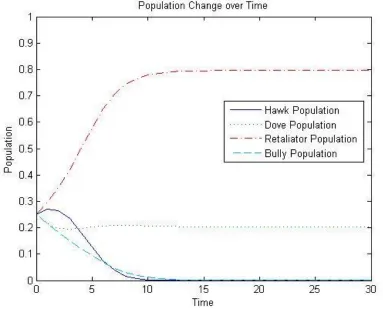
Suppose we start with an initial population distribution that is equally divided
among four behavior tendencies: ~x = (0.25,0.25,0.25,0.25). Then as time goes
by, the interaction between the four behavior types causes the Hawk and the Bully
behavior tendencies to become extinct and the population is composed of 80%
Re-taliators and 20% Doves as shown in Figure 2-1. This corresponds to the equilibirum
point (0, α,1−α,0) where α= 0.2.
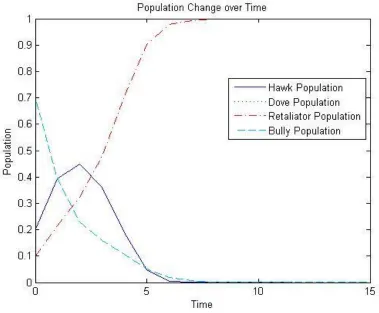
Suppose we start with the initial population distribution ~x = (0.2,0,0.1,0.7).
Then the dynamic will flow toward a population consisting of only Retaliators as
shown in Figure 2-2. This corresponds to the equilibirum point (0,0,1,0).
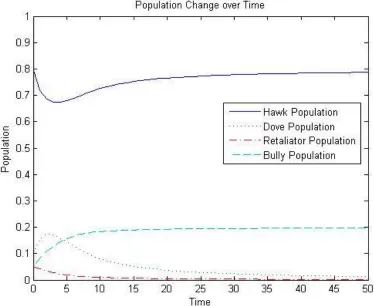
Finally, suppose we start with the initial population distribution
~x = (0.8,0.1,0.05,0.05). Then the dynamic will flow toward an equilibrium point
consisting of 80% Hawks and 20% Bullies as shown in Figure 2-3. This corresponds
Figure 2-1: Graph showing how the replicator dynamic favors a Retaliator-Dove distribution if we start with equal amounts of all behavior tendencies.
These three figures all show how the replicator dynamic behaves over time for
different initial population distributions. Note that we assumed that the entire
pop-ulation resides in a single community where any individual could interact with any
other individual. In the next chapter, we will introduce a spatial dimension into the
dynamical system, to emulate the concept that individuals may be restricted in whom
they are able to interact with because the popluation is distributed among different
Figure 2-2: Graph showing how using a different initial population distribution causes the replicator dynamic to favor a Retaliator-only distribution.
Chapter 3
Incorporating Diffusion into the
Discrete Dynamical System
3.1
Discussing Discrete Diffusion
When we incorporate diffusion into our dynamical system, we introduce a spatial
dimension into our analysis, so that our population dynamic can change through
space as well as time. For simpler analysis, we will restrict diffusion to one dimension,
so that the population can only move in two directions (i.e., to the left or to the right).
We define our spatial region as a ring of k cells, setting cell 0 and cell k to be
the same cell. Let xs
i(t) be the ith population in cell s at time t. Then for any s
such that 1≤s ≤k, populations in cells can only diffuse with cellss−1 ands+ 1.
This allows us to avoid dealing with boundary conditions (or to incorporate periodic
boundary conditions). With k cells, we now have a system of nk equations.
For each variablexi(t), there is an associated diffusion constant,di ∈[0,0.5]. The
of the population within a cell and its adjacent cells. If we have a full cell and two
adjacent cells that are both empty, then we can move up to half of the population
from the full cell to each of the empty cells. Hence, the diffusion constant is capped
at 0.5.
The ring system has an useful property. Suppose a dynamical system has the
equilibrium point (a1, a2, . . . , an). When we introduce the ring of spatial cells, we
treat each cell as an independent and identical dynamical system, and (a1, a2, . . . , an)
is also an equilibrium point for each cell. The ring system then has a ”global”
equilibrium point wherexs
i =ai for all cellss, 1≤s≤k [7].
For example, the Hawk-Dove dynamic has (m,1−m) as an equilibrium point. If
we construct a 3-cell ring system for this dynamic, then each cell can be treated as
its own dynamical system that also has (m,1−m) as an equilibrium point. However,
since we must also adhere to the restriction that all population frequencies add up
to 1, we have to scale the equilibrium point in each cell. Therefore, the global
equilibrium point isxs
1 =
m
3 and x
s
2 = 1−m
3 for 1≤s≤3.
The introduction of diffusion into the dynamical system transforms it from a
purely reaction dynamic (where population values changed over time through
in-teraction with other populations) to a reaction-diffusion dynamic. Now population
frequencies will be affected by both the interaction with other population frequencies
and the spatial motion from one cell to another cell.
In a purely reaction dynamic, the stability of an equilibrium point is purely
temporal; either the initial point near the equilibrium point moves away from or
closer to the equilibrium point as time progresses. When the spatial dimension is
added and the reaction dynamic becomes a reaction-diffusion dynamic, we have to
concern ourselves with whether population values in the spatial cells will remain the
we discuss stability for the reaction-diffusion dynamic, we have to consider both
temporal and spatial stability.
An equilibrium point will be linearly temporally stable if all eigenvalues of the
Jacobian of the reaction dynamic evaluated at this point have magnitude less than
1. When this occurs, then any initial point near the temporally-stable equilibrium
point will move toward it as time passes. If there is at least one eigenvalue that has
a magnitude greater than 1, then the equilibrium point will be temporally-unstable
and any initial point near the equilibrium point will move away from it as time goes
by. If the equilibrium point has at least one eigenvalue equal to 1, then the linear
stability test is inconclusive; it may or may not be stable.
An equilibrium point will be linearly spatially stable if, after the ring system and
diffusion is incorporated into the reaction dynamical system, all eigenvalues of the
Jacobian of the reaction-diffusion dynamic evaluated at this point have magnitude
less than 1 for all cells in the system. If there is at least one cell with at least
one eigenvalue with a magnitude greater than 1, then the equilibrium point will be
spatially unstable. If the equilibrium point has at least one eigenvalue equal to 1 in
any cell, then the linear stability test is inconclusive; it may or may not be stable.
Turing instability occurs when a temporally-stable equilibrium point becomes
spatially-unstable after diffusion is introduced into the system [5, 7].
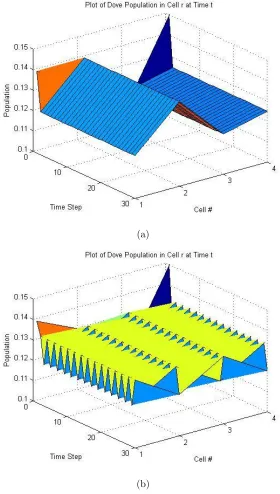
As a visual example of a Turing instability, consider the two graphs shown in
Figure 3.1, both of which represents the same Dove population, one without diffusion
and one with diffusion. In Figure 3-1(a), no diffusion is introduced into the system.
Notice that the spatial distribution of the population becomes constant over time.
Figure 3-1(b) shows what happens when we introduce diffusion into the system.
Notice that the population distribution over the cells are constantly changing. This
finding.
The focus of this paper will be to analyze where in parameter space Turing
in-stability occurs in replicator systems. To do so, we need to figure out a way to
incorporate diffusion into the dynamical system. Discrete diffusion is more
problem-atic than continuous diffusion. In continuous diffusion, the diffusionable material
is able to react with itself and diffuse simultaneously. However, when dealing with
discrete diffusion, we have to choose whether to react first then diffuse or to diffuse
first then react. In the continuous case, it is impossible to achieve Turing instability
if all diffusion coefficients are the same [2]. It will be shown that a similar result
occurs for the discrete reaction-diffusion system, making it a better choice over the
discrete diffusion-reaction system.
3.2
Constructing the Reaction-Diffusion System
Consider a linearized system of 2 discrete differential equations. Subdivide the spatial
region into k cells. Incorporating one-dimensional diffusion into the system
(empha-sizing that reaction occurs before diffusion) gives us the following system
xs(t+ 1)
ys(t+ 1)
=J·
xs(t)
ys(t)
+
dx 0
0 dy
J·
xs−1(t)
ys−1(t)
−2J·
xs(t)
ys(t)
+J·
xs+1(t)
ys+1(t)
where J denotes the Jacobian evaluated at the equilibrium point and dx and dy are
When we explicitly write out each equation, we obtain 2k equations of the form
xs(t+ 1) =J11xs(t) +J12ys(t)
+dxJ11 xs−1(t)−2xs(t) +xs+1(t)
+dxJ12 ys−1(t)−2ys(t) +ys+1(t)
ys(t+ 1) =J21xs(t) +J22ys(t)
+dyJ21 xs−1(t)−2xs(t) +xs+1(t)
+dxJ22 ys−1(t)−2ys(t) +ys+1(t)
Notice that both equations depends on the s−1, s, and s + 1 cells. In order to
investigate linear stability of the coexistence equilibrium in the presence of diffusion,
we will decouple the 2k equations by transforming the x and y variables into u and
v variables. Define the discrete Fourier transform as
xr(t) =
k−1
X
r=0
e2irsπk ur(t)→ur(t) = 1 k
k X
s=0
e−2irsπk xs(t)
yr(t) =
k−1
X
r=0
e2irsπk vr(t)→vr(t) = 1 k
k X
s=0
e−2irsπk ys(t)
This decoupling transformation will also transform the spatial dimension for easier
analysis, so that equations will depend only on cell r instead of cells s−1, s, and
Performing the transformation on the first equation:
ur(t) = 1
k
k X
s=1
e−2irsπk xs(t)
= 1
k
k X
s=1
e−2irsπk J11xs(t) +J12ys(t) +dxJ11 xs−1(t)−2xs(t) +xs+1(t)
+dyJ12 ys−1(t)−2ys(t) +ys+1(t)
=J11
1
k
k X
s=1
e−2irsπk xs(t) +J
12 1 k k X s=1
e−2irsπk ys(t)
+dxJ11
1
k
k X
s=1
e−2irsπk xs−1(t)− 2 k
k X
s=1
e−2irsπk xs(t) + 1 k
k X
s=1
e−2irsπk xs+1(t)
!
+dxJ12
1
k
k X
s=1
e−2irsπk ys−1(t)− 2 k
k X
s=1
e−2irsπk ys(t) + 1 k
k X
s=1
e−2irsπk ys+1(t)
!
=J11
1
k
k X
s=1
e−2irsπk xs(t) +J121 k
k X
s=1
e−2irsπk ys(t)
+dxJ11
1
ke
−2irπ k
k X
s=1
e−2ir(ks−1)πxs−1(t)− 2 k
k X
s=1
e−2irsπk xs(t)
+1 ke 2irπ k k X s=1
e−2ir(ks+1)πxs+1(t)
!
+dxJ12
1
ke
−2irsπ k
k X
s=1
e−2ir(ks−1)πys−1(t)
−2
k
k X
s=1
e−2irsπk ys(t) + 1 ke 2irπ k k X s=1
e−2ir(ks+1)πys+1(t)
!
Using the fact that if 0< r < k, then
k X
s=1
and if r= 0 or r=k, then
k X
s=1
e2irsπk =k
we simpify the equation to obtain
ur(t+ 1) =J11ur(t) +J12vr(t) +dxJ11
e−2kirπ −2 +e
2irπ k
ur(t)
+dxJ12
e−2kirπ −2 +e
2irπ k
vr(t)
Using Euler’s formula and trignometric properties, we hide the imaginary terms to
get:
ur(t+ 1) =J11ur(t) +J12vr(t)−4dxJ11sin2
rπ
k
ur(t)−4dxJ12sin2
rπ
k
vr(t)
=J11
1−4dxsin2 rπ
k
ur(t) +J12
1−4dxsin2 rπ
k
vr(t)
The second equation is transformed similiarly, and we obtain a transformed
sys-tem of equations:
ur(t+ 1) =J11
1−4dxsin2 rπ
k
ur(t) +J12
1−4dxsin2 rπ
k
vr(t)
vr(t+ 1) =J21
1−4dysin2 rπ
k
ur(t) +J22
1−4dysin2 rπ
k
vr(t)
We can rewrite this linearized system of equations in the following matrix form:
ur(t+ 1)
vr(t+ 1)
=
1−4dxsin2 rπk
0
0 1−4dysin2 rπk
J
ur(t)
vr(t)
This matrix system of equations represents a linearized two-dimensional discrete
to any two-dimensional discrete dynamical system in which we wish to search for
Turing instability.
We follow this same procedure for an n-dimensional discrete dynamical system
with k cells. After incorporating diffusion into a linearized n-dimensional system,
the population vector for cell s, −−→xs(t), 1≤s≤k at any given timet is given by
−−−−−→
xs(t+ 1) =J−−→xs(t) +DJ−−−−→xs−1(t)−2J−−→xs(t) +J−−−−→xs+1(t)
where J denotes the Jacobian of the discrete dynamical system evaluated at the
equilibrium point and D is a diagonal matrix of diffusion constants.
Explictly writing out the equations results in
xs1(t+ 1) =
n X
j=1
J1jxsj(t) + n X
j=1
d1J1j xsj−1(t)−2x s
j(t) +x s+1
j (t)
xs2(t+ 1) =
n X
j=1
J2jxsj(t) + n X
j=1
d2J2j xsj−1(t)−2x s
j(t) +x s+1
j (t)
.. .
xsn(t+ 1) =
n X
j=1
Jnjxsj(t) + n X
j=1
dnJnj xsj−1(t)−2x s
j(t) +x s+1
j (t)
By using the same transformation as presented in the two-dimensional case, we can
equations:
ur1(t+ 1) =
n X
j=1
J1j
1−4d1sin
rπ
k
urj(t)
ur2(t+ 1) =
n X
j=1
J2j
1−4d2sin
rπ
k
urj(t)
.. .
urn(t+ 1) =
n X
j=1
Jnj
1−4dnsin rπ
k
urj(t)
which we can rewrite into the following matrix form:
ur1(t+ 1) .. .
urn(t+ 1)
=
1−4dxsin2 rπk
· · · 0
..
. . .. ...
0 · · · 1−4dnsin2 rπk J
ur1(t) .. .
urn(t)
(3.1)
Note thatJ is the Jacobian of some given dynamical system. Thus, the given matrix
system is a general linearizedn-dimensional reaction-diffusion dynamical system that
can be applied to any discrete n-dimensional dynamical system in order to search
for Turing instability.
The Jacobian of (3.1), which we denote as Γ, is defined as
Γ =
1−4d1sin2 rπk
· · · 0
..
. . .. ...
where the trace and the determinant of (3.2) are given as follows:
tr(Γ) =tr(J)−4 sin2rπ
k
Xn
i=1
Jiidi (3.3)
det(Γ) =det(J)
n Y
i=1
1−4disin2 rπ
k
(3.4)
We can use (3.2) to analyze the stability of equilbirum points of any discrete
dy-namical system in the presence of diffusion and determine where Turing instabilities
occur.
To ensure that our discrete reaction-diffusion dynamical system corresponds with
the continuous reaction-diffusion dynamical system, we need to show that Turing
instability will not occur if all diffusion coefficients are equal.
Theorem 1. Turing instabilities cannot occur in a n-dimensional discrete
reaction-diffusion dynamical system with one-dimensional reaction-diffusion if all reaction-diffusion coefficients
are equal.
Proof. Consider an-dimensional discrete dynamical system with an temporally
sta-ble equilbirum point. Let J be the Jacobian of the dynamical system evaluated at
the temporally stable equilibrium point. Let 1-dimensional diffusion be incorporated
into the system so it becomes the transformed reaction-diffusion dynamical system
given in (3.1).
The Jacobian of (3.1) is given by (3.2). Assume that all diffusion coefficients are
equal. That is,
0≤d1 =d2 =· · ·=dn≤0.5
and a scalar:
Γ =
1−4d1sin2
rπ
k
J
Suppose there is no diffusion, implying that d1 = 0. Then Γ = J. Since the
equilbirum point is temporally stable by assumption, all eigenvalues of the Jacobian
J have magnitude less than 1, and therefore Γ is also stable.
Suppose we maximize diffusion, implying thatd1 = 0.5. Then the scalar becomes
1−2 sin2 rπk . Since 1≤r≤k, 1−2 sin2 rπk ∈[−1,1]. SinceJis evaluated at the temporally-stable equilibrium point, then all of its eigenvalues have magnitude
less than 1. Multiplying J by the scalar shrinks these eigenvalues so the eigenvalues
of Γ are guaranteed to have magnitude less than 1. Therefore, the equilibrium point
is spatially stable.
Since the temporally-stable equilibrium point is spatially stable for any diffusion
constant, Turing instability cannot occur if all diffusion constants are equal.
Thus, our linearized discrete reaction-diffusion dynamical system corresponds to
the continuous reaction-diffusion case, and we can apply this system to the replicator
(a)
[image:31.612.161.441.99.593.2](b)
Chapter 4
Searching for Turing Instability in
Discrete Replicator Systems
4.1
Turing Instability in Replicator Dynamics
Now that we have constructed the general reaction-diffusion dynamical system with
one-dimensional diffusion, we can begin to analyze replicator dynamics for presence
of Turing instability. First, it is useful to prove one fact about the Jacobian of the
replicator system.
Theorem 2. The determinant of the Jacobian of any n-dimensional replicator
sys-tem is 0.
Proof. Consider an-dimensional replicator system. The variablexi(t) represents the
population frequency of the ith type in the population at time t. By assumption,
n X
i=1
Hence, without loss of generality, we see that
xn(t) = 1− n−1
X
i=1
xi(t)
xn(t) = 1−x1(t)−x2(t)−...−xn−1(t)
x0n(t) =−x01(t)−x02(t)−...−x0n−1(t)
wherexi(t) is the replicator equation for the variablexi and 0 represents the partial
derivative.
Consider the Jacobian of the replicator system.
J=
∂x1(t)
∂x1 . . .
∂x1(t)
∂xn
..
. . .. ...
∂xn(t)
∂x1 . . .
∂xn(t)
∂xn
For any arbitrary column j, ∂xn(t)
∂xj can be expressed as a linear combination of the
other column entries. That is, for all j, 1≤j ≤n,
∂xn(t)
∂xj
=−
n−1
X
i=1
∂xi(t)
∂xj
Thus, the nth row can be expressed as a linear combination of the other rows.
Therefore, det(J) = 0.
This fact indicates that for any n-dimensional replicator system, all equilibrium
4.2
Turing Instability in the Two-Dimensional Case
Using the fact that the determinant of the Jacobian is always zero, we can prove
that Turing instability cannot occur in the two-dimensional case.
Theorem 3. Turing instability cannot occur in the two-dimensional case.
Proof. Consider the general two-dimensional discrete replicator system with
non-overlapping generations where x1(t) and x2(t) are nonnegative for all t. Such a
system has the following form:
x1(t+ 1) =x1(t)
(A~x)1
~ xTA~x
x2(t+ 1) =x2(t)
(A~x)2
~ xTA~x
where A is a general nonnegative 2 by 2 matrix. Within the evolutionary game
theory framework, we can perceive this as a system describing the dynamic between
the Hawk (x1(t)) population and the Dove (x2(t)) population where their interaction
is determined by the following matrix:
A=
0 1 +m
1−m 1
However, for the proof, we will consider a general nonnegative matrixA.
The Jacobian,J of the system evaluated at a given point (x1, x2) is given by
J=
a11a21x21x2+2a11a22x1x22+a12a22x32
(~xTA~x)2
−a11a21x31−2a11a22x21x2−a12a22x1x22
(~xTA~x)2 −a11a21x21x2−2a11a22x1x22−a12a22x32
(~xTA~x)2
a11a21x31+2a11a22x21x2+a12a22x1x22
(~xTA~x)2
Suppose we construct a spatial region ofkcells and incorporate diffusion into the
system. The Jacobian of the two-dimensional reaction-diffusion system, Γ, is given
by (3.2). We avoid Turing instability if the eigenvalues of Γ have magnitude less
than 1, which will occur if the following inequalities are satisfied [6]:
det(Γ)<1
−tr(Γ−1< det(Γ)
tr(Γ−1< det(Γ)
where, according to (3.4) and (3.3),
det(Γ) =det(J)1−4d1sin2
rπ
k 1−4d2sin
2rπ
k
tr(Γ =tr(J)−4 sin2rπ
k
(d1J11+d2J22)
wherer denotes therth cell, 1≤r≤k.
Since det(J) = 0, then det(Γ) = 0 < 1. Thus, we only need to show that
−1< tr(Γ)<1.
Suppose (x1, x2) is a temporally-stable equilibrium point of the system. Then the
Jacobian, J, evaluated at the point (x1, x2) satisfies the following inequalities [6]:
det(J)<1
−tr(J)−1< det(J)
tr(J)−1< det(J)
generality that 0≤d1 ≤d2 ≤0.5. Then it follows that
J11d1+J22d2 ≤J11d2+J22d2
≤tr(J)d2
≤ tr(J
2
< 1
2
Thus, we know that the term 4 sin2 rπk(J11d1+J22d2) ∈ (0,2). We sum the
in-equalities
0< tr(J) <1
−2< −4 sin2 rπk(J11d1+J22d2) <0
to obtain
−2< tr(J−4 sin2rπ
k
(J11d1+J22d2)<1
Hence, tr(Γ)<1.
To show that−1< tr(Γ), recall that without loss of generality,
Suppose d1 6=d2. Then this is a strict inequality. Therefore,
4 sin2rπ
k
(J11d1+J22d2)<4 sin2
rπ
k
d2tr(J)
−4 sin2rπ
k
d2tr(J)<−4 sin2
rπ
k
(J11d1+J22d2)
tr(J)−4 sin2
rπ
k
d2tr(J)< tr(J)−4 sin2
rπ
k
(J11d1+J22d2)
tr(J)
1−4 sin2
rπ
k d2
< tr(J)−4 sin2
rπ
k
(J11d1+J22d2)
Note that sincetr(J)<1 andd2 ∈[0,0.5]. Then we see that
−1< tr(J)1−4 sin2rπ
k d2
<1
and so we have
1< tr(J)1−4 sin2rπ
k d2
< tr(J)−4 sin2rπ
k
(J11d1 +J22d2)
which showstr(Γ)>−1 as desired.
Since det(Γ) = 0 and |tr(Γ)|< 1, Γ satisfies the three inequalities necessary for
stability. Thus, it is impossible to achieve Turing instability in the 2-dimenisonal
case.
4.3
Turing Instability in the Three-Dimensional
Case
Having proven that Turing instability cannot occur in the two dimensional case, we
replicator system consisting of 3 equations:
x1(t+ 1) =x1(t)
(A~x)1
~ xTA~x
x2(t+ 1) =x2(t)
(A~x)2
~ xTA~x
x3(t+ 1) =x3(t)
(A~x)3
~ xTA~x
where(A) is the fitness matrix
0 1 +m 0
1−m 1 1
0 1 1
with 0< m <1. This system describes the dynamic between three behavior
tenden-cies: Hawks (x1(t)), Doves (x2(t)), and Retaliators (x3(t)).
The equilibirum points of the system and their corresponding eigenvalues are
given in a table below:
Equilibrium Point Eigenvalues Linear Stability Test
(1,0,0) Singularity (Division by 0) Numerical results
suggest instability
(0,1,0) 0, 1 +m, 1 Unstable Equilbirum Point
(0,0,1) 0, 0, 1 Inconclusive
by the Linear Stability Test
(m,1−m,0) 0, 1+1m, 1+1m Stable Equilibrium Point
(0, α,1−α) 0,α(1 +m), 1 Unstable Equilbirum Point
Thus, (m,1−m,0) is the only linear temporally stable equilbirum point which we
need to analyze for Turing instabilty. The equilbirum point (0, α,1−α) is a special
case which will be discussed separately.
Introducing diffusion to the three-dimensional system results in a new Jacobian
of the form (3.2). By Theorem 2, det(J) = 0. This together with (3.4) implies
det(Γ) = 0. By [3], the presence of Turing instability will depend on the trace and
the principal minors of Γ. Starting with a temporally stable equilbirum point, Γ will
be spatially stable if the following inequalities are satisfied:
3
X
i=1
Mi(Γ)<1
tr((Γ)−1<
3
X
i=1
Mi(Γ)
−tr((Γ)−1<
3
X
i=1
Mi(Γ)
The analysis becomes much harder in this case. Previously, in the two-dimensional
case, we only had to concern ourselves with the trace of J and how it relates to trace
of Γ. Now, in order to look for Turing instability, we have to consider the relationship
between the trace and principal minors of J and the trace and the principal minors
of Γ.
We will resort to using numerical simulations to explore the parameter space and
locate where Turing instabilities occur. Since Turing instability does not occur when
there is no diffusion in the system, intuition suggests that if Turing instability cannot
occur even if diffusion is maximized, then it is not possible to cause Turing instability
in the system.
(m,1−m,0) is given as follows: J=
1−m
1+m
−m
1+m
−2m
1+m m−1
1+m m
1+m
2m−1 1+m
0 0 1+1m
From (3.2), after incorporating diffusion into the system, the new Jacobian has the
form Γ =
1−4d1sin2 rπk
0 0
0 1−4d2sin2 rπk
0
0 0 1−4d3sin2 rπk
J
where k is the number of spatial cells introduced into the system and di ∈ [0,0.5].
We want to try maximizing the magnitude of the diagonal entries in the diffusion
matrix. The term sin2 rπk
achieves its maximum value of 1 when the fraction rk is
exactly 12. That can only occur when we have an even number of cells, which we will assume. When that occurs, each diagonal entry Di = 1−4disin2 rπk
∈ [−1,1] for
i= 1,2,3.
We will consider all possible (D1, D2, D3) tuples where Di ∈ −1,0,1 and see
if there exist some tuple that will cause Turing instability by breaking one of the
inequalities necessary for stability. There are 27 possible tuples. By Theorem 1, we
disregard the (0,0,0), (−1,−1,−1), and (1,1,1) tuples since they correspond to the
case where all diffusion coefficients are equal. Thus, we have twenty-four cases we
need to check.
Γ =
1−4d1sin2 rπk
0 0
0 1−4d2sin2 rπk
0
0 0 1−4d3sin2 rπk
1−m
1+m
−m
1+m
−2m
1+m m−1
1+m m
1+m
2m−1 1+m
0 0 1+1m
to obtain Γ =
D1(1−m)
1+m
−D1m
1+m
−2D1m
1+m D2(m−1)
1+m
D2m
1+m
D2(2m−1)
1+m
0 0 D3
1+m
The trace and the principal minors of Γ are
tr(Γ) = D3+D2m+D1−D1m
1 +m
3
X
i=1
Mi(Γ) =
D3(D1+D2m−D1m)
(1 +m)2
We plug each (D1, D2, D3) tuple into the above equations and then vary m to see
whether the linear stability conditions are broken. That is, to avoid Turing instabilty,
we want to verify that the inequalities
D3(D1 +D2m−D1m)<(1 +m)2
±(D3+D2m+D1−D1m)−1−m
1 +m <
D3(D1 +D2m−D1m)
(1 +m)2
Example 1: (0,0,1)
1(0 +m(0−0)) = 0 <(1 +m)2 (1 + 0 +m(0−0))−1−m
1 +m =
−m
1+m <0 −(1 + 0 +m(0−0))−1−m
1 +m =
−2−m
1+m <0
The inequalities holds for all 0< m <1, so the (0,0,1) tuple will not cause Turing
instability.
Example 2: (1,1,−1)
(−1)(1 + (1)m−(1)m)< (1 +m)2 → −1<(1 +m)2
(−1 + (1)m+ 1−(1)m)−1−m
1 +m <
(−1)(1+(1)m−(1)m)
(1+m)2 → −1<
−1 (1 +m)2
−(−1 + (1)m+ 1−(1)m)−1−m
1 +m <
(−1)(1+(1)m−(1)m)
(1+m)2 → −1<
−1 (1 +m)2
The inequalities holds for all 0< m <1, so the (1,1,−1) tuple will not cause Turing
instability.
Example 3: (1,0,−1)
(−1)(1 + (0)m−(1)m)< (1 +m)2 →m−1<(1 +m)2 ((−1) + (0)m+ 1−(1)m)−1−m
1 +m <
(−1)(1+(0)m−(1)m) (1+m)2 →
−1−2m
1 +m <
m−1 (1 +m)2
−((−1) + (0)m+ 1−(1)m)−1−m
1 +m <
(−1)(1+(0)m−(1)m) (1+m)2 →
−1 1 +m <
m−1 (1 +m)2
The inequalities holds for all 0< m <1, so the (1,0,−1) tuple will not cause Turing
instability.
condi-tions for stability are never broken, indicating that the temporally stable equilibrium
point (m,1−m,0) is always spatially stable and Turing instability is not possible.
As a sidenote, consider the equilibrium point (0, α,1−α). Since it has an
eigen-value of 1, it fails the linear stability test and we cannot be sure that it is stable or
unstable. Consider the example whereα =m= 0.5 and we have a spatial region of
six cells. Sinceα = 0.5, then the equilibirum point is 0,12,12. With six spatial cells, this translates to each cell having the following population distribution: 0 Hawks, 121 Doves, and 121 Retaliators.
If we introduce no diffusion in the system, we get the behavior that we expect
from the equilibirum point: for all timet, in all cellsr, the population distribution is
constant, unchanged from the initial population distribution of 0 Hawks, 121 Doves, and 121 Retaliators in each cell. We perturb the initial population distribution by altering only the values of the Doves and Retaliators in each cell. The dynamic using
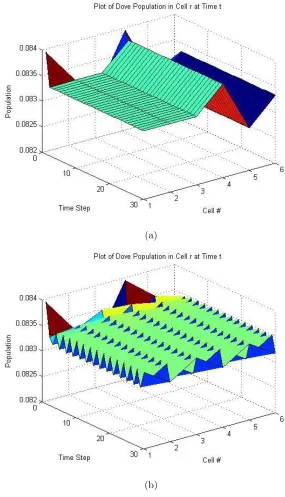
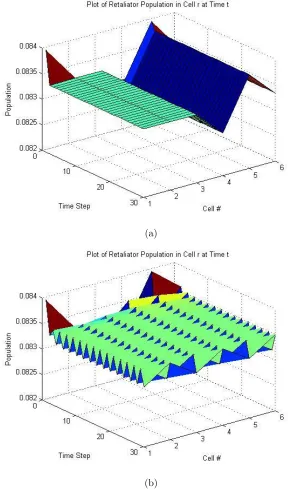
this perturbed initial distribution reaches spatial equilibrium as indicated by Figure
4-1(a) and Figure 4-2(a). In both figures, the Dove and the Retaliator populations
in each cell becomes stable over time.
Without diffusion, the system reaches a stable spatial distribution of the
pop-ulation. Once we introduce diffusion into the system, the system is not able to
reach a spatial equilibirum as shown in Figure 4-1(b) and Figure 4-2(b). Both the
Dove and the Retaliator population in each cell oscillates between 0.0832 and 0.0835
indefinitely. This is an example of spatial instability.
Recall that Turing instability occurs when a temporally stable equilibrium
be-comes spatially unstable. Since (0, α,1−α) has an eigenvalue of 1, it fails the linear
stability test and we cannot be certain that this equilibrium point is linear
tempo-rally stable or not. Hence, we cannot use this as an example of Turing instability
we are looking for when searching for Turing instability.
4.4
Turing Instability in the Four-Dimensional Case
Consider the following four-dimensional discrete replicator system:
x1(t+ 1) =x1(t)
(A~x)1
~ xTA~x
x2(t+ 1) =x2(t)
(A~x)2
~ xTA~x
x3(t+ 1) =x3(t)
(A~x)3
~ xTA~x
x4(t+ 1) =x4(t)
(A~x)4
~ xTA~x
where(A) is the following fitness matrix
0 1 +m 0 1 +m
1−m 1 1 1−m
0 1 1 1 +m
1−m 1 +m 1−m 1−m
with 0 < m < 1. This system describes the dynamics of interaction between four
behavior tendencies: Hawks (x1(t)), Doves (x2(t)), Retaliators (x3(t)), and Bullies
(x4(t)).
The equilibirum points of the system and their corresponding eigenvalues are
Equilibrium Point Eigenvalues Linear Stability Test
(1,0,0,0) Singularity (Division by 0) Numerical results
suggest instability
(0,1,0,0) 0, 1, 1 +m, 1 +m Unstable Equilbirum Point
(0,0,1,0) 0, 0, 1−m, 1 Inconclusive
by the Linear Stability Test
(0,0,0,1) 0, 1, −m1−−m1 , −m1−−m1 Unstable Equilibrium Point (m,1−m,0) 0, 1+1m, 1+1m, 21+m+1m Unstable Equilibrium Point (0, α,1−α,0) 0, 1, α(1 +m), 1 +m(2α−1) Unstable Equilbirum Point
0< α <1 if 1+1m < α <1
2m
1+m,0,0,
1−m
1+m
0, 1, 1, 11+−mm Inconclusive
by the Linear Stability Test
Since there is no linear temporally-stable equilibrium points in the four-dimensional
(a)
[image:46.612.153.438.98.595.2](b)
(a)
[image:47.612.153.441.100.589.2](b)
Chapter 5
Using Diffusion to Create Stable
Equilibrium Points
Consider a related problem. Instead of looking for Turing instability, let’s consider
whether it is possible to use diffusion to force a temporally unstable equilibrium
point to become spatially stable. Recall that the Jacobian evaluated at a temporally
unstable equilibrium point has at least one eigenvalue whose magnitude is greater
than 1. Thus, we want to use diffusion to force the magnitude of all eigenvalues to
be less than 1. This is slightly more complex than it seems.
Recall that when we incorporate diffusion into the dynamical system, we
intro-duced spatial cells, each of which could be considered its own dynamical system. We
have to check whether diffusion will turn the eigenvalues of the unstable equilibrium
point in each cell into a stable equilibrium point.
To perform this analysis, we follow a procedure similar to the approach used to
check for the presence of Turing Instability in the three-dimensional case. That is,
incor-porate diffusion into the matrix (by multiplying the Jacobian with the corresponding
diagonal diffusion matrix), get the corresponding eigenvalues, then see what diffusion
coefficients will force stability.
From the 3-d and the 4-d cases, we will be considering the following equilibrium
points:
Equilibrium Point Eigenvalues Linear Stability Test
(0,1,0) 0, 1 +m, 1 Unstable Equilbirum Point
(0, α,1−α) 0, α(1 +m), 1 Unstable Equilbirum Point
0< α <1 if 1+1m < α <1
(0,1,0,0) 0, 1, 1 +m, 1 +m Unstable Equilbirum Point
(0,0,0,1) 0, 1, −m1−−m1 , −m1−−m1 Unstable Equilibrium Point (m,1−m,0) 0, 1+1m, 1+1m, 21+m+1m Unstable Equilibrium Point (0, α,1−α,0) 0, 1, α(1 +m), 1 +m(2α−1) Unstable Equilbirum Point
0< α <1 if 1+1m < α <1
For each equilibrium point, we compute (3.2) by mulitplying the Jacobian, J
evalu-ated at that equilibrium point with the appropriate diagonal diffusion matrix. Next,
we compute the eigenvalues of (3.2), which are listed as follows:
Equilibrium Point Eigenvalues
(0,1,0) 0,D1(1 +m), D3
(0, α,1−α) 0, D1α(1 +m), D3α+D2−D2α
(0,1,0,0) 0,D3, D1(1 +m), D4(1 +m)
(0,0,0,1) 0, D2,
−D1(1+m)
m−1 ,
−D3(1+m)
m−1
(m,1−m,0) 0, D3
1+m,
D2m+D1−D1m
1+m ,
D4(2m+1)
1+m
where Di = 1−4disin2 rπk
∈ [−1,1] and di ∈ [0,0.5] for i = 1,· · ·,4. In order
to force an temporally unstable equlibirum point to become spatially stable, the
magnitude of each corresponding eigenvalue must be less than 1.
Consider the case where an equilibrium point has an eigenvalue Di for some
i= 1,· · · ,4. For spatial stability, we want
|Di|<1
to hold for all spatial cells r, 1 ≤ r ≤ k. Note that in the kth cell, regardless
of the di value, Di = 1 since sin2 kπk
= 0 It is impossible to force the unstable
equilibrium point in the last (kth) cell to become stable. Therefore, it is not possible
for a temporally-unstable equilbirium point to become spatially stable if they have
Di as an eigenvalue. This allows us to eliminate several cases, leaving only three
equilibrium points to consider.
Consider the point (m,1−m,0,0), which has the D4(2m+1)
1+m eigenvalue. For spatial
stability, we want
D4(2m+1)
1+m
<1
−1< D4(2m+1)
1+m <1 −(1 +m)
1 + 2m < D4 <
(1 +m) 1 + 2m
−(1 +m)
1 + 2m < 1−4d4sin
2 rπ k
< (1 +m)
1 + 2m
−(2 + 3m)
1 + 2m < −4d4sin
2 rπ k
< (−m)
1 + 2m m
4(1 + 2m) < d4sin
2 rπ k
< (2 + 3m)
4(1 + 2m)
Since 0 < m < 1, d4sin2 rπk
hold for the kth cell, regardless of the d
4 value, since sin2 kπk
= 0. Therefore, it is
not possible to force (m,1−m,0,0) to become spatially stable.
Consider the two equilibirum points (0, α,1−α) and (0, α,1−α,0), both of which
have D1α(1 +m) as an eigenvalue. Since we are considering temporally unstable
equilibrium points, α > 1+1m. For spatial stability, we need
|D1α(1 +m)|<1
Since α > 1+1m, let α(1 +m) = x >1. Then we need
|D1x| <1
−1< D1x <1
−1
x < D1 <
1
x
−1
x < 1−4d1sin
2 rπ k
< 1 x
−(1 +x)
x < −4d1sin
2 rπ k
< 1−x x x−1
4x < d1sin
2 rπ k
< 1 +x
4x
Sincex >1,d1sin2 rπk
must be positive. However, this inequality will not hold for
the kth cell, regardless of the d
i value, since sin2 kπk
= 0. Hence, it is not possible
to make the equilibirum points (0, α,1−α) and (0, α,1−α,0) spatially stable using
diffusion.
None of the temporally unstable equilibrium points became spatially stable.
Thus, one might conclude that diffusion cannot be used to turn a temporally unstable
equilibrium point a spatially stable equilibrium point.
in-dicates that we have constant population values for all time t. Thus, it remains to
see whether the spatial distribution of the population across thek cells remains
con-stant (indicating spatial stability) or if populations continue to migrate to different
cells over time, (indicating Turing instability). However, if an equilibrium point is
temporally unstable, then the population values will continue to change over time.
Hence, the spatial distribution of these population values will also change over time,
Chapter 6
Conclusion
The paper aimed to discuss discrete replicator systems and to explore the parameter
space for instances of Turing instability. We presented the formal definition of the
dis-crete replicator dynamic and introduced a framework story connecting the replicator
dynamic to evolutionary game theory through which we would analyze the system.
The framework story enabled us to replace two parameters from the system with
a dimensionless parameter. We found the equilibrium points for the 2-dimensional,
3-dimensional, and 4-dimensional replicator systems. We introduced diffusion into
a general discrete dynamical system and derived a new Jacobian matrix to aid us
when searching for Turing instability. Finally, we proved that Turing instability was
not possible in the two-dimensional replicator system and showed it was unlikely to
occur in the three-dimensional and the four-dimensional replicator systems. We also
showed that it was not possible to use diffusion for a similar problem: changing a
temporally unstable equilibrium point into a spatially stable equilibrium point.
Based on our work, we conjecture that it will be impossible to use diffusion to
to cause Turing instability in the replicator system constructed in Chapter 2.
Re-call that when we constructed the fitness matrix, we assumed if a conflict occurs,
the participants have a 50% chance of winning the fight and gaining access to the
resource. It may be possible to achieve Turing instability in a different replicator
system using a fitness matrix where individuals have unequal chances of winning or
losing a conflict.
The possibility of unequal chances of conflict outcomes poses a new area of
re-search. In essence, this means considering different fitness matrices and analyzing
their corresponding equilibrium points. In addition, although we proved that linear
Turing instability was not possible in the two-dimensional, three dimensional, and
four-dimensional cases, we did provide an example of where Turing instability might
occur in the three-dimensional case if we consider equilibrium points with at least one
eigenvalue of magnitude 1. This presents another possible area to explore: looking
beyond linear stability analysis to nonlinear stability analysis in order to find Turing
Appendix A
Matlab Programs
A.1
Replicator Dynamics
A.1.1
2-dimensional
%Function that performs n steps of the 2d replicator system
%Inputs: parameter m, initial population [x, y], # time steps n
function[pop] = RepEqu2d(m, intpop, n)
%Initalizing the population matrix
pop = zeros(n+1, 2);
pop(1,:) = intpop;
%Constructing the fitness matrix
A = [0 (1+m); (1-m) 1];
a11 = A(1,1); a12 = A(1,2);
for i=2:n+1
%Constructing the denominator
popvect = [pop(i-1,1); pop(i-1,2)];
denom = popvect’*A*popvect;
%Generating the population vector
x = pop(i-1, 1)*(a11*pop(i-1,1)+a12*pop(i-1,2));
y = pop(i-1, 2)*(a21*pop(i-1,1)+a22*pop(i-1,2));
pop(i,1) = x/denom;
pop(i,2) = y/denom;
total = sum(pop(i,1)+pop(i,2));
pop(i,:) = pop(i,:)/total;
end
%Plotting the populations
figure
plot([0:1:n], pop(:,1), [0:1:n], pop(:,2))
xlabel(’Time’)
ylabel(’Population’)
title(’Population Change over Time’)
legend(’Hawk Population’,’Dove Population’)
axis([0 n 0 1])
A.1.2
3-dimensional
%Function that performs n steps of the 3d replicator system
%Inputs: parameter m, initial population [x, y, z], # time steps n
function[pop] = RepEqu3d(m, intpop, n)
%Initalizing the population matrix
pop = zeros(n+1, 3);
pop(1,:) = intpop;
%Constructing the fitness matrix
A = [0 (1+m) 0; (1-m) 1 1; 0 1 1];
a11 = A(1,1); a12 = A(1,2); a13 = A(1,3);
a21 = A(2,1); a22 = A(2,2); a23 = A(2,3);
a31 = A(3,1); a32 = A(3,2); a33 = A(3,3);
for i=2:n+1
%Constructing the denominator
popvect = [pop(i-1,1); pop(i-1,2); pop(i-1,3)];
denom = popvect’*A*popvect;
%Generating the population vector
x = pop(i-1, 1)*(a11*pop(i-1,1)+a12*pop(i-1,2)+a13*pop(i-1,3));
y = pop(i-1, 2)*(a21*pop(i-1,1)+a22*pop(i-1,2)+a23*pop(i-1,3));
z = pop(i-1, 3)*(a31*pop(i-1,1)+a32*pop(i-1,2)+a33*pop(i-1,3));
pop(i,1) = x/denom;
pop(i,2) = y/denom;
total = sum(pop(i,1)+pop(i,2)+pop(i,3));
pop(i,:) = pop(i,:)/total;
end
%Plotting the populations
figure
plot([0:1:n], pop(:,1), [0:1:n], pop(:,2), [0:1:n], pop(:,3))
xlabel(’Time’)
ylabel(’Population’)
title(’Population Change over Time’)
legend(’Hawk Population’,’Dove Population’,’Retaliator Population’)
axis([0 n 0 1])
end
A.1.3
4-dimensional
%Function that performs n steps of the 4d replicator system
%Inputs: parameter m, initial population [x, y, z, w], # time steps n
function[pop] = RepEqu4d(m, intpop, n)
%Initalizing the population matrix
pop = zeros(n+1, 4);
pop(1,:) = intpop;
%Constructing the fitness matrix
0, 1, 1, 1+m; 1-m, 1+m, 1-m, 1-m];
a11 = A(1,1); a12 = A(1,2); a13 = A(1,3); a14 = A(1,4);
a21 = A(2,1); a22 = A(2,2); a23 = A(2,3); a24 = A(2,4);
a31 = A(3,1); a32 = A(3,2); a33 = A(3,3); a34 = A(3,4);
a41 = A(4,1); a42 = A(4,2); a43 = A(4,3); a44 = A(4,4);
for i=2:n+1
%Constructing the denominator
popvect = [pop(i-1,1); pop(i-1,2); pop(i-1,3); pop(i-1,4)];
denom = popvect’*A*popvect;
%Generating the population vector
x = pop(i-1, 1)*(a11*pop(i-1,1)+a12*pop(i-1,2)+a13*pop(i-1,3)+...
a14*pop(i-1,4));
y = pop(i-1, 2)*(a21*pop(i-1,1)+a22*pop(i-1,2)+a23*pop(i-1,3)+...
a24*pop(i-1,4));
z = pop(i-1, 3)*(a31*pop(i-1,1)+a32*pop(i-1,2)+a33*pop(i-1,3)+...
a34*pop(i-1,4));
w = pop(i-1, 4)*(a41*pop(i-1,1)+a42*pop(i-1,2)+a43*pop(i-1,3)+...
a44*pop(i-1,4));
pop(i,1) = x/denom;
pop(i,2) = y/denom;
pop(i,3) = z/denom;
pop(i,4) = w/denom;
total = sum(pop(i,1)+pop(i,2)+pop(i,3)+pop(i,4));
pop(i,:) = pop(i,:)/total;
%Plotting the popluations
figure
plot([0:1:n], pop(:,1), ’-’, [0:1:n], pop(:,2), ’:’, ...
[0:1:n], pop(:,3), ’-.’, [0:1:n], pop(:,4), ’--’)
xlabel(’Time’)
ylabel(’Population’)
title(’Population Change over Time’)
legend(’Hawk Population’,’Dove Population’,...
’Retaliator Population’, ’Bully Population’)
axis([0 n 0 1])
end
A.2
Reaction-Diffusion Replicator Dynamics
Note: in the next three programs, the inital population distribution will be entered
as am-by-n matrix where theijth entry denotes the initial value for the ithbehavior
type in the jth cell, 1≤j ≤n.
A.2.1
2-dimensional
%Function that constructs spatial cells and
%computes population growth for 2d Replicator Dynamics
%Input: parameter m 0<m<1, initial population intpop, number of
function[x, y] = RepRD2d(A, intpop, n, D)
%Unpacking Diffusion coefficients
Dx = D(1); Dy = D(2);
%Error checking
if size(intpop,1) ~=2
fprintf(’Initial population vector must have only 2 rows.\n’)
return
end
if Dx<0 || Dx>.5 || Dy<0 || Dy>.5
fprintf(’Both diffusion coefficients must be within [0, .5].\n’)
return
end
%Constructing the fitness matrix
A = [0 1+m; 1-m 1];
%Gets the number of spatial cells as determined by initial pop vector
r = size(intpop, 2);
%Constructing matrices to store population values
x = zeros(n+1, r); y = zeros(n+1, r);
%Initalizing the 0th row to represent initial distributions
x(1,:) = intpop(1,:); y(1,:) = intpop(2,:);
%Interating through n time steps
for i=2:n+1
%Interating through r spatial cells
%Dealing with boundary conditions
if j==1
jm1 = r; jp1 = 2;
elseif j==r
jm1 = r-1; jp1 = 1;
else
jm1 = j-1; jp1 = j+1;
end
%Constructing the denominators of r, r-1, and r+1 cells
denom = [x(i-1,j) y(i-1,j)]*A*[x(i-1,j);y(i-1,j)];
denom_m1 = [x(i-1,jm1) y(i-1,jm1)]*A*[x(i-1,jm1);y(i-1,jm1)];
denom_p1 = [x(i-1,jp1) y(i-1,jp1)]*A*[x(i-1,jp1);y(i-1,jp1)];
%Computing the population values
x(i,j) = x(i-1,j)*(A(1,1)*x(i-1,j) + A(1,2)*y(i-1,j));
x(i,j) = x(i,j)/denom;
y(i,j) = y(i-1,j)*(A(2,1)*x(i-1,j) + A(2,2)*y(i-1,j));
y(i,j) = y(i,j)/denom;
%Computing diffusion terms for the x population
if Dx ~= 0
%Computing the r-1 cell population
xm1 = x(i-1,jm1)*(A(1,1)*x(i-1,jm1) + A(1,2)*y(i-1,jm1));
xm1 = xm1/denom_m1;
%Computing the r+1 cell populations
xp1 = x(i-1,jp1)*(A(1,1)*x(i-1,jp1) + A(1,2)*y(i-1,jp1));
xp1 = xp1/denom_p1;
xdiff = Dx*(xm1 - 2*x(i,j) + xp1);
%Adding Diffusion terms to r cell populations
x(i,j) = x(i,j) + xdiff;
end
%Computing diffusion terms for the y population
if Dy ~= 0
%Computing the r-1 cell population
ym1 = y(i-1,jm1)*(A(2,1)*x(i-1,jm1) + A(2,2)*y(i-1,jm1));
ym1 = ym1/denom_m1;
%Computing the r+1 cell population
yp1 = y(i-1,jp1)*(A(2,1)*x(i-1,jp1) + A(2,2)*y(i-1,jp1));
yp1 = yp1/denom_p1;
%Computing Diffusion terms
ydiff = Dy*(ym1 - 2*y(i,j) + yp1);
%Adding Diffusion terms to r cell populations
y(i,j) = y(i,j) + ydiff;
end
end %End of loop through space
%Rescale the population vector so it adds up to 1
total = sum(x(i,:)) + sum(y(i,:));
x(i,:) = x(i,:)/total;
y(i,:) = y(i,:)/total;
end %End of loop through time
%Generating 3d plots to show population values
subplot(1, 2, 1)
surf(x([n+1:-1:1],:))
ylabel(’Time Step’)
xlabel(’Cell #’)
zlabel(’Population’)
title(’Plot of Population X in Cell r at Time t’)
subplot(1,2,2)
surf(y([n+1:-1:1],:))
ylabel(’Time Step’)
xlabel(’Cell #’)
zlabel(’Population’)
title(’Plot of Population Y in Cell r at Time t’)
A.2.2
3-dimensional
%Function for constructing spatial cells and
%computing population growth for 3d replicator dynamics
%Input: parameter m, 0<m<1, initial population intpop,
% # time steps n, diffusion coefficient vector [d_1, d_2, d_3]
function[x, y, z] = RepRD3d(m, intpop, n, D)
%Unpacking Diffusion coefficients
Dx = D(1); Dy = D(2); Dz = D(3);
%Error checking
fprintf(’m must be between 0 and 1 exclusive.\n’)
return
end
if size(intpop,1) ~=3
fprintf(’Initial population vector must have only 3 rows.\n’)
return
end
if Dx<0 || Dx>.5 || Dy<0 || Dy>.5 || Dz<0 || Dz>.5
fprintf(’All diffusion coefficients must be within [0, .5].\n’)
return
end
%Constructing the fitness matrix
A = [0 1+m 0; 1-m 1 1; 0 1 1];
%Gets the number of spatial cells determined by initial pop vector
r = size(intpop, 2);
%Constructing matrices to store population values
x