RESEARCH NOTE
Adaptation and validation of the Cyprus
version of the Practice Environment Scale
of the Nursing Work Index: a methodological
study
Georgios Efstathiou
1, Christos Andreou
2, Haritini Tsangari
3, Maria Dimitriadou
2and Evridiki Papastavrou
2*Abstract
Objective: The purpose of this study was to adapt and validate the Revised Practice Environment Scale of the Nurs-ing Work Index, to be utilized among the Cyprus nurses’ population. Validated research scales are valuable tools in the hands of researchers in their attempt to recommend alterations within health care systems, especially during reform periods.
Results: Internal consistency reliability of the scale was satisfactory (alpha = 0.94). Exploratory factor analysis pro-duced a five-factor structure solution. Experts in the field provided further guidance. The findings demonstrated that the Cyprus version of the Revised Practice Environment Scale of the Nursing Work Index is a reliable and valid research instrument, however differences with previous studies on the factor structure were observed, mainly due to cultural reasons. As a valid and reliable scale, it can capture the views of nurses concerning their work environment. The Cyprus version of the Revised Practice Environment Scale of the Nursing Work Index can be used by nurse manag-ers and policy makmanag-ers to introduce changes that may improve the quality of nursing care provided and enhance the patients’ satisfaction from the health system as a whole.
Keywords: Adaptation, Cyprus, Nurses, RN4CAST, Validation, Working environment
© The Author(s) 2018. This article is distributed under the terms of the Creative Commons Attribution 4.0 International License (http://creat iveco mmons .org/licen ses/by/4.0/), which permits unrestricted use, distribution, and reproduction in any medium, provided you give appropriate credit to the original author(s) and the source, provide a link to the Creative Commons license, and indicate if changes were made. The Creative Commons Public Domain Dedication waiver (http://creat iveco mmons .org/ publi cdoma in/zero/1.0/) applies to the data made available in this article, unless otherwise stated.
Introduction
Changes in health care systems result in the necessity to focus on forecasting models for nursing workforce reforms. Evidence indicates that current health work-force planning methods have poor results and do not enable health care managers to predict needs regard-ing the nursregard-ing profession. They also fail to allow policy interventions to be implemented satisfactorily to avoid staffing shortages [1–3]. The European Registered Nurse Forecasting (RN4CAST) research project was launched in 2009 aiming to investigate the nursing working envi-ronment, the nursing staff competency, workload, burn-out and job satisfaction as well as the associations of
those nursing variables towards patients’ outcomes. The present Cyprus RN4CAST survey was a replication of the initial protocol. Data collection regarding nurses’ percep-tions on their working environment was accomplished by using the 32-item, 5-factor structure Revised Practice Environment Scale of the Nursing Work Index (PES-NWI-R). The PES-NWI-R appears cross-culturally appli-cable, it enables the measurement of differences between hospital organizations and it has a clear association with health care outcomes [4–7]. The multi-lingual use of the PES-NWI-R among nurses of different cultural settings led to several methodological studies [5, 8].
Despite the wide use of PES-NWI-R, there is a scarcity of publications reporting modifications of the instrument necessary for use in different settings and countries [5, 9]. Acknowledging that the establishment of cross-culturally relevant, valid, reliable and rigorously adapted instru-ments for international research is crucial for the quality
Open Access
*Correspondence: [email protected]
2 Department of Nursing, Cyprus University of Technology, Limassol,
Cyprus
of research findings, the aim of this study was to adapt and validate the PES-NWI-R for use among Cypriot nurses.
Main text
Methods
This is a methodological study, conducted to adapt and validate the PES-NWI-R [3, 4, 6, 10], specifically the Greek version. Although the Greek language is spoken in Cyprus, differences exist on the use of medical and nurs-ing terminology. Therefore, adaptation of the Greek ver-sion was necessary.
Cross‑cultural adaptation
Face and content validity
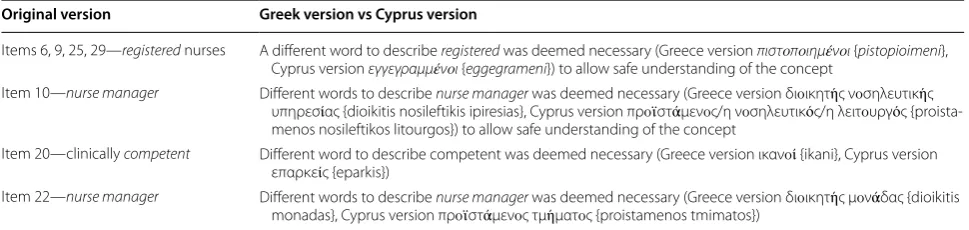
The Greek version of the PES-NWI-R was examined. Words that could confuse Cypriot nurses due to the use of different terminology in daily practice, were replaced (Table 1). Every effort was made to achieve semantic and conceptual equivalence to the Greek version. This first draft was evaluated by six clinical nurses; some sugges-tions for modificasugges-tions were adopted.
Content Validity Index (CVI) was implemented for assessment of the scale’s content validity. Ten experts who were nurses with postgraduate qualifications, evaluated the preliminary Cypriot version in terms of item importance and relevance, using a 4-point Likert scale: 1 = not relevant, 2 = somewhat relevant, 3 = quite relevant, 4 = highly relevant. CVI was satisfactory (CVI = 0.97).
Pilot study
The instrument was piloted among a convenience sample of 95 clinical nurses. Only minor changes were required at this stage. Internal consistency for the whole scale was alpha = 0.93 and for subscales was alpha = 0.71–0.88.
Field study
To further test the instrument, it was distributed to 950 nurses working on medical and surgical wards;
distribution took place during March and May 2015. Eli-gibility criteria were: willingness to participate as well as at least 1 year of professional experience. Research associates distributed the questionnaires and provided information on the scope of the study. Response rate was 65% (N = 507). The Statistical Package for the Social Sci-ences (SPSS) version 20 was used for analysis. Cronbach’s alpha was used to test the scale’s internal consistency and exploratory factor analysis (EFA) with Varimax rotation was used to break the list of 32 statements into groups of related variables and test the scale’s construct validity. The Kaiser–Meyer–Olkin (KMO) Measure of Sampling Adequacy was 0.949, while Bartlett’s test of Spheric-ity had a p-value < 0.001, indicating that the data were appropriate for a factor analysis.
Ethical considerations
The protocol of the study was reviewed by the Cyprus National Bioethics Committee (EEBK EΠ 2014.01.3); the Ministry of Health authorized the distribution of the questionnaires in all public hospitals. Nurses participated voluntarily, maintained the right to withdraw and ver-bally acknowledged that completion of a questionnaire would be considered as informed consent. Anonymity and confidentiality were preserved. Data were kept safely. Permission to replicate the study was obtained by Profes-sor Sermeus (personal contact).
Results
Participants’ characteristics
Most of the participants were young (64% between the ages of 25–34), female (67%), trained in Cyprus (93%) and holding a University Degree in Nursing (98%). Most were working on a full-time basis (98%) with a mean work experience of 11.4 years (SD 10.1).
Internal consistency and EFA
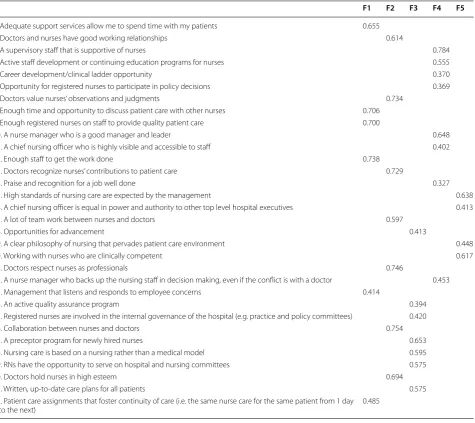
Internal consistency was satisfactory (alpha = 0.94). The EFA extracted five factors (all eigenvalues > 1), explain-ing a total of 56% of the variation. All item loadexplain-ings in
Table 1 Examples of word/phrases changes
Changes are presented in the Greek language (Greek and Cypriot version as well as how it is pronounced in English)
Original version Greek version vs Cyprus version
Items 6, 9, 25, 29—registered nurses A different word to describe registered was deemed necessary (Greece version πιστοποιημένοι {pistopioimeni}, Cyprus version εγγεγραμμένοι {eggegrameni}) to allow safe understanding of the concept
Item 10—nurse manager Different words to describe nurse manager was deemed necessary (Greece version διοικητής νοσηλευτικής υπηρεσίας {dioikitis nosileftikis ipiresias}, Cyprus version προϊστάμενος/η νοσηλευτικός/η λειτουργός {proista-menos nosileftikos litourgos}) to allow safe understanding of the concept
Item 20—clinically competent Different word to describe competent was deemed necessary (Greece version ικανοί {ikani}, Cyprus version επαρκείς {eparkis})
[image:2.595.56.541.600.715.2]their respective factor were over 0.3 (Table 2). Every item was relevant to the other items included in the corresponding factor, therefore—for the benefit of the study—all items were retained.
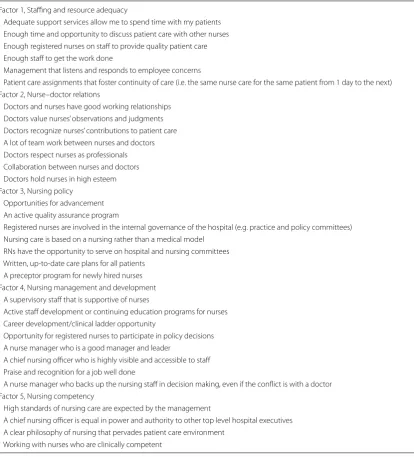
Factors were named according to the items included within each factor (Table 3). Further testing by two experienced registered nurses, validated the above item distribution.
Discussion
The five-factor structure Cyprus version of PES-NWI-R has acceptable CVI and internal consistency (alpha = 0.94). All items of the original version have been retained. Although factorial structure is similar to the original 5 factor-structure of the PES-NWI-R [10, 11],
the items within the factors are different. Similar differ-ences in item structure level have been observed in pre-vious studies [12]. Such differences can be attributed to cultural differences among countries, as well as to varying health care and management systems. This is an impor-tant consideration, as Cyprus has been, during the cur-rent study, in a transitional period concerning its health care system [13]. This might have influenced the nurses’ responses because many changes and political decisions as well as conflicts between unions and government have taken place. Nurse researchers are challenged to further investigate in a more global perspective the concept of nursing working environment, since, once again, it has been shown that is considered differently among cul-tures. Current situations and local condition seem to play
Table 2 Items loadings in corresponding factors (N = 507)
F1 F2 F3 F4 F5
1. Adequate support services allow me to spend time with my patients 0.655
2. Doctors and nurses have good working relationships 0.614
3. A supervisory staff that is supportive of nurses 0.784
4. Active staff development or continuing education programs for nurses 0.555
5. Career development/clinical ladder opportunity 0.370
6. Opportunity for registered nurses to participate in policy decisions 0.369
7. Doctors value nurses’ observations and judgments 0.734
8. Enough time and opportunity to discuss patient care with other nurses 0.706 9. Enough registered nurses on staff to provide quality patient care 0.700
10. A nurse manager who is a good manager and leader 0.648
11. A chief nursing officer who is highly visible and accessible to staff 0.402
12. Enough staff to get the work done 0.738
13. Doctors recognize nurses’ contributions to patient care 0.729
14. Praise and recognition for a job well done 0.327
15. High standards of nursing care are expected by the management 0.638
16. A chief nursing officer is equal in power and authority to other top level hospital executives 0.413
17. A lot of team work between nurses and doctors 0.597
18. Opportunities for advancement 0.413
19. A clear philosophy of nursing that pervades patient care environment 0.448
20. Working with nurses who are clinically competent 0.617
21. Doctors respect nurses as professionals 0.746
22. A nurse manager who backs up the nursing staff in decision making, even if the conflict is with a doctor 0.453
23. Management that listens and responds to employee concerns 0.414
24. An active quality assurance program 0.394
25. Registered nurses are involved in the internal governance of the hospital (e.g. practice and policy committees) 0.420
26. Collaboration between nurses and doctors 0.754
27. A preceptor program for newly hired nurses 0.653
28. Nursing care is based on a nursing rather than a medical model 0.595
29. RNs have the opportunity to serve on hospital and nursing committees 0.575
30. Doctors hold nurses in high esteem 0.694
31. Written, up-to-date care plans for all patients 0.575
32. Patient care assignments that foster continuity of care (i.e. the same nurse care for the same patient from 1 day
[image:3.595.64.540.306.729.2]a vital role on how the nursing environment is described, a fact that policy makers need to be aware of, if they want to achieve an acceptable nursing working environment.
In this study, factor one consists of six items, relevant to Staffing and Resources Adequacy. This is in line with Lake’s study [10], Klopper et al. [6] and Parker et al. [14] studies except item named Working with nurses who are clinically competent which, in the present study, was loaded within a different factor, namely Nursing Com-petency. The move of this item to another factor can be attributed to the current situation in Cyprus; almost all nurses are holders of at least Bachelor’s in nursing.
Competency is seen by nurses in this study as hav-ing to do high level of standards or behav-ing able to have equal power with other top-level hospital executives, which is explained by the position of high academic qualifications.
Factor two of the present study includes seven items, dealing on nurse–doctor relationship. It includes items on how doctors and nurses cooperate but also on what doctors believe—from the nurses’ perspective—about nurses. This factor is the only one that corresponds in its entity with the findings by Klopper et al. [6] and the same items (but not all) are included in the study by Parker
Table 3 Labeling of factors and corresponding items
Factor 1, Staffing and resource adequacy
Adequate support services allow me to spend time with my patients Enough time and opportunity to discuss patient care with other nurses Enough registered nurses on staff to provide quality patient care Enough staff to get the work done
Management that listens and responds to employee concerns
Patient care assignments that foster continuity of care (i.e. the same nurse care for the same patient from 1 day to the next) Factor 2, Nurse–doctor relations
Doctors and nurses have good working relationships Doctors value nurses’ observations and judgments Doctors recognize nurses’ contributions to patient care A lot of team work between nurses and doctors Doctors respect nurses as professionals Collaboration between nurses and doctors Doctors hold nurses in high esteem Factor 3, Nursing policy
Opportunities for advancement An active quality assurance program
Registered nurses are involved in the internal governance of the hospital (e.g. practice and policy committees) Nursing care is based on a nursing rather than a medical model
RNs have the opportunity to serve on hospital and nursing committees Written, up-to-date care plans for all patients
A preceptor program for newly hired nurses Factor 4, Nursing management and development
A supervisory staff that is supportive of nurses
Active staff development or continuing education programs for nurses Career development/clinical ladder opportunity
Opportunity for registered nurses to participate in policy decisions A nurse manager who is a good manager and leader
A chief nursing officer who is highly visible and accessible to staff Praise and recognition for a job well done
A nurse manager who backs up the nursing staff in decision making, even if the conflict is with a doctor Factor 5, Nursing competency
High standards of nursing care are expected by the management
A chief nursing officer is equal in power and authority to other top level hospital executives A clear philosophy of nursing that pervades patient care environment
[image:4.595.58.473.101.559.2]et al. [14], Lake [10] and Van Bogaert et al. [15], whereas in Chiang and Lin [12] study, all items were scattered in various factors, probably due to cultural differences and perceptions in the Chinese population of nurses. The relationship between nurses and doctors can, probably, be affected by historical reasons and how both profes-sions developed (together, in parallel etc.) but also on how the society in general perceives the roles and relationship between the two professions [16]. In some cultures, the doctor’s opinion is decisive and under this status, little opportunity is given to nurses to work as autonomous health professionals [17, 18]. In the Cyprus context, many nurses hold up to Ph.D. qualifications, allowing them to act more autonomously, influencing in this way their per-ceptions regarding their working environment.
Factor three in this study is named Nursing Policy as it includes items that do not correspond with previous labelling of the factors in other studies. For example, the items included in this factor were included in Lake’s study [10] into different factors (Nurse Participation in Hospital affairs and Nursing Foundations for quality of care). However, in this study, these items were grouped in one factor, implying that in the Cyprus environment they form a different idea. They look on how the nursing profession is ruled, what policies exist and how nurses are involved in internal governance within the hospi-tal. Thus, this factor, was named Nursing Policy since it reflects the general policy in nursing that covers the pro-fession. It should be noted that in 2009, a directorate of Nursing Services was set up and is working at Ministerial level. One of its missions, is to develop policies, proto-cols and clinical guidelines that assist nurses to perform their duties. The existence of the directorate, which is independent from other directorates, has facilitated the perception of nurses in Cyprus as autonomous health professionals, that develop their policy and regulate the profession.
Factor four of the present study includes items that deal with management and professional development. It was also labelled differently from previous studies since its content is different, as items from the present study were scattered in different factors in previous studies (e.g. in Parker’s et al. study [14] items a nurse manager who backs up the nursing staff in decision making, even if conflict is with a doctor and Active staff development or continuing education programme for nurses). Once again it is obvious that the effect the possession of high qualifi-cations among nurses in Cyprus has on their perception regarding the importance of professional development of nurses. This has led to grouping of all relevant items regarding this topic under one factor.
Factor five includes four items, all relevant to nurs-ing quality and what is expected from nurses to be
competent/be considered competent e.g. working with nurses who are clinically competent. This is a totally new factor, since in previous studies these items were included in different factors. In Parkers et al. study [14], quality was also seen from the perspective of the exist-ence of a nursing model on which nursing care is based on, whereas Klopper et al. [6] suggested that quality also included a clear philosophy of nursing and the existence of a preceptor programme for new nurses. These findings reflect the differences between health care systems with reference to what is expected to be included in quality nursing care and how this is delivered and presented. For example, in the perception of Cypriot nurses, being com-petent to practice nursing is not relevant to staffing and resources but is grouped with other concepts like high standards and equal authority with other professionals. This is an important consideration, especially in current worldwide trend of practicing nursing in other countries. Nurses originating from other parts of the world and dif-ferent health care and educational systems might find challenging the effort to become part of a new system.
Conclusions
This study showed that the Cyprus version of PES-NWI-R has satisfactory psychometric properties. PES-NWI-Reliability findings are adequate, and a new factor structure is pro-posed. This structure is solid, since all factors include more than three items, they have adequate loading to their respective factor and have semantic relationship. The Cyprus version can be used for further testing the nurses working environment in Cyprus in order to facili-tate changes but also to persuade policy-makers about the importance of nurses as part of the health system. Future studies may also focus into an in more in-depth testing of the PES-NWI-R, by replicating our study, to confirm its factor structure.
Limitations
To follow the RN4CAST protocol, this study was con-fined to nurses working in surgical-medical departments. Therefore, further research in other clinical settings is suggested. A convenience sample was used, limiting the generatability of findings.
Abbreviations
RN4CAST: Nurse Forecasting in Europe; PES-NWI-R: Revised Practice Environ-ment Scale of the Nursing Work Index; ICN: International Council of Nurses; CVI: Content Validity Index.
Authors’ contributions
•fast, convenient online submission •
thorough peer review by experienced researchers in your field • rapid publication on acceptance
• support for research data, including large and complex data types •
gold Open Access which fosters wider collaboration and increased citations maximum visibility for your research: over 100M website views per year •
At BMC, research is always in progress.
Learn more biomedcentral.com/submissions
Ready to submit your research? Choose BMC and benefit from: drafting, and made critical revisions for important intellectual content. HT was
responsible for statistical and data analysis, data interpretation and manuscript drafting. All authors have participated sufficiently in this work and approve the final version of the manuscript. All authors agree to be accountable for all aspects of this work. All authors read and approved the final manuscript.
Author details
1 Educational Sector, Nursing Services, Ministry of Health, Nicosia, Cyprus. 2 Department of Nursing, Cyprus University of Technology, Limassol, Cyprus. 3 University of Nicosia, Nicosia, Cyprus.
Acknowledgements
This study was funded by the Cyprus Nurses and Midwives Association and supported by the Cyprus University of Technology and Nursing Services, Min-istry of Health, Cyprus. In addition, Andreas Charitou, RN, Despo Konstantinou, RN, Stavros Vryonides, RN, Evdokia Athini, RN, Dr. Maria Prodromou, RN and Dr. Anastasios Merkouris, RN, are acknowledged for actively participating in this study. The authors would like to thank Ms. Maria Evangelou for the language editing and Prof. Walter Sermeus for giving the permission to replicate the RN4cast study in Cyprus.
Competing interests
The authors declare that they have no competing interests.
Availability of data and materials
The datasets used and/or analyzed during the current study are available from the corresponding author upon a reasonable request.
Consent for publication Not applicable.
Ethics approval and consent to participate
All participants were fully informed about the study, participated voluntarily and had the right to withdraw at any time. Anonymity was maintained at all stages of the study. Verbal informed consent was obtained by the participants since this study did not involve any invasive procedures. The study’s protocol, which included the above ethical considerations, was reviewed and approved by the Cyprus National Bioethics Committee (Reference Number EEBK EΠ 2014.01.32).
Funding
This study received funding from the Cyprus Nurses and Midwives Association (CYNMA). Members of CYNMA actively participated in the preparation of the research protocol, data collection, data analysis and interpretation of results.
Publisher’s Note
Springer Nature remains neutral with regard to jurisdictional claims in pub-lished maps and institutional affiliations.
Received: 28 August 2018 Accepted: 30 October 2018
References
1. Aiken LH, Clarke SP, Sloane DM, Sochalski J, Silber JH. Hospital nurse staff-ing and patient mortality, nurse burnout and job dissatisfaction. JAMA. 2002;288:1987–93.
2. Aiken L, Clarke S, Sloane D, Lake ET, Cheney T. Effects of hospital care environment on patient mortality and nurse outcomes. J Nurs Adm. 2008;38(5):223–9.
3. Sermeus W, Aiken LH, van den Heede K, et al. Nurse forecasting in Europe (RN4CAST): rationale, design and methodology. BMC Nurs. 2011;10:6. 4. Lake ET. The nursing practice environment: measurement and evidence.
Med Care Res Rev. 2007;64:104–22.
5. Warshawsky ΝE, Havens DS. Global use of the practice environment scale of the nursing work index. Nurs Res. 2011;60(1):17–31.
6. Klopper CH, Coetzee S, Pretorius R, Bester P. Practice environment, job sat-isfaction and burnout of critical care nurses in South Africa. J Nurs Manag. 2012;20:685–95.
7. Orts-Cortés MI, Moreno-Casbas T, Squires A, et al. Content validity of the Spanish version of the Practice Environment Scale of the Nursing Work Index. Appl Nurs Res. 2013;26:e5–9.
8. Aiken LH, Sermeus W, Van den Heede K, et al. Patient safety, satisfaction, and quality of hospital care: cross sectional surveys of nurses and patients in 12 countries in Europe and the United States. BMJ. 2012;344:e1717. 9. Numminen O, Ruoppa E, Leino-Kilpi H, Isoaho H, Hupli M, Meretoja R. Practice environment and its association with professional competence and work-related factors: perception of newly graduated nurses. J Nurs Manag. 2016;24(1):E1–11.
10. Lake ET. Development of the practice environment scale of the Nursing Work Index. Res Nurs Health. 2002;25(3):176–18811.
11. Squires A, Aiken LH, van den Heede K, Sermeus W, Bruyneel L, Lindqvist R, et al. A systematic survey instrument translation process for multi-country, comparative health workforce studies. Int J Nurs Stud. 2013;50(2):264–73.
12. Chiang HY, Lin SY. Psychometric testing of the Chinese version of nursing practice environment scale. J Clin Nurs. 2009;18(6):919–29.
13. Theodorou M, Charalambous C, Petrou C, Cylus J. Cyprus: health system review. Health Syst Transit. 2012;14(6):1–128.
14. Parker D, Tuckett A, Eley R, Hegney D. Construct validity and reliability of the Practice Environment Scale of the Nursing Work Index for Queens-land nurses. J Clin Nurs. 2010;18(6):902–9.
15. Van Bogaert P, Clarke S, Vermeyen K, Meulemans H, Van de Heyning P. Practice environments and their associations with nurse-reported outcomes in Belgian hospitals: development and preliminary validation of a Dutch adaptation of the Revised Nursing Work Index. Int J Nurs Stud. 2009;46(1):54–64.
16. Brown SS, Lindell DF, Dolansky MA, Garber JS. Nurses’ professional values and attitudes toward collaboration with physicians. Nurs Ethics. 2015;22(2):205–16.
17. Patelarou E, Vardavas CI, Ntzilepi P, Sourtzi P. Nursing education and prac-tice in a changing environment: the case of Greece. Nurse Educ Today. 2009;29(8):840–84.