R E S E A R C H A R T I C L E
Open Access
Evaluation of physicians
’
professional
performance: An iterative development and
validation study of multisource feedback
instruments
Karlijn Overeem
1*†, Hub C Wollersheim
1†, Onyebuchi A Arah
2,3,4†, Juliette K Cruijsberg
1†, Richard PTM Grol
1†and
Kiki MJMH Lombarts
4†Abstract
Background:There is a global need to assess physicians’professional performance in actual clinical practice. Valid and reliable instruments are necessary to support these efforts. This study focuses on the reliability and validity, the influences of some sociodemographic biasing factors, associations between self and other evaluations, and the number of evaluations needed for reliable assessment of a physician based on the three instruments used for the multisource assessment of physicians’ professional performance in the Netherlands.
Methods:This observational validation study of three instruments underlying multisource feedback (MSF) was set in 26 non-academic hospitals in the Netherlands. In total, 146 hospital-based physicians took part in the study. Each physician’s professional performance was assessed by peers (physician colleagues), co-workers (including nurses, secretary assistants and other healthcare professionals) and patients. Physicians also completed a self-evaluation. Ratings of 864 peers, 894 co-workers and 1960 patients on MSF were available. We used principal components analysis and methods of classical test theory to evaluate the factor structure, reliability and validity of instruments. We used Pearson’s correlation coefficient and linear mixed models to address other objectives. Results:The peer, co-worker and patient instruments respectively had six factors, three factors and one factor with high internal consistencies (Cronbach’s alpha 0.95 - 0.96). It appeared that only 2 percent of variance in the mean ratings could be attributed to biasing factors. Self-ratings were not correlated with peer, co-worker or patient ratings. However, ratings of peers, co-workers and patients were correlated. Five peer evaluations, five co-worker evaluations and 11 patient evaluations are required to achieve reliable results (reliability coefficient≥0.70). Conclusions:The study demonstrated that the three MSF instruments produced reliable and valid data for evaluating physicians’professional performance in the Netherlands. Scores from peers, co-workers and patients were not correlated with self-evaluations. Future research should examine improvement of performance when using MSF.
Background
In view of demands for high quality care, many health care systems aim to assess physicians’professional per-formance. As the ability to self-assess has shown to be limited, there is a need for external assessments [1].
Reliable, valid, feasible and effective measures of perfor-mance are vital to support these efforts. Since 1993, multisource feedback (MSF) or 360-degree evaluation is increasingly used in health systems around the world as a way of assessing multiple components of professional performance. MSF involves external evaluation of physi-cians’ performance on various tasks by: 1) peers with knowledge of a similar scope of practice, 2) non-physi-cian co-workers (nurses, allied healthcare professionals
* Correspondence: [email protected]
†Contributed equally
1
IQ healthcare, Radboud University Nijmegen Medical Centre, Nijmegen, The Netherlands
Full list of author information is available at the end of the article
or administrative staff) and 3) patients [2]. Raters in those three categories are those who observed the physi-cian’s behaviour in order to be able to answer questions about a physician’s performance. Physicians also com-plete a questionnaire about their own performance and these ratings are compared with others’ratings in order to examine directions for change [3]. Before the wide-spread use of MSF is merited, it is of vital importance that physicians, managers and patients have confidence in the validity and reliability of instruments applied in MSF [4]. In Canada and the United Kingdom, the relia-bility and validity of instruments used for MSF have been established across different specialties [5-10]. How-ever, a recent study in the UK found that there are important sources of systematic bias influencing these multisource assessments, such as specialty and whether or not a doctor works in a locum capacity [11]. This implies that a MSF score given to a doctor might be more affected by sociodemographic variables of the respondent than by the doctors’ true performance, which should be investigated across different MSF set-tings [12].
In addition, it has recently been underlined that instruments validated in one setting should not be used in new settings without revalidation and updating since validation is an ongoing process, not a one-time event [13]. Hence, given the significance of the judgments made, in terms of both patient safety and the usefulness of MSF for physicians’ professional development, it is essential to develop and validate assessment instruments in new settings as rigorously as possible. This paper reports on the validation study of three MSF measure-ment instrumeasure-ments used in in the Netherlands, namely peer completed, co-worker-completed and patient-com-pleted. Specifically, this paper addresses three core aims, namely: (1) the initial psychometric properties of three new instruments based on existing MSF instruments and the influence of potential sociodemographic vari-ables, (2) the correlation between physician self-evalua-tion and other raters’ evaluations, (3) the number of
evaluations needed per physician for reliable
assessments.
Methods
Ethics statement
The study was given expedited approval by the Central Committee on Research Involving Human Subjects (known by its Dutch initials, CCMO), the local institu-tional review board.
MSF system in the Netherlands
The MSF system in the Netherlands consists of feedback from physician colleagues (peers), co-workers and patients. This is combined with a reflective portfolio and
an interview with a trained mentor (a colleague from a different specialty based in the same hospital) to facili-tate the acceptance of feedback and, ultimately, improved performance. To guide performance, the men-tor helps physicians interpret the feedback and critically analyze their performance making use of the feedback. In 2007, as part of a larger physicians’performance pro-ject, the MSF system was launched in three hospitals for physician performance assessment and a pilot study established its feasibility [14]. Subsequently, the MSF system was adopted by 23 other hospitals. The MSF process is managed electronically by an independent web service. Physicians are invited via e-mail and asked to complete a self-evaluation form and nominate up to 16 raters (8 peers and 8 co-workers). All raters except patients are contacted by e-mail and are asked to com-plete a questionnaire via a dedicated web portal pro-tected by a password login. The web service automatically sends reminders to non-respondents after 2 weeks. Data collection from patients takes place via paper questionnaires which are handed out by the receptionist to consecutive patients attending the outpa-tient clinic of the physician participating. Paoutpa-tients are asked to complete the questionnaire after the consulta-tion and anonymity of the quesconsulta-tionnaire is explained by the receptionist. Patients can post the completed form in a sealed box after the consultation. The web-based service provides electronic feedback reports to the men-tor and physician to be discussed face-to-face in a per-sonal interview. The report contains global overall graphic and detailed numeric outcomes of the peers, co-workers and patients’evaluations as well as the self-eva-luation. Free text comments (answers from raters to open questions about the strengths of the physicians and opportunities for improvement) are also provided at the end of the MSF report.
MSF instrument and development
There were two distinct stages of instrument develop-ment as part of the validation study. The two stages are described below.
Content generation and content validity
backward translation-check was performed by an inde-pendent third person. Next, content validity was estab-lished in a small study. Fifteen physicians, ten co-workers and ten patients were asked to rate the rele-vance and clarity of questions on a 1 to 4 scale. (1 = not relevant/not clear, 4 = very relevant/very clear). The accepted norm for inclusion of an item in its current format was set at 70 percent of respondents agreed on relevance (a score of 3 or 4). An item was reformulated if less than 70 percent or respondents agreed on clarity (a score of 3 or 4). For the peers’and co-workers’ ques-tionnaires, all original items were found to be relevant; 6 items on the peer questionnaire needed reformulation for clarity. Two items were removed from the patient questionnaires as they were perceived as irrelevant for the Dutch context and eight items of the patient ques-tionnaire needed reformulation for clarity.
Pilot field testing
In total, 45 physicians participated in a pilot test to investigate the feasibility of the system and appropriate-ness of items. The feasibility results are described else-where [14]. Theappropriatenessof items was evaluated through the item-response frequencies. Raters had the choice of selecting‘unable to evaluate’for each item. An item was judged suitable for the MSF questionnaire if at least 60 percent of the raters (peers, co-workers or patients) responded to the item. After analysis of items with a > 40 percent category of‘unable to evaluate’, five items were removed from the peer questionnaire and two items were removed from the patient questionnaire.
Final MSF system
The final MSF system used in the study and presented in this paper comprised three questionnaires, each pre-faced by an introduction. The peer questionnaire con-sisted of 33 performance items; the co-worker and patient questionnaires included 22 and 18 items respec-tively. All items invited responses on a 9-point Likert type scale: (1 = completely disagree, 5 = neutral, 9 = completely agree). For every item, raters had the option to fill in:‘unable to evaluate’. In addition, all raters were asked to fill in two open questions for narrative feed-back, listing the strengths of individual physicians and formulating concrete suggestions for improvement.
Study design, population and setting
This observational validation study on the use of three MSF instruments in actual practice was set in 26 non-academic hospitals in the Netherlands, including both surgical and medical specialties. For several specialties such as anesthesiology and radiology specialty specific instruments were developed and therefore excluded from our study [5,16]. All physicians who completed the interview with a mentor were approached to participate. No financial incentives were provided and participants
could withdraw from the study at any time without pen-alty. Participating hospital-based physicians consented to provide their anonymous data for research analysis. We aimed to obtain a large sample with sufficient data (more than 100 physicians) to allow an assessment of the performance of the questionnaires in line with recognized best practice [13]. Data collection took place in the period September 2008 to July 2010. The analysis presented in this paper used anonymised datasets derived from this volunteer sample.
Statistical analysis
Pearsons’correlation coefficient using the mean score of all items. To address our final research objective, the number of evaluations needed per physician to establish the reliability of assessments, we used classical test the-ory and generalisability thethe-ory methods. We assumed that, for each instrument, the ratio of the sample size to the reliability coefficient would be approximately con-stant across combinations of sample size and associated reliability coefficients in large study samples. Therefore, if any new pre-specified reliability coefficient was less than or equal to that observed in our study, then the required number of raters’ evaluations per physician should resemble that observed in our study [13,20,21]. To check this assumption using our data, we re-esti-mated the reliability for the different sample sizes pre-dicted by the measure of precision and spread of scores, in line with other studies [22]. We calculated 95% CIs by multiplying the SEM (standard error of measure-ment) by 1.96 and adding and subtracting this from the mean rating [22].“This CI can then be placed around the mean score, providing a measure of precision and, therefore, the reliability that can be attributed to each mean score based on the number of individual scores contributing to it”[verbatim quote] [22].
Results
Study participants
A total of 146 physicians participated in the study. In total 864 peers (a mean of 6.5 per physician), 894 co-workers (a mean of 6.7 per physician) and 1890 patients (a mean of 15 per physician) rated the physicians. Forty percent of the physician participants was female. This is in line with the percentage of female hospital based phy-sicians in the Netherlands. The mean number of years since first registration of the physicians was 13.6 years, (minimum 2 years; maximum 35 years; standard devia-tion 8.4 years).
Mean ratings and missing data
Peers scored physicians highest on the items‘ responsi-bility for patients’(mean = 8.67) and ‘responsibility for own professional actions’(mean = 8.64). Peers provided the lowest ratings for the item‘research activities’(mean = 7.67) and‘evaluating literature’ (mean = 7.96). When aggregated for the individual physician, the mean rating given by peers was 8.37, ranging from 7.67 (min 1 max 9 SD 1.75) to 8.69 (min 2 max 9 SD 0.70). All items were positively skewed. Co-workers rated physicians highest on‘responsibility for professional actions’(mean = 8.64) and lowest on‘verbal communication with co-workers’(mean = 7.78). Patients rated physicians highest on‘respect’(8.54) and gave physicians the lowest rating for ‘asking details about personal life’ (mean = 7.72). Missing data (unable to comment) ranged from 4
percent of co-workers’responding on the item‘ collabo-rates with physician colleagues’to 38.9 percent of peers evaluating physicians’performance on ‘participates ade-quately in research activities’. On average, per item, the mean of missing data was 19.3 percent for peers, 10 per-cent for co-workers’ responses and 17.7 percent for patients. All mean scores of items are summarized in Table 1, 2 and 3.
Dimension structure and reliability of the dimensions
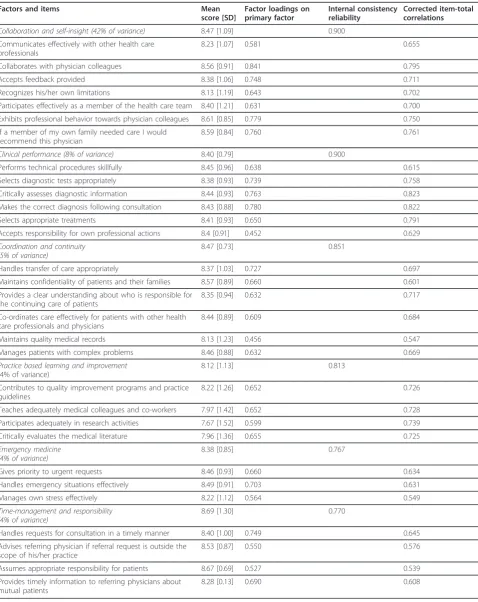
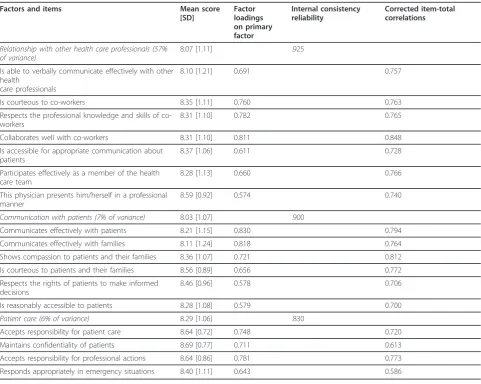
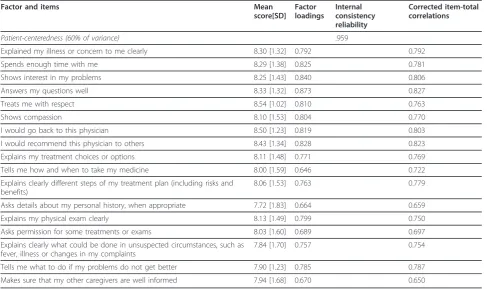
Factor loadings from principal components analysis of the peer ratings, yielded 6 factors with an Eigen value greater than 1, in total explaining 67 percent of variance. The factors comprised: collaboration and self-insight, clinical performance, coordination & continuity, practice based learning and improvement, emergency medicine, time management & responsibility. Due to low factor loadings, three items were eliminated. The six factors were highly consistent with the structure of the ques-tionnaire, as defined by items having a factor loading greater than 0.4 (Table 1). Principal components analysis of the co-worker instrument revealed a 3-factor struc-ture explaining 70 percent of variance. Because of low factor loadings and high frequency of ‘unable to evalu-ate’, five items were removed from the instrument. Fac-tors included: relationship with other healthcare professionals, communication with patients and patient care. The principal components analysis of the patient ratings yielded a 1-factor structure explaining 60 percent of the total variance. Cronbach’s alphas were high for peers’, co-workers’and patients’composite factors, ran-ging from 0.77 to 0.95. (Table 1, 2 and 3) Item-total correlations yielded homogeneity within composite fac-tors. Cronbach’s alpha for the peer, co-worker and patient questionnaires were 0.95, 0.95 and 0.94 respec-tively, indicating good internal consistency and reliability of the questionnaires. Item-total correlations yielded homogeneity within composite factors. Inter-scale corre-lations were positive and < 0.7, indicating that all the factors of the three instruments were distinct. (see Table 4 and 5)
Sociodemographic variables influencing rating
Table 1 Factors derived from the principal components analysis of peers’ratings
Factors and items Mean
score [SD]
Factor loadings on primary factor
Internal consistency reliability
Corrected item-total correlations
Collaboration and self-insight (42% of variance) 8.47 [1.09] 0.900
Communicates effectively with other health care professionals
8.23 [1.07] 0.581 0.655
Collaborates with physician colleagues 8.56 [0.91] 0.841 0.795
Accepts feedback provided 8.38 [1.06] 0.748 0.711
Recognizes his/her own limitations 8.13 [1.19] 0.643 0.702
Participates effectively as a member of the health care team 8.40 [1.21] 0.631 0.700 Exhibits professional behavior towards physician colleagues 8.61 [0.85] 0.779 0.750 If a member of my own family needed care I would
recommend this physician
8.59 [0.84] 0.760 0.761
Clinical performance (8% of variance) 8.40 [0.79] 0.900
Performs technical procedures skillfully 8.45 [0.96] 0.638 0.615 Selects diagnostic tests appropriately 8.38 [0.93] 0.739 0.758 Critically assesses diagnostic information 8.44 [0.93] 0.763 0.823 Makes the correct diagnosis following consultation 8.43 [0.88] 0.780 0.822
Selects appropriate treatments 8.41 [0.93] 0.650 0.791
Accepts responsibility for own professional actions 8.4 [0.91] 0.452 0.629
Coordination and continuity (5% of variance)
8.47 [0.73] 0.851
Handles transfer of care appropriately 8.37 [1.03] 0.727 0.697 Maintains confidentiality of patients and their families 8.57 [0.89] 0.660 0.601 Provides a clear understanding about who is responsible for
the continuing care of patients
8.35 [0.94] 0.632 0.717
Co-ordinates care effectively for patients with other health care professionals and physicians
8.44 [0.89] 0.609 0.684
Maintains quality medical records 8.13 [1.23] 0.456 0.547
Manages patients with complex problems 8.46 [0.88] 0.632 0.669
Practice based learning and improvement
(4% of variance)
8.12 [1.13] 0.813
Contributes to quality improvement programs and practice guidelines
8.22 [1.26] 0.652 0.726
Teaches adequately medical colleagues and co-workers 7.97 [1.42] 0.652 0.728 Participates adequately in research activities 7.67 [1.52] 0.599 0.739 Critically evaluates the medical literature 7.96 [1.36] 0.655 0.725
Emergency medicine (4% of variance)
8.38 [0.85] 0.767
Gives priority to urgent requests 8.46 [0.93] 0.660 0.634
Handles emergency situations effectively 8.49 [0.91] 0.703 0.631
Manages own stress effectively 8.22 [1.12] 0.564 0.549
Time-management and responsibility (4% of variance)
8.69 [1.30] 0.770
Handles requests for consultation in a timely manner 8.40 [1.00] 0.749 0.645 Advises referring physician if referral request is outside the
scope of his/her practice
8.53 [0.87] 0.550 0.576
Assumes appropriate responsibility for patients 8.67 [0.69] 0.527 0.539 Provides timely information to referring physicians about
mutual patients
score physicians lower compared to female co-workers. (Beta = -0.200, p < 0.001). This factor explained 2 per-cent of variance. We found no statistical effect of the length of the relationship of the co-workers and peers with the physician. The patients’age was positively cor-related with the ratings provided to the physician (Beta = 0.005, p < 0.001). Finally, we found no statistical influ-ence of patients’ gender. The model for patient ratings accounted for only 3 percent of the variance in ratings. Parameter estimates of the various biasing factors are summarized in Table 6.
Relationship between the different ratings
Self-ratings were not correlated with the peer ratings, co-worker ratings or patient ratings. Ratings from peers, co-workers and patients in the MSF procedure appeared to be correlated. Peer ratings were positively associated with the patient ratings (r = 0.214, p < 0.01). The corre-lation between the peer ratings and the co-worker rat-ings was significant as well (r = 0.352, p < 0.01). Finally,
co-worker ratings appeared to be positively associated with patient ratings. (r = 0.220, p < 0.01). Overall, all correlations appeared to be small. Table 7 shows the correlations between the mean scores for self ratings, peer ratings, co-worker ratings and patient ratings.
Determining the minimum sample size required
[image:6.595.57.539.98.482.2]Following the methods of a previous work [21], we esti-mated the minimum number of evaluations per physi-cian needed to achieve specified reliability coefficients: assuming a reliability coefficient of 0.60, ratings from 4 peers, 4 co-workers and 9 patients would be required for reliable measurement. When a stricter reliability coefficient of 0.70 was applied, as many as 5 peers, 5 co-workers and 11 patients evaluating each physician would be required. Table 8 summarizes the number of raters needed for reliable results. Reliability calculations based on 95% CIs and the residual component score showed that, with 5 peers, 5 co-workers and 11 patients, none of the physicians scored less than the criterion standard,
Table 2 Factors derived from the principal components analysis of co-workers’ratings
Factors and items Mean score
[SD]
Factor loadings on primary factor
Internal consistency reliability
Corrected item-total correlations
Relationship with other health care professionals (57% of variance)
8.07 [1.11] .925
Is able to verbally communicate effectively with other health
care professionals
8.10 [1.21] 0.691 0.757
Is courteous to co-workers 8.35 [1.11] 0.760 0.763
Respects the professional knowledge and skills of co-workers
8.31 [1.10] 0.782 0.765
Collaborates well with co-workers 8.31 [1.10] 0.811 0.848
Is accessible for appropriate communication about patients
8.37 [1.06] 0.611 0.728
Participates effectively as a member of the health care team
8.28 [1.13] 0.660 0.766
This physician presents him/herself in a professional manner
8.59 [0.92] 0.574 0.740
Communication with patients (7% of variance) 8.03 [1.07] .900
Communicates effectively with patients 8.21 [1.15] 0.830 0.794 Communicates effectively with families 8.11 [1.24] 0.818 0.764 Shows compassion to patients and their families 8.36 [1.07] 0.721 0.812 Is courteous to patients and their families 8.56 [0.89] 0.656 0.772 Respects the rights of patients to make informed
decisions
8.46 [0.96] 0.578 0.706
Is reasonably accessible to patients 8.28 [1.08] 0.579 0.700
Patient care (6% of variance) 8.29 [1.06] .830
in our case 6.0 on a 9-point standard. The various var-iance components (true varvar-iance and residual varvar-iance) necessary for this calculation are provided in Table 9.
Discussion
Main findings
This study shows that the adapted Canadian MSF tool, incorporating peer, co-worker and patient feedback questionnaires is reliable and valid for hospital-based physicians (surgical and medical). We found robust fac-tor structures with good internal consistency across the three instruments. Our study demonstrates that little of the variance in performance could be explained by
factors, such as gender of the rater and length of the relationship with the rater, that were beyond the physi-cians’control. Physicians were rated more positively by members of their physician group, but this accounted for only two percent of variance in ratings. Individual reliable feedback reports could be generated with a minimum of 5 evaluations of peers, 5 co-workers and 11 patients respectively.
Explanation and interpretation
[image:7.595.56.544.100.389.2]Our findings provide strong empirical support for the reliability and validity of the results obtained from the three MSF instruments for physicians’ performance
Table 3 Factors derived from the principal components analysis of patients’ratings
Factor and items Mean
score[SD] Factor loadings
Internal consistency reliability
Corrected item-total correlations
Patient-centeredness (60% of variance) .959
Explained my illness or concern to me clearly 8.30 [1.32] 0.792 0.792
Spends enough time with me 8.29 [1.38] 0.825 0.781
Shows interest in my problems 8.25 [1.43] 0.840 0.806
Answers my questions well 8.33 [1.32] 0.873 0.827
Treats me with respect 8.54 [1.02] 0.810 0.763
Shows compassion 8.10 [1.53] 0.804 0.770
I would go back to this physician 8.50 [1.23] 0.819 0.803
I would recommend this physician to others 8.43 [1.34] 0.828 0.823 Explains my treatment choices or options 8.11 [1.48] 0.771 0.769 Tells me how and when to take my medicine 8.00 [1.59] 0.646 0.722 Explains clearly different steps of my treatment plan (including risks and
benefits)
8.06 [1.53] 0.763 0.779
Asks details about my personal history, when appropriate 7.72 [1.83] 0.664 0.659
Explains my physical exam clearly 8.13 [1.49] 0.799 0.750
Asks permission for some treatments or exams 8.03 [1.60] 0.689 0.697 Explains clearly what could be done in unsuspected circumstances, such as
fever, illness or changes in my complaints
7.84 [1.70] 0.757 0.754
Tells me what to do if my problems do not get better 7.90 [1.23] 0.785 0.787 Makes sure that my other caregivers are well informed 7.94 [1.68] 0.670 0.650
Table 4 Pearson correlation coefficient between peers’factors
Collaboration Clinical performance
Practice based learning and improvement
Coordination and continuity
Responsibility and time-management
Emergency medicine
Collaboration 1.000 0.499** 0.451** 0.295** 0.459 0.437
Clinical performance 1.000 0.551 0.432** 0.383 0.408
Practice based learning and improvement
1.000 0.357** 0.445 0.400**
Coordination and continuity
1.000 0.338 0.343**
Responsibility and time-management
1.000 0.328**
Emergency medicine 1.000
[image:7.595.55.538.592.724.2]evaluation. The results of the psychometric analyses for the three MSF instruments indicate that we could tap into multiple factors per questionnaire. For the peer instrument, our factor analysis suggested a 6-dimen-sional structure. These findings do not support the 4-dimensional structure found in earlier research of the original instruments by Violato and Lockyer. Other stu-dies of instruments used for MSF by Archer et al. [23] and Ramsey et al. [24] assess two generic factors; labeled as clinical and psychosocial qualities. Our findings do not confirm the suggestions made in earlier studies that found only two generic factors [20] Those researchers argue that in MSF evaluations, the halo effect -which is the tendency to give global impressions- and stereotyp-ing exist [25]. This does not seem to apply to Dutch hospital physicians evaluating colleagues. Physicians seem to be able to distinguish between different aspects of professional performance instead of giving global
impressions concerning the clinical performance and humanistic qualities.
[image:8.595.56.544.101.155.2]However, our results underline that peers, co-workers and patients tend to answer on the upper end of the scale, also known as positive skewness. It is not yet clear whether this is the result of the fact that questions are in general formulated with a positive tone or for exam-ple because of the nature of the study (it is not a daily scenario). Other studies show similar results [23,24]. The interpretation of these scores might lead to limited directions for change. Our finding that self-ratings using MSF are not related with ratings made by peers, co-workers and patients is consistent with the current lit-erature on self-assessment and justifies the introduction of MSF for the evaluation of physicians’ professional performance [1]. However, we found support for signifi-cant correlations between ratings of peers, co-workers and patients. They can be considered as three
Table 5 Pearson correlation coefficient between co-workers’factors
Relationship with healthcare professionals Communications with patients Professionalism
Relationship with healthcare professionals 1.000 0.667** 0.537**
Communications with patients 1.000 0.574**
Patient care 1.000
**correlation is significant at 0.01 level
Table 6 Effects of raters’characteristics and physicians’characteristics on overall mean scores
Overall rating peers Overall rating co-workers Overall rating
patients
Parameter estimated coefficient* [SE]
P-value
Parameter estimated coefficient* [SE]
P-value
Parameter estimated coefficient* [SE]
P-value
Physicians’ characteristics
Male (reference: female) -.0137 [.065] .832 -.019 [.091] .838 -.049 [.091] .591 Years of experience -.008 [.004] .043 -.012 [.005] .029 .003 [.005] .598
Surgery ref. ref. ref.
Internal medicine .069 [.064] .287 .139 [.094] .140 .096 [.088] .280
Raters’characteristics
Female ref. ref. ref.
Male -.002 [.051] .974 -.200 [.071] .005 -.055 [.062] .378
Age .005 [.002] .002
Relation
Membership of the same specialist group
.153 [.049] .002
Working together: < 6 months -.115 [.179] .523 .046 [.185] .804 Working together: > 6 months and <
1 year
.042 [.111] .702 -.036 [.122] .770
Working together > 1 year
ref. ref.
[image:8.595.56.540.420.712.2]independent groups of raters, representing different per-spectives, thus supporting the existence of concurrent validity. Similar with other MSF instruments, we have not formally tested the criterion validity of instruments, because a separate gold standard test is lacking [11].
Previous studies with original MSF-questionnaires in Canada demonstrated that 8 peer evaluations,7 co-worker evaluations and 25 patient evaluations are required to produce reliable results [7] while studies in the UK amongst residents found that 4 evaluations are needed [23]. Compared to Canada, in the Netherlands less evaluations are necessary to achieve reliable results. Potentially, teams and physician groups in the Nether-lands are smaller, increasing the interdependence of work as well as opportunities of observing colleagues’ performance [26].
Strengths and limitations
This study was restricted to a self-selected sample of physicians receiving feedback. It is likely that those who agreed to participate were reasonably confident about their own standards of practice and the sample may have been skewed towards good performance. The mean scores, however, are similar to scores reported by other comparable instruments that were also skewed to good performance [24]. Second, we could use only 80 percent of peer responses due to missing values on one or more items. Future work should investigate whether missing values are indicative of the tendency to avoid a negative judgment. Third, participant physicians were asked to distribute the survey to consecutive patients at the outpatient clinic but we were not able to check if
this was correctly executed for all participants. Fourth, because of the cross-sectional design of this study, an assessment of intra-rater (intra-colleague or intra-co-worker) or test-retest reliability was not possible. Further work on the temporal stability of responses of the questionnaires is warranted. Finally, the data being anonymous, the hospital and specialist group specialists were based in were not available for analysis. It would have been interesting to investigate the effects of various hospitals and specialty groups on reported change as these factors have been found to be important determi-nants in previous studies [11].
Implications for practice and research
This study established the validity and reliability of MSF for hospital-based physicians in the Netherlands. Although it cannot be expected that one single tool can guide improvement for all physicians, it offers Dutch physicians feedback about their performance. MSF in the Netherlands has been designed and tested for for-mative purposes. The purpose is to give feedback to physicians so that they can steer their professional development plans towards achieving performance excellence [27]. Reliable results are achieved with 5 peer, 5 co-workers and 11 patient raters, which under-scores that implementation is attainable in academic and non-academic hospitals. With respect to the posi-tive skewness of the results of the questionnaires, pre-sumably the idea of visualizing the outcomes into
‘excellent ratings’versus ‘sufficient ratings’ and‘lower ratings’ presents deficiencies more clearly. This approach might increase the educational potential of MSF [28].
[image:9.595.58.540.112.189.2]We did not test the possibility to use the results of our study to draw conclusions about the ability to detect
Table 7 Pearsons’correlation coefficients between the ratings of four measurements perspectives: self, colleagues, co-workers and patients
Self rating Medical colleagues’
ratings
Co-workers’ ratings
Patient ratings’
Self rating 1.000 0.062 0.082 0.067
Medical colleagues’ratings 1.000 0.352* 0.214*
Co-workers’ratings 1.000 0.220*
Patient ratings’ 1.000
[image:9.595.58.290.659.731.2]* correlation is significant at 0.05 level
Table 8 Number of colleagues, co-workers and patients’ evaluations needed per physician for reliable evaluation of physicians’professional performance for different reliability coefficients
Reliability coefficient of 0.60
Reliability coefficient of 0.70
Reliability coefficient of 0.80
Peers 4 5 5
Co-workers 4 5 6
Patients 9 11 12
Table 9 Variance components for the three different groups of raters
True variance Residual variance
Peers 0.06 0.42
Co-workers 0.16 0.45
[image:9.595.304.540.676.731.2]physicians whose performance might be below standard. In view of the positive skewness of results and the fact that criterion validity is not yet tested, we consider this as an undesirable development. We consider this study a starting point for further research. As a result we do not claim the items presented in the tables to be the final version, because a validation process should be ongoing. Furthermore, additional work is required to further establish the validity of the instruments. We agree with Archer et al. that MSF is unlikely to be suc-cessful without robust regular quality assurance to establish and maintain validity including reliability [22]. Further validity of the factors could be tested by com-paring scores with observational studies of actual perfor-mance requiring external teams of observers or mystery patients.
Conclusions
This study supports the reliability and validity of peer, co-worker and patient completed instruments underly-ing the MSF system for hospital based physicians in the Netherlands. Reliable individual feedback reports can be generated based on a minimum of respectively five, five and 11 evaluations. Physicians may use their individual feedback reports for reflection and designing personal development plans.
Acknowledgements
We thank all physicians who generously participated in this study.
Author details
1IQ healthcare, Radboud University Nijmegen Medical Centre, Nijmegen, The
Netherlands.2Department of Epidemiology, School of Public Health, University of California, Los Angeles (UCLA), Los Angeles, California, USA.
3Center for Health Policy Research, UCLA, Los Angeles, California, USA. 4Department of Quality and Process Innovation, Academic Medical Centre,
University of Amsterdam, Amsterdam, The Netherlands.
Authors’contributions
Conceived and designed the experiments: KO KML HCW. Analyzed the data: KO KML JC OAA. Contributed reagents/materials/analysis tools: KO JC OAA. Wrote the paper: KO. Editing and reviewing the manuscript: KML HCW PRTMG OAA JC. All authors read and approved the final manuscript.
Competing interests
The authors declare that they have no competing interests.
Received: 3 November 2011 Accepted: 26 March 2012 Published: 26 March 2012
References
1. Davis DA, Mazmanian PE, Fordis M, Van Harrison R, Thorpe KE, Perrier L: Accuracy of physician self-assessment compared with observed
measures of competence - A systematic review.JAMA2006,
296:1094-1102.
2. Hall W, Violato C, Lewkonia R, Lockyer J, Fidler H, Toews J, Jenett P, Donoff M, Moores D:Assessment of physician performance in Alberta: the physician achievement review.CMAJ1999,161:52-57.
3. Atwater LE, Brett JF:Antecedents and consequences of reactions to developmental 360 degrees feedback.Journal of Vocational Behavior2005, 66:532-548.
4. Campbell JL, Richards SH, Dickens A, Greco M, Narayanan A, Brearley S: Assessing the professional performance of UK doctors: an evaluation of the utility of the General Medical Council patient and colleague questionnaires.Qual Saf Health Care2008,17:187-193.
5. Lockyer JM, Violato C, Fidler H:A multi source feedback program for anesthesiologists.Can J Anaesth2006,53:33-39.
6. Lockyer JM, Violato C, Fidler H:The assessment of emergency physicians by a regulatory authority.Acad Emerg Med2006,13:1296-1303. 7. Violato C, Lockyer J, Fidler H:Multisource feedback: a method of
assessing surgical practice.BMJ2003,326:546-548.
8. Violato C, Lockyer JM, Fidler H:Assessment of pediatricians by a regulatory authority.Pediatrics2006,117:796-802.
9. Davies H, Archer J, Bateman A,et al:Specialty-specific multi-source feedback: assuring validity, informing training.Med Educ2008, 42:1014-1020.
10. Sargeant JM, Mann KV, Ferrier SN, Langille DD, Muirhead PD, Hayes VM, Sinclair DE:Responses of rural family physicians and their colleague and coworker raters to a multi-source feedback process: a pilot study.Acad Med2003,78:42-44.
11. Campbell JM, Roberts M, Wright C, Hill J, Greco M, Taylor M, Richards S: Factors associated with variability in the assessment of UK doctors’ professionalism: analysis of survey results.BMJ2011,343:d6212. 12. Wilkinson JR, Crossley JGM, Wragg A, Mills P, Cowani G, Wade W:
Implementing workplace-based assessment across the medical specialties in the United Kingdom.Med Educ2008,42:364-373. 13. Streiner DL, Norman GR:Health measurement scales: a practical guide to
their development and use. 4th Edition.Oxford; Oxford university press; 2008:5-36(167-206):247-274.
14. Overeem K, Lombarts MJ, Arah OA, Klazinga NS, Grol RP, Wollersheim HC: Three methods of multi-source feedback compared: a plea for narrative comments and coworkers’perspectives.Med Teach2010,32:141-147. 15. Lombarts MJMH, Klazinga NS:A policy analysis of the introduction and
dissemination of external peer review (visitatie) as a means of professional self-regulation amongst medical specialists in The Netherlands in the period 1985-2000.Health Policy2001,58:191-213. 16. Lockyer JM, Violato C, Fidler HM:Assessment of radiology physicians by a
regulatory authority.Radiology2008,247:771-778.
17. Arah OA, ten Asbroek AH, Delnoij DM, de Koning JS, Stam PJ, Poll AH, Vriens B, Schmidt PF, Klazinga NS:Psychometric properties of the Dutch version of the Hospital-level Consumer Assessment of Health Plans Survey instrument.Health Serv Res2006,41:284-30.
18. Cronbach LJ:Coefficient alpha and the internal structure of tests. Psychometrika1951,16:297-334.
19. Carey RG, Seibert JH:A patient survey system to measure quality improvement: questionnaire reliability and validity.Med Care1993, 31:834-845.
20. Kraemer HC:Ramifications of a population model forkas a coefficient of reliability.Psychometrika1979,44:461-7220.
21. Lombarts KM, Bucx MJ, Arah OA:Development of a system for the evaluation of the teaching qualities of anesthesiology faculty. Anesthesiology2009,111:709-716.
22. Archer J, McGraw M, Davies H:Republished paper: Assuring validity of multisource feedback in a national programme.Postgrad Med J2010, 86:526-531.
23. Archer JC, Norcini J, Davies HA:Use of SPRAT for peer review of paediatricians in training.BMJ2005,330:1251-1253.
24. Ramsey PG, Wenrich MD, Carline JD, Inui TS, Larson EB, LoGerfo JP:Use of peer ratings to evaluate physician performance.JAMA1993,
269:1655-1660.
25. Borman WC:Effects of instructions to avoid halo error on reliability and validityof performance evaluation ratings.J Appl Psychol1975,60:556-560. 26. Peiperl MA:Conditions for the success of peer evaluation.Int J Human
Resource Manag1999,10:429-458.
28. Makoul G, Krupat E, Chang CH:Measuring patient views of physician communication skills: development and testing of the Communication Assessment Tool.Patient Educ Couns2007,67:333-342.
Pre-publication history
The pre-publication history for this paper can be accessed here: http://www.biomedcentral.com/1472-6963/12/80/prepub
doi:10.1186/1472-6963-12-80
Cite this article as:Overeemet al.:Evaluation of physicians’professional performance: An iterative development and validation study of multisource feedback instruments.BMC Health Services Research2012 12:80.
Submit your next manuscript to BioMed Central and take full advantage of:
• Convenient online submission
• Thorough peer review
• No space constraints or color figure charges
• Immediate publication on acceptance
• Inclusion in PubMed, CAS, Scopus and Google Scholar
• Research which is freely available for redistribution