
Vol. 49, No. 2 JOURNAL OFVIROLOGY, Feb. 1984. p.452-458
0022-538X/84/020452-07$02.00/0
Copyright ©)1984, American Society for Microbiology
Characterization
of
Structural and Immunological Properties of
Specific Domains of Friend Ecotropic and Dual-Tropic Murine
Leukemia Virus gp7Os
ABRAHAM PINTER* ANDWILLIAM J. HONNEN
Memorial Sloan-Kettering CancerCenter, Sloan-Kettering Division, Gradiuate Schoolof Medical Sciences, Cornell University, New York, Newt, Yor-k 10021
Received 2 June 1983/Accepted 6 October 1983
Adetailedcomparison of the gp7O proteins of cloned ecotropicFriendmurine leukemia virus (FLV) and
dual-tropic Friend mink focus-forming virus (FrMCF) was performed by analyzing the structural and
immunological properties of amino- and carboxy-terminal domains of these molecules generated upon
controlled trypsinization. The two gp70s gave characteristic fragmentation patterns; the amino-terminal fragments ofFrMCF gp7Oweresmaller than the corresponding fragments ofFLV and containedatrypsin
site which resulted in a 19,000-dalton amino-terminal fragment not observed for FLV, whereas both
molecules yielded an identically sized carboxy-terminal fragment. All amino-terminal fragments of both
gp7O molecules contained an endo H-sensitive oligosaccharide chain; for FrMCF, a second endo
H-sensitive carbohydrate was present as well at a carboxy-terminal site for approximately 50% of the molecules. Several aspectsof thedisulfide interactions ofthe twogp7oswereconserved; in bothcasesthe
carboxy-terminal fragmentsweredisulfidebondedtop15(E), therewerenodisulfide bondsbetween
amino-and carboxy-terminal fragments, and the amino-terminal fragments exhibited a significant increase in
mobility upon analysis by sodium dodecyl sulfate-polyacrylamide gel electrophoresis under nonreducing conditions. Analysis of the immunoreactivity of the different domains of the proteins by immunoprecipita-tionofthe fragments withantiseraprepared against xenotropic murine leukemia virus and feline leukemia virus gp70s indicated major differences in antigenicity forthe amino-terminaldomainsofFLV andFrMCF
gp7O, whereas the carboxy-terminal domains were immunologically conserved. Similar analyses with antibodiesspecificforp15(E)andPrl5(E)demonstratethat thesecomponentsareconservedaswell.These dataprovide directevidence thatp15(E)andtheC-terminal gp7O domain of FrMCF gp7Oare relatedtothe
corresponding regions of the ecotropic FLV parent and indicate that the acquisition of MCF-specific propertiesisduetothe replacement of the ecotropicamino-terminal gp7O domain withsequencesrelatedto
those ofxenotropic gp70s.
The original Friend virus isolate consists of a complex between a replication-competent ecotropic virus, Friend murine leukemia virus (FLV), and a replication-defective virus, spleen focus-forming virus (28). Whereas the spleen
focus-formingvirus component appearstoberesponsiblefor
someofthebiologicalproperties ofthecomplex, it has been
shownwith bothbiologicallyandmolecularlycloned viruses
thatinfectionwith FLVby itselfresults inrapid
transforma-tion ofhematopoieticcells oftheerythroid lineage (19, 31),
and evidence has beenpresented which suggests that FLV
leukemogenesis proceedsviaarecombinantminkcell
focus-forming (MCF)virus intermediate. FLV-inducedleukemias
containgreatlyincreased levelsofxenotropic murine
leuke-mia virus (MuLV)-related env sequences (31), and MCF viruses have frequently been isolated from such leukemic
spleens (10,31). These MCF isolates are themselves
leuke-mogenic in newborn mice (10) and in adult mice when
inoculated aspseudotypes with nonpathogenic viruses (24). In addition, certain strains of mice, such asDBA/2, which
are resistant to infection by MCF viruses are resistant to
leukemogenesis byFLV(1, 24).Thus, it appears that,ashas
been shown for the AKR system, recombinant dual-tropic viruses may be the proximal leukemogenic agents in FLV-induced disease.
*Correspondingauthor.
Weareinterested indeterminingthestructural features of the MCF
gp7O
molecules which correlate with their broad-ened host range and enhancedpathogenicities. Towards thisaim, we have recently described conditions for generating
and characterizing fragments ofnative gp70s which
corre-spond to specific amino- and carboxy-terminal domains of
the molecules(21, 22).
Applying
thistechnique
tothestudy
of ecotropic Akv
gp7O
and itsleukemogenic recombinant,
MCF-247,we havefound that these two
gp70s
differexten-sivelyintheiramino-terminal
regions
but possessconservedcarboxy-terminal domains (21). Inthe present
study,
weuseasimilarapproachtocomparethestructural and
immunolog-ical properties of FLV and Friend MCF
(FrMCF)
gp7O
domains. Our results indicate that, in the Friend system as well, majorstructural andimmunologicaldifferences exist in
the amino-terminaldomains of the
ecotropic
anddual-tropic
viral
gp70s,
whereasthecarboxy-terminal
domainsappeartobehighlyrelated. We find that theamino-terminaldomain of
FrMCF is immunologically related to
xenotropic gp70s
of both theBV-2 and NZB classes of MuLV andantigenically
distinct from the
corresponding
region
ofecotropic
FLV. Theseresults, consistent with theprevious
localizationofaxenotropic-related
antigenic
determinant to a23,000-dalton
amino-terminalfragment ofFrMCF
gp7O
(33),
suggest thattheamino-terminal domainof
gp7O
isfunctionally
important
indetermining the receptor
specificity
of these viruses.452
on November 10, 2019 by guest
http://jvi.asm.org/
DOMAINS OF FRIEND ECOTROPIC AND MCF gp7(s 453 MATERIALS AND METHODS
Viruses. NIH 3T3 cell cultures infected with molecularly cloned ecotropic FLV, clone 57, and biologically cloned
FrMCF-1 viruswereobtainedfrom Allen Oliff. Viruses were
generally labeled by culturingcellsovernight incysteine- or
methionine-free minimum essential medium supplemented with 100 to 150pLCi of35S-labeledcysteineor methionineper ml; labeling with
[3H]mannose
was performed by culturing cellsovernightinminimumessential mediumcontaining500pLCi of
[3HJmannose
perml. Virions were purified byband-ing directly on 15 to60% sucrose gradients.
Conditions for fragmentation and immunoprecipitation of
gp7O. Virions weresolubilized byaddition of
equal
volumesof 2x RIPbuffer(RIPbuffer = 0.01 M Tris [pH 7.4]. 0.5 M
NaCI, 0.5% Nonidet P-40) and treated with appropriate
concentrations oftrypsin for 15 min at 37C, followed by inactivation of the trypsin byaddition of1,000U ofTrasylol (FBA Pharmaceuticals) per ml. For experiments involving intact virions. freshly purified, unfrozen virus preparations
weretrypsinized. treated withTrasylol. and then solubilized
with RIP buffer. Viral lysateswereprecleared by incubation with Staphylococcus aulri-eis (Pansorbin; Calbiochem). and nonspecifically bound components were removed by
pellet-ing. Immunoprecipitations were then performed by
incuba-tion for 1 h at37°C with antisera diluted 1:100. and immune
complexes were collected with Pansorbin and washed three times with RIP buffer. Sampleswere solubilized by boiling for 1 min in buffer containing 1% sodium dodecyl sulfate
(SDS) and analyzed by SDS-polyacrylamide gel
electropho-resis(PAGE)on10 or12%polyacrylamidegels,asdescribed by Laemmli (13). For samples analyzed under reducing
conditions. 1% dithiothreitol was included in the SDS
sam-ple buffer. Gels were treated forfluorography as described by Laskey and Mills (14) and exposed to X-ray film at
-700C.
Reagentsandantisera. Trypsin(tolylsulfonyl phenylalanyl
chloromethyl ketone treated; 12.100 BAEE units per mg of protein) was obtained from Miles Laboratories. Radioiso-topes werepurchasedfrom New England Nuclear Corp. The following antisera were obtained from the Biological Carci-nogenesis Branch of the National Cancer Institute: goat cxRauscher gp69/71, lot no. SS-617 and 78S-225 (the latter serumcontained a proteolytic activity which was inactivated byheating at 50°C for1 h); goat oxBV2gp7O, lot no.76S-431; goat (x-feline leukemia virus (FeLV) gp7O, lot no. 7341. Rabbit aXenCSA serum, prepared by immunization with rabbit SIRC cells infected with NZB-IU-1 MuLV(17), was obtained from H. C. Morse, Jr. This serum recognized both gp7O and p15(E). Monoclonal upl(E)antibodies 9-E8 (16)and 42/114 (20) have been previously described. Rabbit otR serum, prepared against a synthetic pentadecapeptide corresponding to the C terminus ofgPr80'"' and Prl5(E) of Moloney MuLV (7, 27), wasobtained from R. Lerner.
RESULTS
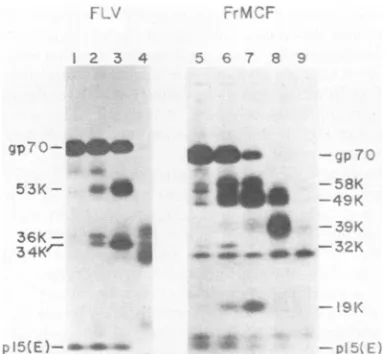
Comparison ofFLV and FrMCFgp7O structural domains. Thefragmentation patterns resulting from treatment of solu-bilized gp7os of ecotropic and dual-tropic Friend MuLVs withvarious concentrations of trypsin are illustrated in Fig.
1. For
[35S]cysteine-labeled
FLVgp7O0 four major fragments were obtained after trypsinization. with SDS-PAGEmobil-ities indicating
apparent molecular weights of51,000,39,000.
36,000.
and 34,000 (Fig. 1A); a fainter band of 53K isoccasionally seen. The 51K band, and to a lesser extent the 36Kband, was quite sensitive to further digestion bytrypsin, whereas the 39K and 34K components were relatively stable. The 39K band was considerably broader than the other components, suggesting more extensive glycosylation. Analysis of the fragmentation pattern of FLV gp7O labeled
with
[35S]methionine
indicated that the 39K and 53Kfrag-ments do not contain any methionine, whereas the other three components do. Since it has been shown that FLV
if .. . -1e
**,.
SF ',e
_
_i-o
OW
--_c,,eeq_gv_ agj4_ _
FIG. 1. Analysis of trypsin-generated fragments of ecotropic and dual-tropic Friendgp70sbySDS-PAGE. Solubilized [35S]cysteineand methionine-labeled FLV(A).or[35S]cvsteine-labeled FrMCF (B), wasimmunoprecipitated after treatment with the following concentrations of trypsin: 1(control), no trypsin;2, 2
jig/ml:
3. 10jlg/ml;
4. 50flg/ml. FLV samples wereimmunoprecipitated withcxRauscher gp7O serum. The lane marked v'' contained a [35S]cysteine-labeled FLV marker. FrMCF samples were immunoprecipitated as indicated with either agp7Oserum ormonoclonal :xpl5(E)antibody 9-E8.VOL. 49. 1984
on November 10, 2019 by guest
http://jvi.asm.org/
[image:2.612.132.480.465.679.2]454 PINTER AND HONNEN
gp7Ocontainsasingle methionine residueatposition47from
the amino terminus of the mature molecule (3, 12), this
indicates that the 51K, 36K, and 34K fragments must be
derived from the amino-terminal end ofthe molecule and
thatthe other two bands arecarboxy-terminal fragments.In
confirmation of these assignments, when similar samples
wereanalyzed undernonreducing conditions, the 39K
frag-mentandthe p15(E) band were not detected, and a new band
corresponding in size to the disulfide-linked 39K-pl5(E)
complexwasobserved (Fig. 2A). This is consistent with our
previous demonstration for Akv and MCF-247 MuLVs (21, 22), and with that by others for Rauscher virus (18), that
p15(E) is disulfide linked to a site in the carboxy-terminal
domain of gp7O. Figure 2A also demonstrates that the
mobilities of the amino-terminal fragments increase signifi-cantly under nonreducing conditions (see also Fig. 5),
sug-gestingthatthey contain one or more disulfide bonds which
stronglyaffecttheconformationof thedenaturedfragments. We have reported a similar feature for the amino-terminal
fragments ofAkv and MCF-247 gp7Os (21, 22).
The trypsin-generated fragmentation pattern of
[35S]CYS-teine-labeled FrMCFgp7Ois illustrated inFig. 1B. For this
molecule similar patterns were obtained withcysteine- and
methionine-labeled viruses, indicatingthat methionine
resi-dueswerepresentinbothaminoandcarboxy domains.Two
relatively broad bands of49Kand39K areformed whichcan
be coprecipitated with otpl5(E) sera, suggesting by analogy
with the results obtained with ecotropic gp7Os that these representthecarboxy-terminal domain ofthemolecule. The larger of these components is cleaved at higher trypsin
concentrations, whereas the 39K band is
stable,
suggestingthat the 49Kfragment isaprecursor to the 39K component.
Additionalfragments of42K,32K,29K, and 19K areformed
which are not associated with p15(E) and which therefore appear to be amino-terminal fragments. Analysis of the
concentrations of these fragments formed with
increasing
a
amountsof
trypsin
suggeststhatthelarger formsareprecur-sorto the smaller
forms,
with the 19K fragment being thefinal product of trypsinization.
The
carbohydrate
content of the various gp7Ofragments
wasanalyzedbyexamining theeffectoftreatmentwith endo H on the mobilities of the fragments andby examining the patternobtainedupontrypsinizationof
[3H]mannose-labeled
FrMCF. We have
previously
found thataglycosylation
sitein the amino-terminal domain of Akv gp7O possesses the
interesting feature that it occasionally retains an endo
H-sensitive
oligosaccharide (22).
Asimilar site is present in thecorresponding domain of MCF-247 gp7O, and for this virus
all of the gp7O molecules possess such asendo H-sensitive
carbohydrate chain(21).ForFLVgp7Oweobserved that the
amino-terminal 51K, 36K, and 34K fragments completely
underwent asize shift upondigestion with endo H,
consis-tentwith the removal ofasingle high-mannose
oligosaccha-ride chain(Fig. 2A). Thus,for FLV all of thegp7Omolecules retained an endo H-sensitive amino-terminal
oligosaccha-ride. A similar result was obtained for the FrMCF
gp7O
amino-terminal fragments (Fig.2B). All of the FrMCF
gp7O
fragments detectedwith
[35S]cysteine
werealso labeled withmannose,whereas, as expected, p15(E) did not incorporate any of the mannose label. After endo H digestion, the mannose-labeled amino-terminal bands were greatly de-creased inintensity, consistent with the removal ofmostof the mannose residues, whereas thecarboxy-terminal bands remained heavily labeled. The deglycosylated
amino-termi-nal fragments did, however, retain a low level of
[3H]man-nose label, indicating that these fragments contain an addi-tional oligosaccharide chain, relatively poor in mannose,
which isresistant to endo H.
Also apparent from Fig. 2B is that a fraction of the
carboxy-terminal fragmentsof49K and 39K alsounderwent
a mobility shift after endo H treatment, indicating that for
FrMCFgp7Othecarboxy-terminal39K domain also contains
[image:3.612.135.490.459.664.2]i .4i'O
FIG. 2. Analysis of endo Hsensitivityof Friend virusgp7Ofragments. (A)Solubilized[35S]cysteine-labeled FLVgp7Owasdigestedwith2 jigoftrypsin per ml,immunoprecipitated withaRauschergp7O serum, and redissolved in buffercontaining1%SDS. Lanes marked "+" containedsamples subsequently digestedwith 2 ,ugof endo H perml;lanes marked''-"containedundigestedcontrolsamples.Theresulting
productswereanalyzed under bothreducingand nonreducingconditions. (B) Solubilized FrMCFgp7O,labeled with either[35S]cysteine or
[3H]mannose,
wasdigestedwith 2.5jigtrypsin (lanes1and2)or25,ugtrypsin (lanes3and4)perml,immunoprecipitated withagp7Oserum,andredissolved in buffercontaining1%SDS. Lanes 2 and4containedsamplessubsequentlytreated with 2,ugof endo H perml;samplesin lanes 1 and 3 weredirectly analyzed. All sampleswere reducedbeforeanalysisby SDS-PAGE.
J.VIROL.
on November 10, 2019 by guest
http://jvi.asm.org/
DOMAINS OF FRIEND ECOTROPIC AND MCF gp70s 455
234
;p
i1M
-:-i3K .4it1
36K, - ,4L
3,¢4K-"
FIG. 3. Analysisofgp7Ofragmentationpatternsof intact virions. Freshly purified, intact FLV and FrMCF. labeled with [15S]cys-teine. were digested with
trypsin.
the trypsin was neutralized withTrasylol.andthe virions were thensolubilizedand
immunoprecipi-tated with o.Rauscher gp7O serum. The concentrations oftrypsin usedwere: 1. 1
p.g/ml;
2.10pLg/ml:
3.100p.g/ml,
4. 1.000p.g/ml:
5.2~Lg/ml: 6. 10
p.g/ml:
7. 50p.g/ml,
8. 250p.g/ml.
9. 1.250V1g/ml.
All samples wereanalyzed bySDS-PAGE underreducing conditions.asite whichpartially retainsahigh-mannoseoligosaccharide
chain. From the intensities of the modified and residual bands one can estimate that approximately50% of the gp7O
molecules contain this carboxy-terminal endo H site. This result distinguishes FrMCF from all ecotropic gp70s
ana-lyzed todate, as well as from gp7Oof the dual-tropic
MCF-247 MuLV.
Comparison
of fragmentsproduced
bytrypsinization
oflysedand intact virions.The resultsdescribedabove indicate
that solubilized gp7Os of both FLV and FrMCF contain a limited numberof trypsin-sensitive sites whicharelocatedat
roughly
homologous
positions
for the twoproteins.
To obtain information on the native conformations of thegp7O
molecules in the viral membranes. we examined which of these
trypsin
sites were exposed in intact virions. In theseexperiments
freshly
purified
virions were incubated withvarious concentrations of trypsin. the
trypsin
wasneutral-361 34K.
ized with Trasylol, the virions were solubilized with RIP buffer, and gp7O fragments were immunoprecipitated. gp7O was considerably more resistant to proteolysis in intact virions than after solubilization (Fig. 3); the intact virions required about 25-fold-higher trypsin concentrations to achieve a similar extent of gp7O cleavage. The resulting patterns differed primarily in that the amino-terminal frag-mentsof 51K for FLV and 42K for FrMCF, which are major initial products for solubilized gp7O, are not produced at all for intact virions. Similarly, the carboxy-terminal 39K frag-ments, which are a major initial product in lysed virions, are formed only at the highest trypsin concentrations for intact virus. The preferred pathway for cleavage ofgp7O in intact virions involves trypsinization at amino-terminal sites, re-sulting in the generation of the small amino-terminal frag-ments and large carboxy-terminal products. These alternate cleavage pathways are diagrammed in Fig. 4.
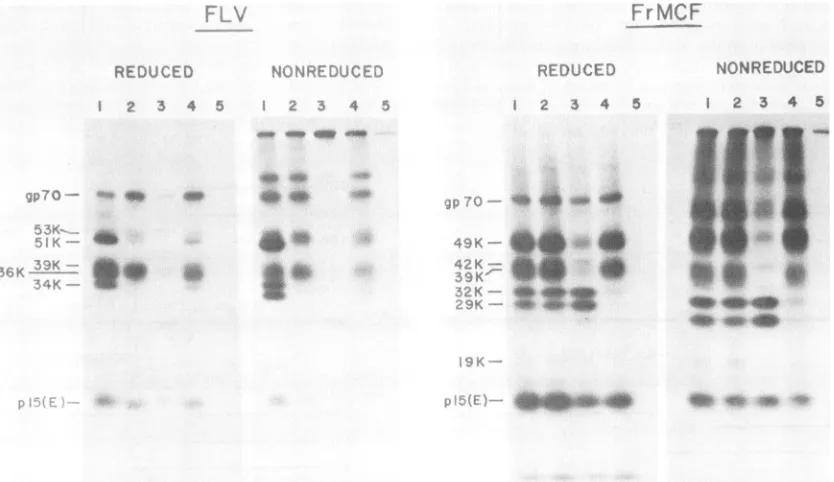
Characterization of immunoreactivitiesof FLV and FrMCF gp7O domains. To obtain informationon the antigenic relat-edness ofthe corresponding domains of FLV and FrMCF
gp70s, we examined the immunoreactivity of the fragments
obtained from these two proteins with antisera prepared
against gp7Os of xenotropic MuLVs and FeLV. All of the
FrMCF domains reacted readily with ahigh-titered antiser-umprepared againstgp7Oof thexenotropic BV-2 virus(Fig. 5). whereas this serum preferentially recognized the
car-boxy-terminal fragment of FLV gp7O (lane 2). A second
serum specific for xenotropic NZB MuLV gp7O, oXenCSA
serum(17). specifically recognized the MCF amino-terminal domains andreacted very weakly ifat all with the carboxy-terminal fragments of FrMCF and FLV gp7O (lane 3). The xFeLV gp7O serum, on the other hand, reacted quite well withcarboxy-terminal FLVgp7O fragments and only weakly with the amino-terminal bands; this serum recognized
pre-dominantlythe carboxy-terminalfragments of FrMCF (lane
4).These results indicate that the major antigenic differences between the FLV and FrMCF gp7Os reside in the amino-terminal domains, whereas the carboxy-amino-terminal domains of these twoproteins share multiple conserved antigenic
deter-minants.
The p15(E) proteins of FLV and FrMCF also possess
identical mobilities and immunoreactivities. FrMCF p15(E)
is recognized by two monoclonal antibodies: 42/114, which
reactswith awidely conserved determinant localized in the
32Kb
29Ko
I 9K
-gp7O
SOLUBILIZED
SOLUBILIZED
34K'
53K 39K
5 1
FLV
49K
29Ki
32K'
Fr-MCF
FIG. 4. Diagram indicating orientationsand structural features of fragmentsformedupontrypsinization ofgp7Ofromintactandsolubilized
FLVandFrMCF. ...
Q
INTACT
T- p15(E) IINTACT
s s I (E)-CWO
49K 58K p15(E)
S
--s VOL.49, 1984
-1
on November 10, 2019 by guest
http://jvi.asm.org/
[image:4.612.83.276.74.251.2] [image:4.612.66.560.539.712.2]456 PINTER AND HONNEN
amino-terminal half ofp15(E) (20); and 9-E8, which reacts with an ecotropic-specific p15(E) determinant (16) (Fig. 6, lanes 2 and 3). In addition, the p15(E) band of FrMCF is recognized by oQR serum, prepared against the C-terminal 15
amino acids ("R" peptide) oftheMoloney MuLV envgene
product (27) (Fig. 6, lane 4). This is a highly type-specific serum which haspreviously been reported to react only with Moloney virus and not with endogenous MuLVs (7). The sequence of the Rpeptideof FLV ishighly related to that of Moloney MuLV, differing only in the substitution of a
tyrosinefor aphenylalanine and a leucine for an isoleucine
(12, 27), thereby accounting for this cross-reactivity. These results are consistent withtheproposedrecombinant nature ofFrMCF andsuggestthat thegenetic sequences codingfor
thecarboxy-terminal gp7O domainandp15(E) ofFrMCFare
derived fromFLV.
DiSCUSSION
The structural characteristics of FLV and FrMCF
gp70s
andtheorigin ofthefragments generatedupontrypsinization
of both intact and solubilized virions are summarized
dia-grammatically in Fig. 4. The position of the single
methio-nine residue ofFLV gp7O determinedby DNA and
protein
sequencingtobe aresidue47is indicatedbythe circled M.
Both viruses contain an endo H-sensitive
oligosaccharide
chain in their amino-terminal
fragments.
Comparisonof thesequencesof several
ecotropic
gp7Os (12, 15, 26)
withthose ofMCF-247(9)and theMoloneyMCF81 isolate(2)
indicates that the only conservedglycosylation
site in theamino-terminal domains ofthese viruses is theone atresidue 12of
the
ecotropic
gp70s. This site is conserved as well for theNFS-Th-1
xenotropic
gp7O (23) and is also present in amolecularly cloned isolate ofFrMCF gp7O (A. Oliff and R.
Friedrich, personalcommunication). Thus, it is most
likely
that this is the site which contains the endo H-sensitive
carbohydrates; this site is indicated as E-CHO on the two
REiI
2 it: 4
gp7O maps. There are no trypsin-sensitive residues between this site and the amino terminus of the molecule, and thus
this oligosaccharide serves as a marker for that end of the
molecule. Ourdata also indicate acarboxy-terminal site in FrMCFgp7Owhich retains an endo H-sensitive oligosaccha-ride chain approximately 50% of the time. This site is also
indicated in Fig. 4; theexact location of this site within the
39K fragment is not known.
Sequencing datafor both ecotropic and MCFgp70s
indi-cate that these molecules are composed of cysteine-rich amino-andcarboxy-terminal domains, joined by a cysteine-free, proline-rich region which is hypervariable for several ecotropicgp70s (2, 12, 15, 26). Our data indicate that there are no disulfide interactions between the amino- and car-boxy-terminal domains of either classofgp7O and allows the
preliminary localizationof severaldisulfidebonds which are
conserved forthe twoviruses. Thedisulfide linkage site to
p15(E)
for both viruses is located in the 39K carboxy-terminal domain, and both gp70s contain one or moredisulfidebonds intheiramino-terminaldomains which result
in a significant increase in the electrophoretic mobility of
fragments derived from this region upon analysis under
nonreducingconditions. ForFrMCFgp7Owehave observed that the 19K amino-terminalfragment does not exhibit this effect (Fig. 5), and thus we canlocalizethebondsinvolved to
the regionbetween 19K and 29K from the aminoterminus.
This is so indicated in the FrMCF
gp7O
map as a singledisulfide bond. The conservation of this structural feature
for both classes ofgp7O suggests thatit may be requiredto
maintain afunctionally importantconformation.
The
gp7O
fragments obtained uponlimited trypsinizationcanbe accounted for bypostulatingthreeprimary cleavage
sites for FLV and four for FrMCF
gp7O.
The apparentlyhomnologous
sitesforthetwoviruses are numbered 1, 2, and3.Incomparingthe cleavagepatternsofgp7O fromintact and
solubilizedvirions,the moststriking difference isthat
cleav-["r
MCF
j*I [
'' j 4 5
INO0NRPED~UCED
2 3 4 5
AN1all,
;I
W 0
-4-0 :qw m
.3.*
Iwo.* :i ....
!*,N*
M*'** ^ < :;-w.:.
FIG. 5. Analysisofimmunoreactivities of FLV and FrMCFgp7Ofragments. [35S]cysteine-labeled virionsweresolubilized anddigested with 2 ,ugof trypsinperml, and the resulting fragments wereimmunoprecipitated with thefollowing antisera: 1,atRauschergp7Oserum; 2, oaBV-2gp7O serum; 3,coXenCSAserum; 4,o(FeLVgp7Oserum; 5, normal goat serum. Theimmunoprecipitates wereanalyzed under both reducing andnonreducing conditions.
J. VIROL.
[image:5.612.105.522.449.690.2]2-l.I '- _ J
... 4...1
W
..
A--iiwk .zf
on November 10, 2019 by guest
http://jvi.asm.org/
DOMAINS OF FRIEND ECOTROPIC AND MCF gp70s 457
Z,l
4
-gp7C
A.
Pr (E) _ p15 (E)
-m
FIG. 6. Analysis of immunoreactivities of FrMCF p15(E) and Prl5(E).[35S]methionine-labeled FrMCF proteinswere
immunopre-cipitated with otRauschergp7Oserum (lane 1). monoclonal cspl5(E)
antibody 42/114(lane 2). monoclonalcxp15(E)antibody9-E8 (lane 3). xRserum(lane4), ornormalgoatserum (lane 5) and analyzed by SDS-PAGEafterreduction.
age in the carboxy-terminal domain at site 1 is markedly
inhibited in intact virions, so that the large amino-terminal fragments, which are majorpreliminary productsfor
solubi-lized gp70s, are not formed at all and the smaller 39K
carboxy-terminal fragments are only formed at very high trypsinconcentrations. These results indicate that this gp7O
site is not accessible in the intact oligomeric env, protein
complex, suggestingthat thisregionmaybeclosely associat-ed with the viral membrane, p15(E) molecules, or regions involved in gp7O oligomerization. Possibly relevant to this feature of gp7O is our recent demonstration of occasional disulfide bonding between the carboxy-terminal domains of
neighboring gp7O molecules for Akv and MCF-247 MuLVs
(21).
The immunological studies illustrated in Fig. 5
demon-strate that the amino-terminal domain of FrMCF gp7O is readily recognized by antisera to gp70s of both BV-2 and NZB xenotropic MuLVs, whereas the corresponding do-main ofecotropic FLV gp7Ois antigenically unrelated. The BV-2 and NZB viruses are prototypes fortwo serologically distinguishable classes of xenotropic MuLVs: the class II
viruses inducible by halogenated pyrimidines and protein synthesis inhibitors from cells ofa large number ofmouse strains, and the class III viruses which are spontaneously expressed at high levels by cells from NZB mice (29, 30).
The latter gp7O is related to the gp7O found in the sera of mice ofa large number of strains(5). These two classes of xenotropic gp70s can be distinguished by both peptide
mapping (4) and type-specific radioimmunoassays (8). The
reactivity ofboth antisera with the amino-terminal FrMCF gp7O fragments indicates that this region of the molecule
contains antigenicdeterminants in commonwith both class-esofxenotropicgp70s.Thereactivityof the tsRauscher gp7O serum with the amino-terminal domains of both ecotropic and MCF viruses probably indicates that this serum was actually prepared against a mixture ofecotropic and dual-tropic gp70s. Supporting this explanation isourobservation
that the anti-xenotropic gp7O sera do not precipitate the amino-terminal domainofecotropic Rauschergp7O(datanot shown) and the recent demonstration that the gp69
compo-nent of thegp69/71 protein complex produced by Rauscher-infectedJLSV-9 cells representsadual-tropicgp7Omolecule (25). The preferential reactivity of the cxFeLV gp7O serum
with the C-terminal fragments of FLV and FrMCF gp7O provides further demonstration of the conserved nature of this region and indicates that this domain carries the major interspecies-specific antigenic determinants of gp7O mole-cules.
Whereasthe data presented in this paper indicate that the carboxy-terminal domains of FLV and FrMCF-1 gp7O are
similar in size and immunologically cross-reactive, these regions are not identical in the two viruses, as evidencedby thefact that the C-terminal fragment of FrMCF gp7O, butnot
ofFLVgp7O, contains a glycosylation site which occasional-ly retains an endoH-sensitive oligosaccharide (Fig. 2). This difference inglycosylation may reflectan altered conforma-tion for this region in the MCF protein, perhaps influenced by association with the xenotropic-like amino-terminal do-main, or may be due to differences in primary structure of theC-terminal domainsofthe two gp7os. Sequence informa-tion will be useful fordistinguishing between these possible explanations.
The leukemogenic MCF viruses studied to date can be placed into two classes according to the specificity of the diseases they produce. One class, typified by the Akv and Moloney MuLV recombinants, produces thymic leukemias, whereas the other class, represented by Friend and Rauscherrecombinants, resultspredominantly in leukemias of erythroid origin. The viral regions which determine this disease specificityarenot yetknown, although considerable evidence suggests that MCF-specific gp7O sequences are required for pathogenicity (6). Comparison of the gp7O fragmentation patterns obtained in this study for FrMCF with those we have previously obtained for the Akv recom-binant MCF-247 (20) indicates that the amino-terminal do-mainsof these two dual-tropic gp70s can be distinguished by both the size and the numberoffragments generated. This suggeststhatadifferent nonecotropic parent may have been involved inthe generation of these two MCF viruses. More
detailed analyses of the structure of the different gp7O domains in these and in other recombinant MuLVs should
help clarify the functional importance of these regions of
gp7O in determining the pathogenicities and the disease specificities of these viruses.
ACKNOWLEDGMENTS
Wethank Allen Oliff for providing us with virus-infected cells and Sandra Ruscetti and Herbert C. Morse. Jr. for providing us with antisera usedinthis study.
This work \was supported by Public Health Service grant CA-16599from the NationalCancer Institute.
LITERATURECITED
1. Bassin, R. H., S. Ruscetti, I. Ali, D. K. Haapala, and A. Rein.
1982. Normal DBA/2 mouse cells synthesize a glycoprotein which interfeeres with MCF virus infection. Virology
123:139-151.
2. Bosselman, R. A., F. Van Straaten, C. Van Beveren, I. M.
Verma, and M. Vogt. 1982. Analysis of the em( gene of a molecularly cloned and biologically active Moloney mink cell focus-formingproviralDNA. J. Virol. 44:19-31.
3. Chen, R. 1982. Complete amino acid sequence and
glycosyla-tion sites of glycoprotein gp71A of Friend murine leukemia VOL.49, 1984
on November 10, 2019 by guest
http://jvi.asm.org/
[image:6.612.124.232.72.248.2]458 PINTER AND HONNEN
virus. Proc. Natl. Acad. Sci. U.S.A. 79:5788-5792.
4. Elder, J.H., J. W. Bautsch, F. C. Jensen, R. A. Lerner, T. M. Chused, H. C. Morse, J. W. Hartley, and W. P. Rowe. 1980. Differential expression of two distinct xenotropic viruses in NZBmice. Clin. Immunol. Immunopathol. 15:493-501. 5. Elder, J. H., F. C. Jensen, M. L. Bryant, and R. A. Lerner. 1977.
Polymorphism of the major envelope glycoprotein (gp70) of murine C-type viruses: virion associated and differentiation antigens encoded by a multi-gene family. Nature (London) 267:23.
6. Famulari, N. G. 1983. Murine leukemia viruses with recombi-nant enm'genes: adiscussion of their roles in leukemogenesis. Curr. Top. Microbiol. Immunol. 103:75-101.
7. Green, N., T. M. Shinnick, 0. Witte, A. Ponticelli, J. G. Sutcliffe, and R. A. Lerner. 1981. Sequence-specific antibodies show that maturation of Moloney leukemia virus envelope polyprotein involves removal of a COOH-terminal peptide. Proc. Natl.Acad. Sci. U.S.A. 78:6023-6027.
8. Hino, S., J. R. Stephenson, and S. A. Aaroson. 1976. Radioim-munoassays for the 70,000-molecular-weight glycoproteins of endogenous mouse type C viruses: viral antigen expression in normal mouse tissuesand sera. J. Virol. 18:933-941.
9. Holland, C. A., J. Wozney, and N. Hopkins. 1983. Nucleotide sequence of the gp7O gene of murine retrovirus MCF 247. J. Virol. 47:413-420.
10. Ishimoto, A.,A. Adachi, K.Sakai, T. Yorifuji, and S. Tsuruta. 1981. Rapidemergenceofmink cellfocus-forming (MCF)virus in various mice infectedwith NB-tropic Friend virus. Virology 113:644-655.
11. Kelley, M., C. A. Holland, M. L. Lung, S. K. Chattopadhyay, D. R. Lowy, and N. H. Hopkins. 1983. Nucleotide sequence of the 3' endofMCF247murine leukemia virus. J. Virol. 45:291-298.
12. Koch, W., G. Hunsmann, and R. Friedrich. 1983. Nucleotide sequenceof the envelope gene ofFriend murine leukemiavirus. J. Virol. 45:1-9.
13. Laemmli,V. K.1970.Cleavage ofstructuralproteins duringthe assembly of the head ofbacteriophage T4. Nature (London) 227:680-685.
14. Laskey, R. A., and A.D.Mills.1975. Quantitativefilmdetection
of3H and "4C polyacrylamide gels by fluorography. Eur. J.
Biochem. 56:335-341.
15. Lenz, J.,R.Crowther, A.Straceski, and W.Haseltine. Nucleo-tide sequence of the Akvenm gene.J. Virol. 42:519-529. 16. Lostrom, M. E., M. R. Stone, M. Tam, W. N. Burnette, A.
Pinter,and R.C. Nowinski. 1979. Monoclonalantibodiesagainst murine leukemiaviruses:identification ofsixantigenic
determi-nants on the p15(E) and gp7O envelope proteins. Virology 98:336-350.
17. Morse, H.C.,T. M.Chused,M.Boehm-Truitt,B.J.Mathieson, S. 0. Sharrow, andJ. W.Hartley. 1979. XenCSA: cell surface antigens relatedtothemajorglycoprotein (gp7O) of xenotropic murine leukemia viruses.J. Immunol. 122:443-454.
18. Niman, H. L., and J. H. Elder. 1982. Structural analysis of Rauscher virus gp7O using monoclonal antibodies: sites of antigenicityand p15(E) linkage. Virology 123:187-205. 19. Oliff, A. I., G. L. Hager, E. H. Chang, E. M. Scolnick, H. W.
Chan, and D. R. Lowy. 1980. Transfection ofmolecularly cloned Friend murineleukemia virus DNA yields a highly leukemogen-ic helper-independent type C virus.J. Virol. 33:475-486. 20. Pinter, A., and W. J. Honnen. 1983. Topography of murine
leukemia virus envelope proteins: characterization of trans-membranecomponents. J. Virol. 46:1056-1060.
21. Pinter, A., and W. J. Honnen. 1983. Comparison of structural domainsof gp7O of ecotropic Akv and its dualtropic recombi-nantMCF-247. Virology 129:40-50.
22. Pinter, A., W. J. Honnen, J. S. Tung, P. V. O'Donnell, and U. Hammerling. 1982. Structural domains ofendogenous murine leukemia virusgp70s containing specific antigenic determinants defined by monoclonal antibodies. Virology 116:499-516. 23. Repaske, R., R. R.O'Neill, A. S. Khan, and M. A. Martin. 1983.
Nucleotide sequence of the em-specific segment ofNFS-Th-1 xenotropicmurineleukemia virus. J.Virol. 46:204-211. 24. Ruscetti, S., L. Davis, J. Feild, andA.Oliff. 1981.Friend murine
leukemia is associated with the formation of mink cell focus-inducing viruses and is blocked in miceexpressing endogenous xenotropicviralenvelope genes. J. Exp. Med. 154:907-920. 25. Schultz, A., A. Rein, L. Henderson, and S. Oroszlan. 1983.
Biological, chemical, and immunological studies ofRauscher ecotropic and mink cell focus-forming viruses from JLS-V9 cells. J. Virol. 45:995-1003.
26. Shinnick, T. M., R. A. Lerner, and J. G. Sutcliffe. 1981. NucleotidesequenceofMoloneymurineleukemiavirus. Nature (London)293:543-548.
27. Sutcliffe, J. G., T. M. Shinnick, N. Green, F. T. Liu, H. L. Niman, and R. A. Lerner. 1980. Chemical synthesis of a
polypeptide predicted fromnucleotide sequence allows detec-tion ofa newretroviral geneproduct. Nature(London) 287:801-805.
28. Steeves,R. A. 1975. Spleen focus-forming virus in Friend and Rauscher leukemia virus preparations. J. Natl. Cancer Inst. 54:289-297.
29. Stephenson, J. R., S. A. Aaronson, P. Arnstein, R.J. Huebner, and S. R. Tronick. 1974.Demonstration oftwoimmunologically distinctxenotropictypeCRNAviruses ofmousecells. Virolo-gy61:56-63.
30. Stephenson, J. R., R. K. Reynolds, S. R. Tronick, and S. A. Aaronson. 1975. Distribution of three classes ofendogenous type-C RNA viruses among inbred strains of mice. Virology 67:404-414.
31. Troxler, D. H., and E M. Scolnick. 1978. Rapid leukemia induced by cloned strain of replicating murine type-C virus: association with induction of xenotropic-related RNA
se-quences contained in spleen focus-forming virus. Virology 85:17-27.
32. Troxler, D. H., E. Yuan, D.Linemeyer, S. Ruscetti, andE. M.
Scolnick. 1978. Helper-independent mink cell focus-inducing strains ofFriend murinetype-C virus:potential relationshipto theorigin ofreplication-defective spleenfocus-formingvirus. J. Exp. Med. 148:639-653.
33. Wolff, L., R. Koller, and S. Ruscetti. 1982. Monoclonalantibody
tospleenfocus-formingvirus-encodedgp52providesaprobefor the amino-terminal region of retroviral envelope proteins that confersdual tropismand xenotropism. J. Virol.43:472-481.
J. VIROL.

![FIG. 2.andcontainedproductslanes[3H]mannose,jig Analysis of endo H sensitivity of Friend virus gp7O fragments](https://thumb-us.123doks.com/thumbv2/123dok_us/1436654.96123/3.612.135.490.459.664/fig-andcontainedproductslanes-mannose-analysis-sensitivity-friend-virus-fragments.webp)
![FIG. 6.antibodycipitatedSDS-PAGEPrl5(E).xR Analysis of immunoreactivities of FrMCF p15(E) and [35S]methionine-labeled FrMCF proteins with otRauscher were immunopre- gp7O serum (lane 1)](https://thumb-us.123doks.com/thumbv2/123dok_us/1436654.96123/6.612.124.232.72.248/antibodycipitatedsds-pageprl-analysis-immunoreactivities-methionine-proteins-otrauscher-immunopre.webp)
