Survey of Teachers 2010
Support to improve teaching practice
Helen Poet
Peter Rudd
Joanne Kelly
All rights reserved.© This work is Copyright of The General Teaching Council for England [November 2010]. Any unauthorised copying, duplication, reproduction or
Acknowledgements i
Executive summary ii
Key findings ii
Conclusions iv
1. Introduction 1
1.1 Background 1
1.2 Aims and objectives 1
1.3 Methodology 2
2. Professional development and learning 7
2.1 Levels of participation in Continuing Professional Development activities 7
2.2 The impact of professional development 10
2.3 Teachers’ characteristics and their views about professional development 11
3. Using research 15
3.1 Teacher views on using research to improve their practice 15
3.2 Teachers’ characteristics and their views about research 16
4. Performance management 19
4.1 Experiences of performance management and its impact 19
4.2 Teachers’ characteristics and their views about performance management 21
5. Professional standards 24
5.1 Use and impact of the professional standards framework 24
5.2 Teachers’ characteristics and their views about the professional standards 26
6. Views on different approaches to improving practice 28
6.1 Perceived usefulness of different ways of improving teaching practice 28
6.2 What types of approaches to practice improvement do teachers find most useful? 33
7. Conclusions 34
Appendix A: GTC survey of teachers 2010 main sample – frequencies 37
Appendix B: Factor analysis 53
Acknowledgements
The authors would like to thank all of the teachers who took the time to complete a questionnaire as part of this study.
We would also like to thank the project Statisticians, Sally Bradshaw and Francesca Saltini for their excellent work on the sampling and analysis. The support they provided to the research team was invaluable. We would also like to thank Jennie Jupp, Deputy Head of Research Data Services for conducting the sampling and Jo Morrison, Senior Statistician, for her guidance on the sampling.
We are grateful to colleagues in Research Data Services for their work in administering the survey and responses.
We would like to thank Sagina Khan, project administrator, who provided outstanding administrative support to the research team.
Executive summary
In 2010 the annual survey of teachers, conducted on behalf of the General Teaching Council for England (GTC), explored teachers’ experiences of the different forms of support they receive to help them maintain and develop their teaching practice. Teachers were asked for their views on the following:
• their participation in Continuing Professional Development (CPD)
• their involvement in activities to improve teaching practice • use of observation and feedback
• use of research
• performance management, and • the professional standards.
The survey gathered the views of a nationally representative sample of teachers, drawn from the GTC’s Register of Teachers, and was conducted by the National Foundation for Educational Research (NFER). The final response figure for the main sample was 4,392, which was 33 per cent of the 13,500 teachers contacted. In addition to providing analysis of the basic frequencies of the responses, NFER conducted more sophisticated analyses, including factor analysis and statistical modelling.
Key findings
Professional development and learning
On the whole, teachers had a positive attitude towards practice improvement and almost all felt that they had a professional responsibility to maintain and improve their practice. Teachers also felt strongly that they should have an entitlement to time and support in order to meet this responsibility.
About two-thirds of teachers were positive about the impact of professional development and learning activities on their teaching, and on the learning of their pupils. This suggests that most CPD activities are relevant and do indeed have an impact upon teachers’ practice. Collaborative (peer-to-peer) learning activities were the most common type of professional development activity teachers had been involved in over the last 12 months.
younger and less experienced teachers were also more likely to take a positive view of professional development as a means for improving teaching.
The survey findings suggest that there may be a ‘gap’, however, in terms of desired professional development and access to CPD activities and experience. Personal motivation to improve teaching appears to be widespread, however many teachers felt that they did not have enough time, or did not have sufficient access or opportunities, to participate in professional development and learning activities.
Using research
The survey asked how teachers used research to inform their teaching practice: these questions covered both teachers conducting their own research and using research conducted by others. Conducting research was not particularly widespread among the sample, but it appears that many teachers would like to be able to be more involved in research.
One third of respondents (33 per cent) said that they had undertaken their own research and enquiry to improve their practice in the last 12 months but about half (49 per cent) said they had not. Of those people who had used research, most had found it a useful way to help them to improve their teaching practice.
Statistical analyses revealed that teachers that had been involved in a higher number of professional development activities in the last 12 months were more likely to have a positive view about the use of research to improve their teaching.
Part of the gap between what teachers would like to do and what they actually experience in terms of professional development may be explained by the presence of what might be called a weak ‘culture of research’ at some schools: it was clear that some teachers felt that schools could do more to support and encourage their use of research and other self-improvement activities.
Performance management
Teachers held mixed views about how the performance management process supported them to improve their teaching. Although around half of teachers agreed that performance management helped them to identify areas for improvement and areas of strength, fewer than three in ten teachers said that performance management was a key factor per se in helping them to improve their teaching. Working towards performance management objectives appears to be considered more useful than the performance management process overall.
Professional standards
the survey showed that although most teachers reported that they had a good understanding of the professional standards framework, overall, teachers had mixed views about how it could help them to improve their practice.
Teachers that had experienced a higher variety and frequency of professional development activities within the last year were more likely to have a positive view about how the professional standards could help them to improve their practice. In addition, both senior teachers and teachers who were relatively new to the profession (although not necessarily younger teachers) were more likely to perceive the standards as helpful.
Views on different approaches to improving standards
A number of questions included in the survey sought to obtain an overview of how teachers felt about the usefulness of different approaches to practice improvement. Which approaches did they use most and which did they value most highly? The method of improving teaching that was valued by the most teachers was self reflection; almost all teachers (97 per cent) reported that ‘reflecting on my own practice’ had been a very or fairly useful way of improving their teaching over the last two years. Although reflection on their own practice was by far the approach that the most teachers found useful in terms of improving their teaching, around three in four teachers also said that the following methods were very or fairly useful:
• observing my peers’ teaching • receiving feedback from pupils
• peers observing my teaching and giving me feedback
• reviewing my practice as part of school self-evaluation • using teacher assessment data
Teachers therefore are open to range of approaches to improving their practice, though self reflection, observation and receiving feedback are seen as the most useful approaches.
Conclusions
A number of common findings emerged from the analysis that looked at the differences in teacher views about the various aspects of practice improvement by their characteristics. For example, it was found that senior teachers were positive about all the aspects of practice improvement featured in the survey. Similarly, it was found that male teachers were less positive about all the aspects of practice improvement discussed (except one – ‘using research’). On the whole, differences in teacher views about improving their teaching were related to personal characteristics; school-level factors (such as proportions of pupils eligible for free school meals (FSM) or overall achievement) generally had little or no effect on teacher attitudes.
1. Introduction
1.1 Background
The General Teaching Council for England (the GTC), as the independent professional body for teaching in England, has commissioned six annual surveys of teachers since 2004 which have explored a range of issues affecting teachers and the teaching profession. The survey, in addition to giving registered teachers a voice, is essential to informing the policy advice that the GTC provides. Each year the survey has gathered the views of a representative sample of teachers on issues such as accountability, personalised learning and other issues of professional interest, all of which affect future teaching practice and policy.
In recent years the survey has moved from an omnibus style survey covering a broad range of topics to one that explores specific themes. The 2010 survey was conducted by the National Foundation for Educational Research (NFER). This year the survey explored teachers’ experiences of the different forms of support they receive to help them maintain and develop their practice. Teachers were asked about participation in Continuing Professional Development (CPD) and its impact; use of and engagement in research; sources of feedback; the professional standards framework; and support to meet performance management objectives.
In addition to this survey, the GTC commissioned a qualitative study about how teachers improve their practice, which was also carried out by NFER and published in 2010.
1.2 Aims and objectives
The key aim of this year’s survey was to gather the views of a representative sample of teachers on issues affecting current and future teaching practice and policy.
More specifically, the objectives of the 2010 teacher survey were to:
• gather the views of a representative sample of registered teachers in England in relation to the development of teaching practice and the support available
• provide detailed analysis and interpretation of the data in an accessible report aimed at practitioners and policy makers
• provide an additional report on the sample of registered teachers of Black and minority ethnic backgrounds (BME)1.
1
1.3 Methodology
Sampling
NFER drew a sample of teachers from the GTC’s Register of teachers. Teachers were considered eligible to take part in the survey if they were:
• fully registered with the GTC
• listed as in service, i.e. working as a teacher in an establishment where registration is required, such as community or voluntary aided schools
• aged 65 and under.
Teachers were excluded if they had been involved in the 2009 survey, had been involved in other research within the last 12 months, or had requested that they were not to be contacted. The criteria used to select the sample of teachers were as follows:
• gender
• phase of education
• type of school
• age group
• Government Office Region (GOR).
Response rates
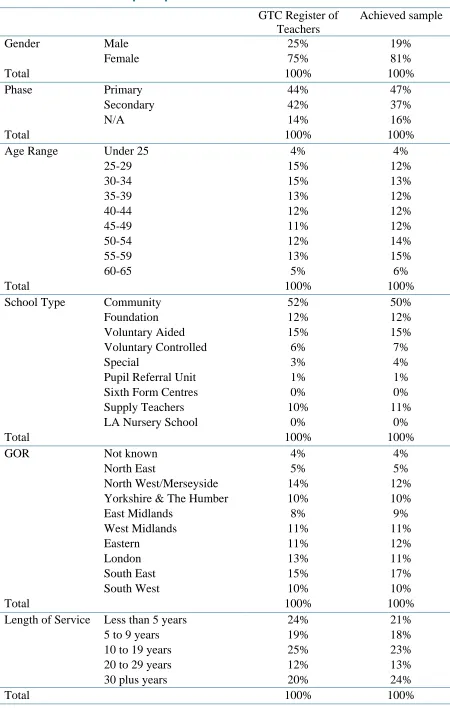
Table 1.1 Sample representativeness
GTC Register of Teachers
Achieved sample
Male 25% 19%
Gender
Female 75% 81%
Total 100% 100%
Primary 44% 47%
Secondary 42% 37%
Phase
N/A 14% 16%
Total 100% 100%
Under 25 4% 4%
25-29 15% 12%
30-34 15% 13%
35-39 13% 12%
40-44 12% 12%
45-49 11% 12%
50-54 12% 14%
55-59 13% 15%
Age Range
60-65 5% 6%
Total 100% 100%
Community 52% 50%
Foundation 12% 12%
Voluntary Aided 15% 15%
Voluntary Controlled 6% 7%
Special 3% 4%
Pupil Referral Unit 1% 1%
Sixth Form Centres 0% 0%
Supply Teachers 10% 11%
School Type
LA Nursery School 0% 0%
Total 100% 100%
Not known 4% 4%
North East 5% 5%
North West/Merseyside 14% 12%
Yorkshire & The Humber 10% 10%
East Midlands 8% 9%
West Midlands 11% 11%
Eastern 11% 12%
London 13% 11%
South East 15% 17%
GOR
South West 10% 10%
Total 100% 100%
Less than 5 years 24% 21%
5 to 9 years 19% 18%
10 to 19 years 25% 23%
20 to 29 years 12% 13%
Length of Service
30 plus years 20% 24%
Questionnaire development
The 2010 survey focused on support for improving practice by exploring the following topics:
• participation in Continuing Professional Development (CPD) • activities to improve teaching practice
• use of observation and feedback
• use of research
• performance management, and
• the professional standards.
The questionnaire was designed by NFER researchers in close consultation with the GTC’s Research and Policy staff. Following this, piloting was carried out, with minor amendments made in light of comments received from the pilot.
Three questions from the previous year’s survey of teachers, asking about teachers’ specific roles, working hours and the key stages they currently work in were repeated in the 2010 questionnaire to enable the drawing of comparisons and analysis of responses by these variables. A further two questions, focussing on professional development were also repeated, with small adjustments made to a few of the statements within the questions. The questionnaire was made available to respondents both online and on paper.
The administration of the survey was based on the five-stage method for survey
administration recommended by Don Dillman2. Sampled teachers were sent
information about the survey in advance of the questionnaire itself. When the questionnaire was sent to the sample, teachers with e-mail addresses received an electronic invitation to complete the questionnaire online in the first instance. All teachers without e-mail addresses were sent paper copies of the questionnaire along with information on how teachers could complete the questionnaire online if they preferred. Two weeks after the despatch of questionnaires, reminder postcards were sent to all teachers within the sample, carefully omitting those who had already requested to be withdrawn from the study. Six weeks after the initial despatch, all non-responding teachers were sent paper copies of the questionnaire, accompanied by details of how to complete the survey online. Telephone reminding was carried out for the teachers with telephone numbers listed towards the end of the survey period, along with a reminder e-mail to all non-responding teachers with e-mail addresses. The survey period was between March and May 2010.
2
Analysis
Analysis of the survey was carried out by the NFER’s team of qualified statisticians along with the research team. The basic analysis of the survey data involved simple frequencies3 and some cross-tabulations.
In addition to providing basic frequencies of the responses, more complex analysis was carried out including factor analysis and regression modelling4. Where applicable, this report will make reference to these analyses, with greater detail included within Appendices B and C. By including these techniques, we were able to ensure that the results of the statistical analysis were thoroughly robust. The BME booster sample respondents have been included along with the main sample respondents for the regression. Through including the BME booster respondents in this regression we were able to make the estimation of an association between BME and any relevant outcome more assured. Regression models are reported fully in this report, with any association between BME and outcome (or the absence of such an association) also being highlighted in the BME booster sample report.
School-level variables
In addition to conducting analysis by teacher characteristics, it was also possible to explore the effects of some school-level variables. The data for the school level variables was obtained from the Register of Schools held by NFER.
In particular the GTC was interested to know if teachers working at schools that encounter particular challenges held different attitudes. As a result, two measures of challenge were agreed:
• a measure of socio-economic challenge – challenged schools were identified as those in the top quintile of the percentage of children entitled to free school meals (FSM)
• a measure of academic challenge – challenged schools were identified as those in the lowest quintile for Key Stage 2 (KS2) attainment (primary) and Key Stage 4 (KS4) attainment (secondary).
Each school was placed in the appropriate quintile based on their position relative to all other schools in the population5. Attainment was to be based on KS2 for primary schools and KS4 for secondary schools; the data was obtained from the NFER register
3
Percentages within this report have been rounded up to the closest integer. The results are presented in full in Appendix A with the percentage response to each question displayed in tables. The percentages shown in the tables have been rounded to the nearest whole number. Due to rounding, the percentages may not sum to 100. Where figures have been presented in the text, they are based on those shown in the tables and consequently are also rounded values.
4
For a full list of the variables included in the factor analysis please see Appendix B, and for the variables included in the regression models, please see Appendix C.
5
In previous years, the analysis based the definition simply on whether a school had higher or lower levels of challenge in a particular area, based on the school figures relative to the other schools in that sample. This year we used quintiles which were calculated based on the population of schools as a whole, not just the schools of the teachers of the sample.
of schools. Although the attainment data is only available for KS2 and KS4, it can provide an indication for that school and therefore can be used for KS1 and KS3 teachers respectively at those schools.
Other school characteristics included in the analysis were:
• the percentage of pupils with English as an Additional Language (EAL) attending that school
• the percentage of pupils with special educational needs (SEN) attending that school.
These variables were used separately and not incorporated into either of the two measures of challenge (as had been the case in previous years) because they provide measures of slightly different things:
• We chose not to combine EAL and FSM into a single measure because having English as an additional language does not affect a child’s attainment in the same way as being in a school with a high level of FSM. EAL is likely to affect attainment but differently depending on how well the child speaks English.
2. Professional development and learning
Key findings:
• around two thirds of teachers were positive about the impact of professional development and learning activities on their teaching, and on the learning of their pupils
• collaborative learning activities were the most common type of professional development activity teachers had been involved in over the last 12 months
• teachers with more responsibilities in school were more likely to feel positively about how professional development and learning activities could improve their teaching practice
• younger and less experienced teachers were more likely to have a positive view about the role of professional development and learning activities in improving their practice
• supply teachers, part-time teachers and those working in secondary schools were more likely to feel negatively about professional development and learning activities as a way of improving their teaching.
2.1 Levels of participation in Continuing Professional
Development activities
One question in the teacher survey sought to find out which professional development activities respondents had experienced in the last 12 months, along with an indication of whether these activities had been experienced ‘frequently’ or ‘occasionally’ or not at all. Nine types of professional development activities were listed in relation to this question. By combining the percentages of respondents who indicated that they experienced the activity either frequently or occasionally we could devise an indicative list of the most prevalent professional activities. These were as follows:
• collaborative learning with colleagues in my school (77 per cent)
• collaborative learning with external partnerships / networks (61 per cent)
• participating in an external course (59 per cent)
• engaging with subject or specialist associations (55 per cent) • being assigned to mentor or coach someone (50 per cent).
frequently or on an ongoing basis and, in addition, a similar proportion (37 per cent) said that this took place occasionally. Within a school, colleagues are clearly an important source of support and advice for individual teachers.
External collaboration and partnership working is also important, though this was not as frequent or as widespread as internal collaboration. Such external working would probably have been quite rare in, for example, the early 1990s, when competition between schools would have been the norm for many. This finding may partly reflect the development of school partnership working, which has been encouraged within the English educational system since the late 1990s, through, for example, Beacon Schools, clusters of schools, City Challenge projects, Federations and School Chains. Although such programmes may have a central model of school to school support to improve pupil outcomes, the sharing of good practice between teachers, either formally or informally, was often an important element of the scheme.
‘Traditional’ professional development in the form of taking part in external courses was still a common experience for the survey sample: with 18 per cent of respondents experiencing this frequently or on an ongoing basis and 41 per cent participating occasionally. But it is also interesting to note that half of all respondents (50 per cent) had at least occasionally been assigned to mentor or coach someone, suggesting that mentoring and coaching are widespread and are being used at a variety of levels of responsibility. (Interestingly only about one in four respondents reported having a coach or mentor assigned to themselves: i.e. coaching roles were considerably more prevalent than ‘coachee’ roles in the sample).
On the basis of numbers experiencing the activity, and frequency, the least prevalent professional development activities were: ‘undertaking action research’, though more than one in five (22 per cent) respondents reported having experienced this at least occasionally in the last 12 months; ‘studying for a postgraduate qualification (e.g. Masters)’ (eight per cent); and ‘participating in the Teacher Learning Academy’ (five per cent). It should be borne in mind, of course, that a lower frequency does not mean a lower importance for this activity for an individual teacher: for example, taking a Masters Degree course is likely to take up much extra time and effort, especially for a full-time teacher.
By looking at the number of responses to the different elements of this question it was possible to identify the proportions of the sample who could be described as ‘inactive’, ‘active’ or ‘very active’ in terms of taking part in professional development activities. Almost all respondents (92 per cent) ticked the ‘frequently or ongoing’ box for at least one activity. Thirteen per cent of respondents were classified as ‘very active’ – they had been involved in at least four professional development activities ‘frequently’ within the last 12 months. This figure is comparable to the 2009 survey when 14 per cent were classified as being ‘very active’. Only a minority (eight per cent) had not experienced any form of professional development activity listed within the previous 12 months (six per cent in the 2009 survey).
The latter point raises some interesting questions. For example, why did nearly one in ten of the sample not take part in any professional development activities during the previous year? This partly appears to be related to the role of teachers; 45 per cent of supply teachers were ‘not active’ compared with only 4 per cent of all other teacher types. However other factors may also influence levels of participation in professional development activities, for example the availability of activities, school support, time to engage in such activities and, possibly most importantly, teacher self motivation to be involved in professional development. Although it is not possible to fully investigate these issues using survey data, it was possible to begin exploring them using modelling in Section 2.3.
One aim of the survey was to find out more about teachers’ access to and experience of professional development activities. We asked respondents to use a broad definition of ‘professional development’ so that, for example, it included coaching and mentoring and undertaking action research, as well as participating in an external course or studying for a qualification. We asked them to indicate their level of agreement with a variety of statements about professional development based upon their previous 12 months’ experience.
One of the main findings in relation to this question was that teachers felt strongly that they should have an entitlement to professional development: nearly six out of ten respondents (59 per cent) ‘strongly agreed’ with the statement that ‘Teachers should have an entitlement to time and support for their professional development’, with a further 37 per cent ‘agreeing’ with the statement. Only two per cent of respondents said ‘neither agree nor disagree’ and none disagreed or strongly disagreed. This is a strong indication, then, that teachers feel that they should have an entitlement to professional development.
This finding, however, needs to be considered alongside responses to a further question about teachers taking individual responsibility for their practice. Again, nearly six out of ten respondents (57 per cent) ‘strongly agreed’ with the statement presented: that ‘I have a professional responsibility to maintain and improve my practice’, and a further 38 per cent ‘agreed’ with the statement. Only two per cent of respondents said ‘neither agree nor disagree’ and none disagreed or strongly disagreed. Teachers therefore feel strongly (and in almost equal measure) that they have a responsibility to improve and maintain their practice, and also that they should have an entitlement to time and support for their professional development.
them: one in five teachers felt that their school had not identified their development needs (21 per cent) and almost a third of teachers said they had not had access to adequate professional development activities in the last 12 months (30 per cent). On the whole, teachers who felt their needs had been identified also said they had access to adequate CPD; however 14 per cent of teachers who felt their needs had been identified by their school did not feel that they had received adequate professional development opportunities within the last 12 months. In addition to receiving support through their school or employer, teachers may need to take a proactive approach to practice improvement in instances where professional development opportunities are limited.
Access appeared to be a particular issue for supply teachers; only 16 per cent of supply teachers agreed that in the last 12 months they had access to adequate professional development opportunities, and almost half (48 per cent) of supply teachers disagreed to some extent with this statement.
In addition to access, time for professional development was limited for almost two-thirds of teachers (65 per cent) who agreed that they need more time to engage in professional development activities. Time seemed to be more of an issue for secondary school teachers than primary school teachers: 73 per cent of secondary school teachers felt they needed more time to engage in professional development activities, compared with 60 per cent of primary school teachers.
2.2 The impact of professional development
Part of the survey was devised to gain a general assessment of how much impact teachers felt professional development had on their teaching and on their pupils’ learning. Two-thirds of teachers (67 per cent) agreed or strongly agreed with the statement that ‘Participation in professional learning and development activities has had a positive impact on my teaching practice in the last 12 months’; a further 16 per cent neither agreed nor disagreed and less than one in ten respondents (nine per cent) disagreed or strongly disagreed with the statement. The majority of teachers, therefore, take the view that professional development has a positive impact on their teaching. This indicates that on the whole, teachers see the benefits of engaging in professional development and learning activities such as attending courses, mentoring and coaching and collaborative learning.
This finding should be encouraging for providers of professional development activities for teachers: two-thirds of teachers take a positive view of the impact of professional development activities upon their teaching, and 60 per cent believe that a positive impact is passed on to their learners. The latter finding can be seen as being particularly encouraging: it suggests that a majority of teachers see professional development as being not only positive for their own pedagogy, but also as something that translates into, and is of practical relevance, to the learning experience of their pupils. Of course there is always room to improve teachers’ professional development – and it would be interesting to explore the reasons why nine per cent of teachers did not feel that these activities had a positive impact on learning6 – but this finding suggests at least a basic level of satisfaction with the relevance of such activities in the past 12 months.
The survey sample were also asked for their views on whether their school (or employer) evaluated the impact of professional learning and development activities on teaching practice. A greater proportion of respondents agreed that professional development was evaluated, than disagreed: 47 per cent agreed or strongly agreed and 20 per cent disagreed or strongly disagreed. The ‘neithers’ and the ‘don’t knows’ added together, however, amounted to 27 per cent, suggesting that over a quarter of teachers were unsure about whether or not such evaluation takes place: perhaps where such evaluation is occurring, schools and local authorities (LAs) could do more to demonstrate to teacher participants that they are indeed evaluating such activities and that they will seek to improve them based upon these evaluations.
2.3 Teachers’
characteristics
and their views about professional
development
Analysis was carried out to explore whether there were differences in the background characteristics of teachers who had a positive attitude towards the role of professional development and learning activities in terms of improving their teaching practice.
Factor analysis was used to create a single measure of teacher attitudes towards professional development by combining a number of related questions. The factor included participation in CPD activities; views on access to CPD and attitudes towards the impact of professional development activities on teaching and learning (see Appendix B for a full list of questions). This means that each of these questions were answered in a similar way, so we know that teachers who had experienced more professional development activities also had a positive view about the availability of professional development support, and tended to feel that such activities had a positive impact on their teaching and their pupils’ learning. Equally, teachers that had experienced fewer professional development activities tended to also have a negative view about being able to access professional development and to disagree with
6
statements about professional development having a positive effect on teaching and learning.
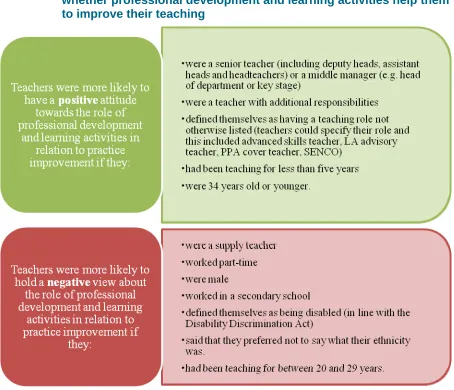
Regression analysis was then used to ascertain the relationship between teacher views about the benefits of using professional development and learning as a way to improve their teaching, and the background characteristics of the teachers – the results of the modelling are shown in Figure 2.1 below.
[image:20.595.74.528.318.708.2]Overall, teachers that were more likely to have a positive view about professional development had recently experienced more professional development and learning activities and consequently they had had more opportunities to see the benefits of engaging in such activities. These teachers were also more likely to have a positive view about access to professional development and about the impact on teaching and learning that professional development could have.
Figure 2.1 Differences in teacher characteristics in relation to views about whether professional development and learning activities help them to improve their teaching
Teachers with more responsibilities – for example senior leaders, middle managers (such as heads of departments or key stages) and teachers with additional responsibilities – were more likely to have a positive attitude towards the benefits of professional development and learning activities in terms of improving teaching.
Younger teachers and those with less teaching experience were more likely to be positive about professional development and learning – perhaps recognising the potential benefits from development and learning opportunities for those with less practical experience of teaching. In contrast, teachers who had been teaching for between 20-29 years were more likely to have a negative view about professional development as a way to improve their teaching, compared with teachers in the profession for less than this, or for more than 30 years. Of course, it is not possible to be sure about the reasons behind this, however teachers who have a long experience of teaching might feel that they have gathered the experience they need from teaching, rather than professional development activities such as attending a course or being involved in mentoring or coaching.
Working in a school that experienced higher levels of economic or academic challenge did not have a significant effect, either positive or negative, on teachers’ attitudes towards the contribution of professional learning and development activities towards improving their teaching. Other school-level variables such as percentage of pupils with EAL and percentage of pupils with SEN did not have a significant effect either.
Supply teachers tend to feel more negatively about the role of CPD activities in improving their teaching and this may be related to the nature of supply work and of working in a variety of different schools over the same school year, making it harder for them to gauge the impact of their professional learning on their teaching skills and the pupils they teach. Furthermore, this indicates that supply teachers are more likely to feel that they do not have access to CPD, and, as highlighted in Section 2.1, supply teachers had a lower level of participation in development activities than other teachers. There might be a similar issue about limited continuous contact with the same pupils for part-time teachers, who were also more likely to have a negative view about professional development.
It is interesting to see that teachers from the secondary sector were less likely to feel positively about the influence of professional learning on the development of their teaching than teachers from primary and middle schools. This could be related to having the time or opportunity to participate, which, as discussed above, seemed to be more of an issue among secondary school teachers.
by teachers of White and BME backgrounds. Teachers who said they had a disability were however more likely to feel negatively about the impact of professional development and learning activities.
3. Using
research
Key findings:
• conducting research was not particularly widespread among the sample, but it appears that many teachers would like to be able to be more involved in research
• teachers that had been involved in a higher number and wider variety of
professional development activities in the last 12 months were more likely to have a positive view about the use of research to improve their teaching
• younger teachers were less likely to feel positively about the use of research to improve their teaching practice.
The survey provided an opportunity to ask how teachers used research or enquiry to inform their teaching practice: these questions covered both teachers conducting their own research and using research conducted by others.
3.1 Teacher views on using research to improve their practice
Only a third of respondents (33 per cent) strongly agreed or agreed with the statement that ‘In the last 12 months I have undertaken my own research and enquiry to improve my practice’; a further 13 per cent neither agreed nor disagreed and just under half (49 per cent) disagreed or strongly disagreed. Indeed, although a sizeable proportion of teachers reported that they had not undertaken their own research (29 per cent) or used other people’s research (24 per cent) within the last two years, of those people who had used research within the previous two years, most had found it a useful way to help them to improve their teaching practice. For example 86 per cent of teachers
who had conducted their own enquiry or research found it ‘very’ or ‘fairly’ useful, and 76 per cent of teachers who had used other people’s research reported that had been useful.
Motivation for professional self-improvement by conducting research does not appear to be a problem, since six out of ten respondents (60 per cent) agreed or strongly agreed that: ‘I would like more opportunities to do my own research to improve my teaching’; and nearly two-thirds (65 per cent) agreed or strongly agreed that ‘I would like more opportunities to collaborate with other colleagues on a piece of research’. Confidence in their own research skills seemed to be an issue for some teachers: only around half of respondents (52 per cent) agreed or strongly agreed with the statement that ‘I feel confident in my research skills to conduct my own enquiry’ while 18 per cent disagreed or strongly disagreed and 25 per cent neither agreed nor disagreed with this statement.
their teaching (61 per cent), yet only 49 per cent of all teachers said that the research they had found they had been able to understand and use. The message here may be that research needs to be made more accessible and more concise for busy teacher audiences.
The barriers to teachers doing their own research appear to consist of a combination of a lack of time and, to some extent, a lack of encouragement from schools, as indicated by the following findings:
• nearly six in ten respondents (58 per cent) agreed or strongly agreed with the statement that ‘I do not have time to conduct my own research’;
• just over two fifths of teachers (42 per cent) said that they did not have time to use research findings by other people;
• less than one in four respondents (23 per cent) agreed or strongly agreed with the statement that ‘My school encourages me to undertake my own enquiry’;
• a similar proportion (24 per cent) said that their school encouraged them to use research findings to improve their practice.
Although peer support and collaboration with colleagues was highlighted in Chapter 2 as an important resource for teachers wishing to improve their practice, only 16 per cent of teachers said that they had frequent (at least termly) opportunities to discuss relevant research findings with their colleagues. In turn, over half of teachers (54 per cent) said that they did not have frequent opportunities to discuss relevant research findings. This suggests that utilising research by other people has not been integrated into the ethos of improving teaching practice in a good proportion of schools. While this cannot be taken as active discouragement by schools, this does point to the possibility of a ‘weak’ research culture within many schools.
3.2 Teachers’
characteristics
and
their views about research
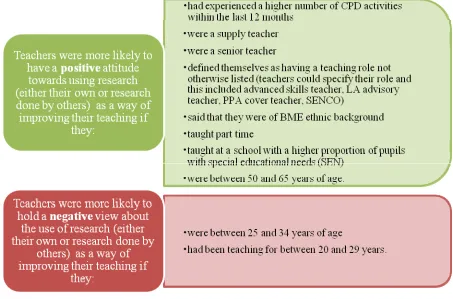
Figure 3.1 Differences in teacher characteristics in relation to views about how using research supports them to improve their teaching
(see Appendix C for more details)
Teachers who had been involved in higher levels of professional development and learning activities were more likely to feel positively about using research or enquiry as a way of improving their teaching practice. Undertaking action research and studying for a postgraduate qualification (for example a Masters) were included in the definition of professional development activities that were used as part of the measure of level of engagement and activity in relation to professional development and learning over the last 12 months.
There were differences in views by teacher roles; senior teachers, supply teachers and teachers with ‘other’ roles were all more likely to have a positive opinion about the contribution that research and enquiry could have to practice improvement. Senior teachers were perhaps more likely to see the strategic benefits of research, and for example, also have more control over their workload so that issues such as having the opportunity to conduct or discuss research were likely to be less of a problem. Many of the teachers in the ‘other’ role category were those with specific areas of interest, which often involve – and in some cases require – research, for example part of the role of an advanced skills teacher involves disseminating best practice based on educational research.
teach and engage pupils with a variety of needs could be one reason that teachers in these schools could see the value in research. Other school-level variables such as the level of challenge, or the proportion of pupils with EAL did not have an effect on teacher views about research.
Part-time teachers were more likely to have a positive attitude about the role of research in their practice improvement, compared to their colleagues who worked full time. The additional non-contact time available to part time teachers means this group have, theoretically, more time and opportunity for research, but this difference could also relate to the perceived differences in value that full and part-time teachers place on research.
Differences were also apparent in terms of personal characteristics of teachers. Compared to teachers from White ethnic groups, teachers from BME backgrounds were more likely to hold a positive view about research in relation to practice improvement. Teachers aged between 50 and 65 years were more likely to have a positive view about research, while teachers aged between 25 and 34 years were more likely to have a negative attitude. It was not possible to explore the reasons for different attitudes among different age groups, but one possibility is that 25 to 34 year olds are concerned to ‘establish’ themselves in the profession before turning to research as a means of professional development. Family and social factors may also have an influence on these attitudes. Those supporting teachers in their efforts to become better teachers may wish to consider promoting the benefits of research in relation to teachers of all age groups and ethnicities.
4. Performance
management
Key findings:
• there were mixed views about the role of performance management in practice improvement. Although around half of teachers agreed that performance management helped them to identify areas for improvement and areas of strength (53 per cent and 49 per cent respectively), fewer than three in ten teachers (28 per cent) said that performance management was a key factor in helping them to improve their teaching
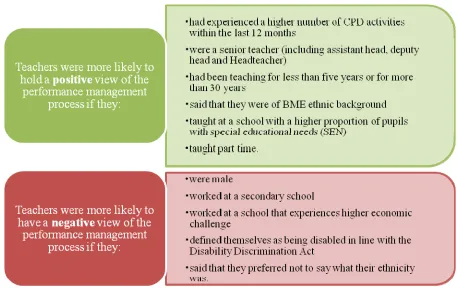
• teachers that worked at schools experiencing ‘economic challenge’ (which had a high proportion of pupils eligible for FSM) were more likely to have a negative view of the performance management process in relation to practice improvement compared with those that worked at schools not experiencing economic challenge
• teachers at schools with a higher proportion of pupils with SEN were more likely to feel positively about the performance management process.
4.1 Experiences of performance management and its impact
Part of the survey focused on how teachers felt that the performance management process supported them to improve their teaching, both in terms of helping them to identify ways to improve, but also in terms of the support and opportunity it provided.
More than half of respondents (56 per cent) agreed or strongly agreed that the evidence used in their performance management processes provided a fair picture of their performance. It is worth noting that almost one in five respondents (19 per cent) disagreed or strongly disagreed with this statement. It may also be worth noting that one in four teachers (25 per cent) felt either that this statement was not applicable to them, or gave a ‘don’t know’ answer, or neither agreed nor disagreed. Overall then, teacher views were mixed about how well performance management reflects their actual performance.
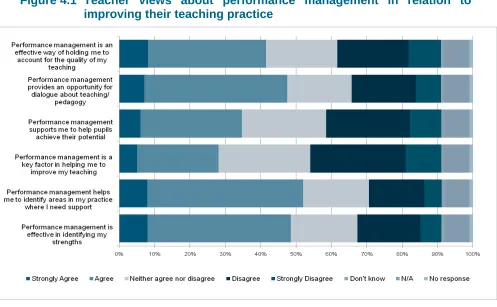
Figure 4.1 Teacher views about performance management in relation to improving their teaching practice
If we look beyond the uncertain group we find that, for most of the statements, more respondents took a positive view of the impact of performance management upon their teaching than took a negative view. For example:
• fifty-three per cent agreed or strongly agreed that performance management ‘helps me to identify areas in my practice where I need support’, compared with 21 per cent disagreeing or strongly disagreeing;
• forty-nine per cent agreed or strongly agreed that performance management was ‘effective in identifying my strengths’, compared with 24 per cent disagreeing or strongly disagreeing;
• forty-seven per cent agreed or strongly agreed that performance management provided ‘an opportunity for dialogue about teaching / pedagogy’, compared with 25 per cent disagreeing or strongly disagreeing;
• forty-one per cent agreed or strongly agreed that performance management was ‘an effective way of holding me to account for the quality of my teaching’, compared with 29 per cent disagreeing or strongly disagreeing.
Respondents were more divided on the impact of performance management processes on improving practice and pupil outcomes. For example:
• there was an almost even split in opinions in relation to the statement: ‘Performance management supports me to help pupils achieve their potential’, with 35 per cent agreeing or strongly agreeing with the statement; 24 per cent neither agreeing nor disagreeing; and 33 per cent disagreeing or strongly disagreeing;
• in relation to the statement that ‘Performance management is a key factor in helping me to improve my teaching’, 28 per cent agreed or strongly agreed with the statement; 26 per cent neither agreed nor disagreed; and 37 per cent disagreed or strongly disagreed.
It seems that performance management is important for some teachers in terms of encouraging dialogue about teaching practice, identifying areas of strength and identifying areas where support is needed, but, for around two-thirds of teachers, it is not perceived as a key factor in helping teachers to improve their teaching.
4.2 Teachers’
characteristics
and
their views about performance
management
Figure 4.2 Differences in teacher characteristics in relation to views about how the performance management process supports them to improve their teaching
(see Appendix C for more details)
Teachers who had a positive view about the performance management process and how it can support them to improve as a teacher tended to be those who had engaged in more professional development and learning activities over the last 12 months. Part of the performance management process involves identifying areas for development and finding ways to support the teacher to improve on that particular aspect of their teaching practice, so it is understandable that teachers who had had the opportunity to work on developing their teaching through such activities were more likely to feel positively about performance management. However, it does not automatically follow that their opportunities to participate in development activities were provided as a result of performance management, and other factors such as personal motivation could play a part.
ways managers approach performance management, or how teachers measure the impact of their performance management activities.
In terms of length of service, teachers either at the beginning or towards the later stages of their teaching career were more likely to feel positively about how performance management could support them to improve their teaching. Although the reasons for this distinction are not clear, perhaps these groups of teachers were more optimistic about the support that the performance management system can provide, compared with their colleagues.
Part-time teachers were more likely to see the benefits of the performance management process than their full-time counterparts. There was also a difference in terms of the phase at which the teacher taught; secondary school teachers were more likely to feel negatively about performance management than their colleagues working at primary and middle schools. These, and the other differences described, could be related to the perceived amount of access to CPD activities required to meet their objectives, and the level of support received in relation to performance management – attitudes towards support, opportunity, and access, all formed part of the factor encompassing overall views towards performance management.
Teachers from BME groups were more likely to have a positive attitude towards the role performance management plays in supporting them to improve their teaching, compared with teachers of White ethnic backgrounds.
Male teachers, as with the findings of the other regression models described in this report, were more likely to feel negatively about the role of the performance management process in practice improvement, compared with female teachers.
Teachers who had defined themselves as disabled were also more likely to be negative about the performance management process.
The performance management model was the only regression carried out for this study where economic challenge was a significant factor in the model. In this case, teachers at schools experiencing a challenge in terms of the socio-economic status7 of the children attending the school were more likely to be negative about the performance management process. In comparison, however, teachers working at schools with a higher proportion of pupils with SEN were more likely to be positive about performance management. Schools knowingly facing these types of challenges may wish to consider reviewing or evaluating how the performance management process supports their teachers to improve their practice. Other school characteristics (such as the proportion of EAL pupils and if schools faced academic challenge) did not have a significant effect on teacher views regarding the support available through the performance management for practice improvement.
7
5. Professional
standards
Key findings:
• although most teachers reported that they had a good understanding of the professional standards framework, overall, teachers had mixed views about the professional standards framework in terms of how it could help them to improve their practice
• teachers that had experienced a higher variety and frequency of professional development activities within the last year were more likely to have a positive view about how the professional standards could help them to improve their practice
• both senior teachers and teachers who were relatively new to the profession (although not necessarily younger teachers) were more likely to perceive the professional standards as helpful.
The survey also provided an opportunity to explore teachers’ views on the professional standards framework, and how and if these standards influenced their approaches to improving their teaching practice. As was the case with performance management, a number of statements were offered to respondents and they were asked about their extent of agreement or disagreement with these statements.
The professional standards were introduced by the Training and Development Agency for schools (TDA) in 2007. The aim of the professional standards framework is to provide a tool which teachers can refer to when considering their professional development, for example to consider gaps or strengths in their practice. The framework provides a series of reference points which teachers at different stages of their career can use when thinking about improving their practice and career progression.
5.1 Use and impact of the professional standards framework
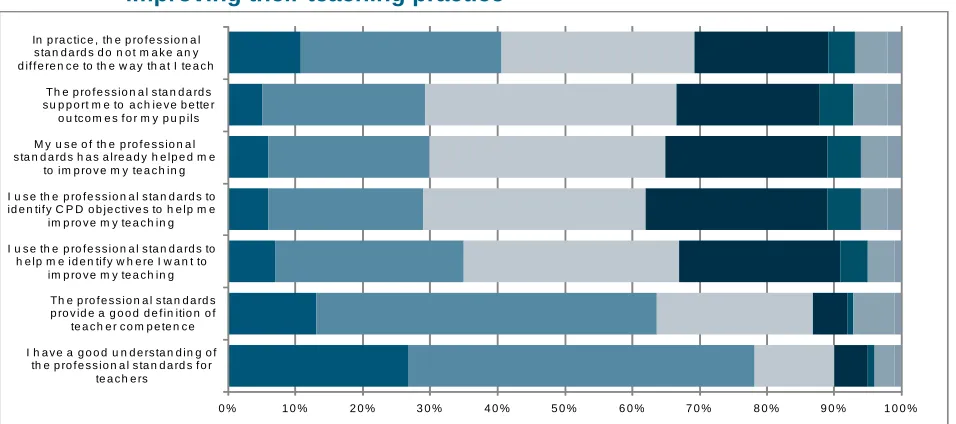
Nearly eight in ten respondents (79 per cent) strongly agreed or agreed that they had a ‘good understanding’ of the professional standards for teachers. Only a small minority of respondents (six per cent) disagreed or strongly disagreed with this statement. It was also apparent that nearly two-thirds of respondents (63 per cent) felt that the professional standards provided ‘a good definition of teacher competence’, suggesting that these standards had provided useful benchmarks for many teachers; again, only six per cent of respondents disagreed or strongly disagreed with this statement, though there were also nearly one in four teachers (23 per cent) that neither agreed nor disagreed.
• in relation to the statement: ‘I use the professional standards to help me identify where I want to improve my teaching’, 35 per cent agreed or strongly agreed with this; 32 per cent neither agreed nor disagreed; and 28 per cent disagreed or strongly disagreed;
• there was an even split in opinions in relation to the statement: ‘My use of the professional standards has already helped me to improve my teaching’, with 30 per cent agreeing or strongly agreeing with this; 35 per cent neither agreeing nor disagreeing; and 29 per cent disagreeing or strongly disagreeing;
• similarly, in response to the statement: ‘The professional standards support me to achieve better outcomes for my pupils’, 29 per cent agreed or strongly agreed with the statement; 37 per cent neither agreed nor disagreed; and 26 per cent disagreed or strongly disagreed.
Perhaps one of the most telling responses to this series of questions was that relating to the direct statement: ‘In practice, the professional standards do not make any difference to the way that I teach’. In this case, although more teachers agreed (41 per cent) than disagreed (24 per cent) with this statement, almost one in three neither agreed nor disagreed (29 per cent): a sizeable proportion of teachers, therefore were ambivalent about the influence of the professional standards on their teaching.
[image:33.595.73.551.544.756.2]It seems that the professional standards provide a useful conceptual or definitional benchmark for a majority of teachers, but when it comes to assessing the practical impact of the standards upon their teaching or upon pupil outcomes, teachers are not as certain about their influence. This was demonstrated by the finding that around a third of respondents neither agreed nor disagreed with five of the seven statements about the standards, as illustrated in Figure 5.1. This may be explained by teachers not having used the standards and therefore being unable to respond to the statements, or it may be that teachers are simply attributing greater importance to other influences on changing their teaching practice.
Figure 5.1 Teacher views about the professional standards in relation to improving their teaching practice
0 % 1 0 % 2 0 % 3 0 % 4 0 % 5 0 % 6 0 % 7 0 % 8 0 % 9 0 % 1 0 0 %
I h a v e a g o o d u n d e rs ta n d in g o f th e p ro f e s s io n a l s ta n d a rd s f o r
te a c h e rs
Th e p ro f e s s io n a l s ta n d a rd s p ro v id e a g o o d d e f in itio n o f
te a c h e r c o m p e te n c e I u s e th e p ro f e s s io n a l s ta n d a rd s to
h e lp m e id e n tif y w h e re I w a n t to im p ro v e m y te a c h in g I u s e th e p ro f e s s io n a l s ta n d a rd s to id e n tif y C P D o b je c tiv e s to h e lp m e
im p ro v e m y te a c h in g M y u s e o f th e p ro f e s s io n a l s ta n d a rd s h a s a lre a d y h e lp e d m e
to im p ro v e m y te a c h in g Th e p ro f e s s io n a l s ta n d a rd s s u p p o rt m e to a c h ie v e b e tte r o u tc o m e s f o r m y p u p ils In p ra c tic e , th e p ro f e s s io n a l s ta n d a rd s d o n o t m a k e a n y d if f e re n c e to th e w a y th a t I te a c h
5.2 Teachers’
characteristics
and their views about the
professional standards
[image:34.595.74.527.312.587.2]After considering the overall responses to the professional standards, analysis was carried out to look at the differences in the characteristics of teachers who felt more positively or negatively about how the professional standards supported them to improve their teaching. A similar approach was taken to the other aspects of practice improvement covered in this report – firstly a factor was created to provide a measure of teacher attitudes towards the professional standards overall (see Appendix B). Regression analysis was then used to explore the relationship between teachers’ views about the role of the professional standards in improving their teaching and the background characteristics of the teachers (see Figure 5.2).
Figure 5.2 Differences in teacher characteristics in relation to views about how the professional standards support them to improve their teaching
(see Appendix C for more details)
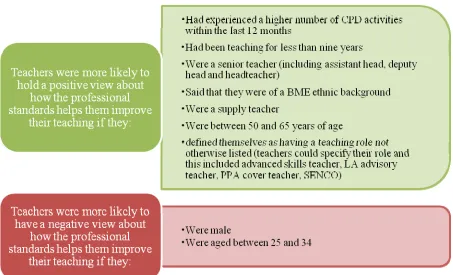
Teachers who joined the profession within the last nine years were more likely to have a positive view on the role the professional standards framework had played in helping them to improve their teaching. The professional standards were introduced in September 2007 and would have been an integral part of the initial teacher training for this cohort onwards. It is likely, therefore, that this group of teachers would be among those with the highest awareness of the professional standards and how they could be used to a teacher’s best advantage. Interestingly, however, teachers nearer retirement (in the 50-65 age group) were more likely to have a positive attitude towards the support the professional standards framework provides in practice improvement, compared with other age groups. Furthermore, teachers aged between 25 and 34 were more likely to have a negative view of the professional standards, compared to teachers in other age groups. Although there is likely to be some overlap between teachers aged between 25 and 34, and teachers who joined the profession in the last nine years, this suggests that age and length of experience are not one and the same, that the two groups do not overlap entirely and that the two behave differently.
Senior teachers were also among those who were more likely to be positive about the professional standards in relation to practice improvement – this finding is similar to that reported in chapter 5 about views on performance management. If the senior teaching team in a school places importance on using the professional standards as part of practice improvement then this message may filter down to staff. Supply teachers also tended to have a positive view about the professional standards. This perhaps suggests that although supply teachers are generally not affiliated with a single school, these teachers may have independently used the professional standards.
There were also some differences in attitudes towards the professional standards in the individual characteristics of teachers. Firstly, teachers of BME backgrounds were more likely to have a positive view about the use of the professional standards in improving their teaching, compared with their White colleagues. Another interesting finding was that male teachers were less likely to have a positive view of the professional standards in relation to practice improvement compared with female teachers. Schools and other organisations promoting the use of the professional standards framework as a way to help teachers improve and develop their teaching may wish to consider ways of highlighting the benefits of the professional standards to teachers from all backgrounds, and at all stages of a teaching career.
6. Views on different approaches to
improving practice
Key findings:
• almost all teachers said that self reflection was a useful way of improving their teaching practice, with more than two thirds reporting it as ‘very’ useful
• observation and feedback were viewed as useful ways of improving teaching practice
• working towards performance management objectives appears to be considered more useful than the performance management process overall
• although most teachers who expressed an opinion about the usefulness of research and the usefulness of observation in terms of improving their practice said they were ‘very’ or ‘quite’ useful, around one in four and one in five teachers respectively said they had no experience of these approaches during the past two years.
6.1 Perceived usefulness of different ways of improving teaching
practice
One of the aims of the survey was to explore if teachers felt differently about the usefulness of different approaches to practice improvement.
The method of improving teaching that was valued by the most teachers was self reflection (as illustrated in Figure 6.1); overall, almost all teachers reported that ‘reflecting on my own practice’ had been a very or fairly useful way of improving their teaching over the last two years (97 per cent). Notably, more than two-thirds of teachers said it was ‘very’ useful (68 per cent). Furthermore, in response to an open question, one in seven teachers spontaneously said that self reflection was one of the main factors that helped them to improve and maintain their teaching quality (14 per cent).
Although reflection on their own practice was by far the approach that the most teachers found useful in terms of improving their teaching, around three in four teachers also said that the following methods were very or fairly useful (also see figure 6.1):
• observing my peers’ teaching (76 per cent)
• feedback from pupils (76 per cent)
Figure 6.1 Teacher ratings of usefulness of different approaches to practice improvement
0% 10% 20% 30% 40% 50% 60% 70% 80% 90% 100%
Discussions about teaching w ith an LA advisor or Sc hool Im provem ent
Partner (SIP)
O bservation and feedback related to external inspec tion/ sc hool
im provem ent proc esses Feedbac k f rom parents U sing the findings of other people's
researc h
D oing m y ow n enquiry or researc h W orking tow ards m y perform anc e
m anagem ent objec tives U sing teacher assessm ent data Peers observ ing m y teaching and
giving m e feedback R eview ing m y practice as part of
sc hool self-evaluation O bserv ing m y peers' teac hing
Feedback from pupils Reflecting on m y ow n prac tic e
Most of the teachers who had been observed or who had observed a colleague said it was ‘very’ or ‘quite’ useful. However almost one in five teachers said that they had not observed their peers’ teaching (19 per cent) and a similar proportion (18 per cent) said that they had not experienced being observed by their peers and receiving feedback on their own performance. Considering the positive views of the majority of teachers who had experienced observation, schools and teachers may wish to consider ways to provide more opportunities for teachers to use this approach to help them to reflect on their teaching practice. Finding the time to conduct observations and to feed back does seem to have a positive pay off for teachers’ professional development.
Conducting their own research and using the findings from other people’s research were viewed as useful by similar proportions of teachers (61 per cent and 58 per cent respectively). Notably, around a quarter of teachers said that they had ‘no experience within the last two years’ of doing their own research (29 per cent) or of using the findings of other people’s research (24 per cent) to improve their teaching. Factors related to the support teachers feel they need in order to make good use of research are discussed in Chapter 3, but it is important to note that the proportions of teachers directly reporting that research was ‘not useful’ was relatively low, as shown in Figure 6.1. This indicates that when teachers have the opportunity to use or conduct research, they do find it a useful tool to improve their teaching.
Working towards their performance management objectives was regarded as a ‘very’ or ‘fairly’ useful way to improve their teaching by almost two thirds of teachers (64 per cent); however, only one in four teachers agreed that performance management was a ‘key factor in helping them improving their teaching’ (28 per cent agreed to some extent). Teachers appeared to have a similar view about the usefulness of the professional standards; only three in ten teachers agreed that using the professional standards had already helped them to improve their teaching (30 per cent agreed to some extent). Thus, while many teachers reported that the objective setting process was beneficial in terms of helping them to improve their teaching practice, fewer rated the performance management process overall and the professional standards as being key to practice improvement. It appears that the more focused and tailored aspects of identifying and working towards particular objectives for the individual were perceived as being more useful than the wider processes.
Using observation and feedback
Observation and feedback is now a common aspect of teaching, from the early stages of embarking on the teacher training course and throughout teachers’ careers as part of the performance management process and school inspections. Indeed, almost all teachers (97 per cent) gave a view about how useful at least one of the types of observation and feedback listed in a survey question were, indicating the widespread use of at least some forms of observation and feedback amongst the sample.
‘quite’ or ‘very’ useful and, in response to an open-ended question, two-fifths of teachers (39 per cent) said that observation was one of the main factors that supported them in maintaining and improving their teaching quality.
[image:39.595.76.523.294.563.2]In light of this apparent importance placed on observation by teachers, additional analysis was carried out to explore which types of teachers have a more positive or negative view about the use of observation and feedback. By using factor analysis, a measure of usefulness of observation of feedback was created (see Appendix B). Regression analysis was then used to ascertain the relationship between this measure and the background characteristics of the teachers: the results of the regression are shown in Figure 6.2 below.
Figure 6.2 Differences in teacher characteristics in relation to views about how useful observation and feedback is to improving their teaching
(see Appendix C for more details)
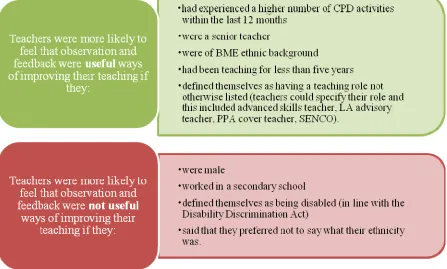
In terms of the level of experience of the teacher, senior leaders and teachers with a role not otherwise listed (including advanced skills teachers and SENCO) were among those more likely to have a positive view about the usefulness of observation and feedback in terms of improving their teaching practice. However, almost at the opposite end of the teaching spectrum, less experienced teachers – those who had been teaching for less than five years – were also more likely to report that observation and feedback was useful for improving their teaching compared with their more experienced colleagues with more years of teaching behind them. Reasons behind these differences could be related to motivation, access to opportunities to observe and be observed, or to do with the types of training they had received most recently as part of their progression within the teaching profession (for example as part of teacher training, or working towards qualifications such as the National Professional Qualification for Headship (NPQH)).
Secondary school teachers were less likely to report that methods of observation and feedback were useful, compared to their primary and middle school colleagues. This could be related to the differences in teaching between the different phases – in primary and middle schools teachers tend to work with a single class for a whole academic year and as a result perhaps it is easier for these teachers to use feedback and to apply it to their teaching with visible results. In contrast, secondary school teachers tend to teach a number of different classes within the same week and so applying the learning might be more difficult; what applies to the teaching approach for one class is not necessarily the same as what works best when teaching a different group of students.
As described below, a number of differences existed in terms of personal characteristics, however it is interesting to note that none of the school-level variables – including the proportion of pupils with EAL or with SEN and whether a school experienced higher levels or socio-economic or academic challenge - had an effect on teacher views about the usefulness of observation and feedback, either positively or negatively. This indicates that the differences were more at the individual, rather than school level.