This is a repository copy of
The DISTINCTIVE University Consortium: An Overview
.
White Rose Research Online URL for this paper:
http://eprints.whiterose.ac.uk/134952/
Version: Accepted Version
Proceedings Paper:
Fairweather, M, Tovey, L, Boxall, C et al. (8 more authors) (2018) The DISTINCTIVE
University Consortium: An Overview. In: Proceedings of the 44th Annual Waste
Management Conference. WM2018: 44th Annual Waste Management Conference, 18-22
Mar 2018, Phoenix, AZ, USA. Waste Management Symposia , pp. 6143-6156. ISBN
978-1-5108-6764-2
© 2018 by Waste Management Symposia, Inc. All Rights Reserved. This is an author
produced version of a paper published in Proceedings of the 44th Annual Waste
Management Conference. Reprinted with Permission.
Reuse
Items deposited in White Rose Research Online are protected by copyright, with all rights reserved unless indicated otherwise. They may be downloaded and/or printed for private study, or other acts as permitted by national copyright laws. The publisher or other rights holders may allow further reproduction and re-use of the full text version. This is indicated by the licence information on the White Rose Research Online record for the item.
Takedown
If you consider content in White Rose Research Online to be in breach of UK law, please notify us by
The DISTINCTIVE University Consortium: An Overview
M. Fairweathera, *, L. Toveya, C. Boxallb, J.A. Hriljacc, N.C. Hyattd, N. Kaltsoyannise, W.E. Leef, R.J. Lunng, S.M. Pimblotte,**, D. Readh, T.B. Scotti
aSchool of Chemical & Process Engineering, University of Leeds, Leeds LS2 9JT, UK
bDept. of Engineering, Lancaster University, Lancaster LA1 4YR, UK
cSchool of Chemistry, University of Birmingham, Birmingham B15 2TT, UK
dDept. of Materials Science & Engineering, University of Sheffield, Sheffield S1 3JD, UK
eSchool of Chemistry, University of Manchester, Manchester M13 9PL, UK
fDept. of Materials, Imperial College London, London SW7 2AZ, UK
gDept. of Civil & Environmental Engineering, University of Strathclyde, Glasgow G1 1XQ, UK
hDepartment of Chemistry, University of Surrey, Guildford GU2 7XH, UK
iSchool of Physics, University of Bristol, Bristol BS8 1TL, UK
ABSTRACT
The UK government remains committed to nuclear energy having an important role to play in delivering a secure, low carbon and affordable energy future. Successful delivery of their strategy recognises the need for underpinning research, in addition to the provision of a skilled workforce and international collaboration as key enablers. One crucial area is the decommissioning and clean-up of all existing civil nuclear licensed sites and the implementation of geological disposal of highly active wastes, with the Nuclear Decommissioning Authority responsible for the delivery of policy aims with respect to legacy wastes. A central component of public acceptance of this strategy is a demonstrated ability to safely manage and dispose of waste, with acceptance linked to having scientifically robust routes for its safe clean-up and disposal. Similarly, the UK Engineering and Physical Sciences Research Council (EPSRC) strategy is to maintain investment in nuclear fission, with the development of approaches for implementing safe, cost-effective clean-up, decommissioning and waste disposal of existing and future nuclear sites and facilities a strategic focus. The EPSRC-supported DISTINCTIVE (Decommissioning, Immobilisation and Storage Solutions for Nuclear Waste Inventories) consortium is carrying out research that addresses the broad area of nuclear waste and decommissioning, bringing together academic researchers from 11 of the UK’s leading research intensive universities and key industry partners. When allied to the strong links of the partners with the industrial and international R&D community, the project provides an excellent route for building a greater capacity for R&D within the UK, underpinning the strategic needs noted. The consortium also addresses the skills agenda in training a significant number of researchers with high level skills of direct relevance to nuclear waste and decommissioning. This paper describes the aims and objectives of the work being undertaken, and the technical work underway within
each of the research theme areas: AGR, Magnox and exotic spent fuels; PuO2 and fuel residues; legacy
ponds and silo wastes; and structural integrity. Projects using radioactive materials are also considered. As the project enters its final year, consideration is given to the impacts of the project for both academic and non-academic beneficiaries.
INTRODUCTION
The UK Engineering and Physical Sciences Research Council (EPSRC) strategy is also to maintain investment in nuclear fission research as a proportion of their portfolio, recognising nuclear power as a key low carbon power generation option with an important role to play in the UK’s future low carbon energy mix. One research area of strategic focus is facilitating the development of approaches for implementing safe, cost-effective clean-up, decommissioning and waste disposal of existing and future nuclear sites and facilities [7].
The Nuclear Decommissioning Authority (NDA) is responsible for the delivery of policy aims with respect to legacy wastes [8]. Through both their policy documents and delivery strategy, the ultimate goal is for the management of waste through a geological disposal facility (GDF), although as yet there is no defined host site. Radioactive Waste Management’s (RWM) mission is to deliver a geological disposal facility and provide radioactive waste management solutions, and they are currently engaging in discussions to help build understanding of geological disposal and are in the process identifying a site for a UK GDF. This lack of a defined host site is again undoubtedly linked to a lack of confidence in proposed waste management approaches and highlights a need to improve understanding and technology in this area. Note that RWM are a wholly-owned subsidiary of the NDA, which is an executive non-departmental public body of the Department for Business, Energy and Industrial Strategy (BEIS).
Given the needs of both new nuclear power generation and legacy wastes, there is a requirement to develop innovative approaches to waste management and decommissioning. The work of the DISTINCTIVE (Decommissioning, Immobilisation and Storage Solutions for Nuclear Waste Inventories) consortium is part of the response to these needs, providing support to a strong and internationally leading group of researchers in this key technology area.
The project follows on from earlier, highly successful consortia which also addressed research challenges associated with nuclear waste management and decommissioning, again supported by the EPSRC, namely the KNOO (Keeping the Nuclear Option Open) and DIAMOND (Decommissioning, Immobilisation and Management of Nuclear Wastes for Disposal) projects. The DISTINCTIVE consortium learned from these previous activities in formulating the new project, and widened and deepened the pool of talent within academia with direct experience of nuclear-related R&D. When allied to the strong links of the partners with the industrial R&D community, the project provides an excellent route for building a greater capacity for R&D within the UK, underpinning the strategic needs of the country. The research being undertaken addresses other key strategic priorities, not least in the training of a significant number of PDRA (post-doctoral research assistants) and PhD student researchers with high level skills of direct relevance to issues in nuclear waste and decommissioning, directly addressing the skills agenda.
The project is led by the University of Leeds, and is made up of a world-class university network with academics from Imperial College London, Lancaster University, Loughborough University, University College London and the universities of Birmingham, Bristol, Leeds, Manchester, Sheffield, Strathclyde and Surrey. Key project partners are the National Nuclear Laboratory (NNL), the NDA and Sellafield Ltd, who play a central role in providing strategic guidance, challenge definition, academic-industrial links, and access to people and facilities. Core funding is provided by the EPSRC which, together with the universities’ contribution, covers the cost of post-doctoral research assistants, investigator and technician time, as well as funding active research projects and impact activities. Additionally, a number of PhD researchers have been funded by the universities and key industry partners who are undertaking work aligned with the technical themes under investigation. This brings the total funding for the project to approximately £8.4M. Overall, the project is providing an excellent route for building a greater capacity for nuclear R&D within the UK, underpinning the country’s strategic needs.
(http://distinctiveconsortium.org/) and below. This large cohort of researchers directly addresses the skills agenda noted above.
The project runs from February 2014 to February 2019, and its strategic aims are:
To carry out internationally leading science and engineering research in the area of decommissioning
and nuclear waste management.
To support research that provides routes to innovative technology developments that can be applied to
decommissioning and nuclear waste management.
To foster and develop new multi-disciplinary research partnerships between academic and industry
researchers.
To train the next generation of UK researchers, equipping them with skills and experiences relevant to
nuclear waste management and decommissioning issues.
To provide a focal point for government, industry and academics through which current and future
R&D issues associated with nuclear waste and decommissioning can be discussed.
To provide a route for public understanding of the underlying research and development needs,
opportunities and solutions to nuclear waste and decommissioning.
The DISTINCTIVE project aims to provide a world-class programme of relevant research into nuclear waste management and decommissioning with a focus on UK needs. Through our impact strategy we aim to bridge the credibility gap in public perception of radioactive waste management, through improved public understanding of the supporting scientific evidence and genuine two-way dialogue concerning socio-economic and ethical impacts of waste management practice. The consortium does not directly address geological disposal or radionuclide leakage/mobility, although many of the research packages link directly to this, as this is currently covered within complementary research activity supported by the Natural Environment Research Council.
In what follows, the major research themes covered by the project are described, together with details of the specific projects being undertaken by the team of researchers. Cross-cutting themes are also covered, namely active research projects and impact activities with groups of non-academic beneficiaries, followed by some conclusions. This paper is intended to act as an overview of the consortium’s activities. As the project enters its final year, companion papers covering each of the technical themes focus on outputs from, and impact of, the research within each theme. Other companion papers are also provided on how the project has helped to transform the UK’s capability for research with highly active materials, and lastly our key industry partners give their perspective on some of the project’s outputs and their take-up within the industry.
RESEARCH THEMES
The current UK waste inventory is large and complex and presents multiple challenges, with new research and knowledge needed to find viable technologies for its ultimate treatment, storage and disposal. The research undertaken was clustered using the strategic R&D themes in the 2011 NDA Strategy [9]. The latter’s themes of “site restoration”, “spent fuels”, “nuclear materials” and “integrated waste management” map directly onto the DISTINCTIVE themes of “structural integrity”, “AGR, Magnox and
exotic spent fuels”, “PuO2 and fuel residues” and “legacy ponds and silo wastes”, respectively. This
ensured strategic alignment of the work undertaken with the needs of UK industry.
AGR, Magnox and Exotic Spent Fuels
SNF and wasteforms of different types, in wet and dry storage environments, including their transitioning between the two.
The aim of this theme is therefore to provide technical underpinning to the options for the management of AGR, Magnox and exotic spent fuels. The objectives are:
To understand the evolution of Magnox and exotic SNF during recovery from aqueous storage, drying
and repackaging.
To develop spectroscopic methods for improved determination of SNF dissolution and corrosion rates
in water.
To determine the optimum drying conditions for AGR fuels and the subsequent surface reactivity and
alteration of unclad UO2 in dry storage.
To determine the consequences of radiation damage in SNF, cladding and other wasteforms for safe
long term storage.
To determine suitable waste management options for spent carbide fuels.
These objectives are being met by several linked projects in three work packages, the details of which are given in Table I.
Notable achievements in this theme to date include work on transitioning spent AGR fuel from wet to dry storage to inform drying and transitioning of legacy materials from current aged storage facilities, to be retrieved and repackaged for ongoing storage at Sellafield, assisting development of fuel handling
operations. Investigations into fuel material behaviour have included U, UC and UO2, with the novel use
of thin films to examine the behaviour of fuels in water and moist atmospheres. These thin film surfaces are directly comparable to surfaces on bulk crystals and hence provide a test substrate for mimicking spent nuclear fuels. Detailed experimental and modelling work has also given improved understanding of the oxidation of uranium carbide fuel from the Dounreay fast breeder reactor, a critical step to enable its disposition. In terms of cladding materials, work has resulted in a better understanding of corrosion behaviour, quantifying the extent of microstructure damage, and developing automated drying techniques. Some of this research has contributed to a change in the way intermediate level waste material from silos at Sellafield will be packaged which feeds into long-term storage strategies for spent fuel being developed by the NDA and Sellafield Ltd.
TABLE I. Projects, researcher type and university undertaking work in the AGR, Magnox and exotic
spent fuels theme, organised by work package (aindicates associated PhD).
Project Title Type University
Wet Fuel Storage Issues
Use of time resolved laser fluorescence spectroscopy to investigate
dissolution rates PDRA
Loughborough / Surrey
Behaviour of used nuclear fuel in wet storage PhDa Lancaster
Transitions to Dry Fuel Storage
Investigation of wasteform evolution during wet-recovery and
drying of SNF PDRA Bristol
UO2 surface reactivity and alteration PhD Bristol
Determination of optimum drying conditions for AGR fuels PhD Leeds
Long-term Storage Effects and Exotic Fuels
Options for exotic carbide fuels PhD Imperial
Grain boundary damage mechanisms in strained AGR cladding
under irradiation PhD Manchester
Life cycle approach as decision tool for nuclear waste management
Further details of the outputs from this theme, and their impact, are given in the companion papers which cover each of the technical themes.
PuO2 and Fuel Residues
The safe and secure management of approximately 140t of separated Pu in long-term storage in the UK is required whilst options for its final treatment and disposition are decided. These include [12] its reuse as a fuel in reactors prior to disposal, its immobilisation for disposal as soon as is practicable, and its continued long-term storage (prior to disposition). Given that the first option is best considered in the context of Pu fuel cycle research, the focus of this theme has been on the remaining choices. Continued long-term storage is the current default option, with the lack of R&D on Pu conditioning and packaging meaning that the need for research in both of these areas is pressing. Addressing these needs is complicated by the nature of Pu and, for some Pu-contaminated materials to be disposed of, their poor inventory. There is therefore also a requirement for research on characterisation methods for Pu-bearing materials.
The main aim of this theme is therefore to provide technical underpinning to the options for the UK’s civil plutonium inventory. The objectives are:
To understand how the structure and properties of PuO2 change with time in the presence of H2O.
To understand the roles these processes play in gaseous product evolution from PuO2 in storage.
To understand radiation-induced amorphisation and dissolution kinetics of Pu wasteforms.
To develop novel, fast neutron based radiometric methods for the quantification, isotopic composition
assessment and remote imaging of Pu-bearing materials.
These objectives are being met by several linked projects in three work packages, the details of which are given in Table II.
Notable achievements in this theme to date include a strategy proposed for the de-risking of Pu management policy in the UK by the adoption of a dual track approach, with the remaining plutonium not converted into MOX fuel, or reused, to be immobilised and treated as waste for disposal. The findings of this study were presented to the House of Commons, All Party Parliamentary Group on Nuclear Energy.
Experiments with PuO2 powders using active glove box facilities have led to an improved understanding
of PuO2 behaviour during out of specification storage, i.e. when in the presence of water or contaminated
with chloride. A detailed atomic-level understanding of the interaction of water with stoichiometric and
defect PuO2 surfaces has also been achieved, with glass-ceramic formulations, and a hot isostatic pressing
process, for the immobilisation of the UK stockpile developed, supported by hands-on Pu-239 validation at ANSTO (the Australian Nuclear Science and Technology Organisation, a statutory body of the Australian government). A unique facility and capability has also been established for the hot isostatic pressing of actinides, and a new methodology developed for the determination of very slow dissolution kinetics of actinide glass-ceramics through ultra-high resolution optical interferometry and atomic force microscopy techniques, providing quantitative input data for disposal system safety assessment. The world’s first long duration synchrotron experiment at the Diamond Light Source to investigate, in-situ, the kinetics of hydration of cement hydrate phases known to sequester Pu and other actinides within cement-encapsulated Pu-contaminated material wastes has also been completed. Note that Diamond is the UK’s national synchrotron, and a not-for-profit limited company funded as a joint venture by the UK Government through the Science & Technology Facilities Council in partnership with the Wellcome
Trust. Lastly, successful trials on UO2 and ThO2 (as PuO2 simulants) of a nanogravimetric device for the
direct measurement of water entrainment in plutonia powders, and the subsequent determination of heats of adsorption, have taken place, with the instrument now transferred to NNL for analogous measurements
on PuO2 powders.
includes acceleration of high hazard and high risk reduction, reduction or mitigation of the impact of the risk of a loss of containment, preparation of facilities for retrieval operations, and subsequent waste retrieval and immobilisation. The projects in this theme provide understanding of key aspects of the Sellafield programme, focussing on the characterisation, mobilisation, transport, conditioning and immobilisation of waste.
TABLE II. Projects, researcher type and university undertaking work in the PuO2 and fuel residues theme,
organised by work package (aindicates associated PhD).
Project Title Type University
Behaviour of PuO2 During Interim Storage
Modelling the surface chemistry of PuO2 at the molecular level PDRA
UCL / Manchester Understanding the interfacial interactions of plutonium dioxide with
water PDRA Lancaster
Computational modelling of PuO2 ageing and fuel residues PhD Birmingham
Investigation of anomalous hydrogen production from water
adsorbed on oxides PhD
a Manchester
Simulation of low-energy electron radiolysis of water adsorbed on
oxides PhD
a Manchester
Understanding surface species and interactions between adsorbed
chloride and water on stored PuO2
PhDa Manchester
The interaction of water with PuO2 surfaces PhDa UCL /
Manchester
Behaviour of Pu-Bearing Wasteforms and Encapsulants
Ceramic materials for actinide disposition PDRA Sheffield
Understanding actinide sorption and binding to cement materials
for radioactive waste management PhD Sheffield
Development of glass-ceramics for Pu disposition using hot
isostatic pressing PhD Sheffield
Methods for the Characterisation of Stored Pu, Plutonium Contaminated Materials and Pu Contaminated Facilities
Real-time fast neutron plutonium assay for plutonium storage and
ageing applications PhD Lancaster
In-situ characterisation of heavily-contaminated plutonium
finishing environments PhD Lancaster
Further details of the outputs from this theme, and their impact, are given in a companion paper.
Legacy Ponds and Silo Wastes
The main aim of this theme is therefore to develop innovative technical approaches to clean up UK legacy wastes. The objectives are:
To understand the durability of heterogeneous intermediate level waste glass-ceramic wasteforms from
LP&S wastestreams.
To develop improved ways to remove radionuclides from solution, using both novel inorganic ion
exchange solids and tailored binding superparamagnetic nanoparticles, to treat complex and variable effluents.
To provide three-dimensional modelling and simulation for sludge disturbance, mobilisation and transport, with supportive experimental studies, and manipulation planning for removing corroding nuclear materials.
To develop a better understanding of gas hold-up in sludges.
To develop improved techniques for remote monitoring of sludges and heterogeneous wastes.
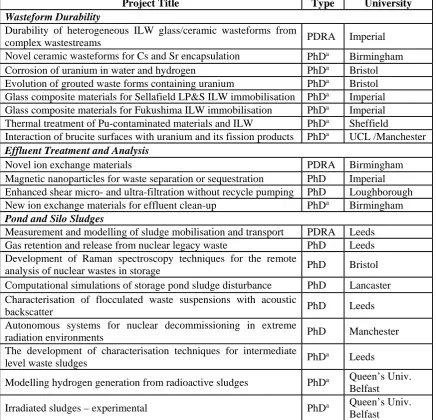
These objectives are being met by several linked projects in three work packages, the details of which are given in Table III.
TABLE III. Projects, researcher type and university undertaking work in the legacy ponds and silo wastes
theme, organised by work package (aindicates associated PhD).
Project Title Type University
Wasteform Durability
Durability of heterogeneous ILW glass/ceramic wasteforms from
complex wastestreams PDRA Imperial
Novel ceramic wasteforms for Cs and Sr encapsulation PhDa Birmingham
Corrosion of uranium in water and hydrogen PhDa Bristol
Evolution of grouted waste forms containing uranium PhDa Bristol
Glass composite materials for Sellafield LP&S ILW immobilisation PhDa Imperial
Glass composite materials for Fukushima ILW immobilisation PhDa Imperial
Thermal treatment of Pu-contaminated materials and ILW PhDa Sheffield
Interaction of brucite surfaces with uranium and its fission products PhDa UCL /Manchester
Effluent Treatment and Analysis
Novel ion exchange materials PDRA Birmingham
Magnetic nanoparticles for waste separation or sequestration PhD Imperial
Enhanced shear micro- and ultra-filtration without recycle pumping PhD Loughborough
New ion exchange materials for effluent clean-up PhDa Birmingham
Pond and Silo Sludges
Measurement and modelling of sludge mobilisation and transport PDRA Leeds
Gas retention and release from nuclear legacy waste PhD Leeds
Development of Raman spectroscopy techniques for the remote
analysis of nuclear wastes in storage PhD Bristol
Computational simulations of storage pond sludge disturbance PhD Lancaster
Characterisation of flocculated waste suspensions with acoustic
backscatter PhD Leeds
Autonomous systems for nuclear decommissioning in extreme
radiation environments PhD Manchester
The development of characterisation techniques for intermediate
level waste sludges PhD
a Leeds
Modelling hydrogen generation from radioactive sludges PhDa Queen’s Univ.
Belfast
Irradiated sludges – experimental PhDa Queen’s Univ.
Belfast
Further details of the outputs from this theme, and their impact, are given in a companion paper.
Structural Integrity
The main aim of this theme is therefore to develop reliable systems for infrastructure characterisation, restoration and preservation, which minimise current, and future, radiation exposure of the workforce whilst providing economically viable technological solutions. The objectives are:
To develop in-situ ground barriers that could act as a ‘second skin’ surrounding on-site structures,
such as silos and ponds, for prevention of subsurface radionuclide migration.
To develop smart solutions for remote crack detection, infrastructure health prediction and building
preservation that can be retrofitted to existing sites.
To develop autonomous systems with increased functionality and to coordinate them through a
CAD-based real-time management system, to facilitate planning and execution of decommissioning works. These objectives are being met by several linked projects in three work packages, the details of which are given in Table IV.
TABLE IV. Projects, researcher type and university undertaking work in the structural integrity theme,
organised by work package (aindicates associated PhD).
Project Title Type University
Physical Ground Barriers for In-Situ Contaminant Containment
In-situ ground contaminant containment (physical barrier) PDRA Strathclyde
In-situ ground contaminant containment (physical barrier) PhD Strathclyde
Development of novel, low cost biomineral permeable reactive
barriers for radionuclide remediation PhD
a Strathclyde
Remote Crack Detection, Infrastructure Health Prediction and Building Preservation
Nano-cracking of cement phases: reactivity and dissolution PhD Strathclyde
Crack sealing and water transport PhD Strathclyde
Monitoring of moisture and chloride in contaminated storage
structures PhD Strathclyde
Simulating radiation damage in cement PhDa Queen’s Univ.
Belfast Impact of recycled concrete fines on the engineering performance
of cementitious infill PhD
a Leeds
Development and Real-time Management of Autonomous Systems for Decommissioning
Production of real-time segmented as-built CAD models for the
planning and execution of remote and human intervention tasks PhD Birmingham
Further details of the outputs from this theme, and their impact, are given in a companion paper.
ACTIVE RESEARCH PROJECTS
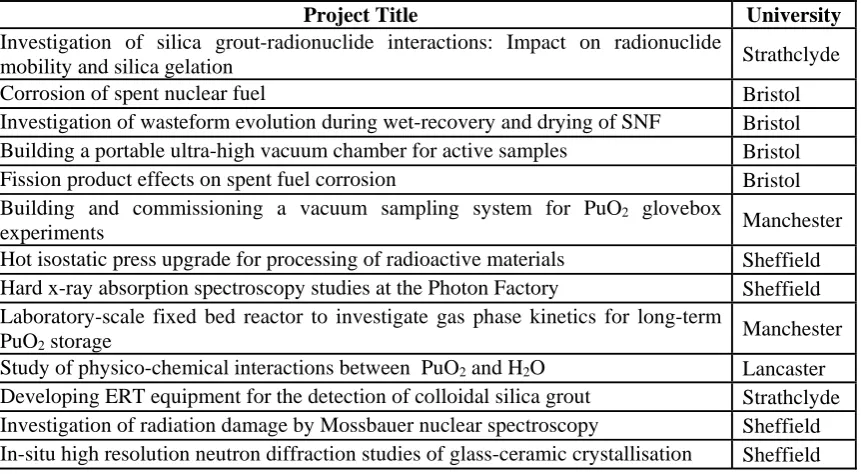
[image:11.595.86.517.364.601.2]A key component of the research programme has been the use of active research facilities at NNL and elsewhere. Active research is costly, time consuming and must be carefully planned. Two major projects were planned at the start of the project which required the embedding of two PDRA staff within NNL. Additionally, a number of other projects indicated a potential need for active research facilities, and the consortium was granted funds in support of these activities. Following four calls for proposals, the flexible funding granted has resulted in 13 activities adding value to the originally proposed projects, with work taking place at 9 laboratories, including in Australia, France, Germany, Japan and the USA. In the UK, this has allowed visiting researchers to work at NNL facilities on active materials that cannot be handled elsewhere. The projects undertaken through this funding route are summarised in Table V. All these projects have led to valuable training for our researchers in the use of active facilities. A companion paper will describe how the consortium is challenging a decline in the national capability for undertaking active research through this targeted programme that addresses waste management research needs utilising high activity materials, and which has contributed to the enhancement and creation of research infrastructure, leveraging best-with-best international collaboration, to deliver impactful research and upskill a cadre of research scientists in radiological materials handling.
TABLE V. Active research projects facilitated through the consortium’s flexible funding.
Project Title University
Investigation of silica grout-radionuclide interactions: Impact on radionuclide
mobility and silica gelation Strathclyde
Corrosion of spent nuclear fuel Bristol
Investigation of wasteform evolution during wet-recovery and drying of SNF Bristol
Building a portable ultra-high vacuum chamber for active samples Bristol
Fission product effects on spent fuel corrosion Bristol
Building and commissioning a vacuum sampling system for PuO2 glovebox
experiments Manchester
Hot isostatic press upgrade for processing of radioactive materials Sheffield
Hard x-ray absorption spectroscopy studies at the Photon Factory Sheffield
Laboratory-scale fixed bed reactor to investigate gas phase kinetics for long-term
PuO2 storage Manchester
Study of physico-chemical interactions between PuO2 and H2O Lancaster
Developing ERT equipment for the detection of colloidal silica grout Strathclyde
Investigation of radiation damage by Mossbauer nuclear spectroscopy Sheffield
In-situ high resolution neutron diffraction studies of glass-ceramic crystallisation Sheffield
IMPACT
As well as the technical impacts noted above, and to be covered in the companion papers, the original proposal identified three distinct groups of non-academic beneficiaries from activities of the project: site licence companies and the associated industrial supply chain; government, regulators and implementation authorities; and, society and stakeholder groups.
Site Licence Companies and the Associated Industrial Supply Chain
half of which are from industry. Industry sponsorship has also been used to support broader participation by beneficiaries not directly associated with the consortium. Theme meetings are also held annually, approximately 6 months before the annual meeting around October/November each year. Three sets of theme meetings have now been held, the last two in Cumbria to enable easy access for industry colleagues. These meetings have provided an opportunity for focused discussion of research findings and emerging collaborative opportunities, assisting integration of knowledge and capability across distinct projects. These meetings have also been well attended by colleagues from industry. A number of challenge-led meetings are also being planned by our industrial partners to harness the broad collective experience and capability of the consortium in meeting specific industry needs-led research challenges, providing a rapid and effective impact mechanism. These are being targeted for 2018, with plans for meetings on in-situ analytical techniques and Pu immobilisation currently being formulated.
More directly, the vast majority of the research projects which make up the overall consortium have at least one and frequently two industrial supervisors who meet researchers regularly on an ad hoc basis. Our key project partners, NDA, NNL and Sellafield Ltd, are members of the Management Board of the consortium, which meets every six months, assisting lead academics in the running of the overall project. The International Advisory Group, which meets annually, includes academic and industrial representatives from the Management Board, as well as other leading researchers from complementary international research organisations. Current non-academic members include: Amec Foster Wheeler, AWE plc, BAM Ritchies, Costain, Environment Agency, Hydrock NMCL, IAEA, Jacobs, LLW Repository Ltd, Longenecker & Associates, MMI Engineering, NDA, NNL, Nuclear Technologies, PNNL, Radioactive Waste Management, Savannah River Consulting, Sellafield Ltd and US Department of Energy (DOE), with the group chaired by Prof. Ian Pegg of the Catholic University of America. Members of both the Management Board and the International Advisory Group review research project progress, provide strategic leadership and ensure relevance, as well as encouraging knowledge transfer activities and collaborations with industry within the UK and overseas.
Presentations by consortium members to encourage engagement were also given at the start of the project to engineers and scientists within industry at two industry roadshow events held at the NNL Central Laboratory in July 2014 and in Warrington in November 2014. Additionally, a similar presentation was given at the three-day Nuclear Operations and DECOM Summit held in Manchester in September 2015 aimed at engineers addressing key issues within the nuclear sector.
A number of presentations have also been made by consortium members in order to promote the project internationally, most notably through a dedicated session at the 2016 WM Symposia, which involved 8 presentations from across all 4 research themes.
Government, Regulators and Implementation Authorities
In terms of Government, regulators and implementation authorities, our research on immobilisation of plutonium residues and stockpile material was presented to the All Party Parliamentary Group on Nuclear Energy in November 2015, attended by 12 Members of Parliament, 2 Members of the House of Lords, and Angela Leadsom MP – then Minister of Energy & Climate Change. Prof. Neil Hyatt discussed the technical progress made on plutonium immobilisation achieved through DISTINCTIVE and the need for a dual track approach to plutonium management in the UK to minimise risk, given the significant cost and technical uncertainty associated with both immobilisation and reuse options [13]. NDA sponsored PhD student Stephanie Thornber also spoke to Members on the fragility of nuclear skills and the need to invest in PhD students to train the leading scientists for the next generation. Angela Leadsom confirmed Government commitment to dealing with the UK’s nuclear waste and decommissioning legacy, and highlighted the need for high quality technical evidence to support appraisal of reuse options, such as that being produced by the DISTINCTIVE project.
Members of the consortium have also promoted DISTINCTIVE during presentations made as part of HMG Foreign & Commonwealth Office delegations to potential UK partners overseas. In 2014, Profs. Lee, Hyatt and Boxall presented at Oak Ridge, Idaho and Argonne National Laboratories as part of a delegation to the US, whilst in 2015 Profs. Boxall and Hyatt made presentations to the Annual Meeting of the Atomic Energy Society of Japan, the Japan Atomic Energy Agency and the Nuclear Damage Compensation and Decommissioning Facilitation Corporation of Japan.
More recently, Dr. Claire Corkhill gave evidence to the US Nuclear Waste Technical Review Board open public meeting held in Richland, Washington, in June 2017, the aim of which was to review information on recent US DOE research activities related to corrosion and the long-term performance of high-level radioactive waste glass.
We are also in the process of arranging further meetings with other influential parliamentary groups and non-departmental public bodies.
Society and Stakeholder Groups
Society and stakeholder groups have been engaged through a number of public activities which were held as part of the Bristol European Green Capital Programme during the summer of 2015 to address the public perception of risk posed by radioactivity and nuclear power in comparison to, and connection with, the more tangible threat posed by climate change. The aim was to enthuse the public about the research being undertaken on the project related to nuclear waste management and decommissioning. A broad cross-section of the public, from school children to local businesses, were involved in a number of activities that stimulated debate and encouraged learning in relation to radioactivity in our environment and the actual (rather than perceived) risk it poses to human health, all in the context of nuclear energy being considered as a green (low-carbon) energy source and in conjunction with the ongoing debate on climate change.
A three-day Public Engagement and Media Summer School was held in Sheffield in June 2016. With decommissioning, nuclear waste treatment and the UK nuclear legacy often featured in the news, and questioned by policy makers, ministers and the public alike, project researchers are often put in the spotlight to discuss their research. As part the project’s impact activities, 30 PhD students and PDRAs from DISTINCTIVE attended this summer school on public engagement, media and science writing. This involved a series of activities, from designing public engagement events, to taking part in a press conference, aimed to give our researchers the confidence to communicate their research now, and in their future academic or nuclear industry careers.
A stakeholder engagement exercise was also organised for use online and at our 3rd Annual Meeting held
in April 2017. The aim was to capture the broader questions concerning the management of radioactive waste in society that are raised by the research within the consortium and beyond. This exercise aimed to allow people to combine their insights to find solutions for complex multi-disciplinary problems. Members of the consortium were encouraged to engage with a broader network of stakeholders that also participated. Contributions are being analysed using a process of Q-method research – a small-scale survey approach whereby different stakeholder participants sort a series of statements into those that are most-liked to least-liked in their own opinion. These are then sorted into a specific distribution pattern and subject to factor analysis, which reveals the different typologies of perspectives that exist around the subject. The method is similar to psychometric research – it shows where different stakeholders agree and disagree on specific issues, and how these relate. Data collection is nearly complete, and the outcomes of the research will be published within the open literature.
Further plans include a World Café, an informal mechanism for public engagement utilising a “drop in format” where members of the public have the opportunity to discuss relevant issues of concern with researchers, and amongst themselves, which is being targeted at National Science Week in 2018. Lastly, a short documentary film focussing on project highlights and achievements, with input from industry, is also in the making.
CONCLUSIONS
New technologies and processing options need to be developed for implementing the safe, timely and cost-effective clean-up and disposal of legacy nuclear waste. This requires a multi-disciplinary approach, and expertise spanning traditional engineering and science boundaries, to undertake the underpinning and applied research required. The DISTINCTIVE consortium is addressing these needs through a team of researches with a range of complementary academic expertise, and through international and industry collaborations that play a major role in project delivery. In doing so the consortium has facilitated new networks between academia and industry, increasing knowledge transfer between the two.
As the decommissioning of numerous nuclear sites within the UK moves forward, and the building of new nuclear power generation plant progresses, it is essential for the university sector to deliver skilled personnel into the industry, particularly due to the demographic of the current workforce. The DISTINCTIVE consortium is helping to meet the ongoing requirement for degree-level professionals by training the next generation of researchers, equipping them with skills and experiences relevant to nuclear waste management and decommissioning issues, including in the use of active materials.
The main aim of the project is to carry out internationally leading science and engineering research in the area of decommissioning and nuclear waste management that has the potential to provide new and innovative pathways to better management of both legacy and future nuclear wastes. At the time of writing, researchers have published 57 peer-reviewed papers and been involved in 139 engagement activities (to audiences of academics, industrialists and members of the public). There have been 27 awards and recognition given to consortium members, in terms of prestigious advisory positions, and research prizes and keynote speaker invitations, and 16 new grants have been awarded based on work undertaken within DISTINCTIVE totalling £2.75M (see http://gtr.rcuk.ac.uk/ for further details). This, and companion papers, have highlighted the main technical achievements and impacts of the project, and the uptake of its successes by industry. With clean-up programmes spanning many decades, and with the many complex challenges that lie ahead, the UK needs a supporting co-ordinated R&D effort such as is provided by the present consortium well into the future.
REFERENCES
1. Department for Business, Innovation & Skills and Department of Energy & Climate Change, Nuclear Energy Research and Development Roadmap: Future Pathways, BIS/13/632, HM Government, Crown Copyright, 2013.
2. Department for Business, Innovation & Skills and Department of Energy & Climate Change, Long-Term Nuclear Energy Strategy, BIS/13/630, HM Government, Crown Copyright, 2013.
3. Department for Business, Innovation & Skills and Department of Energy & Climate Change, Nuclear Industrial Vision Statement, BIS/13/629, HM Government, Crown Copyright, 2013.
4. Department of Energy & Climate Change, Nuclear Power in the UK, 11201-001, HC 511, National Audit Office, 2016.
5. Nuclear Innovation and Research Advisory Board, UK Nuclear Innovation and Research Programme Recommendations, NIRAB-75-10, 2016.
6. Unattributed, A Nuclear Divide, International Atomic Energy Agency Bulletin 50-1, 2008.
7. EPSRC, Independent Review of Fission and Fusion, 2016.
8. Nuclear Decommissioning Authority, Strategy, NDA, Doc. P002798558 03/16, 2016.
9. Nuclear Decommissioning Authority, Strategy, NDA, Doc. 2421693 03/11, 2011.
11. Nuclear Decommissioning Authority, Oxide Fuels: Preferred Options, Doc. SMS/TS/C2-OF/001/Preferred Option, 2012.
12. Department of Energy and Climate Change, Management of the UK’s Plutonium Stocks – A Consultation Response on the Long-Term Management of UK-Owned Separated Civil Plutonium, URN 11D/819, HM Government, 2011.
13. N.C. Hyatt, Plutonium Management Policy in the United Kingdom: The Need for a Dual Track Strategy, Energy Policy, 101, 303-309, 2017.
14. House of Lords, Science and Technology Select Committee, Nuclear Research and Technology: Breaking the Cycle of Indecision, HL Paper 160, 2017.
ACKNOWLEDGEMENTS