This is a repository copy of Climate risks across borders and scales.
White Rose Research Online URL for this paper: http://eprints.whiterose.ac.uk/120485/
Version: Accepted Version
Article:
Challinor, AJ orcid.org/0000-0002-8551-6617, Adger, WN and Benton, TG
orcid.org/0000-0002-7448-1973 (2017) Climate risks across borders and scales. Nature Climate Change, 7. pp. 621-623. ISSN 1758-678X
https://doi.org/10.1038/nclimate3380
© 2017 Macmillan Publishers Limited, Part of Springer Nature. This is an author produced version of a paper published in Nature Climate Change. Uploaded in accordance with the publisher's self-archiving policy.
[email protected] https://eprints.whiterose.ac.uk/ Reuse
Unless indicated otherwise, fulltext items are protected by copyright with all rights reserved. The copyright exception in section 29 of the Copyright, Designs and Patents Act 1988 allows the making of a single copy solely for the purpose of non-commercial research or private study within the limits of fair dealing. The publisher or other rights-holder may allow further reproduction and re-use of this version - refer to the White Rose Research Online record for this item. Where records identify the publisher as the copyright holder, users can verify any specific terms of use on the publisher’s website.
Takedown
If you consider content in White Rose Research Online to be in breach of UK law, please notify us by
Climate risks across borders and scales
Andrew J. Challinor1, W. Neil Adger2 and Tim G. Benton3
Affiliations:
1 School of Earth and Environment, University of Leeds, Leeds LS2 9JT, UK
ORCID: http://orcid.org/0000-0002-8551-6617
2 Geography, College of Life and Environmental Sciences, University of Exeter, Exeter
EX44RJ, UK
ORCID ID: http://orcid.org/0000-0003-4244-2854
3 Faculty of Biological Sciences, University of Leeds, Leeds LS2 9JT, UK
Changing climates are beginning to outpace some components of our food systems. Risk assessments need to account for these rates of change. Assessing risk
transmission mechanisms across sectors and international boundaries and
coordinating policies across government are key steps in addressing this challenge.
Changing climates are projected to result in novel conditions that challenge our ability to adapt. Change is already beginning to outpace the process of breeding crops and having them used by farmers1. The rate of change may begin to outpace other components of food
systems. We already know that, without mitigation, current rates of change will
significantly affect populations across the planet2. Keeping pace with risks in changing
climates requires research and policy to have sufficient lead time to scan for and act on specific future risks.
National-level assessments of climate change impacts and adaptation options seek to
identify gaps between current policy and the policies needed to minimize risk. By definition these national assessments focus on national territory, populations and economic sectors. But national assessments have major blind spots concerning the interaction and
amplification of risks and their international dimensions: how do impacts elsewhere feedback to affect the domestic economy and territory? The US Third National Climate Assessment3 highlighted the cross-border risks for neighbouring countries with shared
water resources The UK s recent Climate Change Risk Assessment (CCRA2017)4 sought for
the first time to systematically assess the risks posed by climate change globally to the UK.
Two cross-border risks emerge from CCRA2017 as requiring urgent policy action. First weather-related shocks to international agricultural production and food supply chains can, through in interaction with multiple other factors, result in food price spikes and reduced access to food for vulnerable groups. Changes in food production and agricultural market instability affect rural economies, food consumers and the fundamental economic geography of every nation.
displaced by weather-related disasters annually and the human costs cascade across countries through demands for humanitarian aid, adaptation support, and economic disruption, estimated at $150-200 billion annually. 5
Transboundary risks are the products of borders and geography: risks are transmitted from one region to another through systematic environmental processes such as downwind movement of air pollution, flows of water and fluctuating resources such as fisheries. The mechanisms of transmission of risk also have multiple direct and indirect pathways and cascade through complex socioeconomic-ecological systems 6. Hence
transmission may come through a wide array of mechanisms: flows of material, flows of people, and economic and trade linkages7. Further, risks may themselves be amplified by
government or societal responses to them8.
Trade interdependence can be one such amplification mechanism, creating risks as well as benefits. The liberalisation of global trade in the past three decades has led to a range of consequences, depending on comparative advantage. Where a country has an advantage from natural endowments, or labour availability, production can be more efficient. Seventy four percent of global calorie production come from wheat, rice, maize, sugar, barley, soy, palm, and potato, where the production is geographically concentrated in a small number of countries9. Virtually every country is dependent on food trade for its local food security
and international commodity market affects local market prices, making disruption to food trade a systemic risk with global impacts. When agricultural commodity markets are stable, reliance on trade can lead to resilience; but if markets are unstable through climate impacts on a few breadbasket areas the result may be reduced resilience. Hence there is emerging recognition that concentration of production enhances climate risks.10
Market instability can arise from multiple sources. Climate extremes can cause supply shortfalls and disruptions to important trade routes (e.g. the Suez Canal) and ports. These impacts can interact with changes in global stockholdings as well as with policy from other domains such as energy11. Further, policies implemented to protect national interests risk
promoting global trade instability. For example, in 2010 India imposed restrictions on rice exports, even though wheat production was impacted by drought in Eastern Europe, driving a rice price spike with impacts across Asia. Thus global connectivity and network asymmetry mean that poor policy responses can exacerbate supply disruptions in a single important location to create global impacts.12 In 2011 a similar process translated
production shortfalls into price volatility via export bans13 with the result that millions of
people were pushed into poverty.
The multiple pathways of interaction and response demonstrate a fundamental
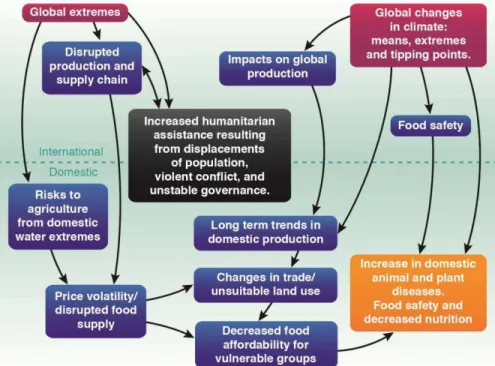
interconnectedness of both climatic and non-climatic risks. Some risks are amplified by borders and the sum of aggregated risks can be significant even if any single risk is relatively minor. Risks can become political crises if they involve sudden onset, affect a large number of people and have significant short term impacts on those populations11 Fig.
CCRA2017 highlighted supply chain interruption and displacement of populations as the two requiring action immediately. Risk assessments for other countries may well highlight other areas, depending on the evidence for international-to-domestic risk transmission (e.g. extent of exposure to global markets) and the ability of existing policy to deal with the risks (e.g. health infrastructure, agricultural policy).
Figure 1. Risks derived from an analysis of international and domestic dimensions of climate change, based on 4 and 12 Blue indicates food system processes; orange indicates
health; black shows trans-border issues.
Some transmission mechanisms are critically dependant on unpredictable elements. For example, long term climate-induced changes in the global pattern of land use suitability send price signals that result in unsustainable intensification of land, with the risk of degrading land further. This in turn risks inducing pressure on the food system and reducing its resilience, as well as enhancing climate risks through increasing sectoral emissions. With different comparative advantages the same price signal could simply result in increasing reliance on food imports for any country. Decreased affordability of food, especially for vulnerable groups, can result from short-term food shocks as well as these longer-term changes. The resulting risks to health and nutrition can themselves be compounded by interactions, for example between the natural and built environments resulting in increased risk of plant and animal disease.4
example, responses to food price volatility have impacts on food security, health, economic growth, trade relations, the environment and conflict risk.
Coordinated policies are not easy to design since they involve multiple government departments with different domains and remits. Further, it is not always clear what the policy should look like. For example, in 2015, France introduced a policy to force supermarkets to donate excess food to charity. This can be expected to improve food security and reduces waste in the short term, but it may discourage development of longer-term changes that could improve efficiency through waste reduction.
We are convinced that national-level risk assessments need to account for complex transmission mechanisms across sectors and international boundaries. Without these international dimensions, assessments and policy responses may significantly
underestimate the risks associated with climate change. The experience of the food, health and disaster communities shows that responses require coordination of strategies across policy domains, but also cooperation, trust in evidence, and trust between nations.
1 Challinor, A. J., Koehler, A. K., Ramirez-Villegas, J., Whitfield, S. & Das, B. Current warming will reduce yields unless maize breeding and seed systems adapt immediately. Nature Clim. Change, doi:10.1038/nclimate3061(2016).
2 Frame, D., Joshi, M., Hawkins, E., Harrington, L. J. & de Roiste, M. Population-based emergence of unfamiliar climates. Nature Climate Change 7, 407-411,
doi:doi:10.1038/nclimate3297 (2017).
3 Jacobs, K. L., Buizer, J. L. & Moser, S. C. The third US national climate assessment: innovations in science and engagement. Climatic Change 135, 1-7,
doi:10.1007/s10584-016-1621-5 (2016).
4 Challinor, A. et al. UK Climate Change Risk Assessment Evidence Report: Chapter 7, International Dimensions. Report prepared for the Adaptation Sub-Committee of the Committee on Climate Change, London. (2016).
5 World Disasters Report 2016. International Federation of Red Cross and Red Crescent Societies 2016. World Disasters Report 2016. IFRC: Geneva. (2016).
6 Liu, J. et al. Systems integration for global sustainability. Science 347, doi:10.1126/science.1258832 (2015).
7 Adger, W. N., Eakin, H. & Winkels, A. Nested and teleconnected vulnerabilities to environmental change. Frontiers in Ecology and the Environment 7, 150-157, doi:10.1890/070148 (2009).
8 The Social Amplification of Risk. (Cambridge University Press, 2003). 9 West, P. C. et al. Leverage points for improving global food security and the
environment. Science 345, 325-328, doi:10.1126/science.1246067 (2014). 10 Michael, J. P., Satyajit, B., So Young, C. & Benjamin, I. C. Assessing the evolving
fragility of the global food system. Environmental Research Letters 10, 024007 (2015).
Report from the UK-US Taskforce on Extreme Weather and Global Food System Resilience, The Global Food Security programme, UK. (2015).