0022-538X/91/062807-09$02.00/0
Copyright © 1991, American Society for Microbiology
Deletion Analysis of
Brome
Mosaic Virus
2a
Protein: Effects
on
RNA Replication and Systemic Spread
PATRICIATRAYNOR,t BENJAMIN M. YOUNG,t AND PAUL AHLQUIST*Institute for Molecular Virology and DepartmentofPlant Pathology, University of Wisconsin-Madison, Madison, Wisconsin53706
Received 7January 1991/Accepted 22 February 1991
Brome mosaic virus (BMV) genomic RNA2 encodes the 94-kDa 2a protein, which is one of two BMV nonstructural proteins required for RNA replication and subgenomic mRNA transcription. 2a contains a
centralpolymeraselike region,which has extensivesequencesimilarity with theSindbis virus nsP4 and tobacco
mosaic virus (TMV) 183-kDa replication proteins, and also contains N- and C-terminal flanking segments
withoutcounterpartsintheSindbisvirus and TMV nonstructural proteins. To further investigate the roles of the central and flankingsegmentsin 2a, wehave constructedaseriesof deletion and frameshiftmutantsina
biologically activeBMVRNA2 cDNAclone and tested their abilityto supportviral RNA replication in barley protoplasts and systemic infection in whole barley plants. The entire 125-amino-acid C-terminal segment
following the polymeraselike region was dispensable for RNA replication and transcription. Within the 200-amino-acid N-terminal flankingsegment, deletion ofthefirst 50 residues dramatically reduced genomic andsubgenomicRNAaccumulation,and deletionof 100or moreresidues abolished detectable RNA synthesis.
Allmutations removing residues from the central polymeraselike domain also blocked RNA replication in
trans. Sequences required incis for RNA2 replication orstability were found to occur within the first 300
nucleotidesofthe2acoding region.Inwhole barley plants, systemicinfectionwasinhibitedevenby 2a deletions
thatsupportedstrongRNAreplicationin protoplasts.Some replication-competent 2a variants failedtospread to uninoculated leaves, while others showed 10- to 500-fold-reduced virus yield in both inoculated and uninoculated leaves. Thesereductions werenot duetoanydefectsin RNA2 encapsidation.
Positive-strand RNA viruses include manysignificant
hu-manandanimalpathogensand themajority of plant viruses. Within thisclass, manyoutwardlydissimilar virusesencode related nonstructural proteins involved in viral RNA repli-cation(5, 13, 21, 25). Theplant bromoviruses, for example, encode RNAreplication factorsthathave extensive similar-ities withnonstructuralproteins ofthe animalalphaviruses, tobacco mosaic virus (TMV), alfalfa mosaic virus, andmany
otherplantviruses.
The type memberof the bromoviruses is brome mosaic virus(BMV). Like other bromoviruses, BMV isan
icosahe-dralvirus whose genome is divided amongRNA1 (3.2 kb),
RNA2 (2.9 kb), and RNA3 (2.1 kb) (2, 4). RNA3 encodes nonstructural protein 3a, which is required for systemic spread of infection (8), and the subgenomic coat protein mRNA,RNA4. RNAs 1 and 2 encodeproteinsla(109 kDa) and 2a(94 kDa), respectively, which togetherare sufficient to direct viral RNA replication in protoplasts (19, 31). A variety of mutations in BMV la or 2a perturb or abolish
RNA replication (33, 34, 53). la is related to the TMV 126-kDaproteinandtoSindbis virusproteinsnsPl and nsP2 (5),which have also beenimplicatedin RNAreplication (23, 24, 28, 52). Recent results suggest that the conserved do-mains in la and itshomologsmayencodeahelicase(22, 26)
andpossibly methyltransferase (38)andguanylyltransferase (16)activities involved in viral RNAcapping.
BMV protein 2a has an extended region ofeven higher
*Correspondingauthor.
tPresent address: Departmentof Botany and Plant Pathology, Michigan StateUniversity, EastLansing, MI48824-1312.
tPresent address: TumorBiology Department, Schering-Plough Research, Bloomfield, NJ07003.
sequence similaritywiththe TMV 183-kDaprotein, Sindbis virus nsP4, and several known RNA-dependent RNA
po-lymerases (9, 25, 30, 43). Thisnearly 500-amino-acid, poly-meraselike conserved domain constitutes the C-terminal 85% of the Sindbis virus nsP4 readthrough proteinand the entire readthrough domain of the TMV 183-kDa protein, whichis translatedby readthrough ofthe leakytermination codonfollowingthe la-like 126-kDaopenreadingframe. The corresponding BMV sequences are located in the central
portionof the 822-residue 2aprotein, beginningnearamino acid 200 andendingnearamino acids 683to689,whichalign with the C termini of the TMV 183-kDa and Sindbis virus nsP4 proteins (25). Thus, 2a contains substantial N- and C-terminal segments that lack apparent counterparts in the corresponding polymeraselike proteins of TMV and Sindbis
virus.
Toinvestigatethe roles of the N- and C-terminal segments flankingthe centralpolymeraselikecoreof BMV 2aprotein,
we have constructed a series of 2a frameshift and deletion mutants and tested these mutants for replication in proto-plasts and systemic infection of whole barley plants. The results show that essentially the entire C-terminal segment but only a smallportion of the N-terminal segment can be deleted from 2a without blocking RNA replication.
More-over, although someN- and C-terminal 2a deletion mutants
arecapableofsupporting systemicinfection ofbarley plants, the in planta yield of virus bearing these mutations was
substantiallyreducedcompared with the wildtype(wt)and didnot parallel the relative levels ofRNA accumulation in
protoplasts. These results complement those ofan earlier RNA replication study that exchanged selected 2a gene segmentsbetween BMV and the related bromovirus cowpea chlorotic mottle virus(CCMV) (53).
2807
on November 10, 2019 by guest
http://jvi.asm.org/
2808 TRAYNOR ET AL.
MATERIALSANDMETHODS
Plasmid constructions. Full-length cDNA copies of wt
BMV RNA1, RNA2, and RNA3 are contained in plasmids
pBlTP3, pB2TP5, and pB3TP8, respectively; infectious
transcripts can be synthesized from these templates by T7 RNA polymerase (29). Deletion and frameshift mutations
were introduced into pB2TP5 asdescribedbelow, by stan-dardrecombinant DNAtechniques (10, 36).RNA2sequence
numberingbelow is asgiven inreference2.
Oligonucleotide-directed, in-frame deletions in the N-ter-minalregionof the BMV 2agenewereperformed according
to the method of Kunkel et al. (35). The deletions in the
initially mutagenized clones were verified by restriction fragment analysisandnucleotide sequencing.Toavoid pos-sibleinclusion ofspuriousmutations thatmight conceivably
havebeenintroduced elsewherein the clonedcDNA, small restriction fragments encompassing the desired changes
werethen subcloned back into wt plasmid pB2TP5. Clone pB2PT14 carries a deletion of nucleotides (nt) 109 to 174 (codons 3 to 24); pB2PT16 has a deletion of nt 111 to 257 (codons 3 to 51); pB2PT18 has a deletion of nt 110 to 406 (codons 3 to 101); and pB2PT24has adeletion of nt 109 to
708(codons3 to 202).InpB2PT20,oligonucleotide-directed mutagenesis was used to change base 97 from C to G and
base 99 from C to T, creating aBclI site and a new AUG
codon nine bases 5' to the wt initiation codon of the 2a reading frame. Translation initiation at thisposition would give Met-Ile-Lys-Met, where the underlined Met
corre-sponds to the normal translational startof the 2aprotein. Internal deletions in the 2a open reading frame were constructed by excising selected restriction fragments and religating the resulting ends. Noncompatible ends were made blunt with T4 DNA polymerase prior to ligation.
Deletions were confirmed by restrictionfragment analysis. pB2PA11 has an in-frame deletion of the NcoI-KpnI frag-ment, nt 887 to 1252(codons 262 to 383). pB2PA12 has an
in-framedeletionof theKpnI-MluI fragment, nt1249 to1680 (codons383 to526). pB2PA13hasaframeshiftingdeletionof
theMluI-SacIfragment, nt 1680 to 2373(codons528to757);
at the ligated junction, the reading frame shifts and termi-nates after nine codons. pB2PT60has aframeshifting
dele-tion of nt 113 to 442, which was constructed by ligating BamHI-bounded fragments from pB2DR18 and pB2DR19 (provided by D. Richards), which are pB2TP5 mutants in
which6-base BamHI linkers were inserted after nt 111and 442, respectively. pB2PT70 has an in-frame deletion of nt
444 to 880 (codons 114 to 259) made by deletion of the
BamHI-NcoI fragment from pB2DR19. pB2PT80 has a
frameshiftingdeletion of nt113 to 880(codons4to259)made by deletion of theBamHI-NcoIfragmentfrompB2DR18.
Frameshift mutations were created by DNA cleavage at unique restriction sites previously introduced by linker
in-sertion mutagenesis, followed by blunting and religation. pB2SB8andpB2SB9, which bearframeshifts after599 and
672 codons, respectively, have been described previously (53). pB2PT10, which has aframeshift after wt codon 697,
wasmade by cleavageata6-baseApaIlinkerinserted after nt 2194 (pB2DR25; provided by D. Richards), followed by
T4 DNA polymerase treatment and religation. pB2PT11,
which has a frameshift after wt codon 790, was made by religating mung bean nuclease-treated, Sall-digested wt pB2TP5 DNA.
pB2PT50 has a deletion of the ApaI-StuI fragment in
pB2DR25, nt 2195 to 2502(codons 698 to 800); thereading
frame terminates after one alternate-frame codon. pBBC2
has been described previously (53); this hybrid RNA2 en-codes a 2aprotein in which the C-terminal 231 amino acids and 3' noncoding region have been replaced by the analo-goussegment from the related virus CCMV.
Double deletion mutants were constructed by digesting
individual RNA2 plasmids at their unique sites for EcoRV (within the center of the 2a open reading frame) and EcoRI (3' to the BMV cDNA insert) and ligating appropriate
fragments recovered from low-melting-point agarose gels. pB2PT64 has a combination of the respective N- and C-ter-minal deletions of mutants pB2PT14 (codons 3 to 24) and pB2PT50 (codons 698 to 822); pB2PT66 combines the re-spective deletions ofmutantspB2PT16(codons 3to51) and pB2PT50.
In vitro transcription, protoplast inoculation, and RNA analysis. Preparation of infectious transcripts, isolation and inoculation ofbarley protoplasts, RNA extraction,
glyoxa-lation, and Northern(RNA) blot analysiswereperformed as
described before (33, 53). Encapsidation of viral RNAs was
assayedby nucleasetreatmentof polyethylene glycol
(PEG)-precipitable virus particles as follows. Approximately
105
inoculated protoplasts were incubated for 40 h and then sonicated for 45 s at 40 W with a Sonifier Cell Disruptor (HeatSystems-Ultrasonics, Inc.; courtesy of P. Wolk). Cell debriswaspelletedat10,000 rpm for 5 min. The supernatant wasmade 9% PEG and 0.185 M NaCl, and 12 ,g of carrier TMV virions was added. After being rocked on ice for 1 h, precipitated viruswaspelleted at 10,000 rpm for 15min and the virions were resuspended in 100 ,ul of 0.5 M sodium acetate(pH
4.8)-80
mMMgCl2. Sampleswereadjustedto1 mMCaC12, and 300 U of micrococcal nuclease (Pharmacia) wasaddedfor digestionat37°C for 15 min. The reactionwasstopped by addition of EGTA (ethylene glycol tetraacetic
acid) to a final concentration of5 mM. PEG-precipitable,
nuclease-protectedviral RNAs were extracted with
phenol-chloroform (1:1) in the presence of 1% sodium dodecyl sulfate(SDS)-0.1 M glycine-0.1 M NaCl-1 mM EDTA (pH
9.5)-2.4
mg of bentonite per ml. Recovered RNAs were denatured with glyoxal and subjected to Northern blotanalysis as described before (33). RNA blots were probed
with SP6 or T7 polymerase transcripts complementary to the conserved3'-proximal200ntof BMV(18) or CCMV (6). The
probespecifictoRNA2(usedinFig.4) was a T7 polymerase
transcript ofacDNAclonecontainingnt30 to 2479ofBMV
RNA2.
Barley inoculation and virion RNA recovery.
Seven-day-old barley plants (Hordeum vulgare L. cv. Morex) were
inoculated with 0.2
jig
each of wt RNA1 and RNA3tran-scriptsand theappropriatemutantor wtRNA2transcript in
5 mgof bentonite per ml-0.25 M NaCl-25 mM Tris-Cl-25
mMNaH2PO4-5 mMEDTA, pH 8.0 (3). All mutants were
tested in four or more separate experiments. For each
experiment with a given mutant, 10 or 12 plants were
inoculated. At 10 to 14 days postinoculation (p.i.), the
inoculatedleavesfromall 10 or 12plants were harvestedand
pooled, and small end portions from all such leaves were
trimmed and discardedasneededtoyieldatotal1-g sample.
Uninoculated leaves were similarly pooled and trimmed to
yieldaseparate1-gsample. These leaf samples were
homog-enized with a Brinkman Polytron PT3000 (courtesy ofR.
Allison). Thehomogenates were clarified, and virions were
precipitatedwith PEG and NaCl by the methods of Verduin
(54). Viral RNA was ethanol precipitated from
phenol-chloroformextractsof1% SDS-lysedvirus, electrophoresed
in 0.8% agarose gels, transferred to nylon membrane, and
hybridized with the BMV 3'-specific probe. The CCMV
J. VIROL.
on November 10, 2019 by guest
http://jvi.asm.org/
DELETION ANALYSIS OF BMV 2a PROTEIN 2809 3'-specific probe was also included in experiments with
BBC2. Virusyieldswereestimated by quantitation of
recov-ered viral RNA by absorbance, by inspection ofethidium
bromide-stained gels and autoradiograms, and, for some
experiments, by quantitation of probed filters with an
AM-BIS MkIIradioanalytic scanner.
RESULTS
To examine the possible contributions of the central
polymeraselike domain and theflanking N- and C-terminal
domains of the BMV 2a protein to RNA replication and systemic spread of BMV infection,aseries offrameshiftand
deletionmutationswereintroducedintoabiologically active
wtBMV RNA2 cDNA clone(Fig.1andTable1).Thedesign of these mutations was aided by inspection of 2a sequence
alignments with similar proteins from alfalfa mosaic virus, TMV, and Sindbis virus (25). Deletion borders and frame-shift siteswereverified byrestriction analysisandnucleotide
sequencingasdescribed in Materials and Methods. In vitro
translation oftranscriptsfrom eachconstruct yielded prod-ucts ofthe expected sizes (resultsnot shown). Most of the RNA2mutantswerefromaplasmid seriesdesignated PTn,
where n is the identification number of each mutant. To simplify labeling, thesemutantsarereferredtointhe figures
by identification number alone (e.g., 16 = PT16). RNA2
mutantsderived fromother series ofplasmidconstructions
are referred to with their identifying prefixes (e.g., SB8, PAll, BBC2). All RNA2 mutants used in this study are
diagramedandlabeled in Fig. 1.
The abilityof thealtered 2a proteinstosupportviral RNA replicationwastestedbyinoculatingbarleyprotoplasts with
invitrotranscripts of each RNA2derivativeplustranscripts
fromwtRNA1and RNA3 cDNA clones. Each mutantwas
tested inatleast sixindependent protoplast experimentsand
gave consistent results. In preliminary experiments, all mutations thatremoved residues from thecentral, polymer-aselike domain of 2aprevented detectable RNA replication
(results not shown). These mutations include contiguous
deletions PT70, PAll,PA12, and PA13, whichtogetherspan
the entirepolymeraselike region (Fig. 1). Frameshift muta-tionsSB8andSB9, affecting onlyC-terminalportions of this region (Fig. 1), also block RNA replication (53). Based on
these results, the N- and C-terminal 2a segments were
targeted for more detailed deletion analysis as described
below.
N-terminal deletions show a gradient of RNA replication
activity. Northern blot analysis showed that 2aproteins with increasingly larger amino-terminal deletions supported de-creasing levels of viral RNA accumulation in protoplasts
(Fig. 2). Deletion of amino acids 3 to 24 in mutant PT14 caused aslight decrease in activity compared with the wt. Deletion of aminoacids 3to51 inmutantPT16substantially reducedbut didnotabolish RNAsynthesis,asevidencedby
theproductionof visible bands forgenomic RNAs 1to3 and
subgenomic RNA4, which is not present in the inoculum. Deletion of amino acids 3 to 101 and 3 to 202, in mutants PT18 and PT24,respectively, blocked detectable RNA
rep-lication. In mutant PT20, basesubstitutions creating a new
AUG codon three codons upstream of thewt 2a initiation sitehadnoapparenteffecton2aactivity (Fig. 2); however,
wehavenotdeterminedthetranslation startsite(s) actually
usedinthismutant.
C-terminal domain flanking the polymeraselike 2a core is
dispensable forRNAreplication. A series of frameshift
mu-tationswereused todemarcate theC-terminalboundary of
0
0 *200
*,|
|.1,~~~~~~~~~~~~~~~~~~~~~~~~~~~~~~~~~~~~~~~~~~~~~~~~
400 600 II0M*usu.*...s SB8
*i.uu.u..u SB9
M*onsoon 10
*01 11
20-p::
wt-14
16
18 60 24 sn
70
PAll
-
PA12-PA13 *
50
:-64 - - -
-66
_~
- - - _ --BBC2
Zmm
FIG. 1. Schematic diagram ofBMV RNA2frameshift and dele-tionmutants.The centraldiagram labeledwtdepicts thestructureof wtRNA2, with the 2a openreading frame boxed and the flanking noncodingregions shownassingle lines. The shadedportion of the 2aopen reading frame, bounded by vertical dotted lines, encodes thepolymeraselike region whose amino acid sequence shows simi-larity with proteins encoded by TMV, Sindbis virus, and certain otherviruses (25). Above the wt RNA2 map, asterisks mark the positions of frameshifts inmutantsSB8, SB9, PT10, and PT11, and thesubsequent untranslatedportions ofthe 2agenearemarkedby dashedlines. (Forbrevity, PTn series mutants aredenoted inthis and laterfigures by identification number alone.)MutantPT20,also shownabove the wtmap,containstwobasesubstitutions thatcreate anewAUG positionedthree codons5' tothe normal 2a startsite (seetext). Below thewtRNA2map,thebold lines show theextent
of sequences deleted inmutantsPT14,-16,-18,-24,-50,-60,-64,-66, -70, and -80, PAll, PA12, and PA13. Mutants PT64 and PT66 contain deletionsatbothends of thereading frame,asindicated. All deletions preserve the2areadingframeexceptforPT60,PT80,and PA13,which introduceframeshiftsfollowing the deletion (see
aster-isks); these mutants were constructed primarily formapping cis-acting sequences (Fig. 4). PA13, which expressesoverhalf of the2a sequence, was also tested for trans-acting activity (see Results). BBC2,diagrammedatthebottom, isanRNA2hybridinwhichthe last231codonsofthe 2agene andthe 3'noncodingregionhavebeen replaced bytheanalogous segment(hatched region)fromtherelated virusCCMV (53). Exactdescriptions of all alterationsaregivenin Materials and Methods, and the codon positions of the N- and C-proximalalterations arelisted in Table 1. Scalesat thetopgive kilobases fromthestartof RNA2 and the number ofencoded amino acidsfrom the startof the2agene.
2a protein sequence required forRNA
replication (Fig. 1).
Theframeshiftin mutant
PT11,
whichprevented
translationofthe last 32amino
acids,
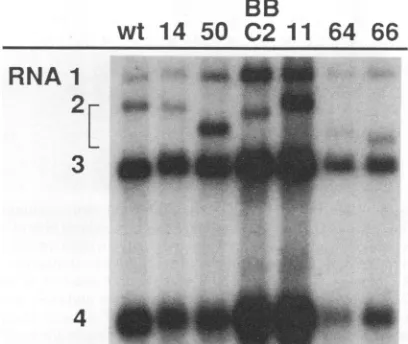
had no detectable effecton viralRNAaccumulation(Fig. 3).MutantPT10containeda
frame-shift onlyeight codons after the end of the
polymeraselike
region,preventing translationof the last 125wtcodons.This
truncated2aproteinwasalso abletodirectRNA
replication,
though viral RNA accumulation was
greatly
reduced(Fig.
3). Frameshifts located 150 codons (mutant
SB9)
and 223codons (mutantSB8) before the end of the2aopen
reading
frame truncated the 2a
protein
within the conservedpoly-meraselike domain. Each of these alterations abolished
detectable RNA
replication (Fig.
3)(53).
m.
=:3..
VOL. 65,1991
II
3k
on November 10, 2019 by guest
http://jvi.asm.org/
[image:3.612.329.565.59.295.2]2810 TRAYNOR ET AL.
TABLE 1. Summaryof amino acids present in 2a proteins with N- or C-terminal alterations
RNA2variant mutationaType of wt residuespresent wt residuesmissingb Alternative-framecodonsaddedc
wt 1-822
N-terminal extension PT20 E 1-822 N 3
N-terminal truncations
PT14 D 1-2, 25-822 N 22
PT16 D 1-2, 52-822 N 49
PT18 D 1-2, 102-822 N99
PT24 D 1-2, 203-822 N200
C-terminaltruncations
PA13 D, F 1-527 C 295 C 9
SB8 F 1-599 C 223 C5
SB9 F 1-672 C150 C 6
PT1O F 1-697 C 125 C9
PT50 D 1-697 C 125 C 1
PT11 F 1-790 C 32 C9
N-and C-terminal truncations
PT64 DD 1-2,25-697 N22,C 125 C 1
PT66 DD 1-2,52-697 N49, C 125 C 1
aD,deletion; E, extension; F, frameshift; DD,doubledeletion.
bNumber of wt residueseliminated from either end of the proteins by frameshiftordeletion. N, N-terminalresidues; C, C-terminal residues.
c Number ofadditional,alternative-frameresidues addedtoeither endoftheprotein by frameshiftordeletion. N,N-terminalresidues; C, C-terminal residues.
To confirm the ability of frameshift mutant PT10 to
support RNA replication and to rule out the possibility of reversion or leaky termination, deletion mutant PT50 was
constructed (Fig. 1 and Table 1). The proteins encoded by
mutants PT10 and PT50 each contain the same wt amino
acids, but while the readingframe in mutant PT10 extends
nine codons after the introduced frameshift, thatin mutant
PT50 terminates after a single alternative-frame codon
downstream from thedeletedsegment.Unliketherelatively low level of mutant PT10 activity, mutant PT50 directed
nearlywtlevels of RNAaccumulation (Fig.3). As wasfound
previously (53), RNA2 hybrid BBC2 also directed
replica-tion atlevels only slightly below wt (Fig. 3). In BBC2 the
BMV 2asegmentfollowingaminoacid591 has beenreplaced
with thecorresponding 2a segment from a distinct
bromovi-rus,CCMV(see reference 7 forcomparison ofthe BMVand
CCMV2aproteins).
wt20
14
16 18 24
RNA
1
2
3
[image:4.612.56.553.88.270.2]4
FIG. 2. Effects ofN-terminal2adeletions onBMV RNA repli-cation. The autoradiogram shows total protoplast nucleic acids
extracted at 20 h p.i., denatured with glyoxal, electrophoresed, transferred to a nylon membrane, and probed to detect progeny
BMVRNAs. Inocula consisted of in vitro transcripts from cDNA clonescorrespondingto wtRNAs 1and 3 plus thewtorPTnseries
RNA2 derivative indicated above each lane. The structure of the RNA2mutantsisgiven in Fig.1.The positions oftheprogenyRNAs areshownontheleft.
MutantPT64combinesthe N- andC-terminal deletions of
mutants PT14andPT50,encodinga2aprotein of676amino acids. The level ofRNA accumulation directed in proto-plasts by this double deletion mutant (Fig. 3) wassimilarto thatof mutant PT14(Fig. 2). MutantPT66, whichbears the
N- and C-terminal deletions of mutants PT16 and PT50,
encodes a 2a protein of 649 amino acids. In repeated
experiments and direct comparisons, the RNA replication
activityof this double truncatedprotein (Fig. 3) was greater
wt
SBi
BB
wt
8 9 10 50 11 C2 64 66
RNA
p
FIG. 3. Effects of C-terminal andcombinedN-andC-terminal2a alterationsonBMV RNAreplication.Northern blotanalysis ofviral RNAreplicationin protoplastswas conducted asdescribed in the legendtoFig.2.Inoculaconsistedof in vitrotranscriptsfrom cDNA clonescorrespondingto wtRNAs 1and3plus theRNA2derivative indicated above each lane. Unprefixednumbers denote PTnseries mutants,and thestructureof all RNA2mutantsisgiveninFig.1. As shownpreviously (53) and inFig. 5below, BBC2 RNA2
accumu-latesto asignificantlevel in such infections. TheBBC2RNA2band was not visualized in this experiment because this blot was only probed to detect RNAs containing the conserved 3'-terminal
se-quences common to wt BMV virion RNAs, while in BBC2 the 3'-terminalnoncodingsequencesandaC-terminal sectionof the 2a gene have been replaced with the corresponding sequences from CCMVRNA2(Fig. 1).
J. VIROL.
on November 10, 2019 by guest
http://jvi.asm.org/
[image:4.612.319.547.445.589.2] [image:4.612.89.263.508.641.2]added
[-PA
-template
--
18 60 24 80
70
11
12 13
wt
14
50
C2 11 64
BB
wt
RNA2
[image:5.612.60.297.72.185.2]A
RNA2
FIG. 4. Amplification of deleted RNA2 templates after
coinocu-lation with the complete wt BMV genome. The autoradiogram
shows a Northern blot of protoplast nucleic acids from
four-componentinoculations, in which the inoculum consisted ofin vitro
transcripts from cDNA clones ofwt RNAs 1, 2, and 3 plus the
additional deleted form of RNA2 indicated aboveeach lane.
Unpre-fixednumbers denote PTn series RNA2mutants.The lane marked
- -contains RNA from protoplasts inoculated only with transcripts
ofwt RNAs 1, 2, and 3. The blot was hybridized with aprobe
specific for RNA2. Positions ofwtand deleted RNA2sareindicated onthe left. All deletion derivativesareelectrophoretically distinct fromwtRNA2 and migrate within the bracketed region.
than that of mutant PT16, which has only the relevant N-terminal deletion (Fig. 2).
For all frameshift and deletion mutants that supported RNA replication, negative-strand RNA accumulation was
determinedby probing Northern blots of glyoxal-denatured protoplast RNA withanegative-strand-specific BMV probe,
asinprevious experiments (33, 34). In allcases, the ratio of
negative- topositive-strand RNA accumulation was similar tothat in thewt(resultsnotshown). To explore the possible existence of multiple independent 2a functions or domains,
protoplasts were inoculated with selected combinations of
nonviable N- and C-terminal RNA2mutants pluswtRNA1 and RNA3. No replicationwas detected whenmutantPT18
or PT24 was coinoculated with either mutant SB8 or SB9 (results not shown). Similarly, coinoculation of weakly
ac-tive mutants PT16 and PT10 plus wt RNA1 and RNA3 transcriptsdidnotenhance the low level of RNAreplication directed byeither of thesemutantsindividually.
Somedeletions showcis-acting effectsonRNA2 accumula-tion. Sequences required incis for normal accumulation of bromovirus RNAs include but are notalways restricted to terminal regions (1, 11, 17, 39, 42, 44, 47). For example,
sequences in the central intercistronicregion, aswellas 5'-and 3'-proximal regions, are necessary for efficient BMV RNA3 accumulation in vivo (17). Experiments with BMV-CCMV RNA2 hybrids also suggested that 5'-proximal
se-quences extending into the 2a reading frame influence the accumulation of BMV RNA2 and the differential in vivo recognition of BMV and CCMVRNA2 by theirrespective replicases (53).
To further localize internal sequences with cis-acting effects on RNA2accumulation, the activity of the deletion mutantsshown in Fig. 1astemplatesfor in vivoreplication
was examined. Collectively these deletions spanall but the extreme3' end of the 2aopenreadingframe(Fig. 1). Viable N-terminal 2a deletion mutants PT14 and PT16 have no
obvious cis-acting defect, since the amplification of these RNA2derivativesinnormalthree-componentinoculations is comparable to that of the wt RNA1 level in the same
infections (Fig. 2). A highlevel of RNA2 template activity
4
l.FIG. 5. Encapsidation of altered RNA2 molecules. Protoplasts wereinoculated with transcripts from cDNA clones ofwtRNAs1 and 3 andthe RNA2 derivative indicated above each lane. Unpre-fixed numbers denote PTn series RNA2 mutants. After 40 h of incubation, protoplasts were harvested and sonicated. Virus was precipitated from the clarified sonicate with PEG. After nuclease
treatmentof the virus pellet, the encapsidated RNAswereextracted with phenol, electrophoresed, transferred to a nylon membrane, hybridized withtwo distinct 32P-labeled probes complementaryto
the 3' noncoding regions of BMV and CCMV RNAs (to detect BBC2), and autoradiographed.
was similarly apparent in inoculations with C-terminal RNA2 deletion mutant PT50 (Fig. 3).
Allother deletionsin thiscollection blockedtheabilityof 2aprotein to support RNA replication in trans (Fig. 2 and results not shown). To determine the cis-acting effects of these remaining deletions, each mutant was coinoculated
into protoplasts along with in vitro transcripts from wt RNA1, RNA2, and RNA3 cDNAclones, thusprovidingall virus functions includingwt 2aprotein intrans(53).
Differ-encesinelectrophoretic mobilityallowed thewtand deleted forms of RNA2to be clearly separated inagarose gels and the level of theirrespective accumulationtobecompared by hybridization to an RNA2-specific probe. Mutants PAll,
PA12, and PA13 wereamplifiedinfour-component inocula-tions, although they accumulated to lower levels than wt RNA2 (Fig. 4). These mutants have large nonoverlapping deletionswithin the central conservedregion of 2a(Fig. 1). Bycontrast,therewas nodetectable accumulation of N-ter-minal deletion mutants PT18, PT24, PT60, and PT80 and internal deletionmutant PT70whenwtBMVproteins were
suppliedintrans(Fig. 4).
Viable RNA2 derivativesareencapsidated.RNAsequences
that directspecificinteractions with viralcapsid proteinhave been described for several viruses, includingTMV(20)and Sindbis virus (55). Accordingly, as preparation for whole-plant tests, the BMV RNA2 derivatives that supported significant RNA replication intrans were assayedfor their ability to be encapsidated into virus particles in barley protoplasts. These RNA2 derivatives (mutants PT11, -14, -50, -64,and -66 andBBC2)wereall recovered frominfected
protoplasts in a PEG-precipitable, nuclease-resistant form (Fig. 5). Previous results confirm that this encapsidation
assay is completely dependent on the expression of BMV coatproteinand itsabilitytointeract with viral RNA(6, 50). The similar ratios of progeny genomic and subgenomic
g'm
66
I,,
RNA 1
2-3
on November 10, 2019 by guest
http://jvi.asm.org/
[image:5.612.335.539.78.250.2]2812 TRAYNOR ET AL.
120 BB
wt 14 50 C2 11 64 66
leaf: u u u u u u u
RNA 1
FIG. 6. Effects of BMV RNA2mutationsonvirusaccumulation inbarley plants. The autoradiogramshowsaNorthern blot of virion RNAsrecoveredat14daysp.i.from inoculated(i)and uninoculated
(u)leaves ofbarley plantsinoculated with in vitrotranscriptsfrom cDNAclones ofwtRNAs 1and 3 plustheindicated wtormutant RNA2. Unprefixed numbers denote PTn series mutants. Samples
fromequivalentamountsof tissuewereused for all lanesexceptfor thesamplesfromwt-infected plants,forwhichequivalentvolumes of 20-fold-dilutedsample (1/20) wereloaded. BMV RNApositions
areshownontheleft. Both BMV- andCCMV-specific probeswere
usedasinFig. 5.
RNAs inthe encapsidated (Fig.5)andtotal RNA(Fig.2and
3) extracts show that the introduced deletions did not
detectably reduce theefficiency of RNA2 encapsidation.
RNA2 mutations affect BMV systemic infection ofbarley.
Omission ofanysingle BMVgenomic RNAtranscript from the inoculum prevents systemic infection of barley plants
(3). Inactivation of either the 3aor the coatgene onRNA3 also abolishes systemic spread of bromoviruses in host
plants(8, 50).Toexamine thepossible effects of deletions in RNA2 and the 2aprotein oninfection ofbarley, transcripts
of RNA2 mutants PT11, -14, -50, -64, and -66 and BBC2
were inoculated onto barleyplants together with wtRNA1 and RNA3 transcripts. Thesemutants werechosen because
theyexhibited wtoronly moderately reduced RNA
replica-tion inprotoplasts (Fig. 2and 3). Eachmutantwastested in fouror moreseparateexperiments.At 7to10daysp.i.,80%
ormoreofwtBMV-inoculatedplantsshowedtypicalmosaic
symptoms, stunting, and chlorosis in both inoculated and uninoculated leaves. Plants inoculated withanyof the above
mutants remained symptomless as long as they were ob-served (4weeks p.i.).
At 2weeks p.i., virus was separately purified from inoc-ulated and uninocinoc-ulated leaves of the aboveplants,andviral RNAswere recovered and subjected toNorthern blot
anal-ysis (Fig. 6). In all cases, much less virion RNA was
recovered from the leaves of mutant-infected plants than from wt-infectedplants. Despite thenearly wtlevelofviral
RNAs inprotoplasts inoculated withmutantPT14, similarly
inoculated plants accumulated approximately 100-fold less virusthanwt-infectedplants. Plants inoculatedwithmutant
PT11, which exhibited wt RNAreplication levels in
proto-plasts, accumulated 10- to 20-fold less virus than
wt-inocu-lated plants. Mutant PT50-infected plants contained 20- to
30-fold less virus than wt-infected plants. Double deletion
mutants PT64 and PT66, which replicated to intermediate
levels in protoplasts, accumulated to levels approximately
500-foldbelowthe wtin inoculatedleaves; trace amountsof
mutant PT64 butnot ofPT66 were recovered from
uninoc-ulatedleaves.Similarly,RNA2hybridBBC2 accumulatedto
averylow level ininoculated leavesbutwasneverdetected inuninoculated leaves (Fig. 6).
DISCUSSION
The sequence of BMV 2a proteincanbedivided into three segments:alarge central domain with extensivesimilarityto polymeraselike proteins from many other RNA viruses and N-and C-terminal flanking domains without obvious coun-terpartsin the nonstructural proteins of these other viruses (25). We have used a series of BMV RNA2 mutantsencoding truncated 2a proteins to examine the role of the noncon-served flanking domains in directing RNA replication in protoplasts and systemic infection in barley. These experi-mentshave identified terminal regions of the 2aprotein that aredispensable for RNA replication and defined a functional corethatprovides all 2a functions required for the synthesis
ofpositive- andnegative-strand genomic RNAs and
subge-nomic RNA. The results show some parallel with mutational analysis of the bacteriophage-encoded
Qp
replicaseprotein, which identified a central polymeraselike domain intolerant of amino acid changes, flanked by terminal domains morepermissive of insertions and substitutions (40). Our
experi-ments also demonstrate that alterations in 2a protein can
have differential effects on RNA replication in protoplasts
and virusaccumulation inwhole plants.
trans-acting effects of N- and C-terminal 2a deletions on RNA replication. No clear-cut boundary between required and dispensable 2a sequences in the N-terminal flanking segment was evident. Small and moderate-sized deletions were associated with corresponding reductions in overall
RNA accumulation; larger N-terminal deletions abolished
RNAreplication(Fig. 2). This gradient of diminishing activ-ity extends earlier evidence that the N-proximal sequences in 2acontribute animportantfunction or functions to RNA
replication. By exchanging selected 2a gene segments
be-tweenBMV and the related bromovirus CCMV, we
previ-ouslyfound that sequences within the N-terminal 358 amino
acids of 2a are a major determinant of the successful
interaction of2a withla protein, RNA1,orboth (53). Recent results suggest that la, 2a and several host proteins exist as an immunoprecipitable complex in BMV polymerase ex-tracts (45). A role for the nonconserved N-terminal 2a segment informinganoncovalent complex between 2aand lawouldexplain the absence of corresponding sequences in
TMV, since theTMVproteindomains analogous to la and
to the polymeraselike core of 2a are covalently linked by
translational readthrough in the TMV 183-kDa RNA repli-cationprotein (see the introduction).
In contrast to the relatively gradual decline in activity exhibitedbyN-terminal deletions, theC-terminalboundary of BMV 2a sequences required for RNA replication was moreclearly demarcated. Proteins lacking the last 125 amino acids were active; those lacking the last 150 residueswere
completely inactive (Fig. 3). As shown in Fig. 1, these
endpoints closely flank the C-terminal boundary of the
polymeraselikeregion in 2a, which has similarity with
Sind-bis virus nsP4, TMV 183-kDa protein, and other viral
proteins. Significantly, theregion of similarity defining this
boundary extendstowithin afew residues of the ends ofthe Sindbis virus and TMV proteins (25). The deletion results
may partially explain the previous finding that antibodies
againstapeptidecontaining the last 26 amino acids of BMV
2afailedtoinhibit RNA synthesis by a 2a-containing extract from BMV-infected cells (46). In fact, while deleting the last 125amino acids of2acaused a very slight reduction in RNA
accumulation, deleting the last 32 amino acids had no
detectable effect on RNA replication (Fig. 3, mutants PT50 and PT11). The highreplicative activity of mutant PT11 is J. VIROL.
on November 10, 2019 by guest
http://jvi.asm.org/
[image:6.612.62.298.77.173.2]also consistent with the observation that the C-terminal 19 amino acids of BMV 2a are missing from the closelyrelated but shorter CCMV 2a protein (7).
By combining N- and C-terminal deletions into one doubly truncated protein, mutant PT66 defines a core region of the 2a protein that is sufficient for all requisite RNA replication and transcription functions (Fig. 1 and 3). Presently it remains unclear why the loss of 2a activity due to the N-terminal deletion of mutant PT16 was partially restored in mutant PT66 by subsequent deletion of C-terminal se-quences (Fig. 2 and 3). This might reflect protein folding and/or stability differences, and the dissimilar replication activities of mutants PT10 andPT50,which differed only in the number ofalternative-frame codons translated after the introduced frameshift or deletion, may have a similar basis. BMV RNA replication entails multiple functions, includ-ing templaterecognition and binding for positive- and nega-tive-strand synthesis, subgenomic promoter binding, initia-tion, elongainitia-tion, strand separainitia-tion, and capping. The large sizes (103 and 94 kDa) of the BMV la and 2a proteins and the presumptive multiplicity of virus-specific functions they must fulfill suggest that one or both may bemultifunctional. The phenotypes of previously characterized site-specific 2a substitution mutants are also consistent with this possibility (33). None of themutants in this study, however, exhibited a defect demonstrably specific to positive-strand, negative-strand, orsubgenomic RNA synthesis, and lethal or weakly active N- and C-terminal deletions failed to complement each other. Thus, the required N-terminalregion and central polymeraselike core of 2a may carry out a single function or linked functions, or some physical constrains may prevent complementation between these regions when carried on separate proteins.
cis-actingeffects of deletions on RNA2 accumulation. Viral RNAs necessarily contain sequences or structures that des-ignate them as templates for viralreplicase. Negative-strand promoter functions reside in the highly structured, tRNA-like end conserved among the 3' noncoding regions of all three BMV genomic RNAs (1, 15, 17, 47). 5' nontranslated sequences of BMV and CCMV RNAs are alsorequired in cis for RNA replication, apparently for promoting positive-strand synthesis (17, 42, 44), and intercistronic noncoding sequences strongly influence BMV RNA3 amplification in cis (17). Results presented here show that cis-acting se-quences regulating BMV RNA accumulation are not always restricted to noncoding regions. Deletion analysis defined a region within the 2a open reading frame, less than 300 nt long, that contains sequences requiredfor detectable accu-mulation of RNA2 in BMV-infected cells (Fig. 1 and 4). Deletions in this region either may remove some cis-acting primary sequence or may influence the higher-order struc-ture of RNA2. These data areconsistent withearlier results that suggested that sequences important for RNA2 replica-tion template activity reside within a large 5'-proximal domain extending into the coding region (53). The Sindbis virus nsPl coding region similarlycontains acis-acting RNA encapsidation signal (55) and a 51-base conserved sequence suspected but not proven to have a cis-acting role in
posi-tive-strand initiation (41).
Differences in RNA stability as well as synthesis may contribute to differences in accumulation within inoculated cells. The mutant RNA2s that failed to accumulate after coinoculation with the complete wt genome (mutants PT18, -24, -60, -70, and -80; Fig. 4)appeared no more labile thanwt RNA2 wheninoculated singly into protoplasts and examined at 20 h p.i. (data not shown). This suggests that the effective
in vivo stabilities of the mutant RNAs were equivalent to
that of wt RNA2, though it does not prove this, since the transfected RNA population monitored in such assays might not have the same intracellular distribution as actively replicating viral RNA. If the mutants are not substantially
reduced in RNA2 stability, their failure to support RNA replication in trans could not result solely from a cis-acting defect in RNA2 amplification. RNA2 made nonreplicatable by removal of the 3' noncoding region, when inoculated together with wt RNAs 1 and 3, supports easily detected amplification of RNAs 1, 3, and 4 (32, 49). The absence of detectable trans-actingreplication activity in mutants PT18, -24, -60, -70, and -80 (Fig. 2 and results not shown)therefore
suggests that these deletions mayinactivate the encoded 2a protein as well asdisrupting RNA2 accumulation.
Influence of RNA2 and 2a protein changes on systemic infection. When viable RNA2 mutants with
N-terminal,
C-terminal, or combined changes in the 2a open reading
frame were tested in barley plants, virus accumulation in inoculated anduninoculated leaves did notparallel thelevel of viral RNAaccumulation inprotoplasts (Fig. 6).Rather,2a mutants showing wt ornearly wt RNAreplication in proto-plasts alldisplayed much greater overall disadvantages
(10-fold to over 500-fold) in plants relative to wt virus. All detectable spread of virus from inoculated to uninoculated
leaves was blocked for deletion mutant PT66 and hybrid
BBC2, inwhich aC-terminal2aportionwas replaced bythe equivalent gene segmentfromCCMV,abromovirusadapted
to systemically infect legumes rather than grasses (53).
Theseeffects were not due todefects in encapsidationof the RNA2 derivatives (Fig. 5). Because the mechanisms of symptom induction in bromovirus-infected plants are un-known, it is unclear whether the lack of symptoms in the mutant-infected plants was due to thereduced virus concen-tration alone or to more specific effects.
The disparity between the replication levels of these mutants on an individual protoplast basis and the relative accumulation of virus in whole plants suggests that the observed yield reductionsin plants may result from defects in the spread ofinfection or conceivablyfrom alterations in host responses toinfection (27). Plant virus infection entails both short-range (cell-to-cell) and long-range
(systemic)
spread ofvirions or viral components in host plant tissues. Despite important recent advances (12, 56), the transport mechanism(s) underlying such infection spread remains un-certain. For TMV and BMV, normal
spread
of infection throughout hostplantsrequiresanonstructural virusprotein
dispensable for RNAreplication (TMV 30-kDa
protein
and BMV 3a protein [8, 14, 37]) and coat protein(8, 50, 51).
Previous reassortment studies with the
genomic
RNAs of BMV, CCMV, and related viruses have also shown that RNA1, RNA2, orbothplay arole in systemicspread
and/or hostspecificity (6, 48, 57). Thepossible role of2aprotein
in systemic spread or in the induction of host responses that limit virus infection (27) is currently unclear.Overall,
the effects of the RNA2 mutations onwhole-plant
infection suggest either that RNA2 encodes functions other than its recognized role in RNA replication or that transport of progeny genomes islinked in someway totheirsynthesis.
ACKNOWLEDGMENTS
We thank Radiya Pacha, Philip Kroner, Richard Allison, and MichaelJanda for usefuldiscussions and comments on the
manu-script. A portion of this work was completed at Michigan State University in laboratory space generously provided by G. A. de Zoeten, DepartmentofBotany andPlantPathology.
on November 10, 2019 by guest
http://jvi.asm.org/
2814 TRAYNOR ET AL.
Thisresearchwassupported bythe National Institutes of Health
under Public Health Servicegrant GM35072and bythe National Science Foundation under award DMB-9004385.
REFERENCES
1. Ahlquist, P., J. J. Bujarski,P.Kaesberg,and T. C. Hall. 1984. Localization of the replicase recognition site within brome
mosaic virus RNA by hybrid-arrested RNA synthesis. Plant
Mol. Biol. 3:37-44.
2. Ahlquist, P., R. Dasgupta, and P. Kaesberg. 1984. Nucleotide sequenceof the brome mosaic virusgenomeand itsimplications
for viralreplication. J. Mol. Biol. 172:369-383.
3. Ahlquist, P., R. French,M.Janda,and L. S. Loesch-Fries. 1984.
MulticomponentRNAplantvirus infection derived from cloned
viralcDNA. Proc. Natl. Acad. Sci. USA81:7066-7070. 4. Ahlquist, P., V. Luckow, and P. Kaesberg. 1981. Complete
nucleotidesequenceof brome mosaic virus RNA3. J. Mol. Biol. 153:23-38.
5. Ahlquist, P., E. G. Strauss, C. M. Rice, J. H. Strauss, J.
Haseloff,and D.Zimmern. 1985. Sindbis virusproteinsnsPl and nsP2 contain homology tononstructural proteinsfromseveral RNAplant viruses. J. Virol. 53:536-542.
6. Allison, R.,M.Janda,and P.Ahlquist.1988. Infectious in vitro
transcripts from cowpea chlorotic mottle virus cDNA clones and exchange of individual components with brome mosaic
virus.J. Virol. 62:3581-3588.
7. Allison, R., M. Janda, and P. Ahlquist. 1989. Sequence of cowpeachloroticmottle virus RNAs 2 and 3 and evidence ofa recombination event during bromoviral evolution. Virology
172:321-330.
8. Allison, R., C. Thompson,and P. Ahlquist.1990. Regeneration
ofafunctional RNA virus genome byrecombination between deletion mutants and requirementforcowpeachloroticmottle
virus 3aandcoatgenesforsystemic infection. Proc.Natl. Acad. Sci. USA 87:1820-1824.
9. Argos,P.1988.Asequencemotif inmanypolymerases.Nucleic Acids Res. 16:9909-9916.
10. Ausubel,F. M., R.Brent, R. E. Kingston,D. D. Moore, J. G.
Seidman, J. A. Smith, and K. Struhl (ed.). 1987. Current
protocolsinmolecularbiology,vol. 1 and 2. JohnWiley&Sons, Inc.,New York.
11. Bujarski, J. J., P. Ahlquist, T.C. Hall, T. W. Dreher, and P.
Kaesberg. 1986. Modulation ofreplication, aminoacylationand
adenylation in vitro and infectivity in vivo of BMV RNAs
containingdeletions within the multifunctional 3' end.EMBO J.
5:1769-1774.
12. Citovsky, V., D. Knorr, G. Schusterand P. Zambryski. 1990.
The P30movementproteinof tobacco mosaic virus isa single-strandednucleic acidbinding protein.Cell 60:637-647. 13. Cornelissen, B., andJ. Bol. 1984. Homologybetweenproteins
encodedbytobacco mosaic virus andtwotricornaviruses. Plant Mol. Biol.3:379-384.
14. Deom, C. M., M. J. Oliver, and R. N. Beachy. 1987. The 30-kilodaltongeneproductoftobacco mosaic viruspotentiates
virusmovement.Science 237:389-394.
15. Dreher,T.W., andT. C. Hall. 1988. Mutationalanalysis of the
sequence and structural requirements in brome mosaic virus RNAforminus strand promoteractivity.J. Mol. Biol. 201:31-40.
16. Dunigan, D. D., and M. Zaitlin. 1990. Capping of tobacco
mosaicvirus RNA. J. Biol. Chem. 265:7779-7786.
17. French, R., and P. Ahiquist. 1987. Intercistronic as well as terminal sequences are required for efficient amplification of bromemosaic virus RNA3. J. Virol. 61:1457-1465.
18. French, R., and P. Ahlquist. 1988. Characterization and engi-neering ofsequences controlling synthesis of brome mosaic
virussubgenomic RNA. J. Virol. 62:2411-2420.
19. French, R., M. Janda, and P. Ahlquist. 1986. Bacterial gene inserted in an engineered RNA virus: efficient expression in monocotyledonous plant cells. Science 231:1294-1297.
20. Fukada, M., Y. Okada, Y. Otsuki, andI.Takebe.1980. Thesite
ofinitiation of rod assembly on the RNA ofatomato anda
cowpeastrain oftobacco mosaic virus. Virology 101:493-502.
21. Goldbach, R. 1987. Genome similarities between plant and animal RNA viruses. Microbiol. Sci. 4:197-202.
22. Gorbalenya,E.A.,E. V.Koonin,A. P.Donchenko,and V. M. Blinov. 1988. A conserved motif inputativehelicases. Nature (London)333:22.
23. Hahn,Y. S.,A.Grakoui, C. M.Rice,E.G.Strauss,andJ. H. Strauss. 1989.Mappingof RNA-temperature-sensitivemutants of Sindbis virus:complementationgroup Fmutantshave lesions in nsP4. J.Virol. 63:1194-1202.
24. Hahn, Y.S.,A.Grakoui, C. M.Rice,E. G.Strauss,andJ. H. Strauss.1989.Mappingof RNA-temperature-sensitivemutants of Sindbis virus: assignmentofcomplementationgroupsA, B, and Gtononstructuralproteins.J. Virol. 63:3142-3150. 25. Haseloff, J.,P. Goelet, D. Zimmern,P. Ahiquist,R.Dasgupta,
and P. Kaesberg. 1984. Striking similarities in amino acid sequence among nonstructural proteins encoded by RNA
vi-ruses that have dissimilar genomic organization. Proc. Natl. Acad. Sci. USA81:4358-4362.
26. Hodgman, T. C. 1988. Anew superfamily ofreplicative pro-teins. Nature(London)333:22-23.
27. Hull,R. 1989.Themovementof virusesinplants.Annu. Rev. Phytopathol.27:213-240.
28. Ishikawa,M., T. Meshi, F. Motoyoshi, N. Takamatsu, and Y. Okada. 1986. In vitro mutagenesis of the putative replicase genes of tobacco mosaic virus. Nucleic Acids Res. 14:8291-8305.
29. Janda, M.,R.French,and P.Ahlquist.1987.High efficiencyT7 polymerase synthesis of infectious RNA from cloned brome mosaic virus cDNA andeffects of5' extensions ontranscript
infectivity.Virology158:259-262.
30. Kamer,G.,andP. Argos. 1984.Primarystructuralcomparison
ofRNA-dependent polymerasesfromplant,animal and
bacte-rialviruses. Nucleic AcidsRes. 12:7269-7282.
31. Kiberstis, P., L. S. Loesch-Fries, and T. C. Hall. 1981. Viral
protein synthesis in barley protoplasts inoculated with native
andfractionated brome mosaic virusRNA. Virology 112:804-808.
32. Kroner, P.,M.Janda,and P. Ahlquist.Unpublisheddata. 33. Kroner, P., D. Richards, P. Traynor, and P. Ahlquist. 1989.
Defined mutations inasmallregionof the brome mosaicvirus 2a genecausediversetemperature-sensitiveRNAreplication
phe-notypes. J. Virol.63:5302-5309.
34. Kroner,P.,B. M.Young,and P.Ahlquist.1990.Analysisof the role ofbrome mosaic virus laprotein domains inRNA repli-cation using linker insertion mutagenesis. J. Virol. 64:6110-6120.
35. Kunkel,T.A.,J.D.Roberts,and R. A. Zakour.1987.Rapidand efficientsite-specificmutagenesiswithoutphenotypicselection. MethodsEnzymol. 154:367-382.
36. Maniatis, T., E. F.Fritsch, andJ. Sambrook. 1982. Molecular cloning:alaboratorymanual. ColdSpringHarborLaboratory, ColdSpring Harbor,N.Y.
37. Meshi, T.,Y. Watanabe,T.Saito,A.Sugimoto,T.Maeda,and Y.Okada. 1987.Function ofthe 30kdproteinof tobaccomosaic virus: involvement incell-to-cell movementanddispensability
forreplication. EMBOJ.6:2557-2563.
38. Mi, S., R. Durbin, H. V. Huang, C. M. Rice,and V. Stollar. 1989.Association of the Sindbis virus RNAmethyltransferase
activitywith the nonstructuralproteinnsPl.Virology 170:385-391.
39. Miller, W. A., J. Bujarski, T. Dreher, and T. Hall. 1986. Minus-strandinitiationbybrome mosaicvirusreplicasewithin the 3' tRNA-like structure ofnative and modified RNA
tem-plates.J.Mol. Biol. 187:537-546.
40. Mills,D.R.,C.Priano,P.DiMauro,andB. D.Binderow.1988. Q1 replicase: mapping the functional domains of an RNA-dependentRNApolymerase.J. Mol. Biol.205:751-764. 41. Niesters,H. G.M.,andJ.H. Strauss.1990.Mutagenesisofthe
conserved 51-nucleotide region of Sindbis virus. J. Virol. 64: 1639-1647.
42. Pacha, R.F., R. F. Allison, and P. Ahlquist. 1990. cis-acting
sequencesrequiredforin vivoamplification ofgenomicRNA3
are organized differently in related bromoviruses. Virology J.VIROL.
on November 10, 2019 by guest
http://jvi.asm.org/
174:436-443.
43. Poch,O.,I. Sauvage,M.Delarue, and N. Tordo. 1989.
Identifi-cation of four conserved motifs among the RNA-dependent polymerase encoding elements. EMBOJ. 8:3867-3874.
44. Pogue, G. P.,L. E.Marsh, and T. C.Hall. 1990.Pointmutations in the ICR2 motif of brome mosaic virus RNAs debilitate (+)-strand replication. Virology 178:152-160.
45. Quadt, R., and E. M. J. Jaspars.1990.Purification and charac-terization of brome mosaic virus RNA-dependent RNA poly-merase. Virology 178:189-194.
46. Quadt, R., H. J. M. Verbeek, and E. M. J. Jaspars. 1988. Involvement ofanonstructural protein in the RNAsynthesis of bromemosaic virus.Virology 165:256-261.
47. Rao, A. L. N., T.W.Dreher, L. E.Marsh,andT. C.Hall.1989. Telomericfunction of the tRNA-likestructureof brome mosaic virus RNA. Proc. Natl. Acad. Sci. USA 86:5335-5339. 48. Rao, A. L. N.,and R.B. Francki. 1982. Distribution of
deter-minants for symptom induction and host range on the three
RNA components of cucumber mosaic virus. J. Gen. Virol. 61:197-205.
49. Rao, A. L. N., and T. C. Hall. 1990. Requirement foraviral trans-acting factor encoded by brome mosaic virus RNA-2 providesstrongselection in vivo for functional recombinants. J. Virol. 64:2437-2441.
50. Sacher, R., and P. Ahlquist. 1989. Effects of deletions in the N-terminal basic arm ofbrome mosaic virus coat protein on RNApackagingandsystemic infection.J. Virol. 63:4545-4552. 51. Saito, T., K. Yamanaka, and Y. Okada. 1990. Long-distance
movementand viralassemblyoftobacco mosaic virusmutants.
Virology176:329-336.
52. Sawicki,D.L., D. B. Barkhimer, S. G. Sawicki, C. M. Rice, and S.Schlesinger. 1990.Temperature-sensitive shut-off of
alphavi-rus minus strand RNA synthesis maps to a nonstructural
protein,nsP4.Virology 174:43-52.
53. Traynor, P., and P. Ahlquist. 1990. Use of bromovirus RNA2 hybrids tomap cis- and trans-acting functions inaconserved RNAreplicationgene. J. Virol.64:69-77.
54. Verduin, B. M. J. 1978. Degradation ofcowpeachloroticmottle virusribonucleic acid in situ. J. Gen. Virol. 39:131-147. 55. Weiss, B., H. Nitschko, I. Ghattas, R. Wright, and S.
Schle-singer. 1989. Evidence for specificity in the encapsidation of Sindbisvirus RNAs. J. Virol. 63:5310-5318.
56. Wolf, S., C. M. Deom, R. N. Beachy, and W. J. Lucas. 1989. Movementprotein of tobacco mosaic virus modifies plasmodes-matal size exclusionlimit. Science 246:377-379.
57. Wyatt, S.D., and C. W. Kuhn. 1980. Derivation ofa newstrain
ofcowpeachlorotic mottle virusfrom resistantcowpea.J.Gen. Virol.49:289-296.