Semantic Web Assisted Learning Experience Management – Architecture and
Strategy for Collaborative Learning Experience Sharing
Feng(Barry) Tao+, David Millard+, Mohd T Zalfan+ , Liming Chen*, Hugh Davis+
+
University of Southampton, *University of Ulster, UK
{ft,dem,mtz04r,hcd}@ecs.soton.ac.uk, [email protected]
Abstract
We propose in this paper a semantic web driven learning management architecture that supports collaborative learning, i.e., learning by reusing, sharing experience and building knowledge together within a particular domain. We address different phases of the development in line with the knowledge life cycle, from ontology building to learning experience management and reuse of semantics for social network analysis in learning. We also describe an Ontology-Driven WSDL-First (ODWF) hybrid implementation strategy to realize the Service Oriented Architecture (SOA) and exploit power of the semantic web technology. We give scenarios in which the system can be used to assist collaborative learning in different domains through learning experience sharing and knowledge construction.
1. Introduction
The term "collaborative learning" originally refers to an instruction method in which students at various performance levels work together in small groups toward a common goal. The students are responsible for one another's learning as well as their own. Proponents of collaborative learning claim that the active exchange of ideas within small groups not only increases interest among the participants but also promotes critical thinking [2].
The advance of Semantic Web and e-learning technologies has provided more opportunities to achieve this goal in a broader scope, allowing collaborative learning to happen among learners who are distributed in both time and location. One of the goals in the Elegi project is to provide a semantic layer of ontology description, ontology management and semantic annotation on learning related content and services. This is to facilitate the learning
paradigm shift from traditional “learning by information transfer” to “learning by knowledge construction” [3] and sharing of experience.
A semantic web driven learning management architecture is proposed in this paper to support collaborative learning in this new context, i.e., learning by reusing, sharing
experience and building knowledge together within a particular domain. Ontology is introduced to explicitly specify the learning experience conceptualization and domain knowledge model. Learners are given the opportunity to annotate, share and reuse their learning experience, which is modeled as triples of {role, event, environment} with domain/subject ontology annotation. For example, a learner can create an instance of {learner_001, conference_001, paper_001} to indicate his/her learning experience in presenting a paper in a particular conference. This can be also further annotated with subject and domain ontology so that they can be reused once shared. We address different phases of the development in line with the knowledge life cycle [1], from ontology building to learning experience management and reuse of semantics for social network analysis in learning.
In line with the Service Oriented Architecture (SOA), functionalities are provided in the form of web services. We proposed a hybrid strategy of Ontology-Driven and WSDL-first (ODWF) in the system realization. Data models are described at the bottom level as ontology to exploit capacity of machine processing and reasoning promised by the semantic web technology. This ontology is then converted to a set of java bean classes for Object Oriented (OO) model manipulation at the programming level. On the other side, the WSDL-first approach improves web service interoperability (WS-I) and allows independent development of service providers and consumers. The Axis’s WSDL tool is then used to generate from the WSDL a set of web service skeletons/stubs. To summaries, the development in this strategy focuses on three parts – the ontology, the WSDL and the java implementation that bridges the java bean models and the service skeletons.
We discuss application of this approach in a learning experience management system to demonstrate our vision of collaborative learning being supported in the new paradigm.
Comparing to more traditional and “information transfer” flavored learning activities such as course attending, lecturing and assessment, typical learning activities in the new paradigm are seminar, workshop, conference, etc.- those academic events that benefit our learning experience. We argue that those working in the academics and research area learn through participating academic activities, exchanging ideas and establish network in these academic events.
With this aim, we describe in this section the SWALEM architecture, the design of ontological concepts and how it helps this type of learning through learning experience annotation
Definition: Learning experience – a semantically annotated event/activity that connects certain annotated resource (e.g., a learning object) in the learning environment to a particular learner (annotated role in learning).
[image:2.595.317.531.170.342.2]Role – a general concept for various roles in the SWALEM. This mainly includes learners (instantiating knowledge), supporting staff (administrating) and knowledge engineers (managing ontology and modeling knowledge)
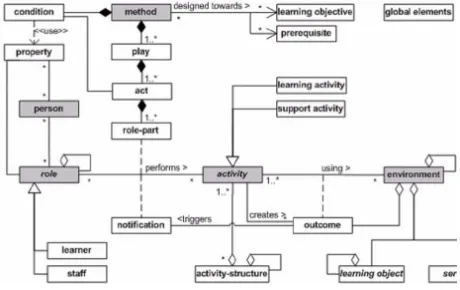
Figure 1 Conceptual model of learning design [4]
The SWALEM architecture is inspired by IMS-Learning Design information model [4]. As illustrated in Figure 1, it implicates a triple structure of “role – activity – environment” with corresponding auxiliary attributes. From this we extract a simple model and use it together with semantics to represent learning experience. This can be illustrated in Figure 2, where the middle layer is the conceptual model of the learning experience; We also introduce a higher level Event, which can be further detailed (if necessary) at the lower granularity using the
Activity defined in the IMS-Learning information model. For example, a ‘Tutorial’ is an event which can be further
[image:2.595.57.287.419.564.2]detailed by a sequence of activities {“reading tutorial notes”, “watching demo”, “hand-on experiments”, “question and answers”}.
Figure 2 the SWALEM architecture
The semantic web technologies are integrated in this SWALEM architecture to help learner build/annotate and share their learning experience and related knowledge. The architecture can be viewed from the following two perspectives.
Horizontal layers:
Learning experience Layer – this is the learning experience data model that sits in the middle layer in Figure 2.
Ontology Layer – this is the top layer where ontology resides to specify conceptualizations and restraints which are used to describe the Learning experience Layer. Ontology layer is mainly the place for knowledge engineer to provide knowledge model.
Semantic annotation layer – bottom layer where annotated learning experiences reside. Basically, learners are allowed to create their learning experience by instantiating the ontology on role, event/activity and subject; they can then associate these instances together for a triple, which represents a learning experience. These instances and triples are then stored in this semantic annotation layer so that they can be reused, shared and queried.
Vertical sections:
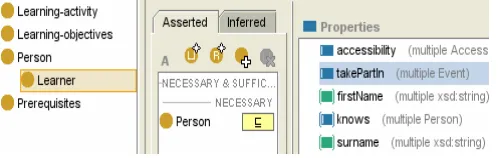
This is the underlying rational that inspires us to inherit FOAF1 for the Learner profile ontology that models the Role in the learning experience management. FOAF defines an RDF vocabulary for expressing social network related metadata, such as “knows”. Inherited from the FOAF, the learner ontology also has additional learning related attributes such as “takePartIn” (links the role with
[image:3.595.57.306.232.311.2]Event.) and “accessibility” (learning ability related description as defined in the IMS Learner Information Package[12]) as shown in Figure 3.
Figure 3 Learner Ontology for Roles
[image:3.595.54.292.458.563.2]Event (Activity) – this is the learning experience’s central point that connects learners to the learning environment and learning object inside. The Event ontology (Figure 4) models this social and constructive phenomenons that give human learners the opportunity to interact, converse and enhance presence. We believe that this event (and activity at the low granularity) facilitates learners of their learning experience.
Figure 4 Event Ontology
Environment – This normally refers to the learning objects, equipments, services, etc. which support the learners in carrying out their learning related activities in the leaning event. An example would be the paper to be presented and published in an academic conference. We say that the paper is part of the learning environment, or learning object inside.
3. The Knowledge Life cycle
1
Friend of A Friend project, http://www.foaf-project.org/
Operations in the SWALEM are also in line with the knowledge life cycle [1, 8]. Knowledge means well structured, relevant resources that are sharable and reusable. To this end, annotated learning experience is the knowledge in this paper. The development and maintenance of ontologies that capture this rich meaning is the subject of Knowledge Engineering. In this section we present the different stages of the Knowledge Life Cycle, a step by step process, as shown in Figure 5, which aims to model, capture and reuse knowledge.
Knowledge acquisition
Knowledge modeling
Knowledge annotation Knowledge
reuse Knowledge maintenance
Figure 5 The Knowledge Life Cycle
• Knowledge Acquisition (KA): The first stage is to acquire the knowledge from the domain. This can be done in a variety of ways including literary review and interviewing domain experts. In this paper, we mainly studied the IMS Learner’s information model and its application in collaborative learning and developed a set of domain vocabulary and relationships (conceptualization) that describe the learning experience
• Knowledge Modelling (KM): The next stage is for this conceptualization to be explicitly described as ontology. Classes are defined based on the concepts identified in the KA stage and the possible relationships between these classes are specified as concept properties. We use protégé [9] in this step for visually building the ontology, protégé can also save or export the ontology in RDF/OWL so that it can be further processed at the programming level later on.
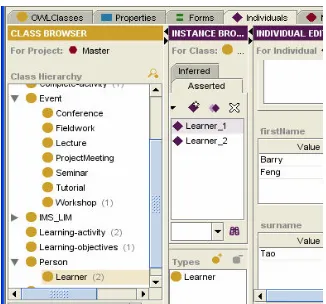
Figure 6 simulation of generating instances in protégé (a)
The elements that form the learning experience annotations are learners, events and environment, which are generated as semantic instances by the learners. These elements are then associated together (by setting
takePartIn property for example) as learning experience annotations, as illustrated in Figure 6 and Figure 7. Automated annotation service and easy seamless user interface are very important so that learners can be freed as much as possible from the tedious annotation tasks.
Figure 7 simulation of generation instances in protégé (b)
• Knowledge reuse: When there is enough knowledge accumulated in the form of semantic instances, knowledge reuse becomes more and more effective in reflecting and re-enhancing the learning experience. Reuse is achieved when new applications make use of the knowledge that are either explicitly indicated as factual data in the annotation repository or implicated through reasoning and inference data in the repository.
Explicit factual knowledge - in the research profile management scenario, learners can make explicate queries that generate a list of academic event/activities
that he/she has been doing over the last specified period of time.
Implicated knowledge - The semantic web also promises the reasoning and inference capacities that allow the learner to discover and reuse knowledge that is implicated. For example, learners can ask for a social network report of other learners who are interested in a particular subject A. This can be realized by analyzing learners’ participating events or using environments that are annotated with a subject B where B is related to A in some way.
The Knowledge Life Cycle is intended to iterate over the project life time. This means that the ontologies are expected to evolve, and maintenance is necessary.
4. Services in the Services Oriented
Architecture (SOA)
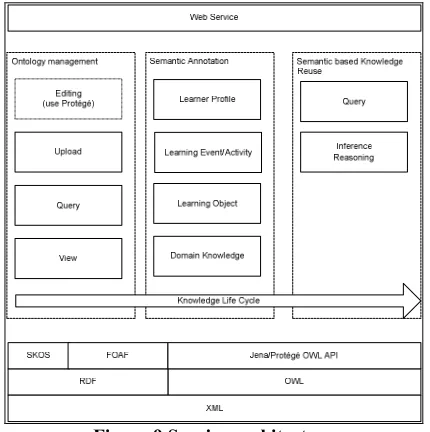
In this section, we describe how it fits into the SOA. As a service oriented architecture, the SWALEM interacts with the learners (and other learning applications and agents) through services – in particular web services and Grid services. We list here three most important high level services (as illustrated in Figure 9) that directly interact with the learners and knowledge engineers.
Ontology management service – this allows the knowledge engineers to update the underlying knowledge models, which are represented in the form of ontology files. To simplify the system and make use of the powerful ontology editing capacity provided by protégé, only file management services such as upload, query and simple view are provided as services. To editing and modify the ontology itself, knowledge engineers are expected to use protégé.
build and share their understanding of the domain, for example, taxonomies or rules.
Figure 9 Service architecture
Knowledge reuse service –
Simple query service: this is mainly querying explicit facts from the learning experience annotations. For example, a learner can use it to generate a report of academic event/activities/publications that he/she has been involved over the last specified period of time.
Inference and reasoning service: this type of services uses semantic reasoning to provide inferred knowledge that is not explicitly stated in the semantic annotation repository. This is made easier by using several semantic web languages and standards2, such as XML, RDF and their upper level application OWL, SKOS and FOAF in the annotation process.
We use FOAF as a basis for our learner profile ontology to include basic user profile and social network related metadata.
SKOS stands for Simple Knowledge Organisation System. The name SKOS was chosen to emphasise the goal of providing a simple yet powerful framework for expressing knowledge organisation systems in a machine-understandable way [6]. SKOS defines a set of semantic relationships such as skos:broader, skos:narrower, skos:related. Figure 9 gives an example of subject ontology with mark-ups using skos-narrower and skos-related.
2
XML, RDF, OWL, SKOS, FOAF are all W3C recommendations
Events and environment in the learning experience can be annotated using the subject ontology. In this way, when the service receives request from learners asking for a social network report of other learners who are interested in a particular subject SemanticWeb, it can analyze the learning experiences with inference on the skos mark-up and produce roles that are also related to
ontology and OWL due to their relationships declared in the skos mark-up (Figure 9).
5. The Ontology-Driven WSDL-First (ODWF)
strategy
We introduce in this section a hybrid ODWF implementation strategy aiming to exploit the power of semantic web and improve service interoperability.
Ontology-driven strategy
[image:5.595.309.545.583.717.2]As a semantic application, ontology is used as the backbone to drive the data model used in the SWALEM services. As illustrated in Figure 11, ontology written in OWL is used to represent the conceptual model of the learning experience at design time. By using Protégé’s OWL API, we convert these ontological models to java classes, representing the data models at the run time environment.
Figure 10 Java model converted from the ontology
<skos:Concept
rdf:about="#Ontology">
<skos:prefLabel>Ontology</skos:prefLabel> <skos:narrower rdf:resource =
"#SemanticWeb"/>
<skos:narrower rdf:resource = "#XML"/>
<skos:related rdf:resource = "#OWL"/>
</skos:Concept>
Figure 11 ODWF implementation strategy of the SWALEM services
Figure 10 shows the UML diagram of the hierarchical java model converted from the ontology by using protégé with OWL plug-in [7]. This can be done at both GUI mode or at programming level though protégé API. Class names, member variables and methods in the java class correspond to the underlying ontological concepts and properties (as shown in Figure 12). In this way, manipulating events (and role, environment similarly) for learning experience annotation at the programming level can now be carried out on top of the memory based java models, therefore allowing implementation to be transparent to the underlying ontological data models developed at the deign phase.
Ontology Java class
Figure 12 Event java class and its ontology concept
The java data model generated also makes use of the protégé OWL API, which is built on top of Jena OWL API for RDF/OWL manipulation yet more friendly to protégé. This helps the encapsulation of the RDF/OWL operations in the java model, the DefaultRDFIndicidual.java in this case as illustrated in Figure 10.
WSDL-First strategy
WSDL in Web service is like contract between producer and consumer. WSDL-first approach is advocated by Web Service Interoperability Organization (WS-I) aiming to improve interoperability, adopt language-independent development and the power of XML.
In Figure 11, bottom-up ontology-driven approach has produced the run-time java model for manipulating learning experience annotations. On the other side, essential services related to the SWALEM are explicitly specified in the WSDL file. Development starts with focus on the data (and their types) being exchanged for any operation. We use Eclipse with Web Tools Platform (WTP) to build the WSDL. Two services contracts have been designed – the EventSearchServicce and the EventAnnotationService, as illustrated in Figure 14.
[image:6.595.357.493.508.622.2]From bottom to top in Figure 14, the <parameter> defines data types (Event in this example) using for service input and output parameters. The <message> element defines the data format of each individual transmission in the communication. The <portType>element groups messages that form a single logical operation. The <binding> element provides the connection between logical and physical mode. Finally the <service> defines a physical location (soap:address) for a communication end-point.
Figure 13 Web service skeletons
[image:6.595.56.305.529.698.2]Figure 14 WSDL graph of the learning event management
Client side service consumers
On the client side, service stubs and proxies can be also generated by using the axis WSDL tool. The services are made transparent and independent to the client side application development. Stand-alone application and web page based portals can be developed to consume the web services seamlessly by operating solely on these service stubs and proxies.
6. Related work and discussion
Buddy space has been used in the Elegi project as an Instant Messenger (IM) and group discussion tool to
address collaborative learning and present enhancing in the e-learning framework. As the project is relatively large in scale (23 partners across Europe) and involves hundreds of individuals distributed both in location and their expertise, buddy-finder is used as a integrated search engine to allow learners find buddies based on a text mining algorithm called CORDER, which can crawl web pages and rank a list of online users based on their “scavenged profiles” on the web. We believe that the SWALEM architecture we proposed in this paper can produce more accurate social network related information through learning experiences related semantic annotations. For example, learners who attended same learning events or sharing relevant learning objects as described in their learning experience annotations will be discovered and ranked as well. Another advantage is that the SWALEM follows SOA, which aims to provide functionalities that can be consumed by the learning application (such as the buddy space) at the service level.
Geodise knowledge [14, 15] aims to provide knowledge support for design engineers in using a suite of grid enabled design optimization and search tools. It supports knowledge capture and reuse in the domain of Engineering Design Search and Optimization (EDSO). Engineers in EDSO are regarded as learners who can annotate their resource and share them as knowledge within the community. This knowledge is further reused in an advisor and a knowledge toolbox [8] that both semantically process resource semantic annotations to aid decision making during workflow construction.
OntoGrid [16] claims that currently the Semantic Grid lacks a reference architecture or any kind of systematic framework for designing Semantic Grid components or applications. It aims to explicitly share and deploy knowledge to be used for the development of innovative Grid infrastructure, and for Grid applications – the Semantic Grid. This inspires two future evolution of the system: to have the semantic annotation stored distributed; and to fine grade the web services and Grid services that follows the Open Grid Service Architecture.
7. Summaries and conclusion
This paper describes our vision of semantic web technologies being used in the learning experience management to support collaborative learning through learning experience annotation and sharing.
form of learning experiences annotations can be managed in different phases of the knowledge life cycle to support this vision.
SOA is adopted and we propose a hybrid ODWF strategy along with related technologies and tool in developing and deploying the SWALEM as semantics assisted web services, which also follow the WS-I for better interoperabiluty and independent development at service providing and consuming.
We describe our approach in the setting of learning experience annotation and reuse scenario. In general, the scenario has some generic characteristics. It is ontology-driven with respect to the underlying data and knowledge models. The learners are given the opportunity to semantically annotate their learning experience as triples of {role, event and environment}, as well as contributes to the domain knowledge as taxonomy and rules. Examples of reusing these learning experience and domain knowledge are query of experience/knowledge and semantic reasoning for social network related facts implicated in the learning community.
Semantics driven knowledge construction of learning experience helps the learning paradigm shift from traditional “learning by information transfer” to “learning by knowledge construction”. The scientific benefits of introducing the semantic layer are very obvious: it enables learners to record and share their learning experience through semantic annotations (knowledge construction) of learning experience. Knowledge accumulated in the form of these semantic annotations can then be reused through query and inference to re-enhance and reflect further learning. We believe that this integrated semantic layer will enable us the flexibility to do things within the eLearning domain that are not currently possible or effective enough.
References
[1] Tao, F. B., Millard, D., Davis, H. and Woukeu, A. (2005) Managing the Semantic Aspects of Learning using the Knowledge Life Cycle. In Proceedings of The 5th IEEE International Conference on Advanced Learning Technologies (ICALT 2005), pp. 575-579, Kaohsiung, Taiwan
[2] Anuradha A. Gokhale, Collaborative Learning Enhances Critical Thinking, Journal of Technology Education Vol.7 No.1, Fall 1995
[3] The European Learning Grid Infrastructure (ELeGI) Project, http://www.elegi.org/
[4] IMS Learning Design Information Model, Version 1.0 Final Specification,
http://www.imsglobal.org/learningdesign/ldv1p0/imsld_infov1p0. html
[5] Web Services Interoperability Organization, http://www.ws-i.org/
[6] W3C SKOS Core Guide, http://www.w3.org/TR/2005/WD-swbp-skos-core-guide-20051102/#secintro
[7] H Knublauch, RW Fergerson, NF Noy, MA Musen, The Protege OWL Plugin: An Open Development Environment for Semantic Web Applications, the 3rd International Semantic Web Conference (ISWC 2004), 2004 – Springer.
[8] Tao, F., Puleston, C., Goble, C., Shadbolt, N., Chen, L., Pound, G. and Cox, S. (2004) Applying the Semantic Web to Manage Knowledge on the Grid. In Proceedings of UK e-Science AHM Conference, Nottingham, UK.
[9] Protégé, Ontology Editor and Knowledge Acquisition System, http://protege.stanford.edu/
[10] H. Knublauch (2004) "Ontology Driven Software Development in the Context of the Semantic Web: An Example, Scenario with Protégé/OWL", 1st International Workshop on the Model Driven Semantic Web (MDSW2004)
[11] The Protégé Owl API,
http://protege.stanford.edu/plugins/owl/api/guide.html
[12] IMS Learner Information Packaging Information Model Specification, http://www.imsproject.org/profiles/lipinfo01.html
[13] Zhu, Dr. Jianhan and Eisenstadt, Prof. Marc and Gonçalves, Mr. Alexandre and Denham, Mr. Chris (2005) BuddyFinder-CORDER: Leveraging Social Networks for Matchmaking by Opportunistic Discovery. In Proceedings International Semantic Web Conference (ISWC2005) Workshop on Semantic Network Analysis, Galway, Ireland.
[14] Grid-enabled Optimisation and Design Search in Engineering (GEODISE), http://www.geodise.org
[15] Chen, L., Shadbolt, N., Goble, C., Tao, F., Cox, S., Puleston, C. and Smart, P. (2003) Towards a Knowledge-based Approach to Semantic Service Composition. In Proceedings of 2nd International Semantic Web Conference (ISWC2003) 2870, pp. 319-334, Florida, USA.
[16] Towards Knowledgeable Grid Services and Systems - OntoGrod, http://www.ontogrid.net/